REVIEW 3 major objections 5 minor 120 references
GPO: Learning from Critical Steps to Improve LLM Reasoning
T0 review · 3 major / 5 minor · reviewed 2026-08-15 · deepseek-v4-flash
Pith's one-line read Reset LLM training at the most critical reasoning step and every optimizer improves.
desk verdict A well-executed empirical plug-in for reasoning fine-tuning whose mechanism is plausible but whose headline attribution to step selection isn't yet isolated from extra compute. read the letter →
The pith
A machine-rendered reading of the paper's core claim, the machinery that carries it, and where it could break.
The reading
What carries the argument
The load-bearing object is the critical step: the reasoning step with maximal estimated advantage $A^{\pi}(x, y_{0:i-1}; y_i)$, defined as the change in $Q$-value when taking that step under the current policy. GPO locates it by Monte Carlo estimation—four rollouts per step in the main runs—then resets the trajectory to that step and samples a continuation, so the training distribution becomes concentrated on pivotal decisions. In the idealized theory, this is formalized as sampling the critical step with probability proportional to $e^{\gamma A}$, with the max-advantage rule as the $\gamma \to \infty$ limit; the online regret bound is argued to tighten as $\gamma$ grows because the step-wise concentrability ratio shrinks. For offline preference optimization, the same construction shows that step-wise DPO with advantage-based preferences is equivalent to advantage-weighted RL, reweighting each step's log-likelihood by $\exp(A/\beta)$.
What would settle it
Measure the density ratio $w(s,a,h,\gamma)=d^{\pi^*}_h(s,a)/d^{\rho}_h(s,a)$ on a real reasoning dataset across increasing $\gamma$: if the supremum over states and actions does not decrease, the claimed tightening of the regret bound fails. A simpler behavioural test: on a new benchmark, run GPO with the advantage-max step versus a uniformly random reset step; if the two accuracies converge, the central mechanism is not critical-step selection.
Extended reading notes
Core claim
The paper's central discovery is that locating the reasoning step with the highest estimated advantage and restarting generation from that point produces training data that improves the policy more than using the original trajectory or a randomly reset one. Concretely, GPO wraps five optimization algorithms—PPO, DPO, KTO, SimPO, and ORPO—and reports higher test accuracy for every wrapper on all seven datasets, with examples such as MATH rising from 79.6 to 87.8 for GPO-PPO and from 82.4 to 86.8 for GPO-DPO. The random-reset ablation on MATH yields 79.9 percent versus 87.9 percent for GPO, which the authors take as evidence that the critical-step selection, not the reset operation itself, is the source of improvement. A user study reports that between 44 and 88 percent of human participants chose the GPO-identified step as the most critical, providing qualitative support for the method's core mechanism.
Load-bearing premise
The regret bound assumes the policy updates by exact exponential weights over actions and that the policy and visitation distributions are log-linear in the optimal advantage with ordered coefficients; the implemented algorithms use clipped PPO and DPO-style losses, so the theory's support for max-advantage selection depends on structural assumptions that are not verified in the experiments.
Editorial extensions
If this is right
- Any trajectory-level optimizer for LLM reasoning can be wrapped with GPO without changing its loss, and the paper reports gains on all seven tested benchmarks and all five optimizers.
- The random-reset ablation implies that merely increasing trajectory diversity by resetting is not enough; the advantage-based choice of reset point is what produces the improvement.
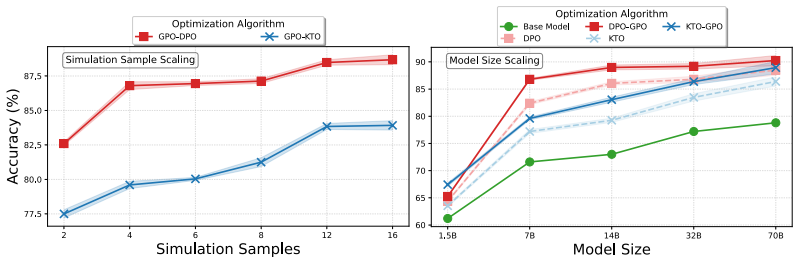
- Better advantage estimates (more Monte Carlo samples) improve GPO up to a saturation point around twelve simulations, so the method's gains track the quality of step-value estimation.
- Under the theory, concentrating the reset distribution toward the highest-advantage step (larger $\gamma$) should tighten the online regret bound, making critical-step selection principled rather than heuristic.
- In the offline setting, advantage-based preference pairs at individual steps are equivalent to advantage-weighted RL, so GPO-style data construction can be understood as reweighting each step's log-likelihood by $\exp(A/\beta)$.
Reading between the lines
- If GPO's mechanism holds, the same reset-at-pivot idea could transfer to program repair or tool-use trajectories, where a 'step' is a function call or code edit rather than a reasoning line; the advantage estimator would need to handle sparse rewards at those boundaries.
- The observed agreement between GPO-identified steps and human choices hints that the advantage signal might serve as an automated explainability map for reasoning failures, independent of its training benefit.
- A testable extension the paper leaves implicit is replacing the Monte Carlo advantage estimator with a learned value model to cut the reported 1.8x to 1.9x overhead without necessarily losing the improvement.
- Because the theory's concentrability argument is not verified empirically, one could check whether the step-wise density ratio actually shrinks with $\gamma$ in a real policy class; that check would separate the theoretical mechanism from the empirical recipe.
Signed reviews
Editorial analysis
A structured set of objections, weighed in public.
Referee Report
Summary. The paper proposes GPO (Guided Pivotal Optimization), a fine-tuning strategy for LLM reasoning that identifies a "critical step" in a sampled reasoning trajectory via Monte Carlo estimates of the advantage function, resets the policy to that step, samples a continuation, and trains on the resulting trajectory or preference pair. The method is presented as a general plug-in applicable to online (PPO) and offline (DPO, KTO, SimPO, ORPO) optimizers, with experiments on seven reasoning benchmarks and a theoretical regret analysis in an online setting plus an advantage-weighted interpretation of step-wise DPO. The main empirical claim is that GPO improves accuracy over each baseline on all datasets, and an ablation against random reset suggests the advantage-based selection mechanism is responsible for the gain.
Significance. If the central claim holds, GPO is a simple and general recipe for improving LLM reasoning by focusing learning on pivotal steps, with broad applicability across common RL and preference-optimization algorithms. The paper includes several strengths: a clear algorithm, code and data release, experiments across 7 datasets and 5 optimizers, a random-reset ablation, a user study, and an attempt at theoretical grounding. However, the significance is conditional on resolving a key confound: the reported overhead of roughly 1.8-1.9x extra rollouts means the baselines are not compute-matched, so the observed gains may stem from additional inference/data rather than from identifying critical steps. The theoretical section also analyzes an exponential-weights update that is not the loss used in the experiments, further limiting the current support for the mechanism.
major comments (3)
- [§6.2, Algorithm 1, §8] The central attribution claim—that advantage-based step selection, not the extra rollouts used to compute it, drives the gains—is not tested under a compute-matched control. Algorithm 1 runs 4 MC rollouts per step to estimate advantages and then a reset rollout, and §8 reports roughly 1.9x PPO training time and 1.8x offline data-preparation overhead; the Figure 2 random-reset baseline (Satori) performs no MC estimation and therefore consumes substantially less inference budget. Because §6.3 shows that increasing the number of MC rollouts improves performance, a random-reset baseline given the same total rollout budget (e.g., 4 extra random resets per trajectory, or an equivalent data-volume multiplier) is necessary to rule out the explanation that GPO's gains come from additional data or compute rather than from the selection mechanism. Without this control, the headline mechanism and the random-reset superiority claim (87.9 vs 79.9 on MATH) are not established.
- [§5, Appendix C.1, Eq. (8)] The theoretical analysis does not cover the algorithms used in the experiments. The regret bound is derived for the closed-form exponential-weights update π^{t+1}(a|s) ∝ π^t(a|s) exp(η Q-hat^{π_t}(s,a)) (Eq. 8 in Appendix C.1), whereas the experiments optimize PPO's clipped surrogate and DPO/KTO/SimPO/ORPO losses, which are not exponential-weights updates. The claim that increasing γ tightens the bound relies on structural assumptions stated in §C.1—d^{π_t}_h(s,a) ∝ exp(β_1 A^{π*}(s,a)), π^{t+1}(a|s) ∝ exp(β_2 A^{π*}(s,a)) with β_1 < β_2, and the supremum density ratio occurring at the argmax-advantage action—none of which are proved for LLM policies. In fact, the derivative computation in Eq. (15) is negative only at a* = argmax_a A^{π*}(s,a), while w_max(γ) is a supremum over all state-action pairs, so the argument does not show that the sup decreases with γ. The paper should either state these as explicit assumptions with justification or temper the theoretical claims to match the implemented losses.
- [Table 1, §6.1] The main empirical claim ("consistently leads to improved test accuracy") is reported without error bars or measures of uncertainty. AIME-2024 and AIME-2025 test sets have 30 problems, so differences such as 23.33 vs 20.00 correspond to a single question and are within binomial noise; the reported averages are over only 3 seeds. Please report standard deviations or confidence intervals for Table 1 and, for claims of "significant" gains, provide significance tests or use more cautious wording.
minor comments (5)
- [§6] The text contains small typos such as "meibitasks" in the baseline-methods paragraph and an extra parenthesis in Eq. (2); these should be corrected.
- [§7, Appendix F] The user study is based on only five hand-selected problems and a convenience sample of college students, so the conclusion of "strong alignment" is overstated; the paper should acknowledge this limitation more explicitly.
- [§7, Appendix F] The paper states in the checklist that compensation details are provided in Appendix F, but Appendix F does not describe participant compensation; this inconsistency should be fixed.
- [Figure 3] The scaling figure does not show error bars, making it difficult to assess whether the differences across MC sample counts and model sizes are meaningful given the stated 3-run averages.
- [§8] The BBEH long-context result is reported only as a single accuracy number without standard deviation or training details beyond a short appendix; adding variability and a compute comparison would strengthen this scalability claim.
Circularity Check
The empirical comparisons are externally benchmarked and not circular; the only mild circularity is Theorem 5.3 restating the DPO/advantage-weighted equivalence from its own advantage-defined preferences.
-
self definitional
[Section 5.2, Theorem 5.3; Appendix C.2, Eq. 18]
"we consider preference pairs of the form (x,[y_{0:i−1}, y_i^+],[y_{0:i−1}, y_i^-]), where both continuations are sampled from the π_ref : y_i^+ ∼ π_ref(·|x,y_{0:i−1}), y_i^- ∼ π_ref(·|x,y_{0:i−1}), and the preference is determined based on the advantage estimates A^{π_ref}(x,y_{0:i−1};·), Combined with Eqn. 16, this yields the following equation: π_i(y_i|x,y_{0:i−1}) ∝ π_ref(y_i|x,y_{0:i−1})·exp(A^{π_ref}(x,y_{0:i−1};y_i)/β). (18)"
The theorem's conclusion, Eq. 4, is the log-odds form of Eq. 18: after moving π_ref to the left, log(π_i/π_ref) = A/β + const, which is exactly the advantage-weighted log-likelihood objective in Eq. 4. Eq. 18 is obtained by substituting the advantage directly as the reward in Eq. 16, so the per-step DPO optimum equals advantage-weighted RL by construction. The paper also credits this equivalence to prior work [21]; the theorem is a known restatement rather than an independent derivation. The main empirical claims are not built on this theorem, so this is a mild, non-load-bearing circularity.
full rationale
The core empirical result—GPO improves PPO, DPO, KTO, SimPO, and ORPO on seven benchmarks—is evaluated against external baselines on held-out test sets, and the mechanism claim is tested by a random-reset ablation in Figure 2. The advantage signal comes from Monte-Carlo rollouts compared with gold answers, not from the test predictions, so the main comparison is not circular. The only exhibitable reduction is Theorem 5.3, where per-step DPO preferences are defined via the advantage and the conclusion is the corresponding advantage-weighted objective; this is a known equivalence cited to [21] and is a restatement rather than an independent derivation. The compute-confound issue acknowledged in Section 8 (1.9x PPO training time and 1.8x offline data preparation overhead, with no compute-matched random-reset control) is a validity threat to the attribution claim, but it is not a circularity: extra rollouts are not a fitted parameter renamed as a prediction. Similarly, Theorem 5.2's reliance on the structural assumptions in Appendix C.1 is an assumption-mismatch risk, not a circular step. Score 2 reflects one mild definitional/known-result step while the central empirical claim remains independent.
Assumptions & free parameters
free parameters (4)
- MC simulation count K =
4
- Question filtering threshold =
8 samples; exclude all-correct and all-incorrect
- Step grouping parameters =
min 30 words per step; max 10 steps (PPO), 15 steps (offline)
- Advantage sampling temperature gamma =
tends to infinity (limit)
assumptions (7)
- domain assumption Bounded Q-values: 0 <= Q^{pi_t}_h(s,a) <= r_max for the function class F (Assumption 5.1).
- domain assumption Deterministic transitions with zero intermediate rewards justify A(s_i,a_i) = Q(s_i,a_i) - Q(s_{i-1},a_{i-1}) (footnote 4).
- ad hoc to paper Policy updates take the closed form pi^{t+1}(a|s) proportional to pi^t(a|s) exp(eta * Qhat^{pi_t}(s,a)) (Eq. 8 in Appendix C.1).
- ad hoc to paper State-action occupancies and policies are exactly exponential in A^{pi*}: d^{pi_t}_h(s,a) proportional to exp(beta_1 * A^{pi*}(s,a)) and pi^{t+1}(a|s) proportional to exp(beta_2 * A^{pi*}(s,a)) with beta_1 < beta_2 (Appendix C.1).
- standard math Monte Carlo rollouts give unbiased estimates of the Q function (Lemma 2, cited from Song et al. [69]).
- standard math BT model for preference data and the DPO-optimal-policy closed form (Eq. 16) used in the proof of Theorem 5.3.
- ad hoc to paper The conceptual per-step preference variant of Procedure-II (Theorem 5.3) is representative of the actual full-trajectory DPO used in experiments.
Cite this review
Pith. "Pith review of GPO: Learning from Critical Steps to Improve LLM Reasoning." pith.science (2026). https://pith.science/paper/YKFGCAL3
@misc{pith2026250916456,
  author       = {Pith},
  title        = {Pith review of: GPO: Learning from Critical Steps to Improve LLM Reasoning},
  year         = {2026},
  howpublished = {\url{https://pith.science/paper/YKFGCAL3}},
  note         = {Machine review of arXiv:2509.16456}
}
read the original abstract
Large language models (LLMs) are increasingly used in various domains, showing impressive potential on different tasks. Recently, reasoning LLMs have been proposed to improve the \textit{reasoning} or \textit{thinking} capabilities of LLMs to solve complex problems. Despite the promising results of reasoning LLMs, enhancing the multi-step reasoning capabilities of LLMs still remains a significant challenge. While existing optimization methods have advanced the LLM reasoning capabilities, they often treat reasoning trajectories as a whole, without considering the underlying critical steps within the trajectory. In this paper, we introduce \textbf{G}uided \textbf{P}ivotal \textbf{O}ptimization (GPO), a novel fine-tuning strategy that dives into the reasoning process to enable more effective improvements. GPO first identifies the `critical step' within a reasoning trajectory - a point that the model must carefully proceed to succeed at the problem. We locate the critical step by estimating the advantage function. GPO then resets the policy to the critical step, samples the new rollout and prioritizes the learning process on those rollouts. This focus allows the model to learn more effectively from pivotal moments within the reasoning process to improve the reasoning performance. We demonstrate that GPO is a general strategy that can be integrated with various optimization methods to improve reasoning performance. Besides theoretical analysis, our experiments across challenging reasoning benchmarks show that GPO can consistently and significantly enhance the performance of existing optimization methods, showcasing its effectiveness and generalizability in improving LLM reasoning by concentrating on pivotal moments within the generation process.
Figures


Reference graph
Works this paper leans on
-
[1]
Carlos E Jimenez, John Yang, Alexander Wettig, Shunyu Yao, Kexin Pei, Ofir Press, and Karthik Narasimhan. Swe-bench: Can language models resolve real-world github issues?arXiv preprint arXiv:2310.06770, 2023
arXiv 2023
-
[2]
Shuyan Zhou, Frank F Xu, Hao Zhu, Xuhui Zhou, Robert Lo, Abishek Sridhar, Xianyi Cheng, Tianyue Ou, Yonatan Bisk, Daniel Fried, et al. Webarena: A realistic web environment for building autonomous agents.arXiv preprint arXiv:2307.13854, 2023
arXiv 2023
-
[3]
Cohen, Ruslan Salakhut- dinov, and Christopher D
Zhilin Yang, Peng Qi, Saizheng Zhang, Yoshua Bengio, William W. Cohen, Ruslan Salakhut- dinov, and Christopher D. Manning. HotpotQA: A dataset for diverse, explainable multi-hop question answering. InConference on Empirical Methods in Natural Language Processing (EMNLP), 2018
2018
-
[4]
Chaojie Wang, Yanchen Deng, Zhiyi Lyu, Liang Zeng, Jujie He, Shuicheng Yan, and Bo An. Q*: Improving multi-step reasoning for llms with deliberative planning.arXiv preprint arXiv:2406.14283, 2024
arXiv 2024
-
[5]
Evan Wang, Federico Cassano, Catherine Wu, Yunfeng Bai, Will Song, Vaskar Nath, Ziwen Han, Sean Hendryx, Summer Yue, and Hugh Zhang. Planning in natural language improves llm search for code generation.arXiv preprint arXiv:2409.03733, 2024
arXiv 2024
-
[6]
Maohao Shen, Guangtao Zeng, Zhenting Qi, Zhang-Wei Hong, Zhenfang Chen, Wei Lu, Gregory Wornell, Subhro Das, David Cox, and Chuang Gan. Satori: Reinforcement learning with chain-of-action-thought enhances llm reasoning via autoregressive search.arXiv preprint arXiv:2502.02508, 2025
arXiv 2025
-
[7]
Training language models to follow instructions with human feedback.Advances in neural information processing systems, 2022
Long Ouyang, Jeffrey Wu, Xu Jiang, Diogo Almeida, Carroll Wainwright, Pamela Mishkin, Chong Zhang, Sandhini Agarwal, Katarina Slama, Alex Ray, et al. Training language models to follow instructions with human feedback.Advances in neural information processing systems, 2022
2022
-
[8]
Proximal policy optimization algorithms.arXiv preprint arXiv:1707.06347, 2017
John Schulman, Sergey Levine, Pieter Abbeel, Michael Jordan, and Philipp Moritz. Proximal policy optimization algorithms.arXiv preprint arXiv:1707.06347, 2017
arXiv 2017
Show all 120 references
-
[9]
Direct preference optimization: Your language model is secretly a reward model
Rafael Rafailov, Archit Sharma, Eric Mitchell, Christopher D Manning, Stefano Ermon, and Chelsea Finn. Direct preference optimization: Your language model is secretly a reward model. Advances in Neural Information Processing Systems, 2023
2023
-
[10]
Chain-of-thought prompting elicits reasoning in large language models
Jason Wei, Xuezhi Wang, Dale Schuurmans, Maarten Bosma, Fei Xia, Ed Chi, Quoc V Le, Denny Zhou, et al. Chain-of-thought prompting elicits reasoning in large language models. Advances in neural information processing systems, 2022
2022
-
[11]
Tree of thoughts: Deliberate problem solving with large language models.Ad- vances in neural information processing systems, 2023
Shunyu Yao, Dian Yu, Jeffrey Zhao, Izhak Shafran, Tom Griffiths, Yuan Cao, and Karthik Narasimhan. Tree of thoughts: Deliberate problem solving with large language models.Ad- vances in neural information processing systems, 2023
2023
-
[12]
Graph of thoughts: Solving elaborate problems with large language models
Maciej Besta, Nils Blach, Ales Kubicek, Robert Gerstenberger, Michal Podstawski, Lukas Gianinazzi, Joanna Gajda, Tomasz Lehmann, Hubert Niewiadomski, Piotr Nyczyk, et al. Graph of thoughts: Solving elaborate problems with large language models. InProceedings of the AAAI Confer...
2024
-
[13]
Self-consistency improves chain of thought reasoning in language models.arXiv preprint arXiv:2203.11171, 2022
Xuezhi Wang, Jason Wei, Dale Schuurmans, Quoc Le, Ed Chi, Sharan Narang, Aakanksha Chowdhery, and Denny Zhou. Self-consistency improves chain of thought reasoning in language models.arXiv preprint arXiv:2203.11171, 2022
2022 arXiv
-
[14]
Openai o1 system card.arXiv preprint arXiv:2412.16720, 2024
Aaron Jaech, Adam Kalai, Adam Lerer, Adam Richardson, Ahmed El-Kishky, Aiden Low, Alec Helyar, Aleksander Madry, Alex Beutel, Alex Carney, et al. Openai o1 system card.arXiv preprint arXiv:2412.16720, 2024
2024 arXiv
-
[15]
Deepseek-r1: Incentivizing reasoning capability in llms via reinforcement learning.arXiv preprint arXiv:2501.12948, 2025
Daya Guo, Dejian Yang, Haowei Zhang, Junxiao Song, Ruoyu Zhang, Runxin Xu, Qihao Zhu, Shirong Ma, Peiyi Wang, Xiao Bi, et al. Deepseek-r1: Incentivizing reasoning capability in llms via reinforcement learning.arXiv preprint arXiv:2501.12948, 2025. 11
2025 arXiv
-
[16]
Mammoth: Building math generalist models through hybrid instruction tuning.arXiv preprint arXiv:2309.05653, 2023
Xiang Yue, Xingwei Qu, Ge Zhang, Yao Fu, Wenhao Huang, Huan Sun, Yu Su, and Wenhu Chen. Mammoth: Building math generalist models through hybrid instruction tuning.arXiv preprint arXiv:2309.05653, 2023
2023 arXiv
-
[17]
Metamath: Bootstrap your own mathematical questions for large language models.arXiv preprint arXiv:2309.12284, 2023
Longhui Yu, Weisen Jiang, Han Shi, Jincheng Yu, Zhengying Liu, Yu Zhang, James T Kwok, Zhenguo Li, Adrian Weller, and Weiyang Liu. Metamath: Bootstrap your own mathematical questions for large language models.arXiv preprint arXiv:2309.12284, 2023
2023 arXiv
-
[18]
Unleashing reasoning capability of llms via scalable question synthesis from scratch.arXiv preprint arXiv:2410.18693, 2024
Yuyang Ding, Xinyu Shi, Xiaobo Liang, Juntao Li, Qiaoming Zhu, and Min Zhang. Unleashing reasoning capability of llms via scalable question synthesis from scratch.arXiv preprint arXiv:2410.18693, 2024
2024 arXiv
-
[19]
s1: Simple test-time scaling.arXiv preprint arXiv:2501.19393, 2025
Niklas Muennighoff, Zitong Yang, Weijia Shi, Xiang Lisa Li, Li Fei-Fei, Hannaneh Hajishirzi, Luke Zettlemoyer, Percy Liang, Emmanuel Candès, and Tatsunori Hashimoto. s1: Simple test-time scaling.arXiv preprint arXiv:2501.19393, 2025
2025 arXiv
-
[20]
Teaching language models to critique via reinforcement learning.arXiv preprint arXiv:2502.03492, 2025
Zhihui Xie, Liyu Chen, Weichao Mao, Jingjing Xu, Lingpeng Kong, et al. Teaching language models to critique via reinforcement learning.arXiv preprint arXiv:2502.03492, 2025
2025
-
[21]
Rl on incorrect synthetic data scales the efficiency of llm math reasoning by eight-fold.Advances in Neural Information Processing Systems, 2024
Amrith Setlur, Saurabh Garg, Xinyang Geng, Naman Garg, Virginia Smith, and Aviral Kumar. Rl on incorrect synthetic data scales the efficiency of llm math reasoning by eight-fold.Advances in Neural Information Processing Systems, 2024
2024
-
[22]
Distillm: Towards streamlined distillation for large language models.arXiv preprint arXiv:2402.03898, 2024
Jongwoo Ko, Sungnyun Kim, Tianyi Chen, and Se-Young Yun. Distillm: Towards streamlined distillation for large language models.arXiv preprint arXiv:2402.03898, 2024
2024 arXiv
-
[23]
Knowledge diffusion for distillation.Advances in Neural Information Processing Systems, 2023
Tao Huang, Yuan Zhang, Mingkai Zheng, Shan You, Fei Wang, Chen Qian, and Chang Xu. Knowledge diffusion for distillation.Advances in Neural Information Processing Systems, 2023
2023
-
[24]
Lifting the curse of capacity gap in distilling large language models
Chen Zhang, Yang Yang, Jiahao Liu, Jingang Wang, Wei Wu, Benyou Wang, and Dawei Song. Lifting the curse of capacity gap in distilling large language models
-
[25]
Minillm: Knowledge distillation of large language models.arXiv preprint arXiv:2306.08543, 2023
Yuxian Gu, Li Dong, Furu Wei, and Minlie Huang. Minillm: Knowledge distillation of large language models.arXiv preprint arXiv:2306.08543, 2023
2023 arXiv
-
[26]
Everything you need to know about knowledge distillation, 2025
Alyona Vert. Everything you need to know about knowledge distillation, 2025. Accessed: 2025-05-04
2025
-
[27]
Self-play fine-tuning converts weak language models to strong language models.arXiv preprint arXiv:2401.01335, 2024
Zixiang Chen, Yihe Deng, Huizhuo Yuan, Kaixuan Ji, and Quanquan Gu. Self-play fine-tuning converts weak language models to strong language models.arXiv preprint arXiv:2401.01335, 2024
2024 arXiv
-
[28]
Reft: Reasoning with reinforced fine-tuning.arXiv preprint arXiv:2401.08967, 3, 2024
Trung Quoc Luong, Xinbo Zhang, Zhanming Jie, Peng Sun, Xiaoran Jin, and Hang Li. Reft: Reasoning with reinforced fine-tuning.arXiv preprint arXiv:2401.08967, 3, 2024
2024 arXiv
-
[29]
Learning math reasoning from self-sampled correct and partially-correct solutions.arXiv preprint arXiv:2205.14318, 2022
Ansong Ni, Jeevana Priya Inala, Chenglong Wang, Oleksandr Polozov, Christopher Meek, Dragomir Radev, and Jianfeng Gao. Learning math reasoning from self-sampled correct and partially-correct solutions.arXiv preprint arXiv:2205.14318, 2022
2022 arXiv
-
[30]
Beyond human data: Scaling self-training for problem-solving with language models.arXiv preprint arXiv:2312.06585, 2023
Avi Singh, John D Co-Reyes, Rishabh Agarwal, Ankesh Anand, Piyush Patil, Xavier Garcia, Peter J Liu, James Harrison, Jaehoon Lee, Kelvin Xu, et al. Beyond human data: Scaling self-training for problem-solving with language models.arXiv preprint arXiv:2312.06585, 2023
2023 arXiv
-
[31]
Chain of preference optimization: Improving chain-of-thought reasoning in llms.Advances in Neural Information Processing Systems, 2024
Xuan Zhang, Chao Du, Tianyu Pang, Qian Liu, Wei Gao, and Min Lin. Chain of preference optimization: Improving chain-of-thought reasoning in llms.Advances in Neural Information Processing Systems, 2024
2024
-
[32]
Star: Bootstrapping reasoning with reasoning.Advances in Neural Information Processing Systems, 2022
Eric Zelikman, Yuhuai Wu, Jesse Mu, and Noah Goodman. Star: Bootstrapping reasoning with reasoning.Advances in Neural Information Processing Systems, 2022
2022
-
[33]
Exploring self-supervised logic-enhanced training for large language models.arXiv preprint arXiv:2305.13718, 2023
Fangkai Jiao, Zhiyang Teng, Bosheng Ding, Zhengyuan Liu, Nancy F Chen, and Shafiq Joty. Exploring self-supervised logic-enhanced training for large language models.arXiv preprint arXiv:2305.13718, 2023. 12
2023 arXiv
-
[34]
Deepseekmath: Pushing the limits of mathematical reasoning in open language models.arXiv preprint arXiv:2402.03300, 2024
Zhihong Shao, Peiyi Wang, Qihao Zhu, Runxin Xu, Junxiao Song, Xiao Bi, Haowei Zhang, Mingchuan Zhang, YK Li, Y Wu, et al. Deepseekmath: Pushing the limits of mathematical reasoning in open language models.arXiv preprint arXiv:2402.03300, 2024
2024 arXiv
-
[35]
Vineppo: Unlocking rl potential for llm reasoning through refined credit assignment.arXiv preprint arXiv:2410.01679, 2024
Amirhossein Kazemnejad, Milad Aghajohari, Eva Portelance, Alessandro Sordoni, Siva Reddy, Aaron Courville, and Nicolas Le Roux. Vineppo: Unlocking rl potential for llm reasoning through refined credit assignment.arXiv preprint arXiv:2410.01679, 2024
-
[36]
Dataset reset policy optimization for rlhf.arXiv preprint arXiv:2404.08495, 2024
Jonathan D Chang, Wenhao Zhan, Owen Oertell, Kianté Brantley, Dipendra Misra, Jason D Lee, and Wen Sun. Dataset reset policy optimization for rlhf.arXiv preprint arXiv:2404.08495, 2024
2024 arXiv
-
[37]
First return, entropy-eliciting explore
Tianyu Zheng, Tianshun Xing, Qingshui Gu, Taoran Liang, Xingwei Qu, Xin Zhou, Yizhi Li, Zhoufutu Wen, Chenghua Lin, Wenhao Huang, et al. First return, entropy-eliciting explore. arXiv preprint arXiv:2507.07017, 2025
2025 arXiv
-
[38]
Edge: Explaining deep reinforcement learning policies.Advances in Neural Information Processing Systems, 2021
Wenbo Guo, Xian Wu, Usmann Khan, and Xinyu Xing. Edge: Explaining deep reinforcement learning policies.Advances in Neural Information Processing Systems, 2021
2021
-
[39]
In32nd USENIX Security Symposium (USENIX Security 23), pages 7375–7392, 2023
Jiahao Yu, Wenbo Guo, Qi Qin, Gang Wang, Ting Wang, and Xinyu Xing.{AIRS}: Expla- nation for deep reinforcement learning based security applications. In32nd USENIX Security Symposium (USENIX Security 23), pages 7375–7392, 2023
2023
-
[40]
Rice: Breaking through the training bottlenecks of reinforcement learning with explanation.arXiv preprint arXiv:2405.03064, 2024
Zelei Cheng, Xian Wu, Jiahao Yu, Sabrina Yang, Gang Wang, and Xinyu Xing. Rice: Breaking through the training bottlenecks of reinforcement learning with explanation.arXiv preprint arXiv:2405.03064, 2024
2024 arXiv
-
[41]
Statemask: Explaining deep reinforcement learning through state mask.Advances in Neural Information Processing Systems, 2023
Zelei Cheng, Xian Wu, Jiahao Yu, Wenhai Sun, Wenbo Guo, and Xinyu Xing. Statemask: Explaining deep reinforcement learning through state mask.Advances in Neural Information Processing Systems, 2023
2023
-
[42]
Lazy-mdps: Towards inter- pretable reinforcement learning by learning when to act.arXiv preprint arXiv:2203.08542, 2022
Alexis Jacq, Johan Ferret, Olivier Pietquin, and Matthieu Geist. Lazy-mdps: Towards inter- pretable reinforcement learning by learning when to act.arXiv preprint arXiv:2203.08542, 2022
2022 arXiv
-
[43]
Establishing appropriate trust via critical states
Sandy H Huang, Kush Bhatia, Pieter Abbeel, and Anca D Dragan. Establishing appropriate trust via critical states. In2018 IEEE/RSJ international conference on intelligent robots and systems (IROS). IEEE
-
[44]
Highlights: Summarizing agent behavior to people
Dan Amir and Ofra Amir. Highlights: Summarizing agent behavior to people. InProceedings of the 17th international conference on autonomous agents and multiagent systems, pages 1168–1176, 2018
2018
-
[45]
Gemma 3 technical report.arXiv preprint arXiv:2503.19786, 2025
Gemma Team, Aishwarya Kamath, Johan Ferret, Shreya Pathak, Nino Vieillard, Ramona Merhej, Sarah Perrin, Tatiana Matejovicova, Alexandre Ramé, Morgane Rivière, et al. Gemma 3 technical report.arXiv preprint arXiv:2503.19786, 2025
2025 arXiv
-
[46]
Kto: Model alignment as prospect theoretic optimization.arXiv preprint arXiv:2402.01306, 2024
Kawin Ethayarajh, Winnie Xu, Niklas Muennighoff, Dan Jurafsky, and Douwe Kiela. Kto: Model alignment as prospect theoretic optimization.arXiv preprint arXiv:2402.01306, 2024
2024 arXiv
-
[47]
Simpo: Simple preference optimization with a reference-free reward.Advances in Neural Information Processing Systems, 2024
Yu Meng, Mengzhou Xia, and Danqi Chen. Simpo: Simple preference optimization with a reference-free reward.Advances in Neural Information Processing Systems, 2024
2024
-
[48]
Deep reinforcement learning from human preferences.Advances in neural information processing systems, 2017
Paul F Christiano, Jan Leike, Tom Brown, Miljan Martic, Shane Legg, and Dario Amodei. Deep reinforcement learning from human preferences.Advances in neural information processing systems, 2017
2017
-
[49]
Rank analysis of incomplete block designs: I
Ralph Allan Bradley and Milton E Terry. Rank analysis of incomplete block designs: I. the method of paired comparisons.Biometrika, 1952
1952
-
[50]
MIT press Cambridge, 1998
Richard S Sutton, Andrew G Barto, et al.Reinforcement learning: An introduction. MIT press Cambridge, 1998
1998
-
[51]
Adversarial policy optimization for offline preference-based reinforcement learning
Hyungkyu Kang and Min-hwan Oh. Adversarial policy optimization for offline preference-based reinforcement learning. InProc. of ICLR, 2025. 13
2025
-
[52]
Step- dpo: Step-wise preference optimization for long-chain reasoning of llms.arXiv preprint arXiv:2406.18629, 2024
Xin Lai, Zhuotao Tian, Yukang Chen, Senqiao Yang, Xiangru Peng, and Jiaya Jia. Step- dpo: Step-wise preference optimization for long-chain reasoning of llms.arXiv preprint arXiv:2406.18629, 2024
2024 arXiv
-
[53]
Discriminator-weighted offline imitation learning from suboptimal demonstrations
Haoran Xu, Xianyuan Zhan, Honglei Yin, and Huiling Qin. Discriminator-weighted offline imitation learning from suboptimal demonstrations. InInternational Conference on Machine Learning. PMLR, 2022
2022
-
[54]
Harness- ing mixed offline reinforcement learning datasets via trajectory weighting.arXiv preprint arXiv:2306.13085, 2023
Zhang-Wei Hong, Pulkit Agrawal, Rémi Tachet des Combes, and Romain Laroche. Harness- ing mixed offline reinforcement learning datasets via trajectory weighting.arXiv preprint arXiv:2306.13085, 2023
2023 arXiv
-
[55]
Open-reasoner-zero: An open source approach to scaling up reinforcement learning on the base model.arXiv preprint arXiv:2503.24290, 2025
Jingcheng Hu, Yinmin Zhang, Qi Han, Daxin Jiang, Xiangyu Zhang, and Heung-Yeung Shum. Open-reasoner-zero: An open source approach to scaling up reinforcement learning on the base model.arXiv preprint arXiv:2503.24290, 2025
2025 arXiv
-
[56]
Lora: Low-rank adaptation of large language models.ICLR, 2022
Edward J Hu, Yelong Shen, Phillip Wallis, Zeyuan Allen-Zhu, Yuanzhi Li, Shean Wang, Lu Wang, Weizhu Chen, et al. Lora: Low-rank adaptation of large language models.ICLR, 2022
2022
-
[57]
Training verifiers to solve math word problems.arXiv preprint arXiv:2110.14168, 2021
Karl Cobbe, Vineet Kosaraju, Mohammad Bavarian, Mark Chen, Heewoo Jun, Lukasz Kaiser, Matthias Plappert, Jerry Tworek, Jacob Hilton, Reiichiro Nakano, et al. Training verifiers to solve math word problems.arXiv preprint arXiv:2110.14168, 2021
-
[58]
Let’s verify step by step.arXiv preprint arXiv:2305.20050, 2023
Hunter Lightman, Vineet Kosaraju, Yura Burda, Harri Edwards, Bowen Baker, Teddy Lee, Jan Leike, John Schulman, Ilya Sutskever, and Karl Cobbe. Let’s verify step by step.arXiv preprint arXiv:2305.20050, 2023
2023 arXiv
-
[59]
Aime 2024 problem set
AIME. Aime 2024 problem set. https://huggingface.co/datasets/Maxwell-Jia/ AIME_2024, 2024
2024
-
[60]
Aime 2025 problem set
AIME. Aime 2025 problem set. https://huggingface.co/datasets/opencompass/ AIME2025, 2025
2025
-
[61]
Challenging big-bench tasks and whether chain-of-thought can solve them.arXiv preprint arXiv:2210.09261, 2022
Mirac Suzgun, Nathan Scales, Nathanael Schärli, Sebastian Gehrmann, Yi Tay, Hyung Won Chung, Aakanksha Chowdhery, Quoc V Le, Ed H Chi, Denny Zhou, , and Jason Wei. Challenging big-bench tasks and whether chain-of-thought can solve them.arXiv preprint arXiv:2210.09261, 2022
-
[62]
Measuring massive multitask language understanding.Proceedings of the International Conference on Learning Representations (ICLR), 2021
Dan Hendrycks, Collin Burns, Steven Basart, Andy Zou, Mantas Mazeika, Dawn Song, and Jacob Steinhardt. Measuring massive multitask language understanding.Proceedings of the International Conference on Learning Representations (ICLR), 2021
2021
-
[63]
Mmlu-pro: A more robust and challenging multi-task language understanding benchmark
Yubo Wang, Xueguang Ma, Ge Zhang, Yuansheng Ni, Abhranil Chandra, Shiguang Guo, Weiming Ren, Aaran Arulraj, Xuan He, Ziyan Jiang, et al. Mmlu-pro: A more robust and challenging multi-task language understanding benchmark. InThe Thirty-eight Conference on Neural Information Pro...
2024
-
[64]
Numinamath 7b tir, 2024
Edward Beeching, Shengyi Costa Huang, Albert Jiang, Jia Li, Benjamin Lipkin, Zihan Qina, Kashif Rasul, Ziju Shen, Roman Soletskyi, and Lewis Tunstall. Numinamath 7b tir, 2024
2024
-
[65]
Numinamath: The largest public dataset in ai4maths with 860k pairs of competition math problems and solutions.Hugging Face repository, 2024
Jia Li, Edward Beeching, Lewis Tunstall, Ben Lipkin, Roman Soletskyi, Shengyi Huang, Kashif Rasul, Longhui Yu, Albert Q Jiang, Ziju Shen, et al. Numinamath: The largest public dataset in ai4maths with 860k pairs of competition math problems and solutions.Hugging Face repository, 2024
2024
-
[66]
Scaling relationship on learning mathematical reasoning with large language models.arXiv preprint arXiv:2308.01825, 2023
Zheng Yuan, Hongyi Yuan, Chengpeng Li, Guanting Dong, Keming Lu, Chuanqi Tan, Chang Zhou, and Jingren Zhou. Scaling relationship on learning mathematical reasoning with large language models.arXiv preprint arXiv:2308.01825, 2023
2023 arXiv
-
[67]
Big-bench extra hard.arXiv preprint arXiv:2502.19187, 2025
Mehran Kazemi, Bahare Fatemi, Hritik Bansal, John Palowitch, Chrysovalantis Anastasiou, Sanket Vaibhav Mehta, Lalit K Jain, Virginia Aglietti, Disha Jindal, Peter Chen, et al. Big-bench extra hard.arXiv preprint arXiv:2502.19187, 2025. 14
2025 arXiv
-
[68]
Processbench: Identifying process errors in mathematical reasoning.arXiv preprint arXiv:2412.06559, 2024
Chujie Zheng, Zhenru Zhang, Beichen Zhang, Runji Lin, Keming Lu, Bowen Yu, Dayiheng Liu, Jingren Zhou, and Junyang Lin. Processbench: Identifying process errors in mathematical reasoning.arXiv preprint arXiv:2412.06559, 2024
2024 arXiv
-
[69]
Hybrid RL: Using both offline and online data can make RL efficient
Yuda Song, Yifei Zhou, Ayush Sekhari, Drew Bagnell, Akshay Krishnamurthy, and Wen Sun. Hybrid RL: Using both offline and online data can make RL efficient. InProc. of ICLR, 2023
2023
-
[70]
Active advantage-aligned online reinforcement learning with offline data.arXiv preprint arXiv:2502.07937, 2025
Xuefeng Liu, Hung TC Le, Siyu Chen, Rick Stevens, Zhuoran Yang, Matthew R Walter, and Yuxin Chen. Active advantage-aligned online reinforcement learning with offline data.arXiv preprint arXiv:2502.07937, 2025
2025
-
[71]
Orpo: Monolithic preference optimization without reference model.arXiv preprint arXiv:2403.07691, 2024
Jiwoo Hong, Noah Lee, and James Thorne. Orpo: Monolithic preference optimization without reference model.arXiv preprint arXiv:2403.07691, 2024
2024 arXiv
-
[72]
Limitations
Yaowei Zheng, Richong Zhang, Junhao Zhang, Yanhan Ye, Zheyan Luo, Zhangchi Feng, and Yongqiang Ma. Llamafactory: Unified efficient fine-tuning of 100+ language models. In Proceedings of the 62nd Annual Meeting of the Association for Computational Linguistics (Volume 3: System ...
2024
-
[73]
Guidelines: • The answer NA means that the paper does not involve crowdsourcing nor research with human subjects
Institutional review board (IRB) approvals or equivalent for research with human subjects Question: Does the paper describe potential risks incurred by study participants, whether such risks were disclosed to the subjects, and whether Institutional Review Board (IRB) approvals...
2025
-
[74]
Let me break this down step by step
Okay, so I need to figure out the date 24 hours after September 1st, 2021. Let me break this down step by step
2021
-
[75]
Wait, does that mean today is September 8th, 2021? Because a week is seven days, so adding seven days to September 1st would land on September 8th
First, the question says it was September 1st, 2021, a week ago. Wait, does that mean today is September 8th, 2021? Because a week is seven days, so adding seven days to September 1st would land on September 8th. But the question is asking about 24 hours after September 1st, n...
2021
-
[76]
It says, ’It was Sept
Wait, no, the question is straightforward. It says, ’It was Sept. 1st, 2021 a week ago. What is the date 24 hours later in MM/DD/YYYY?" So, regardless of today’s date, I just need to find the date that is exactly 24 hours after September 1st, 2021
2021
-
[77]
So, 24 hours later would be the next day, September 1st, plus one day is September 2nd,
-
[79]
That’s way too far in the future
(A) 03/09/2022-That’s March 9th, 2022. That’s way too far in the future. 30
2022
-
[80]
That’s nine days later, not just one
(B) 09/10/2021-September 10th, 2021. That’s nine days later, not just one
2021
-
[81]
That’s the day before September 1st, so that’s a day earlier, not later
(C) 08/31/2021-August 31st, 2021. That’s the day before September 1st, so that’s a day earlier, not later
2021
-
[82]
Again, that’s eight days later
(D) 09/09/2021-September 9th, 2021. Again, that’s eight days later
2021
-
[83]
That’s exactly one day after September 1st
(E) 09/02/2021-September 2nd, 2021. That’s exactly one day after September 1st
2021
-
[84]
That’s 16 days later
(F) 09/17/2021-September 17th, 2021. That’s 16 days later
2021
-
[85]
I think I got it right
So, the correct answer should be option (E), which is 09/02/2021. I think I got it right. Just adding one day to September 1st gives September 2nd
2021
-
[86]
Participant task:There are several steps listed; please select which step you prefer that is more critical to the LLM’s failure
The date 24 hours after September 1st, 2021 is September 2nd, 2021, which corresponds to option (E). Participant task:There are several steps listed; please select which step you prefer that is more critical to the LLM’s failure. • Step 2 • Step 3 • Step 5 • Step 11 Results fo...
2021
-
[87]
Let me break this down step by step
Okay, so I’m trying to figure out whether Drew ordering coffee on Tuesday caused the coffee shop to make a profit that day. Let me break this down step by step
-
[88]
So, the key here is that only one order is needed for a profit
First, the coffee shop makes a profit if at least one person orders coffee. So, the key here is that only one order is needed for a profit. Now, on this particular Tuesday, Drew, Kylie, Oliver, and Jen all ordered coffee. That means there were four orders that day
-
[89]
Did Drew’s action cause the profit? Well, since the shop only needs one order to make a profit, Drew’s order alone would have been sufficient
The question is specifically about Drew’s order. Did Drew’s action cause the profit? Well, since the shop only needs one order to make a profit, Drew’s order alone would have been sufficient. But in this case, there were three other people who also ordered coffee. So, even if ...
-
[90]
For Drew’s order to be a cause, it should be necessary for the outcome
This makes me think about the concept of causation. For Drew’s order to be a cause, it should be necessary for the outcome. But since the outcome (profit) would have happened regardless of Drew’s order, his action isn’t the necessary cause. It’s more like a contributing factor...
-
[91]
So, while his order contributed, it wasn’t the cause in the sense that it was required for the profit
In this case, Drew’s order is sufficient on its own, but it’s not necessary because others also ordered. So, while his order contributed, it wasn’t the cause in the sense that it was required for the profit
-
[92]
If the shop still made a profit because of the others, then Drew’s order wasn’t the cause
Another angle is to think about what would happen if Drew didn’t order. If the shop still made a profit because of the others, then Drew’s order wasn’t the cause. It’s like saying if you have multiple people contributing to an event, each one isn’t the sole cause unless their ...
-
[93]
Therefore, the answer should be no
So, putting it all together, Drew’s order wasn’t the cause because the profit would have occurred without him. Therefore, the answer should be no
-
[94]
Therefore, Drew’s action wasn’t the cause
The coffee shop made a profit because at least one person ordered coffee, but since others also ordered, Drew’s order wasn’t necessary for the profit. Therefore, Drew’s action wasn’t the cause. Participant task:There are several steps listed; please select which step you prefe...
-
[95]
Let me list them out one by one to make sure I don’t miss anything
Okay, so I need to figure out how many objects the person has. Let me list them out one by one to make sure I don’t miss anything
-
[96]
That’s one object
First, they mention a microwave. That’s one object. Then there’s a lamp, so that’s two
-
[97]
Wait, four cars would count as four separate objects, right? So that adds four to the total
Next, they have four cars. Wait, four cars would count as four separate objects, right? So that adds four to the total
-
[98]
Then a toaster, that’s six
After that, there’s a stove, which is another object, making it five so far. Then a toaster, that’s six. Finally, a bed, which brings the total to seven
-
[99]
Microwave (1), lamp (2), four cars (4), stove (5), toaster (6), bed (7)
Let me double-check to make sure I didn’t skip any. Microwave (1), lamp (2), four cars (4), stove (5), toaster (6), bed (7). Yep, that adds up to seven objects in total
-
[100]
Counting each item individually, the total number of objects is 7
The person has a microwave, a lamp, four cars, a stove, a toaster, and a bed. Counting each item individually, the total number of objects is 7. Participant task:There are several steps listed; please select which step you prefer that is more critical to the LLM’s failure. • S...
-
[101]
Next, I’ll calculate the total driving time by dividing the total distance by his average speed
First, I need to determine how long it will take Jeremy to drive 600 miles at an average speed of 50 miles per hour. Next, I’ll calculate the total driving time by dividing the total distance by his average speed
-
[102]
Since he takes a 15-minute break every two hours of driving, I’ll divide the total driving time by 2 to find the number of rest stops
Then, I’ll figure out how many rest stops he’ll need. Since he takes a 15-minute break every two hours of driving, I’ll divide the total driving time by 2 to find the number of rest stops. After that, I’ll calculate the total rest stop time by multiplying the number of rest st...
-
[103]
Then, I’ll find out how many times he needs to refill his gas tank by dividing the total gallons used by the capacity of his gas tank
Next, I’ll determine how much gas he uses during the trip by dividing the total distance by his car’s fuel efficiency. Then, I’ll find out how many times he needs to refill his gas tank by dividing the total gallons used by the capacity of his gas tank
-
[104]
Finally, I’ll add up the driving time, rest stop time, and gas stop time to get the total time for the trip in minutes
Each refill takes 10 minutes, so I’ll multiply the number of refills by 10 to get the total gas stop time. Finally, I’ll add up the driving time, rest stop time, and gas stop time to get the total time for the trip in minutes
-
[105]
Let’s break down Jeremy’s trip step by step to determine the total time he takes to reach his parents’ house. ###1. Calculate the Total Driving Time Distance to Travel: 600 miles Average Speed: 50 miles per hour Driving Time = Distance/Speed = 600 miles/50 mph = 12 hours
-
[106]
Determine the Number of Rest Stops Jeremy makes a rest stop every 2 hours of driving
###2. Determine the Number of Rest Stops Jeremy makes a rest stop every 2 hours of driving. Number of Rest Stops = 12 hours/2 hours per stop = 6 stops. Each rest stop lasts 15 minutes. Total Rest Stop Time = 6 stops * 15 minutes = 90 minutes = 1.5 hours
-
[107]
Calculate the Gas Consumption and Stops Car Fuel Efficiency: 18 miles per gallon Total Gas Used: Total Gas = 600 miles/18 mpg = 33.33 gallons
###3. Calculate the Gas Consumption and Stops Car Fuel Efficiency: 18 miles per gallon Total Gas Used: Total Gas = 600 miles/18 mpg = 33.33 gallons
-
[108]
Number of Gas Stops = 33.33 gallons/15 gallons = 2.22 stops
Number of Gas Stops: Since the gas indicator comes on after using 15 gallons, we divide the total gas by the gas used per stop. Number of Gas Stops = 33.33 gallons/15 gallons = 2.22 stops
-
[109]
Therefore, he makes 2 gas stops
However, since he starts with a full tank, he will need to refill before the gas runs out. Therefore, he makes 2 gas stops. Each gas stop takes 10 minutes. Total Gas Stop Time = 2 stops * 10 minutes = 20 minutes = 1/3 hour
-
[110]
###4. Calculate the Total Time Total Time = Driving Time + Rest Stop Time + Gas Stop Time Total Time = 12 hours + 1.5 hours + 1/3 hours = 13.833 hours Convert the total time to minutes: 13.833 hours * 60 minutes/hour = 830 minutes Participant task:There are several steps liste...
-
[111]
The insur- ance costs $20 per month, so multiplying that by 24 gives the total insurance expenditure
First, I need to calculate the total cost of Tom’s pet insurance over 24 months. The insur- ance costs $20 per month, so multiplying that by 24 gives the total insurance expenditure
-
[112]
The surgery itself costs $5000, but Tom’s pet insurance covers all but 20% of this amount
Next, I’ll determine the cost of the surgery. The surgery itself costs $5000, but Tom’s pet insurance covers all but 20% of this amount. To find the amount covered by insurance, I’ll calculate 20% of $5000 and subtract that from the total surgery cost to get the out-of-pocket expense
-
[113]
By subtracting the out-of-pocket expense from the insurance cost, I can determine how much money Tom saved by having insurance
After that, I’ll compare the total insurance cost with the out-of-pocket surgery cost to find the savings. By subtracting the out-of-pocket expense from the insurance cost, I can determine how much money Tom saved by having insurance. Finally, I’ll present the calculated savin...
-
[114]
###Step 1: Calculate the Total Pet Insurance Cost Tom has pet insurance for 24 months at a cost of $20 per month
Let’s break down the problem step by step to determine how much money Tom saved by having pet insurance. ###Step 1: Calculate the Total Pet Insurance Cost Tom has pet insurance for 24 months at a cost of $20 per month
-
[115]
Total Insurance Cost = 24 months * $20/month = $480 ###Step 2: Determine the Surgery Cost Covered by Insurance The surgery costs $5000, and the insurance covers all but 20% of this amount
-
[116]
Insurance Coverage = 100% - 20% = 80% Amount Covered by Insurance = 80% * $5000 = 0.8 * $5000 = $4000
-
[117]
Out-of-Pocket Expense = 20% * $5000 = 0.2 * $5000 = $1000
###Step 3: Calculate the Out-of-Pocket Expense Tom will pay the remaining 20% of the surgery cost out of pocket. Out-of-Pocket Expense = 20% * $5000 = 0.2 * $5000 = $1000
-
[118]
Savings = Total Insurance Cost - Out-of-Pocket Expense = $480 - $1000 = -$520
###Step 4: Determine the Savings To find out how much Tom saved by having insurance, subtract the out-of-pocket expense from the total insurance cost. Savings = Total Insurance Cost - Out-of-Pocket Expense = $480 - $1000 = -$520
-
[119]
However, this doesn’t make sense because insurance should reduce his expenses
Wait, this result indicates that Tom actually spent $520 more with insurance compared to not having insurance. However, this doesn’t make sense because insurance should reduce his expenses. Let’s re-examine the calculations. Revised Approach The correct way to calculate savings is:
-
[120]
The correct way to calculate savings is: Savings = Surgery Cost - (Surgery Cost - Insurance Coverage) - Total Insurance Cost Savings = $5000 - ($5000 * 0.8) - $480 = $5000 - $4000 - $480 = $520 Participant task:There are several steps listed; please select which step you prefe...
-
[2021]
Let me check the options provided
Reviewed August 15, 2026 · model on record in the stance chip above.
Discussion (0). Continue with ORCID to comment.