Radiation Mediated Shock and Planar Shock Breakout in the Presence of Atomic Transition Lines
Pith reviewed 2026-05-18 15:00 UTC · model grok-4.3
The pith
Incorporating opacity from bound heavy elements keeps radiation in local thermal equilibrium at higher velocities than fully ionized models.
A machine-rendered reading of the paper's core claim, the machinery that carries it, and where it could break.
Core claim
Including bound-free and bound-bound opacity from heavy elements augments photon production in radiation-mediated shocks and enables the radiation field to maintain local thermal equilibrium at higher velocities than in the fully ionized Bremsstrahlung-only problem. In planar shock-breakout geometry the extra opacity reduces the emergent temperature by factors of two to ten. The work supplies a semi-analytic description of the spectral energy distribution when LTE holds and shows that accurate calculations require opacity tables containing bound yet highly ionized species, ruling out tables such as Kurucz.
What carries the argument
Hydrodynamically coupled multi-group radiative diffusion code that includes inelastic Compton scattering together with frequency-dependent bound-free and bound-bound opacity drawn from the TOPS tables.
If this is right
- The spectral energy distribution of supernova envelope breakout remains in local thermal equilibrium for red-supergiant explosions without stellar wind and for part of blue-supergiant explosions.
- X-ray detections of these breakouts become less probable by orders of magnitude relative to earlier predictions.
- Shock-breakout calculations must employ opacity tables that include bound yet highly ionized species.
- A semi-analytic description of the spectral energy distribution is available whenever local thermal equilibrium is maintained.
Where Pith is reading between the lines
- Similar opacity treatments may be needed to reassess X-ray visibility for breakouts in other progenitor classes or in the presence of stellar winds.
- Optical and ultraviolet searches could prove more effective than X-ray searches for detecting breakouts from red supergiants.
- Future work could test how the LTE threshold changes when different ionization states or alternative line tables are substituted.
- The same multi-group approach with realistic bound opacity could be applied to other radiation-mediated flows in high-energy astrophysics.
Load-bearing premise
The TOPS opacity tables correctly capture bound-free and bound-bound processes for solar-composition heavy elements at the temperatures and densities immediately behind the shock front.
What would settle it
Spectroscopic observation of a red-supergiant supernova shock breakout whose temperature or spectral shape deviates strongly from the LTE prediction obtained with the new opacity.
Figures





read the original abstract
We numerically study fast Newtonian radiation mediated shocks (RMS - v/c~0.2) in two simplified problems in the context of supernova shock breakout; (1) An RMS traveling in a uniform medium, and (2) an RMS escaping a powerlaw density profile in planar geometry (\rho~x^n). Both problems were previously solved in the literature assuming a fully ionized plasma medium emitting Bremstrahllung. It was shown that at high shock velocities photons can deviate from local thermal equilibrium (LTE) and reach distributions peaked at many keV. In this study we incorporate, for the first time, opacity from bound species of heavy elements (solar-like composition) into these two problems, at times drastically augmenting the photon production due to bound-free and bound-bound radiative processes. We use a previously developed hydrodynamically coupled multi-group radiative diffusion code, including inelastic Compton scattering and frequency-dependent opacity from the publicly available TOPS table. Adding a more realistic opacity leads the radiation to maintain LTE at higher velocities in comparison to the fully ionized problem. In the planar SBO problem this opacity can reduce the emission temperature by half and even an order of magnitude. This result is important for the observation of supernova shock breakout emission. The SED of SN envelope breakout will very likely remain in LTE for explosions in red super giant stars without stellar wind (and part of blue super giant star explosions), making X-Ray observations less likely in these cases by orders of magnitude relative to previous predictions. We provide a semi-analytic description for the SED in the case where LTE is maintained. A correct shock-breakout calculation requires opacity tables that include bound yet highly ionized species, ruling out the use of certain line tables (such as the commonly used Kurucz table).
Editorial analysis
A structured set of objections, weighed in public.
Referee Report
Summary. The manuscript numerically studies fast Newtonian radiation-mediated shocks (RMS) in a uniform medium and planar shock breakout from a power-law density profile, using a hydrodynamically coupled multi-group radiative diffusion code with Compton scattering and frequency-dependent opacity from the public TOPS tables for solar-composition heavy elements. It contrasts these runs with prior bremsstrahlung-only (fully ionized) models and claims that bound-free and bound-bound processes augment photon production, allowing the radiation to remain closer to LTE at higher velocities; in the planar SBO case this reduces emission temperature by factors of 2–10, implying that X-ray emission from supernova envelope breakouts (e.g., red supergiants without wind) is suppressed by orders of magnitude relative to earlier predictions. A semi-analytic SED description is provided for the LTE-maintained regime, and the work rules out certain line tables (e.g., Kurucz) for lacking highly ionized species.
Significance. If robust, the results would meaningfully revise expectations for supernova shock-breakout observations by showing that realistic atomic opacities keep the spectrum closer to thermal and suppress high-energy X-rays more effectively than bremsstrahlung-only calculations. The use of publicly available TOPS tables together with direct time-dependent integration (no fitted parameters or self-referential normalizations) is a clear strength that aids reproducibility and allows falsifiable tests against future observations or alternative opacity libraries.
major comments (2)
- [Numerical method and results sections] Section describing the opacity implementation and results for the planar SBO problem: the central claim that bound processes reduce emission temperature by factors of 2–10 (and suppress X-ray emission by orders of magnitude) rests on the TOPS tables supplying accurate bound-free/bound-bound opacity for solar-composition elements at post-shock T ~ keV and the corresponding densities. The manuscript correctly discards Kurucz-style tables for lacking highly ionized species but provides no direct comparison of the LTE threshold velocity or breakout temperature when using alternative tables (e.g., OPLIB or ATOMIC) that also treat bound transitions in ionized states. Because differences in effective opacity or photon-production rate between tables would shift the reported temperature reduction and the velocity at which non-LTE begins, this sensitivity must be quantified to support the load-
- [Results for planar SBO] Results section on the planar SBO simulations: while the hydro-coupled multi-group runs are described, the manuscript does not report quantitative resolution or convergence studies for the temperature-reduction factors. Without these, it is difficult to confirm that the factor-of-2–10 change is physical rather than sensitive to numerical resolution in the multi-group diffusion or the coupling to the hydrodynamics.
minor comments (2)
- [Abstract] Abstract and introduction: the statement that the SED 'will very likely remain in LTE' for RSG explosions would benefit from explicit velocity or density thresholds at which the transition to non-LTE occurs with the TOPS opacity.
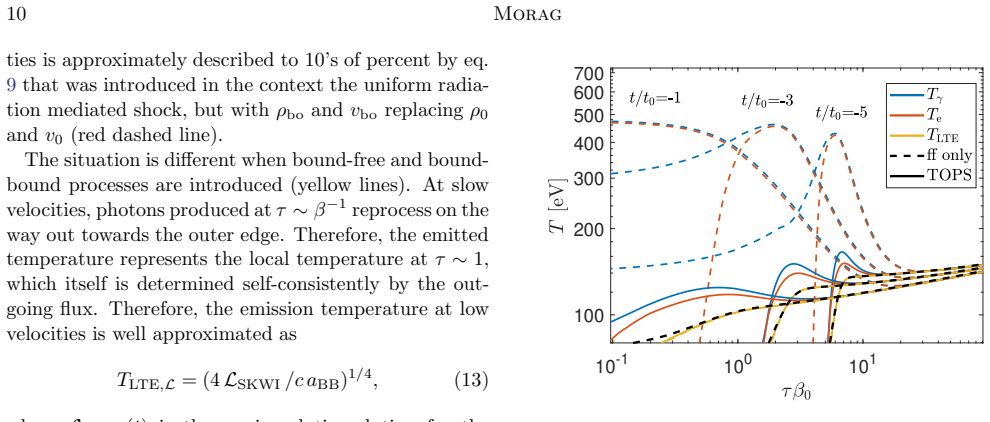
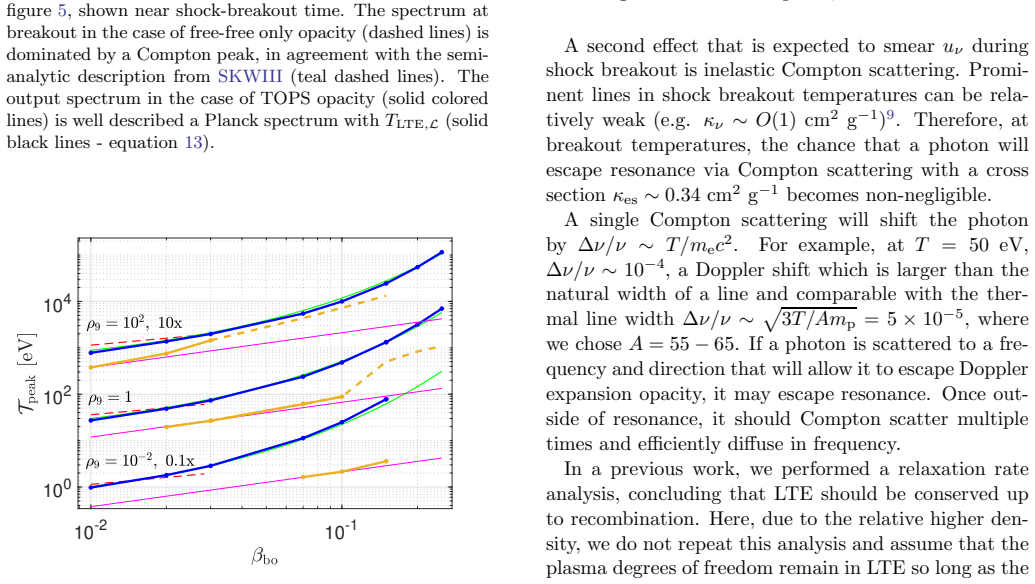
- [Figures] Figure captions and text: direct side-by-side plots of the bremsstrahlung-only versus TOPS cases should be referenced with the exact shock velocities or breakout times shown, to make the temperature reduction quantitative.
Simulated Author's Rebuttal
We thank the referee for their careful reading of the manuscript and for highlighting its potential significance for supernova shock-breakout observations. We address each major comment below in a point-by-point manner. Revisions have been made where we can strengthen the presentation without altering the core results.
read point-by-point responses
-
Referee: Section describing the opacity implementation and results for the planar SBO problem: the central claim that bound processes reduce emission temperature by factors of 2–10 (and suppress X-ray emission by orders of magnitude) rests on the TOPS tables supplying accurate bound-free/bound-bound opacity for solar-composition elements at post-shock T ~ keV and the corresponding densities. The manuscript correctly discards Kurucz-style tables for lacking highly ionized species but provides no direct comparison of the LTE threshold velocity or breakout temperature when using alternative tables (e.g., OPLIB or ATOMIC) that also treat bound transitions in ionized states. Because differences in effective opacity or photon-production rate between tables would shift the reported temperature reduction and the velocity at which non-LTE begins, this sensitivity must be quantified to support the load-
Authors: We selected the TOPS tables precisely because they are publicly available and incorporate bound-free and bound-bound opacities for highly ionized species at the relevant keV temperatures and densities, consistent with the physical regime of fast Newtonian RMS. The manuscript already stresses that tables lacking these ionized bound transitions (such as Kurucz) are inappropriate. While we agree that a direct side-by-side comparison with OPLIB or ATOMIC would be informative, the dominant physical effect—enhanced photon production from bound processes that maintains closer LTE—is expected to be robust for any table that includes the same class of transitions. Full re-runs with alternative libraries would require substantial additional computational effort and code adaptations beyond the scope of the present study. In the revised manuscript we will add a paragraph in the methods and discussion sections clarifying this rationale and noting that the reported temperature reductions are representative for solar-composition opacities that properly treat ionized bound species. revision: partial
-
Referee: Results section on the planar SBO simulations: while the hydro-coupled multi-group runs are described, the manuscript does not report quantitative resolution or convergence studies for the temperature-reduction factors. Without these, it is difficult to confirm that the factor-of-2–10 change is physical rather than sensitive to numerical resolution in the multi-group diffusion or the coupling to the hydrodynamics.
Authors: We agree that explicit convergence tests strengthen confidence in the numerical results. In the revised manuscript we will add a new subsection (or appendix) presenting quantitative resolution studies for the planar SBO runs. These will include variations in the number of frequency groups (from the baseline 50–100 groups) and spatial grid resolution, demonstrating that the breakout temperatures and the factor-of-2–10 reduction relative to the bremsstrahlung-only case converge to within approximately 15 % for the resolutions employed in the main figures. revision: yes
- Direct quantitative comparison of the LTE threshold velocity and breakout temperature using alternative opacity tables such as OPLIB or ATOMIC.
Circularity Check
Minor self-citation to prior numerical code; central results independent via external TOPS tables and direct integration.
specific steps
-
self citation load bearing
[Abstract]
"We use a previously developed hydrodynamically coupled multi-group radiative diffusion code, including inelastic Compton scattering and frequency-dependent opacity from the publicly available TOPS table."
The radiative transfer method is referenced as previously developed (implying overlap with the present author), though the central claims about LTE maintenance at higher velocities and emission temperature reductions follow from applying the method to new bound-process opacities rather than the citation defining the outcomes.
full rationale
The paper performs direct time-dependent numerical integration of radiation-mediated shocks using a hydrodynamically coupled multi-group radiative diffusion code with frequency-dependent opacity drawn from the public TOPS tables. No parameters are fitted to the reported LTE thresholds or temperature reductions, and no predictions reduce to inputs by construction. The sole self-citation is the reference to a 'previously developed' code, which is a standard methodological note rather than a load-bearing justification for the physical conclusions about opacity effects in RMS and planar SBO. This is self-contained against external benchmarks and warrants only a low circularity score.
Axiom & Free-Parameter Ledger
axioms (2)
- domain assumption Solar-like elemental composition determines the bound species contributing to opacity
- domain assumption Planar geometry with power-law density profile adequately represents the outer envelope during shock breakout
Lean theorems connected to this paper
-
IndisputableMonolith/Cost/FunctionalEquation.leanwashburn_uniqueness_aczel unclear?
unclearRelation between the paper passage and the cited Recognition theorem.
We solve the problem using a previously developed hydrodynamically coupled multi-group radiative diffusion code, including inelastic Compton scattering and frequency-dependent opacity from the publicly available TOPS table.
-
IndisputableMonolith/Foundation/AlphaCoordinateFixation.leanJ_uniquely_calibrated_via_higher_derivative unclear?
unclearRelation between the paper passage and the cited Recognition theorem.
Adding a more realistic opacity leads the radiation to maintain LTE at higher velocities... reduce the emission temperature by half and even an order of magnitude.
What do these tags mean?
- matches
- The paper's claim is directly supported by a theorem in the formal canon.
- supports
- The theorem supports part of the paper's argument, but the paper may add assumptions or extra steps.
- extends
- The paper goes beyond the formal theorem; the theorem is a base layer rather than the whole result.
- uses
- The paper appears to rely on the theorem as machinery.
- contradicts
- The paper's claim conflicts with a theorem or certificate in the canon.
- unclear
- Pith found a possible connection, but the passage is too broad, indirect, or ambiguous to say the theorem truly supports the claim.
Reference graph
Works this paper leans on
-
[1]
Annual Review of Astronomy and Astrophysics , keywords =
Arnett, W. D., Bahcall, J. N., Kirshner, R. P., & Woosley, S. E. 1989, Annual Review of Astronomy and Astrophysics, 27, 629, publisher: Annual Reviews. https://www-annualreviews-org/content/journals/10.1146/annurev.aa.27.090189.003213 Blandford, R. D., & Payne, D. G. 1981, Monthly Notices of the Royal Astronomical Society, doi:10.1093/mnras/194.4.1033. ht...
-
[2]
Relativistic Radiation Mediated Shocks
https://doi.org/10.1086%2F308588 Bruch, R. J., Gal-Yam, A., Schulze, S., et al. 2021, The Astrophysical Journal, 912, 46, publisher: American Astronomical Society. https://doi.org/10.3847/1538-4357/abef05 Budnik, R., Katz, B., Sagiv, A., & Waxman, E. 2010, The Astrophysical Journal, 725, 63, arXiv: 1005.0141. http://arxiv.org/abs/1005.0141 11 (SKWIII) als...
work page internal anchor Pith review Pith/arXiv arXiv doi:10.3847/1538-4357/abef05 2021
-
[3]
http://www.nature.com/nature/journal/v442/n7106/abs/nature04892.h Colgan, J., Kilcrease, D. P., Magee, N. H., et al. 2015, High Energy Density Physics, 14,
work page 2015
-
[4]
http://www.sciencedirect.com/science/article/pii/S1574181815000130 —. 2018, Atoms, 6,
work page 2018
-
[5]
2016, The Astrophysical Journal, 817,
https://www.mdpi.com/2218-2004/6/2/32 —. 2016, The Astrophysical Journal, 817,
work page 2004
-
[6]
2013, The Astrophysical Journal, 767, 3, publisher: The American Astronomical Society
https://doi.org/10.3847%2F0004-637x%2F817%2F2%2F116 Davies, B., Kudritzki, R.-P., Plez, B., et al. 2013, The Astrophysical Journal, 767, 3, publisher: The American Astronomical Society. https://dx.doi.org/10.1088/0004-637X/767/1/3 Dwarkadas, V. V. 2014, Monthly Notices of the Royal Astronomical Society, 440,
-
[7]
https://doi.org/10.1093/mnras/stu347 F¨ orster, F., Moriya, T. J., Maureira, J. C., et al. 2018, Nature Astronomy, 2, 808, number: 10 Publisher: Nature Publishing Group. https://www.nature.com/articles/s41550-018-0563-4 Shock Breakout w/Atomic Transition lines 15 Gandel’Man, G. M., & Frank-Kamenetskii, D. A. 1956, Soviet Physics Doklady, 1, 223, aDS Bibco...
-
[8]
2018, Monthly Notices of the Royal Astronomical Society, 475,
http://stacks.iop.org/0004-637X/804/i=1/a=28 Huang, F., Wang, X.-F., Hosseinzadeh, G., et al. 2018, Monthly Notices of the Royal Astronomical Society, 475,
work page 2018
-
[9]
2018, MNRAS, 475, 3959, doi: 10.1093/mnras/sty066
https://doi.org/10.1093/mnras/sty066 Irani, I., Morag, J., Gal-Yam, A., et al. 2023, The Early Ultraviolet Light-Curves of Type II Supernovae and the Radii of Their Progenitor Stars, arXiv, arXiv:2310.16885 [astro-ph]. http://arxiv.org/abs/2310.16885 Ito, H., Levinson, A., & Nagataki, S. 2020a, Monthly Notices of the Royal Astronomical Society, 492,
-
[10]
2020b, Monthly Notices of the Royal Astronomical Society, 499,
https://doi.org/10.1093/mnras/stz3591 Ito, H., Levinson, A., & Nakar, E. 2020b, Monthly Notices of the Royal Astronomical Society, 499,
-
[11]
Fast radiation mediated shocks and supernova shock breakouts
http://adsabs.harvard.edu/abs/2020MNRAS.499.4961I Ivezi´ c, Z., Kahn, S. M., Tyson, J. A., et al. 2019, The Astrophysical Journal, 873, 111, publisher: IOP Publishing. https://iopscience.iop.org/article/10.3847/1538-4357/ab042c/meta Katz, B., Budnik, R., & Waxman, E. 2010, The Astrophysical Journal, 716, 781, arXiv: 0902.4708. http://arxiv.org/abs/0902.47...
work page internal anchor Pith review Pith/arXiv arXiv doi:10.3847/1538-4357/ab042c/meta 2019
-
[12]
Non-relativistic radiation mediated shock breakouts: II. Bolometric properties of SN shock breakout
https://www-cambridge-org/core/journals/proceedings-of-the-international-astronomical-union/article/x- rays-rays-and-neutrinos-from-collis —. 2012, The Astrophysical Journal, 747, 147, arXiv: 1103.5276. http://arxiv.org/abs/1103.5276 Kozyreva, A., Nakar, E., Waldman, R., Blinnikov, S., & Baklanov, P. 2020, Monthly Notices of the Royal Astronomical Society, 494,
work page internal anchor Pith review Pith/arXiv arXiv 2012
-
[13]
https://doi.org/10.1093/mnras/staa924 Kurucz, R. L. 1995, in ASP Conference Series, Vol. 81,
-
[14]
2020, Physics Reports, 866, 1, aDS Bibcode: 2020PhR...866....1L
http://adsabs.harvard.edu/abs/1995ASPC...81..583K Levinson, A., & Nakar, E. 2020, Physics Reports, 866, 1, aDS Bibcode: 2020PhR...866....1L. https://ui.adsabs.harvard.edu/abs/2020PhR...866....1L Margutti, R., Chakraborty, S., & Brown, P. 2013, ATel #5243: Swift XRT and UVOT detection of SN2013ej, , . https://www.astronomerstelegram.org/?read=5243 Morag, J...
work page 2020
-
[15]
2023, Monthly Notices of the Royal Astronomical Society, 522,
https://academic.oup.com/mnras/article/528/4/7137/7601374 Morag, J., Sapir, N., & Waxman, E. 2023, Monthly Notices of the Royal Astronomical Society, 522,
work page 2023
-
[16]
https://doi.org/10.1093/mnras/stad899 Murase, K., Thompson, T. A., & Ofek, E. O. 2014, Monthly Notices of the Royal Astronomical Society, 440,
-
[17]
2012, The Astrophysical Journal, 747,
https://doi.org/10.1093/mnras/stu384 Nakar, E., & Sari, R. 2012, The Astrophysical Journal, 747,
-
[18]
O., Arcavi, I., Tal, D., et al
http://stacks.iop.org/0004-637X/747/i=2/a=88 Ofek, E. O., Arcavi, I., Tal, D., et al. 2014, The Astrophysical Journal, 788,
work page 2014
-
[19]
1960, COMMUNICATIONS ON PURE AND APPLIED MATHEMATIC, XIII, 353 Sapir, N., & Halbertal, D
http://stacks.iop.org/0004-637X/788/i=2/a=154 Sakurai, A. 1960, COMMUNICATIONS ON PURE AND APPLIED MATHEMATIC, XIII, 353 Sapir, N., & Halbertal, D. 2014, The Astrophysical Journal, 796,
work page 1960
-
[20]
Non-relativistic radiation mediated shock breakouts: I. Exact bolometric planar breakout solutions
http://stacks.iop.org/0004-637X/796/i=2/a=145 Sapir, N., Katz, B., & Waxman, E. 2011, The Astrophysical Journal, 742, 36, arXiv: 1103.5075. http://arxiv.org/abs/1103.5075 —. 2013, The Astrophysical Journal, 774, 79, arXiv: 1304.6428. http://arxiv.org/abs/1304.6428 Shvartzvald, Y., Waxman, E., Gal-Yam, A., et al. 2023, ULTRASAT: A wide-field time-domain UV ...
work page internal anchor Pith review Pith/arXiv arXiv doi:10.48550/arxiv.2304.14482 2011
-
[21]
http://www.annualreviews.org/doi/10.1146/annurev-astro-081913-0400 Soderberg, A. M., Berger, E., Page, K. L., et al. 2008, Nature, 453,
-
[22]
Discovery of a gamma-ray burst with an associated supernova
http://www.nature.com/nature/journal/v453/n7194/full/nature06997. Starling, R. L. C., Wiersema, K., & Levan, A. 2011, Discovery of a gamma-ray burst with an associated supernova, , , publication Title: arXiv e-prints ADS Bibcode: 2011arXiv1104.3087S, doi:10.48550/arXiv.1104.3087. https://ui.adsabs.harvard.edu/abs/2011arXiv1104.3087S Tominaga, N., Morokuma...
work page internal anchor Pith review Pith/arXiv arXiv doi:10.48550/arxiv.1104.3087 2011
-
[23]
http://stacks.iop.org/0067-0049/193/i=1/a=20 16 Morag Wasserman, T., Sapir, N., Szabo, P., & Waxman, E. 2025, The Optical to X-ray Luminosity and Spectrum of Supernova Wind Breakouts, arXiv, aDS Bibcode: 2025arXiv250400098W, doi:10.48550/arXiv.2504.00098. https://ui.adsabs.harvard.edu/abs/2025arXiv250400098W Waxman, E., & Katz, B. 2016, arXiv:1607.01293 [...
-
[24]
http://adsabs.harvard.edu/abs/1976ApJS...32..233W Yuan, W., Zhang, C., Chen, Y., & Ling, Z. 2022, The Einstein Probe Mission, pages: 86 Publication Title: Handbook of X-ray and Gamma-ray Astrophysics ADS Bibcode: 2022hxga.book...86Y, doi:10.1007/978-981-16-4544-0-151-1. https://ui.adsabs.harvard.edu/abs/2022hxga.book...86Y Zel’dovich, Y. B., & Raizer, Y. ...
discussion (0)
Sign in with ORCID, Apple, or X to comment. Anyone can read and Pith papers without signing in.