RX Gru: a short-period pre-main-sequence eclipsing binary with a distant circumbinary companion
Pith reviewed 2026-05-18 14:52 UTC · model grok-4.3
The pith
RX Gru is a 28-million-year-old eclipsing binary of two nearly identical solar-mass stars orbited by a distant 89-Jupiter-mass companion.
A machine-rendered reading of the paper's core claim, the machinery that carries it, and where it could break.
Core claim
RX Gru consists of a tight inner binary composed of two twin components and an outer low-mass companion (a massive brown dwarf or a very low-mass star) in a relatively wide orbit, with the system placed at an age of approximately 28 Myr at the very end of the pre-main-sequence phase.
What carries the argument
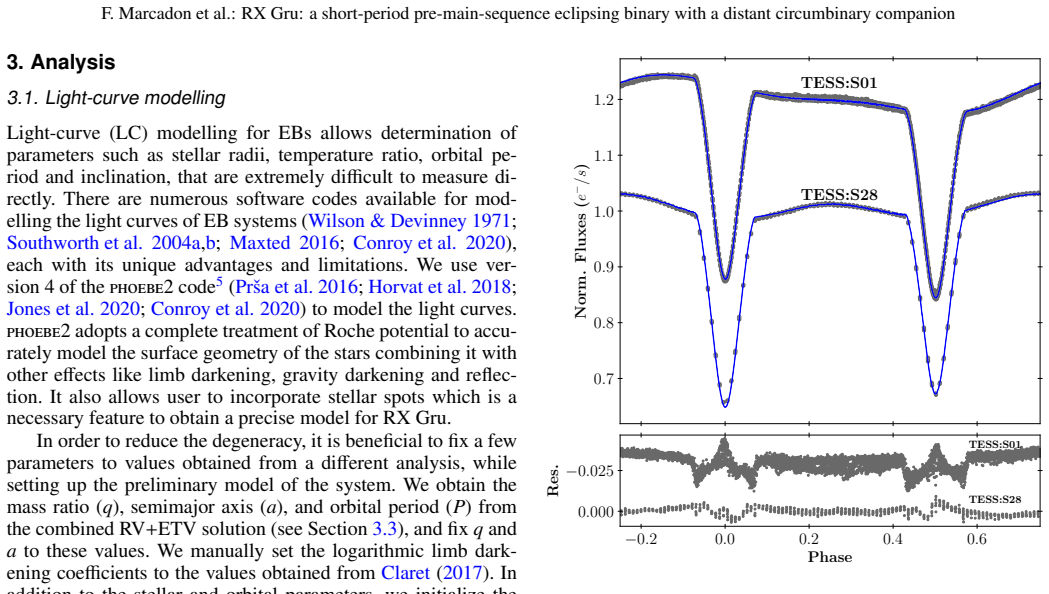
Combined analysis of photometric light curves from Solaris, TESS, and SWASP with radial velocities from HARPS, FEROS, CHIRON, and HRS to derive absolute stellar parameters and detect the long-period tertiary signal.
If this is right
- The inner binary components are twin solar-mass stars with radii about 1.01 solar radii, still contracting toward the main sequence.
- The tertiary has a minimum mass of 89 Jupiter masses and a period of 23.79 years, indicating a bound circumbinary object at the brown-dwarf to very-low-mass-star boundary.
- The system age of roughly 28 Myr places both stars at the terminus of the pre-main-sequence phase.
- The architecture is consistent with formation through dynamical unfolding of a wider triple accompanied by equalizing accretion from a shared circumbinary reservoir.
Where Pith is reading between the lines
- Similar short-period pre-main-sequence binaries with wide tertiaries could provide empirical tests of how mass is shared during the final stages of disk accretion.
- Long-term astrometric monitoring could measure the true mass and inclination of the outer companion and check whether the inner binary orbit is aligned with the outer orbit.
- The near-twin masses support the idea that circumbinary accretion efficiently equalizes component masses before the disk dissipates.
Load-bearing premise
The two stellar evolution codes produce an accurate age when given the observed masses, radii, and effective temperatures, without large systematic offsets in the late pre-main-sequence regime for solar-mass stars.
What would settle it
An independent age determination from lithium depletion patterns or from kinematic membership in a known young stellar association that differs substantially from 28 Myr would falsify the pre-main-sequence classification and reported age.
Figures


read the original abstract
We report the discovery of a new short-period pre-main-sequence eclipsing binary, RX Gru, orbited by a distant circumbinary companion. We characterized the system by analysing the photometric observations from the Solaris network, the Transiting Exoplanet Survey Satellite, and the Super Wide Angle Search for Planets survey, combined with the radial velocities from four high-resolution spectrographs: HARPS, FEROS, CHIRON, and HRS. We derived the parameters of the eclipsing components, which are $M_{\rm Aa} = 1.004^{+0.027}_{-0.026}\,$M$_\odot$, $R_{\rm Aa} = 1.007\pm0.021\,$R$_\odot$, and $T_{\rm eff,Aa} = 5379\pm289\,$K for the primary, and $M_{\rm Ab} = 0.985^{+0.024}_{-0.025}\,$M$_\odot$, $R_{\rm Ab} = 1.024\pm0.023\,$R$_\odot$, and $T_{\rm eff,Ab} = 5322\pm278\,$K for the secondary. We determined the age of the system from the observed parameters using two evolution codes, MESA and Cesam2k20. We obtained an age of $\sim$28$\,$Myr, placing the two stars at the very end of the pre-main-sequence phase. We also derived the minimum mass and orbital period of the tertiary companion, which are found to be $M_{\rm B} = 89.0\pm3.5\,$M$_{\rm Jup}$ and $P_{\rm AB} = 23.79 ^{+0.10 }_{-0.25}\,$yr, respectively. We conclude that RX Gru consists of a tight inner binary composed of two twin components and an outer low-mass companion (a massive brown dwarf or a very low-mass star) in a relatively wide orbit, and we suggest that the system was formed via the dynamical unfolding mechanism coupled with the shared accretion of the circumbinary material by the binary components.
Editorial analysis
A structured set of objections, weighed in public.
Referee Report
Summary. The paper reports the discovery of RX Gru, a short-period eclipsing binary consisting of two nearly identical solar-mass stars, orbited by a distant circumbinary companion. Using photometry from Solaris, TESS, and SWASP, and radial velocities from HARPS, FEROS, CHIRON, and HRS, the authors derive precise masses (M_Aa ≈ 1.004 M⊙, M_Ab ≈ 0.985 M⊙), radii (R_Aa ≈ 1.007 R⊙, R_Ab ≈ 1.024 R⊙), and effective temperatures (T_eff,Aa ≈ 5379 K, T_eff,Ab ≈ 5322 K). They determine an age of approximately 28 Myr using MESA and Cesam2k20 stellar evolution codes, classifying the components as being at the end of the pre-main-sequence phase. The tertiary companion has a minimum mass of 89 M_Jup and an orbital period of about 23.8 years. The authors suggest formation via dynamical unfolding coupled with shared accretion.
Significance. If the age determination holds, this work provides a well-constrained example of a young eclipsing binary near the zero-age main sequence with a low-mass tertiary companion. The use of multiple independent photometric surveys and four spectrographs offers redundant and robust constraints on the inner binary parameters, strengthening the reliability of the derived masses, radii, and temperatures. Such systems are valuable for calibrating pre-main-sequence evolutionary models and for studying hierarchical triple formation mechanisms. The suggestion of dynamical unfolding as the formation pathway, while speculative, adds to the discussion on binary formation in young stellar associations.
major comments (1)
- [Age determination (abstract and stellar evolution modeling section)] The classification of the components as pre-main-sequence stars at ~28 Myr relies on matching the observed masses, radii, and effective temperatures to isochrones from MESA and Cesam2k20. However, in the late pre-main-sequence regime for solar-mass stars, model ages can be sensitive to choices such as the mixing-length parameter, convective overshooting, and atmospheric boundary conditions, with potential discrepancies of tens of Myr between codes. The manuscript does not provide sensitivity tests, published evolutionary tracks, or a quantitative assessment of systematic offsets between the two codes. This is a load-bearing issue for the PMS classification and the proposed formation scenario.
minor comments (3)
- [Abstract] The error bars on the tertiary orbital period are reported as 23.79 ^{+0.10 }_{-0.25} yr; ensure consistent formatting and that the asymmetry is clearly explained in the main text.
- [Throughout manuscript] Some notation for uncertainties (e.g., +0.027_{-0.026}) could be standardized for clarity across tables and text.
- [Discussion section] The suggestion of dynamical unfolding is presented without quantitative N-body simulations or comparison to alternative formation channels; consider adding a brief discussion of supporting evidence or caveats.
Simulated Author's Rebuttal
We thank the referee for the positive evaluation of the scientific significance of RX Gru and for the detailed and constructive comments. We address the single major comment below and have prepared revisions that directly respond to the concerns raised.
read point-by-point responses
-
Referee: [Age determination (abstract and stellar evolution modeling section)] The classification of the components as pre-main-sequence stars at ~28 Myr relies on matching the observed masses, radii, and effective temperatures to isochrones from MESA and Cesam2k20. However, in the late pre-main-sequence regime for solar-mass stars, model ages can be sensitive to choices such as the mixing-length parameter, convective overshooting, and atmospheric boundary conditions, with potential discrepancies of tens of Myr between codes. The manuscript does not provide sensitivity tests, published evolutionary tracks, or a quantitative assessment of systematic offsets between the two codes. This is a load-bearing issue for the PMS classification and the proposed formation scenario.
Authors: We agree that additional documentation of model sensitivities would strengthen the age determination. In the revised manuscript we will expand the stellar evolution modeling section to include: (i) a brief sensitivity test varying the mixing-length parameter between 1.6 and 2.0 and including moderate convective overshooting; (ii) the specific published evolutionary grids and boundary conditions adopted for both MESA and Cesam2k20; and (iii) a quantitative comparison showing that the two codes yield ages differing by only ~4 Myr for the observed parameters, with both placing the stars at the very end of the pre-main-sequence phase. These additions will make the ~28 Myr age and the PMS classification more robust while preserving the formation-scenario discussion. revision: yes
Circularity Check
No significant circularity detected in derivation chain
full rationale
Masses, radii, and effective temperatures are obtained via direct least-squares fitting to photometric light curves from Solaris, TESS, and SWASP combined with radial-velocity time series from HARPS, FEROS, CHIRON, and HRS; these quantities are therefore independent of the subsequent age inference. The reported age of ~28 Myr is produced by feeding the fitted M, R, and Teff values into two external stellar-evolution codes (MESA and Cesam2k20) whose physics and isochrones are not constructed from the present data set. The formation-mechanism suggestion is an interpretive statement that follows from the derived parameters rather than a mathematical step that reduces to the inputs by definition. No self-citations, ansatzes, or uniqueness theorems are invoked to close any load-bearing loop, and the central results remain externally falsifiable against independent photometric and spectroscopic observations.
Axiom & Free-Parameter Ledger
free parameters (2)
- tertiary orbital period =
23.79 yr
- minimum companion mass =
89 Mjup
axioms (2)
- domain assumption Stellar evolution models (MESA, Cesam2k20) accurately map observed mass, radius, and effective temperature to age for ~1 solar-mass stars at the end of the pre-main-sequence phase
- domain assumption The outer orbit is Keplerian and the observed RV trend is due to a single bound companion
Lean theorems connected to this paper
-
IndisputableMonolith/Cost/FunctionalEquation.leanwashburn_uniqueness_aczel unclear?
unclearRelation between the paper passage and the cited Recognition theorem.
We determined the age of the system from the observed parameters using two evolution codes, MESA and Cesam2k20. We obtained an age of ∼28 Myr, placing the two stars at the very end of the pre-main-sequence phase.
What do these tags mean?
- matches
- The paper's claim is directly supported by a theorem in the formal canon.
- supports
- The theorem supports part of the paper's argument, but the paper may add assumptions or extra steps.
- extends
- The paper goes beyond the formal theorem; the theorem is a base layer rather than the whole result.
- uses
- The paper appears to rely on the theorem as machinery.
- contradicts
- The paper's claim conflicts with a theorem or certificate in the canon.
- unclear
- Pith found a possible connection, but the passage is too broad, indirect, or ambiguous to say the theorem truly supports the claim.
Reference graph
Works this paper leans on
-
[1]
, " * write output.state after.block = add.period write newline
ENTRY address archiveprefix author booktitle chapter edition editor howpublished institution eprint journal key month note number organization pages publisher school series title type volume year label extra.label sort.label short.list INTEGERS output.state before.all mid.sentence after.sentence after.block FUNCTION init.state.consts #0 'before.all := #1 ...
-
[2]
" write newline "" before.all 'output.state := FUNCTION n.dashify 't := "" t empty not t #1 #1 substring "-" = t #1 #2 substring "--" = not "--" * t #2 global.max substring 't := t #1 #1 substring "-" = "-" * t #2 global.max substring 't := while if t #1 #1 substring * t #2 global.max substring 't := if while FUNCTION word.in bbl.in " " * FUNCTION format....
-
[3]
Asplund , M., Grevesse , N., Sauval , A. J., & Scott , P. 2009, , 47, 481
work page 2009
-
[4]
Baraffe , I., Chabrier , G., Allard , F., & Hauschildt , P. H. 2002, , 382, 563
work page 2002
-
[5]
Bate , M. R. 2000, , 314, 33
work page 2000
- [6]
-
[7]
Blanco-Cuaresma , S., Soubiran , C., Heiter , U., & Jofr \'e , P. 2014, , 569, A111
work page 2014
- [8]
- [9]
-
[10]
Borkovits , T., Hajdu , T., Sztakovics , J., et al. 2016, , 455, 4136
work page 2016
-
[11]
Borkovits , T., Rappaport , S., Hajdu , T., & Sztakovics , J. 2015, , 448, 946
work page 2015
-
[12]
Borkovits , T., Rappaport , S. A., Hajdu , T., et al. 2020, , 493, 5005
work page 2020
-
[13]
Borkovits , T., Rappaport , S. A., Mitnyan , T., et al. 2025, , 695, A209
work page 2025
-
[14]
Brasseur , C. E., Phillip , C., Fleming , S. W., Mullally , S. E., & White , R. L. 2019, Astrocut: Tools for creating cutouts of TESS images
work page 2019
-
[15]
Butters , O. W., West , R. G., Anderson , D. R., et al. 2010, , 520, L10
work page 2010
- [16]
- [17]
- [18]
- [19]
- [20]
-
[21]
E., Kochoska , A., Hey , D., et al
Conroy , K. E., Kochoska , A., Hey , D., et al. 2020, , 250, 34
work page 2020
-
[22]
Coronado , J., He miniak , K. G., Vanzi , L., et al. 2015, , 448, 1937
work page 2015
- [23]
-
[24]
Crause , L. A., Sharples , R. M., Bramall , D. G., et al. 2014, in Society of Photo-Optical Instrumentation Engineers (SPIE) Conference Series, Vol. 9147, Ground-based and Airborne Instrumentation for Astronomy V, ed. S. K. Ramsay , I. S. McLean , & H. Takami , 91476T
work page 2014
-
[25]
Czekala , I., Andrews , S. M., Torres , G., et al. 2017, , 851, 132
work page 2017
- [26]
- [27]
-
[28]
Ferguson , J. W., Alexander , D. R., Allard , F., et al. 2005, , 623, 585
work page 2005
-
[29]
2019, The Journal of Open Source Software, 4, 1864
Foreman-Mackey , D., Farr , W., Sinha , M., et al. 2019, The Journal of Open Source Software, 4, 1864
work page 2019
-
[30]
Foreman-Mackey , D., Hogg , D. W., Lang , D., & Goodman , J. 2013, , 125, 306
work page 2013
-
[31]
2022 a , VizieR Online Data Catalog: Gaia DR3 Part 1
Gaia Collaboration . 2022 a , VizieR Online Data Catalog: Gaia DR3 Part 1. Main source (Gaia Collaboration, 2022) , VizieR On-line Data Catalog: I/355. Originally published in: Astron. Astrophys., in prep. (2022)
work page 2022
-
[32]
2022 b , VizieR Online Data Catalog, I/357
Gaia Collaboration . 2022 b , VizieR Online Data Catalog, I/357
work page 2022
-
[33]
Gilmore , G., Randich , S., Asplund , M., et al. 2012, The Messenger, 147, 25
work page 2012
- [34]
-
[35]
Grevesse , N., Asplund , M., & Sauval , A. J. 2007, , 130, 105
work page 2007
-
[36]
Gustafsson , B., Edvardsson , B., Eriksson , K., et al. 2008, , 486, 951
work page 2008
-
[37]
Hastings, W. K. 1970, Biometrika, 57, 97
work page 1970
-
[38]
G., Konacki , M., R \'o \.z yczka , M., et al
He miniak , K. G., Konacki , M., R \'o \.z yczka , M., et al. 2012, , 425, 1245
work page 2012
-
[39]
G., Marcadon , F., Moharana , A., Pawar , T., & Konacki , M
He miniak , K. G., Marcadon , F., Moharana , A., Pawar , T., & Konacki , M. 2022, in Proceedings of the Polish Astronomical Society, Vol. 12, XL Polish Astronomical Society Meeting, ed. E. Szuszkiewicz , A. Majczyna , K. Ma ek , M. Ratajczak , E. Niemczura , U. B a k-St e \'s licka , R. Poleski , M. Bilicki , & . Wyrzykowski , 163--166
work page 2022
-
[40]
G., Moharana , A., Pawar , T., et al
He miniak , K. G., Moharana , A., Pawar , T., et al. 2021, , 508, 5687
work page 2021
-
[41]
Hensberge , H., Iliji \'c , S., & Torres , K. B. V. 2008, , 482, 1031
work page 2008
-
[42]
Hilditch , R. W. 2001, An Introduction to Close Binary Stars
work page 2001
-
[43]
Horvat , M., Conroy , K. E., Pablo , H., et al. 2018, , 237, 26
work page 2018
-
[44]
Iglesias , C. A. & Rogers , F. J. 1996, , 464, 943
work page 1996
-
[45]
Ilijic , S., Hensberge , H., Pavlovski , K., & Freyhammer , L. M. 2004, in Astronomical Society of the Pacific Conference Series, Vol. 318, Spectroscopically and Spatially Resolving the Components of the Close Binary Stars, ed. R. W. Hilditch , H. Hensberge , & K. Pavlovski , 111--113
work page 2004
-
[46]
Irwin , J. B. 1952, , 116, 211
work page 1952
-
[47]
Jones , D., Conroy , K. E., Horvat , M., et al. 2020, , 247, 63
work page 2020
-
[48]
Kaufer , A., Stahl , O., Tubbesing , S., et al. 1999, The Messenger, 95, 8
work page 1999
- [49]
- [50]
- [51]
-
[52]
Kozłowski, S. K., Sybilski, P. W., Konacki, M., et al. 2017, Publications of the Astronomical Society of the Pacific, 129, 105001
work page 2017
- [53]
-
[54]
Lidov , M. L. 1962, , 9, 719
work page 1962
-
[55]
Lightkurve Collaboration , Cardoso , J. V. d. M., Hedges , C., et al. 2018, Lightkurve: Kepler and TESS time series analysis in Python , Astrophysics Source Code Library
work page 2018
-
[56]
Lomb , N. R. 1976, , 39, 447
work page 1976
-
[57]
Marcadon , F., Appourchaux , T., & Marques , J. P. 2018, , 617, A2
work page 2018
-
[58]
Marcadon , F., He miniak , K. G., Marques , J. P., et al. 2020, , 499, 3019
work page 2020
- [59]
-
[60]
Marques , J. P., Goupil , M. J., Lebreton , Y., et al. 2013, , 549, A74
work page 2013
-
[61]
Maxted , P. F. L. 2016, , 591, A111
work page 2016
-
[62]
1990, Bulletin of the Astronomical Institutes of Czechoslovakia, 41, 231
Mayer , P. 1990, Bulletin of the Astronomical Institutes of Czechoslovakia, 41, 231
work page 1990
-
[63]
Mayor , M., Pepe , F., Queloz , D., et al. 2003, The Messenger, 114, 20
work page 2003
-
[64]
Metropolis , N., Rosenbluth , A. W., Rosenbluth , M. N., Teller , A. H., & Teller , E. 1953, , 21, 1087
work page 1953
- [65]
-
[66]
Mikul \'a s ek , Z., Wolf , M., Zejda , M., & Pecharov \'a , P. 2006, , 304, 363
work page 2006
-
[67]
Milone , E. E. 1968, , 73, 708
work page 1968
- [68]
- [69]
- [70]
-
[71]
Moharana , A., He miniak , K. G., Marcadon , F., et al. 2023, , 521, 1908
work page 2023
-
[72]
Moharana , A., He miniak , K. G., Marcadon , F., et al. 2024 a , , 527, 53
work page 2024
-
[73]
Moharana , A., He miniak , K. G., Marcadon , F., et al. 2024 b , , 690, A153
work page 2024
- [74]
- [75]
- [76]
-
[77]
Nelder, J. A. & Mead, R. 1965, The Computer Journal, 7, 308
work page 1965
- [78]
-
[79]
O'Connell , D. J. K. 1951, Publications of the Riverview College Observatory, 2, 85
work page 1951
-
[80]
B., Miszuda , A., He miniak , K
Pawar , T. B., Miszuda , A., He miniak , K. G., et al. 2025, arXiv e-prints, arXiv:2502.20626
discussion (0)
Sign in with ORCID, Apple, or X to comment. Anyone can read and Pith papers without signing in.