Coarsening dynamics for spiral and disordered waves in active Potts models
Pith reviewed 2026-05-18 15:14 UTC · model grok-4.3
The pith
Active Potts models with cyclic flips show domain coarsening that follows the Lifshitz-Allen-Cahn law with a temporary speedup before locking into stable waves.
A machine-rendered reading of the paper's core claim, the machinery that carries it, and where it could break.
Core claim
In q-state active Potts models under cyclic symmetry, the correlation length and mean cluster size grow as t to the power 1/2 in the intermediate regime, in accordance with the Lifshitz-Allen-Cahn law, before saturating at the characteristic wavelengths of the emerging waves; a transient elevation of the coarsening exponent occurs prior to saturation, and this elevation is larger for disordered waves than for spiral waves and increases with q.
What carries the argument
Active cyclic state flipping in the q-state Potts model, which generates finite-length moving waves whose wavelength is controlled by activity strength and temperature.
If this is right
- Correlation length and cluster size increase as the square root of time until they reach the wave wavelength set by activity.
- The temporary rise in growth rate is larger when the final state is disordered waves rather than spirals.
- Increasing the number of states q amplifies the transient boost in the coarsening exponent.
- Domains restricted to two- or three-state factorized modes at q=6 still obey the same Lifshitz-Allen-Cahn growth.
- The coarsening trajectory is insensitive to whether a square or hexagonal lattice is used and to whether Metropolis or Glauber updates are chosen.
Where Pith is reading between the lines
- Activity strength may serve as a control parameter that tunes how quickly patterns reach their final scale in other lattice-based active systems.
- The observed saturation suggests a dynamical balance between domain merging and wave propagation that could be examined in continuum active-matter equations.
- Similar transient accelerations might appear in experimental realizations of cyclic Potts-like systems, such as certain chemical reaction-diffusion media or multicellular aggregates.
- The greater transient effect in disordered waves implies that symmetry breaking in the final state influences the approach to saturation.
Load-bearing premise
The Monte Carlo dynamics at the chosen activity and temperature produce stable waves whose wavelength is fixed by the model parameters rather than by the finite size of the simulation box or lattice details.
What would settle it
Running the same model on lattices at least ten times larger in linear size and checking whether the transient exponent increase and the subsequent saturation both disappear or shift to much later times.
Figures


read the original abstract
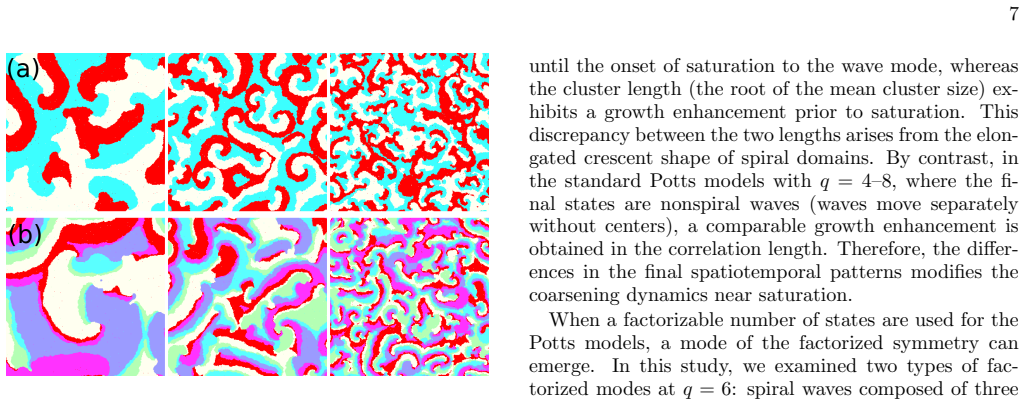
This study examines the domain-growth dynamics of $q$-state active Potts models ($q=3$--$8$) under the cyclically symmetric conditions using Monte Carlo simulations on square and hexagonal lattices. By imposing active cyclic flipping of states, finite-length waves emerge in the long-term limit. This study focuses on coarsening dynamics from an initially random mixture of states to these moving-domain states. The correlation length and mean cluster size grow, following the Lifshitz--Allen--Cahn (LAC) law ($\propto t^{1/2}$) in the intermediate time range, and in the late range, saturation is observed at the characteristic wavelengths. It is found that the growth rate is raised prior to saturation, leading to a transient increase in the coarsening exponent. The coarsening dynamics to disordered waves exhibit greater transient increases than those to spiral waves. Moreover, the transient increase is greater at higher $q$. In factorized symmetry modes at $q=6$, domains composed of two or three states similarly follow the LAC law. Finally, this study confirms that the choice of lattice type (square or hexagonal) and update scheme (Metropolis or Glauber) does not alter the dynamic behavior.
Editorial analysis
A structured set of objections, weighed in public.
Referee Report
Summary. The paper examines coarsening dynamics in q-state active Potts models (q=3--8) with cyclic symmetry using Monte Carlo simulations on square and hexagonal lattices. From random initial states, finite-length waves emerge, and the correlation length and mean cluster size are shown to grow as t^{1/2} following the Lifshitz-Allen-Cahn law in the intermediate time regime. Saturation occurs at characteristic wavelengths in the late stage, preceded by a transient increase in the effective coarsening exponent, which is larger for disordered waves than for spiral waves and increases with q. The dynamics are consistent across lattice types and update schemes (Metropolis and Glauber). In factorized symmetry modes at q=6, similar behavior is observed for domains of two or three states.
Significance. If the reported scaling and transients hold as intrinsic features, this work contributes to the study of non-equilibrium coarsening in active systems by demonstrating how wave formation influences domain growth beyond standard LAC behavior. The consistency across different lattices and dynamics strengthens the reliability of the numerical findings. The distinction between spiral and disordered waves, and the q-dependence, offers new insights into symmetry-breaking and activity-driven dynamics in Potts models.
major comments (1)
- [Results] Results section on correlation length and cluster size evolution: The central claim that saturation of the correlation length and mean cluster size occurs at wavelengths fixed by activity strength and temperature (rather than finite lattice size) is not supported by explicit system-size scaling checks. No comparison of saturation times, saturated values, or transient exponent peaks is reported across at least two different linear sizes L, leaving open the possibility that the observed transient increase in the coarsening exponent is contaminated by the approach to the box size.
minor comments (1)
- [Abstract] Abstract: The statement that growth follows the Lifshitz-Allen-Cahn law provides no quantitative measures such as fitted exponents with uncertainties, time-range definitions for the intermediate regime, or system-size details.
Simulated Author's Rebuttal
We are grateful to the referee for their thorough review and constructive feedback on our manuscript. We address the major comment in detail below and have made revisions to strengthen the presentation of our results.
read point-by-point responses
-
Referee: [Results] Results section on correlation length and cluster size evolution: The central claim that saturation of the correlation length and mean cluster size occurs at wavelengths fixed by activity strength and temperature (rather than finite lattice size) is not supported by explicit system-size scaling checks. No comparison of saturation times, saturated values, or transient exponent peaks is reported across at least two different linear sizes L, leaving open the possibility that the observed transient increase in the coarsening exponent is contaminated by the approach to the box size.
Authors: We thank the referee for highlighting this important point. Upon reflection, we acknowledge that the manuscript does not present explicit finite-size scaling analyses comparing results for different linear system sizes L. The saturation lengths reported are tied to the activity and temperature parameters through the observed wave wavelengths, which are independent of L in our simulations. Nevertheless, to fully address this concern and rule out any contamination from the finite box size, we will conduct additional simulations using at least two different system sizes (e.g., L=256 and L=512) and include comparisons of the saturation times, saturated correlation lengths and cluster sizes, as well as the transient peaks in the effective exponent. These new results will be added to the revised manuscript, confirming that the observed behavior is intrinsic. revision: yes
Circularity Check
No circularity: direct numerical outputs benchmarked externally
full rationale
The paper reports Monte Carlo simulation results on coarsening in active Potts models. Growth of correlation length and cluster size is stated to follow the Lifshitz-Allen-Cahn law in an intermediate regime and to saturate at characteristic wavelengths in the late regime; both are presented as direct outputs of the runs rather than quantities fitted or defined in terms of each other. The LAC reference is an external benchmark, not a self-citation or internal ansatz. No equations, fitted parameters, or uniqueness theorems are invoked that reduce the central claims to the simulation inputs by construction. Lattice-type and update-scheme checks are likewise independent numerical tests. The derivation chain is therefore self-contained against external benchmarks.
Axiom & Free-Parameter Ledger
axioms (1)
- domain assumption The active cyclic flipping rule produces stable finite-wavelength waves whose coarsening can be compared to the passive Lifshitz-Allen-Cahn law.
Lean theorems connected to this paper
-
IndisputableMonolith/Foundation/ArithmeticFromLogic.leanreality_from_one_distinction unclear?
unclearRelation between the paper passage and the cited Recognition theorem.
The correlation length and mean cluster size grow following the Lifshitz-Allen-Cahn (LAC) law (∝ t^{1/2}) in the intermediate time range, with a transient increase in the coarsening exponent prior to saturation at characteristic wavelengths
What do these tags mean?
- matches
- The paper's claim is directly supported by a theorem in the formal canon.
- supports
- The theorem supports part of the paper's argument, but the paper may add assumptions or extra steps.
- extends
- The paper goes beyond the formal theorem; the theorem is a base layer rather than the whole result.
- uses
- The paper appears to rely on the theorem as machinery.
- contradicts
- The paper's claim conflicts with a theorem or certificate in the canon.
- unclear
- Pith found a possible connection, but the passage is too broad, indirect, or ambiguous to say the theorem truly supports the claim.
Reference graph
Works this paper leans on
-
[1]
The dashed lines represent the exponents calculated from the data for 30< r cr1 <100 and for 200< n 1/2 cl <400 at h= 0. C. Repulsive Nonflip-Contact Potts Models Next, we describe the coarsening dynamics of repulsive nonflip-contact Potts models (J k,[k+n] =−J k,k with 2≤ n≤q/2) atq= 4–8 [Figs. 4–6, and S8–S12]. Because nonflip contacts (s=kand [k+n] pai...
work page 2048
-
[2]
7(a)], which dynamics is called the M2W3 mode [39]
Ath >0, these three domains form spiral waves [see Fig. 7(a)], which dynamics is called the M2W3 mode [39]. The coarsening dynamics of these mixed domains are al- most identical to those of the three-state Potts model 0.45 0.5 α cr (a) Metropolishex Glauber 0.4 0.45 0.5 0.55 0 0.5 α cl h (b) Metropolis Glauber FIG. 6. Coarsening exponents (a)α cr and (b)α...
work page 2048
-
[3]
S. Puri and V. Wadhawan, eds.,Kinetics of phase tran- sitions(CRC Press, Boca Raton, 1982)
work page 1982
- [4]
-
[5]
A. J. Bray, Adv. Phys.43, 357 (1994)
work page 1994
-
[6]
G. S. Grest, M. P. Anderson, and D. J. Srolovitz, Phys. Rev. B38, 4752 (1988)
work page 1988
-
[7]
T. M. Rogers, K. R. Elder, and R. C. Desai, Phys. Rev. B37, 9638 (1988)
work page 1988
- [8]
- [9]
-
[10]
E. E. Ferrero and S. A. Cannas, Phys. Rev. E76, 031108 (2007)
work page 2007
-
[11]
Y. Yang, Y.-H. Liu, R. M. Fernandes, and G.-W. Chern, Phys. Rev. B111, 144315 (2025)
work page 2025
- [12]
-
[13]
S. M. Allen and J. W. Cahn, Acta Metall.27, 1085 (1979)
work page 1979
-
[14]
I. M. Lifshitz and V. V. Slyozov, J. Phys. Chem. Solids 19, 35 (1961)
work page 1961
- [15]
-
[16]
O. Al Hammal, H. Chat´ e, I. Dornic, and M. A. Mu˜ noz, Phys. Rev. Lett.94, 230601 (2005)
work page 2005
- [17]
-
[18]
L. C. F. Latoski, W. G. Dantas, and J. J. Arenzon, Phys. Rev. E106, 014121 (2022)
work page 2022
-
[19]
K. R. Elder, J. Vi˜ nals, and M. Grant, Phys. Rev. Lett. 68, 3024 (1992)
work page 1992
-
[20]
M. C. Cross and D. I. Meiron, Phys. Rev. Lett.75, 2152 (1995)
work page 1995
-
[21]
S. Dey, D. Das, and R. Rajesh, Phys. Rev. Lett.108, 238001 (2012)
work page 2012
- [22]
-
[23]
S. Saha, J. Agudo-Canalejo, and R. Golestanian, Phys. Rev. X10, 041009 (2020)
work page 2020
- [24]
- [25]
-
[26]
F. Dittrich, J. Midya, P. Virnau, and S. K. Das, Phys. Rev. E108, 024609 (2023)
work page 2023
-
[27]
S. Bandyopadhyay, S. Chatterjee, A. K. Dutta, M. Kar- makar, H. Rieger, and R. Paul, Phys. Rev. E109, 064143 (2024)
work page 2024
-
[28]
Y. Rouzaire, P. Rahmani, I. Pagonabarraga, F. Peruani, and D. Levis, Phys. Rev. Lett.134, 188301 (2025)
work page 2025
-
[29]
G. Nicolis and I. Prigogine,Self-organization in nonequi- librium systems : From dissipative structures to order through fluctuations(Wiley, New York, 1977)
work page 1977
-
[30]
Haken,Synergetics : Introduction and advanced topics (Springer, Berlin, 2004)
H. Haken,Synergetics : Introduction and advanced topics (Springer, Berlin, 2004)
work page 2004
-
[31]
Mikhailov,Foundations of synergetics I: Distributed active systems, 2nd ed
A. Mikhailov,Foundations of synergetics I: Distributed active systems, 2nd ed. (Springer, Berlin, 1994)
work page 1994
-
[32]
M. I. Rabinovich, A. B. Ezersky, and P. D. Weidman, The dynamics of patterns(World Scientific, Singapore, 2000)
work page 2000
-
[33]
Kuramoto,Chemical oscillations, waves, and turbu- lence(Springer, Berlin, 1984)
Y. Kuramoto,Chemical oscillations, waves, and turbu- lence(Springer, Berlin, 1984)
work page 1984
-
[34]
J. D. Murray,Mathematical biology II: Spatial models and biomedical applications, 3rd ed. (Springer, New York, 2003)
work page 2003
- [35]
-
[36]
A. Bailles, E. W. Gehrels, and T. Lecuit, Annu. Rev. Cell Dev. Biol.38, 321 (2022)
work page 2022
-
[37]
Noguchi, ChemSystemsChem7, e202400042 (2025)
H. Noguchi, ChemSystemsChem7, e202400042 (2025)
work page 2025
-
[38]
H. Noguchi, F. van Wijland, and J.-B. Fournier, J. Chem. Phys.161, 025101 (2024)
work page 2024
- [39]
- [40]
- [41]
- [42]
-
[43]
F. Y. Wu, Rev. Mod. Phys.54, 235 (1982)
work page 1982
-
[44]
R. B. Potts, Proc. Camb. Phil. Soc.48, 106 (1952)
work page 1952
- [45]
- [46]
-
[47]
V. Gorodetskii, J. Lauterbach, H.-H. Rotermund, J. H. Block, and G. Ertl, Nature370, 276 (1994)
work page 1994
-
[48]
C. Barroo, Z.-J. Wang, R. Schlr¨ ogl, and M.-G. Willinger, Nat. Catal.3, 30 (2020)
work page 2020
-
[49]
Zeininger and et al., ACS Catal.12, 11974 (2022)
J. Zeininger and et al., ACS Catal.12, 11974 (2022)
work page 2022
- [50]
- [51]
-
[52]
G. Holl´ o, Y. Miele, F. Rossi, and I. Lagzi, Phys. Chem. Chem. Phys.23, 4262 (2021)
work page 2021
- [53]
- [54]
- [55]
-
[56]
R. V. Ditzian, J. R. Banavar, G. S. Grest, and L. P. Kadanoff, Phys. Rev. B22, 2542 (1980)
work page 1980
-
[57]
G. S. Grest and M. Widom, Phys. Rev. B24, 6508 (1981)
work page 1981
-
[58]
J. Olejarz, P. L. Krapivsky, and S. Redner, J. Stat. Mech. 2013, P06018 (2013)
work page 2013
- [59]
discussion (0)
Sign in with ORCID, Apple, or X to comment. Anyone can read and Pith papers without signing in.