REVIEW 3 major objections 5 minor 53 references
Budgeted Indirect Adversarial Attack on Graph-Based Anomaly Detection in Sensor Networks
T0 review · 3 major / 5 minor · reviewed 2026-08-04 · deepseek-v4-flash
Pith's one-line read The paper introduces BETA, a budgeted indirect evasion attack that fools GNN-based anomaly detectors in sensor networks by perturbing a small, carefully selected set of non-target sensors.
desk verdict The explainer-guided budgeted attack pipeline is a genuine contribution, but the attack's dependence on the true anomaly label undermines the 'realistic constraints' claim until the authors justify it or re-run without that oracle. read the letter →
The pith
A machine-rendered reading of the paper's core claim, the machinery that carries it, and where it could break.
The reading
What carries the argument
GAFExplainer, a graph-neural-network explainer that learns an edge mask highlighting the subgraph most influential for the target node's prediction; eigenvector centrality, to rank candidate influencer nodes by structural importance and cap the set at the budget B; and constrained Projected Gradient Descent (PGD), to add imperceptible ℓ∞-bounded perturbations to the selected nodes' features while leaving the target's features untouched. PGD is masked to only touch the influencer nodes, and the whole pipeline is guided by a surrogate model trained with query access to the victim.
What would settle it
Compare BETA's success when the true label y is replaced by a label estimated from the victim's own predictions or from the surrogate's output; if FTA degradation largely disappears, BETA's reported effectiveness depends on oracle labels rather than on the node-selection strategy.
Extended reading notes
Core claim
The paper claims that a practical, budget-limited attacker can meaningfully blind or mislead GNN-based anomaly detectors without ever perturbing the target node. The central discovery is that the right choice of which sensors to compromise matters more than the perturbation method: using GAFExplainer to extract the subgraph most responsible for the target's anomaly score, then pruning that subgraph to the attack budget with eigenvector centrality, and finally applying constrained PGD to the selected nodes' features, yields consistent performance degradation (FTA as low as 0.20–0.30 for GDN on SJVAir at B=6) across datasets and models. BETA outperforms random attacks, a feature-only variant o
Load-bearing premise
The attack's PGD step is supervised by the true anomaly label of the target node, but the paper never states how an attacker without ground-truth knowledge obtains that label at test time; if the attacker must guess or infer it, the attack could be substantially weaker.
Editorial extensions
If this is right
- With a budget of only 5 compromised sensors, BETA lowers F1 of GDN to 0.28–0.45 and TopoGDN to 0.44–0.56 across three real datasets, versus much higher no-attack values.
- BETA consistently achieves the lowest Fractional Target Accuracy across all tested budgets (B=1–6), indicating that explanation-guided selection plus PGD optimization is more effective than either component alone.
- Ablation results attribute much of the attack power to GAFExplainer-based node selection; on SJVAir, BETA at B=6 nearly matches its unbudgeted variant for GDN (FTA 0.2544 vs 0.2298).
- Eigenvector centrality is the best pruning heuristic among tested centrality measures, yielding consistently lower FTA than degree, closeness, betweenness, clustering coefficient, or average neighbor degree.
Reading between the lines
- Because the attack only perturbs a small number of non-target sensors, deployments of GNN-based anomaly detectors in security-critical sensor networks should treat 'safe' sensors as part of the attack surface; monitoring or feature-level hardening of high-eigenvector-centrality nodes may blunt the attack.
- Algorithm 1 requires the target's true anomaly label to compute the PGD gradient, but the paper does not explain how an attacker without ground truth obtains this label; a label-free variant (e.g., maximizing change in the target's anomaly score or using the surrogate's own prediction as a pseudo-label) is a natural next test, and its measured success would bound the real-world risk.
- The finding that GAFExplainer's edge-mask explanation combined with eigenvector centrality beats pure centrality suggests that explainability tools can double as attack-planning tools; the same pipeline might be repurposed for defense by identifying and hardening the nodes that most influence each detector's decisions.
Editorial analysis
A structured set of objections, weighed in public.
Referee Report
Summary. The paper introduces BETA, a budgeted, indirect, grey-box evasion attack against GNN-based anomaly detectors in sensor networks. The attacker selects a small set of influencer nodes (excluding the target) using GAFExplainer plus eigenvector-centrality pruning, then perturbs their features with a constrained PGD procedure that maximizes cross-entropy loss on a surrogate model. The attack is evaluated against GDN and TopoGDN on SWaT, WADI, and SJVAir, reporting consistent FTA reductions and lower F1/AUC-PR relative to random attack, Nettack, and two ablations.
Significance. If the reported results hold, BETA is a useful contribution: it addresses a realistic and under-studied setting—indirect, budgeted evasion attacks on multivariate time-series anomaly detectors—where the attacker cannot touch the target sensor. The paper's strengths are its clean problem formulation, the combination of explainability-based node selection with PGD, and a reasonably complete ablation study (component-wise ablations, centrality comparisons, budget sensitivity). The empirical comparisons cover three real-world datasets and two victim models, and the attack consistently outperforms baselines, which is a meaningful and falsifiable claim. However, the significance is conditional on the threat model being realistic: the attack's optimization depends on ground-truth anomaly labels, and the surrogate's fidelity is never measured, so the central 'realistic constraints' claim is not yet fully supported.
major comments (3)
- [Algorithm 1 / Section 5] Algorithm 1 takes the true anomaly label y as input, and Eq. (15) updates the perturbation by maximizing cross-entropy between the surrogate output and y. The threat model in Section 5 never explains how the attacker obtains ground-truth labels for the current target at attack time; it grants graph structure A, query access to the victim, and the ability to intercept segments, but not label access. This is load-bearing: the sign of every PGD step is determined by the oracle label. If y is unavailable and must be inferred from the victim's own output, then for targets initially misclassified as normal the objective would push the surrogate toward the victim's current label, i.e., away from flipping the decision. The reported FTA/F1 reductions in Tables 3-4 therefore conflate attack effectiveness with label access. Please either justify label availability within the threat model or evaluat
- [Section 6 / Section 7.2] The central mechanism is surrogate-guided PGD, but the paper never measures surrogate fidelity. Section 6 says the surrogate is trained on pairs {(X_t, y_u^(t))} using query access, yet it does not specify whether y_u^(t) is the victim model's output or ground-truth label, nor does it state the size, temporal split, or sampling of the historical set. Without a surrogate-victim agreement metric, a reader cannot tell whether the attack transfers because the surrogate is accurate or because the reported numbers are an artifact of training on test-time labels. Please report surrogate accuracy/F1 against the victim on a held-out query set, describe how labels are obtained, and clarify the composition of the surrogate training set.
- [Section 4 / Section 6] Section 4 states that the model 'is trained using cross-entropy loss to classify each node as normal or anomalous,' which contradicts the GDN/TopoGDN descriptions in Section 3 and the original papers: those models are trained with forecasting loss on normal data, and the anomaly threshold is chosen from validation errors. If the surrogate is instead trained as a binary classifier with cross-entropy loss, its decision boundary may differ substantially from the victim's forecasting-error boundary. This is a load-bearing methodological inconsistency because all PGD gradients and GAFExplainer explanations come from the surrogate. Please clarify the actual training objective of the victim and the surrogate, and justify the surrogate's use if the objectives differ.
minor comments (5)
- [Abstract] The abstract reports F1 reductions of '36.07 to 50.45%' in the first paragraph and '30.62 to 39.16%' in the second paragraph. These ranges are inconsistent and should be reconciled by referring to the specific tables and metric definitions.
- [Section 7.3 / Section 8.2] The 'BETA (Unbudgeted)' variant is described in Section 7.3 and referenced in Section 8.2, but it does not appear in Tables 3 or 4; only textual FTA values are given. Please add the unbudgeted row to the tables for completeness.
- [Section 8.2 / Figures 5-6] Figures 5-6 include error bars, but no statistical significance tests are reported. Since the gaps between BETA and Nettack+GAFExplainer are sometimes small (e.g., WADI), a paired significance test or confidence intervals would strengthen the claim that BETA 'consistently achieves the lowest FTA.'
- [Notation throughout] Algorithm 1 returns X'_t, while Eq. (13)-(15) use X_0, X_k, X_{k+1}; please make the notation consistent. Also, the dataset names are spelled inconsistently ('SJV Air' vs 'SJVAir').
- [Reference [45]] The text refers to GAFExplainer but cites [45] as GNNExplainer. If GAFExplainer is a different method, the citation is incorrect; if it is an extension, please clarify the relationship.
Circularity Check
No significant circularity: BETA's attack success is measured on victim models with a surrogate optimized against known labels; the label input is a threat-model assumption, not a fitted quantity, and no load-bearing self-citation or definitional reduction is present.
full rationale
The paper's claimed contribution, a budgeted indirect grey-box evasion attack, is an empirical pipeline: GAFExplainer selects candidate influencer nodes, eigenvector centrality prunes them to budget, and PGD perturbs those nodes' features to maximize cross-entropy loss of a surrogate model against a supplied label. The success metric (F1, AUC-PR, FTA) is computed on the victim models GDN and TopoGDN using ground-truth labels, so the reported attack effectiveness is not recovered from the optimization objective itself. The surrogate is trained with query access to the victim and is a separate approximation; the attack does not use victim gradients or parameters. The only notable unstated assumption is Algorithm 1's 'True anomaly label y' input, which means the attacker is assumed to know the ground-truth status of the target at attack time. This is a threat-model realism concern, not a circularity: the label is an external oracle input, not a fitted parameter, and it is not derived from the attack's output. There are no load-bearing self-citations (the reference list contains no self-citations), no imported uniqueness theorem, and no known result merely renamed. The attack's components (GAFExplainer, centrality, PGD) are external and independently established; the paper's contribution is their combination and empirical evaluation. Therefore no derivation step reduces, by construction or self-citation, to its own inputs.
Assumptions & free parameters
free parameters (5)
- perturbation bound epsilon =
0.1
- GAFExplainer edge budget E =
not reported (E <= B-1)
- PGD step size alpha =
0.01
- PGD iterations K =
10
- SJVAir anomaly injection parameters =
zeta=10, lambda_var=7
assumptions (4)
- domain assumption The attacker has full access to the learned graph structure A of the victim model.
- domain assumption The surrogate model f_zeta approximates the victim model f_theta well enough that gradients transfer.
- ad hoc to paper Ground-truth anomaly label y of the target node is available to the attacker.
- domain assumption The attacker can intercept and delay transmissions of influencer nodes without detection.
Cite this review
Pith. "Pith review of Budgeted Indirect Adversarial Attack on Graph-Based Anomaly Detection in Sensor Networks." pith.science (2026). https://pith.science/paper/T2G7IHYH
@misc{pith2026250917987,
  author       = {Pith},
  title        = {Pith review of: Budgeted Indirect Adversarial Attack on Graph-Based Anomaly Detection in Sensor Networks},
  year         = {2026},
  howpublished = {\url{https://pith.science/paper/T2G7IHYH}},
  note         = {Machine review of arXiv:2509.17987}
}
read the original abstract
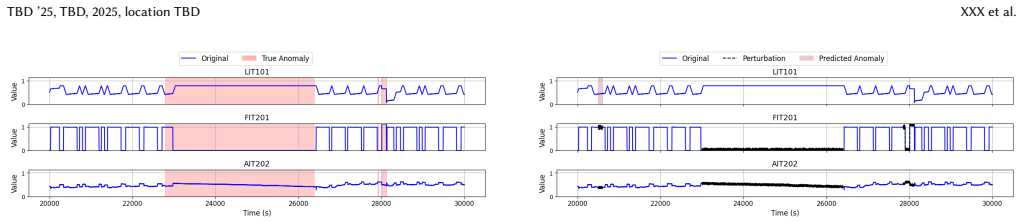
Graph Neural Networks (GNNs) have emerged as powerful models for anomaly detection in sensor networks, particularly when analyzing multivariate time series. In this work, we introduce BETA, a novel indirect evasion attack targeting such GNN-based detectors, where the attacker is constrained to perturb sensor readings from a limited set of nodes, excluding the target sensor, with the goal of either suppressing a true anomaly or triggering a false alarm at the target node. BETA uses a graph explanatory model combined with a centrality-based pruning strategy to identify the most influential nodes, subsequently injecting carefully crafted adversarial perturbations into their features. Extensive experiments on three real-world sensor network datasets show that BETA consistently outperforms baseline attack strategies while operating under realistic constraints, reducing the F1-score of state-of-the-art GNN-based detectors by 36.07 to 50.45\% on average.
Figures


Figures from the paper (3 more)


Reference graph
Works this paper leans on
-
[1]
2024. SJVAir. Official Website. https://www.sjvair.com/. Accessed: 2024-07-21
2024
-
[2]
Visual Crossing
2024. Visual Crossing. Historical Weather Data & Weather Forecast Data. https: //www.visualcrossing.com/weather-data
2024
-
[3]
Chuadhry Mujeeb Ahmed, Venkata Reddy Palleti, and Aditya P. Mathur. 2017. WADI: a water distribution testbed for research in the design of secure cyber physical systems. InProceedings of the 3rd International Workshop on Cyber- Physical Systems for Smart Water Networks(Pittsburgh, Pennsylvania)(CySW A- TER ’17). Association for Computing Machinery, New Yo...
arXiv 2017
-
[4]
Alex Bavelas. 1950. Communication patterns in task-oriented groups.Journal of the acoustical society of America(1950)
1950
-
[5]
Murray A Beauchamp. 1965. An improved index of centrality.Behavioral science 10, 2 (1965), 161–163
1965
-
[6]
Phillip Bonacich. 1972. Factoring and weighting approaches to status scores and clique identification.Journal of mathematical sociology2, 1 (1972), 113–120
1972
-
[7]
Phillip Bonacich. 2007. Some unique properties of eigenvector centrality.Social networks29, 4 (2007), 555–564
2007
-
[8]
Stephen P Borgatti and Martin G Everett. 1997. Network analysis of 2-mode data. Social networks19, 3 (1997), 243–269
1997
Show all 53 references
-
[9]
Yulong Cao, Chaowei Xiao, Benjamin Cyr, Yimeng Zhou, Won Park, Sara Ram- pazzi, Qi Alfred Chen, Kevin Fu, and Z Morley Mao. 2019. Adversarial sensor attack on lidar-based perception in autonomous driving. InProceedings of the 2019 ACM SIGSAC conference on computer and communic...
2019
-
[10]
Nicholas Carlini and David Wagner. 2017. Towards evaluating the robustness of neural networks. In2017 ieee symposium on security and privacy (sp). Ieee, 39–57
2017
-
[11]
Liang Chen, Jintang Li, Jiaying Peng, Tao Xie, Zengxu Cao, Kun Xu, Xiangnan He, Zibin Zheng, and Bingzhe Wu. 2020. A survey of adversarial learning on graphs.arXiv preprint arXiv:2003.05730(2020)
2020 arXiv
-
[12]
Zekai Chen, Dingshuo Chen, Xiao Zhang, Zixuan Yuan, and Xiuzhen Cheng
-
[13]
Hanjun Dai, Hui Li, Tian Tian, Xin Huang, Lin Wang, Jun Zhu, and Le Song
-
[14]
Ailin Deng and Bryan Hooi. 2021. Graph neural network-based anomaly detection in multivariate time series. InProceedings of the AAAI conference on artificial intelligence, Vol. 35. 4027–4035
2021
-
[15]
Ian J Goodfellow, Jonathon Shlens, and Christian Szegedy. 2014. Explaining and harnessing adversarial examples.arXiv preprint arXiv:1412.6572(2014)
2014 arXiv
-
[16]
Adam Goodge, Bryan Hooi, See Kiong Ng, and Wee Siong Ng. 2021. Robustness of autoencoders for anomaly detection under adversarial impact. InProceedings of the twenty-ninth international conference on international joint conferences on artificial intelligence. 1244–1250
2021
-
[17]
Thi Kieu Khanh Ho, Ali Karami, and Narges Armanfard. 2025. Graph Anomaly Detection in Time Series: A Survey.IEEE Transactions on Pattern Analysis and Machine Intelligence47, 8 (2025), 6990–7009
2025
-
[18]
Yifan Jia, Jingyi Wang, Christopher M Poskitt, Sudipta Chattopadhyay, Jun Sun, and Yuqi Chen. 2021. Adversarial attacks and mitigation for anomaly detectors of cyber-physical systems.International Journal of Critical Infrastructure Protection 34 (2021), 100452
2021
-
[19]
Ming Jin, Huan Yee Koh, Qingsong Wen, Daniele Zambon, Cesare Alippi, Geof- frey I Webb, Irwin King, and Shirui Pan. 2024. A survey on graph neural networks for time series: Forecasting, classification, imputation, and anomaly detection. IEEE Transactions on Pattern Analysis an...
2024
-
[20]
Hwan Kim, Byung Suk Lee, Won-Yong Shin, and Sungsu Lim. 2022. Graph anomaly detection with graph neural networks: Current status and challenges. IEEE Access10 (2022), 111820–111829
2022
-
[21]
Alexey Kurakin, Ian Goodfellow, and Samy Bengio. 2016. Adversarial machine learning at scale.arXiv preprint arXiv:1611.01236(2016)
2016 arXiv
-
[22]
Jongsoo Lee, Byeongtae Park, and Dong-Kyu Chae. 2023. Duogat: Dual time- oriented graph attention networks for accurate, efficient and explainable anomaly detection on time-series. InProceedings of the 32nd ACM International Conference on Information and Knowledge Management. ...
2023
-
[23]
Pedro G Lind, Marta C Gonzalez, and Hans J Herrmann. 2005. Cycles and clustering in bipartite networks.Physical Review E—Statistical, Nonlinear, and Soft Matter Physics72, 5 (2005), 056127
2005
-
[24]
Qinghua Liu and John Paparrizos. 2024. The elephant in the room: Towards a re- liable time-series anomaly detection benchmark.Advances in Neural Information Processing Systems37 (2024), 108231–108261
2024
-
[25]
Zhe Liu, Xiang Huang, Jingyun Zhang, Zhifeng Hao, Li Sun, and Hao Peng. 2024. Multivariate time-series anomaly detection based on enhancing graph attention networks with topological analysis. InProceedings of the 33rd ACM International Conference on Information and Knowledge M...
2024
-
[26]
Xiaoxiao Ma, Jia Wu, Shan Xue, Jian Yang, Chuan Zhou, Quan Z Sheng, Hui Xiong, and Leman Akoglu. 2021. A comprehensive survey on graph anomaly detection with deep learning.IEEE transactions on knowledge and data engineering 35, 12 (2021), 12012–12038
2021
-
[27]
Srinidhi Madabhushi and Rinku Dewri. 2025. Mitigating Over-Generalization in Anomalous Power Consumption Detection using Adversarial Training.ACM Transactions on Cyber-Physical Systems(2025)
2025
-
[28]
Aleksander Madry, Aleksandar Makelov, Ludwig Schmidt, Dimitris Tsipras, and Adrian Vladu. 2017. Towards deep learning models resistant to adversarial attacks. arXiv preprint arXiv:1706.06083(2017)
2017 arXiv
-
[29]
Aditya P Mathur and Nils Ole Tippenhauer. 2016. SWaT: A water treatment testbed for research and training on ICS security. In2016 international workshop on cyber-physical systems for smart water networks (CySWater). IEEE, 31–36
2016
-
[30]
Apostolos Modas, Ricardo Sanchez-Matilla, Pascal Frossard, and Andrea Cav- allaro. 2020. Toward robust sensing for autonomous vehicles: An adversarial perspective.IEEE Signal Processing Magazine37, 4 (2020), 14–23
2020
-
[31]
Tsay, Themis Palpanas, and Michael J
John Paparrizos, Yuhao Kang, Paul Boniol, Ruey S. Tsay, Themis Palpanas, and Michael J. Franklin. 2022. TSB-UAD: an end-to-end benchmark suite for univariate time-series anomaly detection.Proc. VLDB Endow.15, 8 (April 2022), 1697–1711
2022
-
[32]
A Paszke. 2019. Pytorch: An imperative style, high-performance deep learning library.arXiv preprint arXiv:1912.01703(2019)
2019 arXiv
-
[33]
Aikaterini Protogerou, Stavros Papadopoulos, Anastasios Drosou, Dimitrios Tzovaras, and Ioannis Refanidis. 2021. A graph neural network method for distributed anomaly detection in IoT.Evolving Systems12, 1 (2021), 19–36
2021
-
[34]
Abdul Kalam Shaik, Amitansu Das, and Venkata Reddy Palleti. 2025. Study of Adversarial Attacks on Anomaly Detectors In Industrial Control Systems. A vailable at SSRN 5126158(2025)
2025
-
[35]
Jiawei Su, Danilo Vasconcellos Vargas, and Kouichi Sakurai. 2019. One Pixel Attack for Fooling Deep Neural Networks.IEEE Transactions on Evolutionary Computation23, 5 (2019), 828–841
2019
-
[36]
Lichao Sun, Yingtong Dou, Carl Yang, Kai Zhang, Ji Wang, S Yu Philip, Lifang He, and Bo Li. 2022. Adversarial attack and defense on graph data: A survey.IEEE Transactions on Knowledge and Data Engineering35, 8 (2022), 7693–7711
2022
-
[37]
Shahroz Tariq, Binh M Le, and Simon S Woo. 2022. Towards an Awareness of Time Series Anomaly Detection Models’ Adversarial Vulnerability. InProceedings of the 31st ACM International Conference on Information & Knowledge Management. 3534–3544
2022
-
[38]
Shreshth Tuli, Giuliano Casale, and Nicholas R Jennings. 2022. Tranad: Deep transformer networks for anomaly detection in multivariate time series data. arXiv preprint arXiv:2201.07284(2022)
2022 arXiv
-
[39]
Petar Veličković, Guillem Cucurull, Arantxa Casanova, Adriana Romero, Pietro Lio, and Yoshua Bengio. 2017. Graph attention networks.arXiv preprint arXiv:1710.10903(2017)
2017 arXiv
-
[40]
Aristidis G Vrahatis, Konstantinos Lazaros, and Sotiris Kotsiantis. 2024. Graph attention networks: a comprehensive review of methods and applications.Future Internet16, 9 (2024), 318
2024
-
[41]
Xiang Wang, Xiangnan He, Yixin Cao, Meng Liu, and Tat-Seng Chua. 2019. Kgat: Knowledge graph attention network for recommendation. InProceedings of the 25th ACM SIGKDD international conference on knowledge discovery & data mining. 950–958. TBD ’25, TBD, 2025, location TBD XXX et al
2019
-
[42]
Xiao Wang, Houye Ji, Chuan Shi, Bai Wang, Yanfang Ye, Peng Cui, and Philip S Yu
-
[43]
Stanley Wasserman and Katherine Faust. 1994. Social network analysis: Methods and applications. (1994)
1994
-
[44]
Yulei Wu, Hong-Ning Dai, and Haina Tang. 2021. Graph neural networks for anomaly detection in industrial Internet of Things.IEEE Internet of Things Journal 9, 12 (2021), 9214–9231
2021
-
[45]
Zhitao Ying, Dylan Bourgeois, Jiaxuan You, Marinka Zitnik, and Jure Leskovec
-
[46]
He Zhang, Bang Wu, Xiangwen Yang, Chuan Zhou, Shuo Wang, Xingliang Yuan, and Shirui Pan. 2021. Projective ranking: A transferable evasion attack method on graph neural networks. InProceedings of the 30th ACM International Conference on Information & Knowledge Management. 3617–3621
2021
-
[47]
Xiaona Zhou, Constantin Brif, and Ismini Lourentzou. 2025. mTSBench: Bench- marking Multivariate Time Series Anomaly Detection and Model Selection at Scale.arXiv preprint arXiv:2506.21550(2025)
2025
-
[48]
Daniel Zügner, Amir Akbarnejad, and Stephan Günnemann. 2018. Adversarial attacks on neural networks for graph data. InProceedings of the 24th ACM SIGKDD international conference on knowledge discovery & data mining. 2847–2856
2018
-
[49]
Gnnexplainer: Generating explanations for graph neural networks.Ad- vances in neural information processing systems32 (2019)
2019
-
[53]
Daniel Zügner and Stephan Günnemann. 2024. Adversarial Attacks on Graph Neural Networks via Meta Learning. arXiv:1902.08412 [cs.LG] https://arxiv.org/ abs/1902.08412
2024 arXiv
-
[2018]
InInternational conference on machine learning
Adversarial attack on graph structured data. InInternational conference on machine learning. PMLR, 1115–1124
-
[2019]
InThe world wide web conference
Heterogeneous graph attention network. InThe world wide web conference. 2022–2032
2022
-
[2021]
Learning graph structures with transformer for multivariate time-series anomaly detection in IoT.IEEE Internet of Things Journal9, 12 (2021), 9179–9189
2021
Reviewed August 4, 2026 · model on record in the stance chip above.
Discussion (0). Sign in to comment.