Not a Collaborator or a Supervisor, but an Assistant: Striking the Balance Between Efficiency and Ownership in AI-incorporated Qualitative Data Analysis
Pith reviewed 2026-05-18 13:55 UTC · model grok-4.3
The pith
Qualitative researchers prefer AI as an assistant in data analysis rather than a collaborator or supervisor to balance efficiency with ownership.
A machine-rendered reading of the paper's core claim, the machinery that carries it, and where it could break.
Core claim
Through interviews with 16 qualitative researchers, the study finds preferences for human-initiated AI coding over human-only or AI-initiated approaches. Researchers value efficiency gains from AI but require human control and transparency to maintain ownership and build trust, positioning AI as a supportive assistant in QDA workflows.
What carries the argument
Three degrees of delegation in QDA: human-only, human-initiated, and AI-initiated coding. This spectrum is used to surface how researchers weigh efficiency against ownership and trust.
If this is right
- AI tools should include mechanisms for researchers to initiate and review AI suggestions to support ownership.
- Transparency features about AI decision processes are needed to foster trust in automated coding.
- Treating AI as an assistant rather than an autonomous agent can help keep human interpretation central and reduce analysis bias.
- Designs that strengthen human-AI collaboration in QDA follow directly from prioritizing researcher control.
Where Pith is reading between the lines
- The same efficiency-ownership tension may appear in other interpretive fields that adopt AI assistance, such as historical document analysis.
- Real-world testing of human-initiated AI interfaces in ongoing QDA projects could refine the three delegation levels.
- Wider use of assistant-style AI might gradually shift training and expectations around what counts as original qualitative insight.
Load-bearing premise
The preferences reported by the 16 interviewed qualitative researchers represent those of the wider community of qualitative researchers.
What would settle it
A follow-up study with a larger, more diverse sample of qualitative researchers that finds majority preference for either fully AI-initiated coding or complete avoidance of AI would contradict the reported balance.
Figures


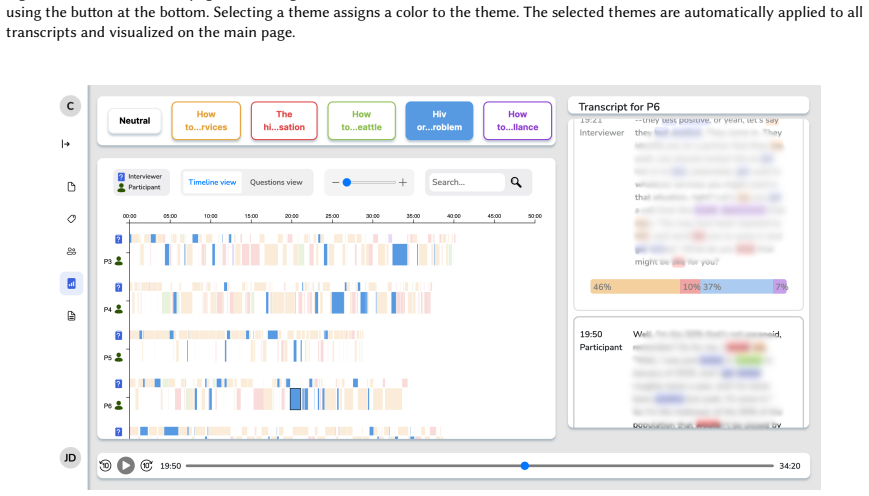
read the original abstract
Qualitative research offers deep insights into human experiences, but its processes, such as coding and thematic analysis, are time-intensive and laborious. Recent advancements in qualitative data analysis (QDA) tools have introduced AI capabilities, allowing researchers to handle large datasets and automate labor-intensive tasks. However, qualitative researchers have expressed concerns about AI's lack of contextual understanding and its potential to overshadow the collaborative and interpretive nature of their work. This study investigates researchers' preferences among three degrees of delegation of AI in QDA (human-only, human-initiated, and AI-initiated coding) and explores factors influencing these preferences. Through interviews with 16 qualitative researchers, we identified efficiency, ownership, and trust as essential factors in determining the desired degree of delegation. Our findings highlight researchers' openness to AI as a supportive tool while emphasizing the importance of human oversight and transparency in automation. Based on the results, we discuss three factors of trust in AI for QDA and potential ways to strengthen collaborative efforts in QDA and decrease bias during analysis.
Editorial analysis
A structured set of objections, weighed in public.
Referee Report
Summary. The paper reports results from semi-structured interviews with 16 qualitative researchers examining their preferences across three levels of AI delegation in qualitative data analysis (human-only, human-initiated, and AI-initiated coding). It identifies efficiency, ownership, and trust as the primary factors shaping these preferences and argues that researchers remain open to AI as a supportive tool provided human oversight and transparency are maintained. The manuscript concludes with design implications for strengthening collaboration and reducing bias in AI-supported QDA.
Significance. If the thematic findings hold, the work supplies empirical grounding for HCI discussions on acceptable AI roles in interpretive research practices. It usefully surfaces the efficiency-ownership tension and proposes three trust factors, which could inform tool design. The study is a standard exploratory interview project with no circular derivations or invented parameters; its value lies in the direct participant-reported factors rather than in broad generalization.
major comments (2)
- [Abstract and Methods] Abstract and Methods: the abstract states that efficiency, ownership, and trust were identified as essential factors but supplies no information on the coding process, inter-rater reliability checks, or how saturation was assessed. Without these details the derivation of the three factors remains opaque and the load-bearing claim that they determine delegation preferences cannot be fully evaluated.
- [Discussion] Discussion section: the design recommendations for AI tools in QDA rest on the preferences reported by the 16 participants. The manuscript provides neither a participant table, disciplinary spread, recruitment criteria, nor evidence that variation across subfields (e.g., ethnography versus grounded theory) was captured; this weakens the step from observed factors to prescriptive guidance.
minor comments (2)
- The three delegation levels are introduced clearly in the abstract but would benefit from a concise table or diagram in the main text to help readers map participant quotes to each level.
- A short limitations paragraph explicitly addressing sample size and disciplinary coverage would strengthen the manuscript even if the authors do not claim broad generalizability.
Simulated Author's Rebuttal
We thank the referee for the constructive feedback. We address each major comment below and indicate planned revisions to improve transparency and strengthen the manuscript.
read point-by-point responses
-
Referee: [Abstract and Methods] Abstract and Methods: the abstract states that efficiency, ownership, and trust were identified as essential factors but supplies no information on the coding process, inter-rater reliability checks, or how saturation was assessed. Without these details the derivation of the three factors remains opaque and the load-bearing claim that they determine delegation preferences cannot be fully evaluated.
Authors: We agree that the abstract would benefit from greater methodological transparency. The full Methods section details our reflexive thematic analysis: the first author performed open coding on transcripts, followed by team discussions to develop and refine themes; saturation was evaluated iteratively by monitoring for the emergence of new codes until thematic stability was reached. Inter-rater reliability was not computed because the analysis was interpretive and primarily single-coder with collaborative refinement, which aligns with common practice in exploratory qualitative work. We will revise the abstract to concisely note the analysis approach and saturation assessment, thereby clarifying how the three factors were derived. revision: yes
-
Referee: [Discussion] Discussion section: the design recommendations for AI tools in QDA rest on the preferences reported by the 16 participants. The manuscript provides neither a participant table, disciplinary spread, recruitment criteria, nor evidence that variation across subfields (e.g., ethnography versus grounded theory) was captured; this weakens the step from observed factors to prescriptive guidance.
Authors: We acknowledge that a participant summary table and explicit discussion of sample diversity would better ground the design implications. The manuscript already describes recruitment via academic networks, professional organizations, and snowball sampling, targeting researchers with at least two years of qualitative experience. Participants spanned education, psychology, sociology, and health sciences and employed a range of approaches including phenomenology, grounded theory, and ethnography. We will add a demographics table and expand the Discussion to report how efficiency, ownership, and trust preferences were consistent across these subfields, thereby strengthening the link from findings to recommendations. revision: yes
Circularity Check
No circularity in empirical interview study
full rationale
This manuscript reports an empirical qualitative study based on interviews with 16 researchers. Its central claims about preferences for AI delegation levels and the importance of efficiency, ownership, and trust are presented as direct outcomes of thematic analysis of participant responses. No equations, fitted parameters, predictions derived from subsets of data, or self-referential derivations appear in the provided text. The derivation chain consists of data collection followed by interpretation, with no step that reduces by construction to its own inputs or relies on a load-bearing self-citation chain. The study is therefore self-contained against external benchmarks as a standard interview-based investigation.
Axiom & Free-Parameter Ledger
axioms (1)
- domain assumption Semi-structured interviews with qualitative researchers can surface reliable factors influencing AI delegation preferences in QDA.
Lean theorems connected to this paper
-
IndisputableMonolith/Foundation/RealityFromDistinction.leanreality_from_one_distinction unclear?
unclearRelation between the paper passage and the cited Recognition theorem.
We investigated the topic through the lens of how their preferences align with existing human collaboration in QDA and how AI might shift or support these collaborative practices.
-
IndisputableMonolith/Cost/FunctionalEquation.leanwashburn_uniqueness_aczel unclear?
unclearRelation between the paper passage and the cited Recognition theorem.
efficiency, ownership, and trust as essential factors in determining the desired degree of delegation
What do these tags mean?
- matches
- The paper's claim is directly supported by a theorem in the formal canon.
- supports
- The theorem supports part of the paper's argument, but the paper may add assumptions or extra steps.
- extends
- The paper goes beyond the formal theorem; the theorem is a base layer rather than the whole result.
- uses
- The paper appears to rely on the theorem as machinery.
- contradicts
- The paper's claim conflicts with a theorem or certificate in the canon.
- unclear
- Pith found a possible connection, but the passage is too broad, indirect, or ambiguous to say the theorem truly supports the claim.
Reference graph
Works this paper leans on
-
[1]
2020. Automated insights. https://help-nv.qsrinternational.com/20/win/Content/coding/automated-insights.htm. [Online; accessed 19-January- 2025]
work page 2020
-
[2]
Corey M Abramson, Jacqueline Joslyn, Katharine A Rendle, Sarah B Garrett, and Daniel Dohan. 2018. The promises of computational ethnography: improving transparency, replicability, and validity for realist approaches to ethnographic analysis.Ethnography19, 2 (2018), 254–284
work page 2018
-
[3]
Al-Dhalea, Hend Ahmed Al-kaf, Mohammed A
Mohammed Ali H. Al-Dhalea, Hend Ahmed Al-kaf, Mohammed A. Al-Sharafi, Ammar Muthanna, Abdul Waheed Kouchay, Hafedh Alasaady, and Jae-Young Pyun. 2025. A Systematic Review of Machine Learning Methods for Multimodal EEG Data in Clinical Application.arXiv preprint arXiv:2501.08585(January 2025). arXiv:2501.08585 https://arxiv.org/pdf/2501.08585 Although focu...
-
[4]
Aitken Alan. 2016. Abstracts, Oral Presentations for Qualitative Methods Conference, May 2016 Doing Collaborative Research: The Good, the Bad, and the Politics and GPs Views on Facilitators and Barriers of Screening for Autism in Oman. (2016)
work page 2016
-
[5]
Victoria Antoniadou. 2017. Collecting, organizing and analyzing multimodal data sets: the contributions of CAQDAS. InQualitative approaches to research on plurilingual education, E. Moore and M. Dooly (Eds.). Research-publishing.net, 435–450. https://doi.org/10.14705/rpnet.2017.emmd2016. 640
-
[6]
Arsturn. 2023. The Benefits of Running AI Locally: Security & Privacy Considerations. https://www.arsturn.com/blog/the-benefits-of-running-ai- locally-security-privacy-considerations Accessed: 2025-04
work page 2023
-
[7]
2025 (accessed January 19, 2025).ATLAS.ti: The Qualitative Data Analysis & Research Software
ATLAS.ti. 2025 (accessed January 19, 2025).ATLAS.ti: The Qualitative Data Analysis & Research Software. https://atlasti.com
work page 2025
-
[8]
Tehmina Basit. 2003. Manual or electronic? The role of coding in qualitative data analysis.Educational Research45, 2 (2003), 143–154. https: //doi.org/10.1080/0013188032000133548 Published online: 02 Dec 2010
-
[9]
Sara Behimehr and Hamid R. Jamali. 2020. Cognitive Biases and Their Effects on Information Behaviour of Graduate Students in Their Research Projects.Journal of Information Science Theory and Practice8, 2 (2020), 18–31. https://doi.org/10.1633/JISTaP.2020.8.2.2
-
[10]
Andrea Bierema, Anne-Marie Hoskinson, Rosa Moscarella, Alex Lyford, Kevin Haudek, John Merrill, and Mark Urban-Lurain. 2020. Quantifying cognitive bias in educational researchers.International Journal of Research & Method in Education(2020). https://doi.org/10.1080/1743727X.2020. 1804541
-
[11]
G Blank. 2014. Big data and CAQDAS. Keynote presented at the CAQDAS Conference: Past, Present and Future–25
work page 2014
-
[12]
Virginia Braun and Victoria Clarke. 2006. Using Thematic Analysis in Psychology.Qualitative Research in Psychology3, 2 (January 2006), 77–101. https://doi.org/10.1191/1478088706qp063oa
-
[13]
Bringer, Lynne Halley Johnston, and Celia H
Joy D. Bringer, Lynne Halley Johnston, and Celia H. Brackenridge. 2006. Using Computer-Assisted Qualitative Data Analysis Software to Develop a Grounded Theory Project.Field Methods18, 3 (2006), 245–266. https://doi.org/10.1177/1525822X06287602
-
[14]
2007.Seeing Ethnographically: Teaching ethnography as part of CSCW
Barry Brown, Johan Lundin, Mattias Rost, Gustav Lymer, and Lars Erik Holmquist. 2007.Seeing Ethnographically: Teaching ethnography as part of CSCW. Springer London, 411–430. https://doi.org/10.1007/978-1-84800-031-5_22
-
[15]
Borgman C., F. Wofford Morgan, S. Golshan Milena, Darch P., and Scroggins Michael. 2020. Collaborative Ethnography at Scale: Reflections on 20 years of data integration. (2020)
work page 2020
-
[16]
Rasheeta Chandler, Erica Anstey, and Henry Ross. 2015. Listening to voices and visualizing data in qualitative research: Hypermodal dissemination possibilities.Sage Open5, 2 (2015), 2158244015592166
work page 2015
-
[17]
2006.Constructing grounded theory: A practical guide through qualitative analysis
Kathy Charmaz. 2006.Constructing grounded theory: A practical guide through qualitative analysis. Sage Publications, Thousand Oaks, CA
work page 2006
-
[18]
Nan-Chen Chen, Margaret Drouhard, Rafal Kocielnik, Jina Suh, and Cecilia R. Aragon. 2018. Using Machine Learning to Support Qualitative Coding in Social Science.ACM Transactions on Interactive Intelligent Systems8, 2 (jun 21 2018), 1–20. https://doi.org/10.1145/3185515
-
[19]
Collier, Simranjeet Kaur, Melissa McKinney-Lepp, and Zachary J
Diane R. Collier, Simranjeet Kaur, Melissa McKinney-Lepp, and Zachary J. Rondinelli. 2023. Screenshotting What’s Important in Video Data: An Experiment in Collaborative, Subjective Analysis of Artifactual, Cultural Research with Children.International Journal of Qualitative Methods22 (feb 15 2023). https://doi.org/10.1177/16094069231157695
-
[20]
Juliet Corbin and Anselm Strauss. 1990. Grounded theory research: Procedures, canons, and evaluative criteria.Qualitative Sociology13, 1 (1990), 3–21. https://doi.org/10.1007/BF00988593
-
[21]
Shelley L Craig, Lauren B McInroy, Ami Goulden, and Andrew D Eaton. 2021. Engaging the Senses in Qualitative Research via Multimodal Coding: Triangulating Transcript, Audio, and Video Data in a Study With Sexual and Gender Minority Youth.International Journal of Qualitative Methods 20 (2021), 16094069211013659
work page 2021
-
[22]
John W. Creswell and Cheryl N. Poth. 2016.Qualitative inquiry and research design: Choosing among five approaches(4th ed.). Sage publications
work page 2016
-
[23]
Suthers D. and Lund Kristine. 2010. Productive multivocality in the analysis of collaborative learning.International Conference of the Learning Sciences(2010)
work page 2010
-
[24]
Judith Davidson, Shanna Thompson, and Andrew Harris. 2017. Qualitative Data Analysis Software Practices in Complex Research Teams: Troubling the Assumptions About Transparency and Portability.Qualitative Inquiry23, 10 (sep 25 2017), 779–788. https://doi.org/10.1177/1077800417731082
-
[25]
Leite Denise, Pinho I., Caregnato C., Sfredo Miorando Bernardo, Gonzaga dos Santos Lima Elizeth, and Pinho Cláudia. 2019. The use of WebQDA to reconfigure a conceptual model: to operationalizing data analysis on research networks. (2019)
work page 2019
-
[26]
Norman K. Denzin and Yvonna S. Lincoln (Eds.). 2018.The SAGE Handbook of Qualitative Research(5th ed.). Sage Publications. Manuscript submitted to ACM 18 Anoushka Puranik, Ester Chen, Roshan L Peiris, and Ha-Kyung Kong
work page 2018
-
[27]
Martin Drapeau. 2002. Subjectivity in research: Why not? But. . . .The Qualitative Report7, 3 (2002), 1–15
work page 2002
-
[28]
Tutt Dylan, Shaukat M., Fraser Mike, Hindmarsh J., and R
E. Tutt Dylan, Shaukat M., Fraser Mike, Hindmarsh J., and R. McCarthy Michael. 2007. Can You See What I See? Developing Coherent Support for Distributed Collaborative Video Analysis with MiMeG. (2007)
work page 2007
-
[29]
Jeanine C Evers. 2018. Current issues in qualitative data analysis software (QDAS): A user and developer perspective.The Qualitative Report23, 13 (2018), 61–73
work page 2018
-
[30]
Jeanine C Evers et al. 2011. From the past into the future. How technological developments change our ways of data collection, transcription and analysis. InForum Qualitative Sozialforschung/Forum: Qualitative Social Research, Vol. 12
work page 2011
-
[31]
Jessica L. Feuston and Jed R. Brubaker. 2021. Putting Tools in Their Place: The Role of Time and Perspective in Human-AI Collaboration for Qualitative Analysis.Proceedings of the ACM on Human-Computer Interaction5, CSCW2 (October 2021), Article 469, 25 pages. https://doi.org/10.1145/3479856
-
[32]
Kate Ford, Iddo Oberski, and Steve Higgens. 2000. Computer-Aided Qualitative Analysis of Interview Data: Some Recommendations for Collaborative Working.The Qualitative Report(mar 1 2000). https://doi.org/10.46743/2160-3715/2000.2075
-
[33]
Jie Gao, Junming Cao, ShunYi Yeo, Kenny Tsu Wei Choo, Zheng Zhang, Toby Jia-Jun Li, Shengdong Zhao, and Simon Tangi Perrault. 2023. Impact of Human-AI Interaction on User Trust and Reliance in AI-Assisted Qualitative Coding. InWoodstock ’18: ACM Symposium on Neural Gaze Detection (Woodstock, NY, June 03–05, 2018). ACM, 31. https://doi.org/10.48550/arXiv.2...
-
[34]
Jie Gao, Kenny Tsu Wei Choo, Junming Cao, Roy Ka-Wei Lee, and Simon Perrault. 2023. CoAIcoder: Examining the Effectiveness of AI- assisted Human-to-Human Collaboration in Qualitative Analysis.ACM Transactions on Computer-Human Interaction31, 1 (nov 29 2023), 1–38. https://doi.org/10.1145/3617362
-
[35]
Linda S Gilbert, Kristi Jackson, and Silvana di Gregorio. 2014. Tools for analyzing qualitative data: The history and relevance of qualitative data analysis software. InHandbook of research on educational communications and technology. Springer, 221–236
work page 2014
-
[36]
Greg Guest, Kathleen M. MacQueen, and Emily E. Namey. 2012.Applied thematic analysis. Sage publications
work page 2012
-
[37]
Birgit Heckemann, Friederike Thilo, and Axel Wolf. 2020. Working via Distance—Using Computer-Assisted Qualitative Data Analysis Software, Email, and Teleconferencing in Qualitative Content Analysis: Experiences, Pitfalls, and Practical Tips. (2020). https://doi.org/10.4135/9781529714197
-
[38]
Susan Hilbolling, Vern Glaser, Jaewoo Jung, Natalia Levina, Xule Lin, Kevin Corley, Anne Smith, and Renate Kratochvil. 2024. AI AS A COLLABO- RATOR FOR QUALITATIVE RESEARCH SCHOLARS? REFLECTIONS ON EMBRACING OPPORTUNITIES WHILE PRESERVING ITS ESSENCE. https://doi.org/10.13140/RG.2.2.31694.16961
-
[39]
William Housley and Robin James Smith. 2011. Telling the CAQDAS code: Membership categorization and the accomplishment of ‘coding rules’ in research team talk.Discourse Studies13, 4 (jul 27 2011), 417–434. https://doi.org/10.1177/1461445611403258
-
[40]
Keiko Ishii, Jose Alberto Reyes, and Shinobu Kitayama. 2003. Spontaneous attention to word content versus emotional tone: Differences among three cultures.Psychological science14, 1 (2003), 39–46
work page 2003
-
[41]
Tyler Jamison, Candace L. Kemp, Katherine E. Speirs, Andrea Swenson, and Colleen K. Vesely. 2018.Dialogue About Qualitative Data Analysis Software. Routledge, 221–227. https://doi.org/10.4324/9781315171647-16
-
[42]
Jialun Aaron Jiang, Kandrea Wade, Casey Fiesler, and Jed R. Brubaker. 2021. Supporting Serendipity: Opportunities and Challenges for Human-AI Collaboration in Qualitative Analysis.Proceedings of the ACM on Human-Computer Interaction5, CSCW1 (April 2021), Article 94, 23 pages. https://doi.org/10.1145/3449168
-
[43]
Gao Jie, Guo Yuchen, Lim Gionnieve, Zhang Tianqin, Zhang Zheng, Li Toby Jia-Jun, and Perrault Simon Tangi. 2024. CollabCoder: a lower-barrier, rigorous workflow for inductive collaborative qualitative analysis with large language models. InProceedings of the 2024 CHI Conference on Human Factors in Computing Systems. 1–29
work page 2024
-
[44]
Olson Joel, McAllister Chad, Grinnell Lynn, Walters K., and Appunn Frank. 2016. Applying Constant Comparative Method with Multiple Investigators and Inter-Coder Reliability. (2016)
work page 2016
-
[45]
Sillito Jonathan. 2008. Sharing the Load Exploring Collaborative Qualitative Analysis. (2008)
work page 2008
-
[46]
Daye Kang and Jeffrey M. Rzeszotarski. [n. d.]. Challenges and Opportunities for Tool Adoption in Industrial UX Research Collaborations. 8 ([n. d.]), 1–27. Issue CSCW2. https://doi.org/10.1145/3686982 Publisher: Association for Computing Machinery (ACM)
- [47]
-
[48]
Joyce Splann Krothe and Vicki C. Pappas. 1998. Using Technology for Collaborative Research and Writing.Qualitative Health Research8, 4 (7 1998), 563–569. https://doi.org/10.1177/104973239800800410
-
[49]
Merging Results Is No Easy Task
Emily Kuang, Xiaofu Jin, and Mingming Fan. 2022. “Merging Results Is No Easy Task”: An International Survey Study of Collaborative Data Analysis Practices Among UX Practitioners. InProceedings of the 2022 CHI Conference on Human Factors in Computing Systems. 1–16
work page 2022
-
[50]
2019.Analyzing Qualitative Data with MAXQDA: Text, Audio, and Video
Udo Kuckartz and Stefan Rädiker. 2019.Analyzing Qualitative Data with MAXQDA: Text, Audio, and Video. Springer VS, Wiesbaden. https: //doi.org/10.1007/978-3-030-15671-8
-
[51]
The Good, The Bad, and The Ugly
K. Jackson L., Cameron M., and M. Staller Karen. 2006. "The Good, The Bad, and The Ugly": A Doctoral Student’s Reflections on Doing Grounded Theory Research in Henry’s Light. (2006)
work page 2006
-
[52]
Milli Lake, Samantha Majic, and Rahsaan Maxwell. 2019. Research on Vulnerable and Marginalized Populations. American Political Science Association Organized Section for Qualitative and Multi-Method Research, Qualitative Transparency Deliberations, Working Group Final Reports, Report IV.3 (2018). Retrieved from https://ssrn.com/abstract=3333511 or http://d...
-
[53]
John D. Lee and Katrina A. See. 2004. Trust in automation: Designing for appropriate reliance.Human Factors: The Journal of Human Factors and Ergonomics Society46 (2004), 50–80
work page 2004
-
[54]
Ola Leifler and Henrik Eriksson. 2011. Analysis tools in the study of distributed decision-making: a meta-study of command and control research. Cognition, Technology & Work14, 2 (mar 17 2011), 157–168. https://doi.org/10.1007/s10111-011-0177-4
-
[55]
Brian Lubars and Chenhao Tan. 2019. Ask not what AI can do, but what AI should do: Towards a framework of task delegability. InAdvances in Neural Information Processing Systems 32, H. Wallach, H. Larochelle, A. Beygelzimer, F. d’Alché Buc, E. Fox, and R. Garnett (Eds.). Curran Associates, Inc., 57–67. http://papers.nips.cc/paper/8301-ask-not-what-ai-can-d...
work page 2019
-
[56]
Shuai Ma, Ying Lei, Xinru Wang, Chengbo Zheng, Chuhan Shi, Ming Yin, and Xiaojuan Ma. 2023. Who Should I Trust: AI or Myself? Leveraging Human and AI Correctness Likelihood to Promote Appropriate Trust in AI-Assisted Decision-Making. InProceedings of the 2023 CHI Conference on Human Factors in Computing Systems. ACM, Hamburg, Germany, 1–19. https://doi.or...
-
[57]
2020.Understanding and Supporting Analysis of Audio and Video
Johannes Maas. 2020.Understanding and Supporting Analysis of Audio and Video. Doctoral dissertation. RWTH Aachen University
work page 2020
-
[58]
Natasha Mack. 2005. Qualitative research methods: A data collector’s field guide. (2005)
work page 2005
-
[59]
Megh Marathe and Kentaro Toyama. 2018. Semi-automated coding for qualitative research: A user-centered inquiry and initial prototypes. In Proceedings of the 2018 CHI Conference on Human Factors in Computing Systems. 1–12
work page 2018
-
[60]
Kelly Melekis and Carol Weisse. 2023. COLLABORATIVE RESEARCH WITH A MIXED-METHOD DATASET USING DECEDENT DATA.Innovation in Aging7, Supplement_1 (dec 1 2023), 296–296. https://doi.org/10.1093/geroni/igad104.0987
-
[61]
Liliana Melgar Estrada and Marijn Koolen. 2018. Audiovisual media annotation using qualitative data analysis software: A comparative analysis. The Qualitative Report23, 13 (2018), 40–60
work page 2018
-
[62]
Janice M. Morse. [n. d.]. Styles of Collaboration in Qualitative Inquiry. 18, 1 ([n. d.]), 3–4. https://doi.org/10.1177/1049732307309451 Publisher: SAGE Publications
-
[63]
Gayathri Naganathan, Sinthu Srikanthan, Abhirami Balachandran, Angel Gladdy, and Vasuki Shanmuganathan. 2022. Collaborative Zoom Coding— A Novel Approach to Qualitative Analysis.International Journal of Qualitative Methods21 (feb 23 2022). https://doi.org/10.1177/16094069221075862
-
[64]
Neang, Will Sutherland, Michael W
Andrew B. Neang, Will Sutherland, Michael W. Beach, and Charlotte P. Lee. 2021. Data Integration as Coordination.Proceedings of the ACM on Human-Computer Interaction4, CSCW3 (jan 5 2021), 1–25. https://doi.org/10.1145/3432955
-
[65]
2025 (accessed January 19, 2025).Try The Software for Free Today | NVivo
NVivo. 2025 (accessed January 19, 2025).Try The Software for Free Today | NVivo. https://www.qsrinternational.com/nvivo-qualitative-data- analysis-software/try-nvivo
work page 2025
-
[66]
Anthony J Onwuegbuzie and Nancy L Leech. 2007. Validity and qualitative research: An oxymoron?Quality & quantity41, 2 (2007), 233–249
work page 2007
-
[67]
OpenAI. 2023. GPT-4 Technical Report. https://openai.com/research/gpt-4 Accessed: 2025-04
work page 2023
-
[68]
Cassandra Overney, Belén Saldías, Dimitra Dimitrakopoulou, and Deb Roy. 2024. SenseMate: An Accessible and Beginner-Friendly Human-AI Platform for Qualitative Data Analysis. In29th International Conference on Intelligent User Interfaces (IUI ’24)(Greenville, SC, USA, March 18–21, 2024). ACM, 18. https://doi.org/10.1145/3640543.3645194
-
[69]
Kay L O’Halloran. 2009. Multimodal analysis and digital technology. InInterdisciplinary Perspectives on Multimodality: Theory and Practice, Proceedings of the Third International Conference on Multimodality, Palladino, Campobasso
work page 2009
-
[70]
Trishan Panch, Heather Mattie, and Rifat Atun. 2019. Artificial intelligence and algorithmic bias: implications for health systems.Journal of Global Health9 (2019), 010318
work page 2019
-
[71]
2014.Qualitative research & evaluation methods: Integrating theory and practice(4th ed.)
Michael Quinn Patton. 2014.Qualitative research & evaluation methods: Integrating theory and practice(4th ed.). Sage publications
work page 2014
-
[72]
I Tell You, It’s a Journey, Isn’t It?
Trena M. Paulus, Marianne Woodside, and Mary F. Ziegler. 2010. “I Tell You, It’s a Journey, Isn’t It?” Understanding Collaborative Meaning Making in Qualitative Research.Qualitative Inquiry16, 10 (oct 26 2010), 852–862. https://doi.org/10.1177/1077800410383124
-
[73]
Roy Pea, Robb Lindgren, and Joseph Rosen. 2008. Cognitive technologies for establishing, sharing and comparing perspectives on video over computer networks.Social Science Information47, 3 (9 2008), 353–370. https://doi.org/10.1177/0539018408092577
-
[74]
Alexandra K. Perron, Brenna Greenfield, Atasha Brown, Frank Johnson, Toni Napier, Jordan Stipek, Aanji’bide Community Action Board, and Jennifer J. Mootz. 2024. Reflections on the Collaborative Story Analysis Method to Understand Qualitative Perspectives of Indigenous Syringe Services Program Clients.SSM - Qualitative Research in Health6 (12 2024), 100469...
-
[75]
Huibrie C. Pieters and Katrina Dornig. 2011. Collaboration in grounded theory analysis: Reflections and practical suggestions.Qualitative Social Work12, 2 (nov 28 2011), 200–214. https://doi.org/10.1177/1473325011424085
-
[76]
Mary Pietrowicz and Karrie G Karahalios. 2014. Visualizing vocal expression. InCHI’14 Extended Abstracts on Human Factors in Computing Systems. 1369–1374
work page 2014
-
[77]
Rafael Prikladnicki, Roberto Evaristo, Daniela Damian, and Jorge Luis N. Audy. 2008. Conducting Qualitative Research in an International and Distributed Research Team: Challenges and Lessons Learned. InProceedings of the 41st Annual Hawaii International Conference on System Sciences (HICSS 2008). IEEE, 442–442. https://doi.org/10.1109/hicss.2008.97
-
[78]
Prikladinicki Rafael, Evaristo R., Gallagher Kevin, Lopes L., and Audy J. 2005. The Role of Culture in Interpreting Qualitative Data : Methodological Issues in an Exploratory Study of Cross-Cultural Distributed Software Development. (2005)
work page 2005
-
[79]
K. Andrew R. Richards and Michael A. Hemphill. [n. d.]. A Practical Guide to Collaborative Qualitative Data Analysis. 37, 2 ([n. d.]), 225–231. https://doi.org/10.1123/jtpe.2017-0084 Publisher: Human Kinetics
-
[80]
Tim Rietz and Alexander Maedche. 2021. Cody: An AI-Based System to Semi-Automate Coding for Qualitative Research. InProceedings of the 2021 CHI Conference on Human Factors in Computing Systems (CHI ’21)(New York, NY, USA). Association for Computing Machinery, Article 394, 1–14. Manuscript submitted to ACM 20 Anoushka Puranik, Ester Chen, Roshan L Peiris, ...
discussion (0)
Sign in with ORCID, Apple, or X to comment. Anyone can read and Pith papers without signing in.