Does Embodiment Matter to Biomechanics and Function? A Comparative Analysis of Head-Mounted and Hand-Held Assistive Devices for Individuals with Blindness and Low Vision
Pith reviewed 2026-05-18 13:45 UTC · model grok-4.3
The pith
Head-mounted devices reduce upper-body movement and task time for daily tasks in people with blindness and low vision, while hand-held versions improve success on small or curved text.
A machine-rendered reading of the paper's core claim, the machinery that carries it, and where it could break.
Core claim
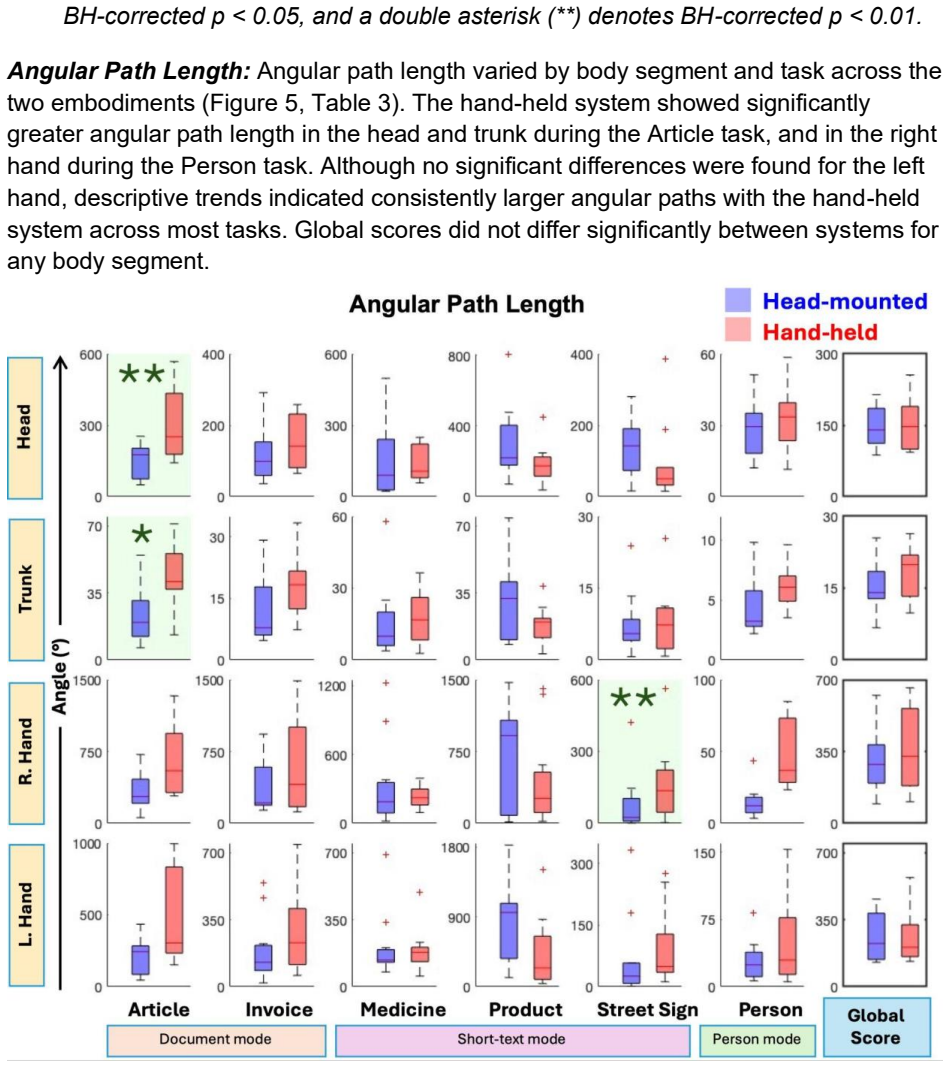
In direct comparison, the head-mounted ARx Vision system reduced upper-body movement and task completion time relative to the hand-held smartphone version of Seeing AI, most clearly during document-scanning activities, whereas the hand-held embodiment produced higher success rates on tasks that involved small or curved text.
What carries the argument
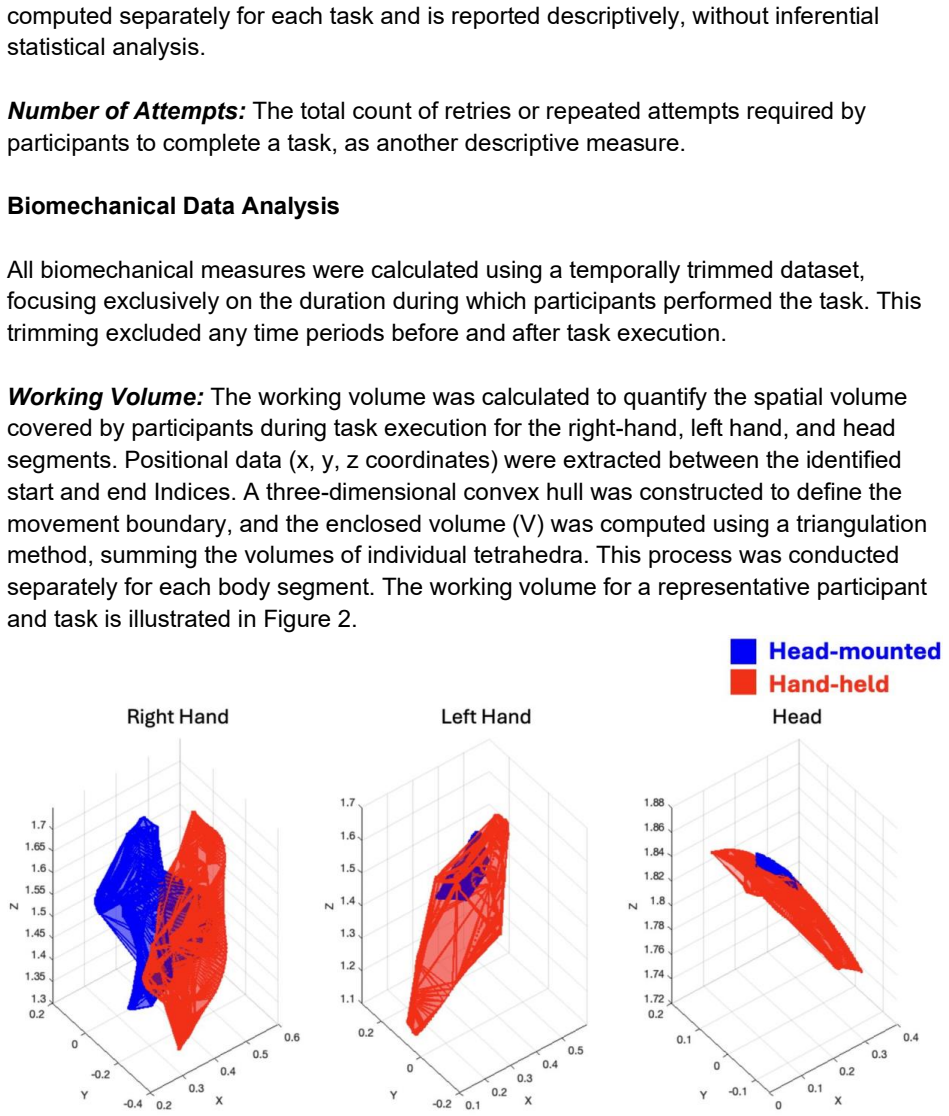
Side-by-side evaluation of two device embodiments through simultaneous motion-capture recording of joint range of motion, angular path length, working volume, and movement smoothness, paired with functional measures of time, success rate, and attempts.
If this is right
- Task type should guide device selection: head-mounted for efficiency in scanning-style work and hand-held for precision with irregular text.
- Biomechanical metrics such as movement volume and smoothness should be added to standard evaluations of assistive devices to assess long-term physical load.
- Designs can target the trade-off between reduced body movement and higher task success by considering how each embodiment interacts with different activities.
Where Pith is reading between the lines
- A hybrid device that allows quick switching between head-mounted and hand-held modes might capture the advantages of both.
- The same embodiment comparison could be applied to non-visual assistive technologies such as navigation aids or prosthetics.
- Reduced upper-body movement from head-mounted use might lower fatigue over extended periods, an outcome that could be tested in longer sessions.
Load-bearing premise
The six chosen activities of daily living and the sample of 11 participants adequately represent the range of real-world tasks and the broader population of persons with blindness and low vision.
What would settle it
A larger study using a broader set of tasks and more participants that finds no reliable difference in upper-body movement, task time, or success rates between the two embodiments would contradict the central claim.
Figures





read the original abstract
Visual assistive technologies, such as Microsoft Seeing AI, can improve access to environmental information for persons with blindness or low vision (pBLV). Yet, the physical and functional implications of different device embodiments remain unclear. In this study, 11 pBLV participants used Seeing AI on a hand-held smartphone and on a head-mounted ARx Vision system to perform six activities of daily living, while their movements were captured with Xsens motion capture. Functional outcomes included task time, success rate, and number of attempts, and biomechanical measures included joint range of motion, angular path length, working volume, and movement smoothness. The head-mounted system generally reduced upper-body movement and task time, especially for document-scanning style tasks, whereas the hand-held system yielded higher success rates for tasks involving small or curved text. These findings indicate that both embodiments are viable, but they differ in terms of physical demands and ease of use. Incorporating biomechanical measures into assistive technology evaluations can inform designs that optimise user experience by balancing functional efficiency, physical sustainability, and intuitive interaction.
Editorial analysis
A structured set of objections, weighed in public.
Referee Report
Summary. The manuscript reports a within-subject comparative study of head-mounted (ARx Vision) versus hand-held (smartphone) embodiments of the Seeing AI assistive application. Eleven participants with blindness or low vision performed six activities of daily living while upper-body kinematics were recorded with Xsens motion capture. Functional metrics (task time, success rate, attempts) and biomechanical metrics (joint range of motion, angular path length, working volume, movement smoothness) were collected. The central finding is that the head-mounted system generally reduced upper-body movement and task time (especially for document-scanning tasks) while the hand-held system produced higher success rates on tasks involving small or curved text; both embodiments are deemed viable but with distinct physical and usability trade-offs.
Significance. If the directional differences are statistically reliable, the work supplies objective biomechanical evidence that device embodiment affects physical demand and functional performance in visual assistive technology. The inclusion of motion-capture measures alongside conventional success and time metrics is a clear strength, moving evaluations beyond purely functional outcomes toward considerations of physical sustainability. The findings can usefully inform design choices that balance reduced movement with task accuracy for heterogeneous pBLV users.
major comments (2)
- [Abstract / Results] Abstract and Results: the claims that the head-mounted system 'generally reduced upper-body movement and task time' and that the hand-held system 'yielded higher success rates' for certain tasks are presented without statistical tests, p-values, effect sizes, or error bars. With n=11 and a heterogeneous population, these directional statements lack the quantitative support needed to ground the comparative conclusions.
- [Methods] Methods: no power analysis, justification for the sample size of 11, or correction for multiple comparisons across six tasks and multiple kinematic variables is described. This directly affects the reliability of the 'generally' qualifier in the headline comparison.
minor comments (2)
- [Abstract] The six activities of daily living are referenced but not enumerated or justified in the abstract; a brief listing or rationale for their selection would improve immediate readability.
- [Methods] Operational definitions for 'success rate,' 'movement smoothness,' and 'working volume' should be stated explicitly in the Methods to allow replication.
Simulated Author's Rebuttal
We thank the referee for their detailed and constructive feedback on our manuscript. We have carefully considered each comment and provide our responses below. We believe these revisions will strengthen the paper.
read point-by-point responses
-
Referee: [Abstract / Results] Abstract and Results: the claims that the head-mounted system 'generally reduced upper-body movement and task time' and that the hand-held system 'yielded higher success rates' for certain tasks are presented without statistical tests, p-values, effect sizes, or error bars. With n=11 and a heterogeneous population, these directional statements lack the quantitative support needed to ground the comparative conclusions.
Authors: We acknowledge the validity of this observation. The original presentation relied on descriptive trends observed across participants. To provide stronger quantitative grounding, we have performed and now report statistical analyses in the revised Results section, including appropriate tests for the within-subject comparisons, p-values, effect sizes, and visualizations with error bars. The abstract has been revised to include these details and to temper the 'generally' claims based on the statistical findings. revision: yes
-
Referee: [Methods] Methods: no power analysis, justification for the sample size of 11, or correction for multiple comparisons across six tasks and multiple kinematic variables is described. This directly affects the reliability of the 'generally' qualifier in the headline comparison.
Authors: We agree that these elements are important for transparency. We have added to the Methods section a justification for the sample size of 11, based on recruitment constraints for this specific population and precedents from related assistive technology studies. A post-hoc power analysis is now included. For multiple comparisons, we have implemented a correction (Bonferroni) and report the adjusted results alongside the primary findings. revision: yes
Circularity Check
No significant circularity in empirical comparative study
full rationale
This paper reports an empirical user study that directly measures biomechanical variables (joint ROM, path length, working volume, smoothness) via Xsens motion capture and functional outcomes (task time, success rate, attempts) from 11 pBLV participants performing six fixed ADLs with two device embodiments. All reported comparisons are computed from the collected data without any mathematical derivation, fitted parameters, predictive models, or equations that reduce to their own inputs by construction. No self-citations are invoked to establish uniqueness theorems, ansatzes, or load-bearing premises; the central claims rest on observed within-subject differences rather than internal definitional loops. The study is therefore self-contained against its external benchmarks of participant performance data.
Axiom & Free-Parameter Ledger
axioms (2)
- domain assumption Xsens motion capture system provides valid and reliable measures of joint range of motion and movement smoothness for upper-body tasks.
- domain assumption The six selected activities of daily living are representative of tasks that pBLV users perform with visual assistive technology.
Lean theorems connected to this paper
-
IndisputableMonolith/Cost/FunctionalEquation.leanwashburn_uniqueness_aczel unclear?
unclearRelation between the paper passage and the cited Recognition theorem.
The head-mounted system generally reduced upper-body movement and task time, especially for document-scanning style tasks, whereas the hand-held system yielded higher success rates for tasks involving small or curved text.
-
IndisputableMonolith/Foundation/AbsoluteFloorClosure.leanreality_from_one_distinction unclear?
unclearRelation between the paper passage and the cited Recognition theorem.
Biomechanical measures included joint range of motion, angular path length, working volume, and movement smoothness.
What do these tags mean?
- matches
- The paper's claim is directly supported by a theorem in the formal canon.
- supports
- The theorem supports part of the paper's argument, but the paper may add assumptions or extra steps.
- extends
- The paper goes beyond the formal theorem; the theorem is a base layer rather than the whole result.
- uses
- The paper appears to rely on the theorem as machinery.
- contradicts
- The paper's claim conflicts with a theorem or certificate in the canon.
- unclear
- Pith found a possible connection, but the passage is too broad, indirect, or ambiguous to say the theorem truly supports the claim.
Reference graph
Works this paper leans on
-
[1]
“Design Considerations for the Ideal Low Vision Aid: Insights from de-Brief Interviews Following a Real-World Recording Study.” Ophthalmic & Physiological Optics: The Journal of the British College of Ophthalmic Opticians (Optometrists) 41 (2): 266–80. Hamilton-Fletcher, Giles, Mingxin Liu, Diwei Sheng, Chen Feng, Todd E. Hudson, John- Ross Rizzo, and Kev...
-
[2]
“Effects of Smartphone Overuse on Hand Function, Pinch Strength, and the Median Nerve: Smartphone Overuse.” Muscle & Nerve 52 (2): 183–88. Kolli, A., K. Seiler, N. Kamdar, De Lott L. B., M. D. Peterson, M. A. Meade, and J. R. Ehrlich. 2022. “Longitudinal Associations between Vision Impairment and the Incidence of Neuropsychiatric, Musculoskeletal, and Car...
-
[3]
Postures and Repetitive Movements during Use of a Long Cane by Individuals with Visual Impairment
“Postures and Repetitive Movements during Use of a Long Cane by Individuals with Visual Impairment.” The Journal of Orthopaedic and Sports Physical Therapy 31 (7): 375–83. Mount, Julie, Laura N. Gitlin, and Paul D. Howard. 1997. “Musculoskeletal Consequences of Travel Aid Use among Visually Impaired Adults: Directions for Future Research and Training.” Te...
discussion (0)
Sign in with ORCID, Apple, or X to comment. Anyone can read and Pith papers without signing in.