REVIEW 5 major objections 4 minor 94 references
TOI-2155 b: A Massive Brown Dwarf or a Very Low-Mass Star?
T0 review · 5 major / 4 minor · reviewed 2026-08-04 · deepseek-v4-flash
Pith's one-line read A transiting companion of about 81 Jupiter masses, with a density of 110 grams per cubic centimeter, sits at the hydrogen-burning limit and is best classified as a brown dwarf rather than a very low-mass star.
desk verdict Well-measured companion near the H-burning boundary; the data do not prove it is a brown dwarf, and the paper should say so in the title. read the letter →
The pith
A machine-rendered reading of the paper's core claim, the machinery that carries it, and where it could break.
The reading
What carries the argument
The argument is carried by the joint modeling of transit photometry and radial-velocity measurements, which yields the companion's mass, radius, and orbital parameters, and by the comparison of the resulting mass–radius–density relation against theoretical evolutionary isochrones. The central physical mechanism is electron degeneracy pressure: in a cooled, evolved brown dwarf, degeneracy support produces the high density and the characteristic mass–radius relation that distinguishes it from a hydrogen-fusing star, which would be inflated to a larger radius at the same mass. The paper uses the object's position on the mass–radius and mass–density diagrams, alongside its inferred age, to argue
What would settle it
A decisive test would be to measure the companion's intrinsic luminosity directly—for example, through a secondary eclipse or high-contrast imaging—and see whether it falls on the cooling track of a degenerate brown dwarf at 3.2 Gyr or on the main-sequence track of a very low-mass star of the same mass. Alternatively, a more precise dynamical mass that clearly exceeds the model-dependent hydrogen-burning minimum for the host star's metallicity (e.g., above about 85 Jupiter masses) would settle the classification, as would the detection of lithium in its atmosphere, which a 3.2-Gyr-old brown dw
Extended reading notes
Core claim
The central claim is that TOI-2155 b, with a dynamically measured mass of 81.1 ± 1.1 Jupiter masses and a radius of 0.975 ± 0.008 Jupiter radii, is a high-mass brown dwarf rather than a very low-mass star. The argument rests on the object's very high bulk density, about 110 g/cm³, which the paper connects to electron degeneracy pressure, and on the absence of evidence for core hydrogen fusion at the system's estimated age of roughly 3.2 billion years. The paper acknowledges that the boundary between these two classes is set by theoretical evolutionary models, with current upper limits on the brown dwarf mass near 81.7 Jupiter masses under low-metallicity, cloud-free conditions, and that the
Load-bearing premise
The classification as a brown dwarf rests on theoretical model boundaries for the hydrogen-burning minimum mass and on inferring the absence of hydrogen fusion from density and age; if either is wrong, an 81-Jupiter-mass object could be a very low-mass star.
Editorial extensions
If this is right
- If TOI-2155 b is a brown dwarf, it provides a rare precisely measured mass, radius, and density for an object at the hydrogen-burning limit, directly testing evolutionary models in that regime.
- The system's very short orbital period (3.72 days) and nearly circular orbit place it in the brown dwarf desert, and its presence adds to evidence that a well-defined desert is not valid.
- The mild radius inflation (about 2% larger than evolutionary model predictions) suggests that irradiation from the host star can subtly affect the structure of close-in brown dwarfs.
- The low orbital eccentricity and the estimated circularization timescale shorter than the system age imply that tidal interaction has erased any primordial eccentricity.
- The high mass ratio (companion to star ≈ 0.061) favors a stellar-like formation pathway, such as gravitational collapse or disk fragmentation, rather than a planet-like formation.
Reading between the lines
- Editorial inference: If the classification holds, TOI-2155 b becomes a calibration point that could sharpen the empirical location of the hydrogen-burning minimum mass, since its mass sits within 1–2 Jupiter masses of the theoretical boundary.
- Editorial inference: The reported high density implies that any radius-inflation mechanism at this mass must be modest; a direct measurement of the companion's infrared emission (e.g., through a secondary eclipse) could test whether its intrinsic luminosity follows the degenerate cooling track or shows excess from residual nuclear burning.
- Editorial inference: The system's age estimate is model-dependent; if future asteroseismic or gyrochronological constraints shift the age substantially, the interpretation of the object's internal structure would need revisiting.
- Editorial inference: Comparing TOI-2155 b to other transiting companions above 80 Jupiter masses could reveal whether the mass–radius relation flattens at the boundary or whether some such objects are actually very low-mass stars, effectively mapping the empirical boundary.
Signed reviews
Editorial analysis
A structured set of objections, weighed in public.
Referee Report
Summary. The paper reports the discovery and characterization of TOI-2155 b, a short-period (P = 3.7247 d) transiting companion to an F-type subgiant, using TESS photometry, TRES radial velocities, and ground-based follow-up photometry. Joint Allesfitter modeling gives R_b = 0.975 ± 0.008 R_J, M_b = 81.1 ± 1.1 M_J, and ρ_b = 110 ± 3 g cm^-3. The authors argue that the object lies at the brown-dwarf/very-low-mass-star boundary and, on the basis of its high density, inferred age of ~3.2 Gyr, and an asserted lack of lithium absorption, classify it as a brown dwarf supported by electron degeneracy pressure that does not sustain hydrogen fusion. The paper also discusses its position in the brown dwarf desert, its mild radius inflation relative to evolutionary models, and its likely stellar-like formation pathway.
Significance. If the measured mass, radius, and density are correct, TOI-2155 b is a valuable benchmark for substellar evolutionary models near the hydrogen-burning limit. The quantitative analysis has several strengths: the joint transit/RV fit uses standard public tools; an internal check excludes the Rossiter–McLaughlin affected RVs and recovers a consistent mass; high-resolution speckle imaging rules out close companions; and the stellar parameters are checked with an independent SED fit. The main weakness is interpretive: the brown-dwarf classification rests on theoretical model boundaries and on assertions—particularly the lithium claim—that are not adequately documented, and the paper itself concedes that a low-mass star cannot be fully ruled out.
major comments (5)
- [§4, §4.2, Fig. 7] The central claim that density ~110 g cm^-3 and age ~3.2 Gyr 'strongly indicate' electron degeneracy support and absence of hydrogen fusion does not follow. A very low-mass star of ~0.077 M_sun has a radius near 0.10 R_sun (~0.96 R_J) and a mean density of order 100 g cm^-3, and is itself partially degenerate. The measured R_b and ρ_b therefore cannot, by themselves, discriminate between a cooled brown dwarf and a barely hydrogen-burning star. The comparison in Fig. 7 uses the Baraffe (2003) and Marley (2021) models, which are the very theoretical predictions under test, and the quoted 81.7 M_J ceiling from Morley et al. (2024) applies to low-metallicity, cloud-free conditions, whereas the host has [M/H] = 0.13. Please reframe the central claim as an object at the BD/star boundary, state the model-dependence explicitly, and remove or strongly qualify the 'does not sustain hydrogen fusion
- [§4.4] The lithium argument is not evidence as presented. No spectrum, equivalent width, or upper limit is shown; the 'lack of detectable lithium absorption' is simply asserted. More importantly, at ~0.077 M_sun lithium is depleted in both a very low-mass star and a high-mass brown dwarf (lithium burning occurs near ~0.065 M_sun), so a non-detection cannot separate these two cases. Either present the actual lithium constraint with data and an upper limit, or delete this claim from the classification argument.
- [Abstract vs §3.2/Table 7] The reported physical parameters are internally inconsistent. The opening abstract gives R_b = 0.972^{+0.009}_{-0.008} R_J, M_b = 80.6^{+1.0}_{-1.1} M_J, and ρ_b = 109^{+3.1}_{-3.3} g cm^-3, while the full-text abstract and Table 7 quote R_b = 0.975 ± 0.008 R_J, M_b = 81.1 ± 1.1 M_J, and ρ_b = 110 ± 3 g cm^-3. The period uncertainties also differ. These values must be reconciled, and every quoted number should match the final fit.
- [§3.1.1, Table 4] The stellar mass is quoted as M⋆ = 1.33 ± 0.008 M☉, a relative precision of 0.6%. This is implausibly small for an SED/Torres-relation estimate and is not justified in the text. Since the companion mass is derived from the RV semi-amplitude together with M⋆, an underestimate of the stellar-mass uncertainty propagates directly into M_b and its quoted precision. Please document the stellar-mass error budget, including the correlations among Teff, log g, [Fe/H], and extinction, or report a more realistic uncertainty.
- [§3.2, Fig. 5] The ground-based photometry (WST, LCO, WBR) is excluded from the global fit, with the only stated reason being that it lacks 'a sufficiently long baseline.' Because the companion radius—and hence the density and the entire classification discussion—rests on TESS photometry alone, this exclusion needs quantitative justification. Please show that including the ground-based transits with appropriate detrending does not change R_b, or quantify the systematic uncertainty introduced by their exclusion.
minor comments (4)
- [§2.2.2] 'The long-exposure vision was 1.45″' should read 'the seeing was 1.45″.'
- [§3.2] The independent Allesfitter fit to the ground-based photometry is mentioned but not described. State the priors, the fitted transit parameters, and the resulting values, or move this to an appendix.
- [§7] Data availability says TRES and ground-based photometry 'will be shared with the associated authors upon request.' For reproducibility in a journal article, please provide a permanent repository or machine-readable tables.
- [References] There are minor reference inconsistencies, e.g., in-text 'Barkaoui, K. et al. 2025' versus the reference list format. Please standardize all author-year citations.
Circularity Check
No significant circularity: the companion's mass, radius, and density come from independent transit and RV fits, and the brown dwarf classification is an external model comparison rather than a fitted input.
full rationale
I traced the derivation chain in the manuscript. TOI-2155 b's fundamental parameters are obtained from a joint Allesfitter fit to TESS transit photometry and TRES radial velocities: Mb = 81.1 +/- 1.1 MJ, Rb = 0.975 +/- 0.008 RJ, and rho_b = 110 +/- 3 g cm^-3 (Section 3.2, Tables 6-7). These quantities are not fitted to brown-dwarf evolutionary tracks; they are measured from the light curve and Keplerian RV signal. The stellar mass, radius, and age used for context come from SPC spectroscopy, SED fitting, and MIST/EXOFASTv2, which are external to the companion's mass-radius measurement. The paper's classification of TOI-2155 b as a brown dwarf is an interpretive step that invokes external theoretical models (Burrows et al. 2001; Chabrier et al. 2000; Morley et al. 2024) and compares the measured radius/density to isochrones from Baraffe et al. (2003) and Marley et al. (2021). No equation in the paper reduces a predicted quantity to a fitted parameter, and no load-bearing conclusion is forced by a self-citation chain. The manuscript itself explicitly concedes the classification is not definitive: 'we cannot fully rule out the possibility that TOI-2155 b is a low-mass star' (Section 4). The lithium argument in Section 4.4 is presented without a spectrum or equivalent width, and the inference from high density to electron-degeneracy support and absence of hydrogen fusion is physically model-dependent; however, these are evidentiary or model-application concerns, not circularity. The only self-citations (e.g., Allesfitter by Daylan, SED methods by Stassun & Torres, boundary discussions citing Carmichael et al.) are methodological or contextual and do not carry the central derivation. Therefore the paper is self-contained for its measured parameters and the circularity score is 0.
Assumptions & free parameters
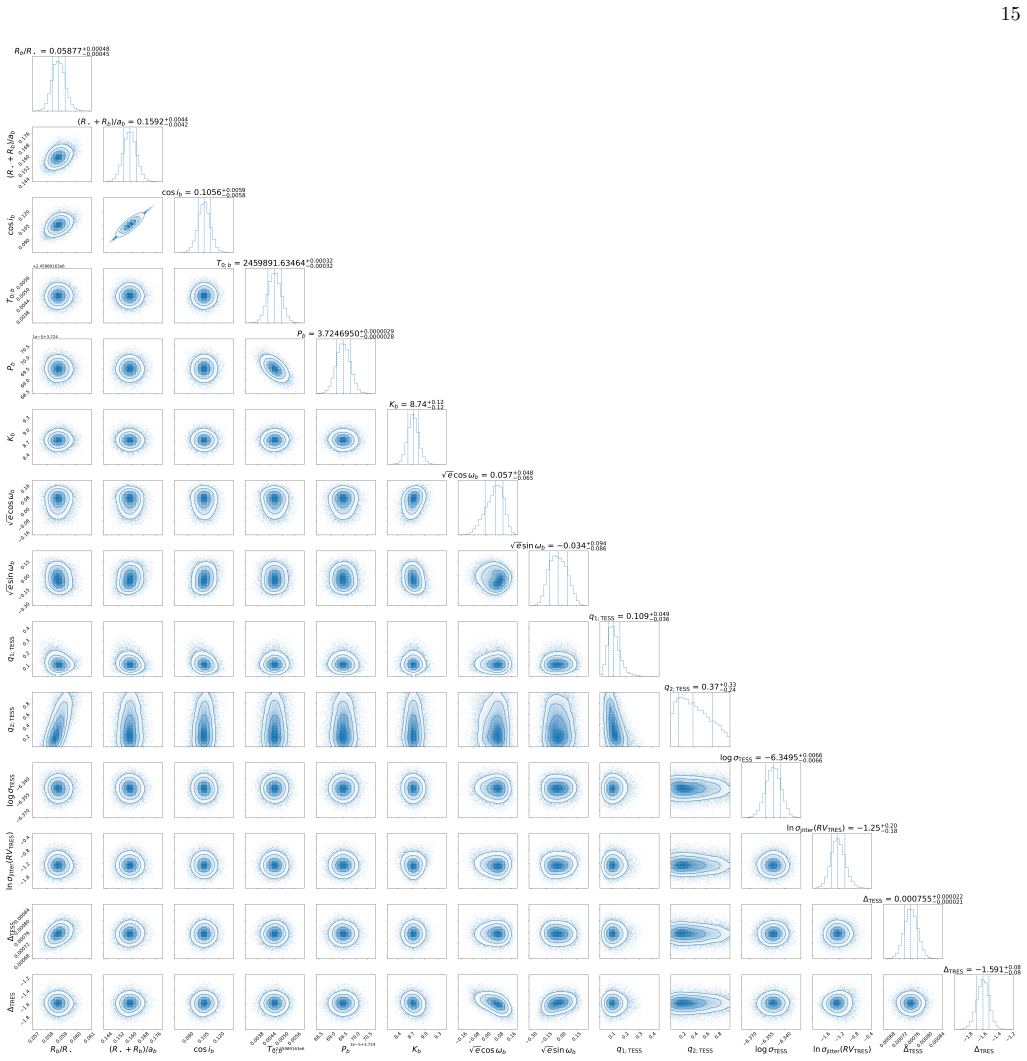
free parameters (10)
- TESS limb darkening q1 (Kipping parametrization) =
0.109+0.049/-0.036
- TESS limb darkening q2 =
0.37+0.33/-0.24
- sqrt(e) cos(omega) =
0.057+0.048/-0.065
- sqrt(e) sin(omega) =
-0.034+0.094/-0.086
- TESS white noise log sigma =
-6.3495+0.0066/-0.0066
- TRES RV jitter ln sigma =
-1.25+0.20/-0.18
- TESS baseline offset =
0.000755+0.000022/-0.000021
- TRES baseline offset =
-1.591+0.085/-0.089
- Stellar age from MIST/EXOFASTv2 fit =
3.2+1.9/-0.93 Gyr
- Interstellar extinction A_V in SED fit =
0.16 +/- 0.08
assumptions (6)
- standard math Kepler's third law and transit geometry connect fitted dimensionless parameters to physical masses and radii.
- domain assumption MIST isochrones and PHOENIX/MESA atmosphere models correctly translate Teff, [Fe/H], photometry, and parallax into stellar mass, radius, and age.
- domain assumption The theoretical brown-dwarf upper boundary of 81.7 M_J (Morley et al. 2024, under low metallicity and cloud-free conditions) is relevant to TOI-2155 b.
- domain assumption Electron degeneracy pressure and the absence of sustained hydrogen fusion can be inferred from bulk density, age, and model comparisons rather than from direct spectra.
- domain assumption No undetected stellar companion dilutes the TESS transit; speckle sensitivity limits and Gaia completeness cover the relevant angular separations.
- domain assumption TRES RV calibration, template construction, and jitter treatment produce unbiased velocities; including or excluding RM-affected points does not change the mass.
Cite this review
Pith. "Pith review of TOI-2155 b: A Massive Brown Dwarf or a Very Low-Mass Star?." pith.science (2026). https://pith.science/paper/JSMHAWRS
@misc{pith2026250918503,
  author       = {Pith},
  title        = {Pith review of: TOI-2155 b: A Massive Brown Dwarf or a Very Low-Mass Star?},
  year         = {2026},
  howpublished = {\url{https://pith.science/paper/JSMHAWRS}},
  note         = {Machine review of arXiv:2509.18503}
}
abstract
We present TOI-2155\,b, a massive transiting companion, discovered using data from NASA's Transiting Exoplanet Survey Satellite (TESS) mission and confirmed with ground-based RV measurements from the Tillinghast Reflector Echelle Spectrograph (TRES). We also analyze ground-based follow-up photometric data from the Wendelstein Observatory (WST), Las Cumbres Observatory Global Telescope (LCOGT), and Wild Boar Remote Observatory (WBR). TOI-2155\,b is a short-period companion with {$P= 3.7246950 \pm{0.0000014}$}~days. The radius and mass of TOI-2155\,b are found to be $R_b = 0.972^{+0.009}_{-0.008} \,\mathrm{R_J}$ and $M_b = 80.6^{+1.0}_{-1.1} \,\mathrm{M_J}$, respectively, corresponding to a density of {$\rho_b= 109^{+3.1}_{-3.3}$ g cm$^{-3}$}. The F-type subgiant host star has an effective temperature of $T_{\rm eff} = 6085\pm 78$ K, a radius $R_{\thinstar} = 1.705^{+0.066}_{-0.064}$ $\mathrm{R_\odot}$ and a mass $M_\star = 1.33 \pm 0.008$~M$_\odot$. With a mass close to the hydrogen-burning minimum mass, TOI-2155\,b lies at the boundary between brown dwarfs and low-mass stars. Its measured mass, radius, and density place it in a transitional region, where distinguishing between a massive brown dwarf and a very low-mass star is not straightforward. TOI-2155\,b therefore provides a valuable benchmark for testing evolutionary models of stellar and substellar structure near the hydrogen-burning limit.
Figures


Figures from the paper (7 more)


Reference graph
Works this paper leans on
-
[1]
, " * write output.state after.block = add.period write newline
ENTRY address archivePrefix author booktitle chapter doi edition editor eprint howpublished institution journal key month number organization pages publisher school series title misctitle type volume year version url label extra.label sort.label short.list INTEGERS output.state before.all mid.sentence after.sentence after.block FUNCTION init.state.consts ...
-
[2]
write newline
" write newline "" before.all 'output.state := FUNCTION format.url url empty "" new.block "" url * "" * if FUNCTION format.eprint eprint empty "" archivePrefix empty "" archivePrefix "arXiv" = new.block " " eprint * " " * new.block " " eprint * " " * if if if FUNCTION format.doi doi empty "" " " doi * " " * if FUNCTION format.pid doi empty eprint empty ur...
-
[4]
J., & Bonnell, I
Armitage, P. J., & Bonnell, I. A. 2002, title Orbital migration and the brown dwarf desert, Monthly Notices of the Royal Astronomical Society, 330, L11
2002
-
[5]
P., Tollerud , E
Astropy Collaboration , Robitaille , T. P., Tollerud , E. J., et al. 2013, title Astropy: A community Python package for astronomy , , 558, A33
2013
-
[6]
M., Sip o cz , B
Astropy Collaboration , Price-Whelan , A. M., Sip o cz , B. M., et al. 2018, title The Astropy Project: Building an Open-science Project and Status of the v2.0 Core Package , , 156, 123
2018
-
[7]
2002, title Evolutionary models for low-mass stars and brown dwarfs: Uncertainties and limits at very young ages, Astronomy & Astrophysics, 382, 563
Baraffe, I., Chabrier, G., Allard, F., & Hauschildt, P. 2002, title Evolutionary models for low-mass stars and brown dwarfs: Uncertainties and limits at very young ages, Astronomy & Astrophysics, 382, 563
2002
-
[8]
2003, title Evolutionary models for cool brown dwarfs and extrasolar giant planets
Baraffe, I., Chabrier, G., Barman, T., Allard, F., & Hauschildt, P. 2003, title Evolutionary models for cool brown dwarfs and extrasolar giant planets. The case of HD 209458, Astronomy & Astrophysics, 402, 701
2003
-
[9]
, Sebastian, D
Barkaoui, K. , Sebastian, D. , Zúñiga-Fernández, S. , et al. 2025, title TOI-6508 b: A massive transiting brown dwarf orbiting a low-mass star, , 696, A44
2025
Show all 94 references
-
[10]
1986, title Candidate solar-type protostars in nearby molecular cloud cores, Astrophysical Journal, Part 1 (ISSN 0004-637X), vol
Beichman, C., Myers, P., Emerson, J., et al. 1986, title Candidate solar-type protostars in nearby molecular cloud cores, Astrophysical Journal, Part 1 (ISSN 0004-637X), vol. 307, Aug. 1, 1986, p. 337-349., 307, 337
1986
-
[11]
A., et al
Bieryla, A., Tronsgaard, R., Buchhave, L. A., et al. 2021, in Posters from the TESS Science Conference II (TSC2), 124
2021
-
[12]
P., Blunt, S
Bowler, B. P., Blunt, S. C., & Nielsen, E. L. 2020, title Population-level eccentricity distributions of imaged exoplanets and brown dwarf companions: dynamical evidence for distinct formation channels, The Astronomical Journal, 159, 63
2020
-
[13]
P., et al
Bowler, B. P., et al. 2021, title An inflated brown dwarf transiting a young star in the Upper Scorpius association, , 161, 279
2021
-
[14]
M., Baliber , N., Bianco , F
Brown , T. M., Baliber , N., Bianco , F. B., et al. 2013, title Las Cumbres Observatory Global Telescope Network , , 125, 1031
2013
-
[15]
A., Bakos , G
Buchhave , L. A., Bakos , G. \'A ., Hartman , J. D., et al. 2010, title HAT-P-16b: A 4 M _ J Planet Transiting a Bright Star on an Eccentric Orbit , , 720, 1118
2010
-
[16]
A., Latham, D., Johansen, A., et al
Buchhave, L. A., Latham, D., Johansen, A., et al. 2012, title An abundance of small exoplanets around stars with a wide range of metallicities, Nature, 486, 375
2012
-
[17]
2018, Large-Scale Searches for Brown Dwarfs and Free-Floating Planets, ed
Burningham, B. 2018, Large-Scale Searches for Brown Dwarfs and Free-Floating Planets, ed. H. J. Deeg & J. A. Belmonte (Cham: Springer International Publishing), 503--529
2018
-
[18]
B., Lunine, J
Burrows, A., Hubbard, W. B., Lunine, J. I., & Liebert, J. 2001, title The theory of brown dwarfs and extrasolar giant planets, Rev. Mod. Phys., 73, 719
2001
-
[19]
1997, title A nongray theory of extrasolar giant planets and brown dwarfs, The Astrophysical Journal, 491, 856
Burrows, A., Marley, M., Hubbard, W., et al. 1997, title A nongray theory of extrasolar giant planets and brown dwarfs, The Astrophysical Journal, 491, 856
1997
-
[20]
W., Quinn, S
Carmichael, T. W., Quinn, S. N., Mustill, A. J., et al. 2020, title Two intermediate-mass transiting brown dwarfs from the TESS mission, The Astronomical Journal, 160, 53
2020
-
[21]
W., Quinn, S
Carmichael, T. W., Quinn, S. N., Zhou, G., et al. 2021, title TOI-811b and TOI-852b: New transiting brown dwarfs with similar masses and very different radii and ages from the TESS mission, The Astronomical Journal, 161, 97
2021
-
[22]
W., Irwin, J
Carmichael, T. W., Irwin, J. M., Murgas, F., et al. 2022, title TOI-2119: a transiting brown dwarf orbiting an active M-dwarf from NASA’s TESS mission, Monthly Notices of the Royal Astronomical Society, 514, 4944
2022
-
[23]
2020, title NLTT5306B: an inflated, weakly irradiated brown dwarf, Monthly Notices of the Royal Astronomical Society, 499, 5318
Casewell, S., Debes, J., Braker, I., et al. 2020, title NLTT5306B: an inflated, weakly irradiated brown dwarf, Monthly Notices of the Royal Astronomical Society, 499, 5318
2020
-
[24]
1997, title Structure and evolution of low-mass stars, arXiv preprint astro-ph/9704118
Chabrier, G., & Baraffe, I. 1997, title Structure and evolution of low-mass stars, arXiv preprint astro-ph/9704118
1997 arXiv
-
[25]
2000, title Theory of low-mass stars and substellar objects, Annual Review of Astronomy and Astrophysics, 38, 337
Chabrier, G., & Baraffe, I. 2000, title Theory of low-mass stars and substellar objects, Annual Review of Astronomy and Astrophysics, 38, 337
2000
-
[26]
2000 a , title Evolutionary Models for Very Low-Mass Stars and Brown Dwarfs with Dusty Atmospheres, The Astrophysical Journal, 542, 464
Chabrier, G., Baraffe, I., Allard, F., & Hauschildt, P. 2000 a , title Evolutionary Models for Very Low-Mass Stars and Brown Dwarfs with Dusty Atmospheres, The Astrophysical Journal, 542, 464
2000
-
[27]
Chabrier, G., Baraffe, I., Allard, F., & Hauschildt, P. H. 2000 b , title Evolutionary Models for Very Low-Mass Stars and Brown Dwarfs, , 542, 464
2000
-
[28]
2016, title Mesa Isochrones and Stellar Tracks (MIST)
Choi , J., Dotter , A., Conroy , C., et al. 2016, title Mesa Isochrones and Stellar Tracks (MIST). I. Solar-scaled Models , , 823, 102
2016
-
[29]
2023, title Gaia Data Release 3, , 674, A41
Collaboration, G., Bailer-Jones, C., Teyssier, D., et al. 2023, title Gaia Data Release 3, , 674, A41
2023
-
[30]
A., Kielkopf , J
Collins , K. A., Kielkopf , J. F., Stassun , K. G., & Hessman , F. V. 2017, title AstroImageJ: Image Processing and Photometric Extraction for Ultra-precise Astronomical Light Curves , , 153, 77
2017
-
[31]
2016, in The CoRoT Legacy Book ( EDP Sciences), 143
Csizmadia, S. 2016, in The CoRoT Legacy Book ( EDP Sciences), 143
2016
-
[32]
1997, title Evolution of low mass stars, Memorie della Societa Astronomica Italiana, 68, 807
D'Antona, F., & Mazzitelli, I. 1997, title Evolution of low mass stars, Memorie della Societa Astronomica Italiana, 68, 807
1997
-
[33]
2008, title Transiting exoplanets from the CoRoT space mission-VI
Deleuil, M., Deeg, H., Alonso, R., et al. 2008, title Transiting exoplanets from the CoRoT space mission-VI. CoRoT-Exo-3b: the first secure inhabitant of the brown-dwarf desert, Astronomy & Astrophysics, 491, 889
2008
-
[34]
2016, title MESA Isochrones and Stellar Tracks (MIST) 0: Methods for the Construction of Stellar Isochrones , , 222, 8
Dotter , A. 2016, title MESA Isochrones and Stellar Tracks (MIST) 0: Methods for the Construction of Stellar Isochrones , , 222, 8
2016
-
[35]
2013, title Stellar multiplicity, Annual Review of Astronomy and Astrophysics, 51, 269
Duch \^e ne, G., & Kraus, A. 2013, title Stellar multiplicity, Annual Review of Astronomy and Astrophysics, 51, 269
2013
-
[36]
T., De Rosa, R
Duch \^e ne, G., Oon, J. T., De Rosa, R. J., et al. 2023, title A low-mass companion desert among intermediate-mass visual binaries: The scaled-up counterpart to the brown dwarf desert, , 519, 778
2023
-
[37]
D., Rodriguez , J
Eastman , J. D., Rodriguez , J. E., Agol , E., et al. 2019, title EXOFASTv2: A public, generalized, publication-quality exoplanet modeling code , arXiv e-prints, arXiv:1907.09480
2019 arXiv
-
[38]
2008, PhD thesis, University of Szeged, Hungary
F u r\'esz, G. 2008, PhD thesis, University of Szeged, Hungary
2008
-
[39]
W., Lang, D., & Goodman, J
Foreman-Mackey, D., Hogg, D. W., Lang, D., & Goodman, J. 2013, title emcee: the MCMC hammer, Publications of the Astronomical Society of the Pacific, 125, 306
2013
-
[40]
J., Marley, M
Fortney, J. J., Marley, M. S., & Barnes, J. W. 2007, title Planetary radii across five orders of magnitude in mass and stellar insolation: application to transits, The Astrophysical Journal, 659, 1661
2007
-
[41]
Gaia Collaboration , Brown, A. G. A. , Vallenari, A. , et al. 2021, title Gaia Early Data Release 3 - Summary of the contents and survey properties, , 649, A1
2021
-
[42]
S., & Winn, J
Gaudi, B. S., & Winn, J. N. 2007, title Prospects for the characterization and confirmation of transiting exoplanets via the Rossiter-McLaughlin effect, The Astrophysical Journal, 655, 550
2007
-
[43]
Grether, D., & Lineweaver, C. H. 2006, title How dry is the brown dwarf desert? Quantifying the relative number of planets, brown dwarfs, and stellar companions around nearby Sun-like stars, The Astrophysical Journal, 640, 1051
2006
-
[44]
2021, title Populating the brown dwarf and stellar boundary: Five stars with transiting companions near the hydrogen-burning mass limit, Astronomy & Astrophysics, 652, A127
Grieves, N., Bouchy, F., Lendl, M., et al. 2021, title Populating the brown dwarf and stellar boundary: Five stars with transiting companions near the hydrogen-burning mass limit, Astronomy & Astrophysics, 652, A127
2021
-
[45]
N., & Daylan , T
G \"u nther , M. N., & Daylan , T. 2019, title allesfitter: Flexible star and exoplanet inference from photometry and radial velocity , , Astrophysics Source Code Library, record ascl:1903.003
2019
-
[46]
N., & Daylan , T
G \"u nther , M. N., & Daylan , T. 2021, title Allesfitter: Flexible Star and Exoplanet Inference from Photometry and Radial Velocity , , 254, 13
2021
-
[47]
P., & Rauer, H
Hatzes, A. P., & Rauer, H. 2015, title A definition for giant planets based on the mass--density relationship, The Astrophysical Journal Letters, 810, L25
2015
-
[48]
A., Casewell, S
Henderson, B. A., Casewell, S. L., Goad, M. R., et al. 2024, title NGTS-28Ab: A short period transiting brown dwarf, Monthly Notices of the Royal Astronomical Society, stae508
2024
-
[49]
J., Mulders, G
Hippke, M., David, T. J., Mulders, G. D., & Heller, R. 2019, title Wōtan: Comprehensive Time-series Detrending in Python, The Astronomical Journal, 158, 143
2019
-
[50]
V., et al
H g , E., Fabricius , C., Makarov , V. V., et al. 2000, title The Tycho-2 catalogue of the 2.5 million brightest stars , , 355, L27
2000
-
[51]
W.-S., Kochanek, C
Holoien, T. W.-S., Kochanek, C. S., Prieto, J. L., et al. 2017, title The ASAS-SN Bright Supernova Catalog— I. 2013–2014, , 467, 1098–1110
2017
-
[52]
2013, title A new extensive library of PHOENIX stellar atmospheres and synthetic spectra, , 553, A6
Husser, T.-O., Wende-von Berg, S., Dreizler, S., et al. 2013, title A new extensive library of PHOENIX stellar atmospheres and synthetic spectra, , 553, A6
2013
-
[53]
2008, title Tidal Evolution of Close-in Extrasolar Planets, The Astrophysical Journal, 678, 1396
Jackson, B., Greenberg, R., & Barnes, R. 2008, title Tidal Evolution of Close-in Extrasolar Planets, The Astrophysical Journal, 678, 1396
2008
-
[54]
2020, title Detection of the phase curve and occultation of WASP-100b with TESS, Monthly Notices of the Royal Astronomical Society, 494, 4077
Jansen, T., & Kipping, D. 2020, title Detection of the phase curve and occultation of WASP-100b with TESS, Monthly Notices of the Royal Astronomical Society, 494, 4077
2020
-
[55]
M., Twicken, J
Jenkins, J. M., Twicken, J. D., McCauliff, S., et al. 2016, in Software and Cyberinfrastructure for Astronomy IV, Vol. 9913, SPIE, 1232--1251
2016
-
[56]
2013, title Tapir: A web interface for transit/eclipse observability, Astrophysics Source Code Library, ascl
Jensen, E. 2013, title Tapir: A web interface for transit/eclipse observability, Astrophysics Source Code Library, ascl
2013
-
[57]
Kipping, D. M. 2013, title Efficient, uninformative sampling of limb darkening coefficients for two-parameter laws, Monthly Notices of the Royal Astronomical Society, 435, 2152
2013
-
[58]
Larson, R. B. 1981, title Turbulence and star formation in molecular clouds, Monthly Notices of the Royal Astronomical Society, 194, 809
1981
-
[59]
2021, title Gaia Early Data Release 3
Lindegren , L., Bastian , U., Biermann , M., et al. 2021, title Gaia Early Data Release 3. Parallax bias versus magnitude, colour, and position , , 649, A4
2021
-
[60]
W., & Butler, R
Marcy, G. W., & Butler, R. P. 2000, title Planets orbiting other suns, Publications of the Astronomical Society of the Pacific, 112, 137
2000
-
[61]
S., Saumon, D., Visscher, C., et al
Marley, M. S., Saumon, D., Visscher, C., et al. 2021, title The Sonora brown dwarf atmosphere and evolution models. I. Model description and application to cloudless atmospheres in rainout chemical equilibrium, The Astrophysical Journal, 920, 85
2021
-
[62]
2016, title ellc: A fast, flexible light curve model for detached eclipsing binary stars and transiting exoplanets, Astronomy & Astrophysics, 591, A111
Maxted, P. 2016, title ellc: A fast, flexible light curve model for detached eclipsing binary stars and transiting exoplanets, Astronomy & Astrophysics, 591, A111
2016
-
[63]
H., Harbeck , D.-R., et al
McCully , C., Volgenau , N. H., Harbeck , D.-R., et al. 2018, in Society of Photo-Optical Instrumentation Engineers (SPIE) Conference Series, Vol. 10707, , 107070K
2018
-
[64]
1924, title Some results of a spectrographic study of the Algol system., Astrophysical Journal, 60, 22-31 (1924), 60
McLaughlin, D. 1924, title Some results of a spectrographic study of the Algol system., Astrophysical Journal, 60, 22-31 (1924), 60
1924
-
[65]
V., Mukherjee, S., Marley, M
Morley, C. V., Mukherjee, S., Marley, M. S., et al. 2024, title The Sonora substellar atmosphere models. III. Diamondback: atmospheric properties, spectra, and evolution for warm cloudy substellar objects, The Astrophysical Journal, 975, 59
2024
-
[66]
1983, title Dense cores in dark clouds
Myers, P., & Benson, P. 1983, title Dense cores in dark clouds. II-NH3 observations and star formation, The Astrophysical Journal, 266, 309
1983
-
[67]
G., et al
Parsons, S. G., et al. 2018, title Testing low-mass stellar models with eclipsing binaries, , 481, 1083
2018
-
[68]
2015, title Modules for Experiments in Stellar Astrophysics (MESA): Binaries, Pulsations, and Explosions , , 220, 15
Paxton , B., Marchant , P., Schwab , J., et al. 2015, title Modules for Experiments in Stellar Astrophysics (MESA): Binaries, Pulsations, and Explosions , , 220, 15
2015
-
[69]
J., & Mamajek, E
Pecaut, M. J., & Mamajek, E. E. 2013, title INTRINSIC COLORS, TEMPERATURES, AND BOLOMETRIC CORRECTIONS OF PRE-MAIN-SEQUENCE STARS, The Astrophysical Journal Supplement Series, 208, 9
2013
-
[70]
2017, title A companion on the planet/brown dwarf mass boundary on a wide orbit discovered by gravitational microlensing, Astronomy & Astrophysics, 604, A103
Poleski, R., Udalski, A., Bond, I., et al. 2017, title A companion on the planet/brown dwarf mass boundary on a wide orbit discovered by gravitational microlensing, Astronomy & Astrophysics, 604, A103
2017
-
[71]
2022, title Three new brown dwarfs and a massive hot Jupiter revealed by TESS around early-type stars, Astronomy & Astrophysics, 664, A94
Psaridi, A., Bouchy, F., Lendl, M., et al. 2022, title Three new brown dwarfs and a massive hot Jupiter revealed by TESS around early-type stars, Astronomy & Astrophysics, 664, A94
2022
-
[72]
N., White , R
Quinn , S. N., White , R. J., Latham , D. W., et al. 2014, title HD 285507b: An Eccentric Hot Jupiter in the Hyades Open Cluster , , 787, 27. 1310.7328
2014 arXiv
-
[73]
Rossiter, R. 1924, title On the detection of an effect of rotation during eclipse in the velocity of the brigher component of beta Lyrae, and on the constancy of velocity of this system., Astrophysical Journal, 60, 15-21 (1924), 60
1924
-
[74]
2017, title The speckle polarimeter of the 2.5-m telescope: Design and calibration, Astronomy Letters, 43, 344
Safonov, B., Lysenko, P., & Dodin, A. 2017, title The speckle polarimeter of the 2.5-m telescope: Design and calibration, Astronomy Letters, 43, 344
2017
-
[75]
Saumon, D., & Marley, M. S. 2008, title The evolution of L and T dwarfs in color-magnitude diagrams, The Astrophysical Journal, 689, 1327
2008
-
[76]
J., Finkbeiner , D
Schlegel , D. J., Finkbeiner , D. P., & Davis , M. 1998, title Maps of Dust Infrared Emission for Use in Estimation of Reddening and Cosmic Microwave Background Radiation Foregrounds , , 500, 525
1998
-
[77]
P., Schlaufman, K
Schmidt, S. P., Schlaufman, K. C., Ding, K., et al. 2023, title Verification of Gaia Data Release 3 Single-lined Spectroscopic Binary Solutions With Three Transiting Low-mass Secondaries, The Astronomical Journal, 166, 225
2023
-
[78]
F., Cutri, R., Stiening, R., et al
Skrutskie, M. F., Cutri, R., Stiening, R., et al. 2006, title The two micron all sky survey (2MASS), , 131, 1163
2006
-
[79]
F., Cutri , R
Skrutskie , M. F., Cutri , R. M., Stiening , R., et al. 2006, title The Two Micron All Sky Survey (2MASS) , , 131, 1163
2006
-
[80]
Speagle, J. S. 2020, title dynesty: a dynamic nested sampling package for estimating Bayesian posteriors and evidences, Monthly Notices of the Royal Astronomical Society, 493, 3132
2020
-
[81]
S., Burrows, A., & Milsom, J
Spiegel, D. S., Burrows, A., & Milsom, J. A. 2011, title The deuterium-burning mass limit for brown dwarfs and giant planets, The Astrophysical Journal, 727, 57
2011
-
[82]
G., Corsaro, E., Pepper, J
Stassun, K. G., Corsaro, E., Pepper, J. A., & Gaudi, B. S. 2017, title Empirical accurate masses and radii of single stars with TESS and Gaia, The Astronomical Journal, 155, 22
2017
-
[83]
G., & Torres, G
Stassun, K. G., & Torres, G. 2016, title Eclipsing binary stars as benchmarks for trigonometric parallaxes in the Gaia era, The Astronomical Journal, 152, 180
2016
-
[84]
G., & Torres, G
Stassun, K. G., & Torres, G. 2018, title Evidence for a systematic offset of- 80 as in the Gaia DR2 parallaxes, The Astrophysical Journal, 862, 61
2018
-
[85]
G., & Torres, G
Stassun, K. G., & Torres, G. 2021, title Parallax systematics and photocenter motions of benchmark eclipsing binaries in Gaia EDR3, The Astrophysical Journal Letters, 907, L33
2021
-
[86]
G., Oelkers , R
Stassun , K. G., Oelkers , R. J., Pepper , J., et al. 2018, title The TESS Input Catalog and Candidate Target List , , 156, 102
2018
-
[87]
W., et al
S ubjak, J., Sharma, R., Carmichael, T. W., et al. 2020, title TOI-503: the first known brown-dwarf Am-star binary from the TESS mission, , 159, 151
2020
-
[88]
D., & Hartkopf, W
Tokovinin, A., Mason, B. D., & Hartkopf, W. I. 2010, title Speckle Interferometry at the Blanco and SOAR Telescopes in 2008 and 2009, The Astronomical Journal, 139, 743
2010
-
[89]
2010, title On the use of empirical bolometric corrections for stars, The Astronomical Journal, 140, 1158
Torres, G. 2010, title On the use of empirical bolometric corrections for stars, The Astronomical Journal, 140, 1158
2010
-
[90]
E., Latham, D
Vowell, N., Rodriguez, J. E., Latham, D. W., et al. 2025, title Eleven New Transiting Brown Dwarfs and Very-low-mass Stars from TESS, , 170, 68
2025
-
[91]
2016, title The SOPHIE search for northern extrasolar planets-IX
Wilson, P., H \'e brard, G., Santos, N., et al. 2016, title The SOPHIE search for northern extrasolar planets-IX. Populating the brown dwarf desert, Astronomy & Astrophysics, 588, A144
2016
-
[92]
L., Eisenhardt , P
Wright , E. L., Eisenhardt , P. R. M., Mainzer , A. K., et al. 2010, title The Wide-field Infrared Survey Explorer (WISE): Mission Description and Initial On-orbit Performance , , 140, 1868
2010
-
[93]
2009, title The generalised Lomb-Scargle periodogram
Zechmeister , M., & K \"u rster , M. 2009, title The generalised Lomb-Scargle periodogram. A new formalism for the floating-mean and Keplerian periodograms , , 496, 577
2009
-
[94]
Y., Carmichael, T
Zhang, E. Y., Carmichael, T. W., Huber, D., et al. 2025, title An Oasis in the Brown Dwarf Desert: Confirmation of Two Low-mass Transiting Brown Dwarfs Discovered by TESS, arXiv preprint arXiv:2503.05115
2025 arXiv
-
[95]
A., Bayliss, D., et al
Zhou, G., Bakos, G. A., Bayliss, D., et al. 2019, title HATS-70b: A 13 MJ Brown Dwarf Transiting an A Star , , 157, 31
2019
Reviewed August 4, 2026 · model on record in the stance chip above.
Discussion (0). Continue with ORCID to comment.