Strain-Tuned Optical Properties of a Two-Dimensional Hexagonal Lattice: Exploiting Saddle Degrees of Freedom and Saddle Filtering Effects
Pith reviewed 2026-05-18 15:07 UTC · model grok-4.3
The pith
Strain enables efficient M-point saddle filtering with linearly polarized light in hexagonal lattices.
A machine-rendered reading of the paper's core claim, the machinery that carries it, and where it could break.
Core claim
The central claim is that a highly efficient M-point saddle filtering effect takes place, induced by linearly polarized light, with strong absorbance due to interband transitions near the M-point saddles linked to van Hove singularities for specific values of nearest and next-nearest hopping energy.
What carries the argument
The M-point saddle filtering effect, in which strain selects among M-point saddles and linearly polarized light drives selective interband absorption analogous to valley polarization.
If this is right
- Transmittance and absorbance measurements can determine both the direction and magnitude of applied strain.
- Optical properties deviate strongly from the isotropic unstrained limit, enabling strain readout.
- The approach supports strain-programmable devices such as polarization-selective photodetectors and tunable absorbers.
- The same framework applies directly to anisotropic hexagonal lattices such as black phosphorus and borophene oxide.
Where Pith is reading between the lines
- Real-material tests on strained black phosphorus or borophene oxide could confirm whether the predicted M-point absorbance peaks appear at the expected energies.
- The saddle-filtering mechanism might be combined with existing valleytronic schemes to create devices that filter carriers at multiple Brillouin-zone locations simultaneously.
- Active strain control could allow on-chip switching between different polarization-selective absorption bands.
Load-bearing premise
The tight-binding model with chosen nearest and next-nearest neighbor hopping parameters accurately captures the electronic band structure and optical transitions under arbitrary strain in the hexagonal lattice.
What would settle it
Spectroscopic measurement of absorbance under controlled uniaxial strain that fails to show the predicted strong peak at the M-point energy for the chosen hopping parameters would falsify the saddle-filtering claim.
Figures




read the original abstract
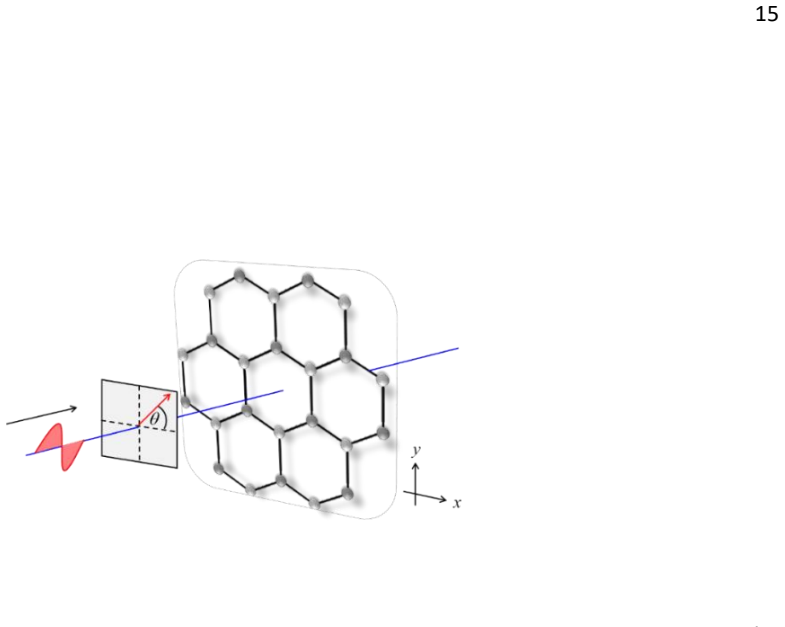
The deformation of hexagonal lattices has attracted considerable attention due to its promising applications in straintronics. This study employs the tight-binding model to investigate the anisotropic spectrum, where electronic transport can be manipulated by the degree of deformation. The longitudinal conductivities, light transmittance, and absorbance are analyzed, revealing enhancement along one direction and suppression along the other. The findings indicate that the direction and magnitude of strain can be determined by measuring transmittance and absorbance, showing significant deviations from the unstrained condition. Furthermore, a strong absorbance is observed due to the interband transition of electrons near the M-point saddles, linked to van Hove singularities for specific values of nearest and next-nearest hoping energy. The unexpected characteristics of saddle polarization-analogous to valley polarization at K- and K'-become particularly prominent when strain affects the selection of M-point saddle. Notably, the demonstration indicates that a highly efficient M-point saddle filtering effect takes place, induced by linearly polarized light. This model paves the way for exploring the optical properties of anisotropic hexagonal lattices, such as black phosphorus and borophene oxide. These results also open a pathway to strain-programmable optoelectronic devices, such as polarization-selective photodetectors, tunable absorbers, and ultrathin optical filters.
Editorial analysis
A structured set of objections, weighed in public.
Referee Report
Summary. The manuscript employs a tight-binding model to study strain effects on the anisotropic electronic spectrum and optical response of a 2D hexagonal lattice. It reports directional enhancement and suppression of longitudinal conductivities, transmittance, and absorbance, with significant deviations from the unstrained case that could allow optical determination of strain magnitude and direction. The central claims are a strong absorbance arising from interband transitions near M-point saddles tied to van Hove singularities (for chosen nearest- and next-nearest-neighbor hopping energies) and a highly efficient M-point saddle filtering effect under linearly polarized light, analogous to valley polarization, with suggested applications to strain-programmable devices in materials such as black phosphorus and borophene oxide.
Significance. If the model assumptions hold, the work would be significant for straintronics and 2D optoelectronics by offering a computationally simple route to predict and exploit anisotropic optical responses. The proposed saddle-filtering mechanism and the analogy to valley polarization constitute a conceptual extension that could stimulate further theoretical and experimental studies on M-point physics in deformed lattices.
major comments (1)
- [Tight-binding model and results on absorbance/transmittance] The central claim of an efficient M-point saddle filtering effect with strong absorbance relies on the tight-binding Hamiltonian (with fixed nearest- and next-nearest-neighbor hopping energies chosen to produce van Hove singularities at the M points) correctly reproducing the strained band structure and velocity-operator matrix elements. The abstract explicitly invokes 'specific values' of these hoppings; however, under arbitrary strain the hoppings must be scaled with deformed bond lengths (standard practice via exponential dependence or DFT relaxation). Without this adjustment the saddle locations, joint density of states, and polarization selectivity can shift, directly affecting the predicted transmittance/absorbance deviations and filtering efficiency. This assumption is load-bearing for the quantitative optical claims.
minor comments (2)
- [Abstract] Abstract: 'hoping energy' is a typographical error and should read 'hopping energy'.
- [Abstract] Abstract: the clause 'The unexpected characteristics of saddle polarization-analogous to valley polarization at K- and K'-become particularly prominent when strain affects the selection of M-point saddle' is grammatically awkward and conceptually underspecified; rephrase for clarity and define what 'selection of M-point saddle' means in this context.
Simulated Author's Rebuttal
We thank the referee for their careful reading and constructive comments on our manuscript. We address the major comment below and have revised the manuscript to strengthen the presentation of the model assumptions and results.
read point-by-point responses
-
Referee: The central claim of an efficient M-point saddle filtering effect with strong absorbance relies on the tight-binding Hamiltonian (with fixed nearest- and next-nearest-neighbor hopping energies chosen to produce van Hove singularities at the M points) correctly reproducing the strained band structure and velocity-operator matrix elements. The abstract explicitly invokes 'specific values' of these hoppings; however, under arbitrary strain the hoppings must be scaled with deformed bond lengths (standard practice via exponential dependence or DFT relaxation). Without this adjustment the saddle locations, joint density of states, and polarization selectivity can shift, directly affecting the predicted transmittance/absorbance deviations and filtering efficiency. This assumption is load-bearing for the quantitative optical claims.
Authors: We appreciate the referee's observation regarding the treatment of hopping parameters under strain. Our choice of fixed nearest- and next-nearest-neighbor hopping energies was made to isolate the geometric effects of lattice deformation on the positions of the M-point saddles and the resulting polarization-dependent optical response. This is a common simplification in minimal tight-binding models of strained hexagonal lattices to highlight changes in the Brillouin zone and velocity matrix elements. We agree, however, that a more complete treatment requires scaling the hoppings with bond lengths. In the revised manuscript we have implemented an exponential dependence of the hopping integrals on the strained interatomic distances. We have recomputed the electronic spectrum, longitudinal conductivities, transmittance, and absorbance using these strain-dependent parameters. The updated results confirm that the directional anisotropy and the highly efficient M-point saddle filtering effect under linearly polarized light remain robust, although the precise numerical values of absorbance and transmittance are modestly adjusted. We have revised the abstract to clarify the model assumptions, added a dedicated subsection on the strain-dependent hopping implementation, and included a comparison of fixed versus scaled hoppings in the supplementary material. These changes ensure the quantitative claims are placed on a firmer footing. revision: yes
Circularity Check
No significant circularity in derivation chain
full rationale
The paper applies a standard tight-binding model with chosen nearest- and next-nearest-neighbor hopping parameters to compute anisotropic conductivities, transmittance, and absorbance under strain, including interband transitions near M-point saddles. No equations or steps are shown that reduce any claimed prediction to a fitted input by construction, nor does the work rely on self-citations for load-bearing uniqueness theorems or ansatzes. The optical filtering results follow directly from the model's Hamiltonian and velocity matrix elements without circular redefinition or statistical forcing, rendering the derivation self-contained.
Axiom & Free-Parameter Ledger
free parameters (1)
- nearest and next-nearest neighbor hopping energies
axioms (1)
- domain assumption Tight-binding model sufficiently describes the electronic spectrum and optical transitions in deformed hexagonal lattices
Lean theorems connected to this paper
-
IndisputableMonolith/Cost/FunctionalEquation.leanwashburn_uniqueness_aczel unclear?
unclearRelation between the paper passage and the cited Recognition theorem.
employs the tight-binding model... hopping parameter t'... van Hove singularities... M-point saddle filtering effect... linearly polarized light
-
IndisputableMonolith/Foundation/AlexanderDuality.leanalexander_duality_circle_linking unclear?
unclearRelation between the paper passage and the cited Recognition theorem.
uniaxial strain on hexagonal lattice... anisotropic spectrum... longitudinal conductivities
What do these tags mean?
- matches
- The paper's claim is directly supported by a theorem in the formal canon.
- supports
- The theorem supports part of the paper's argument, but the paper may add assumptions or extra steps.
- extends
- The paper goes beyond the formal theorem; the theorem is a base layer rather than the whole result.
- uses
- The paper appears to rely on the theorem as machinery.
- contradicts
- The paper's claim conflicts with a theorem or certificate in the canon.
- unclear
- Pith found a possible connection, but the passage is too broad, indirect, or ambiguous to say the theorem truly supports the claim.
Forward citations
Cited by 1 Pith paper
-
Ab initio study of saddle-point excitons in monolayer SnS2
Bound excitons at saddle points in monolayer SnS2 couple selectively to linearly polarized light, producing three independent states that break C3 symmetry and may enable valleytronic encoding.
Reference graph
Works this paper leans on
-
[1]
Uniaxial strain controls the merging of Dirac cones, induces a tunable energy gap, and modifies the density of states
-
[2]
Longitudinal optical conductivities become strongly anisotropic, leading to polarization - dependent transmittance and absorbance
-
[3]
A novel M -point saddle filtering effect and saddle polarization emerge, enabling selective control of optical transitions beyond conventional valley polarization
-
[4]
The predicted effects occur within strain and photon-energy regimes achievable in current 2D materials, including black phosphorus and borophene oxide. These results open a pathway to strain -programmable optoelectronic devices, such as polarization -selective photodetectors, tunable absorbers, and ultrathin optical filters. Future work should focus on fi...
-
[5]
Reviews of Modern Physics, 2009
Castro Neto, A.H., et al., The electronic properties of graphene. Reviews of Modern Physics, 2009. 81(1): p. 109-162
work page 2009
-
[6]
Chowdhury, S. and D. Jana, A theoretical review on electronic, magnetic and optical properties of silicene. Rep Prog Phys, 2016. 79(12): p. 126501
work page 2016
-
[7]
Ezawa, M., Triplet fermions and Dirac fermions in borophene. Physical Review B, 2017. 96(3)
work page 2017
-
[8]
Hill, A., A. Sinner, and K. Ziegler, Valley symmetry breaking and gap tuning in graphene by spin doping. New Journal of Physics, 2011. 13(3)
work page 2011
-
[9]
Arakawa, N. and K. Yonemitsu, Light-induced large and tunable valley-selective Hall effect in a 9 centrosymmetric system. Physical Review B, 2024. 109(24)
work page 2024
-
[10]
Mrudul, M.S., et al., Light-induced valleytronics in pristine graphene. Optica, 2021. 8(3)
work page 2021
-
[11]
Li, S.-Y., et al., Experimental evidence for orbital magnetic moments generated by moiré-scale current loops in twisted bilayer graphene. Physical Review B, 2020. 102(12)
work page 2020
-
[12]
Mu, X. and J. Zhou, Valley-dependent giant orbital moments and transport features in rhombohedral graphene multilayers. Physical Review B, 2025. 111(16)
work page 2025
-
[13]
Pereira, V.M., A.H. Castro Neto, and N.M.R. Peres, Tight-binding approach to uniaxial strain in graphene. Physical Review B, 2009. 80(4)
work page 2009
-
[14]
Montambaux, G., et al., Merging of Dirac points in a two-dimensional crystal. Physical Review B, 2009. 80(15)
work page 2009
-
[15]
The European Physical Journal B, 2009
Montambaux, G., et al., A universal Hamiltonian for motion and merging of Dirac points in a two- dimensional crystal. The European Physical Journal B, 2009. 72(4): p. 509-520
work page 2009
-
[16]
Ziegler, K. and A. Sinner, Lattice symmetries, spectral topology and opto-electronic properties of graphene-like materials. EPL (Europhysics Letters),
-
[17]
Oliva-Leyva, M. and G.G. Naumis, Tunable dichroism and optical absorption of graphene by strain engineering. 2D Materials, 2015. 2(2)
work page 2015
-
[18]
Ni, G.X., et al., Tuning optical conductivity of large- scale CVD graphene by strain engineering. Adv Mater, 2014. 26(7): p. 1081-6
work page 2014
-
[19]
Nualpijit, P., A. Sinner, and K. Ziegler, Tunable transmittance in anisotropic two-dimensional materials. Physical Review B, 2018. 97(23)
work page 2018
-
[20]
Low, T., et al., Tunable optical properties of multilayer black phosphorus thin films. Physical Review B, 2014. 90(7)
work page 2014
-
[21]
Xiao, G., et al., Tunable and anisotropic perfect absorber using graphene-black phosphorus nanoblock. Opt Express, 2022. 30(13): p. 23198- 23207
work page 2022
-
[22]
Cortes, N., et al., Magnetic quantum phase transition extension in strained P-doped graphene. Phys Chem Chem Phys, 2025. 27(9): p. 4627-4633
work page 2025
-
[23]
Nualpijit, P. and B. Soodchomshom, Anisotropic optical conductivity induced by magnetic atoms embedded in honeycomb lattices. Journal of Magnetism and Magnetic Materials, 2023. 586
work page 2023
-
[24]
physica status solidi (RRL) – Rapid Research Letters,
Cayssol, J., et al., Floquet topological insulators. physica status solidi (RRL) – Rapid Research Letters,
-
[25]
Li, R., et al., Floquet engineering of the orbital Hall effect and valleytronics in two-dimensional topological magnets. Mater Horiz, 2024. 11(16): p. 3819-3824
work page 2024
-
[26]
Choi, D., et al., Observation of Floquet–Bloch states in monolayer graphene. Nature Physics, 2025
work page 2025
-
[27]
Physica B: Condensed Matter, 2023
Lin, Z., et al., Monolayer black phosphorus: Tunable band gap and optical properties. Physica B: Condensed Matter, 2023. 657
work page 2023
-
[28]
Chen, S.G., et al., Anomalous Klein tunneling in two- dimensional black phosphorus heterojunctions. Phys Chem Chem Phys, 2023. 25(35): p. 23836-23846
work page 2023
-
[29]
Zhong, C., et al., Two-dimensional honeycomb borophene oxide: strong anisotropy and nodal loop transformation. Nanoscale, 2019. 11(5): p. 2468- 2475
work page 2019
-
[30]
npj Computational Materials, 2020
Yan, L., et al., Theoretical dissection of superconductivity in two-dimensional honeycomb borophene oxide B2O crystal with a high stability. npj Computational Materials, 2020. 6(1)
work page 2020
-
[31]
Ziegler, K., Robust transport properties in graphene. Phys Rev Lett, 2006. 97(26): p. 266802
work page 2006
-
[32]
Dietl, P., F. Piechon, and G. Montambaux, New magnetic field dependence of Landau levels in a graphenelike structure. Phys Rev Lett, 2008. 100(23): p. 236405
work page 2008
-
[33]
Mahan, G.D., Many-Particle Physics. 2000: Springer New York, NY
work page 2000
-
[34]
Hasegawa, Y., et al., Zero modes of tight-binding electrons on the honeycomb lattice. Physical Review B, 2006. 74(3)
work page 2006
-
[35]
Kubo, R., Statistical-Mechanical Theory of Irreversible Processes. I. General Theory and Simple Applications to Magnetic and Conduction Problems. J. Phys. Soc. Jpn, 1957. 12: p. 570-586
work page 1957
-
[36]
Sinner, A., et al., Valley quantum Hall effect meets strain: Subgap formation and large increment of the Hall conductivity. Physical Review B, 2023. 108(23)
work page 2023
-
[37]
K.W. Chiu, T.K.L., J.J. Quinn, Infrared magneto- transmittance of a two-dimensional electron gas. Surface Science,, 1976. 58(1): p. 182-184
work page 1976
-
[38]
Liang, Y., S. Huang, and L. Yang, Many-electron effects on optical absorption spectra of strained graphene. Journal of Materials Research, 2011. 27(2): p. 403-409
work page 2011
-
[39]
Chaves, A.J., N.M.R. Peres, and T. Low, Pumping electrons in graphene to theMpoint in the Brillouin zone: Emergence of anisotropic plasmons. Physical Review B, 2016. 94(19)
work page 2016
-
[40]
Fox, A.M., Optical Properties of Solids. 2001: Oxford University Press
work page 2001
-
[41]
Lew Yan Voon, L.C. and L.R. Ram-Mohan, Tight- binding representation of the optical matrix elements: Theory and applications. Phys Rev B Condens Matter, 1993. 47(23): p. 15500-15508
work page 1993
-
[42]
Sangeeta Sharma, D.G., John Kay Dewhurst, Peter Elliott, Sam Shallcross, Ultrafast Saddletronics. arXiv:2503.21376, 2025
-
[43]
EPL (Europhysics Letters), 2010
Pereira, V.M., et al., Optical properties of strained graphene. EPL (Europhysics Letters), 2010. 92(6). 10
work page 2010
-
[44]
EPL (Europhysics Letters), 2017
Oliveira, O., et al., Signature of curved QFT effects on the optical properties of deformed graphene. EPL (Europhysics Letters), 2017. 117(2)
work page 2017
-
[45]
Margulis, V.A., E.E. Muryumin, and E.A. Gaiduk, Optical reflection, transmission and absorption properties of single-layer black phosphorus from a model calculation. Journal of Optics, 2016. 18(5)
work page 2016
-
[46]
Betancur-Ocampo, Y., F. Leyvraz, and T. Stegmann, Electron Optics in Phosphorene pn Junctions: Negative Reflection and Anti-Super-Klein Tunneling. Nano Lett, 2019. 19(11): p. 7760-7769
work page 2019
-
[47]
Li, Z., et al., Generation of Anisotropic Massless Dirac Fermions and Asymmetric Klein Tunneling in Few-Layer Black Phosphorus Superlattices. Nano Lett, 2017. 17(4): p. 2280-2286
work page 2017
-
[48]
Physica E: Low-dimensional Systems and Nanostructures,
Yang, C.H., et al., Orientation and strain dependence of optical absorption in black phosphorene. Physica E: Low-dimensional Systems and Nanostructures,
-
[49]
Maniyar, A. and S. Choudhary, Visible region absorption in TMDs/phosphorene heterostructures for use in solar energy conversion applications. RSC Adv, 2020. 10(53): p. 31730-31739
work page 2020
-
[50]
Inglot, M. and T. Szczepanski, Impurity-Induced Magnetization of Graphene. Materials (Basel), 2022. 15(2)
work page 2022
-
[51]
Boland, C.S., Y. Sun, and D.G. Papageorgiou, Bandgap Engineering of 2D Materials toward High- Performing Straintronics. Nano Lett, 2024. 24(41): p. 12722-32
work page 2024
-
[52]
Nakhaee, M., S.A. Ketabi, and F.M. Peeters, Tight- binding model for borophene and borophane. Physical Review B, 2018. 97(12)
work page 2018
-
[53]
Lherbier, A., A.R. Botello-Méndez, and J.-C. Charlier, Electronic and optical properties of pristine and oxidized borophene. 2D Materials, 2016. 3(4)
work page 2016
-
[54]
Solomenko, A.G., et al., Straintronics in phosphorene via tensile vs shear strains and their combinations for manipulating the band gap. Sci Rep, 2023. 13(1): p. 13444
work page 2023
-
[55]
Midtvedt, D., C.H. Lewenkopf, and A. Croy, Multi- scale approach for strain-engineering of phosphorene. J Phys Condens Matter, 2017. 29(18): p. 185702. 11 Fig.1: The hexagonal lattice with the nearest -neighbor vectors ia and hopping parameters it . 12 Fig.2: (a) the energy gap parameter , as a function of 't . (b)-(e) Contour plots of the energy disper...
work page 2017
discussion (0)
Sign in with ORCID, Apple, or X to comment. Anyone can read and Pith papers without signing in.