REVIEW 4 major objections 4 minor 53 references
Advancing Metallic Surface Defect Detection via Anomaly-Guided Pretraining on a Large Industrial Dataset
T0 review · 4 major / 4 minor · reviewed 2026-08-04 · deepseek-v4-flash
Pith's one-line read Anomaly-guided pretraining of both backbone and detector on 120,000 unlabeled industrial images consistently improves metallic surface defect detection over ImageNet and COCO initialization.
desk verdict Solid anomaly-guided pretraining study with a real dataset, but the undisclosed prompt source and overclaimed COCO comparison need fixing. read the letter →
The pith
A machine-rendered reading of the paper's core claim, the machinery that carries it, and where it could break.
The reading
What carries the argument
The central object is the anomaly map: a pixel-wise score heatmap indicating where defects are likely. It carries the whole argument. KeAD generates the maps by comparing CLIP patch features against normal and anomalous text prompts, using detailed defect descriptions instead of generic words and a V-V attention variant that preserves local spatial information. The maps then do double duty: the backbone stage distills them into high-level feature maps (L2 loss within ViTs, cosine loss across architectures), and the detector stage converts them into pseudo-defect boxes through a category-specific dynamic threshold and connected-component extraction. This single signal unifies feature learning
What would settle it
Run AGSSP with KeAD prompts constructed only from the pretraining corpus—no representative images from Casting Billet, Steel Pipe, or GC10—and finetune on those datasets. If the large gains in Tables 2 and 3 mostly disappear, the effect depends on target-informed prompt construction; if the gains persist, the anomaly-guidance prior is genuinely general.
Extended reading notes
Core claim
The paper's central claim is that anomaly maps can act as a pretraining supervision signal that aligns representation learning with the defect-detection task better than either natural-image pretraining or naive in-domain self-supervision. To produce these maps at scale, the authors introduce KeAD, a training-free extension of the CLIP-based WinCLIP method that uses defect-specific text descriptions and a local-attention variant, and they collect 120,000 unlabeled industrial images across 61 categories. In the first pretraining stage, the backbone is trained so its high-level attention maps match the anomaly maps through a distillation loss; in the second, pseudo-defect boxes extracted from
Load-bearing premise
The load-bearing premise is that the anomaly maps used for supervision are a transferable prior and not a way of leaking target-dataset knowledge: for the downstream categories absent from the pretraining data, the text prompts are built from representative images, and if those come from the target datasets themselves, the observed gains could reflect the teacher already knowing those defect types.
Editorial extensions
If this is right
- AGSSP-pretrained weights can replace ImageNet or COCO initialization for metallic surface defect detectors, improving accuracy without changing inference cost.
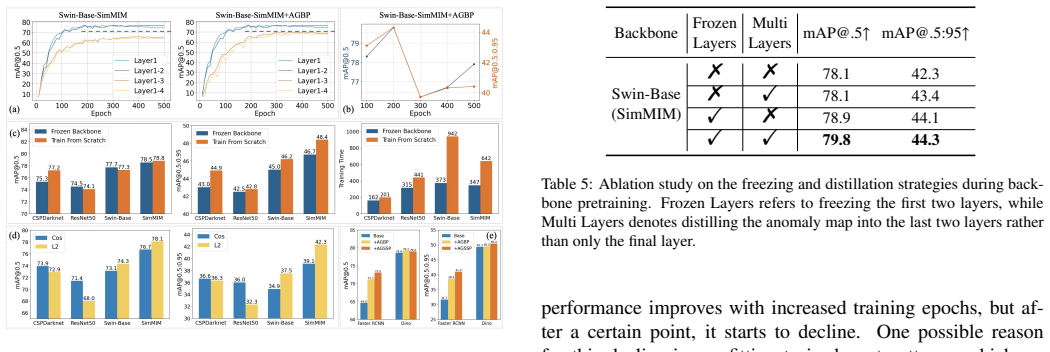
- The benefit is concentrated in low-data regimes: on a 50-image training split, gains reach +41% mAP@0.5 and +24.5% mAP@0.5:0.95 over ImageNet/SimMIM baselines.
- The method transfers across backbone architectures (CSPDarknet, ResNet50, Swin-Base) and detectors (YOLOv8, Faster R-CNN, DINO), suggesting the anomaly-guidance principle is not tied to one architecture.
- It also improves a non-metallic fabric defect dataset, indicating some generality beyond metal surfaces.
- Anomaly guidance can be added on top of existing pretraining objectives such as classification, contrastive learning, and masked image modeling, rather than replacing them.
Reading between the lines
- If the anomaly prior is the true driver, substituting KeAD with any strong zero- or few-shot anomaly detector should preserve most of the gain; this is directly testable.
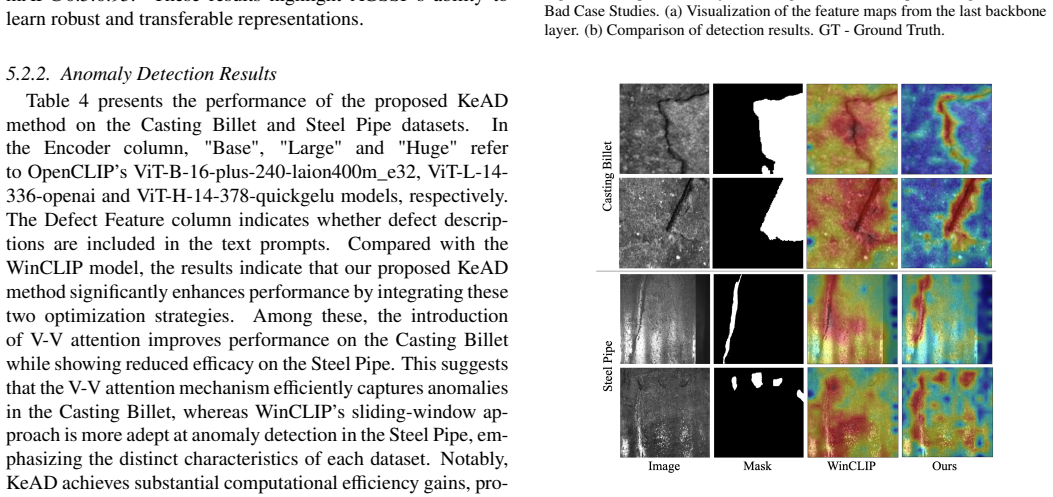
- The authors' own bad-case analysis flags noise-mimicking textures and extremely subtle defects as failure modes, which points to a next step: adding a noise-invariance or texture-robustness term to the distillation loss.
- Because the pseudo-boxes are derived from dense maps, the same pipeline could plausibly pretrain segmentation models by converting maps to pseudo-masks, not just boxes.
- The prompt-construction step uses representative images for the downstream categories, so an important open check is whether the gains survive when prompts are built without any access to the validation datasets; that check separates a general pretraining prior from target-specific knowledge.
Editorial analysis
A structured set of objections, weighed in public.
Referee Report
Summary. The paper proposes AGSSP (Anomaly-Guided Self-Supervised Pretraining), a two-stage pretraining framework for metallic surface defect detection. In Stage 1 (AGBP), anomaly maps generated by a CLIP-based teacher (KeAD) are distilled into the backbone's high-level feature maps via an attention-map loss, optionally combined with existing SSL objectives. In Stage 2 (AGDP), the same anomaly maps are binarized with a dynamic threshold and converted to pseudo-defect boxes, which supervise detector pretraining. The authors collect a 120,000-image, 61-category industrial dataset, introduce two new pixel-level labeled defect datasets (Casting Billet, Steel Pipe), and evaluate across three backbones, multiple pretraining methods, and several downstream datasets including GC10-DET and a fabric dataset. They report consistent gains over ImageNet/COCO baselines, up to 10% mAP@0.5 and 11.4% mAP@0.5:0.95, with particularly large gains in extreme few-shot settings.
Significance. If the reported gains are attributable to the proposed anomaly-guidance mechanism rather than to target-informed prompt construction, this is a significant contribution to industrial defect detection: it provides a general paradigm for in-domain pretraining, a large public pretraining corpus, and two new labeled datasets, with code and models to be released. The experimental scope is extensive—three backbones, three pretraining tasks, multiple detectors, and six evaluation settings—and the paper explicitly compares against ImageNet and COCO initialization. The main scientific risk is leakage via the text-prompt construction: the teacher's prompts are built from representative images whose provenance is not disclosed, which could confound the claimed transferable anomaly prior. This issue is load-bearing for the central claim and must be addressed with additional disclosure and ablation.
major comments (4)
- [Sec. 4.1.1, Sec. 3.1] KeAD's text prompts are constructed from 'one representative image' per object category, described by GPT-4o and expert knowledge. The paper does not state whether the validation categories (Casting Billet, Steel Pipe, GC10) are among the 61 pretraining categories, nor where the representative images for those categories were taken from. If these representative images come from the validation sets themselves, then the anomaly maps used in AGBP/AGDP are implicitly tuned to downstream defect types, and the reported gains (up to 10% mAP@0.5, 11.4% mAP@0.5:0.95) could reflect target-informed prompt engineering rather than a general, transferable anomaly prior. This is the main load-bearing assumption of the paper. Please disclose the source of all representative images and add a control experiment using generic prompts (e.g., WinCLIP's 'damaged/defected') or prompts constructed from categori
- [Sec. 5.1.2, Sec. 1] KeAD's few-shot mode uses 'four normal samples' as reference images, yet the large-scale pretraining dataset is described as unlabeled, with 'no labels distinguishing normal from defective samples' (Sec. 1). The paper does not explain how these four normal samples are selected. If they are chosen by human inspection, this is a form of supervision that should be reported; if they are selected at random, some may contain defects, which could corrupt the anomaly maps used as pseudo-labels. Please specify the selection protocol and evaluate the sensitivity of the results to the number and quality of normal reference samples.
- [Sec. 5.2.1, Table 3, Sec. 1] The extreme few-shot results on Casting Billet-Mini50 (gains of +20 to +41 mAP@0.5 over ImageNet and COCO baselines) are presented as evidence of the method's effectiveness. However, if the KeAD prompts already encode the target defect categories through representative images from the target domain (see first major comment), these large gains may be due to the teacher already knowing the downstream defect types, rather than to a sample-efficient anomaly-guidance mechanism. To separate these explanations, the authors should compare AGSSP pretraining with prompts built from the target categories against prompts built from unrelated categories; if the latter also produces large gains, the transferability claim is supported. This ablation is missing.
- [Sec. 4.2, Eq. (9)-(11)] The pseudo-box generation pipeline involves several hyperparameters: the threshold offset δ=0.1, the top-10 box cutoff, and NMS. The paper only ablates δ with a mask-IoU metric (Fig. 7), not with respect to the final detection performance of AGDP. The sensitivity of the two-stage pretraining to the number of pseudo-boxes and NMS thresholds should be documented, since these choices directly affect the supervisory signal in the detector pretraining stage.
minor comments (4)
- [Sec. 5.2.1, Table 2] The table formatting is inconsistent (e.g., 'GC10-Det' vs 'GC10-DET', missing delimiters in some rows). Also, clarify what 'Detection COCO' means for each backbone: is it the COCO-pretrained version of the same CSPDarknet/ResNet/Swin architecture, and are the COCO weights obtained from the original papers or MMDetection?
- [Sec. 3.2] The training/validation split for Casting Billet and Steel Pipe is described as '1:1 ratio.' Please specify whether the split is random, whether it is stratified by defect type, and the number of defect instances in each split. The unusually large validation fraction affects the reliability of the reported metrics.
- [Sec. 4.1.1, Eq. (1)] The temperature τ in the scoring function is not specified. Report the value used for the CLIP text-image similarity, as it affects the anomaly map calibration and the 0.5 image-level threshold in Sec. 4.2.
- [Sec. 4.1.2, Eq. (8)] The hyperparameter λ is set from the ratio of loss values at the first iteration. Specify whether this is computed on the first batch of each training run, and whether λ is held fixed throughout pretraining or adjusted in later iterations.
Circularity Check
No significant circularity: AGSSP is an empirical distillation method whose supervision signal is not the downstream labels by construction.
full rationale
AGSSP's derivation chain is: KeAD (a training-free adaptation of WinCLIP with an external CLIP encoder) produces anomaly maps from 120k unlabeled industrial images; AGBP aligns student high-level attention maps to these maps via Eq. (7); AGDP derives pseudo-boxes from the same maps via Eqs. (9)-(11) and pretrains the detector. At no point is the downstream mAP encoded in the pretraining objective. The teacher (CLIP) and the attention-transfer technique ([49]) are external, and the validation images are stated to be disjoint from the pretraining set (Sec. 3.1). The only arguable weakness is that KeAD's text prompts are built from 'one representative image' plus expert knowledge (Sec. 4.1.1), whose source is not disclosed. If that image came from an evaluation domain, it would be a leakage confound, not a mathematical reduction of the reported gain to a fitted parameter. No self-citation is load-bearing; the two self-citations in Sec. 2.3 are related-work context. Hence no circular step can be quoted or exhibited.
Assumptions & free parameters
free parameters (6)
- delta =
0.1
- backbone_pretraining_epochs =
200
- distillation_layers =
last two layers
- frozen_lower_layers =
first two layers
- lambda_loss_weight =
ratio of initial losses
- pseudo_box_count =
top 10
assumptions (5)
- domain assumption CLIP's zero-shot image-text alignment generalizes to industrial surface images
- domain assumption Hand-crafted defect text prompts are a transferable prior
- domain assumption Anomaly maps are a good proxy for defect locations
- domain assumption Low-level features are domain-agnostic and can be kept frozen from ImageNet
- domain assumption The 120k industrial dataset is representative of downstream defect distributions
Cite this review
Pith. "Pith review of Advancing Metallic Surface Defect Detection via Anomaly-Guided Pretraining on a Large Industrial Dataset." pith.science (2026). https://pith.science/paper/4GX2JJXN
@misc{pith2026250918919,
  author       = {Pith},
  title        = {Pith review of: Advancing Metallic Surface Defect Detection via Anomaly-Guided Pretraining on a Large Industrial Dataset},
  year         = {2026},
  howpublished = {\url{https://pith.science/paper/4GX2JJXN}},
  note         = {Machine review of arXiv:2509.18919}
}
read the original abstract
The pretraining-finetuning paradigm is a crucial strategy in metallic surface defect detection for mitigating the challenges posed by data scarcity. However, its implementation presents a critical dilemma. Pretraining on natural image datasets such as ImageNet, faces a significant domain gap. Meanwhile, naive self-supervised pretraining on in-domain industrial data is often ineffective due to the inability of existing learning objectives to distinguish subtle defect patterns from complex background noise and textures. To resolve this, we introduce Anomaly-Guided Self-Supervised Pretraining (AGSSP), a novel paradigm that explicitly guides representation learning through anomaly priors. AGSSP employs a two-stage framework: (1) it first pretrains the model's backbone by distilling knowledge from anomaly maps, encouraging the network to capture defect-salient features; (2) it then pretrains the detector using pseudo-defect boxes derived from these maps, aligning it with localization tasks. To enable this, we develop a knowledge-enhanced method to generate high-quality anomaly maps and collect a large-scale industrial dataset of 120,000 images. Additionally, we present two small-scale, pixel-level labeled metallic surface defect datasets for validation. Extensive experiments demonstrate that AGSSP consistently enhances performance across various settings, achieving up to a 10\% improvement in mAP@0.5 and 11.4\% in mAP@0.5:0.95 compared to ImageNet-based models. All code, pretrained models, and datasets are publicly available at https://clovermini.github.io/AGSSP-Dev/.
Figures


Figures from the paper (4 more)


Reference graph
Works this paper leans on
-
[1]
X. Lv, F. Duan, J.-j. Jiang, X. Fu, L. Gan, Deep metallic surface defect detection: The new benchmark and detec- tion network, Sensors 20 (6) (2020) 1562
2020
-
[2]
Ameri, C.-C
R. Ameri, C.-C. Hsu, S. S. Band, A systematic review of deep learning approaches for surface defect detection in industrial applications, Engineering Applications of Arti- ficial Intelligence 130 (2024) 107717. 11
2024
-
[3]
Saberironaghi, J
A. Saberironaghi, J. Ren, M. El-Gindy, Defect detection methods for industrial products using deep learning tech- niques: A review, Algorithms 16 (2) (2023) 95
2023
-
[4]
C.-L. Li, K. Sohn, J. Yoon, T. Pfister, Cutpaste: Self- supervised learning for anomaly detection and localiza- tion, in: Proceedings of the IEEE/CVF conference on computer vision and pattern recognition, 2021, pp. 9664– 9674
2021
-
[5]
Y . Tai, K. Yang, T. Peng, Z. Huang, Z. Zhang, Defect im- age sample generation with diffusion prior for steel sur- face defect recognition, arXiv preprint arXiv:2405.01872 (2024)
arXiv 2024
-
[6]
J. Liu, F. Guo, H. Gao, M. Li, Y . Zhang, H. Zhou, Defect detection of injection molding products on small datasets using transfer learning, Journal of manufacturing pro- cesses 70 (2021) 400–413
2021
-
[7]
J. Deng, W. Dong, R. Socher, L.-J. Li, K. Li, L. Fei- Fei, Imagenet: A large-scale hierarchical image database, in: 2009 IEEE conference on computer vision and pattern recognition, Ieee, 2009, pp. 248–255
2009
-
[8]
T.-Y . Lin, M. Maire, S. Belongie, J. Hays, P. Perona, D. Ramanan, P. Dollár, C. L. Zitnick, Microsoft coco: Common objects in context, in: Computer Vision–ECCV 2014: 13th European Conference, Zurich, Switzerland, September 6-12, 2014, Proceedings, Part V 13, Springer, 2014, pp. 740–755
2014
Show all 53 references
-
[9]
X. Chen, S. Xie, K. He, An empirical study of training self-supervised vision transformers, in: Proceedings of the IEEE/CVF international conference on computer vi- sion, 2021, pp. 9640–9649
2021
-
[10]
Z. Xie, Z. Zhang, Y . Cao, Y . Lin, J. Bao, Z. Yao, Q. Dai, H. Hu, Simmim: A simple framework for masked im- age modeling, in: Proceedings of the IEEE/CVF confer- ence on computer vision and pattern recognition, 2022, pp. 9653–9663
2022
-
[11]
K. Tian, Y . Jiang, Q. Diao, C. Lin, L. Wang, Z. Yuan, Designing bert for convolutional networks: Sparse and hierarchical masked modeling, arXiv preprint arXiv:2301.03580 (2023)
2023 arXiv
-
[12]
Oquab, T
M. Oquab, T. Darcet, T. Moutakanni, H. V o, M. Szafraniec, V . Khalidov, P. Fernandez, D. Haz- iza, F. Massa, A. El-Nouby, et al., Dinov2: Learning robust visual features without supervision, arXiv preprint arXiv:2304.07193 (2023)
2023 arXiv
-
[13]
X. Hu, J. Yang, F. Jiang, A. Hussain, K. Dashtipour, M. Gogate, Steel surface defect detection based on self-supervised contrastive representation learning with matching metric, Applied Soft Computing 145 (2023) 110578
2023
-
[14]
Torpey, L
D. Torpey, L. Pratt, R. Klein, A large-scale evaluation of pretraining paradigms for the detection of defects in elec- troluminescence solar cell images (2024)
2024
-
[15]
X. Liu, X. Miao, H. Jiang, J. Chen, M. Wu, Z. Chen, Tower masking mim: A self-supervised pretraining method for power line inspection, IEEE Transactions on Industrial Informatics 20 (1) (2023) 513–523
2023
-
[16]
M. Li, J. Wu, X. Wang, C. Chen, J. Qin, X. Xiao, R. Wang, M. Zheng, X. Pan, Aligndet: Aligning pre-training and fine-tuning in object detection, in: Proceedings of the IEEE/CVF International Conference on Computer Vision, 2023, pp. 6866–6876
2023
-
[17]
Huang, Y
Z. Huang, Y . Feng, Q. Liu, Y . Wang, Mutdet: Mutu- ally optimizing pre-training for remote sensing object de- tection, in: European Conference on Computer Vision, Springer, 2025, pp. 1–17
2025
-
[18]
Jeong, Y
J. Jeong, Y . Zou, T. Kim, D. Zhang, A. Ravichandran, O. Dabeer, Winclip: Zero-/few-shot anomaly classifica- tion and segmentation, in: Proceedings of the IEEE/CVF Conference on Computer Vision and Pattern Recognition, 2023, pp. 19606–19616
2023
-
[19]
Q. Sun, K. Xu, H. Liu, Unsupervised surface defect detec- tion of aluminum sheets with combined bright-field and dark-field illumination, Optics and Lasers in Engineering 168 (2023) 107674
2023
-
[20]
Y . Li, H. Wang, Y . Duan, X. Li, Clip surgery for better ex- plainability with enhancement in open-vocabulary tasks, arXiv preprint arXiv:2304.05653 (2023)
2023 arXiv
-
[21]
S. Ren, K. He, R. Girshick, J. Sun, Faster r-cnn: Towards real-time object detection with region proposal networks, IEEE transactions on pattern analysis and machine intelli- gence 39 (6) (2016) 1137–1149
2016
-
[22]
Jocher, A
G. Jocher, A. Chaurasia, J. Qiu, Ultralytics yolov8 (2023). URLhttps://github.com/ultralytics/ ultralytics
2023
-
[23]
Jocher, J
G. Jocher, J. Qiu, Ultralytics yolo11 (2024). URLhttps://github.com/ultralytics/ ultralytics
2024
-
[24]
Y . Tian, Q. Ye, D. Doermann, Yolov12: Attention- centric real-time object detectors, arXiv preprint arXiv:2502.12524 (2025)
2025 arXiv
-
[25]
Zhang, F
H. Zhang, F. Li, S. Liu, L. Zhang, H. Su, J. Zhu, L. M. Ni, H.-Y . Shum, Dino: Detr with improved denoising an- chor boxes for end-to-end object detection, arXiv preprint arXiv:2203.03605 (2022)
2022 arXiv
-
[26]
W. Lv, Y . Zhao, Q. Chang, K. Huang, G. Wang, Y . Liu, Rtdetrv2: All-in-one detection transformer beats yolo and dino (2024).arXiv:2407.17140. 12
2024 arXiv
-
[27]
Y . Liu, Y . Liu, X. Guo, X. Ling, Q. Geng, Metal surface defect detection using slf-yolo enhanced yolov8 model, Scientific Reports 15 (1) (2025) 11105
2025
-
[28]
H. Feng, K. Song, W. Cui, Y . Zhang, Y . Yan, Cross po- sition aggregation network for few-shot strip steel surface defect segmentation, IEEE Transactions on Instrumenta- tion and Measurement 72 (2023) 1–10
2023
-
[29]
Huang, Y
J. Huang, Y . Wu, X. Zhou, J. Lin, Z. Chen, G. Zhang, L. Xia, J. Zhang, Multi-scale adaptive prototype trans- former network for few-shot strip steel surface defect segmentation, IEEE Transactions on Instrumentation and Measurement (2025)
2025
-
[30]
Y . Ma, M. Liu, Y . Zhang, X. Wang, Y . Wang, Spdp-net: A semantic prior guided defect perception network for auto- mated aero-engine blades surface visual inspection, IEEE Transactions on Automation Science and Engineering 22 (2024) 2724–2733
2024
-
[31]
Y . Fang, W. Wang, B. Xie, Q. Sun, L. Wu, X. Wang, T. Huang, X. Wang, Y . Cao, Eva: Exploring the limits of masked visual representation learning at scale, in: Pro- ceedings of the IEEE/CVF conference on computer vision and pattern recognition, 2023, pp. 19358–19369
2023
-
[32]
Caron, H
M. Caron, H. Touvron, I. Misra, H. Jégou, J. Mairal, P. Bojanowski, A. Joulin, Emerging properties in self- supervised vision transformers, in: Proceedings of the IEEE/CVF international conference on computer vision, 2021, pp. 9650–9660
2021
-
[33]
Siméoni, H
O. Siméoni, H. V . V o, M. Seitzer, F. Baldassarre, M. Oquab, C. Jose, V . Khalidov, M. Szafraniec, S. Yi, M. Ramamonjisoa, et al., Dinov3, arXiv preprint arXiv:2508.10104 (2025)
2025 arXiv
-
[34]
H.-Y . Zhou, S. Yu, C. Bian, Y . Hu, K. Ma, Y . Zheng, Com- paring to learn: Surpassing imagenet pretraining on radio- graphs by comparing image representations, in: Medical Image Computing and Computer Assisted Intervention– MICCAI 2020: 23rd International Conference, Lima, P...
2020
-
[35]
Stuckner, B
J. Stuckner, B. Harder, T. M. Smith, Microstructure seg- mentation with deep learning encoders pre-trained on a large microscopy dataset, npj Computational Materials 8 (1) (2022) 200
2022
-
[36]
M. He, L. Qin, Y . Wang, X. Deng, Q. Liu, Y . Zhang, K. Liu, A weakly supervised contrastive learning pretrain- ing method for visual defect detection of transmission lines, IEEE Transactions on Instrumentation and Mea- surement 74 (2025) 1–15
2025
-
[37]
Bouniot, R
Q. Bouniot, R. Audigier, A. Loesch, A. Habrard, Proposal-contrastive pretraining for object detection from fewer data, in: The Eleventh International Conference on Learning Representations, 2023
2023
-
[38]
Kirillov, E
A. Kirillov, E. Mintun, N. Ravi, H. Mao, C. Rolland, L. Gustafson, T. Xiao, S. Whitehead, A. C. Berg, W.- Y . Lo, et al., Segment anything, in: Proceedings of the IEEE/CVF International Conference on Computer Vision, 2023, pp. 4015–4026
2023
-
[39]
K. Roth, L. Pemula, J. Zepeda, B. Schölkopf, T. Brox, P. Gehler, Towards total recall in industrial anomaly de- tection, in: Proceedings of the IEEE/CVF conference on computer vision and pattern recognition, 2022, pp. 14318–14328
2022
-
[40]
Z. You, L. Cui, Y . Shen, K. Yang, X. Lu, Y . Zheng, X. Le, A unified model for multi-class anomaly detection, Advances in Neural Information Processing Systems 35 (2022) 4571–4584
2022
-
[41]
Q. Sun, K. Xu, D. Zhao, H. Li, L. Jin, C. Liu, P. Xu, Png: an adaptive local-global hybrid framework for unsuper- vised material surface defect detection, Expert Systems with Applications (2025) 128711
2025
-
[42]
Radford, J
A. Radford, J. W. Kim, C. Hallacy, A. Ramesh, G. Goh, S. Agarwal, G. Sastry, A. Askell, P. Mishkin, J. Clark, et al., Learning transferable visual models from natural language supervision, in: International conference on ma- chine learning, PMLR, 2021, pp. 8748–8763
2021
-
[43]
X. Chen, Y . Han, J. Zhang, A zero-/few-shot anomaly classification and segmentation method for cvpr 2023 vand workshop challenge tracks 1&2: 1st place on zero- shot ad and 4th place on few-shot ad, arXiv preprint arXiv:2305.17382 (2023)
2023 arXiv
-
[44]
Q. Zhou, G. Pang, Y . Tian, S. He, J. Chen, Anomalyclip: Object-agnostic prompt learning for zero-shot anomaly detection, in: The Twelfth International Conference on Learning Representations, 2023
2023
-
[45]
W. Ma, X. Zhang, Q. Yao, F. Tang, C. Wu, Y . Li, R. Yan, Z. Jiang, S. K. Zhou, Aa-clip: Enhancing zero- shot anomaly detection via anomaly-aware clip, in: Pro- ceedings of the Computer Vision and Pattern Recognition Conference, 2025, pp. 4744–4754
2025
-
[46]
URLhttps://www.kaggle.com/competitions/ severstal-steel-defect-detection/data
Severstal: Steel defect detection, retrieved 2 May 2022 (2019). URLhttps://www.kaggle.com/competitions/ severstal-steel-defect-detection/data
2022
-
[47]
S. Chen, S. Jiang, X. Wang, P. Sun, C. Hua, J. Sun, An ef- ficient detector for detecting surface defects on cold-rolled steel strips, Engineering Applications of Artificial Intelli- gence 138 (2024) 109325
2024
-
[48]
Vaswani, Attention is all you need, Advances in Neural Information Processing Systems (2017)
A. Vaswani, Attention is all you need, Advances in Neural Information Processing Systems (2017)
2017
-
[49]
Zagoruyko, N
S. Zagoruyko, N. Komodakis, Paying more attention to attention: Improving the performance of convolutional neural networks via attention transfer, arXiv preprint arXiv:1612.03928 (2016). 13
2016 arXiv
-
[50]
K. He, X. Zhang, S. Ren, J. Sun, Deep residual learning for image recognition, in: Proceedings of the IEEE con- ference on computer vision and pattern recognition, 2016, pp. 770–778
2016
-
[51]
Bochkovskiy, C.-Y
A. Bochkovskiy, C.-Y . Wang, H.-Y . M. Liao, Yolov4: Optimal speed and accuracy of object detection (2020). arXiv:2004.10934
2020 arXiv
-
[52]
Bradski, Learning opencv: Computer vision with the opencv library, O’REILLY google schola 2 (2008) 334– 352
G. Bradski, Learning opencv: Computer vision with the opencv library, O’REILLY google schola 2 (2008) 334– 352
2008
-
[53]
Neamah, Fabric defects object detection dataset (2024).doi:10.6084/m9.figshare.25546465.v2
O. Neamah, Fabric defects object detection dataset (2024).doi:10.6084/m9.figshare.25546465.v2. 14
2024 doi
Reviewed August 4, 2026 · model on record in the stance chip above.
Discussion (0). Sign in to comment.