Post-collapse Lagrangian perturbation theory in three dimensions
Pith reviewed 2026-05-18 14:34 UTC · model grok-4.3
The pith
A perturbative Lagrangian method captures three-dimensional matter evolution after the first shell-crossing by using pancake caustics.
A machine-rendered reading of the paper's core claim, the machinery that carries it, and where it could break.
Core claim
We present the first fully perturbative approach in three dimensions by using Lagrangian coordinates that asymptotically captures the highly nonlinear nature of matter evolution after the first shell-crossing. This is made possible essentially thanks to two basic ingredients: (1) We employ high-order standard Lagrangian perturbation theory to evolve the system until shell-crossing, and (2) we exploit the fact that the density caustic structure near the first shell-crossing begins generically with pancake formation. The latter property allows us to exploit largely known one-dimensional results to determine perturbatively the gravitational backreaction after collapse, yielding accurate results
What carries the argument
Post-collapse perturbation theory (PCPT) that combines high-order Lagrangian perturbation theory up to shell-crossing with one-dimensional pancake-caustic results to compute gravitational backreaction afterward.
If this is right
- PCPT supplies accurate perturbative solutions for the early stages of post-collapse dynamics.
- The formalism is validated by direct comparison to high-resolution Vlasov-Poisson simulations.
- It provides a robust perturbative framework for describing highly nonlinear matter evolution shortly after the first shell-crossing.
- The approach asymptotically captures the nonlinear regime using only Lagrangian coordinates.
Where Pith is reading between the lines
- PCPT could serve as an efficient bridge between linear theory and full N-body runs for the onset of multi-streaming in large-scale structure.
- The pancake-based backreaction step might be generalized to include higher-order caustic geometries that appear later in collapse.
- Applications to modified gravity or different initial power spectra would test how sensitively post-collapse dynamics depend on the initial conditions.
Load-bearing premise
The density caustic structure near the first shell-crossing begins generically with pancake formation.
What would settle it
If high-resolution Vlasov-Poisson simulations show that PCPT density or velocity predictions deviate substantially from the simulated fields within the early post-shell-crossing window, the perturbative backreaction treatment would be falsified.
Figures




read the original abstract
The gravitational collapse of collisionless matter leads to shell-crossing singularities that challenge the applicability of standard perturbation theory. Here, we present the first fully perturbative approach in three dimensions by using Lagrangian coordinates that asymptotically captures the highly nonlinear nature of matter evolution after the first shell-crossing. This is made possible essentially thanks to two basic ingredients: (1) We employ high-order standard Lagrangian perturbation theory to evolve the system until shell-crossing, and (2) we exploit the fact that the density caustic structure near the first shell-crossing begins generically with pancake formation. The latter property allows us to exploit largely known one-dimensional results to determine perturbatively the gravitational backreaction after collapse, yielding accurate solutions within our post-collapse perturbation theory (PCPT) formalism. We validate the PCPT predictions against high-resolution Vlasov-Poisson simulations and demonstrate that PCPT provides a robust framework for describing the early stages of post-collapse dynamics.
Editorial analysis
A structured set of objections, weighed in public.
Referee Report
Summary. The manuscript introduces a post-collapse Lagrangian perturbation theory (PCPT) in three dimensions for collisionless matter. It evolves the system with high-order standard Lagrangian perturbation theory until the first shell-crossing and then exploits the generic pancake-like caustic structure to incorporate known one-dimensional post-collapse results for the gravitational backreaction, claiming to yield a fully perturbative description that asymptotically captures the early nonlinear regime after shell-crossing, with validation against Vlasov-Poisson simulations.
Significance. If the central construction holds, the work would supply a controlled perturbative extension past the shell-crossing singularity, which remains a key obstacle in analytic modeling of cosmic structure formation. The reuse of established high-order LPT and one-dimensional pancake solutions together with direct simulation benchmarks constitutes a practical strength, though the three-dimensional consistency of the backreaction step determines the overall reach.
major comments (1)
- [Abstract] Abstract: The claim that the generic pancake formation near first shell-crossing permits the use of one-dimensional results to determine the three-dimensional gravitational backreaction perturbatively is load-bearing. The three-dimensional Poisson equation introduces transverse gradient couplings; it is not shown that small deviations from perfect planarity (unavoidable in generic initial conditions) produce force corrections that remain perturbatively controlled by the planar one-dimensional solutions alone.
minor comments (1)
- [Abstract] Abstract: Quantitative error measures (e.g., relative L2 norms, convergence with LPT order, or time intervals of validity) are not reported, which would allow readers to gauge the accuracy of the PCPT predictions against the cited simulations.
Simulated Author's Rebuttal
We thank the referee for their careful reading of the manuscript and for identifying the central claim regarding the three-dimensional consistency of the post-collapse backreaction. We address this point directly below and have revised the manuscript to strengthen the discussion of perturbative control.
read point-by-point responses
-
Referee: The claim that the generic pancake formation near first shell-crossing permits the use of one-dimensional results to determine the three-dimensional gravitational backreaction perturbatively is load-bearing. The three-dimensional Poisson equation introduces transverse gradient couplings; it is not shown that small deviations from perfect planarity (unavoidable in generic initial conditions) produce force corrections that remain perturbatively controlled by the planar one-dimensional solutions alone.
Authors: We agree that demonstrating perturbative control over transverse couplings is essential. Near first shell-crossing the density field develops a locally planar caustic structure, with the dominant collapse occurring along one axis while transverse gradients remain parametrically small. In the Poisson equation these transverse terms enter at higher order in the small parameter set by the time elapsed since crossing and the amplitude of transverse perturbations. The manuscript constructs the backreaction by matching the known one-dimensional post-collapse solution onto this locally planar geometry and treats deviations perturbatively. Direct comparison with Vlasov-Poisson simulations in the early post-crossing regime shows that the resulting force corrections remain under control, supporting the validity of the approximation. To make this reasoning more explicit we have added a dedicated paragraph in Section 3 and revised the abstract to state the perturbative ordering more clearly. revision: yes
Circularity Check
No significant circularity; derivation uses external 1D results and standard LPT
full rationale
The paper's central construction combines pre-existing high-order Lagrangian perturbation theory evolved to shell-crossing with independently known one-dimensional pancake caustic solutions to model post-collapse 3D gravitational backreaction. These are presented as external inputs rather than quantities fitted or defined inside the present work, and validation is performed against separate Vlasov-Poisson simulations. No quoted equation or claim reduces the PCPT predictions to a self-defined fit, renamed ansatz, or load-bearing self-citation chain by construction; the formalism therefore remains self-contained against external benchmarks.
Axiom & Free-Parameter Ledger
axioms (1)
- domain assumption The density caustic structure near the first shell-crossing begins generically with pancake formation.
Lean theorems connected to this paper
-
IndisputableMonolith/Foundation/AlexanderDuality.leanalexander_duality_circle_linking echoes?
echoesECHOES: this paper passage has the same mathematical shape or conceptual pattern as the Recognition theorem, but is not a direct formal dependency.
we exploit the fact that the density caustic structure near the first shell-crossing begins generically with pancake formation... reduce the problem to an effectively one-dimensional treatment along the collapse axis while retaining the transverse directions as parameters
What do these tags mean?
- matches
- The paper's claim is directly supported by a theorem in the formal canon.
- supports
- The theorem supports part of the paper's argument, but the paper may add assumptions or extra steps.
- extends
- The paper goes beyond the formal theorem; the theorem is a base layer rather than the whole result.
- uses
- The paper appears to rely on the theorem as machinery.
- contradicts
- The paper's claim conflicts with a theorem or certificate in the canon.
- unclear
- Pith found a possible connection, but the passage is too broad, indirect, or ambiguous to say the theorem truly supports the claim.
Reference graph
Works this paper leans on
-
[1]
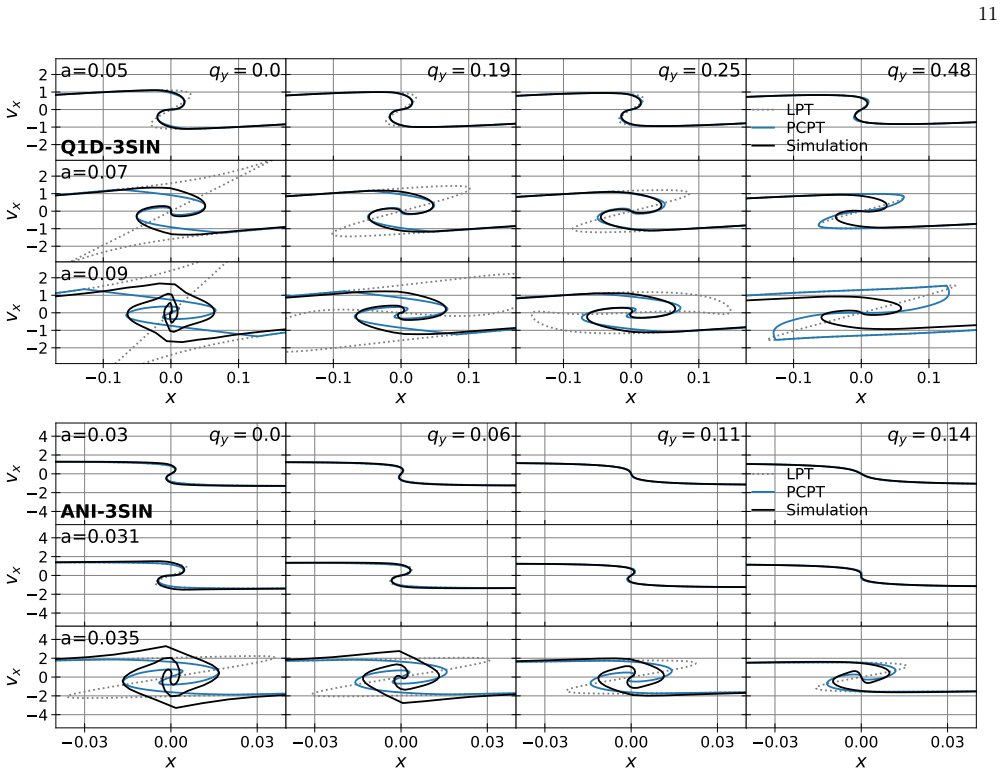
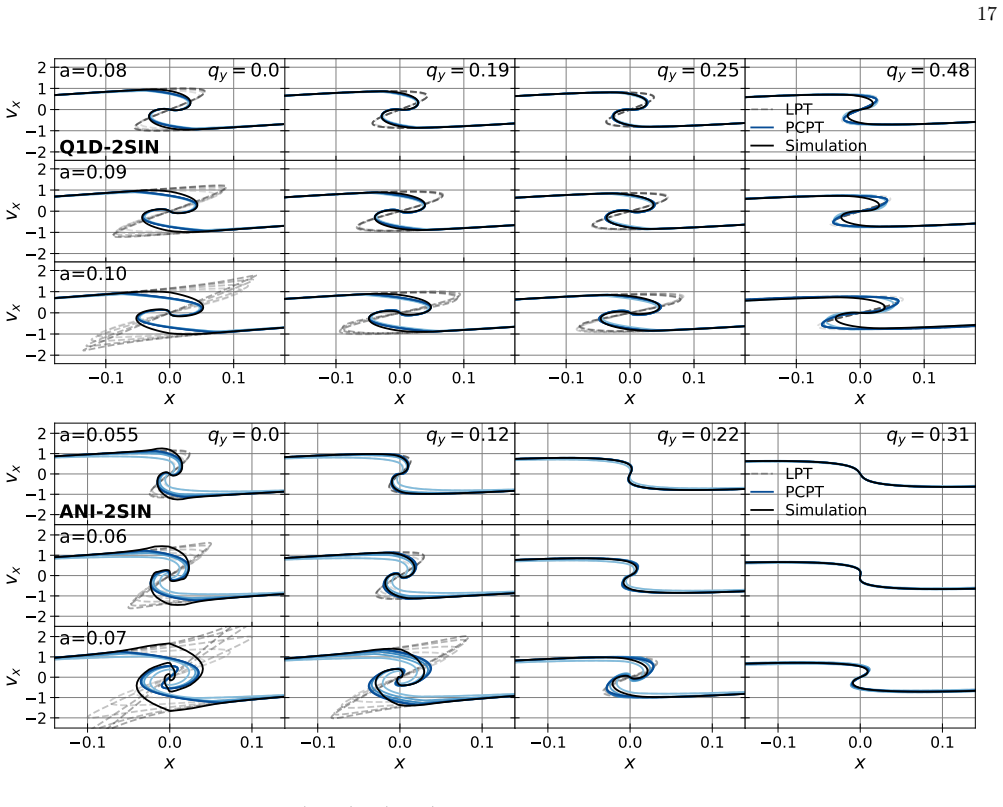
Lagrangian phase-space slices In Figs. 2 and 3, we examine Lagrangian phase-space slices,x-v x, after the first shell crossing, by plotting func- tionsx(τ,q)andv x(τ,q)varyingq x while fixingq y and (qy, qz)for the two- and three-sine waves cases, respec- tively. We clearly see that the analytical predictions based on PCPT reproduce well the phase-space s...
-
[2]
Eulerian density slices Finally, to further understand how well PCPT is able to describe the multi-stream region and its caustic struc- ture, Eulerian density slices are shown on Fig. 4. Their visual inspection confirms the analyses of the phase-space diagrams. Shortly after collapse (top lines of each group of panels), PCPT predictions clearly improve ov...
work page 2017
-
[3]
P.J.E.Peebles,Large-scalebackgroundtemperatureand mass fluctuations due to scale-invariant primeval pertur- bations, ApJ263, L1 (1982)
work page 1982
-
[4]
P. J. E. Peebles, Dark matter and the origin of galaxies and globular star clusters, ApJ277, 470 (1984)
work page 1984
-
[5]
G. R. Blumenthal, S. M. Faber, J. R. Primack, and M. J. Rees, Formation of galaxies and large-scale struc- ture with cold dark matter., Nature311, 517 (1984)
work page 1984
-
[6]
P. J. E. Peebles,The large-scale structure of the universe (1980). 17 0.1 0.0 0.1 2 1 0 1 2 vx a=0.08 Q1D-2SIN qy = 0.0 0.1 0.0 0.1 2 1 0 1 2 qy = 0.19 0.1 0.0 0.1 2 1 0 1 2 qy = 0.25 0.1 0.0 0.1 2 1 0 1 2 qy = 0.48 LPT PCPT Simulation 0.1 0.0 0.1 2 1 0 1 2 vx a=0.09 0.1 0.0 0.1 2 1 0 1 2 0.1 0.0 0.1 2 1 0 1 2 0.1 0.0 0.1 2 1 0 1 2 0.1 0.0 0.1 x 2 1 0 1 2...
work page 1980
-
[7]
Large-Scale Structure of the Universe and Cosmological Perturbation Theory
F. Bernardeau, S. Colombi, E. Gaztañaga, and R. Scoc- cimarro, Large-scale structure of the Universe and cos- mological perturbation theory, Phys. Rep.367, 1 (2002), arXiv:astro-ph/0112551 [astro-ph]
work page internal anchor Pith review Pith/arXiv arXiv 2002
-
[8]
Ya. B. Zel’dovich, Gravitational instability: An approxi- mate theory for large density perturbations., A&A5, 84 (1970)
work page 1970
-
[9]
S. F. Shandarin and Ya. B. Zeldovich, The large-scale structure of the universe: Turbulence, intermittency, structures in a self-gravitating medium, Reviews of Mod- ern Physics61, 185 (1989)
work page 1989
-
[10]
T. Buchert, Lagrangian theory of gravitational instabil- ity of Friedman-Lemaitre cosmologies and the ’Zel’dovich approximation’, MNRAS254, 729 (1992)
work page 1992
-
[11]
F. R. Bouchet, S. Colombi, E. Hivon, and R. Juszkiewicz, Perturbative Lagrangian approach to gravitational insta- bility., A&A296, 575 (1995), astro-ph/9406013
work page internal anchor Pith review Pith/arXiv arXiv 1995
-
[12]
Lagrangian perturbations and the matter bispectrum I: fourth-order model for non-linear clustering
C. Rampf and T. Buchert, Lagrangian perturbations and the matter bispectrum I: fourth-order model for non- linear clustering, JCAP06, 021, arXiv:1203.4260 [astro- ph.CO]
work page internal anchor Pith review Pith/arXiv arXiv
-
[13]
Memory of Initial Conditions in Gravitational Clustering
M. Crocce and R. Scoccimarro, Memory of initial condi- tions in gravitational clustering, Phys. Rev. D73, 063520 (2006), arXiv:astro-ph/0509419 [astro-ph]
work page internal anchor Pith review Pith/arXiv arXiv 2006
-
[14]
Matter power spectrum from a Lagrangian-space regularization of perturbation theory
P. Valageas, T. Nishimichi, and A. Taruya, Matter power spectrum from a Lagrangian-space regularization of perturbation theory, Phys. Rev. D87, 083522 (2013), arXiv:1302.4533 [astro-ph.CO]
work page internal anchor Pith review Pith/arXiv arXiv 2013
-
[15]
Nonlinear Evolution of Baryon Acoustic Oscillations
M. Crocce and R. Scoccimarro, Nonlinear evolution of baryon acoustic oscillations, Phys. Rev. D77, 023533 (2008), arXiv:0704.2783 [astro-ph]
work page internal anchor Pith review Pith/arXiv arXiv 2008
-
[16]
A Closure Theory for Non-linear Evolution of Cosmological Power Spectra
A. Taruya and T. Hiramatsu, A Closure Theory for Non- linear Evolution of Cosmological Power Spectra, ApJ 674, 617 (2008), arXiv:0708.1367 [astro-ph]
work page internal anchor Pith review Pith/arXiv arXiv 2008
-
[17]
T. Matsubara, Resumming cosmological perturbations via the Lagrangian picture: One-loop results in real space and in redshift space, Phys. Rev. D77, 063530 (2008), arXiv:0711.2521 [astro-ph]
work page internal anchor Pith review Pith/arXiv arXiv 2008
-
[18]
Flowing with Time: a New Approach to Nonlinear Cosmological Perturbations
M. Pietroni, Flowing with time: a new approach to non-linear cosmological perturbations, J. Cosmology As- tropart. Phys.2008, 036 (2008), arXiv:0806.0971 [astro- ph]
work page internal anchor Pith review Pith/arXiv arXiv 2008
-
[19]
A. Taruya, T. Nishimichi, S. Saito, and T. Hiramatsu, Nonlinear evolution of baryon acoustic oscillations from 18 0.1 0.0 0.1 2 1 0 1 2 vx a=0.05 qy = 0.0 Q1D-3SIN 0.1 0.0 0.1 2 1 0 1 2 qy = 0.19 0.1 0.0 0.1 2 1 0 1 2 qy = 0.25 0.1 0.0 0.1 2 1 0 1 2 qy = 0.48 LPT PCPT Simulation 0.1 0.0 0.1 2 1 0 1 2 vx a=0.07 0.1 0.0 0.1 2 1 0 1 2 0.1 0.0 0.1 2 1 0 1 2 0...
work page internal anchor Pith review Pith/arXiv arXiv 2009
-
[20]
T. Matsubara, Nonlinear perturbation theory integrated with nonlocal bias, redshift-space distortions, and pri- mordial non-Gaussianity, Phys. Rev. D83, 083518 (2011), arXiv:1102.4619 [astro-ph.CO]
work page internal anchor Pith review Pith/arXiv arXiv 2011
-
[21]
Constructing Regularized Cosmic Propagators
F. Bernardeau, M. Crocce, and R. Scoccimarro, Con- structing regularized cosmic propagators, Phys. Rev. D 85, 123519 (2012), arXiv:1112.3895 [astro-ph.CO]
work page internal anchor Pith review Pith/arXiv arXiv 2012
-
[22]
Cosmic propagators at two-loop order
F. Bernardeau, A. Taruya, and T. Nishimichi, Cosmic propagators at two-loop order, Phys. Rev. D89, 023502 (2014), arXiv:1211.1571 [astro-ph.CO]
work page internal anchor Pith review Pith/arXiv arXiv 2014
-
[23]
Cosmological perturbation theory at three-loop order
D.Blas, M.Garny,andT.Konstandin,Cosmologicalper- turbation theory at three-loop order, J. Cosmology As- tropart. Phys.2014, 010 (2014), arXiv:1309.3308 [astro- ph.CO]
work page internal anchor Pith review Pith/arXiv arXiv 2014
-
[24]
Response function of the large-scale structure of the universe to the small scale inhomogeneities
T. Nishimichi, F. Bernardeau, and A. Taruya, Response function of the large-scale structure of the universe to the small scale inhomogeneities, Physics Letters B762, 247 (2016), arXiv:1411.2970 [astro-ph.CO]
work page internal anchor Pith review Pith/arXiv arXiv 2016
- [25]
-
[26]
Time-analyticity of Lagrangian particle trajectories in ideal fluid flow
V. Zheligovsky and U. Frisch, Time-analyticity of La- grangian particle trajectories in ideal fluid flow, Jour- nal of Fluid Mechanics749, 404 (2014), arXiv:1312.6320 [math.AP]
work page internal anchor Pith review Pith/arXiv arXiv 2014
-
[27]
How smooth are particle trajectories in a $\Lambda$CDM Universe?
C. Rampf, B. Villone, and U. Frisch, How smooth are particle trajectories in aΛCDM Universe?, MNRAS452, 1421 (2015), arXiv:1504.00032 [astro-ph.CO]
work page internal anchor Pith review Pith/arXiv arXiv 2015
-
[28]
C. Rampf, Cosmological Vlasov–Poisson equations for dark matter: Recent developments and connections to selected plasma problems, Rev. Mod. Plasma Phys.5, 10 (2021), arXiv:2110.06265 [astro-ph.CO]
-
[29]
M. Michaux, O. Hahn, C. Rampf, and R. E. Angulo, Accurate initial conditions for cosmological N-body sim- ulations: minimizing truncation and discreteness er- rors, MNRAS500, 663 (2021), arXiv:2008.09588 [astro- ph.CO]
- [30]
-
[31]
C. Rampf and O. Hahn, Renormalization group and UV completion of cosmological perturbations: Gravitational collapse as a critical phenomenon, Phys. Rev. D107, 023515 (2023), arXiv:2211.02053 [astro-ph.CO]. 19
-
[32]
Cosmological Non-Linearities as an Effective Fluid
D. Baumann, A. Nicolis, L. Senatore, and M. Zal- darriaga, Cosmological non-linearities as an effective fluid, J. Cosmology Astropart. Phys.2012, 051 (2012), arXiv:1004.2488 [astro-ph.CO]
work page internal anchor Pith review Pith/arXiv arXiv 2012
-
[33]
J. J. M. Carrasco, M. P. Hertzberg, and L. Senatore, Theeffectivefieldtheoryofcosmologicallargescalestruc- tures, Journal of High Energy Physics2012, 82 (2012), arXiv:1206.2926 [astro-ph.CO]
work page internal anchor Pith review Pith/arXiv arXiv 2012
-
[34]
M. P. Hertzberg, Effective field theory of dark mat- ter and structure formation: Semianalytical results, Phys. Rev. D89, 043521 (2014), arXiv:1208.0839 [astro- ph.CO]
work page internal anchor Pith review Pith/arXiv arXiv 2014
-
[35]
T. Baldauf, L. Mercolli, and M. Zaldarriaga, Effec- tive field theory of large scale structure at two loops: The apparent scale dependence of the speed of sound, Phys. Rev. D92, 123007 (2015), arXiv:1507.02256 [astro- ph.CO]
work page internal anchor Pith review Pith/arXiv arXiv 2015
-
[36]
G. d’Amico, J. Gleyzes, N. Kokron, K. Markovic, L. Sen- atore, P. Zhang, F. Beutler, and H. Gil-Marín, The cos- mological analysis of the SDSS/BOSS data from the Ef- fective Field Theory of Large-Scale Structure, J. Cosmol- ogy Astropart. Phys.2020, 005 (2020), arXiv:1909.05271 [astro-ph.CO]
- [37]
- [38]
-
[39]
M. Garny and R. Scoccimarro, Vlasov Perturbation The- ory and the role of higher cumulants, arXiv e-prints , arXiv:2502.20451 (2025), arXiv:2502.20451 [astro- ph.CO]
-
[40]
Vlasov-Poisson in 1D for initially cold systems: post-collapse Lagrangian perturbation theory
S. Colombi, Vlasov-Poisson in 1D for initially cold systems: post-collapse Lagrangian perturbation the- ory, MNRAS446, 2902 (2015), arXiv:1411.4165 [astro- ph.CO]
work page internal anchor Pith review Pith/arXiv arXiv 2015
-
[41]
Post-collapse perturbation theory in 1D cosmology -- beyond shell-crossing
A. Taruya and S. Colombi, Post-collapse perturbation theory in 1D cosmology - beyond shell-crossing, MNRAS 470, 4858 (2017), arXiv:1701.09088 [astro-ph.CO]
work page internal anchor Pith review Pith/arXiv arXiv 2017
- [42]
-
[43]
Structure formation beyond shell-crossing: nonperturbative expansions and late-time attractors
M. Pietroni, Structure formation beyond shell-crossing: nonperturbative expansions and late-time attractors, J. Cosmology Astropart. Phys.2018, 028 (2018), arXiv:1804.09140 [astro-ph.CO]
work page internal anchor Pith review Pith/arXiv arXiv 2018
-
[44]
S. Saga, A. Taruya, and S. Colombi, Lagrangian Cosmological Perturbation Theory at Shell Crossing, Phys. Rev. Lett.121, 241302 (2018), arXiv:1805.08787 [astro-ph.CO]
work page internal anchor Pith review Pith/arXiv arXiv 2018
- [45]
-
[46]
ColDICE: a parallel Vlasov-Poisson solver using moving adaptive simplicial tessellation
T. Sousbie and S. Colombi, ColDICE: A parallel Vlasov- Poisson solver using moving adaptive simplicial tessella- tion, Journal of Computational Physics321, 644 (2016), arXiv:1509.07720 [physics.comp-ph]
work page internal anchor Pith review Pith/arXiv arXiv 2016
-
[47]
S. Colombi, Phase-space structure of protohalos: Vlasov versus particle-mesh, A&A647, A66 (2021), arXiv:2012.04409 [astro-ph.CO]
-
[48]
A. G. Doroshkevich, V. S. Ryaben’kii, and S. F. Shan- darin, Nonlinear theory of the development of potential perturbations, Astrophysics9, 144 (1973)
work page 1973
-
[49]
A Convenient Set of Comoving Cosmological Variables and Their Application
H. Martel and P. R. Shapiro, A convenient set of comov- ing cosmological variables and their application, MNRAS 297, 467 (1998), arXiv:astro-ph/9710119 [astro-ph]
work page internal anchor Pith review Pith/arXiv arXiv 1998
-
[50]
F. R. Bouchet, R. Juszkiewicz, S. Colombi, and R. Pellat, Weakly nonlinear gravitational instability for arbitrary Omega, ApJ394, L5 (1992)
work page 1992
-
[51]
T. Buchert and J. Ehlers, Lagrangian theory of grav- itational instability of Friedman-Lemaitre cosmologies – second-orderapproach: animprovedmodelfornon-linear clustering, MNRAS264, 375 (1993)
work page 1993
-
[52]
The Nonlinear Evolution of Rare Events
F. Bernardeau, The nonlinear evolution of rare events, ApJ427, 51 (1994), astro-ph/9311066
work page internal anchor Pith review Pith/arXiv arXiv 1994
-
[53]
The recursion relation in Lagrangian perturbation theory
C. Rampf, The recursion relation in Lagrangian pertur- bation theory, J. Cosmology Astropart. Phys.2012, 004 (2012), arXiv:1205.5274 [astro-ph.CO]
work page internal anchor Pith review Pith/arXiv arXiv 2012
-
[54]
Recursive Solutions of Lagrangian Perturbation Theory
T. Matsubara, Recursive solutions of Lagrangian per- turbation theory, Phys. Rev. D92, 023534 (2015), arXiv:1505.01481 [astro-ph.CO]
work page internal anchor Pith review Pith/arXiv arXiv 2015
-
[55]
Shell-crossing in quasi-one-dimensional flow
C. Rampf and U. Frisch, Shell-crossing in quasi- one-dimensional flow, MNRAS471, 671 (2017), arXiv:1705.08456 [astro-ph.CO]
work page internal anchor Pith review Pith/arXiv arXiv 2017
-
[56]
Schmidt, Ann-th order Lagrangian Forward Model for Large-Scale Structure, J
F. Schmidt, Ann-th order Lagrangian Forward Model for Large-Scale Structure, J. Cosmology Astropart. Phys. 04, 033 (2021), arXiv:2012.09837 [astro-ph.CO]
-
[57]
C. Rampf and O. Hahn, Shell-crossing in aΛCDM Uni- verse, MNRAS501, L71 (2021), arXiv:2010.12584 [astro- ph.CO]
- [58]
- [59]
-
[60]
F. Moutarde, J. M. Alimi, F. R. Bouchet, R. Pellat, and A. Ramani, Precollapse Scale Invariance in Gravitational Instability, ApJ382, 377 (1991)
work page 1991
-
[61]
F. Moutarde, J. M. Alimi, F. R. Bouchet, and R. Pel- lat, Scale Invariance and Self-Similar Behavior of Dark Matter Halos, ApJ441, 10 (1995)
work page 1995
- [62]
-
[63]
Extending the domain of validity of the Lagrangian approximation
S. Nadkarni-Ghosh and D. F. Chernoff, Extending the domainofvalidityoftheLagrangianapproximation,MN- RAS410, 1454 (2011), arXiv:1005.1217 [astro-ph.CO]
work page internal anchor Pith review Pith/arXiv arXiv 2011
-
[64]
J. A. Fillmore and P. Goldreich, Self-similar gravitational collapse in an expanding universe, ApJ281, 1 (1984)
work page 1984
-
[65]
E. Bertschinger, Self-similar secondary infall and ac- cretion in an Einstein-de Sitter universe, ApJS58, 39 (1985)
work page 1985
-
[66]
A. Parichha, S. Colombi, S. Saga, and A. Taruya, Dark matter halo dynamics in 2D Vlasov simula- tions: A self-similar approach, A&A697, A218 (2025), arXiv:2501.07001 [astro-ph.CO]
-
[67]
Earth-mass dark-matter haloes as the first structures in the early Universe
J. Diemand, B. Moore, and J. Stadel, Earth-mass dark- matter haloes as the first structures in the early Universe, Nature433, 389 (2005), arXiv:astro-ph/0501589 [astro- ph]
work page internal anchor Pith review Pith/arXiv arXiv 2005
-
[68]
Hierarchical Formation of Dark Matter Halos and the Free Streaming Scale
T. Ishiyama, Hierarchical Formation of Dark Matter Ha- 20 los and the Free Streaming Scale, ApJ788, 27 (2014), arXiv:1404.1650 [astro-ph.CO]
work page internal anchor Pith review Pith/arXiv arXiv 2014
-
[69]
What sets the central structure of dark matter haloes?
G. Ogiya and O. Hahn, What sets the central struc- ture of dark matter haloes?, MNRAS473, 4339 (2018), arXiv:1707.07693 [astro-ph.CO]
work page internal anchor Pith review Pith/arXiv arXiv 2018
-
[70]
M. S. Delos, A. L. Erickcek, A. P. Bailey, and M. A. Al- varez, Are ultracompact minihalos really ultracompact?, Phys. Rev. D97, 041303 (2018), arXiv:1712.05421 [astro- ph.CO]
work page internal anchor Pith review Pith/arXiv arXiv 2018
-
[71]
M. S. Delos, A. L. Erickcek, A. P. Bailey, and M. A. Al- varez, Density profiles of ultracompact minihalos: Impli- cations for constraining the primordial power spectrum, Phys. Rev. D98, 063527 (2018), arXiv:1806.07389 [astro- ph.CO]
work page internal anchor Pith review Pith/arXiv arXiv 2018
- [72]
- [73]
-
[74]
J. F. Navarro, C. S. Frenk, and S. D. M. White, The Structure of Cold Dark Matter Halos, ApJ462, 563 (1996), arXiv:astro-ph/9508025 [astro-ph]
work page internal anchor Pith review Pith/arXiv arXiv 1996
-
[75]
J. Feldbrugge, R. van de Weygaert, J. Hidding, and J. Feldbrugge, Caustic Skeleton & Cosmic Web, J. Cosmology Astropart. Phys.2018, 027 (2018), arXiv:1703.09598 [astro-ph.CO]
work page internal anchor Pith review Pith/arXiv arXiv 2018
discussion (0)
Sign in with ORCID, Apple, or X to comment. Anyone can read and Pith papers without signing in.