Orbital-Selective Band Structure Evolution in BaFe_(2-x)M_xAs₂ (M = Cr, Co, Cu, Ru and Mn) Probed by Polarization-Dependent ARPES
Pith reviewed 2026-05-18 13:59 UTC · model grok-4.3
The pith
Suppression of the spin-density wave transition in BaFe2-xMxAs2 is primarily driven by changes in the Fe-As bond length, with stronger impact on planar-character electronic states.
A machine-rendered reading of the paper's core claim, the machinery that carries it, and where it could break.
Core claim
In BaFe2-xMxAs2 (M = Cr, Co, Cu, Ru, Mn) at low substitution levels with comparable T_SDW, the central hole pockets remain largely unchanged with no correlation to T_SDW or As height, whereas a modest increase in the η_X electron pocket size correlates with T_SDW suppression; this contraction of the pocket is tied to rising As height, leading to the conclusion that Fe-As bond length changes primarily suppress T_SDW and do so more strongly in planar-character states.
What carries the argument
Polarization-dependent ARPES that separates orbital characters of bands, used to compare pocket sizes and structural parameters such as Fe-As bond length across substitutions.
If this is right
- Central hole pockets (α, β, γ) stay similar in size across substitutions and do not track T_SDW.
- A modest increase in η_X electron pocket size correlates directly with suppression of T_SDW.
- Contraction of the η_X pocket is associated with increased As height above the Fe planes.
- Fe-As bond length variations drive T_SDW suppression more than As height changes alone.
- The bond-length effect is stronger in electronic states that have planar orbital character.
Where Pith is reading between the lines
- Isovalent substitutions that hold Fe-As bond length fixed might preserve high T_SDW despite other doping changes.
- Similar orbital-selective sensitivity to bond length could appear under applied pressure or uniaxial strain in related compounds.
- Tuning superconductivity in this family may benefit from targeting bond length rather than carrier concentration.
Load-bearing premise
Low substitution levels and comparable T_SDW values across the five dopants produce sufficiently controlled comparisons without confounding changes in disorder, carrier density, or As height that are not captured by the reported trends.
What would settle it
High-resolution structural measurements on the same samples showing no systematic correlation between Fe-As bond length and either T_SDW values or the size shifts in planar-character bands would falsify the main claim.
Figures




read the original abstract
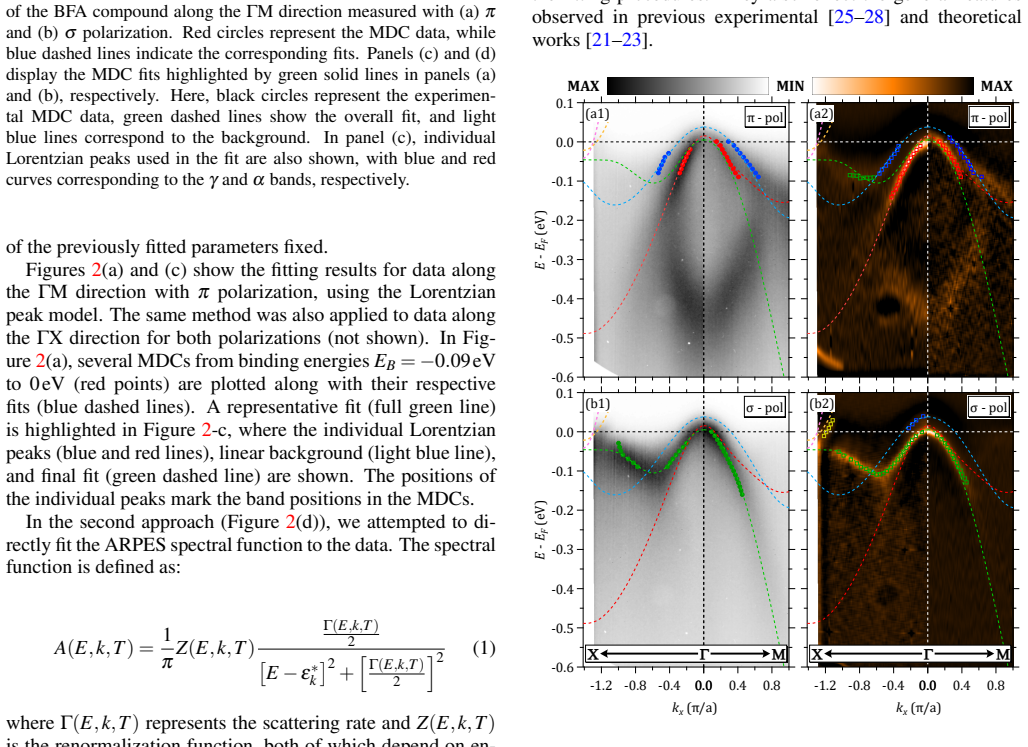
We present a systematic study of the evolution of the band structure in the Fe-based superconductor family BaFe$_{2-x}$M$_x$As$_2$ (M = Cr, Co, Cu, Ru and Mn) using polarization-dependent angle-resolved photoemission spectroscopy (ARPES). Low-substituted samples, with comparable spin-density wave transition temperatures ($T_\text{SDW}$), were chosen to facilitate controlled comparisons. The sizes of the central hole pockets ($\alpha$, $\beta$, and $\gamma$) remain largely unchanged across different substitutions, showing no clear correlation with either $T_\text{SDW}$ or the As height relative to the Fe planes. However, subtle trends are observed: a modest increase in the size of the $\eta_\text{X}$ electron pocket correlates with the suppression of $T_\text{SDW}$. Furthermore, the contraction of the $\eta_\text{X}$ pocket appears to be linked to an increase in the As height relative to the Fe planes. Our results suggest that the suppression of $T_\text{SDW}$ is primarily driven by changes in the Fe-As bond length, with the effect being more pronounced in electronic states with planar character. These findings provide insight into the electronic structure of BaFe$_{2-x}$M$_x$As$_2$.
Editorial analysis
A structured set of objections, weighed in public.
Referee Report
Summary. The paper reports a polarization-dependent ARPES study of band-structure evolution in low-substituted BaFe_{2-x}M_xAs_2 (M = Cr, Co, Cu, Ru, Mn) samples chosen to have comparable T_SDW. Hole-pocket sizes (α, β, γ) are reported as largely unchanged with no clear correlation to T_SDW or As height, while the η_X electron pocket exhibits subtle trends: a modest size increase that correlates with T_SDW suppression and a contraction linked to increased As height. The authors conclude that T_SDW suppression is driven primarily by Fe-As bond-length changes, with stronger effects in planar-character states.
Significance. If the reported trends in the η_X pocket survive quantitative error analysis and controls for dopant-specific confounders, the work would add useful experimental constraints on how local structural parameters (Fe-As distance) modulate the electronic states relevant to the SDW transition in the 122 family, complementing existing doping studies.
major comments (2)
- [Abstract] Abstract: the central claim that T_SDW suppression is 'primarily driven by changes in the Fe-As bond length' rests on qualitative visual inspection of ARPES maps; no quantitative error bars on pocket areas, no statistical test of the η_X–T_SDW correlation, and no explicit data-exclusion criteria are provided, leaving the robustness of the correlation unclear.
- [Abstract] Abstract: the choice of low-substitution samples with comparable T_SDW does not address potential confounding variables introduced by chemically distinct dopants (valence mismatch, ionic-size differences, disorder potentials) that can alter carrier density and scattering independently of As height; no decomposition or control measurements for these effects are described.
minor comments (1)
- The polarization dependence used to assign orbital character to the η_X pocket should be shown explicitly with raw data or matrix-element calculations in the main text or supplementary information.
Simulated Author's Rebuttal
We thank the referee for the constructive comments on our manuscript. We address the concerns about the quantitative robustness of the central claims and potential dopant-specific confounders below, providing the strongest honest responses based on the existing data and analysis.
read point-by-point responses
-
Referee: [Abstract] Abstract: the central claim that T_SDW suppression is 'primarily driven by changes in the Fe-As bond length' rests on qualitative visual inspection of ARPES maps; no quantitative error bars on pocket areas, no statistical test of the η_X–T_SDW correlation, and no explicit data-exclusion criteria are provided, leaving the robustness of the correlation unclear.
Authors: We agree that quantitative support strengthens the interpretation. The trends in the η_X pocket were identified through direct comparison of Fermi surface maps and energy-momentum cuts across samples, with the correlation to T_SDW and As height emerging from the systematic choice of comparable T_SDW. In the revised manuscript we will add error bars on extracted pocket areas (derived from Lorentzian fits to multiple momentum distribution curves) and include a Pearson correlation coefficient with p-value for the η_X size versus T_SDW trend. Data-exclusion criteria were limited to discarding spectra with poor signal-to-noise or surface contamination, as stated in the methods; we will make this explicit in a dedicated paragraph. revision: yes
-
Referee: [Abstract] Abstract: the choice of low-substitution samples with comparable T_SDW does not address potential confounding variables introduced by chemically distinct dopants (valence mismatch, ionic-size differences, disorder potentials) that can alter carrier density and scattering independently of As height; no decomposition or control measurements for these effects are described.
Authors: The low-substitution regime and matched T_SDW were chosen precisely to reduce the magnitude of dopant-specific effects while isolating structural changes. We acknowledge that valence mismatch, ionic radii, and disorder can still influence carrier density and scattering. The revised manuscript will expand the discussion section to compare our observed band shifts with published Hall-effect and resistivity data on the same doping series, thereby addressing possible carrier-density changes. However, our ARPES dataset does not contain the additional control samples or decomposition analysis needed to fully separate these contributions from the Fe-As bond-length effect. revision: partial
Circularity Check
No circularity: experimental ARPES observations with direct data interpretation
full rationale
This experimental ARPES study selects low-substituted samples with comparable T_SDW for comparisons and reports measured trends in hole and electron pocket sizes, noting no clear correlation for central hole pockets but modest trends for the η_X pocket linked to As height. The central suggestion that T_SDW suppression is driven by Fe-As bond length changes (more in planar states) is an interpretive summary of these direct measurements rather than any derivation, model fit, or self-referential construction. No equations, ansatzes, uniqueness theorems, or self-citations are invoked to force the result; the paper remains self-contained against external benchmarks with no reduction of claims to inputs by construction.
Axiom & Free-Parameter Ledger
axioms (2)
- domain assumption Polarization-dependent ARPES can cleanly separate bands of different orbital character in these materials.
- domain assumption Low substitution levels produce minimal additional disorder that would otherwise broaden or shift the observed pockets.
Lean theorems connected to this paper
-
IndisputableMonolith/Foundation/RealityFromDistinction.leanreality_from_one_distinction unclear?
unclearRelation between the paper passage and the cited Recognition theorem.
Our results suggest that the suppression of T_SDW is primarily driven by changes in the Fe-As bond length, with the effect being more pronounced in electronic states with planar character.
What do these tags mean?
- matches
- The paper's claim is directly supported by a theorem in the formal canon.
- supports
- The theorem supports part of the paper's argument, but the paper may add assumptions or extra steps.
- extends
- The paper goes beyond the formal theorem; the theorem is a base layer rather than the whole result.
- uses
- The paper appears to rely on the theorem as machinery.
- contradicts
- The paper's claim conflicts with a theorem or certificate in the canon.
- unclear
- Pith found a possible connection, but the passage is too broad, indirect, or ambiguous to say the theorem truly supports the claim.
Reference graph
Works this paper leans on
-
[1]
and van Roekeghemet al.[22] generally suggest that the FS is dominated byt2g orbitals, whereas thee g orbitals lie well belowE F or contribute only at specific regions of the BZ, such as near the Z point. Similar conclusions were reached by Pfau et al.[25] in their ARPES study of twinned and detwinned BFA, where nematicity was shown to induce a splitting ...
-
[2]
and Mn-substitution [29]. In fact, the Mn-substitution study showed that even at higher nominal substitution levels, theγband undergoes little evolution relative to the pure com- pound. In contrast, the Cr-BFA sample exhibits a markedly enlargedγpocket, consistent with previous reports, indicat- ing that Cr introduces hole doping and enhances the size of ...
work page 2017
-
[3]
Y . Kamihara, T. Watanabe, M. Hirano, and H. Hosono, J. Am. Chem. Soc.130, 3296 (2008)
work page 2008
- [4]
-
[5]
P. C. Canfield and S. L. Bud’ko, Annu. Rev. Condens. Matter Phys.1, 27 (2010)
work page 2010
- [6]
- [7]
- [8]
-
[9]
G. R. Stewart, Rev. Mod. Phys.83, 1589 (2011)
work page 2011
-
[10]
W. Yang, F.-J. Jia, L.-Y . Tang, Q. Tao, Z.-A. Xu, and X.-J. Chen, J. Appl. Phys.115, 083915 (2014)
work page 2014
- [11]
- [12]
-
[13]
C.-H. Lee, A. Iyo, H. Eisaki, H. Kito, M. T. Fernandez-Diaz, T. Ito, K. Kihou, H. Matsuhata, M. Braden, and K. Yamada, J. Phys. Soc. Jpn.77, 083704 (2008)
work page 2008
-
[14]
Y . Mizuguchi, Y . Hara, K. Deguchi, S. Tsuda, T. Yamaguchi, K. Takeda, H. Kotegawa, H. Tou, and Y . Takano, Supercond. Sci. Technol.23, 054013 (2010)
work page 2010
-
[15]
I. A. Nekrasov, Z. V . Pchelkina, and M. V . Sadovskii, JETP Lett. 88, 144 (2008)
work page 2008
-
[16]
L. Li, J. Wang, Y . Liang, Y . Cui, H. Tao, S. Liu, B. Song, J. Jian, Z. Zhang, and M. He, J. Mater. Sci.56, 16533 (2021)
work page 2021
- [17]
-
[18]
R. A. Jishi and H. M. Alyahyaei, Adv. Condens. Matter Phys. 2010, 804343 (2010)
work page 2010
-
[19]
D. Lu, M. Yi, S.-K. Mo, J. Analytis, J.-H. Chu, A. Erickson, D. Singh, Z. Hussain, T. Geballe, I. Fisher, and Z.-X. Shen, Physica C469, 452 (2009)
work page 2009
-
[20]
J. H. Shim, K. Haule, and G. Kotliar, Phys. Rev. B79, 060501 (2009)
work page 2009
- [21]
-
[22]
R. M. Fernandes, A. I. Coldea, H. Ding, I. R. Fisher, P. J. Hirschfeld, and G. Kotliar, Nature601, 35 (2022)
work page 2022
-
[23]
Z. P. Yin, K. Haule, and G. Kotliar, Nat. Mater.10, 932 (2011)
work page 2011
-
[24]
A. van Roekeghem, P. Richard, H. Ding, and S. Biermann, C. R. Phys.17, 140 (2016)
work page 2016
- [25]
-
[26]
Y . Wang, M. N. Gastiasoro, B. M. Andersen, M. Tomi´c, H. O. Jeschke, R. Valentí, I. Paul, and P. Hirschfeld, Phys. Rev. Lett. 114, 097003 (2015)
work page 2015
-
[27]
H. Pfau, C. R. Rotundu, J. C. Palmstrom, S. D. Chen, M. Hashimoto, D. Lu, A. F. Kemper, I. R. Fisher, and Z.-X. Shen, Phys. Rev. B99, 035118 (2019)
work page 2019
-
[28]
D. V . Evtushinsky, V . B. Zabolotnyy, T. K. Kim, A. A. Kordyuk, A. N. Yaresko, J. Maletz, S. Aswartham, S. Wurmehl, A. V . Boris, D. L. Sun, C. T. Lin, B. Shen, H. H. Wen, A. Varykhalov, R. Follath, B. Büchner, and S. V . Borisenko, Phys. Rev. B89, 064514 (2014)
work page 2014
-
[29]
B. Mansart, V . Brouet, E. Papalazarou, M. Fuglsang Jensen, L. Petaccia, S. Gorovikov, A. N. Grum-Grzhimailo, F. Rullier- Albenque, A. Forget, D. Colson, and M. Marsi, Phys. Rev. B 83, 064516 (2011)
work page 2011
- [30]
-
[31]
M. R. Cantarino, K. R. Pakuszewski, B. Salzmann, P. H. A. Moya, W. R. d. S. Neto, G. S. Freitas, P. G. Pagliuso, W. H. Brito, C. Monney, C. Adriano, and F. A. Garcia, Phys. Rev. B 108, 245124 (2023)
work page 2023
-
[32]
M. R. Cantarino, K. R. Pakuszewski, B. Salzmann, P. H. A. Moya, W. R. da Silva Neto, G. S. Freitas, P. G. Pagliuso, C. Adriano, W. H. Brito, and F. A. Garcia, SciPost Phys.17, 141 (2024)
work page 2024
-
[33]
J. Fink, E. D. L. Rienks, M. Yao, R. Kurleto, J. Bannies, S. Aswartham, I. Morozov, S. Wurmehl, T. Wolf, F. Hardy, C. Meingast, H. S. Jeevan, J. Maiwald, P. Gegenwart, C. Felser, and B. Büchner, Phys. Rev. B103, 155119 (2021)
work page 2021
-
[34]
E. M. Bittar, C. Adriano, T. M. Garitezi, P. F. S. Rosa, L. Men- don ça Ferreira, F. Garcia, G. d. M. Azevedo, P. G. Pagliuso, and E. Granado, Phys. Rev. Lett.107, 267402 (2011)
work page 2011
-
[35]
T. M. Garitezi, C. Adriano, P. F. S. Rosa, E. M. Bittar, L. Bu- faiçal, R. L. d. Almeida, E. Granado, T. Grant, Z. Fisk, M. A. Avila, R. A. Ribeiro, P. L. Kuhns, A. P. Reyes, R. R. Urbano, and P. G. Pagliuso, Braz. J. Phys.43, 223 (2013)
work page 2013
-
[36]
A. Damascelli, Z. Hussain, and Z.-X. Shen, Rev. Mod. Phys. 75, 473 (2003)
work page 2003
-
[37]
See Supplemental Material at, [url will be inserted by pub- lisher], for details of ARPES analysis and fittings
- [38]
-
[39]
I. Avigo, S. Thirupathaiah, E. D. L. Rienks, L. Rettig, A. Char- nukha, M. Ligges, R. Cortes, J. Nayak, H. S. Jeevan, T. Wolf, Y . Huang, S. Wurmehl, M. I. Sturza, P. Gegenwart, M. S. Golden, L. X. Yang, K. Rossnagel, M. Bauer, B. Büchner, M. V ojta, M. Wolf, C. Felser, J. Fink, and U. Bovensiepen, Phys. Status Solidi B254, 1600382 (2017)
work page 2017
-
[40]
W. Zhang,Photoemission Spectroscopy on High Temperature Superconductor(Springer Berlin Heidelberg, 2013)
work page 2013
-
[41]
J. Fink, E. D. L. Rienks, S. Thirupathaiah, J. Nayak, A. van Roekeghem, S. Biermann, T. Wolf, P. Adelmann, H. S. Jeevan, P. Gegenwart, S. Wurmehl, C. Felser, and B. Buechner, Phys. Rev. B95, 144513 (2017)
work page 2017
-
[42]
J. A. Sobota, Y . He, and Z.-X. Shen, Rev. Mod. Phys.93, 025006 (2021)
work page 2021
-
[43]
M. Yi, D. H. Lu, R. Yu, S. C. Riggs, J.-H. Chu, B. Lv, Z. K. Liu, M. Lu, Y .-T. Cui, M. Hashimoto, S.-K. Mo, Z. Hussain, C. W. Chu, I. R. Fisher, Q. Si, and Z.-X. Shen, Phys. Rev. Lett.110, 067003 (2013)
work page 2013
-
[44]
M. Yi, Z. K. Liu, Y . Zhang, R. Yu, J. X. Zhu, J. J. Lee, R. G. Moore, F. T. Schmitt, W. Li, S. C. Riggs, J. H. Chu, B. Lv, J. Hu, M. Hashimoto, S. K. Mo, Z. Hussain, Z. Q. Mao, C. W. Chu, I. R. Fisher, Q. Si, Z. X. Shen, and D. H. Lu, Nat. Commun.6 (2015)
work page 2015
-
[45]
H. Miao, Z. P. Yin, S. F. Wu, J. M. Li, J. Ma, B.-Q. Lv, X. P. Wang, T. Qian, P. Richard, L.-Y . Xing, X.-C. Wang, C. Q. Jin, K. Haule, G. Kotliar, and H. Ding, Phys. Rev. B94, 201109 (2016)
work page 2016
- [46]
- [47]
-
[48]
L. D. Landau, Sov. Phys. JETP8, 70 (1959)
work page 1959
- [49]
-
[50]
G. R. Stewart, Rev. Mod. Phys.73, 797 (2001)
work page 2001
-
[51]
C. M. Varma, Rev. Mod. Phys.92, 031001 (2020)
work page 2020
-
[52]
C. M. Varma, P. B. Littlewood, S. Schmitt-Rink, E. Abrahams, and A. E. Ruckenstein, Phys. Rev. Lett.63, 1996 (1989)
work page 1996
discussion (0)
Sign in with ORCID, Apple, or X to comment. Anyone can read and Pith papers without signing in.