Parameter Space Analysis through Guided Visual Interpolations
Pith reviewed 2026-05-18 13:55 UTC · model grok-4.3
The pith
A visual tool lets users interpolate through high-dimensional parameter spaces toward optimal settings with XAI guidance.
A machine-rendered reading of the paper's core claim, the machinery that carries it, and where it could break.
Core claim
ParamInter is a novel tool for high-dimensional input parameter space analysis by making interpolation towards optimal parameter sets explorable using guided analytics. The interpolation is accompanied by both small multiples in linked views and utilizes t-SNE representations to show an interpolation overview, with guidance coming from state-of-the-art effect-based XAI and uncertainty quantification approaches integrated into an exploration loop focused on moving from initial to target parameters.
What carries the argument
Guided exploration loop that interpolates between initial and user-specified target parameters while overlaying XAI effect suggestions, uncertainty quantification, t-SNE overviews, and small multiples of input parameters in linked views.
If this is right
- Users gain a concrete visual path showing how each input parameter evolves from start to optimum instead of only seeing final values.
- XAI effect suggestions appear at each interpolation step to highlight which changes most influence the outputs.
- Uncertainty information is carried along the interpolation so users can judge the reliability of intermediate points.
- The same workflow applies directly to other multi-objective engineering problems once a surrogate model is available.
Where Pith is reading between the lines
- The method could be paired with active learning loops that propose new simulation runs along promising interpolation segments.
- Similar guided interpolation might help in hyperparameter tuning for machine learning models where the space is also high-dimensional.
- The small-multiples layer suggests a natural extension to time-varying or ensemble simulations by animating parameter changes.
Load-bearing premise
That integrating effect-based XAI and uncertainty quantification will give users reliable and effective guidance during the interpolation process toward chosen targets.
What would settle it
A controlled user study in which participants using the tool show no measurable gain in speed, accuracy, or insight when identifying better parameter paths compared with a version lacking the XAI and UQ guidance layers.
Figures


read the original abstract
We propose Parameter Space Analysis through Guided Visual Interpolations (ParamInter), a novel tool for high-dimensional input parameter space analysis by making interpolation towards optimal parameter sets explorable using guided analytics. The interpolation is accompanied by both small multiples in linked views and utilizes t-Distributed Stochastic Neighbor Embedding (t-SNE) representations to show an interpolation overview. ParamInter uses a guided exploration loop focusing on the interpolation towards user-specified target parameters from many output parameters. The exploration process is additionally guided through eXplainable Artificial Intelligence (XAI)-based effect suggestions throughout our tool. ParamInter, compared to prior work, focuses on the integration of state-of-the art effect-based XAI and Uncertainty Quantification (UCQ) approaches for guidance, and introduces an interpolation towards the optimal solution through interpolation between the initial parameter setting and the optimal setting. We also add an interpretability layer for dimensionality-reduced data by displaying our novel interpolation towards the optimum, enhanced by small multiples of the input parameters on top. We demonstrate the direct applicability of our tool on a real-world use case for a blast furnace optimisation process, where a multi-objective problem is solved through modeling and visualisation.
Editorial analysis
A structured set of objections, weighed in public.
Referee Report
Summary. The paper proposes ParamInter, a visualization tool for high-dimensional parameter space analysis in optimization. It supports guided exploration of interpolations from initial to user-specified or optimal parameter settings, using t-SNE for an overview, linked small-multiples views, and guidance derived from effect-based XAI and Uncertainty Quantification methods. The approach is illustrated via a demonstration on a real-world blast furnace multi-objective optimization process.
Significance. If the guided interpolation loop and XAI/UCQ integration can be shown to reliably improve exploration, the tool could advance visual analytics for complex engineering parameter spaces by enhancing interpretability during navigation toward optima. The real-world demonstration is a strength, but the lack of supporting evidence for the guidance effectiveness reduces the assessed significance at present.
major comments (3)
- [Abstract] Abstract: The central claim that integration of state-of-the-art effect-based XAI and Uncertainty Quantification provides effective and reliable guidance throughout the interpolation exploration loop is unsupported by any quantitative evidence. No metrics (e.g., task completion time, success rate, distance to optimum, or comparison against unguided baselines) or ablation studies are reported to validate that the guidance improves outcomes over standard interpolation.
- [Demonstration] Demonstration section: The blast-furnace use case describes direct applicability but provides no concrete details on which specific XAI methods (e.g., SHAP, partial dependence plots) are employed, how their outputs are mapped onto the t-SNE overview or small-multiples views, or any assessment of guidance reliability during the loop from initial to target parameters.
- [Method] Method description: The interpolation mechanism toward the optimal solution is introduced as a core novelty, yet the manuscript does not specify the interpolation function (linear, spline, or model-driven), how it is constrained by the guided analytics, or how uncertainty quantification modulates the visual suggestions.
minor comments (2)
- The abstract contains several long sentences that could be split to improve readability and clarity of the tool's contributions.
- Figure captions for the t-SNE and small-multiples views should explicitly state how XAI effect suggestions are visually encoded (color, size, or annotations).
Simulated Author's Rebuttal
We thank the referee for their constructive feedback on our manuscript. We have carefully considered each comment and provide detailed responses below. Where appropriate, we have made revisions to improve the paper.
read point-by-point responses
-
Referee: [Abstract] Abstract: The central claim that integration of state-of-the-art effect-based XAI and Uncertainty Quantification provides effective and reliable guidance throughout the interpolation exploration loop is unsupported by any quantitative evidence. No metrics (e.g., task completion time, success rate, distance to optimum, or comparison against unguided baselines) or ablation studies are reported to validate that the guidance improves outcomes over standard interpolation.
Authors: We acknowledge the lack of quantitative metrics in the current manuscript. The paper presents ParamInter as a visualization tool with a demonstration on a real-world use case, emphasizing qualitative insights from the blast furnace optimization. To address this, we have revised the abstract to focus on the tool's capabilities rather than claiming 'effective and reliable' without evidence, and added a paragraph in the discussion section outlining plans for future user studies with metrics such as task completion time and comparisons to baselines. revision: partial
-
Referee: [Demonstration] Demonstration section: The blast-furnace use case describes direct applicability but provides no concrete details on which specific XAI methods (e.g., SHAP, partial dependence plots) are employed, how their outputs are mapped onto the t-SNE overview or small-multiples views, or any assessment of guidance reliability during the loop from initial to target parameters.
Authors: We have expanded the Demonstration section to provide concrete details. Specifically, we employ SHAP for effect-based XAI to identify influential parameters and partial dependence plots for visualizing effects. These outputs are mapped by highlighting high-impact parameters in the t-SNE overview and updating the small-multiples views accordingly. We include an assessment of guidance reliability by showing how the suggestions led to parameter settings closer to the optimal in the multi-objective optimization. revision: yes
-
Referee: [Method] Method description: The interpolation mechanism toward the optimal solution is introduced as a core novelty, yet the manuscript does not specify the interpolation function (linear, spline, or model-driven), how it is constrained by the guided analytics, or how uncertainty quantification modulates the visual suggestions.
Authors: We have updated the Method section to specify that the interpolation uses a linear function between the initial parameter setting and the optimal setting. The guided analytics constrain the path by weighting steps based on XAI effect magnitudes, focusing on parameters with significant impact. Uncertainty Quantification modulates the visual suggestions by adjusting the opacity or step size of suggested interpolations to reflect confidence levels. revision: yes
Circularity Check
No circularity: tool proposal with no derivations or fitted predictions
full rationale
The paper is a design and demonstration of a visualization tool (ParamInter) for exploring parameter spaces via guided interpolations, t-SNE overviews, small multiples, and integration of existing XAI/UCQ methods. No equations, first-principles derivations, parameter fits, or predictions are presented that could reduce to inputs by construction. Claims about guidance effectiveness and applicability rest on the described system architecture and a real-world use-case demonstration rather than any self-referential loop or renamed result. Self-citations, if present, are not load-bearing for any core claim. The work is self-contained as an engineering contribution without circular reasoning.
Axiom & Free-Parameter Ledger
Lean theorems connected to this paper
-
IndisputableMonolith/Cost/FunctionalEquation.leanwashburn_uniqueness_aczel unclear?
unclearRelation between the paper passage and the cited Recognition theorem.
We propose Parameter Space Analysis through Guided Visual Interpolations (ParamInter)... interpolation towards optimal parameter sets... t-SNE representations... XAI-based effect suggestions... SmoothGrad (SG) to guide the user... convex combination xλ = λx0 + x1(1−λ)
-
IndisputableMonolith/Foundation/DimensionForcing.leanalexander_duality_circle_linking unclear?
unclearRelation between the paper passage and the cited Recognition theorem.
The dataset contains a total of 324632 data samples... six input ratios and 64 resulting elemental composition...
What do these tags mean?
- matches
- The paper's claim is directly supported by a theorem in the formal canon.
- supports
- The theorem supports part of the paper's argument, but the paper may add assumptions or extra steps.
- extends
- The paper goes beyond the formal theorem; the theorem is a base layer rather than the whole result.
- uses
- The paper appears to rely on the theorem as machinery.
- contradicts
- The paper's claim conflicts with a theorem or certificate in the canon.
- unclear
- Pith found a possible connection, but the passage is too broad, indirect, or ambiguous to say the theorem truly supports the claim.
Reference graph
Works this paper leans on
-
[1]
M. Bostock, V . Ogievetsky, and J. Heer. D3: Data-driven documents. IEEE Trans. Visualization & Comp. Graphics (Proc. InfoVis), 2011. 2
work page 2011
-
[2]
K. Bugelnig and G. Requena. SciVisContest - Materials Discovery Challenge - version 2025, 2024. doi: 10.5281/ZENODO.15189444 1
-
[3]
S. Chen, D. Amid, O. M. Shir, L. Limonad, D. Boaz, A. Anaby-Tavor, and T. Schreck. Self-organizing maps for multi-objective pareto fron- tiers. In2013 IEEE Pacific Visualization Symposium (PacificVis), pp. 153–160, 2013. doi: 10.1109/PacificVis.2013.6596140 1
-
[4]
L. Cibulski, H. Mitterhofer, T. May, and J. Kohlhammer. Paved: Pareto front visualization for engineering design.Computer Graph- ics Forum, 39(3):405–416, June 2020. doi: 10.1111/cgf.13990 1
-
[5]
S. Goguelin, J. M. Flynn, W. P. Essink, and V . Dhokia. A data visu- alization dashboard for exploring the additive manufacturing solution space.Procedia CIRP, 60:193–198, 2017. doi: 10.1016/j.procir.2017 .01.016 1
- [6]
-
[7]
S. Raschka, J. Patterson, and C. Nolet. Machine learning in python: Main developments and technology trends in data science, machine learning, and artificial intelligence, 2020. 2
work page 2020
-
[8]
SmoothGrad: removing noise by adding noise
D. Smilkov, N. Thorat, B. Kim, F. B. Vi ´egas, and M. Watten- berg. Smoothgrad: removing noise by adding noise.CoRR, abs/1706.03825, 2017. 1
work page internal anchor Pith review Pith/arXiv arXiv 2017
-
[9]
L. van der Maaten and G. Hinton. Visualizing data using t-sne.Jour- nal of Machine Learning Research, 9(86):2579–2605, 2008. 1
work page 2008
-
[10]
J. Yang, M. O. Ward, and E. A. Rundensteiner. Interactive hierarchi- cal displays: a general framework for visualization and exploration of large multivariate data sets.Computers & Graphics, 27(2):265–283,
-
[11]
doi: 10.1016/S0097-8493(02)00283-2 1
-
[12]
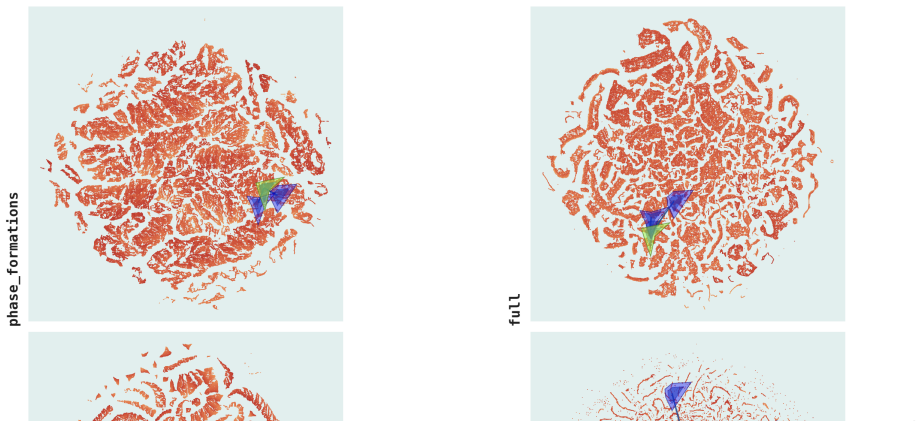
H. Zhang, S. Si, and C.-J. Hsieh. Gpu-acceleration for large-scale tree boosting, 2017. 1 Figure 2: Search Interface for the initial point search. Figure 3: Interface for the output parameter setting, with sensitivity guides. Figure 4: Selection and embedding preview for possible input configuration for the intended outputs. Figure 5: Interpolation overvi...
work page 2017
discussion (0)
Sign in with ORCID, Apple, or X to comment. Anyone can read and Pith papers without signing in.