Incomplete Data, Complete Dynamics: A Diffusion Approach
Pith reviewed 2026-05-18 14:14 UTC · model grok-4.3
The pith
Diffusion training on incomplete data converges asymptotically to the true complete generative process for physical dynamics.
A machine-rendered reading of the paper's core claim, the machinery that carries it, and where it could break.
Core claim
The central claim is that the diffusion training paradigm on incomplete data achieves asymptotic convergence to the true complete generative process under mild regularity conditions. This is realized by strategically partitioning each incomplete sample into observed context and unobserved query components and training a conditional diffusion model to reconstruct the missing query portions given the available contexts, thereby enabling accurate imputation across arbitrary observation patterns without complete data supervision.
What carries the argument
The splitting strategy that partitions each incomplete sample into observed context and unobserved query components, allowing the conditional diffusion model to reconstruct missing portions and recover the full dynamics.
If this is right
- Accurate imputation is possible across arbitrary observation patterns without requiring complete data supervision.
- The method significantly outperforms existing baselines on synthetic and real-world physical dynamics benchmarks including fluid flows and weather systems.
- Particularly strong performance holds in limited and irregular observation regimes.
- The approach supplies a theoretically principled route to learning and imputing partially observed dynamics.
Where Pith is reading between the lines
- The convergence guarantee may extend to other generative modeling families if an analogous conditional splitting can be defined.
- This suggests incomplete observational streams could suffice for online or continual learning of dynamics in sensor networks.
- Integration with physics-informed regularizers might further stabilize the recovered dynamics on very sparse real-world data.
- The framework could be tested on non-physical systems such as epidemiological or financial time series that share irregular sampling traits.
Load-bearing premise
The carefully designed splitting strategy that partitions each incomplete sample into observed context and unobserved query components is sufficient to enable the conditional diffusion model to recover the full underlying dynamics.
What would settle it
Training the model on a synthetic complete dataset with known dynamics and then checking whether the learned conditional distribution matches the true generative process when queries are masked according to the splitting rule; systematic mismatch on held-out complete trajectories would falsify the asymptotic convergence result.
Figures




read the original abstract
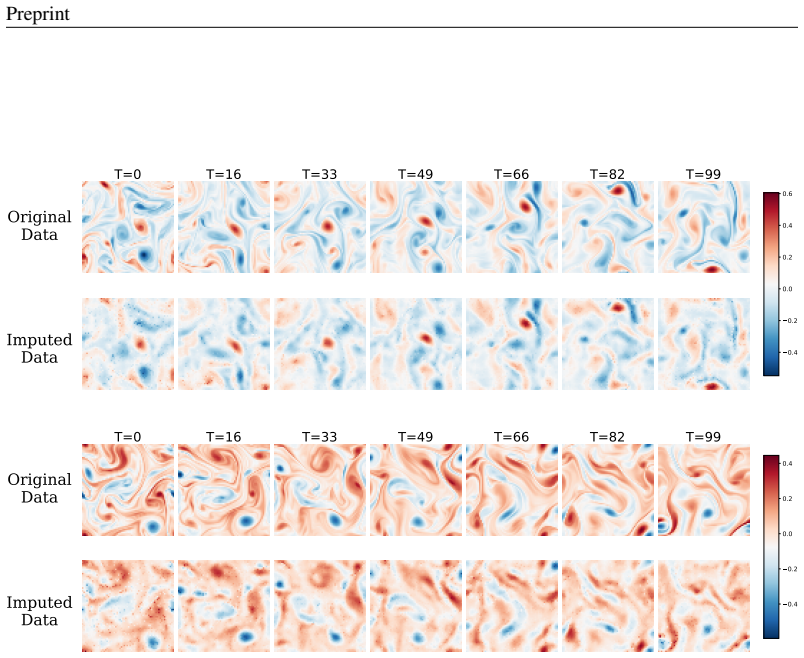
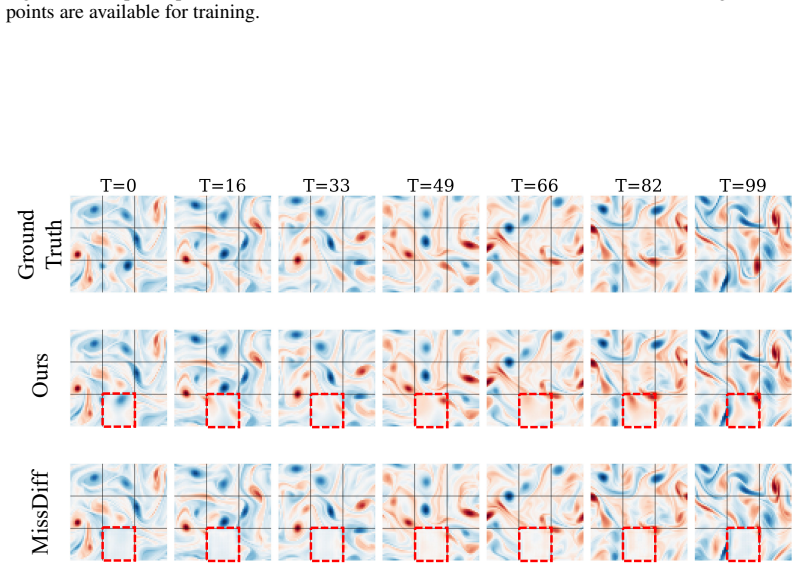
Learning physical dynamics from data is a fundamental challenge in machine learning and scientific modeling. Real-world observational data are inherently incomplete and irregularly sampled, posing significant challenges for existing data-driven approaches. In this work, we propose a principled diffusion-based framework for learning physical systems from incomplete training samples. To this end, our method strategically partitions each such sample into observed context and unobserved query components through a carefully designed splitting strategy, then trains a conditional diffusion model to reconstruct the missing query portions given available contexts. This formulation enables accurate imputation across arbitrary observation patterns without requiring complete data supervision. Specifically, we provide theoretical analysis demonstrating that our diffusion training paradigm on incomplete data achieves asymptotic convergence to the true complete generative process under mild regularity conditions. Empirically, we show that our method significantly outperforms existing baselines on synthetic and real-world physical dynamics benchmarks, including fluid flows and weather systems, with particularly strong performance in limited and irregular observation regimes. These results demonstrate the effectiveness of our theoretically principled approach for learning and imputing partially observed dynamics.
Editorial analysis
A structured set of objections, weighed in public.
Referee Report
Summary. The paper introduces a diffusion-based framework for learning physical dynamics from incomplete and irregularly sampled data. Each incomplete sample is partitioned into observed context and unobserved query components using a designed splitting strategy. A conditional diffusion model is trained to reconstruct the query from the context, enabling imputation for arbitrary observation patterns. The authors provide theoretical analysis showing asymptotic convergence to the true complete generative process under mild regularity conditions and demonstrate empirical outperformance over baselines on synthetic and real-world benchmarks such as fluid flows and weather systems.
Significance. If the theoretical result holds, this work would offer a significant advance in data-driven modeling of physical systems by handling incomplete observations without requiring complete data. The approach could improve accuracy in scientific applications like fluid dynamics and meteorology where data is often partial. The empirical results indicate particular strength in limited and irregular observation settings, which are common in practice.
major comments (2)
- [Theoretical Analysis] The central convergence claim relies on the splitting strategy inducing a training distribution where the conditional diffusion loss recovers the full joint score function. However, the manuscript treats the splitting operator as given without deriving the required measure-theoretic or measure-preserving properties for equivalence to score matching on full trajectories. This is load-bearing for the asymptotic convergence result to the true complete generative process.
- [§4.2] The mild regularity conditions under which convergence is claimed are not specified in detail; without explicit statement of these conditions and how they ensure the conditional model recovers the underlying dynamics, the support for the claim remains incomplete.
minor comments (2)
- [Experiments] The description of the experimental protocols could be expanded to include more details on how the incomplete data is generated for the benchmarks.
- [Notation] Some notation in the method section could be clarified for readers unfamiliar with conditional diffusion models.
Simulated Author's Rebuttal
We thank the referee for their careful reading and constructive feedback. We address the two major comments below and will revise the manuscript to provide the requested clarifications and derivations in the theoretical analysis.
read point-by-point responses
-
Referee: [Theoretical Analysis] The central convergence claim relies on the splitting strategy inducing a training distribution where the conditional diffusion loss recovers the full joint score function. However, the manuscript treats the splitting operator as given without deriving the required measure-theoretic or measure-preserving properties for equivalence to score matching on full trajectories. This is load-bearing for the asymptotic convergence result to the true complete generative process.
Authors: We appreciate the referee pointing out this key technical step. The current manuscript presents the high-level argument that the splitting induces the desired conditional training distribution but does not contain an explicit measure-theoretic derivation of the required properties. In the revision we will add a dedicated appendix subsection that formally shows the splitting operator is measure-preserving with respect to the data measure and that the conditional score-matching objective is equivalent to score matching on the full trajectories, thereby supporting the asymptotic convergence claim. revision: yes
-
Referee: [§4.2] The mild regularity conditions under which convergence is claimed are not specified in detail; without explicit statement of these conditions and how they ensure the conditional model recovers the underlying dynamics, the support for the claim remains incomplete.
Authors: We agree that the regularity conditions should be stated more explicitly. In the revised §4.2 we will enumerate the precise assumptions (Lipschitz continuity of the vector field, standard Gaussian noise schedule, finite second moments of the data distribution, and compactness of the observation mask set) and insert a short proof sketch showing how each condition guarantees that the conditional diffusion process converges in distribution to the true complete generative process. revision: yes
Circularity Check
No circularity: theoretical convergence claim rests on external regularity conditions and splitting strategy without reduction to inputs by construction.
full rationale
The paper's derivation presents a conditional diffusion model trained on context-query splits from incomplete samples, with a theoretical result claiming asymptotic convergence to the true generative process under mild regularity conditions. No equations or steps in the abstract or description reduce the claimed convergence to a fitted parameter, self-definition, or self-citation chain; the splitting strategy is introduced as a design choice enabling the conditional objective rather than being derived from the target result itself. The analysis is framed as independent of the specific fitted values and relies on stated external assumptions, making the chain self-contained.
Axiom & Free-Parameter Ledger
axioms (1)
- domain assumption mild regularity conditions
Lean theorems connected to this paper
-
Cost.FunctionalEquationwashburn_uniqueness_aczel unclear?
unclearRelation between the paper passage and the cited Recognition theorem.
Theorem 1 (Optimal solution under context masking...): xθ(t,Mctx ⊙ xobs,t,Mctx) = E[x0 | Mctx ⊙ xobs,t,Mctx] when union of query supports covers all dimensions.
-
Foundation.BranchSelectionbranch_selection unclear?
unclearRelation between the paper passage and the cited Recognition theorem.
Principle 1 (Principle of uniform query exposure): P((Mqry)i=1 | Mctx) > 0 and approximately uniform for all unobserved dimensions.
-
Foundation.RealityFromDistinctionreality_from_one_distinction unclear?
unclearRelation between the paper passage and the cited Recognition theorem.
Theorem 2 (Ensemble approximation convergence): lim K→∞ E[||μ̂K − E[x0|obs]||²] = ||E[E[x0|ctx]] − E[x0|obs] + E[b(ctx)]||²
What do these tags mean?
- matches
- The paper's claim is directly supported by a theorem in the formal canon.
- supports
- The theorem supports part of the paper's argument, but the paper may add assumptions or extra steps.
- extends
- The paper goes beyond the formal theorem; the theorem is a base layer rather than the whole result.
- uses
- The paper appears to rely on the theorem as machinery.
- contradicts
- The paper's claim conflicts with a theorem or certificate in the canon.
- unclear
- Pith found a possible connection, but the passage is too broad, indirect, or ambiguous to say the theorem truly supports the claim.
Reference graph
Works this paper leans on
-
[1]
Stochastic interpolants with data-dependent couplings
Michael S Albergo, Mark Goldstein, Nicholas M Boffi, Rajesh Ranganath, and Eric Vanden-Eijnden. Stochastic interpolants with data-dependent couplings. arXiv preprint arXiv:2310.03725, 2023
-
[2]
Giovanni S Alberti and Matteo Santacesaria. Infinite dimensional compressed sensing from anisotropic measurements and applications to inverse problems in pde. Applied and Computational Harmonic Analysis, 50: 0 105--146, 2021
work page 2021
-
[3]
Navier-stokes, fluid dynamics, and image and video inpainting
Marcelo Bertalmio, Andrea L Bertozzi, and Guillermo Sapiro. Navier-stokes, fluid dynamics, and image and video inpainting. In Proceedings of the 2001 IEEE Computer Society Conference on Computer Vision and Pattern Recognition. CVPR 2001, volume 1, pp.\ I--I. IEEE, 2001
work page 2001
-
[4]
Pattern recognition and machine learning, volume 4
Christopher M Bishop and Nasser M Nasrabadi. Pattern recognition and machine learning, volume 4. Springer, 2006
work page 2006
-
[5]
Promising directions of machine learning for partial differential equations
Steven L Brunton and J Nathan Kutz. Promising directions of machine learning for partial differential equations. Nature Computational Science, 4 0 (7): 0 483--494, 2024
work page 2024
-
[6]
Navier-stokes dataset of isotropic turbulence in a periodic box, 2024
Shuhao Cao. Navier-stokes dataset of isotropic turbulence in a periodic box, 2024. URL https://huggingface.co/datasets/scaomath/navier-stokes-dataset. Funded by National Science Foundation: NSF award DMS-2309778
work page 2024
-
[7]
Hanyang Chen, Yang Jiang, Shengnan Guo, Xiaowei Mao, Youfang Lin, and Huaiyu Wan. Difflight: a partial rewards conditioned diffusion model for traffic signal control with missing data. Advances in Neural Information Processing Systems, 37: 0 123353--123378, 2024 a
work page 2024
-
[8]
Rethinking the diffusion models for missing data imputation: A gradient flow perspective
Zhichao Chen, Haoxuan Li, Fangyikang Wang, Odin Zhang, Hu Xu, Xiaoyu Jiang, Zhihuan Song, and Hao Wang. Rethinking the diffusion models for missing data imputation: A gradient flow perspective. Advances in Neural Information Processing Systems, 37: 0 112050--112103, 2024 b
work page 2024
-
[9]
Diffusion Posterior Sampling for General Noisy Inverse Problems
Hyungjin Chung, Jeongsol Kim, Michael T Mccann, Marc L Klasky, and Jong Chul Ye. Diffusion posterior sampling for general noisy inverse problems. arXiv preprint arXiv:2209.14687, 2022
work page internal anchor Pith review Pith/arXiv arXiv 2022
-
[10]
Artificial intelligence for weather forecasting
Silvia Conti. Artificial intelligence for weather forecasting. Nature Reviews Electrical Engineering, 1 0 (1): 0 8--8, 2024
work page 2024
-
[11]
Latentpaint: Image inpainting in latent space with diffusion models
Ciprian Corneanu, Raghudeep Gadde, and Aleix M Martinez. Latentpaint: Image inpainting in latent space with diffusion models. In Proceedings of the IEEE/CVF winter conference on applications of computer vision, pp.\ 4334--4343, 2024
work page 2024
-
[12]
Sadi: Similarity-aware diffusion model-based imputation for incomplete temporal ehr data
Zongyu Dai, Emily Getzen, and Qi Long. Sadi: Similarity-aware diffusion model-based imputation for incomplete temporal ehr data. In International Conference on Artificial Intelligence and Statistics, pp.\ 4195--4203. PMLR, 2024
work page 2024
-
[13]
Ambient diffusion: Learning clean distributions from corrupted data
Giannis Daras, Kulin Shah, Yuval Dagan, Aravind Gollakota, Alex Dimakis, and Adam Klivans. Ambient diffusion: Learning clean distributions from corrupted data. Advances in Neural Information Processing Systems, 36: 0 288--313, 2023
work page 2023
-
[14]
Learning signal-agnostic manifolds of neural fields
Yilun Du, Katie Collins, Josh Tenenbaum, and Vincent Sitzmann. Learning signal-agnostic manifolds of neural fields. Advances in Neural Information Processing Systems, 34: 0 8320--8331, 2021
work page 2021
-
[15]
Causal deciphering and inpainting in spatio-temporal dynamics via diffusion model
Yifan Duan, Jian Zhao, Junyuan Mao, Hao Wu, Jingyu Xu, Caoyuan Ma, Kai Wang, Kun Wang, Xuelong Li, et al. Causal deciphering and inpainting in spatio-temporal dynamics via diffusion model. Advances in Neural Information Processing Systems, 37: 0 107604--107632, 2024
work page 2024
-
[16]
From data to functa: Your data point is a function and you can treat it like one
Emilien Dupont, Hyunjik Kim, SM Eslami, Danilo Rezende, and Dan Rosenbaum. From data to functa: Your data point is a function and you can treat it like one. arXiv preprint arXiv:2201.12204, 2022
-
[17]
Tweedie’s formula and selection bias
Bradley Efron. Tweedie’s formula and selection bias. Journal of the American Statistical Association, 106 0 (496): 0 1602--1614, 2011
work page 2011
-
[18]
Score matching with missing data
Josh Givens, Song Liu, and Henry WJ Reeve. Score matching with missing data. arXiv preprint arXiv:2506.00557, 2025
-
[19]
Manoj Kumar Goshisht. Machine learning and deep learning in synthetic biology: Key architectures, applications, and challenges. ACS omega, 9 0 (9): 0 9921--9945, 2024
work page 2024
-
[20]
Hans Hersbach, Bill Bell, Paul Berrisford, Shoji Hirahara, Andr \'a s Hor \'a nyi, Joaqu \' n Mu \ n oz-Sabater, Julien Nicolas, Carole Peubey, Raluca Radu, Dinand Schepers, et al. The era5 global reanalysis. Quarterly journal of the royal meteorological society, 146 0 (730): 0 1999--2049, 2020
work page 1999
-
[21]
Denoising diffusion probabilistic models
Jonathan Ho, Ajay Jain, and Pieter Abbeel. Denoising diffusion probabilistic models. Advances in neural information processing systems, 2020
work page 2020
-
[22]
Temporally coherent completion of dynamic video
Jia-Bin Huang, Sing Bing Kang, Narendra Ahuja, and Johannes Kopf. Temporally coherent completion of dynamic video. ACM Transactions on Graphics (ToG), 35 0 (6): 0 1--11, 2016
work page 2016
-
[23]
Diffusionpde: Generative pde-solving under partial observation
Jiahe Huang, Guandao Yang, Zichen Wang, and Jeong Joon Park. Diffusionpde: Generative pde-solving under partial observation. arXiv preprint arXiv:2406.17763, 2024
-
[24]
not-miwae: Deep generative modelling with missing not at random data
Niels Bruun Ipsen, Pierre-Alexandre Mattei, and Jes Frellsen. not-miwae: Deep generative modelling with missing not at random data. arXiv preprint arXiv:2006.12871, 2020
-
[25]
Analyzing and improving the training dynamics of diffusion models
Tero Karras, Miika Aittala, Jaakko Lehtinen, Janne Hellsten, Timo Aila, and Samuli Laine. Analyzing and improving the training dynamics of diffusion models. In Proceedings of the IEEE/CVF Conference on Computer Vision and Pattern Recognition, pp.\ 24174--24184, 2024
work page 2024
-
[26]
Noise2score: tweedie’s approach to self-supervised image denoising without clean images
Kwanyoung Kim and Jong Chul Ye. Noise2score: tweedie’s approach to self-supervised image denoising without clean images. Advances in Neural Information Processing Systems, 34: 0 864--874, 2021
work page 2021
-
[28]
Jean-Marie Lemercier, Julius Richter, Simon Welker, Eloi Moliner, Vesa V \"a lim \"a ki, and Timo Gerkmann. Diffusion models for audio restoration: A review [special issue on model-based and data-driven audio signal processing]. IEEE Signal Processing Magazine, 41 0 (6): 0 72--84, 2025
work page 2025
-
[29]
Learning from irregularly-sampled time series: A missing data perspective
Steven Cheng-Xian Li and Benjamin Marlin. Learning from irregularly-sampled time series: A missing data perspective. In International Conference on Machine Learning, pp.\ 5937--5946. PMLR, 2020
work page 2020
-
[30]
MisGAN: Learning from Incomplete Data with Generative Adversarial Networks
Steven Cheng-Xian Li, Bo Jiang, and Benjamin Marlin. Misgan: Learning from incomplete data with generative adversarial networks. arXiv preprint arXiv:1902.09599, 2019
work page internal anchor Pith review Pith/arXiv arXiv 1902
-
[31]
Fourier Neural Operator for Parametric Partial Differential Equations
Zongyi Li, Nikola Kovachki, Kamyar Azizzadenesheli, Burigede Liu, Kaushik Bhattacharya, Andrew Stuart, and Anima Anandkumar. Fourier neural operator for parametric partial differential equations. arXiv preprint arXiv:2010.08895, 2020
work page internal anchor Pith review Pith/arXiv arXiv 2010
-
[32]
I ^2 sb: Image-to-image schr\" o dinger bridge
Guan-Horng Liu, Arash Vahdat, De-An Huang, Evangelos A Theodorou, Weili Nie, and Anima Anandkumar. I ^2 sb: Image-to-image schr\" o dinger bridge. arXiv preprint arXiv:2302.05872, 2023
-
[33]
Repaint: Inpainting using denoising diffusion probabilistic models
Andreas Lugmayr, Martin Danelljan, Andres Romero, Fisher Yu, Radu Timofte, and Luc Van Gool. Repaint: Inpainting using denoising diffusion probabilistic models. In Proceedings of the IEEE/CVF conference on computer vision and pattern recognition, pp.\ 11461--11471, 2022
work page 2022
-
[34]
Physics-informed neural networks for pde problems: a comprehensive review
Kuang Luo, Jingshang Zhao, Yingping Wang, Jiayao Li, Junjie Wen, Jiong Liang, Henry Soekmadji, and Shaolin Liao. Physics-informed neural networks for pde problems: a comprehensive review. Artificial Intelligence Review, 58 0 (10): 0 1--43, 2025
work page 2025
-
[35]
Vaem: a deep generative model for heterogeneous mixed type data
Chao Ma, Sebastian Tschiatschek, Richard Turner, Jos \'e Miguel Hern \'a ndez-Lobato, and Cheng Zhang. Vaem: a deep generative model for heterogeneous mixed type data. Advances in Neural Information Processing Systems, 33: 0 11237--11247, 2020
work page 2020
-
[36]
When physics meets machine learning: A survey of physics-informed machine learning
Chuizheng Meng, Sam Griesemer, Defu Cao, Sungyong Seo, and Yan Liu. When physics meets machine learning: A survey of physics-informed machine learning. Machine Learning for Computational Science and Engineering, 1 0 (1): 0 20, 2025
work page 2025
-
[37]
Missdiff: Training diffusion models on tabular data with missing values
Yidong Ouyang, Liyan Xie, Chongxuan Li, and Guang Cheng. Missdiff: Training diffusion models on tabular data with missing values. arXiv preprint arXiv:2307.00467, 2023
-
[38]
Machine learning empowering drug discovery: Applications, opportunities and challenges
Xin Qi, Yuanchun Zhao, Zhuang Qi, Siyu Hou, and Jiajia Chen. Machine learning empowering drug discovery: Applications, opportunities and challenges. Molecules, 29 0 (4): 0 903, 2024
work page 2024
-
[39]
Palette: Image-to-image diffusion models
Chitwan Saharia, William Chan, Huiwen Chang, Chris Lee, Jonathan Ho, Tim Salimans, David Fleet, and Mohammad Norouzi. Palette: Image-to-image diffusion models. In ACM SIGGRAPH 2022 conference proceedings, pp.\ 1--10, 2022
work page 2022
-
[40]
Cfmi: Flow matching for missing data imputation
Vaidotas Simkus and Michael U Gutmann. Cfmi: Flow matching for missing data imputation. arXiv preprint arXiv:2506.09258, 2025
-
[41]
Generative modeling by estimating gradients of the data distribution
Yang Song and Stefano Ermon. Generative modeling by estimating gradients of the data distribution. Advances in neural information processing systems, 32, 2019
work page 2019
-
[42]
Score-Based Generative Modeling through Stochastic Differential Equations
Yang Song, Jascha Sohl-Dickstein, Diederik P Kingma, Abhishek Kumar, Stefano Ermon, and Ben Poole. Score-based generative modeling through stochastic differential equations. arXiv preprint arXiv:2011.13456, 2020
work page internal anchor Pith review Pith/arXiv arXiv 2011
-
[43]
An image inpainting technique based on the fast marching method
Alexandru Telea. An image inpainting technique based on the fast marching method. Journal of graphics tools, 9 0 (1): 0 23--34, 2004
work page 2004
-
[44]
Recent advances on machine learning for computational fluid dynamics: A survey
Haixin Wang, Yadi Cao, Zijie Huang, Yuxuan Liu, Peiyan Hu, Xiao Luo, Zezheng Song, Wanjia Zhao, Jilin Liu, Jinan Sun, et al. Recent advances on machine learning for computational fluid dynamics: A survey. arXiv preprint arXiv:2408.12171, 2024
-
[45]
Restart sampling for improving generative processes
Yilun Xu, Mingyang Deng, Xiang Cheng, Yonglong Tian, Ziming Liu, and Tommi Jaakkola. Restart sampling for improving generative processes. Advances in Neural Information Processing Systems, 36: 0 76806--76838, 2023
work page 2023
-
[46]
Unifying bayesian flow networks and diffusion models through stochastic differential equations
Kaiwen Xue, Yuhao Zhou, Shen Nie, Xu Min, Xiaolu Zhang, Jun Zhou, and Chongxuan Li. Unifying bayesian flow networks and diffusion models through stochastic differential equations. arXiv preprint arXiv:2404.15766, 2024
-
[47]
Image restoration through generalized ornstein-uhlenbeck bridge
Conghan Yue, Zhengwei Peng, Junlong Ma, Shiyan Du, Pengxu Wei, and Dongyu Zhang. Image restoration through generalized ornstein-uhlenbeck bridge. arXiv preprint arXiv:2312.10299, 2023
-
[48]
Diffputer: Empowering diffusion models for missing data imputation
Hengrui Zhang, Liancheng Fang, Qitian Wu, and Philip S Yu. Diffputer: Empowering diffusion models for missing data imputation. In The Thirteenth International Conference on Learning Representations, 2025 a
work page 2025
-
[49]
Machine learning methods for weather forecasting: A survey
Huijun Zhang, Yaxin Liu, Chongyu Zhang, and Ningyun Li. Machine learning methods for weather forecasting: A survey. Atmosphere, 16 0 (1): 0 82, 2025 b
work page 2025
-
[50]
Improved techniques for maximum likelihood estimation for diffusion odes
Kaiwen Zheng, Cheng Lu, Jianfei Chen, and Jun Zhu. Improved techniques for maximum likelihood estimation for diffusion odes. In International Conference on Machine Learning, pp.\ 42363--42389. PMLR, 2023
work page 2023
-
[51]
Generating physical dynamics under priors
Zihan Zhou, Xiaoxue Wang, and Tianshu Yu. Generating physical dynamics under priors. arXiv preprint arXiv:2409.00730, 2024
-
[52]
Diffusion probabilistic fields
Peiye Zhuang, Samira Abnar, Jiatao Gu, Alex Schwing, Joshua M Susskind, and Miguel Angel Bautista. Diffusion probabilistic fields. In The Eleventh International Conference on Learning Representations, 2023
work page 2023
-
[53]
" write newline "" before.all 'output.state := FUNCTION n.dashify 't := "" t empty not t #1 #1 substring "-" = t #1 #2 substring "--" = not "--" * t #2 global.max substring 't := t #1 #1 substring "-" = "-" * t #2 global.max substring 't := while if t #1 #1 substring * t #2 global.max substring 't := if while FUNCTION format.date year duplicate empty "emp...
-
[54]
\@ifxundefined[1] #1\@undefined \@firstoftwo \@secondoftwo \@ifnum[1] #1 \@firstoftwo \@secondoftwo \@ifx[1] #1 \@firstoftwo \@secondoftwo [2] @ #1 \@temptokena #2 #1 @ \@temptokena \@ifclassloaded agu2001 natbib The agu2001 class already includes natbib coding, so you should not add it explicitly Type <Return> for now, but then later remove the command n...
-
[55]
\@lbibitem[] @bibitem@first@sw\@secondoftwo \@lbibitem[#1]#2 \@extra@b@citeb \@ifundefined br@#2\@extra@b@citeb \@namedef br@#2 \@nameuse br@#2\@extra@b@citeb \@ifundefined b@#2\@extra@b@citeb @num @parse #2 @tmp #1 NAT@b@open@#2 NAT@b@shut@#2 \@ifnum @merge>\@ne @bibitem@first@sw \@firstoftwo \@ifundefined NAT@b*@#2 \@firstoftwo @num @NAT@ctr \@secondoft...
-
[56]
@open @close @open @close and [1] URL: #1 \@ifundefined chapter * \@mkboth \@ifxundefined @sectionbib * \@mkboth * \@mkboth\@gobbletwo \@ifclassloaded amsart * \@ifclassloaded amsbook * \@ifxundefined @heading @heading NAT@ctr thebibliography [1] @ \@biblabel @NAT@ctr \@bibsetup #1 @NAT@ctr @ @openbib .11em \@plus.33em \@minus.07em 4000 4000 `\.\@m @bibit...
discussion (0)
Sign in with ORCID, Apple, or X to comment. Anyone can read and Pith papers without signing in.