Electro-mechanical wrinkling of soft dielectric films bonded to hyperelastic substrates
Pith reviewed 2026-05-18 13:48 UTC · model grok-4.3
The pith
A soft dielectric film on a hyperelastic substrate reaches wrinkling at explicit critical voltages and stretches obtained from bifurcation equations.
A machine-rendered reading of the paper's core claim, the machinery that carries it, and where it could break.
Core claim
We derive the explicit bifurcation equations giving the critical stretch and critical voltage for wrinkling, as well as the corresponding critical wavenumber. We examine cases of constant voltage with varying stretch and constant stretch with varying voltage. Thresholds are given for the shear modulus ratio r_c^0 or pre-stretch λ_c^0 below which the system wrinkles mechanically prior to voltage application, so that choosing r or λ slightly larger enables wrinkling with only a small voltage.
What carries the argument
The Stroh formalism and surface impedance method applied to the incremental electro-mechanical equations, producing exact and sixth-order approximate bifurcation equations that locate the onset of wrinkles.
If this is right
- Selecting the shear modulus ratio or pre-stretch slightly above the mechanical threshold lets wrinkling be activated by a small applied voltage.
- The same formulas give the critical wavenumber, fixing the wavelength of the surface pattern that emerges.
- Finite-element post-buckling simulations confirm that the linear predictions remain useful guides into the nonlinear regime.
Where Pith is reading between the lines
- The same control parameters could be used to switch surface topography on and off repeatedly in adaptive devices without large mechanical reconfiguration.
- The bifurcation approach may extend to films with different boundary conditions or to multilayer stacks, yielding similar design rules for other soft electro-active systems.
Load-bearing premise
The pre-bifurcation state is taken to stay homogeneous and perturbations are assumed to remain infinitesimal right up to the critical point.
What would settle it
Direct experimental measurement of the voltage or stretch at which wrinkles first appear, for a known modulus ratio and pre-stretch, that deviates measurably from the value predicted by the bifurcation equations.
Figures



read the original abstract
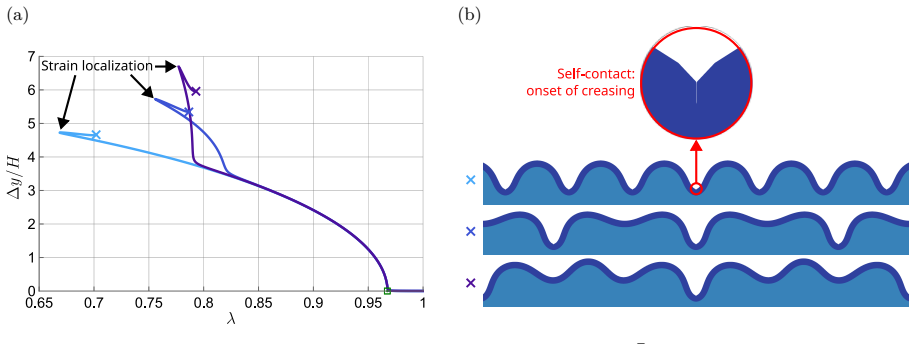
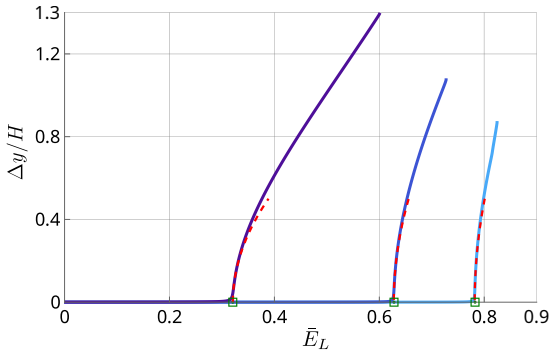
Active control of wrinkling in soft film-substrate composites using electric fields is a critical challenge in tunable material systems. Here, we investigate the electro-mechanical instability of a soft dielectric film bonded to a hyperelastic substrate, revealing the fundamental mechanisms that enable on-demand surface patterning. For the linearized stability analysis, we use the Stroh formalism and the surface impedance method to obtain exact and sixth-order approximate bifurcation equations that signal the onset of wrinkles. We derive the explicit bifurcation equations giving the critical stretch and critical voltage for wrinkling, as well as the corresponding critical wavenumber. We look at scenarios where the voltage is kept constant and the stretch changes, and vice versa. We provide the thresholds of the shear modulus ratio $r_{\rm c}^0$ or pre-stretch $\lambda_{\rm c}^0$ below which the film-substrate system wrinkles mechanically, prior to the application of a voltage. These predictions offer theoretical guidance for practical structural design, as the shear modulus ratio $r$ and/or the pre-stretch $\lambda$ can be chosen to be slightly greater than $r_{\rm c}^0$ and/or $\lambda_{\rm c}^0$, so that the film-substrate system wrinkles with a small applied voltage. Finally, we simulate the full nonlinear behavior using the Finite Element method (FEniCS) to validate our formulas and conduct a post-buckling analysis. This work advances the fundamental understanding of electro-mechanical wrinkling instabilities in soft material systems. By enabling active control of surface morphologies via applied electric fields, our findings open new avenues for adaptive technologies in soft robotics, flexible electronics, smart surfaces, and bioinspired systems.
Editorial analysis
A structured set of objections, weighed in public.
Referee Report
Summary. The paper derives explicit bifurcation equations (exact and sixth-order approximate) for the onset of electro-mechanical wrinkling in a soft dielectric film bonded to a hyperelastic substrate. Using the Stroh formalism and surface impedance method on the incremental electro-elastic equations, it obtains critical stretch, critical voltage, and critical wavenumber for cases of fixed voltage with varying stretch and vice versa. It also identifies mechanical wrinkling thresholds r_c^0 and lambda_c^0 below which wrinkling occurs without voltage, suggests design choices slightly above these thresholds for voltage-triggered wrinkling, and validates the predictions against nonlinear FEM simulations in FEniCS with post-buckling analysis.
Significance. If the derivations are valid, the explicit analytical expressions for critical parameters provide useful design guidance for tunable soft composites, allowing parameter selection to achieve wrinkling at small voltages. The FEM cross-validation strengthens the results by offering a check on the linear analysis. This advances understanding of active control of surface patterns with potential applications in soft robotics and flexible electronics. The production of closed-form bifurcation equations is a clear strength when the base-state assumptions hold.
major comments (2)
- [§2 and §3] §2 (Pre-bifurcation state) and §3 (Incremental formulation): The Stroh formalism and surface impedance method are applied under the assumption of a homogeneous pre-bifurcation state with constant coefficients in the incremental ODEs. However, differing dielectric constants between film and substrate can induce thickness-wise or lateral variations in the electric field and Maxwell stress even without perturbations, as the electric displacement depends on both deformation and local field. The manuscript should explicitly solve and verify uniformity of the base electric potential and displacement across the bonded interface for the chosen constitutive laws; without this, the constant-coefficient reduction and resulting bifurcation equations lose validity.
- [§4] §4 (Bifurcation equations): The sixth-order approximate bifurcation equation is presented alongside the exact one, but no quantitative error bound or comparison table is given for representative values of the shear modulus ratio r and pre-stretch lambda. This approximation is load-bearing for the design recommendations (choosing r or lambda slightly above critical), so its accuracy range must be documented.
minor comments (2)
- [§2] Notation for the dielectric permittivity and hyperelastic strain-energy functions should be introduced with explicit definitions in the constitutive section to allow readers to reproduce the incremental moduli without ambiguity.
- [§5] The FEM validation section should report mesh convergence studies and the specific form of the coupled electro-mechanical weak form used in FEniCS to strengthen reproducibility.
Simulated Author's Rebuttal
We thank the referee for their careful reading of the manuscript and for the constructive comments, which have helped us clarify and strengthen several aspects of the work. We address each major comment in turn below.
read point-by-point responses
-
Referee: [§2 and §3] §2 (Pre-bifurcation state) and §3 (Incremental formulation): The Stroh formalism and surface impedance method are applied under the assumption of a homogeneous pre-bifurcation state with constant coefficients in the incremental ODEs. However, differing dielectric constants between film and substrate can induce thickness-wise or lateral variations in the electric field and Maxwell stress even without perturbations, as the electric displacement depends on both deformation and local field. The manuscript should explicitly solve and verify uniformity of the base electric potential and displacement across the bonded interface for the chosen constitutive laws; without this, the constant-coefficient reduction and resulting bifurcation equations lose validity.
Authors: We appreciate the referee drawing attention to the base-state assumptions. In the model, the substrate is treated as a purely hyperelastic material with no dielectric response (permittivity taken as that of free space), so that the electric displacement and Maxwell stresses are confined to the dielectric film. The pre-bifurcation state is obtained by imposing a uniform in-plane stretch λ together with a uniform electric field through the film thickness. This field satisfies div D = 0 with constant coefficients, yields a linear electric potential across the film, and meets the interface conditions of continuous potential and continuous normal D (with D = 0 inside the substrate). Consequently the incremental equations retain constant coefficients. To make this verification explicit, we have added a short subsection in §2 that solves the base electrostatic problem and confirms uniformity of the electric displacement and potential for the constitutive laws employed. revision: yes
-
Referee: [§4] §4 (Bifurcation equations): The sixth-order approximate bifurcation equation is presented alongside the exact one, but no quantitative error bound or comparison table is given for representative values of the shear modulus ratio r and pre-stretch lambda. This approximation is load-bearing for the design recommendations (choosing r or lambda slightly above critical), so its accuracy range must be documented.
Authors: We agree that a quantitative assessment of the sixth-order approximation is necessary to support the design recommendations. In the revised manuscript we have inserted a new table that compares the critical stretch, critical voltage and critical wavenumber obtained from the exact bifurcation equation with those from the sixth-order approximation, for representative ranges of the shear-modulus ratio r (0.1–10) and pre-stretch λ (1.0–1.5). The relative error remains below 0.5 % throughout the parameter region relevant to voltage-triggered wrinkling. A brief discussion of the approximation’s validity range has also been added to §4. revision: yes
Circularity Check
Derivation chain is self-contained with no circular reductions
full rationale
The paper applies the standard Stroh formalism and surface impedance method to the linearized incremental electro-mechanical equations to derive explicit bifurcation equations for critical stretch, voltage, and wavenumber. These critical values are outputs of the resulting eigenvalue problem rather than inputs presupposed by definition or fitted from the same data. No self-citations are invoked to justify load-bearing uniqueness theorems or ansatzes, and the homogeneous pre-bifurcation assumption is a standard modeling choice for linearized stability analysis without reducing the final predictions to the paper's own fitted quantities by construction. The derivation therefore remains independent of its target results.
Axiom & Free-Parameter Ledger
free parameters (2)
- shear modulus ratio r
- pre-stretch lambda
axioms (2)
- domain assumption Materials are incompressible and the pre-bifurcation deformation is homogeneous.
- domain assumption Electric field and mechanical fields are coupled through the standard electrostatic Maxwell stress in the dielectric.
Reference graph
Works this paper leans on
-
[1]
Alawiye, H., Farrell, P. E., and Goriely, A. (2020). Revisiting the wrinkling of elastic bilayers II : Post-bifurcation analysis. Journal of the Mechanics and Physics of Solids , 143:104053
work page 2020
-
[2]
Alawiye, H., Kuhl, E., and Goriely, A. (2019). Revisiting the wrinkling of elastic bilayers I : Linear analysis. Philosophical Transactions of the Royal Society A , 377:20180076
work page 2019
-
[3]
Allen, H. G. (1969). Analysis and Design of Structural Sandwich Panels . Pergamon Press, London
work page 1969
-
[4]
Almamo, A., Su, Y. P., Chen, W. Q., and Wang, H. M. (2024). Axisymmetric vibration and stability of dielectric-elastic tubular bilayer system. Proceedings of the Royal Society A , 480:20230727
work page 2024
-
[5]
Aln s, M., Blechta, J., Hake, J., Johansson, A., Kehlet, B., Logg, A., Richardson, C., Ring, J., Rognes, M. E., and Wells, G. N. (2015). The FE ni CS project version 1.5. Archive of Numerical Software , 3(100)
work page 2015
-
[6]
Autumn, K., Sitti, M., Liang, Y. A., Peattie, A. M., Hansen, W. R., Sponberg, S., Kenny, T. W., Fearing, R., Israelachvili, J. N., and Full, R. J. (2002). Evidence for van der W aals adhesion in gecko setae. Proceedings of the National Academy of Sciences , 99(19):12252--12256
work page 2002
-
[7]
Balbi, V., Destrade, M., and Goriely, A. (2020). Mechanics of human brain organoids. Physical Review E , 101(2):022403
work page 2020
-
[8]
Bertoldi, K. and Gei, M. (2011). Instabilities in multilayered soft dielectrics. Journal of the Mechanics and Physics of Solids , 59(1):18–42
work page 2011
-
[9]
Brau, F., Vandeparre, H., Sabbah, A., Poulard, C., Boudaoud, A., and Damman, P. (2011). Multiple-length-scale elastic instability mimics parametric resonance of nonlinear oscillators. Nature Physics , 7(1):56--60
work page 2011
-
[10]
Brochu, P. and Pei, Q. (2009). Advances in dielectric elastomers for actuators and artificial muscles. Macromolecular Rapid Communications , 31(1):10–36
work page 2009
-
[11]
C., Dorfmann, L., and Destrade, M
Broderick, H. C., Dorfmann, L., and Destrade, M. (2020). Electro-elastic Lamb waves in dielectric plates. Extreme Mechanics Letters , 39:100782
work page 2020
-
[12]
Budday, S., Kuhl, E., and Hutchinson, J. W. (2015). Period-doubling and period-tripling in growing bilayered systems. Philosophical Magazine , 95(28-30):3208--3224
work page 2015
-
[13]
Cai, Z. X. and Fu, Y. B. (1999). On the imperfection sensitivity of a coated elastic half-space. Proceedings of the Royal Society A , 455(1989):3285--3309
work page 1999
-
[14]
Cai, Z. X. and Fu, Y. B. (2000). Exact and asymptotic stability analyses of a coated elastic half-space. International Journal of Solids and Structures , 37(22):3101–3119
work page 2000
-
[15]
Cao, Y. P. and Hutchinson, J. W. (2011). From wrinkles to creases in elastomers: The instability and imperfection-sensitivity of wrinkling. Proceedings of the Royal Society A , 468(2137):94–115
work page 2011
-
[16]
Cao, Y. P. and Hutchinson, J. W. (2012). Wrinkling phenomena in neo- Hookean film/substrate bilayers. Journal of Applied Mechanics , 79(3):031019
work page 2012
-
[17]
Cheewaruangroj, N. and Biggins, J. S. (2019). Pattern selection when a layer buckles on a soft substrate. Soft Matter , 15(18):3751–3770
work page 2019
-
[18]
Chen, Y. F., Zhao, H. C., Mao, J., Chirarattananon, P., Helbling, E. F., Hyun, N.-S. P., Clarke, D. R., and Wood, R. J. (2019). Controlled flight of a microrobot powered by soft artificial muscles. Nature , 575(7782):324–329
work page 2019
-
[19]
Destrade, M. (2015). Incremental equations for soft fibrous materials. In Nonlinear Mechanics of Soft Fibrous Materials , pages 233--267. Springer, Wien
work page 2015
-
[20]
Destrade, M., Gilchrist, M. D., Prikazchikov, D. A., and Saccomandi, G. (2008). Surface instability of sheared soft tissues. Journal of Biomechanical Engineering , 130:061007
work page 2008
-
[21]
Dorfmann, L. and Ogden, R. W. (2014). Nonlinear Theory of Electroelastic and Magnetoelastic Interactions . Springer, New York
work page 2014
-
[22]
Dorfmann, L. and Ogden, R. W. (2019). Electroelastic plate instabilities based on the S troh method in terms of the energy function ^ * ( F , D _ L ) . Mechanics Research Communications , 96:67--74
work page 2019
-
[23]
Ende, D. V. D., Kamminga, J., Boersma, A., Andritsch, T., and Steeneken, P. G. (2013). Voltage‐controlled surface wrinkling of elastomeric coatings. Advanced Materials , 25(25):3438–3442
work page 2013
-
[24]
Fern \'a ndez, V., Llinares-Benadero, C., and Borrell, V. (2016). Cerebral cortex expansion and folding: W hat have we learned? The EMBO Journal , 35(10):1021--1044
work page 2016
-
[25]
Fu, Y. B. and Cai, Z. X. (2015). An asymptotic analysis of the period-doubling secondary bifurcation in a film/substrate bilayer. SIAM Journal on Applied Mathematics , 75(6):2381--2395
work page 2015
-
[26]
Fu, Y. B. and Ciarletta, P. (2015). Buckling of a coated elastic half-space when the coating and substrate have similar material properties. Proceedings of the Royal Society A , 471(2178):20140979
work page 2015
-
[27]
Fu, Y. B., Dorfmann, L., and Xie, Y. X. (2018). Localized necking of a dielectric membrane. Extreme Mechanics Letters , 21:44–48
work page 2018
-
[28]
D., Morris, J., Larroche, J.-C., and Reeves, M
Griffiths, P. D., Morris, J., Larroche, J.-C., and Reeves, M. (2009). Atlas of F etal and P ostnatal B rain MR . Elsevier Health Sciences, Philadelphia
work page 2009
-
[29]
Guo, Y., Liu, L., Liu, Y., and Leng, J. (2021). Review of dielectric elastomer actuators and their applications in soft robots. Advanced Intelligent Systems , 3(10):2000282
work page 2021
-
[30]
Hohlfeld, E. and Mahadevan, L. (2011). Unfolding the sulcus. Physical Review Letters , 106(10):105702
work page 2011
-
[31]
Hutchinson, J. W. (2013). The role of nonlinear substrate elasticity in the wrinkling of thin films. Philosophical Transactions of the Royal Society A , 371(1993):20120422
work page 2013
-
[32]
Hutchinson, J. W. (2021). Surface instabilities of constrained elastomeric layers subject to electro-static stressing. Journal of the Mechanics and Physics of Solids , 153:104462
work page 2021
-
[33]
Kofod, G., Sommer-Larsen, P., Kornbluh, R., and Pelrine, R. (2003). Actuation response of polyacrylate dielectric elastomers. Journal of Intelligent Material Systems and Structures , 14(12):787–793
work page 2003
-
[34]
M., Huang, R., and Hutchinson, J
Landis, C. M., Huang, R., and Hutchinson, J. W. (2022). Formation of surface wrinkles and creases in constrained dielectric elastomers subject to electromechanical loading. Journal of the Mechanics and Physics of Solids , 167:105023
work page 2022
-
[35]
Lee, G., Zarei, M., Wei, Q. S., , Y., and Lee, S. G. (2022). Surface wrinkling for flexible and stretchable sensors. Small , 18(42):2203491
work page 2022
-
[36]
Lee, J., Jung, S., and Kim, W. (2021). Dependence of the effective surface tension of liquid phase eutectic gallium indium on wrinkles of the surface oxide. Extreme Mechanics Letters , 48:101386
work page 2021
-
[37]
Li, B., Cao, Y. P., Feng, X. Q., and Gao, H. J. (2011). Surface wrinkling of mucosa induced by volumetric growth: T heory, simulation and experiment. Journal of the Mechanics and Physics of Solids , 59(4):758--774
work page 2011
-
[38]
Li, B., Cao, Y. P., Feng, X. Q., and Gao, H. J. (2012). Mechanics of morphological instabilities and surface wrinkling in soft materials: A review. Soft Matter , 8(21):5728--5745
work page 2012
-
[39]
Li, Q., Yao, F. Z., Liu, Y., Zhang, G. Z., Wang, H., and Wang, Q. (2018). High-temperature dielectric materials for electrical energy storage. Annual Review of Materials Research , 48(1):219–243
work page 2018
-
[40]
F., Keplinger, C., Baumgartner, R., Bauer, S., Yang, W., and Suo, Z
Li, T. F., Keplinger, C., Baumgartner, R., Bauer, S., Yang, W., and Suo, Z. G. (2013). Giant voltage-induced deformation in dielectric elastomers near the verge of snap-through instability. Journal of the Mechanics and Physics of Solids , 61(2):611–628
work page 2013
-
[41]
W., Zhai, Y., Wang, Y., Wendland, G
Li, Z. W., Zhai, Y., Wang, Y., Wendland, G. M., Yin, X. B., and Xiao, J. L. (2017). Harnessing surface wrinkling--cracking patterns for tunable optical transmittance. Advanced Optical Materials , 5(19):1700425
work page 2017
-
[42]
Liang, W., Liu, H., Wang, K. Y., Qian, Z. H., Ren, L. Q., and Ren, L. (2020). Comparative study of robotic artificial actuators and biological muscle. Advances in Mechanical Engineering , 12(6):168781402093340
work page 2020
-
[43]
Lin, I.-T., Choi, Y. S., Wojcik, C., Wang, T. S., Kar-Narayan, S., and Smoukov, S. K. (2020). Electro-responsive surfaces with controllable wrinkling patterns for switchable light reflection--diffusion--grating devices. Materials Today , 41:51--61
work page 2020
-
[44]
Liu, R. C., Liu, Y., and Goriely, A. (2024). Surface wrinkling of a film coated to a graded substrate. Journal of the Mechanics and Physics of Solids , 186:105603
work page 2024
-
[45]
Ogden, R. and Sotiropoulos, D. (1996). The effect of pre-stress on guided ultrasonic waves between a surface layer and a half-space. Ultrasonics , 34(2–5):491–494
work page 1996
-
[46]
Pelrine, R. E., Kornbluh, R. D., and Joseph, J. P. (1998). Electrostriction of polymer dielectrics with compliant electrodes as a means of actuation. Sensors and Actuators A: Physical , 64(1):77--85
work page 1998
-
[47]
Psarra, E., Bodelot, L., and Danas, K. (2017). Two-field surface pattern control via marginally stable magnetorheological elastomers. Soft Matter , 13(37):6576–6584
work page 2017
-
[48]
Riccobelli, D. and Bevilacqua, G. (2020). Surface tension controls the onset of gyrification in brain organoids. Journal of the Mechanics and Physics of Solids , 134:103745
work page 2020
-
[49]
Riccobelli, D., Ciarletta, P., Vitale, G., Maurini, C., and Truskinovsky, L. (2024). Elastic instability behind brittle fracture. Physical Review Letters , 132(24):248202
work page 2024
- [50]
-
[51]
Shield, T. W., Kim, K. S., and Shield, R. T. (1994). The buckling of an elastic layer bonded to an elastic substrate in plane strain. Journal of Applied Mechanics , 61(2):231–235
work page 1994
-
[52]
Shuvalov, A. and Every, A. (2002). Some properties of surface acoustic waves in anisotropic-coated solids, studied by the impedance method. Wave Motion , 36(3):257--273
work page 2002
-
[53]
Si, L., Kong, L. H., Chen, W. Q., Bao, R. H., and Wu, B. (2025). Voltage‐controlled vibrations in bending‐deformed soft electro‐active slabs. Advanced Engineering Materials , page 2500594
work page 2025
-
[54]
Sriram, S., Polukhov, E., and Keip, M.-A. (2024). Data-driven analysis of structural instabilities in electroactive polymer bilayers based on a variational saddle-point principle. International Journal of Solids and Structures , 291:112663
work page 2024
-
[55]
Stafford, C. M., Harrison, C., Beers, K. L., Karim, A., Amis, E. J., VanLandingham, M. R., Kim, H.-C., Volksen, W., Miller, R. D., and Simonyi, E. E. (2004). A buckling-based metrology for measuring the elastic moduli of polymeric thin films. Nature Materials , 3(8):545--550
work page 2004
-
[56]
Su, Y. P., Broderick, H. C., Chen, W. Q., and Destrade, M. (2018). Wrinkles in soft dielectric plates. Journal of the Mechanics and Physics of Solids , 119:298--318
work page 2018
-
[57]
Su, Y. P., Chen, W. Q., and Destrade, M. (2019a). Tuning the pull-in instability of soft dielectric elastomers through loading protocols. International Journal of Non-Linear Mechanics , 113:62--66
-
[58]
Su, Y. P., Chen, W. Q., Dorfmann, L., and Destrade, M. (2020a). The effect of an exterior electric field on the instability of dielectric plates. Proceedings of the Royal Society A , 476(2239):20200267
-
[59]
Su, Y. P., Riccobelli, D., Chen, Y. J., Chen, W. Q., and Ciarletta, P. (2023). Tunable morphing of electroactive dielectric-elastomer balloons. Proceedings of the Royal Society A , 479
work page 2023
-
[60]
Su, Y. P., Shen, X. D., Zhao, Z. N., Wu, B., and Chen, W. Q. (2024). Electromechanical deformations and bifurcations in soft dielectrics: A review. Materials , 17(7):1499
work page 2024
-
[61]
Su, Y. P., Wu, B., Chen, W. Q., and Destrade, M. (2019b). Finite bending and pattern evolution of the associated instability for a dielectric elastomer slab. International Journal of Solids and Structures , 158:191–209
-
[62]
Su, Y. P., Wu, B., Chen, W. Q., and Destrade, M. (2020b). Pattern evolution in bending dielectric-elastomeric bilayers. Journal of the Mechanics and Physics of Solids , 136:103670
- [63]
-
[64]
Toupin, R. A. (1956). The elastic dielectric. Journal of Rational Mechanics and Analysis , 5(6):849--915
work page 1956
-
[65]
Verma, P. and Chaudhury, H. (1966). Small deformation superposed on large deformation of an elastic dielectric. International Journal of Engineering Science , 4(3):235--247
work page 1966
-
[66]
Wang, M., Mu, L., Zhang, H., Ma, S. Q., Liang, Y. H., and Ren, L. (2022). Flexible strain sensor with ridge-like microstructures for wearable applications. Polymers for Advanced Technologies , 33(1):96--103
work page 2022
-
[67]
Wang, Q. and Zhao, X. (2015). A three-dimensional phase diagram of growth-induced surface instabilities. Scientific reports , 5(1):8887
work page 2015
-
[68]
Wang, Q. M., Tahir, M., Zang, J. F., and Zhao, X. H. (2012). Dynamic electrostatic lithography: Multiscale on-demand patterning on large-area curved surfaces. Advanced Materials , 24(15):1947--1951
work page 2012
-
[69]
M., Tahir, M., Zhang, L., and Zhao, X
Wang, Q. M., Tahir, M., Zhang, L., and Zhao, X. H. (2011a). Electro-creasing instability in deformed polymers: E xperiment and theory. Soft Matter , 7(14):6583
-
[70]
Wang, Q. M., Zhang, L., and Zhao, X. H. (2011b). Creasing to cratering instability in polymers under ultrahigh electric fields. Physical Review Letters , 106(11):118301
-
[71]
Wang, Q. M. and Zhao, X. H. (2013). Creasing-wrinkling transition in elastomer films under electric fields. Physical Review E , 88(4):042403
work page 2013
-
[72]
Yang, S. Y. and Sharma, P. (2023). A tutorial on the stability and bifurcation analysis of the electromechanical behaviour of soft materials. Applied Mechanics Reviews , 75(4):044801
work page 2023
-
[73]
Yin, A., Chen, R. G., Yin, R., Zhou, S. Q., Ye, Y., Wang, Y. X., Wang, P. K., Qi, X., Liu, H. P., Liu, J., Yu, S. Z., and Wei, J. (2024). An ultra-soft conductive elastomer for multifunctional tactile sensors with high range and sensitivity. Materials Horizons , 11(8):1975–1988
work page 2024
-
[74]
Zhao, X. X., Wang, J. J., Huang, J. K., Li, L. L., Liu, E. P., Zhao, J. X., Li, Q. F., Zhang, X., and Lu, C. H. (2020a). Path-guided hierarchical surface relief gratings on azo-films induced by polarized light illumination through surface-wrinkling phase mask. Langmuir , 36(11):2837--2846
-
[75]
Zhao, Y., Feng, B., Lee, J., Lu, N., and Pierce, D. M. (2020b). A multi-layered computational model for wrinkling of human skin predicts aging effects. Journal of the Mechanical Behavior of Biomedical Materials , 103:103552
-
[76]
Z., Wu, B., Destrade, M., Wang, H
Zhu, F. Z., Wu, B., Destrade, M., Wang, H. M., Bao, R. H., and Chen, W. Q. (2024). Voltage-controlled non-axisymmetric vibrations of soft electro-active tubes with strain-stiffening effect. International Journal of Solids and Structures , 290:112671
work page 2024
-
[77]
Zurlo, G., Destrade, M., DeTommasi, D., and Puglisi, G. (2017). Catastrophic thinning of dielectric elastomers. Physical Review Letters , 118(7):078001
work page 2017
discussion (0)
Sign in with ORCID, Apple, or X to comment. Anyone can read and Pith papers without signing in.