REVIEW 3 major objections 5 minor 59 references
ControlHair: Synergizing Physics Simulator and Video Diffusion for Controllable Dynamic Hair Rendering
T0 review · 3 major / 5 minor · reviewed 2026-08-15 · deepseek-v4-flash
Pith's one-line read ControlHair claims that cascading a physics simulator with a conditional video diffusion model gives precise, per-frame control over hair dynamics in generated video.
desk verdict Good system, honest limitations, but the quantitative evaluation never tests the full simulator-to-video control loop. read the letter →
The pith
A machine-rendered reading of the paper's core claim, the machinery that carries it, and where it could break.
The reading
What carries the argument
The load-bearing mechanism is the two-step encoding from physics to pixels: a particle-system simulator converts hair properties and external forces into per-frame 3D strand geometry, which is the paper's canonical intermediate representation. That geometry is projectively mapped to each camera view and reduced to per-frame control signals, chiefly hair strand maps (orientation-like maps that disambiguate directional conflicts in hair flow) and sparse 2D body poses, blended by a hair mask. These control signals have the same spatial shape as the output video, so a 3D convolutional encoder can inject them frame-by-frame into a pretrained video diffusion transformer while the reference image supplies appearance. The physical reasoning is delegated to the simulator, and the diffusion model only has to render photorealistic pixels consistent with the supplied geometry.
What would settle it
Take a reference image and simulate two distinct wind directions, say 70 degrees clockwise and 70 degrees counterclockwise from the camera, then run ControlHair on both; if the generated videos show nearly identical hair motion or motion that does not follow the simulated direction, the claimed precise control is refuted. A more direct check uses the paper's own reconstruction protocol in reverse: generate a video from control signals, re-extract strand maps and poses from the generated video, and compare them frame-by-frame with the input control signals to see whether the generator actually followed them.
Extended reading notes
Core claim
The paper's central claim is that fine-grained control over hair dynamics in generated video is achievable by placing a physics simulator before a conditional video diffusion model, a design the authors call ControlHair. Given a reference image, physics parameters, and a camera trajectory, ControlHair estimates 3D hair strands, simulates per-frame hair geometry, projects that geometry along the desired camera path, and extracts per-frame strand maps and sparse human poses as control signals. A video diffusion transformer, fine-tuned with low-rank adapters from a general human-image-animation model, then synthesizes an RGB video that preserves the reference appearance while following the simulated motion. The authors state that ControlHair is the first physics-informed video diffusion framework for controllable dynamic hair rendering and report that it outperforms text- and pose-conditioned baselines in qualitative comparisons and in quantitative reconstruction metrics on a curated 10K-video training set.
Load-bearing premise
The whole chain rests on the assumption that the 2D control signals extracted from the simulated 3D hair geometry carry enough information to tell the generator exactly which hair motion was requested; if two different physics states collapse to nearly the same strand maps and poses, the claimed fine-grained control collapses with them.
Editorial extensions
If this is right
- Changing the physics model does not require retraining the video generator: any simulator that outputs per-frame hair geometry can be plugged in, so new forces or material models become available by swapping the simulator.
- Text or pose alone cannot reliably specify hair dynamics; the paper's strong-wind and head-rotation experiments show that text-conditioned baselines fail to move hair, while ControlHair's per-frame strand maps give pixel-level control over motion direction and magnitude.
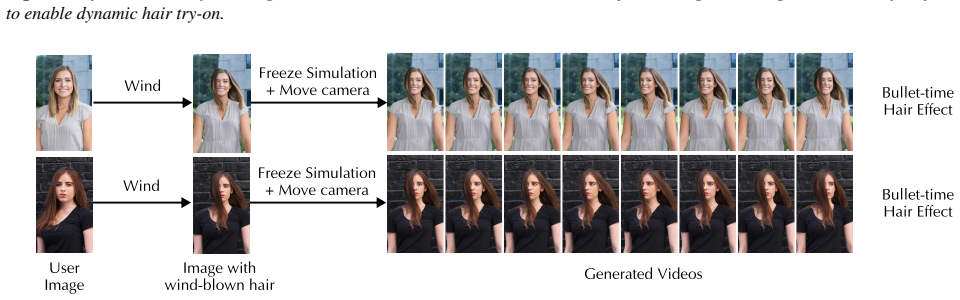
- Static hair try-on can be upgraded to dynamic hair try-on by cascading a static hairstyle transfer system with ControlHair, letting users preview a hairstyle in motion, under wind, and with head rotation.
- Freezing the simulator while moving the camera yields bullet-time effects, and fixing the human pose while animating hair supports looping cinemagraphic videos, including physics regimes rarely seen in training data such as zero gravity.
- Training-data annotation becomes simpler because the model learns from per-frame geometry rather than from ground-truth physics parameters, which are nearly impossible to infer from video.
Reading between the lines
- The paper does not pursue this, but the same cascade should transfer to other deformable objects such as clothing, fur, leaves, or flags: wherever a simulator can emit per-frame geometry, the video diffusion model need never know the underlying physics, only the geometry.
- The paper stops short of testing invertibility of its control signals; if two distinct physics states project to nearly identical strand maps, the generator cannot distinguish them, so a natural extension is to add multi-view projections or explicitly physics-labeled training data to break such ambiguities.
- The paper's auto-correction observation implies that control strength is partly learned rather than guaranteed, because the diffusion model occasionally overrides imperfect simulated geometry to match the reference hairstyle; one could quantify this by measuring how far generated hair motion deviates from the simulated strand maps.
- The use of sparse human poses leaves human details such as facial expressions uncontrolled, which the paper notes; a testable extension is to supplement the pose channel with dense or expression-specific conditioning for fully frozen-body effects.
Signed reviews
Editorial analysis
A structured set of objections, weighed in public.
Referee Report
Summary. The paper introduces CONTROLHAIR, a three-stage framework for controllable dynamic hair video generation. Stage 1 uses a physics simulator (Blender particle system) on a 3D hair model estimated from a single image, with user-specified hair properties and external forces, to produce per-frame hair geometry (Eq. 4). Stage 2 projects this geometry along a user-specified camera trajectory and extracts per-frame control signals, specifically hair strand maps and sparse human poses (Eqs. 5-6). Stage 3 feeds these control signals and a reference image into a video diffusion model, initialized from UniAnimate-DiT and fine-tuned with LoRA on a curated 10K-video dataset, to generate the output video. The paper claims this is the first physics-informed video diffusion framework for controllable hair dynamics and that it delivers precisely controlled hair motion, outperforming text- and pose-conditioned baselines. It also demonstrates applications in dynamic hair try-on, bullet-time effects, and cinemagraphic animation.
Significance. If the central claim is validated, CONTROLHAIR would be a useful integration of physics simulation with modern video diffusion, offering a practical way for users to specify hair dynamics without labeling videos with physics parameters. The proposed decoupling is well motivated: unifying diverse physics inputs into per-frame geometry makes the downstream diffusion model agnostic to the simulation model, and extracting control signals from geometry simplifies training-data annotation. The paper is honest about limitations in Sec. 6, including imperfect strand estimation and imperfect simulators. However, the quantitative evidence currently does not exercise the full simulator-to-video path, so the claim of precisely controlled hair dynamics is not yet established. The work could be significant for graphics and generative-model applications, but the evaluation must be strengthened before the claims are supportable.
major comments (3)
- [Sec. 5.2-5.3, Eqs. 4-6] The quantitative evaluation does not test the claimed physics-to-video control loop. Eq. 4 produces per-frame hair geometry from the simulator, and Eq. 6 extracts control signals from that geometry, but the Sec. 5.3 reconstruction experiment extracts control signals from real VEO-2 RGB frames rather than from simulator output. Table 2 therefore measures whether the diffusion model can follow control signals estimated from real video, not whether user-specified physics parameters such as wind direction or hair stiffness are faithfully rendered. The qualitative wind example in Fig. 5 reports no measurement of whether the generated hair direction matches the specified wind direction. The paper should add an experiment where simulator-generated controls for several wind directions/strengths and head motions are fed into the model, followed by a quantitative or perceptual measure of alignment with the specified physics. Without such evidence, the central claim of 'precisely controlled hair dynamics' is not demonstrated.
- [Sec. 5.3, Table 2] The evidence base for the quantitative claim is thin: only 10 synthetic VEO-2 videos, one aggregated number per metric, no error bars, no per-video breakdown, and no significance test. The reported 'up to 47%' improvement over Wan 2.1 is a relative gain on a single aggregated PSNR value and could be driven primarily by pose conditioning rather than by the strand-map control. There is no ablation that removes the strand-map channel or that replaces it with a pose-only condition, and no comparison between controls extracted from simulator projections and controls extracted from real frames. Please report per-video results with standard deviations, add ablations, and state whether the improvements are statistically meaningful.
- [Sec. 4.2 and Implementation Details] The control-signal extractors, HairStep and DWPose, are pretrained on real images, but in the intended pipeline they are applied to rendered Blender projections of simulated geometry (Eq. 5). This domain gap is never measured. The only quantitative experiment bypasses the gap by extracting controls from real VEO-2 frames, so it does not establish that the strand-map estimator produces meaningful signals on simulated projections. If the extractor mis-estimates strand maps on projected geometry, the diffusion model would receive degraded controls even though the reconstruction experiment succeeds. The paper should provide evidence that strand maps extracted from simulated projections are reliable, for example by comparing them to ground-truth strand maps on rendered hair, or by adapting the extractor to the simulator domain.
minor comments (5)
- [Sec. 5.3] The first sentence of Sec. 5.3 says 'We now evaluate qualitatively how well our diffusion model can leverage and follow the control signals,' but the section reports quantitative metrics; this should be corrected to 'quantitatively'.
- [Table 2] The caption says results are averaged across 10 videos, while the text says they are averaged across all frames in all videos; please clarify the aggregation procedure.
- [Sec. 5.2] The statement that CONTROLHAIR achieves 'accurate control' in the qualitative comparison is not supported by any measurement in that section; please either add quantitative support or soften the wording.
- [Sec. 5.4, Cinemagraphic Effects] The description that 'with multiple runs (like a lottery), we are likely to yield the desired cinemagraphic results' conflicts with the paper's emphasis on precise control; if the output is stochastic, the success rate should be reported or the claim of precision should be qualified.
- [Abstract and Sec. 7] The phrase 'precisely controlled hair dynamics' is used in both the abstract and conclusion, but Sec. 6 acknowledges that imperfect strand estimation and simulator imperfections can degrade results; consider using more measured language throughout.
Circularity Check
No significant circularity: ControlHair's simulator-to-control-signal pipeline and its reconstruction evaluation are distinct, and no prediction reduces to a fitted input or self-citation.
full rationale
ControlHair is a cascade in which each stage is defined independently of the claim it is used to support. The physics simulator (Eq. 4) maps user-specified physics parameters to per-frame hair geometry; the perspective projection (Eq. 5) and geometric feature extraction (Eq. 6) define control signals as functions of that geometry; and the diffusion model (Eq. 7) maps reference image plus control signals to video. None of these equations is fitted to the quantity it is said to predict. The physics parameters (mass, stiffness, damping, wind strength, gravity) are chosen simulator inputs rather than parameters estimated from the benchmark videos. The quantitative evaluation in Sec. 5.3 is explicitly a reconstruction task: control signals are extracted from VEO-2 ground-truth videos and used to reconstruct those videos, which tests whether the diffusion model follows control signals; it does not claim to derive physics from video. The paper's own Sec. 6 acknowledges that the full physics-to-video chain can suffer from 3D strand estimation error and simulator imperfections, which is a validation gap rather than a circular reduction. The cited external components (Wan 2.1, UniAnimate-DiT, HairStep, DWPose, DiffLocks, Blender) are used as off-the-shelf tools, and there is no load-bearing self-citation chain. Therefore the derivation is self-contained and no circularity is present.
Assumptions & free parameters
free parameters (5)
- hair mass =
0.1
- hair stiffness =
6
- hair damping =
9
- wind strength =
10
- gravity scale =
1
assumptions (4)
- domain assumption Per-frame hair geometry is a sufficient and unambiguous mid-level representation for conveying arbitrary physics parameters to a video diffusion model.
- domain assumption The strand maps and sparse human poses extracted from projected geometry preserve the dynamics information needed by the diffusion model.
- domain assumption The 3D hair strand estimator (DiffLocks) produces a 3D model from a single image that is accurate enough for the downstream simulation.
- domain assumption Blender particle simulation with configured parameters produces physically plausible hair dynamics for real-world rendering.
Cite this review
Pith. "Pith review of ControlHair: Synergizing Physics Simulator and Video Diffusion for Controllable Dynamic Hair Rendering." pith.science (2026). https://pith.science/paper/7BHVPPKP
@misc{pith2026250921541,
  author       = {Pith},
  title        = {Pith review of: ControlHair: Synergizing Physics Simulator and Video Diffusion for Controllable Dynamic Hair Rendering},
  year         = {2026},
  howpublished = {\url{https://pith.science/paper/7BHVPPKP}},
  note         = {Machine review of arXiv:2509.21541}
}
read the original abstract
Hair simulation and rendering are challenging due to complex strand dynamics, diverse material properties, and intricate light-hair interactions. Recent video diffusion models can generate high-quality videos, but they lack fine-grained control over hair dynamics. We present ControlHair, a hybrid framework that integrates a physics simulator with conditional video diffusion to enable precise and controllable dynamic hair rendering. ControlHair adopts a three-stage pipeline: it first encodes physics conditions into per-frame geometry using a simulator, then extracts per-frame control signals, and finally feeds control signals into a video diffusion model to generate videos with desired hair dynamics. This cascaded design decouples physics reasoning from video generation, supports diverse physics, and makes training the video diffusion model easy. Trained on a curated 10K video dataset, ControlHair outperforms text- and pose-conditioned baselines, delivering precisely controlled hair dynamics. We also demonstrate three use cases of ControlHair, including dynamic hairstyle try-on, bullet-time effects, and cinemagraphic. Project page: https://linwk20.github.io/controlhair-web.
Figures


Figures from the paper (6 more)




Reference graph
Works this paper leans on
-
[1]
write newline
" write newline "" before.all 'output.state := FUNCTION fin.entry add.period write newline FUNCTION new.block output.state before.all = 'skip after.block 'output.state := if FUNCTION new.sentence output.state after.block = 'skip output.state before.all = 'skip after.sentence 'output.state := if if FUNCTION not #0 #1 if FUNCTION and 'skip pop #0 if FUNCTIO...
-
[2]
write newline
" write newline "" before.all 'output.state := FUNCTION fin.entry.original add.period write newline FUNCTION new.block output.state before.all = 'skip after.block 'output.state := if FUNCTION new.sentence output.state after.block = 'skip output.state before.all = 'skip after.sentence 'output.state := if if FUNCTION not #0 #1 if FUNCTION and 'skip pop #0 i...
-
[3]
: A simple method for extracting the natural beauty of hair
Anjyo K.-i., Usami Y., Kurihara T. : A simple method for extracting the natural beauty of hair. In Proceedings of the 19th annual conference on Computer graphics and interactive techniques (1992), pp. 111--120
work page 1992
-
[4]
Bergou M., Wardetzky M., Robinson S., Audoly B., Grinspun E. : Discrete elastic rods. In ACM SIGGRAPH 2008 papers. 2008, pp. 1--12
work page 2008
-
[5]
: Echomimic: Lifelike audio-driven portrait animations through editable landmark conditions
Chen Z., Cao J., Chen Z., Li Y., Ma C. : Echomimic: Lifelike audio-driven portrait animations through editable landmark conditions. In Proceedings of the AAAI Conference on Artificial Intelligence (2025), vol. 39, pp. 2403--2410
work page 2025
-
[6]
Community B. O. : Blender - a 3d modelling and rendering package, 2018. URL: http://www.blender.org
work page 2018
-
[7]
Chung C., Park S., Kim J., Choo J. : What to preserve and what to transfer: Faithful, identity-preserving diffusion-based hairstyle transfer. In Proceedings of the AAAI Conference on Artificial Intelligence (2025), vol. 39, pp. 2582--2590
work page 2025
-
[8]
Epic Games : An early look at next-generation real-time hair and fur . Unreal Engine Tech Blog, 2020. URL: https://www.unrealengine.com/en-US/tech-blog/an-early-look-at-next-generation-real-time-hair-and-fur
work page 2020
Show all 59 references
-
[9]
: Principles towards real-time simulation of material point method on modern gpus
Fei Y., Huang Y., Gao M. : Principles towards real-time simulation of material point method on modern gpus. arXiv preprint arXiv:2111.00699 (2021)
2021 arXiv
-
[10]
: Introducing gen-3 alpha: A new frontier for video generation
Germanidis A. : Introducing gen-3 alpha: A new frontier for video generation. https://runwayml.com/research/introducing-gen-3-alpha, 2024. Runway Research
2024
-
[11]
: Seedance 1.0: Exploring the boundaries of video generation models
Gao Y., Guo H., Hoang T., Huang W., Jiang L., Kong F., Li H., Li J., Li L., Li X., et al. : Seedance 1.0: Exploring the boundaries of video generation models. arXiv preprint arXiv:2506.09113 (2025)
2025 arXiv
-
[12]
T., Poole B
Gao R., Holynski A., Henzler P., Brussee A., Martin-Brualla R., Srinivasan P., Barron J. T., Poole B. : Cat3d: Create anything in 3d with multi-view diffusion models. arXiv preprint arXiv:2405.10314 (2024)
2024 arXiv
-
[13]
https://deepmind.google/models/veo/, 2025
Google DeepMind : Veo — state-of-the-art video generation model. https://deepmind.google/models/veo/, 2025. Google DeepMind
2025
-
[14]
: Ltx-video: Realtime video latent diffusion
HaCohen Y., Chiprut N., Brazowski B., Shalem D., Moshe D., Richardson E., Levin E., Shiran G., Zabari N., Gordon O., et al. : Ltx-video: Realtime video latent diffusion. arXiv preprint arXiv:2501.00103 (2024)
2024 arXiv
-
[15]
J., Shen Y., Wallis P., Allen-Zhu Z., Li Y., Wang S., Wang L., Chen W
Hu E. J., Shen Y., Wallis P., Allen-Zhu Z., Li Y., Wang S., Wang L., Chen W. : Lora: Low-rank adaptation of large language models. arxiv 2021. arXiv preprint arXiv:2106.09685 10 (2021)
2021 arXiv
-
[16]
: Scope of validity of psnr in image/video quality assessment
Huynh-Thu Q., Ghanbari M. : Scope of validity of psnr in image/video quality assessment. Electronics letters 44, 13 (2008), 800--801
2008
-
[17]
: Animate anyone: Consistent and controllable image-to-video synthesis for character animation
Hu L. : Animate anyone: Consistent and controllable image-to-video synthesis for character animation. In Proceedings of the IEEE/CVF Conference on Computer Vision and Pattern Recognition (2024), pp. 8153--8163
2024
-
[18]
: Sag-free initialization for strand-based hybrid hair simulation
Hsu J., Wang T., Pan Z., Gao X., Yuksel C., Wu K. : Sag-free initialization for strand-based hybrid hair simulation. ACM Transactions on Graphics (TOG) 42, 4 (2023), 1--14
2023
-
[19]
: Cameractrl: Enabling camera control for text-to-video generation
He H., Xu Y., Guo Y., Wetzstein G., Dai B., Li H., Yang C. : Cameractrl: Enabling camera control for text-to-video generation. arXiv preprint arXiv:2404.02101 (2024)
2024 arXiv
-
[20]
: Artistic simulation of curly hair
Iben H., Meyer M., Petrovic L., Soares O., Anderson J., Witkin A. : Artistic simulation of curly hair. In Proceedings of the 12th ACM SIGGRAPH/Eurographics Symposium on Computer Animation (2013), pp. 63--71
2013
-
[21]
: Vidsketch: Hand-drawn sketch-driven video generation with diffusion control
Jiang L., Chen S., Wu B., Guan X., Zhang J. : Vidsketch: Hand-drawn sketch-driven video generation with diffusion control. arXiv preprint arXiv:2502.01101 (2025)
2025 arXiv
-
[22]
: Dreampose: Fashion video synthesis with stable diffusion
Karras J., Holynski A., Wang T.-C., Kemelmacher-Shlizerman I. : Dreampose: Fashion video synthesis with stable diffusion. In Proceedings of the IEEE/CVF International Conference on Computer Vision (2023), pp. 22680--22690
2023
-
[23]
: A style-based generator architecture for generative adversarial networks
Karras T., Laine S., Aila T. : A style-based generator architecture for generative adversarial networks. In Proceedings of the IEEE/CVF conference on computer vision and pattern recognition (2019), pp. 4401--4410
2019
-
[24]
: Hunyuanvideo: A systematic framework for large video generative models
Kong W., Tian Q., Zhang Z., Min R., Dai Z., Zhou J., Xiong J., Li X., Wu B., Zhang J., et al. : Hunyuanvideo: A systematic framework for large video generative models. arXiv preprint arXiv:2412.03603 (2024)
2024 arXiv
-
[25]
: Open-sora plan: Open-source large video generation model
Lin B., Ge Y., Cheng X., Li Z., Zhu B., Wang S., He X., Ye Y., Yuan S., Chen L., et al. : Open-sora plan: Open-source large video generation model. arXiv preprint arXiv:2412.00131 (2024)
2024 arXiv
-
[26]
: Diffusion renderer: Neural inverse and forward rendering with video diffusion models
Liang R., Gojcic Z., Ling H., Munkberg J., Hasselgren J., Lin C.-H., Gao J., Keller A., Vijaykumar N., Fidler S., et al. : Diffusion renderer: Neural inverse and forward rendering with video diffusion models. In Proceedings of the Computer Vision and Pattern Recognition Confer...
2025
-
[27]
W.-C., Larionov E., Chen H.-y., Roble D., Stuyck T
Lin G. W.-C., Larionov E., Chen H.-y., Roble D., Stuyck T. : Neuralocks: Real-time dynamic neural hair simulation. arXiv preprint arXiv:2507.05191 (2025)
2025 arXiv
-
[28]
: Gaussianhair: Hair modeling and rendering with light-aware gaussians
Luo H., Ouyang M., Zhao Z., Jiang S., Zhang L., Zhang Q., Yang W., Xu L., Yu J. : Gaussianhair: Hair modeling and rendering with light-aware gaussians. arXiv preprint arXiv:2402.10483 (2024)
2024 arXiv
-
[29]
: Dsplats: 3d generation by denoising splats-based multiview diffusion models
Miao K., Agrawal H., Zhang Q., Semeraro F., Cavallo M., Gu J., Toshev A. : Dsplats: 3d generation by denoising splats-based multiview diffusion models. arXiv preprint arXiv:2412.09648 (2024)
2024 arXiv
-
[30]
: Follow your pose: Pose-guided text-to-video generation using pose-free videos
Ma Y., He Y., Cun X., Wang X., Chen S., Li X., Chen Q. : Follow your pose: Pose-guided text-to-video generation using pose-free videos. In Proceedings of the AAAI Conference on Artificial Intelligence (2024), vol. 38, pp. 4117--4125
2024
-
[31]
R., Jensen H
Marschner S. R., Jensen H. W., Cammarano M., Worley S., Hanrahan P. : Light scattering from human hair fibers. ACM Transactions on Graphics (TOG) 22, 3 (2003), 780--791
2003
-
[32]
T., Walter B., Marschner S
Moon J. T., Walter B., Marschner S. : Efficient multiple scattering in hair using spherical harmonics. In ACM SIGGRAPH 2008 papers. 2008, pp. 1--7
2008
-
[33]
https://openai.com/sora/, 2024
OpenAI : Sora. https://openai.com/sora/, 2024
2024
-
[34]
: Volumetric methods for simulation and rendering of hair
Petrovic L., Henne M., Anderson J. : Volumetric methods for simulation and rendering of hair. Pixar Animation Studios 2, 4 (2005), 1--6
2005
-
[35]
https://pikalabs.org/tag/pika-1-5/, 2024
Pika Labs : Tag: Pika 1.5 [blog posts: Pika Labs 1.5 Video Generation Features, Pika 1.5 Pikaffects]. https://pikalabs.org/tag/pika-1-5/, 2024. Pika Labs
2024
-
[36]
: Movie gen: A cast of media foundation models
Polyak A., Zohar A., Brown A., Tjandra A., Sinha A., Lee A., Vyas A., Shi B., Ma C.-Y., Chuang C.-Y., et al. : Movie gen: A cast of media foundation models. arXiv preprint arXiv:2410.13720 (2024)
2024 arXiv
-
[37]
E., Carlson W
Rosenblum R. E., Carlson W. E., Tripp III E. : Simulating the structure and dynamics of human hair: modelling, rendering and animation. The Journal of Visualization and Computer Animation 2, 4 (1991), 141--148
1991
-
[38]
A., Wu K., Feng Y., Zheng Y., Black M
Rosu R. A., Wu K., Feng Y., Zheng Y., Black M. J. : Difflocks: Generating 3d hair from a single image using diffusion models. In Proceedings of the Computer Vision and Pattern Recognition Conference (2025), pp. 10847--10857
2025
-
[39]
: Mvdream: Multi-view diffusion for 3d generation
Shi Y., Wang P., Ye J., Long M., Li K., Yang X. : Mvdream: Multi-view diffusion for 3d generation. arXiv preprint arXiv:2308.16512 (2023)
2023 arXiv
-
[40]
: Emo2: End-effector guided audio-driven avatar video generation
Tian L., Hu S., Wang Q., Zhang B., Bo L. : Emo2: End-effector guided audio-driven avatar video generation. arXiv preprint arXiv:2501.10687 (2025)
2025 arXiv
-
[41]
P., Hariharan B
Tang L., Jia M., Wang Q., Phoo C. P., Hariharan B. : Emergent correspondence from image diffusion. Advances in Neural Information Processing Systems 36 (2023), 1363--1389
2023
-
[42]
C., Sheikh H
Wang Z., Bovik A. C., Sheikh H. R., Simoncelli E. P. : Image quality assessment: from error visibility to structural similarity. IEEE transactions on image processing 13, 4 (2004), 600--612
2004
-
[43]
Ward K., Galoppo N., Lin M. C. : A simulation-based vr system for interactive hairstyling. In IEEE Virtual Reality Conference (VR 2006) (2006), IEEE, pp. 257--260
2006
-
[44]
: Neuwigs: A neural dynamic model for volumetric hair capture and animation
Wang Z., Nam G., Stuyck T., Lombardi S., Cao C., Saragih J., Zollh \"o fer M., Hodgins J., Lassner C. : Neuwigs: A neural dynamic model for volumetric hair capture and animation. In Proceedings of the IEEE/CVF Conference on Computer Vision and Pattern Recognition (2023), pp. 8...
2023
-
[45]
: Wan: Open and advanced large-scale video generative models
Wan T., Wang A., Ai B., Wen B., Mao C., Xie C.-W., Chen D., Yu F., Zhao H., Yang J., et al. : Wan: Open and advanced large-scale video generative models. arXiv preprint arXiv:2503.20314 (2025)
2025 arXiv
-
[46]
: Unianimate: Taming unified video diffusion models for consistent human image animation
Wang X., Zhang S., Gao C., Wang J., Zhou X., Zhang Y., Yan L., Sang N. : Unianimate: Taming unified video diffusion models for consistent human image animation. arXiv preprint arXiv:2406.01188 (2024)
2024 arXiv
-
[47]
: Unianimate-dit: Human image animation with large-scale video diffusion transformer
Wang X., Zhang S., Tang L., Zhang Y., Gao C., Wang Y., Sang N. : Unianimate-dit: Human image animation with large-scale video diffusion transformer. arXiv preprint arXiv:2504.11289 (2025)
2025
-
[48]
: Gaussian head avatar: Ultra high-fidelity head avatar via dynamic gaussians
Xu Y., Chen B., Li Z., Zhang H., Wang L., Zheng Z., Liu Y. : Gaussian head avatar: Ultra high-fidelity head avatar via dynamic gaussians. In Proceedings of the IEEE/CVF conference on computer vision and pattern recognition (2024), pp. 1931--1941
2024
-
[49]
: Tooncrafter: Generative cartoon interpolation
Xing J., Liu H., Xia M., Zhang Y., Wang X., Shan Y., Wong T.-T. : Tooncrafter: Generative cartoon interpolation. ACM Transactions on Graphics (TOG) 43, 6 (2024), 1--11
2024
-
[50]
: Physanimator: Physics-guided generative cartoon animation
Xie T., Zhao Y., Jiang Y., Jiang C. : Physanimator: Physics-guided generative cartoon animation. In Proceedings of the Computer Vision and Pattern Recognition Conference (2025), pp. 10793--10804
2025
-
[51]
: Stylemaster: Stylize your video with artistic generation and translation
Ye Z., Huang H., Wang X., Wan P., Zhang D., Luo W. : Stylemaster: Stylize your video with artistic generation and translation. In Proceedings of the Computer Vision and Pattern Recognition Conference (2025), pp. 2630--2640
2025
-
[52]
: Cogvideox: Text-to-video diffusion models with an expert transformer
Yang Z., Teng J., Zheng W., Ding M., Huang S., Xu J., Yang Y., Hong W., Zhang X., Feng G., et al. : Cogvideox: Text-to-video diffusion models with an expert transformer. arXiv preprint arXiv:2408.06072 (2024)
2024 arXiv
-
[53]
: Effective whole-body pose estimation with two-stages distillation
Yang Z., Zeng A., Yuan C., Li Y. : Effective whole-body pose estimation with two-stages distillation. In Proceedings of the IEEE/CVF International Conference on Computer Vision (2023), pp. 4210--4220
2023
-
[54]
A., Shechtman E., Wang O
Zhang R., Isola P., Efros A. A., Shechtman E., Wang O. : The unreasonable effectiveness of deep features as a perceptual metric. In Proceedings of the IEEE conference on computer vision and pattern recognition (2018), pp. 586--595
2018
-
[55]
: Hairstep: Transfer synthetic to real using strand and depth maps for single-view 3d hair modeling
Zheng Y., Jin Z., Li M., Huang H., Ma C., Cui S., Han X. : Hairstep: Transfer synthetic to real using strand and depth maps for single-view 3d hair modeling. In Proceedings of the IEEE/CVF Conference on Computer Vision and Pattern Recognition (2023), pp. 12726--12735
2023
-
[56]
: Open-sora: Democratizing efficient video production for all
Zheng Z., Peng X., Yang T., Shen C., Li S., Liu H., Zhou Y., Li T., You Y. : Open-sora: Democratizing efficient video production for all. arXiv preprint arXiv:2412.20404 (2024)
2024 arXiv
-
[57]
: Adding conditional control to text-to-image diffusion models
Zhang L., Rao A., Agrawala M. : Adding conditional control to text-to-image diffusion models. In Proceedings of the IEEE/CVF international conference on computer vision (2023), pp. 3836--3847
2023
-
[58]
: Dual scattering approximation for fast multiple scattering in hair
Zinke A., Yuksel C., Weber A., Keyser J. : Dual scattering approximation for fast multiple scattering in hair. In ACM SIGGRAPH 2008 papers. 2008, pp. 1--10
2008
-
[59]
: Stable-hair: Real-world hair transfer via diffusion model
Zhang Y., Zhang Q., Song Y., Zhang J., Tang H., Liu J. : Stable-hair: Real-world hair transfer via diffusion model. In Proceedings of the AAAI Conference on Artificial Intelligence (2025), vol. 39, pp. 10348--10356
2025
Reviewed August 15, 2026 · model on record in the stance chip above.
Discussion (0). Continue with ORCID to comment.