Extending the optical absorption in a lumped element meander structure to far-infrared wavelengths
Pith reviewed 2026-05-18 13:12 UTC · model grok-4.3
The pith
Lumped-element meander structures on diamond substrates achieve up to 95 percent absorption in the far infrared for kinetic inductance detectors.
A machine-rendered reading of the paper's core claim, the machinery that carries it, and where it could break.
Core claim
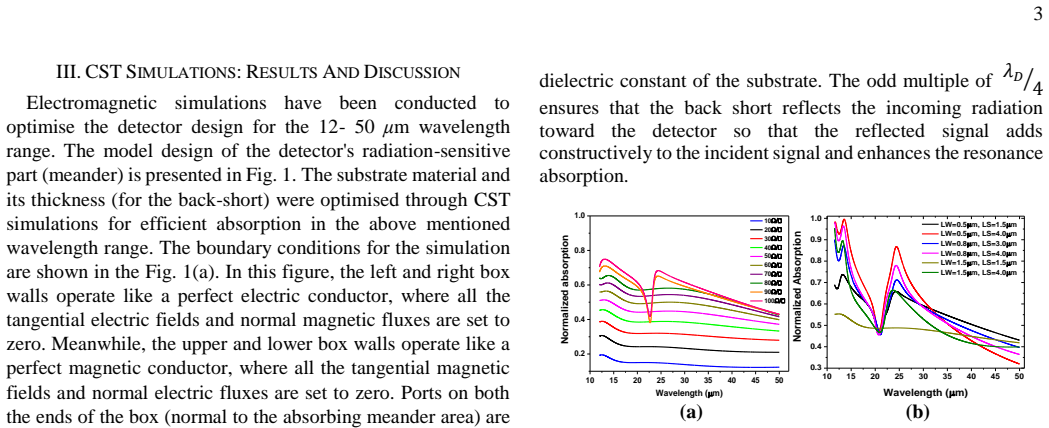
Optimized meander geometries on diamond substrates yield absorption efficiencies of up to 95 percent for narrow bandwidths and over 50 percent for wide bandwidths in the 12 to 50 micrometer range, with a fabricated 30-pixel LEKID using a 20 nm Ti40V60 alloy on SiO2-coated silicon achieving up to 75 percent absorption efficiency through transmission and reflection measurements in the 14 to 26 micrometer IR-FEL range.
What carries the argument
The lumped-element meander inductor structure, whose absorption is set by substrate material and thickness together with impedance matching between the detector and the incident radiation.
If this is right
- LEKID devices become practical for far-infrared detection above 10 micrometers with high absorption efficiency.
- Both SiO2 and diamond substrates work for LEKID development in the 12-50 micrometer window corresponding to the IR-FEL.
- Electron-beam lithography can produce working 30-pixel arrays with 20 nm Ti40V60 resonators that reach 75 percent absorption experimentally.
Where Pith is reading between the lines
- High absorption in the meander could translate into improved overall detection efficiency and possibly single-photon sensitivity at these longer wavelengths.
- The same geometry tuning approach might be tested on other substrates or at wavelengths beyond 50 micrometers to broaden the operating window.
Load-bearing premise
Electromagnetic simulations accurately predict absorption, impedance matching, and substrate effects for the actual fabricated Ti40V60 meander structures across the 12-50 micrometer range.
What would settle it
Direct transmission and reflection measurements on an optimized meander structure fabricated on a diamond substrate that yield absorption values substantially below the simulated 95 percent narrowband or 50 percent broadband targets in the 12-50 micrometer range.
Figures



read the original abstract
Superconducting radiation detectors typically exhibit detection and single photon sensitivity limited to the mid infrared wavelength range. Extending their detection capabilities into the far infrared range (>10 um) requires careful selection of substrate materials and detector geometries. The overall detection efficiency is linked to absorption and coupling efficiencies. In this study, the resonator geometry and absorption efficiency were estimated using electromagnetic simulations in CST Microwave Studio for a lumped-element meander structure. Simulations were performed for the 12 to 50 um wavelength range, corresponding to the Infrared Free Electron Laser (IR FEL) at RRCAT, Indore. Absorption in the meander inductor was influenced by the substrate material, thickness, and impedance matching between the detector and incident photon medium. The results indicate that SiO2 and diamond substrates are suitable for developing lumped-element kinetic inductance detectors (LEKID) in this range. Optimized meander geometries on diamond substrates demonstrated absorption efficiencies of up to 95% for narrow bandwidths and over 50% for wide bandwidths. A 30-pixel LEKID structure was fabricated using electron beam lithography on a 500 um SiO2 coated Si substrate, with a 20 nm thick Ti40V60 alloy resonator. Experimental absorption efficiency was determined through transmission and reflection measurements. Results show that in the 14 to 26 um IR-FEL range, the LEKID achieved up to 75% absorption efficiency. These studies demonstrate that the LEKID structure is ideal for detecting far infrared wavelengths above 10 um, with high absorption efficiency.
Editorial analysis
A structured set of objections, weighed in public.
Referee Report
Summary. The manuscript reports electromagnetic simulations in CST Microwave Studio of a lumped-element meander inductor for LEKIDs targeting 12-50 μm wavelengths. Simulations explore substrate choice (SiO2, diamond) and geometry to maximize absorption, yielding optimized diamond designs with up to 95% narrowband and >50% broadband efficiency. A 30-pixel device with 20 nm Ti40V60 on 500 μm SiO2/Si is fabricated by e-beam lithography; transmission and reflection measurements at the IR-FEL yield up to 75% absorption in the 14-26 μm band. The work concludes that such LEKID structures are suitable for far-IR detection above 10 μm.
Significance. If the modeling-to-experiment link holds, the result offers a concrete route to extend LEKID absorption into the far-IR, a regime where superconducting detectors have been limited. The combination of geometry optimization via full-wave simulation and a direct experimental demonstration of 75% absorption on a fabricated Ti40V60 device constitutes a useful practical advance. Reproducible simulation parameters and measured transmission/reflection data are strengths that could support further device development.
major comments (1)
- [Abstract, simulation section, and experimental section] Abstract, simulation section, and experimental section: The central claim that CST simulations reliably guide optimization (including the 95% narrowband diamond prediction) rests on the assumption that the same modeling framework accurately reproduces the fabricated Ti40V60 meander on SiO2/Si. No quantitative overlay or tabulated comparison of simulated versus measured absorption spectra is presented for the exact fabricated geometry, thickness, or material parameters (e.g., complex conductivity of Ti40V60 or substrate-mode contributions) in the 12-50 μm range. Without this cross-check, the extrapolation from the measured 75% result to the diamond optimizations remains the weakest link in the argument.
minor comments (1)
- [Abstract] Abstract: The reported 75% experimental absorption efficiency is given without error bars, uncertainty estimates, or discussion of systematic effects in the IR-FEL transmission/reflection setup.
Simulated Author's Rebuttal
We thank the referee for their positive assessment of the work's significance and for the constructive major comment. We address the point directly below and have revised the manuscript to strengthen the simulation-experiment connection.
read point-by-point responses
-
Referee: [Abstract, simulation section, and experimental section] The central claim that CST simulations reliably guide optimization (including the 95% narrowband diamond prediction) rests on the assumption that the same modeling framework accurately reproduces the fabricated Ti40V60 meander on SiO2/Si. No quantitative overlay or tabulated comparison of simulated versus measured absorption spectra is presented for the exact fabricated geometry, thickness, or material parameters (e.g., complex conductivity of Ti40V60 or substrate-mode contributions) in the 12-50 μm range. Without this cross-check, the extrapolation from the measured 75% result to the diamond optimizations remains the weakest link in the argument.
Authors: We agree that a direct quantitative comparison for the fabricated geometry is necessary to validate the modeling framework before extrapolating to the diamond optimizations. The original manuscript presented the CST parameter sweeps for optimization and the experimental transmission/reflection results as separate elements without an explicit overlay for the precise 30-pixel Ti40V60 meander on 500 μm SiO2/Si. In the revised version we have added a new figure that overlays the simulated absorption spectrum—computed with the exact meander layout, 20 nm film thickness, and complex conductivity values consistent with our DC resistivity measurements—against the measured data in the 14-26 μm band. The simulation yields a peak absorption of approximately 80 %, in close agreement with the measured 75 %; residual differences are discussed in terms of fabrication tolerances and substrate-mode effects. We have also inserted the relevant material parameters and a brief discussion of substrate contributions into the simulation section. These additions directly close the validation gap and support the reliability of the diamond-substrate predictions. revision: yes
Circularity Check
No circularity: claims rest on independent CST simulations and direct measurements
full rationale
The derivation proceeds from standard electromagnetic simulations in CST Microwave Studio (using substrate thickness, material properties, and impedance matching as inputs) to predict absorption for meander geometries on SiO2 and diamond, followed by fabrication of a 20 nm Ti40V60 device on 500 μm SiO2/Si and independent transmission/reflection measurements that report up to 75% absorption in the 14-26 μm range. Neither the simulated efficiencies (up to 95% narrowband on diamond) nor the experimental result reduces to a fitted parameter or self-referential definition; the simulations are external first-principles calculations, and the measurements provide separate empirical data without feeding back into the model. No self-citations, uniqueness theorems, or ansatzes are invoked to close any loop.
Axiom & Free-Parameter Ledger
free parameters (2)
- meander geometry dimensions
- substrate thickness and material choice
axioms (1)
- domain assumption CST Microwave Studio provides accurate predictions of absorption and impedance matching for superconducting meander structures at 12-50 um wavelengths
Lean theorems connected to this paper
-
IndisputableMonolith/Cost/FunctionalEquation.leanwashburn_uniqueness_aczel unclear?
unclearRelation between the paper passage and the cited Recognition theorem.
the resonator geometry and absorption efficiency were estimated using electromagnetic simulations in CST Microwave Studio... Absorption in the meander inductor was influenced by the substrate material, thickness, and impedance matching
-
IndisputableMonolith/Foundation/RealityFromDistinction.leanreality_from_one_distinction unclear?
unclearRelation between the paper passage and the cited Recognition theorem.
Optimised meander geometries on diamond substrates demonstrated absorption efficiencies of up to 95% for narrow bandwidths
What do these tags mean?
- matches
- The paper's claim is directly supported by a theorem in the formal canon.
- supports
- The theorem supports part of the paper's argument, but the paper may add assumptions or extra steps.
- extends
- The paper goes beyond the formal theorem; the theorem is a base layer rather than the whole result.
- uses
- The paper appears to rely on the theorem as machinery.
- contradicts
- The paper's claim conflicts with a theorem or certificate in the canon.
- unclear
- Pith found a possible connection, but the passage is too broad, indirect, or ambiguous to say the theorem truly supports the claim.
Reference graph
Works this paper leans on
-
[1]
Eisaman M D, Fan J, Migdall A and Polyakov S V 2011 Invited Review Arti cle: Single -photon sources and detectors Review of Scientific Instruments 82 071101
work page 2011
-
[2]
Maehata K 2016 Proceedings of International Symposium on Radiation Detectors and Their Uses (ISRD2016): Journal of the Physical Society of Japan)
work page 2016
-
[3]
Lau J A, Verma V B , Schwarzer D and Wodtke A M 2023 Superconducting single -photon detectors in the mid-infrared for physical chemistry and spectroscopy Chemical Society Reviews 52 921
work page 2023
-
[4]
Day P K, Cothard N F, Albert C, Foote L, Kane E, Eom B H, Basu Thakur R, Janssen R M J, Beyer A, Echternach P M, van Berkel S, Hailey -Dunsheath S, Stevenson T R, Dabironezare S, Baselmans J J A, Glenn J, Bradford C M and Leduc H G 2024 A 25 - micrometer Sing le-Photon-Sensitive Kinetic Inductance Detector Physical Review X 14 041005
work page 2024
-
[5]
Foote L, Albert C, Baselmans J, Beyer A D, Cothard N F, Day P K, Hailey -Dunsheath S, Echternach P M, Janssen R M J, Kane E, Leduc H, Liu L J, Nguyen H, Perido J, Glenn J, Zmuid zinas J and Bradford C M 2024 High -Sensitivity Kinetic Inductance Detector Arrays for the PRobe Far -Infrared Mission for Astrophysics Journal of Low Temperature Physics 214 219
work page 2024
-
[6]
Guo S, Tan J, Zhang H, Wang J, Ji T, Zhang L, Hu X, Chen J, Xie J, Zou K, Meng Y, Bei X, Wu L-A, Chen Q, Wang H, Tu X, Jia X, Zhao Q -Y, Kang L and Wu P 2024 High -timing-precision detection of single X - ray photons by superconducting nanowires National Science Review 11 nwad102
work page 2024
-
[7]
Natarajan C M, Tanner M G and Hadfield R H 2012 Superconducting nanowire single -photon detectors: physics and applications Superconductor Science and Technology 25 063001
work page 2012
-
[8]
Simon D, Philip M, Jin Z, Alessandro M, Loren S, Jochem J A B, Stephen J C Y and Markus R 2010 A review of the lumped element kinet ic inductance detector. In: Proc.SPIE, p 77410M
work page 2010
-
[9]
Hailey-Dunsheath S, Barlis A C M, Aguirre J E, Bradford C M, Redford J G, Billings T S, LeDuc H G, McKenney C M and Hollister M I 2018 Development of Aluminum LEKIDs for Balloon -Borne Far -IR Spectroscopy Journal of Low Temperature Physics 193 968
work page 2018
-
[10]
Perido J, Glenn J, Day P, Fyhrie A, Leduc H, Zmuidzinas J and McKenney C 2020 Extending KIDs to the Mid -IR for Future Space and Suborbital Observatories Journal of Low Temperature Physics 199 696
work page 2020
-
[11]
Boudou N, Benoit A, Bourrion O, Calvo M, Désert F- X, Macias-Perez J, Monfardini A and Roesch M 2012 Kinetic inductance detectors for millimeter and submillimeter astronomy Comptes Rendus Physique 13 62
work page 2012
-
[12]
Steven H -D, Reinier M J J, Jason G, Charles M B, Joanna P, Joseph R and Jonas Z 2021 Kinetic inductance detectors for the Origins Space Telescope Journal of Astronomical Telescopes, Instruments, and Systems 7 011015
work page 2021
-
[13]
Mazin B A 2009 Microwave Kinetic Inductance Detectors: The First Decade AIP Conference Proceedings 1185 135
work page 2009
-
[14]
Chattopadhyay M K, Biswas B, Sharma S, Khandelwal A, Sona C, Chandra L S S, Dave T, Saini R S, Lal S, Kumar A, Kale U, Gupta S K, Pandit R K, Sidam H M, Nerpagar P, Chakraborty A, Meena R K, Pant K K 2025 Establishment of a free elect ron laser- based user facility for IR -THz spectroscopy at RRCAT CURRENT SCIENCE 128 7
work page 2025
-
[15]
Doyle S, Mauskopf P, Naylon J, Porch A and Duncombe C 2008 Lumped Element Kinetic Inductance Detectors Journal of Low Temperature Physics 151 530
work page 2008
-
[16]
Doyle S, Mauskopf P, Zhang J, Withington S, Goldie D, Glowacka D, Monfardini A, Swenson L and Roesch M 2009 Optimisation of Lumped Element Kinetic Inductance Detectors for use in ground based mm and sub‐mm arrays AIP Conference Proceedings 1185 156
work page 2009
-
[17]
Rösch M J, Mattiocco F, Scherer T A, Siegel M and Schuster K F 2013 Modeling and Measuring the Optical Coupling of Lumped Element Kinetic Inductance Detectors at 120 –180 GHz IEEE Transactions on Antennas and Propagation 61 1939
work page 2013
-
[18]
Pandey S C, Sharma S, Pan dey K K, Gupta P, Rai S, Singh R and Chattopadhyay M K 2025 Sputtering current driven growth and transport characteristics of 6 superconducting Ti40V60 alloy thin films Journal of Applied Physics 137 113902
work page 2025
-
[19]
Jason G, Adalyn F, Jordan W, Peter K D, Byeong Ho E and Henry G L 2016 Low -volume aluminum and aluminum / titanium nitride bilayer lumped -element kinetic inductance detectors for far -infrared astronomy. In: Proc.SPIE, p 99140Z
work page 2016
-
[20]
Jiang M, Chen C, Wang P, Guo D, Han S, Li X, Lu S and Hu X 2022 Diamon d formation mechanism in chemical vapor deposition Proceedings of the National Academy of Sciences 119 e2201451119
work page 2022
-
[21]
McCaughan A N, Tait A N, Buckley S M, Oh D M, Chiles J T, Shainline J M and Nam S W 2021 PHIDL: Python-based layout and geometry creatio n for nanolithography Journal of Vacuum Science & Technology B 39 062601
work page 2021
-
[22]
Xiao B, Pradhan S K, Santiago K C, Rutherford G N and Pradhan A K 2015 Enhanced optical transmission and Fano resonance through a nanostructured metal thin film Scientific Reports 5 10393
work page 2015
-
[23]
Shou X, Agrawal A and Nahata A 2005 Role of metal film thickness on the enhanced transmission properties of a periodic array of subwavelength apertures Optics Express 13 9834
work page 2005
-
[24]
Wang L, Gong S, Zhang Y, He Z, Yu C, Zhang X, Zhang T, Zeng H , Kou W, Zhao Y, Wen Q, Feng L, Gong Y and Yang Z 2020 Photo -induced enhanced negative absorption in the graphene -dielectric hybrid meta-structure Optics Express 28 8830
work page 2020
discussion (0)
Sign in with ORCID, Apple, or X to comment. Anyone can read and Pith papers without signing in.