Geometric decomposition of information flow: New insights into information thermodynamics
Pith reviewed 2026-05-18 13:06 UTC · model grok-4.3
The pith
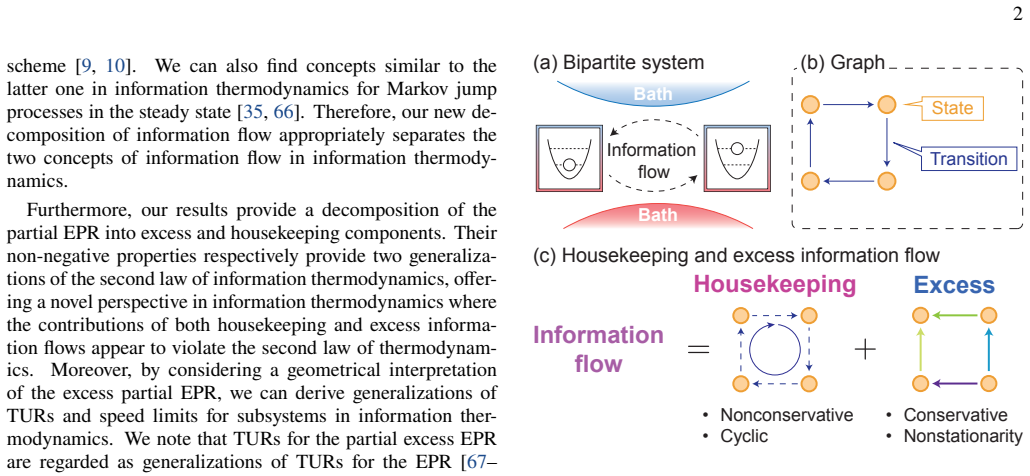
Information flow in bipartite Markov jump processes decomposes into a housekeeping component from cyclic modes that sustains correlations and an excess component from conservative forces that changes mutual information.
A machine-rendered reading of the paper's core claim, the machinery that carries it, and where it could break.
Core claim
We propose a decomposition of information flow into housekeeping and excess components for autonomous bipartite systems described by Markov jump processes. We introduce this decomposition using the geometric structure of probability currents and the conjugate thermodynamic forces. The housekeeping component arises from cyclic modes caused by violations of detailed balance and maintains the correlations between the two subsystems. In contrast, the excess component arises from conservative forces and alters the mutual information between the two subsystems. With this decomposition, we generalize previous results, such as the second law of information thermodynamics, the cyclic decomposition, a
What carries the argument
The geometric structure of probability currents and their conjugate thermodynamic forces, used to separate information flow into housekeeping (cyclic, correlation-maintaining) and excess (conservative, mutual-information-altering) components.
Load-bearing premise
The decomposition assumes that probability currents and their conjugate thermodynamic forces have a well-defined geometric structure in autonomous bipartite Markov jump processes.
What would settle it
Measure the information flow in a controlled bipartite Markov jump process with known cyclic modes and conservative forces, then check whether the observed flow splits into the predicted housekeeping and excess contributions that match the geometric definitions.
Figures


read the original abstract
We propose a decomposition of information flow into housekeeping and excess components for autonomous bipartite systems described by Markov jump processes. We introduce this decomposition using the geometric structure of probability currents and the conjugate thermodynamic forces. The housekeeping component arises from cyclic modes caused by violations of detailed balance and maintains the correlations between the two subsystems. In contrast, the excess component arises from conservative forces and alters the mutual information between the two subsystems. With this decomposition, we generalize previous results, such as the second law of information thermodynamics, the cyclic decomposition, and the information-thermodynamic extensions of thermodynamic trade-off relations.
Editorial analysis
A structured set of objections, weighed in public.
Referee Report
Summary. The manuscript proposes a geometric decomposition of information flow into housekeeping and excess components for autonomous bipartite systems described by Markov jump processes. The decomposition is constructed from the structure of probability currents and their conjugate thermodynamic forces, with the housekeeping component associated with cyclic modes that preserve correlations and the excess component linked to conservative forces that alter mutual information. The authors claim that this split generalizes the second law of information thermodynamics, cyclic decompositions, and information-thermodynamic extensions of thermodynamic trade-off relations.
Significance. If the geometric construction is unambiguous and the claimed equalities hold without residual cross terms, the work would offer a unified framework for separating correlation-preserving and information-changing contributions in nonequilibrium information thermodynamics. The geometric approach from currents and forces could strengthen existing results by providing a projection-based rationale rather than ad-hoc splitting, particularly for autonomous bipartite Markov systems.
major comments (2)
- [§3.2] §3.2, definition of the inner product on current space: the manuscript must specify the metric used for the Helmholtz-Hodge-style decomposition of J into cyclic and conservative parts. Different choices of inner product can alter the orthogonality condition, potentially introducing cross terms that prevent the excess component from equaling exactly dI/dt as required for the generalizations.
- [§4] §4, Eq. (18): the generalized second law is presented as an inequality involving only the excess information flow. The derivation assumes that conjugate forces F are defined via log-ratios under local detailed balance; the paper should demonstrate that the result remains valid when this assumption is relaxed or when the system is not bipartite.
minor comments (2)
- [§2] Notation for probability currents J and forces F is introduced without an explicit comparison table to prior definitions in the literature on information thermodynamics; adding such a table would improve readability.
- [Figure 2] Figure 2 caption does not state the parameter values used for the numerical example of the decomposition; this should be added for reproducibility.
Simulated Author's Rebuttal
We are grateful to the referee for the detailed and constructive feedback on our manuscript. We respond to each major comment below and have updated the manuscript to address the concerns raised.
read point-by-point responses
-
Referee: [§3.2] §3.2, definition of the inner product on current space: the manuscript must specify the metric used for the Helmholtz-Hodge-style decomposition of J into cyclic and conservative parts. Different choices of inner product can alter the orthogonality condition, potentially introducing cross terms that prevent the excess component from equaling exactly dI/dt as required for the generalizations.
Authors: We thank the referee for this important remark. Our decomposition employs the inner product on current space given by ⟨J, K⟩ = ∑_{i,j} J_{ij} K_{ij} / (p_i w_{ij}), where w_{ij} is the symmetric part of the transition rate and p_i the stationary distribution, which is the natural metric ensuring the orthogonality of the cyclic and gradient (conservative) components in the Helmholtz-Hodge decomposition for Markov processes. This choice eliminates cross terms and ensures the excess information flow precisely equals the rate of change of mutual information. We have explicitly defined and justified this inner product in the revised Section 3.2. revision: yes
-
Referee: [§4] §4, Eq. (18): the generalized second law is presented as an inequality involving only the excess information flow. The derivation assumes that conjugate forces F are defined via log-ratios under local detailed balance; the paper should demonstrate that the result remains valid when this assumption is relaxed or when the system is not bipartite.
Authors: The generalized second law relies on the local detailed balance condition to identify the conjugate forces F with thermodynamic affinities via log-ratios of rates. This is essential for the thermodynamic consistency in our autonomous bipartite Markov jump process framework. Relaxing local detailed balance would invalidate the thermodynamic force interpretation, and the decomposition is tailored to bipartite systems where information flow between subsystems is well-defined. We have revised the manuscript to explicitly state these assumptions in Section 4 and added a discussion on the scope, noting that the result generalizes prior works under the same conditions. Demonstrating validity outside this regime is beyond the current scope but could be explored in future studies. revision: partial
Circularity Check
No circularity: decomposition introduced from geometric structure of currents and forces
full rationale
The paper defines the housekeeping/excess split of information flow directly from the geometric decomposition of probability currents J and conjugate forces F for autonomous bipartite Markov jump processes. This split is not obtained by fitting to target observables, nor does any central claim reduce to a self-citation or prior ansatz by the same authors. The generalizations of the second law, cyclic decomposition, and trade-off relations are presented as consequences of the new split rather than inputs to it. No load-bearing step equates a derived quantity to its own definition or to a fitted parameter renamed as a prediction. The derivation chain is therefore self-contained against external benchmarks.
Axiom & Free-Parameter Ledger
axioms (2)
- domain assumption The systems under study are autonomous bipartite Markov jump processes.
- domain assumption Probability currents possess a geometric structure with conjugate thermodynamic forces.
invented entities (2)
-
housekeeping component of information flow
no independent evidence
-
excess component of information flow
no independent evidence
Lean theorems connected to this paper
-
IndisputableMonolith/Foundation/AlexanderDuality.lean; Cost/FunctionalEquation.leanreality_from_one_distinction; washburn_uniqueness_aczel unclear?
unclearRelation between the paper passage and the cited Recognition theorem.
We introduce this decomposition by using the geometric structure of probability currents and the conjugate thermodynamic forces. The housekeeping component arises from cyclic modes caused by violations of detailed balance...
-
IndisputableMonolith/Cost/FunctionalEquation.leanJ_uniquely_calibrated_via_higher_derivative unclear?
unclearRelation between the paper passage and the cited Recognition theorem.
˙Σhk(p) := ∥F(p)−F∗(p)∥²_L(p); ˙Σex(p) := ∥F∗(p)∥²_L(p)
What do these tags mean?
- matches
- The paper's claim is directly supported by a theorem in the formal canon.
- supports
- The theorem supports part of the paper's argument, but the paper may add assumptions or extra steps.
- extends
- The paper goes beyond the formal theorem; the theorem is a base layer rather than the whole result.
- uses
- The paper appears to rely on the theorem as machinery.
- contradicts
- The paper's claim conflicts with a theorem or certificate in the canon.
- unclear
- Pith found a possible connection, but the passage is too broad, indirect, or ambiguous to say the theorem truly supports the claim.
Reference graph
Works this paper leans on
-
[1]
Wasserstein distance for marginal distributions We here propose a formalization of the2-Wasserstein dis- tance for marginal distributions. As we reviewed in Sec. II C 2, the2-Wasserstein distance for joint distributions is defined by the minimization problem (38) under the constraints (39). In- spired by this formulation, we now define the2-Wasserstein di...
-
[2]
Geometric decomposition of partial EPR We discuss the geometric decomposition of the partial EPR ˙Σα forα∈ {X, Y}. We consider a solution to the master equation{p(t)} t∈[0,τ] (i.e.,d tp=∇ ⊤J(p) = ∇⊤L(p)F(p)) and the corresponding marginal distribution {pα(t) = Π αp(t)}t∈[0,τ] . To perform the geometric decom- position, we focus on the fact that the follow...
-
[3]
Speed limit We now introduce the thermodynamic speed limit. We consider a solution to the master equation and the correspond- ing marginal distribution:{p(t)} t∈[0,τ] and{p α(t)}[t∈[0,τ] = {Παp(t)}t∈[0,τ] forα∈ {X, Y}. We write the initial and final distributions asp (0) =p(0),p (1) =p(τ),p (0) α =p α(0), and p(1) α =p α(τ). First, the triangle inequality...
-
[4]
J. C. Maxwell,Theory of heat(Courier Corporation, 2012)
work page 2012
-
[5]
Landauer, Information is physical, Physics Today44, 23 (1991)
R. Landauer, Information is physical, Physics Today44, 23 (1991)
work page 1991
-
[6]
M. Esposito and C. Van den Broeck, Second law and landauer principle far from equilibrium, Europhysics Letters95, 40004 (2011)
work page 2011
-
[7]
L. Szilard, ¨Uber die entropieverminderung in einem ther- modynamischen system bei eingriffen intelligenter wesen, Zeitschrift f¨ ur Physik53, 840–856 (1929)
work page 1929
-
[8]
J. Schnakenberg, Network theory of microscopic and macro- scopic behavior of master equation systems, Reviews of Mod- ern physics48, 571 (1976)
work page 1976
-
[9]
Sekimoto,Stochastic Energetics(Springer Berlin Heidel- berg, 2010)
K. Sekimoto,Stochastic Energetics(Springer Berlin Heidel- berg, 2010)
work page 2010
-
[10]
U. Seifert, Stochastic thermodynamics, fluctuation theorems and molecular machines, Reports on progress in physics75, 126001 (2012)
work page 2012
-
[11]
Seifert,Stochastic thermodynamics(CAMBRIDGE Univer- sity Press, 2025)
U. Seifert,Stochastic thermodynamics(CAMBRIDGE Univer- sity Press, 2025)
work page 2025
-
[12]
J. M. Parrondo, J. M. Horowitz, and T. Sagawa, Thermody- namics of information, Nature physics11, 131 (2015)
work page 2015
-
[13]
T. Sagawa and M. Ueda, Generalized jarzynski equality under nonequilibrium feedback control, Physical review letters104, 090602 (2010)
work page 2010
- [14]
-
[15]
T. Sagawa and M. Ueda, Second law of thermodynamics with discrete quantum feedback control, Physical review letters100, 080403 (2008)
work page 2008
-
[16]
K. Ptaszy ´nski and M. Esposito, Thermodynamics of quantum information flows, Physical review letters122, 150603 (2019)
work page 2019
-
[17]
T. Yada, N. Yoshioka, and T. Sagawa, Quantum fluctuation theorem under quantum jumps with continuous measurement and feedback, Physical Review Letters128, 170601 (2022)
work page 2022
-
[18]
A. C. Barato, D. Hartich, and U. Seifert, Efficiency of cellular information processing, New Journal of Physics16, 103024 (2014)
work page 2014
-
[19]
P. Sartori, L. Granger, C. F. Lee, and J. M. Horowitz, Thermo- dynamic costs of information processing in sensory adaptation, PLoS computational biology10, e1003974 (2014)
work page 2014
- [20]
- [21]
-
[22]
A. B ´erut, A. Arakelyan, A. Petrosyan, S. Ciliberto, R. Dil- lenschneider, and E. Lutz, Experimental verification of lan- dauer’s principle linking information and thermodynamics, Nature483, 187 (2012)
work page 2012
-
[23]
Y. Jun, M. Gavrilov, and J. Bechhoefer, High-precision test of 28 landauer’s principle in a feedback trap, Physical review letters 113, 190601 (2014)
work page 2014
-
[24]
J. V. Koski, V. F. Maisi, J. P. Pekola, and D. V. Averin, Exper- imental realization of a szilard engine with a single electron, Proceedings of the National Academy of Sciences111, 13786 (2014)
work page 2014
-
[25]
M. D. Vidrighin, O. Dahlsten, M. Barbieri, M. Kim, V. Ve- dral, and I. A. Walmsley, Photonic maxwell’s demon, Physical review letters116, 050401 (2016)
work page 2016
- [26]
-
[27]
S. Ciliberto, Experiments in stochastic thermodynamics: Short history and perspectives, Physical Review X7, 021051 (2017)
work page 2017
-
[28]
Y. Masuyama, K. Funo, Y. Murashita, A. Noguchi, S. Kono, Y. Tabuchi, R. Yamazaki, M. Ueda, and Y. Nakamura, Information-to-work conversion by maxwell’s demon in a su- perconducting circuit quantum electrodynamical system, Na- ture communications9, 1291 (2018)
work page 2018
-
[29]
M. Naghiloo, J. Alonso, A. Romito, E. Lutz, and K. Murch, Information gain and loss for a quantum maxwell’s demon, Physical review letters121, 030604 (2018)
work page 2018
-
[30]
M. Ribezzi-Crivellari and F. Ritort, Large work extraction and the landauer limit in a continuous maxwell demon, Nature Physics15, 660 (2019)
work page 2019
-
[31]
M. Rico-Pasto, R. K. Schmitt, M. Ribezzi-Crivellari, J. M. Parrondo, H. Linke, J. Johansson, and F. Ritort, Dissipation reduction and information-to-measurement conversion in dna pulling experiments with feedback protocols, Physical Review X11, 031052 (2021)
work page 2021
-
[32]
T. K. Saha, J. N. Lucero, J. Ehrich, D. A. Sivak, and J. Bech- hoefer, Maximizing power and velocity of an information en- gine, Proceedings of the National Academy of Sciences118, e2023356118 (2021)
work page 2021
- [33]
-
[34]
T. Yada, P.-J. Stas, A. Suleymanzade, E. N. Knall, N. Yoshioka, T. Sagawa, and M. D. Lukin, Experimentally probing entropy reduction via iterative quantum information transfer, Physical Review X15, 031054 (2025)
work page 2025
- [35]
- [36]
-
[37]
D. Hartich, A. C. Barato, and U. Seifert, Stochastic thermo- dynamics of bipartite systems: transfer entropy inequalities and a maxwell’s demon interpretation, Journal of Statistical Mechanics: Theory and Experiment2014, P02016 (2014)
work page 2014
-
[38]
J. M. Horowitz and M. Esposito, Thermodynamics with con- tinuous information flow, Physical Review X4, 031015 (2014)
work page 2014
-
[39]
J. M. Horowitz and H. Sandberg, Second-law-like inequali- ties with information and their interpretations, New Journal of Physics16, 125007 (2014)
work page 2014
-
[40]
N. Shiraishi and T. Sagawa, Fluctuation theorem for par- tially masked nonequilibrium dynamics, Physical Review E 91, 012130 (2015)
work page 2015
-
[41]
J. M. Horowitz, Multipartite information flow for multiple maxwell demons, Journal of Statistical Mechanics: Theory and Experiment2015, P03006 (2015)
work page 2015
-
[42]
M. L. Rosinberg and J. M. Horowitz, Continuous information flow fluctuations, Europhysics Letters116, 10007 (2016)
work page 2016
-
[43]
S. Ito, Backward transfer entropy: Informational measure for detecting hidden markov models and its interpretations in thermodynamics, gambling and causality, Scientific reports 6, 36831 (2016)
work page 2016
-
[44]
R. E. Spinney, J. T. Lizier, and M. Prokopenko, Transfer entropy in physical systems and the arrow of time, Physical Review E 94, 022135 (2016)
work page 2016
-
[45]
G. E. Crooks and S. Still, Marginal and conditional second laws of thermodynamics, Europhysics Letters125, 40005 (2019)
work page 2019
- [46]
-
[47]
S. Ito, M. Oizumi, and S.-i. Amari, Unified framework for the entropy production and the stochastic interaction based on information geometry, Physical Review Research2, 033048 (2020)
work page 2020
-
[48]
D. H. Wolpert, Uncertainty relations and fluctuation theorems for bayes nets, Physical Review Letters125, 200602 (2020)
work page 2020
-
[49]
M. Nakazato and S. Ito, Geometrical aspects of entropy pro- duction in stochastic thermodynamics based on wasserstein distance, Physical Review Research3, 043093 (2021)
work page 2021
-
[50]
M. P. Leighton, J. Ehrich, and D. A. Sivak, Information arbi- trage in bipartite heat engines, Physical Review X14, 041038 (2024)
work page 2024
- [51]
-
[52]
K. Matsumoto, S.-i. Sasa, and A. Dechant, Learning rate ma- trix and information-thermodynamic trade-off relation, arXiv preprint arXiv:2504.09981 (2025)
-
[53]
D. Hartich, A. C. Barato, and U. Seifert, Sensory capacity: An information theoretical measure of the performance of a sensor, Physical Review E93, 022116 (2016)
work page 2016
-
[54]
S. Yoshida, Y. Okada, E. Muneyuki, and S. Ito, Thermody- namic role of main reaction pathway and multi-body informa- tion flow in membrane transport, Physical Review Research4, 023229 (2022)
work page 2022
- [55]
- [56]
-
[57]
C. Maes and K. Neto ˇcn` y, A nonequilibrium extension of the clausius heat theorem, Journal of Statistical Physics154, 188 (2014)
work page 2014
-
[58]
A. Dechant, S.-i. Sasa, and S. Ito, Geometric decomposition of entropy production in out-of-equilibrium systems, Physical Review Research4, L012034 (2022)
work page 2022
-
[59]
A. Dechant, S.-i. Sasa, and S. Ito, Geometric decomposition of entropy production into excess, housekeeping, and coupling parts, Physical Review E106, 024125 (2022)
work page 2022
-
[60]
K. Yoshimura, A. Kolchinsky, A. Dechant, and S. Ito, House- keeping and excess entropy production for general nonlinear dynamics, Physical Review Research5, 013017 (2023)
work page 2023
-
[61]
S. Ito, Geometric thermodynamics for the fokker–planck equa- tion: stochastic thermodynamic links between information ge- ometry and optimal transport, Information geometry7, 441 (2024)
work page 2024
-
[62]
T. Hatano and S.-i. Sasa, Steady-state thermodynamics of 29 langevin systems, Physical review letters86, 3463 (2001)
work page 2001
-
[63]
M. Esposito and C. Van den Broeck, Three faces of the second law. i. master equation formulation, Physical Review E—Statistical, Nonlinear, and Soft Matter Physics82, 011143 (2010)
work page 2010
- [64]
-
[65]
D. Sekizawa, S. Ito, and M. Oizumi, Decomposing thermo- dynamic dissipation of linear langevin systems via oscillatory modes and its application to neural dynamics, Physical Review X14, 041003 (2024)
work page 2024
-
[66]
R. Nagayama, K. Yoshimura, A. Kolchinsky, and S. Ito, Ge- ometric thermodynamics of reaction-diffusion systems: Ther- modynamic trade-off relations and optimal transport for pattern formation, Physical Review Research7, 033011 (2025)
work page 2025
-
[67]
K. Yoshimura and S. Ito, Two applications of stochastic ther- modynamics to hydrodynamics, Physical Review Research6, L022057 (2024)
work page 2024
-
[68]
K. Yoshimura, Y. Maekawa, R. Nagayama, and S. Ito, Force- current structure in markovian open quantum systems and its applications: Geometric housekeeping-excess decomposition and thermodynamic trade-off relations, Physical Review Re- search7, 013244 (2025)
work page 2025
-
[69]
S. Yamamoto, S. Ito, N. Shiraishi, and T. Sagawa, Lin- ear irreversible thermodynamics and onsager reciprocity for information-driven engines, Physical Review E94, 052121 (2016)
work page 2016
-
[70]
A. C. Barato and U. Seifert, Thermodynamic uncertainty re- lation for biomolecular processes, Physical review letters114, 158101 (2015)
work page 2015
-
[71]
J. M. Horowitz and T. R. Gingrich, Thermodynamic uncer- tainty relations constrain non-equilibrium fluctuations, Nature Physics16, 15 (2020)
work page 2020
- [72]
-
[73]
T. Tanogami, T. Van Vu, and K. Saito, Universal bounds on the performance of information-thermodynamic engine, Physical Review Research5, 043280 (2023)
work page 2023
-
[74]
T. Kamijima, A. Takatsu, K. Funo, and T. Sagawa, Optimal finite-time maxwell’s demons in langevin systems, Physical Review Research7, 023159 (2025)
work page 2025
-
[75]
Villaniet al.,Optimal transport: old and new, Vol
C. Villaniet al.,Optimal transport: old and new, Vol. 338 (Springer, 2008)
work page 2008
-
[76]
J. Maas, Gradient flows of the entropy for finite markov chains, Journal of Functional Analysis261, 2250 (2011)
work page 2011
-
[77]
A. Dechant, Minimum entropy production, detailed balance and wasserstein distance for continuous-time markov pro- cesses, Journal of Physics A: Mathematical and Theoretical 55, 094001 (2022)
work page 2022
-
[78]
T. Van Vu and K. Saito, Thermodynamic unification of opti- mal transport: Thermodynamic uncertainty relation, minimum dissipation, and thermodynamic speed limits, Physical Review X13, 011013 (2023)
work page 2023
-
[79]
T. Van Vu and K. Saito, Topological speed limit, Physical review letters130, 010402 (2023)
work page 2023
-
[80]
A. Kolchinsky, A. Dechant, K. Yoshimura, and S. Ito, Gen- eralized free energy and excess entropy production for active systems, arXiv preprint arXiv:2412.08432 (2024)
work page internal anchor Pith review Pith/arXiv arXiv 2024
discussion (0)
Sign in with ORCID, Apple, or X to comment. Anyone can read and Pith papers without signing in.