REVIEW 2 major objections 5 minor 70 references
This paper claims that one Bayesian transport map can learn the non-Gaussian joint distribution of a spatial field across multiple resolutions from a handful of training sample pairs, and then yield the conditional distribution of fine-scal
Reviewed by Pith at T0; open to challenge. T0 means a machine referee read the full paper against a public rubric. the ladder, T0–T4 →
A new multi-fidelity Bayesian transport map method learns non-Gaussian joint distributions across spatial scales and outperforms existing emulators in downscaling climate fields from small training sets.
T0 review reviewed 2026-08-04 challenge →
load-bearing objection A clean, useful extension of BTM to multi-fidelity spatial data with a closed-form likelihood and strong empirical results; the main gap is that the Markov assumption across fidelities is never tested where it could fail. the 2 major comments →
Generative multi-scale modeling and downscaling via spatial autoregressive transport maps
The pith
A machine-rendered reading of the paper's core claim, the machinery that carries it, and where it could break.
The reading
Core claim
The paper claims that a single probabilistic model can learn the full non-Gaussian, nonstationary joint distribution of a spatial field observed at multiple resolutions from a small training ensemble, and that the conditional distribution of any higher-fidelity level given the immediately coarser level is available in closed form after training. The claim is carried by a lower-triangular transport map that maps the multi-fidelity field to independent standard normals; each map component is a Gaussian process autoregression with variance priors that decay polynomially with distance to previously ordered points, and kernels whose relevance weights decay exponentially with neighbor order, explo
What carries the argument
Fidelity-aware autoregressive transport map: a lower-triangular map T from the multi-fidelity field y to iid standard normals, with component T_{r,i}(y) = (y_{r,i} − f_{r,i}(neighbors)) / d_{r,i}. The conditioning sets use a conditional maximin ordering: coarser-fidelity locations are ordered first, and each fine location conditions on its nearest previously ordered same-fidelity neighbors plus nearest neighbors in the immediately coarser fidelity. Priors are inverse-gamma on the conditional variances with means decaying polynomially in the distance to the nearest previously ordered point, and the kernel combines a linear-in-neighbors term with a squared-exponential nonlinearity whose range
Load-bearing premise
The load-bearing assumption is that each fidelity level depends on the data only through the immediately coarser level, p(y_r | y_<r) = p(y_r | y_{r-1}), so any dependence on other coarse scales or on longer-range history must be mediated through that single level.
What would settle it
Train the model on a synthetic ensemble in which the fine field is generated as a nonlinear function of both the medium and the coarse fields, so the Markov property is false, and compare held-out log-scores against a variant that conditions on both levels; a significant drop for the Markov-restricted model would show where the assumption binds. Alternatively, apply the method to a real multi-fidelity dataset with three or more levels and test whether residuals from the fitted conditionals remain independent of the skipped coarse level.
If this is right
- Statistical emulation of regional climate models from global model output becomes feasible with roughly 10 to 40 training pairs, producing probabilistic fine-scale fields in closed form rather than requiring thousands of deep-learning training samples.
- The closed-form conditional distribution allows cheap generation of many synthetic high-fidelity fields from new coarse inputs, enabling large-ensemble climate studies and uncertainty propagation at a fraction of the dynamical downscaling cost.
- Because training factorizes across fidelities and uses sparse conditioning sets, the approach scales to very large fine grids (e.g., 78,400 locations) with modest per-fidelity computational cost.
- The model captures nonlinear cross-fidelity relationships, as demonstrated by the block-minima simulation, so it can represent aggregation rules that are not simple linear averages.
- The probabilistic formulation gives a strictly proper scoring rule (log-score) for model comparison, making it possible to quantify gains over simpler kriging-based and deep-learning downscaling methods.
- The ability to sample conditionally from the fitted distribution supports downstream tasks such as assessing extreme-event probabilities and calibrating regional model parameters.
- Because the method is Bayesian, it could be extended to incorporate hyperparameter uncertainty via MCMC or Laplace approximation when uncertainty quantification is critical.
Where Pith is reading between the lines
- The Markov assumption that each fidelity depends only on the immediately coarser level is stated as 'for notational simplicity'; relaxing it to condition on multiple coarse levels could extend the method to settings where fine-scale processes are influenced by planetary-scale and regional-scale features simultaneously, which the authors note is straightforward.
- The success on block-minima suggests the transport map implicitly learns the physical aggregation operation; this could be exploited for detecting or validating downscaling relationships in climate model outputs, or for bias-correcting coarse fields by sampling from the learned conditional.
- Applying the method to precipitation, which has heavy tails and many zeros, would be a stiffer test because the conditional Gaussian components may struggle; the authors mention flexible-map extensions that could address this, implying a roadmap for non-Gaussian conditional structure.
- The closed-form posterior could enable rare-event simulation by importance sampling on low-fidelity fields, potentially making it easier to study extreme heat or heavy rainfall without running expensive regional models.
Editorial analysis
A structured set of objections, weighed in public.
Referee Report
Summary. The paper extends the Bayesian transport map (BTM) framework of Katzfuss and Schäfer (2023) to multi-fidelity spatial fields. The joint distribution over R fields is factored autoregressively, and a Markov assumption is imposed so that each higher-fidelity field depends only on the immediately lower-fidelity field. A conditional maximin ordering is used to define small conditioning sets (same-fidelity nearest neighbors plus nearest neighbors from the previous fidelity), and fidelity-specific GP priors with inverse-gamma variances are specified. Conjugacy yields a closed-form integrated likelihood (Eq. 4), enabling empirical-Bayes hyperparameter estimation by stochastic gradient descent. The fitted transport map provides closed-form conditional distributions of fine fields given coarse fields. The method is compared with hierarchical kriging, NARGP, a Matérn model, and a VAE on two simulation studies (block averages, block minima) and on GCM-RCM climate model output, using average log-scores. MF BTM reports the best average log-scores in all settings.
Significance. If the results hold, the paper provides a practical and scalable non-Gaussian multi-fidelity emulator that is specifically designed for the small-training-ensemble regime. The strongest points are the closed-form integrated likelihood (Eq. 4), the scalable conditional maximin ordering, and the availability of code and data links. The method is genuinely generative and can sample high-fidelity fields conditional on coarse inputs. The empirical comparison is broad and includes reasonable baselines. However, the contribution is incremental relative to the single-fidelity BTM, and the empirical evidence for the general multi-fidelity claim is narrower than the abstract suggests.
major comments (2)
- [Section 2.2] The Markov assumption p(y_r|y_<r)=p(y_r|y_{r-1}) is load-bearing for the claim that the method learns the joint multi-fidelity distribution. The paper says relaxing it is 'straightforward,' but no derivation or experiment is given. Moreover, all numerical experiments are settings where the assumption is either vacuous or automatically satisfied: the climate experiment (Section 4) has R=2, so p(y_2|y_1) is the full conditional; the R=3 simulations (Sections 3.2 and 3.3) use deterministic coarsening (block averages and block minima), making y_1 a deterministic function of y_2 and hence p(y_3|y_1,y_2)=p(y_3|y_2) by construction. Thus there is no test of the Markov assumption in a regime where it can fail. If a real multi-fidelity process has dependence on multiple coarse scales, the conditioning sets used in Eq. (2) and (3) are misspecified. Please add a simulation with R>=3 in which the co
- [Figures 5 and 8] The empirical comparisons report only point estimates of average log-scores. Figure 5 uses 50 test fields and Figure 8 uses 10 held-out test samples, but no standard errors, confidence intervals, or repeated training/test splits are provided. In the small-n regime (n=5-10), the differences between methods could be within Monte Carlo noise; the abstract's claim that the approach 'substantially outperforms existing methods' is therefore not quantitatively supported. Please add error bars (e.g., bootstrap or repeated random splits) and, if feasible, assess whether the reported ranking is stable across independent training sets.
minor comments (5)
- [Section 4 and Figure 7] The RCM acronym is inconsistent: the text uses CRMC5 and CRCM5, and Figure 7 uses CRM5. Please standardize.
- [Equation (4)] The notation K_{r,i} is used both for the kernel function in (3) and for the n x n Gram matrix in (4). Use a bold symbol or an explicit definition for the matrix to avoid confusion.
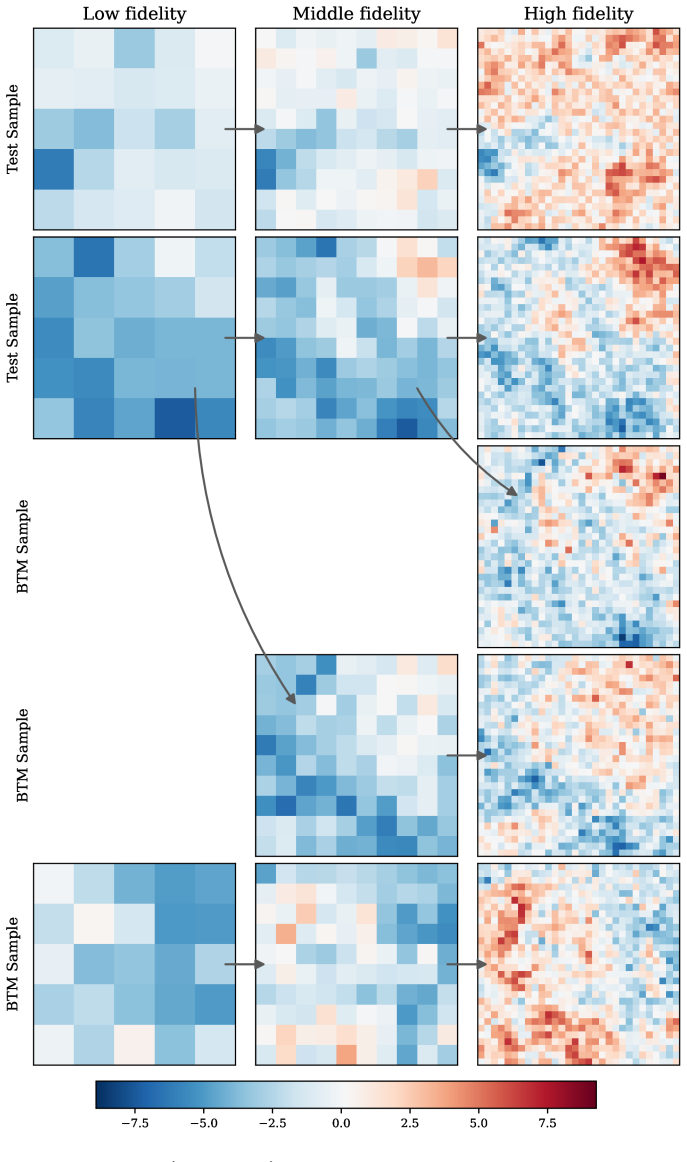
- [Figure 3] The caption is long and the four rows are not labeled in the figure. Consider labeling panels (a)-(d) so the reader can connect the rows to the described quantities.
- [Section 3.2] The statement that the Matérn model is 'the second best for small n' appears to refer only to the left panel of Figure 5; the right panel does not include Matérn. Please make this explicit.
- [Appendix A] The VAE comparison is based on a bespoke architecture; the description gives general structure but no layer sizes, number of parameters, or detailed training schedule. Please provide enough detail for exact reproducibility.
Circularity Check
No circular reduction found; the core derivation is a self-contained hierarchical GP transport model validated on held-out data.
full rationale
The paper's central claim—that MF BTM substantially outperforms existing methods—is supported by held-out log-score evaluations on simulations and on CanESM2/CRCM5 climate data, not by a fitted parameter relabeled as a prediction. The model's joint density is the autoregressive product p(y)=∏_r p(y_r|y_<r); the Markov restriction in Section 2.2 is an explicit modeling assumption, not a definitional equivalence to the target result. Hyperparameters θ are estimated by empirical Bayes from training data and then evaluated on held-out test fields; no test quantity is an input to the fit. The paper cites prior work by the same group (Katzfuss & Schäfer 2023; Schäfer et al. 2021; Chen et al. 2025) for the BTM framework, screening-effect rates, and conditional-maximin ordering; these are published mathematical/algorithmic results with stated assumptions and are not equivalent to the present claim of empirical outperformance. The simulation studies draw from a transport-map generator related to the model class, but this is a model-match sensitivity check, not a circular reduction, and the nonlinear block-minima and real-data experiments provide independent evidence. The paper does assert 'relaxing [the Markov assumption] is straightforward' (Section 2.2) and that temporal extension is 'straightforward' (Sections 4 and 5); these are unverified scope claims and should be weighed as robustness risks, but they are not circularity. No self-definitional, fitted-input-as-prediction, uniqueness-imported, ansatz-smuggled, or renaming pattern is present.
Axiom & Free-Parameter Ledger
free parameters (6)
- θ^d1_r, θ^d2_r (variance decay parameters per fidelity) =
estimated via empirical Bayes
- θ^γ_r (kernel range per fidelity) =
estimated via empirical Bayes
- θ^{σ1}_r, θ^{σ2}_r (nonlinearity variance decay per fidelity) =
estimated via empirical Bayes
- θ^{q0}_r, θ^{q1}_r, θ^{q'0}_r, θ^{q'1}_r (relevance weights per fidelity) =
estimated via empirical Bayes
- g (prior coefficient of variation factor) =
4
- ε (relevance threshold) =
0.01
axioms (5)
- domain assumption Markov assumption p(y_r|y_<r) = p(y_r|y_{r-1}) between fidelities
- domain assumption Conditional Gaussianity of each transport-map component given the conditioning set: y_{r,i} | y~c_{r,i}, f_{r,i}, d^2_{r,i} ~ N(...)
- domain assumption Screening effect: relevance decays exponentially with neighbor order, so truncating conditioning sets to m_r + m'_r nearest neighbors suffices
- ad hoc to paper Polynomial decay of conditional variance: E[d^2_{r,i}] = exp(θ^d1_r) ℓ^{θ^d2_r}_{r,i}
- standard math Normal-inverse-gamma conjugacy yields closed-form integrated likelihood
Cite this review
Pith. "Pith review of Generative multi-scale modeling and downscaling via spatial autoregressive transport maps." pith.science (2026). https://pith.science/paper/2R3MITPR
@misc{pith2026250922474,
  author       = {Pith},
  title        = {Pith review of: Generative multi-scale modeling and downscaling via spatial autoregressive transport maps},
  year         = {2026},
  howpublished = {\url{https://pith.science/paper/2R3MITPR}},
  note         = {Machine review of arXiv:2509.22474}
}
read the original abstract
Spatial fields in the Earth and environmental sciences are often available at multiple scales or resolutions. While coarse-scale data (e.g., from global circulation models) are often abundant, they lack the local detail provided by fine-scale data (e.g., from regional climate models), which are typically computationally expensive to generate. Statistical downscaling and multi-scale data fusion address this challenge by predicting high-resolution fields from low-resolution or related inputs. We propose a highly scalable Bayesian approach that can learn the joint non-Gaussian distribution and nonlinear dependence structure of nonstationary spatial fields across multiple scales from a small number of training samples. Our method employs scale-aware autoregressive Gaussian processes with suitably chosen regularization-inducing priors to model the conditional distribution of fine-scale fields given coarse-scale data. Exploiting conjugacy, the integrated likelihood is available in closed form, enabling efficient parameter optimization via stochastic gradient descent. Once trained, the method provides a closed-form characterization of the posterior distribution of fine-scale fields given coarse-scale inputs. In numerical comparisons, we demonstrate that our approach substantially outperforms existing methods and effectively characterizes and simulates fine-scale climate behavior based on output from coarse global circulation models.
Figures




Reference graph
Works this paper leans on
-
[1]
Adams, R. A. and Fournier, J. J. (2003). Sobolev spaces , volume 140. Elsevier
2003
-
[2]
Baptista, R., Hosseini, B., Kovachki, N. B., and Marzouk, Y. (2020). Conditional sampling with monotone gans: from generative models to likelihood-free inference. arXiv preprint arXiv:2006.06755
Pith/arXiv arXiv 2020
-
[3]
Baptista, R., Marzouk, Y., and Zahm, O. (2024). On the representation and learning of monotone triangular transport maps. Foundations of Computational Mathematics , 24(6):2063--2108
2024
-
[4]
Bhouri, M. A., Peng, L., Pritchard, M. S., and Gentine, P. (2023). Multi-fidelity climate model parameterization for better generalization and extrapolation. arXiv preprint arXiv:2309.10231
Pith/arXiv arXiv 2023
-
[5]
Bird, S., Fernandez, M., Ho, M.-F., Qezlou, M., Monadi, R., Ni, Y., Chen, N., Croft, R., and Di Matteo, T. (2023). Priya: a new suite of lyman- forest simulations for cosmology. Journal of Cosmology and Astroparticle Physics , 2023(10):037
2023
-
[6]
M., Kucukelbir, A., and McAuliffe, J
Blei, D. M., Kucukelbir, A., and McAuliffe, J. D. (2017). Variational Inference: A Review for Statisticians . Journal of the American Statistical Association , 112(518):859--877
2017
-
[7]
Bocquet, M. (2023). Surrogate modeling for the climate sciences dynamics with machine learning and data assimilation. Frontiers in Applied Mathematics and Statistics , 9:1133226
2023
-
[8]
Burda, Y., Grosse, R., and Salakhutdinov, R. (2015). Importance weighted autoencoders. arXiv preprint arXiv:1509.00519
Pith/arXiv arXiv 2015
-
[9]
N., Glaws, A., and King, R
Buster, G., Benton, B. N., Glaws, A., and King, R. N. (2024). High-resolution meteorology with climate change impacts from global climate model data using generative machine learning. Nature Energy , pages 1--13
2024
-
[10]
Chakraborty, A. and Katzfuss, M. (2024). Learning non-gaussian spatial distributions via bayesian transport maps with parametric shrinkage. arXiv preprint arXiv:2409.19208
Pith/arXiv arXiv 2024
-
[11]
Chattopadhyay, A. and Hassanzadeh, P. (2023). Long-term instabilities of deep learning-based digital twins of the climate system: The cause and a solution. arXiv:2304.07029
Pith/arXiv arXiv 2023
-
[12]
Chen, J. and Sanz-Alonso, D. (2024). Precision and cholesky factor estimation for gaussian processes. arXiv preprint arXiv:2412.08820
Pith/arXiv arXiv 2024
-
[13]
Chen, Y., Owhadi, H., and Sch \"a fer, F. (2025). Sparse cholesky factorization for solving nonlinear pdes via gaussian processes. Mathematics of Computation , 94(353):1235--1280
2025
-
[14]
A., De, S., Becker, S., and Doostan, A
Cheng, N., Malik, O. A., De, S., Becker, S., and Doostan, A. (2024). Bi-fidelity variational auto-encoder for uncertainty quantification. Computer Methods in Applied Mechanics and Engineering , 421:116793
2024
-
[15]
A., Karagiannis, G., and Kang, E
Cheng, S., Konomi, B. A., Karagiannis, G., and Kang, E. L. (2023). Recursive nearest neighbor co-kriging models for big multi-fidelity spatial data sets. Environmetrics , page e2844
2023
-
[16]
Chylek, P., Li, J., Dubey, M., Wang, M., and Lesins, G. (2011). Observed and model simulated 20th century arctic temperature variability: Canadian earth system model canesm2. Atmospheric Chemistry and Physics Discussions , 11(8):22893--22907
2011
-
[17]
A., Glazer, R., Giuliani, G., Di Sante, F., Nogherotto, R., and Giorgi, F
Coppola, E., Stocchi, P., Pichelli, E., Torres Alavez, J. A., Glazer, R., Giuliani, G., Di Sante, F., Nogherotto, R., and Giorgi, F. (2021). Non-hydrostatic regcm4 (regcm4-nh): model description and case studies over multiple domains. Geoscientific Model Development Discussions , 2021:1--25
2021
-
[18]
L., Braverman, A., and Kalmus, P
Ekanayaka, A., Kang, E. L., Braverman, A., and Kalmus, P. (2025). A multivariate spatial statistical model for statistical downscaling of sea surface temperature in the great barrier reef region. Journal of the Royal Statistical Society Series C: Applied Statistics , page qlaf019
2025
-
[19]
Fern \'a ndez-Godino, M. G. (2023). Review of multi-fidelity models. Advances in Computational Science and Engineering , 1(4):351--400
2023
-
[20]
and Bates, G
Giorgi, F. and Bates, G. T. (1989). The climatological skill of a regional model over complex terrain. Monthly Weather Review , 117(11):2325--2347
1989
-
[21]
M., Pichelli, E., Nogherotto, R., Raffaele, F., Malguzzi, P., Davolio, S., Stocchi, P., et al
Giorgi, F., Coppola, E., Giuliani, G., Ciarlo, J. M., Pichelli, E., Nogherotto, R., Raffaele, F., Malguzzi, P., Davolio, S., Stocchi, P., et al. (2023). The fifth generation regional climate modeling system, regcm5: Description and illustrative examples at parameterized convection and convection-permitting resolutions. Journal of Geophysical Research: Atm...
2023
-
[22]
and Katzfuss, M
Gneiting, T. and Katzfuss, M. (2014). Probabilistic forecasting . Annual Review of Statistics and Its Application , 1(1):125--151
2014
-
[23]
Guinness, J. (2018). Permutation and grouping methods for sharpening Gaussian process approximations . Technometrics , 60(4):415--429
2018
-
[24]
and G \"o rtz, S
Han, Z.-H. and G \"o rtz, S. (2012). Hierarchical kriging model for variable-fidelity surrogate modeling. AIAA journal , 50(9):1885--1896
2012
-
[25]
Hao, S., Han, W., Jiang, T., Li, Y., Wu, H., Zhong, C., Zhou, Z., and Tang, H. (2024). Synthetic data in AI : Challenges, applications, and ethical implications. arXiv:2401.01629
Pith/arXiv arXiv 2024
-
[26]
Hensman, J., Fusi, N., and Lawrence, N. D. (2013). Gaussian processes for big data. arXiv preprint arXiv:1309.6835
Pith/arXiv arXiv 2013
-
[27]
Higgins, I., Matthey, L., Pal, A., Burgess, C., Glorot, X., Botvinick, M., Mohamed, S., and Lerchner, A. (2017). beta-vae: Learning basic visual concepts with a constrained variational framework. In International conference on learning representations
2017
-
[28]
Ho, M.-F., Bird, S., and Shelton, C. R. (2021). Multifidelity emulation for the matter power spectrum using Gaussian processes . Monthly Notices of the Royal Astronomical Society , 509(2):2551--2565
2021
-
[29]
Huang, L., Gao, Z., and Zhang, D. (2013). Research on multi-fidelity aerodynamic optimization methods. Chinese Journal of Aeronautics , 26(2):279--286
2013
-
[30]
J., Scetbon, M., Pal, S., and Harchaoui, Z
Irons, N. J., Scetbon, M., Pal, S., and Harchaoui, Z. (2022). Triangular flows for generative modeling: Statistical consistency, smoothness classes, and fast rates. In International Conference on Artificial Intelligence and Statistics , pages 10161--10195. PMLR
2022
-
[31]
and Schäfer, F
Katzfuss, M. and Schäfer, F. (2023). Scalable bayesian transport maps for high-dimensional non-gaussian spatial fields. Journal of the American Statistical Association , 0(0):1--15
2023
-
[32]
E., Deser, C., Phillips, A., Mai, A., Hannay, C., Strand, G., Arblaster, J
Kay, J. E., Deser, C., Phillips, A., Mai, A., Hannay, C., Strand, G., Arblaster, J. M., Bates, S., Danabasoglu, G., Edwards, J., et al. (2015). The community earth system model (cesm) large ensemble project: A community resource for studying climate change in the presence of internal climate variability. Bulletin of the American Meteorological Society , 9...
2015
-
[33]
Kennedy, M. C. and O'Hagan, A. (2000). Predicting the output from a complex computer code when fast approximations are available. Biometrika , 87(1):1--13
2000
-
[34]
Kingma, D. P. and Welling, M. (2014). Auto-encoding variational Bayes . In International Conference on Learning Representations
2014
-
[35]
C., Zwiers, F
Kirchmeier-Young, M. C., Zwiers, F. W., and Gillett, N. P. (2017). Attribution of extreme events in arctic sea ice extent. Journal of Climate , 30(2):553--571
2017
-
[36]
J., Mudryk, L
Kushner, P. J., Mudryk, L. R., Merryfield, W., Ambadan, J. T., Berg, A., Bichet, A., Brown, R., Derksen, C., D \'e ry, S. J., Dirkson, A., et al. (2018). Canadian snow and sea ice: assessment of snow, sea ice, and related climate processes in canada's earth system model and climate-prediction system. The Cryosphere , 12(4):1137--1156
2018
-
[37]
and Garnier, J
Le Gratiet, L. and Garnier, J. (2014). Recursive co-kriging model for design of computer experiments with multiple levels of fidelity. International Journal for Uncertainty Quantification , 4(5)
2014
-
[38]
B., Gigu \`e re, M., Brissette, F., Turcotte, R., Braun, M., et al
Leduc, M., Mailhot, A., Frigon, A., Martel, J.-L., Ludwig, R., Brietzke, G. B., Gigu \`e re, M., Brissette, F., Turcotte, R., Braun, M., et al. (2019). The climex project: A 50-member ensemble of climate change projections at 12-km resolution over europe and northeastern north america with the canadian regional climate model (crcm5). Journal of Applied Me...
2019
-
[39]
Lophaven, S., Nielsen, H., and S ndergaard, J. (2002). Dace - a matlab kriging toolbox, version 2.0. Technical report, Technical University of Denmark
2002
-
[40]
L., Braverman, A
Ma, P., Kang, E. L., Braverman, A. J., and Nguyen, H. M. (2019). Spatial statistical downscaling for constructing high-resolution nature runs in global observing system simulation experiments. Technometrics , 61(3):322--340
2019
-
[41]
A., Asher, T
Ma, P., Karagiannis, G., Konomi, B. A., Asher, T. G., Toro, G. R., and Cox, A. T. (2022). Multifidelity computer model emulation with high-dimensional output: An application to storm surge. Journal of the Royal Statistical Society Series C: Applied Statistics , 71(4):861--883
2022
-
[42]
Mardani, M., Brenowitz, N., Cohen, Y., Pathak, J., Chen, C.-Y., Liu, C.-C., Vahdat, A., Kashinath, K., Kautz, J., and Pritchard, M. (2023). Residual diffusion modeling for km-scale atmospheric downscaling
2023
-
[43]
Martynov, A., Laprise, R., Sushama, L., Winger, K., S eparovi \'c , L., and Dugas, B. (2013). Reanalysis-driven climate simulation over cordex north america domain using the canadian regional climate model, version 5: model performance evaluation. Climate dynamics , 41(11):2973--3005
2013
-
[44]
M., Moselhy, T., Parno, M., and Spantini, A
Marzouk, Y. M., Moselhy, T., Parno, M., and Spantini, A. (2016). Sampling via measure transport: An introduction . In Ghanem, R., Higdon, D., and Owhadi, H., editors, Handbook of Uncertainty Quantification . Springer
2016
-
[45]
Mearns, L., McGinnis, S., Korytina, D., Arritt, R., Biner, S., Bukovsky, M., Chang, H., Christensen, O., Herzmann, D., Jiao, Y., et al. (2017). The na-cordex dataset, version 1.0. ncar climate data gateway, boulder co
2017
-
[46]
O., Gutowski, W., Jones, R., Leung, R., Mcginnis, S., Nunes, A., and Qian, Y
Mearns, L. O., Gutowski, W., Jones, R., Leung, R., Mcginnis, S., Nunes, A., and Qian, Y. (2009). A regional climate change assessment program for North America . Eos , 90(36):311--312
2009
-
[47]
and Laizet, S
Mole, A. and Laizet, S. (2024). Multi-fidelity bayesian optimisation of wind farm wake steering using wake models and large eddy simulations. Flow, Turbulence and Combustion , pages 1--26
2024
-
[48]
Modernizing Probable Maximum Precipitation Estimation
NASEM (2024). Modernizing Probable Maximum Precipitation Estimation . The National Academies Press, Washington, DC
2024
-
[49]
Nikolenko, S. I. (2021). Synthetic Data for Deep Learning , volume 174. Springer
2021
-
[50]
Niu, R., Wu, D., Kim, K., Ma, Y.-A., Watson-Parris, D., and Yu, R. (2024). Multi-fidelity residual neural processes for scalable surrogate modeling. arXiv preprint arXiv:2402.18846
Pith/arXiv arXiv 2024
-
[51]
Peherstorfer, B., Willcox, K., and Gunzburger, M. (2018). Survey of multifidelity methods in uncertainty propagation, inference, and optimization. Siam Review , 60(3):550--591
2018
-
[52]
D., and Karniadakis, G
Perdikaris, P., Raissi, M., Damianou, A., Lawrence, N. D., and Karniadakis, G. E. (2017). Nonlinear information fusion algorithms for data-efficient multi-fidelity modelling. Proceedings of the Royal Society A: Mathematical, Physical and Engineering Sciences , 473(2198):20160751
2017
-
[53]
J., Slinskey, E., Graves, S., Biyani, S., Wang, B., Cropper, S., and the UCLA Center for Climate Science Team (2024)
Rahimi, S., Huang, L., Norris, J., Hall, A., Goldenson, N., Krantz, W., Bass, B., Thackeray, C., Lin, H., Chen, D., Dennis, E., Collins, E., Lebo, Z. J., Slinskey, E., Graves, S., Biyani, S., Wang, B., Cropper, S., and the UCLA Center for Climate Science Team (2024). An overview of the western united states dynamically downscaled dataset (wus-d3). Geoscie...
2024
-
[54]
and Mohamed, S
Rezende, D. and Mohamed, S. (2015). Variational inference with normalizing flows. In International conference on machine learning , pages 1530--1538. PMLR
2015
-
[55]
Sch \" a fer, F., Katzfuss, M., and Owhadi, H. (2021). Sparse Cholesky factorization by Kullback-Leibler minimization . SIAM Journal on Scientific Computing , 43(3):A2019--A2046
2021
-
[56]
J., and Owhadi, H
Sch\" a fer, F., Sullivan, T. J., and Owhadi, H. (2021). Compression, inversion, and approximate pca of dense kernel matrices at near-linear computational complexity. Multiscale Modeling & Simulation , 19(2):688--730
2021
-
[57]
R., and Wills, R
Schneider, T., Leung, L. R., and Wills, R. C. (2024). Opinion: Optimizing climate models with process knowledge, resolution, and artificial intelligence. Atmospheric Chemistry and Physics , 24(12):7041--7062
2024
-
[58]
and Craig, G
Selz, T. and Craig, G. C. (2015). Simulation of upscale error growth with a stochastic convection scheme. Geophysical Research Letters , 42(8):3056--3062
2015
-
[59]
Stein, M. L. (2002). The screening effect in kriging . Annals of Statistics , 30(1):298--323
2002
-
[60]
Stein, M. L. (2011). When does the screening effect hold? Annals of Statistics , 39(6):2795--2819
2011
-
[61]
M., Buekenhout, D., and Willems, P
Tabari, H., Paz, S. M., Buekenhout, D., and Willems, P. (2021). Comparison of statistical downscaling methods for climate change impact analysis on precipitation-driven drought. Hydrology and Earth System Sciences , 25(6):3493--3517
2021
-
[62]
Tague, C. (2024). Digital twins of the E arth: can they keep up?
2024
-
[63]
Umakant, J., Sudhakar, K., Mujumdar, P., and Rao, C. R. (2007). Ranking based uncertainty quantification for a multifidelity design approach. Journal of aircraft , 44(2):410--419
2007
-
[64]
Vecchia, A. (1988). Estimation and model identification for continuous spatial processes . Journal of the Royal Statistical Society, Series B , 50(2):297--312
1988
-
[65]
Wang, S. and Marzouk, Y. (2022). On minimax density estimation via measure transport. arXiv preprint arXiv:2207.10231
Pith/arXiv arXiv 2022
-
[66]
Wiemann, P. F. V. and Katzfuss, M. (2023). Bayesian nonparametric generative modeling of large multivariate non-Gaussian spatial fields . Journal of Agricultural, Biological and Environmental Statistics , 28(4):597--617
2023
-
[67]
and Nickisch, H
Wilson, A. and Nickisch, H. (2015). Kernel interpolation for scalable structured gaussian processes (kiss-gp). In International conference on machine learning , pages 1775--1784. PMLR
2015
-
[68]
Wu, D., Chinazzi, M., Vespignani, A., Ma, Y.-A., and Yu, R. (2022). Multi-fidelity hierarchical neural processes. In Proceedings of the 28th ACM SIGKDD Conference on Knowledge Discovery and Data Mining , pages 2029--2038
2022
-
[69]
Xu, Z., Han, Y., and Yang, Z. (2019). Dynamical downscaling of regional climate: A review of methods and limitations. Science China Earth Sciences , 62(2):365--375
2019
-
[70]
B., and Li, Z
Yu, G., Wright, D. B., and Li, Z. (2020). The upper tail of precipitation in convection-permitting regional climate models and their utility in nonstationary rainfall and flood frequency analysis. Earth's Future , 8(10):e2020EF001613. e2020EF001613 2020EF001613
2020
This paper was first reviewed by deepseek-v4-flash on August 4, 2026.
discussion (0)
Sign in with ORCID, Apple, or X to comment. Anyone can read and Pith papers without signing in.