REVIEW 3 major objections 4 minor
Deformable Medical Image Registration with KAN-based Implicit Neural Representations
T0 review · 3 major / 4 minor · reviewed 2026-08-04 · deepseek-v4-flash
Pith's one-line read Kolmogorov-Arnold networks improve deformable image registration accuracy and seed stability over MLP-based implicit neural representations.
desk verdict A useful first KAN-based INR for registration with a neat randomized sampling trick, but the headline numbers are inflated by test-set tuning and baseline confounds. read the letter →
The pith
A machine-rendered reading of the paper's core claim, the machinery that carries it, and where it could break.
The reading
What carries the argument
The key machinery is a Chebyshev KAN layer: each layer computes weighted sums of Chebyshev polynomials applied to tanh-normalized coordinates, combined with a learnable SiLU skip-connection. RandKAN-IDIR adds a randomization mechanism that independently selects a small subset of polynomial degrees per layer (always including degree 0) before training, shrinking the basis dictionary. The training objective couples negative normalized cross-correlation with total-variation smoothness and a Jacobian-determinant folding penalty.
What would settle it
Re-run the same three datasets with MLP-based INRs matched in parameter count, iteration count, and loss terms, without any of the authors' baseline modifications; if an MLP INR achieves equal or better TRE and Dice with similar seed variance, the central claim that KANs improve accuracy and stability would be refuted.
Extended reading notes
Core claim
The paper's central claim is that replacing the MLP backbone with a Chebyshev KAN in an implicit neural representation yields more accurate deformation fields for deformable image registration, consistently across three anatomies and two modalities. The authors further show that randomly sampling a subset of polynomial basis functions per layer preserves accuracy while cutting runtime and memory, and that this random selection outperforms a learned adaptive selection of basis indices. They report fewer outlier landmarks on the DIR-Lab lung dataset and markedly better seed-to-seed consistency than MLP-based INR baselines, making the deformation fields more reliable and the optimization more r
Load-bearing premise
The reported accuracy advantage over MLP-based INR baselines depends on comparisons where the authors fixed bugs, changed a stopping criterion, and altered train/test splits for several baselines; without a controlled capacity-matched test, the size of the gain may be overstated.
Editorial extensions
If this is right
- INR-based registration can reach near-classical accuracy on lung CT while running about seven times faster than the leading iterative method.
- Randomized basis sampling cuts runtime by roughly 30% with no loss in quality, making per-pair optimization feasible on consumer GPUs.
- Because the method needs no dataset-level training and is resolution-independent, it can be applied to a new anatomy or modality from a single image pair.
- Improved seed-to-seed stability means clinical researchers can expect consistent deformations without hand-tuning random initializations.
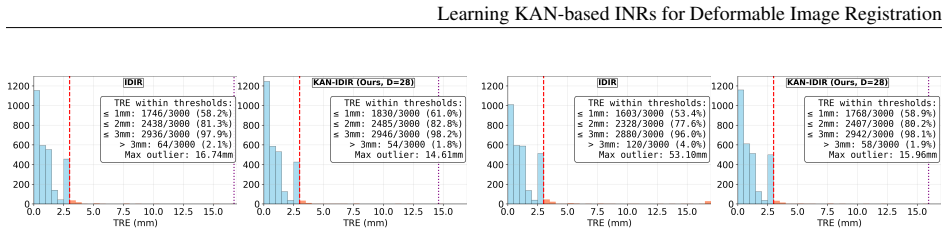
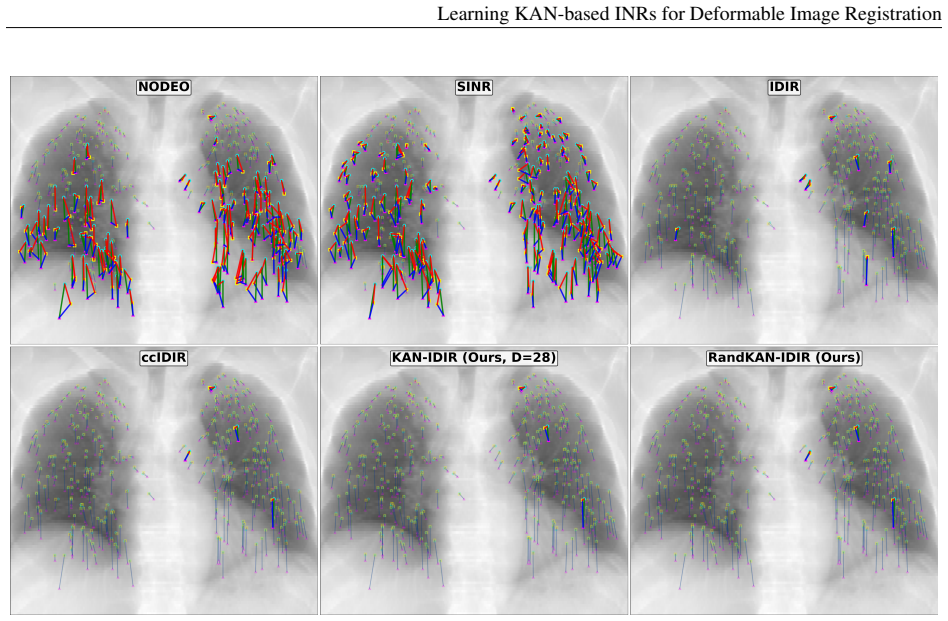
- On DIR-Lab, the method reduces the number of >3 mm landmark outliers, suggesting safer deformation fields where large errors are clinically important.
Reading between the lines
- If KANs are inherently better at approximating smooth physical fields, the same architecture could transfer to other coordinate-regression tasks such as optical flow, atlas construction, or biomechanical model fitting.
- The result that random basis selection beats learned selection hints that the specific choice of basis subset is not informative; only its size matters, so even cheaper sparse or structured grids may suffice.
- Because the baselines were not capacity-matched, a fair parameter-controlled comparison could shift the magnitude of the reported gain; the main claim of improved stability may still hold, but accuracy margins may narrow.
- Random basis sampling resembles function-space dropout; this could be exploited to build ensembles of random basis subsets for uncertainty quantification in deformation fields, a direction the paper leaves implicit.
Editorial analysis
A structured set of objections, weighed in public.
Referee Report
Summary. The paper introduces KAN-IDIR and RandKAN-IDIR, the first Kolmogorov-Arnold network (KAN) based implicit neural representations (INRs) for deformable medical image registration. KAN-IDIR uses Chebyshev polynomial bases in every layer; RandKAN-IDIR randomly samples a small subset of basis degrees per layer. The registration loss is a combination of negative normalized cross-correlation, total variation on the displacement gradient, and a Jacobian determinant penalty. Experiments on DIR-Lab (lung CT), OASIS-1 (brain MRI), and ACDC (cardiac MRI) compare the proposed methods against INR baselines (IDIR, ccIDIR, SINR, NODEO), dataset-trained models (VoxelMorph, TransMorph, CorrMLP), and a classical method (pTV). The paper claims that KAN-IDIR and RandKAN-IDIR achieve the highest accuracy among INR-based methods, lower runtime/memory than most alternatives, and improved seed stability. Source code is provided.
Significance. If the empirical claims hold, the paper offers a useful practical contribution: KAN-based INRs with randomized basis sampling can be competitive with or better than MLP/SIREN-based INR registration at lower cost and with better seed stability. The paper is honest about the INR-relative nature of its headline claims, provides code, and reports per-case and per-seed information for DIR-Lab. The randomized basis sampling idea is simple and potentially reusable. However, the central accuracy claims currently rest on hyperparameters chosen on the same evaluation sets and on modified baselines, so the significance is conditional until these issues are addressed.
major comments (3)
- [§4.4, Table 7, Figure 4] The headline results are obtained after selecting hyperparameters on the same test datasets. Table 7 selects D=28 using DIR-Lab average TRE; Figure 4 (left) selects lambda=0.4 and gamma=15 using OASIS-1 Dice/NJD; Figure 4 (right) selects k=12 and K=84 using OASIS-1. Tables 1, 3, and 4 then report the final numbers on those same datasets. This is test-set selection and yields an optimistic bias for the claim of 'highest accuracy among INR-based methods.' A held-out validation split or nested selection procedure is needed before the reported gains (e.g., 0.98 vs 1.07 mm TRE on DIR-Lab) can be taken at face value.
- [§A.3] The baseline comparisons are confounded by implementation modifications. The authors state that SINR's stopping criterion was revised (to 500 iterations) and that SINR required additional cropping on DIR-Lab; VoxelMorph and TransMorph train/test splits were changed from the original 19 to 49 pairs; and 'substantial bugs' were fixed in SINR and NODEO. Since the paper does not report results for the original baseline configurations or a capacity-matched comparison, it is unclear whether the relative improvements over MLP/SIREN-based INRs stem from the KAN architecture or from these changes. A sensitivity analysis or reproduction of original-config results is needed to support the fair-comparison claim.
- [Tables 1, 3, 4 and Figure 1] The paper claims superior seed stability and accuracy advantages, but the reported parenthesized values are not clearly seed-level standard deviations. The differences between KAN-IDIR and the best MLP INR baselines are small (e.g., 0.98 vs 1.04 mm TRE; DSC 0.793 vs 0.779 in Table 3), while the reported dispersion is large (e.g., 0.16 DSC). Without seed-level error bars or paired significance tests, the statistical support for the superiority claim is not established. Please clarify what the parentheses denote and provide seed-level statistics.
minor comments (4)
- [§A.3 vs Table 3] The appendix says NODEO was extended to 'DIR-Lab and ACDC', yet Table 3 reports NODEO results on OASIS-1. Please resolve this inconsistency.
- [Throughout] Typos and formatting issues: 'perfomance' (Sec. 1), 'V oxelMorph' and 'V oxels' (Secs. 1, 4), 'functios' (Table 7 caption), and inconsistent spacing around 'KAN-IDIR (28)' labels. These do not affect the science but should be cleaned up.
- [§4.3 and Table 1] The runtime comparison with pTV (442 s vs 43.1 s) is presented as a strength, but it is not stated whether pTV was run on the same GPU/CPU hardware or using the authors' implementation. Please specify the hardware and implementation details for classical baselines in the runtime comparison.
- [§A.1, Table 5] The text says A-KAN-IDIR was excluded from evaluations, but Table 5 provides a comparison against it. Please clarify whether A-KAN-IDIR is part of the evaluation or only reported in the appendix as a supplementary study.
Circularity Check
No circularity found: the central claims are empirical comparisons; KAT is only motivational, and self-citations are not load-bearing.
full rationale
The paper's contribution is empirical: it defines KAN-IDIR and RandKAN-IDIR architectures (Eqs. 4-7), a loss function (Eqs. 8-10), and then evaluates them on three benchmarks. The derivation chain does not define any claimed result in terms of itself. The Kolmogorov-Arnold theorem is used only as motivation for using KANs, not as a proof that the proposed architecture must succeed. The two self-citations (Drozdov & Sorokin 2024) appear in related work and motivation, not as the load-bearing justification for the registration accuracy claims. Hyperparameter choices (D, λ, γ, k, K) are selected using the same evaluation datasets in Section 4.4 and Table 7, which is an experimental design weakness that can make the 'highest accuracy' headline optimistic, but it is not circular: the reported metrics are not forced by construction and no equation or fitted parameter is renamed as a prediction. The baseline modifications described in A.3 raise fairness concerns but are not circularity. Overall, no claimed derivation reduces to its own inputs, so the circularity score is 0.
Assumptions & free parameters
free parameters (8)
- lambda (TV regularization weight) =
0.4
- gamma (Jacobian determinant regularization weight) =
15
- epsilon (Jacobian overcorrection constant) =
0.1
- k (random basis sample size) =
12
- K (basis pool size) =
84
- D (maximum polynomial degree) =
28 for DIR-Lab and OASIS-1, 8 for ACDC
- Network depth and width =
2 hidden layers, 70 neurons each
- Learning rate and iterations =
1e-4, 1500 iterations, 10,000 samples per iteration
assumptions (5)
- standard math Kolmogorov-Arnold representation theorem: any continuous multivariate function on [0,1]^n can be expressed as superpositions of univariate functions.
- standard math Chebyshev polynomials T_n(x)=cos(n arccos(x)) form a basis capable of approximating smooth deformation fields.
- domain assumption The deformation field Phi(x)=x+U(x) is a continuous function of normalized coordinates over the domain mask.
- ad hoc to paper Hyperparameters tuned on OASIS-1 transfer to DIR-Lab and ACDC.
- ad hoc to paper Randomly sampling basis degrees per layer preserves network capacity for deformation fields.
Cite this review
Pith. "Pith review of Deformable Medical Image Registration with KAN-based Implicit Neural Representations." pith.science (2026). https://pith.science/paper/CBJLFVB4
@misc{pith2026250922874,
  author       = {Pith},
  title        = {Pith review of: Deformable Medical Image Registration with KAN-based Implicit Neural Representations},
  year         = {2026},
  howpublished = {\url{https://pith.science/paper/CBJLFVB4}},
  note         = {Machine review of arXiv:2509.22874}
}
read the original abstract
Deformable image registration (DIR) is central to medical image analysis, supporting spatial alignment for longitudinal studies and multi-modal fusion. Learning-based methods such as CNNs and transformers provide rapid inference but often require large training datasets and can underperform classical iterative methods for specific anatomies or modalities. Implicit neural representations (INRs) offer a data-efficient alternative by modeling deformation fields as continuous coordinate-to-displacement mappings, yet their per-pair optimization makes runtime efficiency and robustness to initialization essential. We introduce KAN-IDIR and RandKAN-IDIR, the first Kolmogorov--Arnold network (KAN)-based INR framework for pairwise-optimized, resolution-independent DIR, designed to improve seed stability and resource efficiency without dataset-level training. KANs use learnable activation functions that are well suited to continuous, physically structured deformation fields. RandKAN-IDIR further reduces cost through randomized basis sampling, preserving registration quality with fewer basis functions. We evaluate the methods on lung CT, brain MRI, and cardiac MRI datasets against pairwise INR approaches, dataset-trained deep models, and classical baselines. KAN-IDIR and RandKAN-IDIR achieve the highest accuracy among INR-based methods, with low computational overhead and superior stability across random initializations. RandKAN-IDIR slightly outperforms adaptive basis selection variants while avoiding their additional training-time complexity. This makes the approach practical for reproducible clinical research use. Source code is available at https://github.com/anac0der/KAN-IDIR.
Figures

Figures from the paper (2 more)


Reviewed August 4, 2026 · model on record in the stance chip above.
Discussion (0). Sign in to comment.