Network Inequality through Preferential Attachment, Triadic Closure, and Homophily
Pith reviewed 2026-05-18 13:10 UTC · model grok-4.3
The pith
A model called PATCH shows that gender disparities in physics and computer science networks emerge from the combined action of preferential attachment, moderate homophily, and triadic closure.
A machine-rendered reading of the paper's core claim, the machinery that carries it, and where it could break.
Core claim
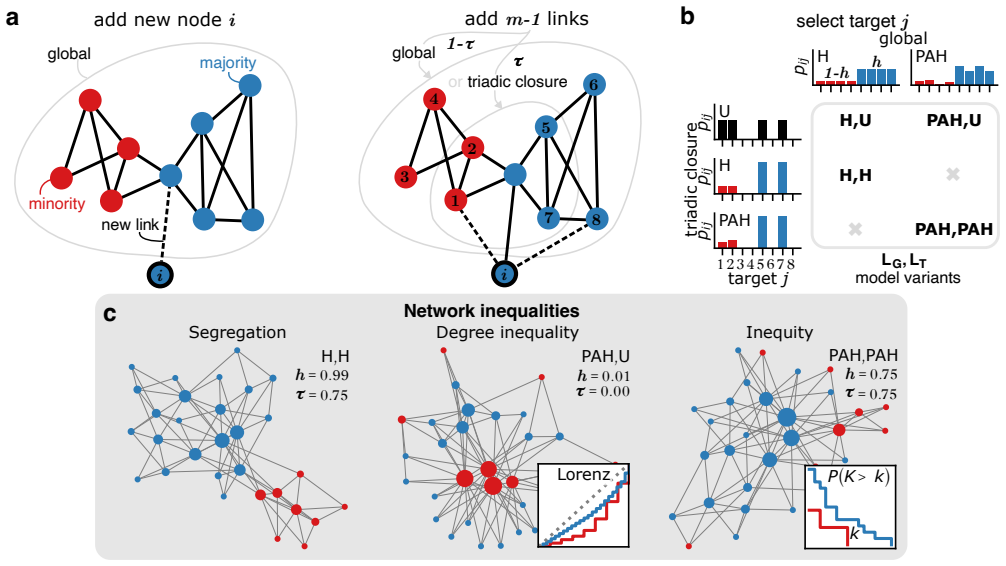
PATCH is a network growth model that combines preferential attachment, homophily, and triadic closure. Simulations establish that homophily and preferential attachment increase segregation and degree inequalities, while triadic closure has opposing effects: it increases overall degree inequality yet reduces segregation and between-group degree disparities. PATCH reproduces the gender disparities observed in fifty years of physics and computer science collaboration networks when preferential attachment is strong, gender homophily is moderate, and triadic closure operates at varying strengths.
What carries the argument
PATCH, a network growth model that integrates preferential attachment, homophily, and triadic closure to generate and explain group disparities in synthetic and empirical networks.
If this is right
- Homophily and preferential attachment together increase both segregation and degree inequality between groups.
- Triadic closure increases population-wide degree inequality while decreasing segregation and between-group degree disparities.
- The observed gender disparities in physics and computer science networks can be reproduced by moderate gender homophily, strong preferential attachment, and suitable triadic closure.
- Adjusting the relative strengths of the three mechanisms offers a route to reduce group disparities in network outcomes.
Where Pith is reading between the lines
- Interventions that increase triadic closure in academic networks could reduce gender segregation while leaving overall degree inequality largely unchanged.
- The model suggests that early differences in attachment and closure rates compound over decades, implying that timing matters for efforts to equalize outcomes.
- Similar patterns may appear when the same mechanisms are applied to other group attributes such as institutional prestige or geographic location.
Load-bearing premise
The real-world gender disparities in these collaboration networks arise primarily from the three modeled mechanisms and can be matched by tuning their relative strengths without large contributions from unmodeled factors.
What would settle it
Finding no combination of preferential attachment strength, homophily level, and triadic closure rate in PATCH that matches the measured degree distributions, segregation levels, and between-group degree gaps in the actual physics and computer science networks would falsify the account.
Figures


read the original abstract
Inequalities in social networks arise from linking mechanisms, such as preferential attachment (connecting to popular nodes), homophily (connecting to similar others), and triadic closure (connecting through mutual contacts). While preferential attachment mainly drives degree inequality and homophily drives segregation, their three-way interaction remains understudied. This gap limits our understanding of how network inequalities emerge. Here, we introduce PATCH, a network growth model combining the three mechanisms to understand how they create disparities among two groups in synthetic networks. Extensive simulations confirm that homophily and preferential attachment increase segregation and degree inequalities, while triadic closure has countervailing effects: conditional on the other mechanisms, it amplifies population-wide degree inequality while reducing segregation and between-group degree disparities. We demonstrate PATCH's explanatory potential on fifty years of Physics and Computer Science collaboration and citation networks exhibiting persistent gender disparities. PATCH accounts for these gender disparities with the joint presence of preferential attachment, moderate gender homophily, and varying levels of triadic closure. By connecting mechanisms to observed inequalities, PATCH shows how their interplay sustains group disparities and provides a framework for designing interventions that promote more equitable social networks.
Editorial analysis
A structured set of objections, weighed in public.
Referee Report
Summary. The manuscript introduces the PATCH network growth model integrating preferential attachment, homophily, and triadic closure to examine how these mechanisms generate group disparities in degree distributions and segregation. Simulations establish the directional and interactive effects of each process, with triadic closure shown to amplify overall inequality while mitigating between-group disparities under moderate homophily. The model is then applied to fifty years of Physics and Computer Science collaboration and citation networks, claiming that the joint presence of preferential attachment, moderate gender homophily, and varying triadic closure accounts for the observed persistent gender disparities.
Significance. If the central claims hold, this work supplies a mechanistic account of how standard network formation rules interact to sustain group-level inequalities, with the countervailing role of triadic closure representing a clear advance over pairwise mechanism studies. The simulations provide reproducible directional evidence for the three-way interplay, and the framework offers a basis for testing interventions aimed at equitable network growth. Credit is due for the explicit generative process and the attempt to connect micro-level rules to macro disparities in real collaboration data.
major comments (1)
- [Real-network application section] Real-network application section: the claim that PATCH 'accounts for' the observed gender disparities in degree and segregation rests on selecting parameter combinations (homophily strength, triadic closure rate, preferential attachment exponent) that align with empirical patterns. No details are supplied on the estimation procedure, optimization criterion, goodness-of-fit statistics, cross-validation, or sensitivity to parameter perturbations, rendering it impossible to distinguish explanatory power from post-hoc calibration.
minor comments (2)
- [Abstract and Simulations] The abstract and simulation results section would benefit from explicit statements of the explored parameter ranges and the number of independent runs used to establish the reported qualitative effects.
- [Model definition] Notation for the two groups (e.g., gender labels) and the precise functional forms of the attachment and closure probabilities should be consolidated in a single definitions subsection to improve readability.
Simulated Author's Rebuttal
We thank the referee for the constructive feedback and positive assessment of the manuscript's significance. We address the major comment on the real-network application section below.
read point-by-point responses
-
Referee: [Real-network application section] Real-network application section: the claim that PATCH 'accounts for' the observed gender disparities in degree and segregation rests on selecting parameter combinations (homophily strength, triadic closure rate, preferential attachment exponent) that align with empirical patterns. No details are supplied on the estimation procedure, optimization criterion, goodness-of-fit statistics, cross-validation, or sensitivity to parameter perturbations, rendering it impossible to distinguish explanatory power from post-hoc calibration.
Authors: We agree that the current version of the real-network application section lacks sufficient detail on parameter selection and fit assessment. The parameters were chosen to be consistent with ranges reported in prior studies of academic collaboration networks (for homophily and triadic closure) and with maximum-likelihood estimates of the preferential attachment exponent from the empirical degree distributions, then adjusted within those ranges to produce qualitatively similar levels of gender segregation and degree inequality. In the revised manuscript we will expand the section to: (i) cite the specific literature sources and estimation methods for each parameter, (ii) report the exact values used for each network, (iii) add quantitative goodness-of-fit comparisons (Kolmogorov-Smirnov distances for degree distributions and direct comparisons of segregation and group-degree metrics), and (iv) include a sensitivity analysis showing how modest perturbations around the chosen values affect the match to the data. These additions will make the calibration process transparent and allow readers to evaluate the strength of the explanatory claim. revision: yes
Circularity Check
No significant circularity in derivation chain
full rationale
The PATCH model is defined by combining three explicit generative mechanisms (preferential attachment, homophily, triadic closure). Simulations then derive directional effects on segregation and degree inequality directly from the update rules; these outcomes are not equivalent to the inputs by construction and do not rely on self-citation chains or fitted parameters for their validity. The real-network application selects parameter values to align synthetic outputs with observed gender disparities in Physics and CS data, serving as a sufficiency demonstration rather than a load-bearing prediction or first-principles derivation that reduces to the empirical patterns themselves. No quoted step equates a claimed result to its own fitted inputs or prior author work.
Axiom & Free-Parameter Ledger
free parameters (3)
- homophily strength
- triadic closure rate
- preferential attachment exponent
axioms (2)
- domain assumption Network growth proceeds by sequential addition of nodes and edges governed by the three mechanisms
- domain assumption Group membership (gender) is a fixed binary attribute that influences link formation
Lean theorems connected to this paper
-
IndisputableMonolith/Foundation/RealityFromDistinction.leanreality_from_one_distinction unclear?
unclearRelation between the paper passage and the cited Recognition theorem.
We introduce PATCH, a network growth model combining the three mechanisms... homophily and preferential attachment increase segregation and degree inequalities, while triadic closure has countervailing effects
What do these tags mean?
- matches
- The paper's claim is directly supported by a theorem in the formal canon.
- supports
- The theorem supports part of the paper's argument, but the paper may add assumptions or extra steps.
- extends
- The paper goes beyond the formal theorem; the theorem is a base layer rather than the whole result.
- uses
- The paper appears to rely on the theorem as machinery.
- contradicts
- The paper's claim conflicts with a theorem or certificate in the canon.
- unclear
- Pith found a possible connection, but the passage is too broad, indirect, or ambiguous to say the theorem truly supports the claim.
Forward citations
Cited by 1 Pith paper
-
Combining opinion and structural similarity in link recommendations to counter extreme polarization
Weak structural similarity combined with strong opinion similarity in link recommendations prevents network fragmentation and favors moderate opinions under strong homophily.
Reference graph
Works this paper leans on
-
[1]
Networks: An Introduction (Oxford University Press, 2010)
Newman, M. Networks: An Introduction (Oxford University Press, 2010)
work page 2010
-
[2]
Mislove, A., Marcon, M., Gummadi, K. P., Druschel, P. & Bhattacharjee, B. Measurement and analysis of online social networks. In Proceedings of the 7th ACM SIGCOMM conference on Internet measurement , IMC ’07, 29–42, DOI: 10.1145/1298306.1298311 (Association for Computing Machinery, New York, NY , USA, 2007)
-
[3]
Burt, R. S. Structural Holes: The Social Structure of Competition (Harvard University Press, Cambridge, MA, 1995)
work page 1995
-
[4]
Social capital: A theory of social structure and action , vol
Lin, N. Social capital: A theory of social structure and action , vol. 19 (Cambridge university press, 2002)
work page 2002
-
[5]
Huang, J., Gates, A. J., Sinatra, R. & Barab´asi, A.-L. Historical comparison of gender inequality in scientific careers across countries and disciplines. Proc. Natl. Acad. Sci. 117, 4609–4616, DOI: 10.1073/pnas.1914221117 (2020)
-
[6]
Kong, H., Martin-Gutierrez, S. & Karimi, F. Influence of the first-mover advantage on the gender disparities in physics citations. Commun. Phys. 5, 1–11, DOI: 10.1038/s42005-022-00997-x (2022)
-
[7]
Zappal`a, C., Gallo, L., Bachmann, J., Battiston, F. & Karimi, F. Gender disparities in the dissemination and acquisition of scientific knowledge, DOI: 10.48550/arXiv.2407.17441 (2024). 2407.17441
-
[8]
V´as´arhelyi, O., Zakhlebin, I., Milojevi´c, S. & Horv´at, E.- ´A. Gender inequities in the online dissemination of scholars’ work. Proc. Natl. Acad. Sci. 118, DOI: 10.1073/pnas.2102945118 (2021)
-
[9]
Barab´asi, A.-L. & Albert, R. Emergence of scaling in random networks. Science 286, 509–512, DOI: 10.1126/science.286.5439.509 (1999)
-
[10]
Merton, R. K. The matthew effect in science. Science 159, 56–63, DOI: 10.1126/science.159.3810.56 (1968)
-
[11]
Newman, M. E. J. Clustering and preferential attachment in growing networks. Phys. Rev. E 64, 025102, DOI: 10.1103/PhysRevE.64.025102 (2001)
-
[12]
Cumulative Advantage of Brokerage in Academia
Bachmann, J., Esp´ın-Noboa, L., I˜niguez, G. & Karimi, F. Cumulative advantage of brokerage in academia (2024). 2407.11909
work page internal anchor Pith review Pith/arXiv arXiv 2024
-
[13]
Newman, M. E. J. The structure of scientific collaboration networks. Proc. Natl. Acad. Sci. 98, 404–409, DOI: 10.1073/pnas.98.2.404 (2001)
-
[14]
Abebe, R., Immorlica, N., Kleinberg, J., Lucier, B. & Shirali, A. On the effect of triadic closure on network segregation. In Proceedings of the 23rd ACM Conference on Economics and Computation , EC ’22, 249–284, DOI: 10.1145/3490486.3538322 (Association for Computing Machinery, New York, NY , USA, 2022). 13/28
-
[15]
McPherson, M., Smith-Lovin, L. & Cook, J. M. Birds of a feather: Homophily in social networks. Annu. Rev. Sociol. 27, 415–444, DOI: 10.1146/annurev.soc.27.1.415 (2001)
-
[16]
Karimi, F., G´enois, M., Wagner, C., Singer, P. & Strohmaier, M. Homophily influences ranking of minorities in social networks. Sci. Reports 8, 11077, DOI: 10.1038/s41598-018-29405-7 (2018)
-
[17]
Klimek, P. & Thurner, S. Triadic closure dynamics drives scaling laws in social multiplex networks. New J. Phys. 15, 063008, DOI: 10.1088/1367-2630/15/6/063008 (2013)
-
[18]
Ure˜na-Carri´on, J., Karimi, F., ´I˜niguez, G. & Kivel ¨a, M. Assortative and preferential attachment lead to core-periphery networks. Phys. Rev. Res. 5, 043287, DOI: 10.1103/PhysRevResearch.5.043287 (2023)
-
[19]
Lee, E. et al. Homophily and minority-group size explain perception biases in social networks. Nat. Hum. Behav. 3, 1078–1087, DOI: 10.1038/s41562-019-0677-4 (2019)
-
[20]
Esp´ın-Noboa, L., Wagner, C., Strohmaier, M. & Karimi, F. Inequality and inequity in network-based ranking and recommendation algorithms. Sci. Reports 12, 2012, DOI: 10.1038/s41598-022-05434-1 (2022)
-
[21]
Asikainen, A., I˜niguez, G., Ure˜na-Carri´on, J., Kaski, K. & Kivel¨a, M. Cumulative effects of triadic closure and homophily in social networks. Sci. Adv. 6, eaax7310, DOI: 10.1126/sciadv.aax7310 (2020)
-
[22]
Laber, M., Dies, S., Ehlert, J., Klein, B. & Eliassi-Rad, T. Effects of higher-order interactions and homophily on information access inequality, DOI: 10.48550/arXiv.2506.00156 (2025). 2506.00156
-
[23]
Sajjadi, S. et al. Structural inequalities exacerbate infection disparities. Sci. Reports 15, 9082, DOI: 10.1038/ s41598-025-91008-w (2025)
work page 2025
-
[24]
Holme, P. & Kim, B. J. Growing scale-free networks with tunable clustering. Phys. Rev. E 65, 026107, DOI: 10.1103/PhysRevE.65.026107 (2002)
-
[25]
Bianconi, G., Darst, R. K., Iacovacci, J. & Fortunato, S. Triadic closure as a basic generating mechanism of communities in complex networks. Phys. Rev. E 90, 042806, DOI: 10.1103/PhysRevE.90.042806 (2014)
-
[26]
Neuh¨auser, L., Karimi, F., Bachmann, J., Strohmaier, M. & Schaub, M. T. Improving the visibility of minorities through network growth interventions. Commun. Phys. 6, 1–13, DOI: 10.1038/s42005-023-01218-9 (2023)
-
[27]
Kossinets, G. & Watts, D. J. Origins of homophily in an evolving social network. Am. J. Sociol. 115, 405–450, DOI: 10.1086/599247 (2009)
-
[28]
Calv´o-Armengol, A. & Jackson, M. O. The effects of social networks on employment and inequality. Am. Econ. Rev. 94, 426–454, DOI: 10.1257/0002828041464542 (2004)
-
[29]
Sajjadi, S., Martin-Gutierrez, S. & Karimi, F. Unveiling homophily beyond the pool of opportunities, DOI: 10.48550/arXiv.2401.13642 (2024). 2401.13642
-
[30]
Krackhardt, D. & Stern, R. N. Informal networks and organizational crises: An experimental simulation. Soc. Psychol. Q. 51, 123–140, DOI: 10.2307/2786835 (1988)
-
[31]
Feld, S. L. Why your friends have more friends than you do. Am. J. Sociol. 96, 1464–1477 (1991)
work page 1991
-
[32]
McGraw, K. O. & Wong, S. P. A common language effect size statistic. Psychol. Bull. 111, 361–365, DOI: 10.1037/0033-2909.111.2.361 (1992)
-
[33]
Mann, H. B. & Whitney, D. R. On a test of whether one of two random variables is stochastically larger than the other. The Annals Math. Stat. 18, 50–60, DOI: 10.1214/aoms/1177730491 (1947)
-
[34]
American physical society (aps) data sets for research (2023)
American Physical Society. American physical society (aps) data sets for research (2023)
work page 2023
-
[35]
dblp computer science bibliography – monthly snapshot xml release, DOI: 10.4230/dblp.xml (2016)
dblp Team. dblp computer science bibliography – monthly snapshot xml release, DOI: 10.4230/dblp.xml (2016)
-
[36]
Barnes, K. et al. Edge interventions can mitigate demographic and prestige disparities in the computer science coauthorship network, DOI: 10.48550/arXiv.2506.04435 (2025). 2506.04435. 14/28
-
[37]
Karimi, F. & Oliveira, M. On the inadequacy of nominal assortativity for assessing homophily in networks. Sci. Reports 13, 21053, DOI: 10.1038/s41598-023-48113-5 (2023)
-
[38]
Jadidi, M., Karimi, F., Lietz, H. & Wagner, C. Gender disparities in science? dropout, productivity, col- laborations and success of male and female computer scientists. Adv. Complex Syst. 21, 1750011, DOI: 10.1142/S0219525917500114 (2017)
-
[39]
Larivi`ere, V ., Ni, C., Gingras, Y ., Cronin, B. & Sugimoto, C. R. Bibliometrics: Global gender disparities in science. Nature 504, 211–213, DOI: 10.1038/504211a (2013)
-
[40]
Li, W., Zhang, S., Zheng, Z., Cranmer, S. J. & Clauset, A. Untangling the network effects of productivity and prominence among scientists. Nat. Commun. 13, 4907, DOI: 10.1038/s41467-022-32604-6 (2022)
-
[41]
Sarig¨ol, E., Pfitzner, R., Scholtes, I., Garas, A. & Schweitzer, F. Predicting scientific success based on coauthorship networks. EPJ Data Sci. 3, 9, DOI: 10.1140/epjds/s13688-014-0009-x (2014)
-
[42]
The chaperone effect in scientific publishing
Sekara, V .et al. The chaperone effect in scientific publishing. Proc. Natl. Acad. Sci. 115, 12603–12607, DOI: 10.1073/pnas.1800471115 (2018)
-
[43]
Dies, S., Liu, D. & Eliassi-Rad, T. Forecasting faculty placement from patterns in co-authorship networks, DOI: 10.48550/arXiv.2507.14696 (2025). 2507.14696
-
[44]
Dworkin, J. D. et al. The extent and drivers of gender imbalance in neuroscience reference lists. Nat. Neurosci. 23, 918–926, DOI: 10.1038/s41593-020-0658-y (2020)
-
[45]
M., Macedo, M., Oliveira, M., Karimi, F
Jaramillo, A. M., Macedo, M., Oliveira, M., Karimi, F. & Menezes, R. Systematic comparison of gender inequality in scientific rankings across disciplines, DOI: 10.48550/arXiv.2501.13061 (2025). 2501.13061
-
[46]
Morgan, A. C. et al. The unequal impact of parenthood in academia. Sci. Adv. 7, eabd1996, DOI: 10.1126/ sciadv.abd1996 (2021)
work page 2021
-
[47]
Gutmann, M. U., Cor, J. & er. Bayesian optimization for likelihood-free inference of simulator-based statistical models. J. Mach. Learn. Res. 17, 1–47 (2016)
work page 2016
-
[48]
Currarini, S., Jackson, M. O. & Pin, P. Identifying the roles of race-based choice and chance in high school friendship network formation. Proc. Natl. Acad. Sci. 107, 4857–4861, DOI: 10.1073/pnas.0911793107 (2010)
-
[49]
Buskirk, I. V ., Clauset, A. & Larremore, D. B. An open-source cultural consensus approach to name-based gender classification. Proc. Int. AAAI Conf. on Web Soc. Media 17, 866–877, DOI: 10.1609/icwsm.v17i1.22195 (2023)
-
[50]
Sinatra, R., Wang, D., Deville, P., Song, C. & Barab´asi, A.-L. Quantifying the evolution of individual scientific impact. Science 354, aaf5239, DOI: 10.1126/science.aaf5239 (2016)
-
[51]
Rubin, D. B. Bayesianly justifiable and relevant frequency calculations for the applied statistician. The Annals Stat. 12, 1151–1172 (1984)
work page 1984
-
[52]
Lintusaari, J., Gutmann, M. U., Dutta, R., Kaski, S. & Corander, J. Fundamentals and recent developments in approximate bayesian computation. Syst. Biol. 66, e66–e82, DOI: 10.1093/sysbio/syw077 (2017)
-
[53]
Marin, J.-M., Pudlo, P., Robert, C. P. & Ryder, R. J. Approximate bayesian computational methods. Stat. Comput. 22, 1167–1180, DOI: 10.1007/s11222-011-9288-2 (2012)
-
[54]
Lintusaari, J. et al. Elfi: Engine for likelihood-free inference. J. Mach. Learn. Res. 19, 1–7 (2018)
work page 2018
-
[55]
Adapting the abc distance function
Prangle, D. Adapting the abc distance function. Bayesian Analysis 12, 289–309, DOI: 10.1214/16-BA1002 (2017)
-
[56]
The dblp computer science bibliography: Evolution, research issues, perspectives
Ley, M. The dblp computer science bibliography: Evolution, research issues, perspectives. In Laender, A. H. F. & Oliveira, A. L. (eds.) String Processing and Information Retrieval , 1–10, DOI: 10.1007/3-540-45735-6 1 (Springer, Berlin, Heidelberg, 2002). 15/28
-
[57]
Kunegis, J. Konect: the koblenz network collection. In Proceedings of the 22nd International Conference on World Wide Web, WWW ’13 Companion, 1343–1350, DOI: 10.1145/2487788.2488173 (Association for Computing Machinery, New York, NY , USA, 2013). Acknowledgements The authors thank Eric Dignum for helpful discussions on the likelihood-free inference approa...
discussion (0)
Sign in with ORCID, Apple, or X to comment. Anyone can read and Pith papers without signing in.