Community detection robustness of graph neural networks
Pith reviewed 2026-05-18 12:45 UTC · model grok-4.3
The pith
Supervised GNNs start more accurate on community detection but unsupervised models like DMoN hold up better under perturbations and attacks.
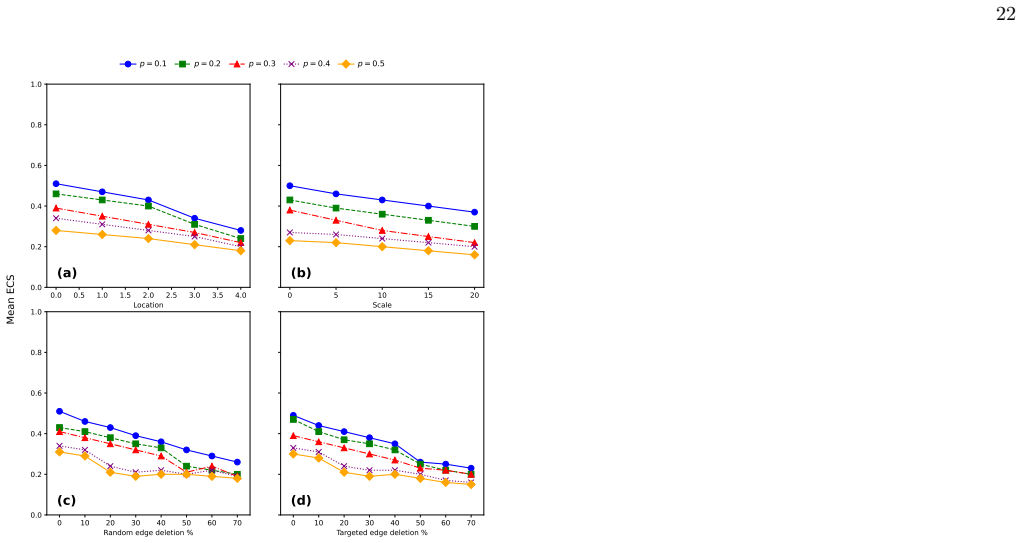
A machine-rendered reading of the paper's core claim, the machinery that carries it, and where it could break.
Core claim
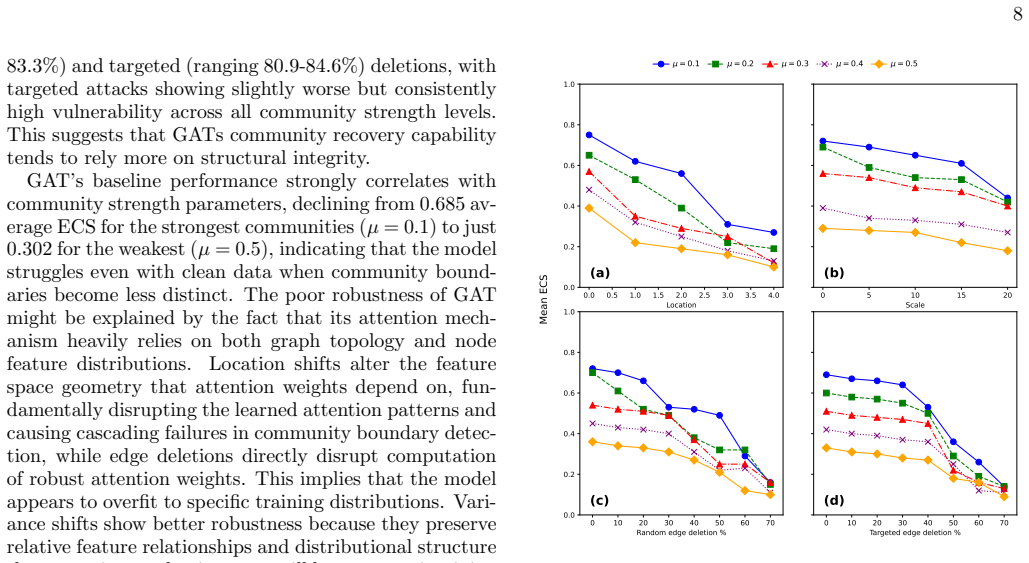
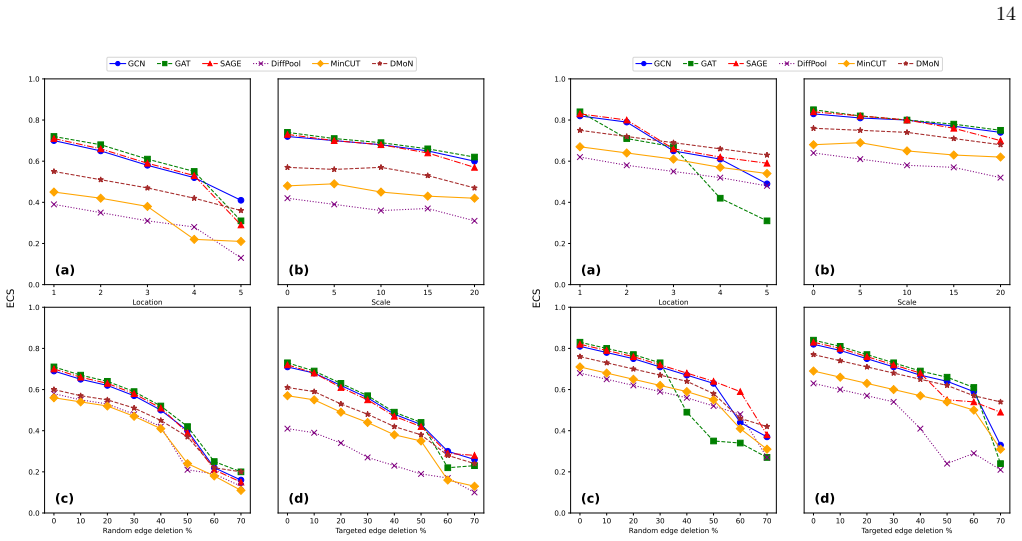
Supervised GNNs tend to achieve higher baseline accuracy, while unsupervised methods, particularly DMoN, maintain stronger resilience under targeted and adversarial perturbations. Robustness appears to be strongly influenced by community strength, with well-defined communities reducing performance loss. Across all models, node attribute perturbations associated with targeted edge deletions and shift in attribute distributions tend to cause the largest degradation in community recovery.
What carries the argument
Comparative evaluation of six GNN architectures (GCN, GAT, Graph-SAGE, DiffPool, MinCUT, DMoN) across node attribute manipulations, edge topology distortions, and adversarial attacks, scored by element-centric similarity.
If this is right
- Unsupervised architectures such as DMoN become preferable when networks may contain adversarial tampering or attribute noise.
- Stronger inherent community structure in the data lowers the performance drop for every tested model.
- Targeted changes to node attributes combined with edge deletions inflict more damage than random or uniform perturbations.
- Designers must weigh initial accuracy against sustained performance when deploying GNNs for real-world grouping tasks.
- Well-separated communities act as a buffer that preserves detection quality even after moderate attacks.
Where Pith is reading between the lines
- Adding explicit robustness objectives during training could narrow the accuracy gap between supervised and unsupervised approaches.
- The same evaluation pattern may appear in other graph tasks such as link prediction or node classification under attack.
- Testing on time-varying networks would show whether the observed resilience holds when perturbations accumulate over time.
- Practitioners facing high-stakes grouping decisions might default to DMoN when data integrity cannot be guaranteed.
Load-bearing premise
The synthetic benchmarks, real citation networks, and three chosen categories of perturbations represent the conditions GNNs face in typical community detection settings.
What would settle it
A controlled experiment on a new set of networks with stronger community mixing or a different attack type that reverses the resilience pattern, showing unsupervised models degrading faster than supervised ones.
Figures








read the original abstract
Graph neural networks (GNNs) are increasingly widely used for community detection in attributed networks. They combine structural topology with node attributes through message passing and pooling. However, their robustness or lack of thereof with respect to different perturbations and targeted attacks in conjunction with community detection tasks is not well understood. To shed light into latent mechanisms behind GNN sensitivity on community detection tasks, we conduct a systematic computational evaluation of six widely adopted GNN architectures: GCN, GAT, Graph-SAGE, DiffPool, MinCUT, and DMoN. The analysis covers three perturbation categories: node attribute manipulations, edge topology distortions, and adversarial attacks. We use element-centric similarity as the evaluation metric on synthetic benchmarks and real-world citation networks. Our findings indicate that supervised GNNs tend to achieve higher baseline accuracy, while unsupervised methods, particularly DMoN, maintain stronger resilience under targeted and adversarial perturbations. Furthermore, robustness appears to be strongly influenced by community strength, with well-defined communities reducing performance loss. Across all models, node attribute perturbations associated with targeted edge deletions and shift in attribute distributions tend to cause the largest degradation in community recovery. These findings highlight important trade-offs between accuracy and robustness in GNN-based community detection and offer new insights into selecting architectures resilient to noise and adversarial attacks.
Editorial analysis
A structured set of objections, weighed in public.
Referee Report
Summary. The paper evaluates the robustness of six GNN models (GCN, GAT, Graph-SAGE, DiffPool, MinCUT, DMoN) for community detection under node attribute manipulations, edge topology distortions, and adversarial attacks on synthetic and real-world networks. It reports that supervised GNNs have higher baseline accuracy, unsupervised methods like DMoN are more resilient, robustness depends on community strength, and node attribute perturbations with targeted edge deletions cause the most degradation, using element-centric similarity.
Significance. If validated, these empirical findings would be significant for understanding accuracy-robustness trade-offs in GNN community detection, aiding model selection in noisy environments. The multi-perturbation analysis and focus on community strength provide actionable insights beyond single-model studies.
major comments (1)
- [Experimental Setup] The central claim contrasting supervised GNNs' higher baseline accuracy with unsupervised methods' stronger resilience under perturbations assumes a uniform evaluation protocol. However, if unsupervised models like DMoN are re-optimized on perturbed graphs while supervised models like GCN are applied with parameters fixed from clean training data, the resilience difference may reflect adaptation rather than robustness. The manuscript must specify this protocol explicitly in the experimental setup to support the claim.
minor comments (1)
- [Abstract] The abstract presents qualitative findings without including any quantitative results, error bars, or specific parameter values for perturbations, making it difficult to assess the practical significance of the reported differences.
Simulated Author's Rebuttal
We thank the referee for their thorough review and constructive feedback on our manuscript. We have carefully considered the major comment regarding the experimental setup and protocol for evaluating robustness. We address this point below and will make the necessary revisions to enhance clarity.
read point-by-point responses
-
Referee: [Experimental Setup] The central claim contrasting supervised GNNs' higher baseline accuracy with unsupervised methods' stronger resilience under perturbations assumes a uniform evaluation protocol. However, if unsupervised models like DMoN are re-optimized on perturbed graphs while supervised models like GCN are applied with parameters fixed from clean training data, the resilience difference may reflect adaptation rather than robustness. The manuscript must specify this protocol explicitly in the experimental setup to support the claim.
Authors: We appreciate the referee pointing out the need for explicit clarification on our evaluation protocol. To address this, we confirm that in our experiments, the supervised GNNs (GCN, GAT, Graph-SAGE) are trained exclusively on the clean, unperturbed graphs using their standard training procedures. These trained models are then directly applied to the perturbed graphs for evaluation, without any re-optimization or adaptation to the perturbations. This setup tests the models' robustness to changes in input data. For the unsupervised models (DiffPool, MinCUT, DMoN), which do not involve a separate training phase on clean data, they are optimized or run directly on each perturbed graph as input. This is the natural and standard way to apply unsupervised community detection methods. We believe this protocol fairly compares the robustness, as it reflects real-world usage where supervised models are deployed after training and unsupervised ones process the available (possibly noisy) data. We will add a detailed description of this protocol in the Experimental Setup section of the revised manuscript to support our claims more robustly. revision: yes
Circularity Check
No circularity: empirical evaluation of GNN robustness
full rationale
The paper performs a direct computational comparison of six existing GNN architectures on community detection tasks under node, edge, and adversarial perturbations, reporting results via element-centric similarity on synthetic benchmarks and citation networks. No mathematical derivations, first-principles claims, or parameter-fitting steps are present that could reduce to the inputs by construction. All reported findings on accuracy-robustness trade-offs and the influence of community strength follow from the experimental protocol and external benchmarks rather than any self-definitional or self-citation load-bearing steps.
Axiom & Free-Parameter Ledger
axioms (2)
- domain assumption Synthetic benchmarks and citation networks constitute a sufficient testbed for generalizing robustness observations.
- domain assumption Element-centric similarity is an appropriate metric for comparing community recovery under perturbation.
Lean theorems connected to this paper
-
IndisputableMonolith/Foundation/AbsoluteFloorClosure.leanreality_from_one_distinction unclear?
unclearRelation between the paper passage and the cited Recognition theorem.
We conduct a systematic computational evaluation of six widely adopted GNN architectures: GCN, GAT, Graph-SAGE, DiffPool, MinCUT, and DMoN... using element-centric similarity as the evaluation metric on synthetic benchmarks and real-world citation networks.
-
IndisputableMonolith/Cost/FunctionalEquation.leanwashburn_uniqueness_aczel unclear?
unclearRelation between the paper passage and the cited Recognition theorem.
DMoN combines modularity maximization with collapse regularization... LDMoN(C; A) = −1/2m Tr(CT BC) + ...
What do these tags mean?
- matches
- The paper's claim is directly supported by a theorem in the formal canon.
- supports
- The theorem supports part of the paper's argument, but the paper may add assumptions or extra steps.
- extends
- The paper goes beyond the formal theorem; the theorem is a base layer rather than the whole result.
- uses
- The paper appears to rely on the theorem as machinery.
- contradicts
- The paper's claim conflicts with a theorem or certificate in the canon.
- unclear
- Pith found a possible connection, but the passage is too broad, indirect, or ambiguous to say the theorem truly supports the claim.
Reference graph
Works this paper leans on
-
[1]
LFR benchmark The Lancichinetti–Fortunato–Radicchi (LFR) bench- mark has emerged as a popular tool for generating graphs with known community structures [32, 39]. Its primary strength lies in its ability to create networks where both degree and community size distributions follow power- laws, mirroring the characteristics of many real-world networks. Key ...
-
[2]
to generate undirected, unweighted LFR benchmark graphs with 1,000 nodes. We vary the mixing parameter µ ranging between 0.1 to 0.5 to investigate the effects of perturbations at different initial community strengths
-
[3]
In the SBM, a graph with n vertices is partitioned into K different communities
Stochastic block model (SBM) The standard (degree-free) SBM is a probabilistic framework for generating random graphs with planted community structure [41]. In the SBM, a graph with n vertices is partitioned into K different communities. Each vertex is assigned to one of these K communi- ties, and the probability of an edge existing between any two vertic...
-
[4]
Node attribute perturbation Here, we perturb node attributes by first, altering the location and then scale of their distribution. We add random Gaussian noise generated by varying location parameter and keeping scale parameter fixed and then varying the scale parameter, but keeping the location parameter fixed, similar to [22]. By doing this, we per- tur...
-
[5]
We follow the procedure outlined by [31]
Graph topology perturbation We explore how removing edges affects network struc- ture through two approaches, random and targeted edge deletions. We follow the procedure outlined by [31]. In the random approach, which emulates real-world network failures, we randomly select some percentage of nodes ranging between 10% to 70% of the nodes in increments of ...
-
[6]
Adversarial attacks for community detection We also evaluate GNN robustness under more sophis- ticated attacks that target the overall learning process to degrade community detection performance. Specifically, we use Nettack [23] and Metattack [24] schemes, which represent advanced adversarial techniques designed to compromise graph-based machine learning...
-
[7]
They allow the learning of node representations based on both node features and graph structure
GCN GCNs are a type of GNN designed to work with graph structured data, extending the concept of convolutional neural networks to graphs. They allow the learning of node representations based on both node features and graph structure. The core operation in a GCN is the graph convolution, where for a single GCN layer, the output features H(l+1) are compute...
-
[8]
GAT GAT uses attention mechanism enabling structural learning on networks. In this GNN, the node features are updated as h(l+1) i = σ(P j∈N(i) αijW(l)h(l) j ), with atten- tion coefficients αij = softmax j(eij) = exp(eij)P k∈N (i) exp(eik), where eij = LeakyReLU(aT [W(l)H(l) i ∥W(l)H(l) j ]) and ∥ denotes concatenation. This allows the network to assign d...
-
[9]
GraphSAGE GraphSAGE generalizes the neighborhood ag- gregation approach with h(l+1) i = σ(W(l) · CONCAT(h(l) i , AGG({h(l) j , ∀j ∈ N(i)}))), where AGG is a permutation-invariant aggregation function such as mean, max, or LSTM, applied to the neighbor set. The key innovation is the sampling of a fixed-size neighborhood and the combination of the node’s ow...
-
[10]
MinCut MinCutPool is differentiable graph pooling layer that performs hierarchical clustering based on spectral clus- tering [21]. The key idea is to formulate a continuous relaxation of the normalized MinCut problem and train- ing a GNN to compute optimal cluster assignments. The normalized MinCut objective aims to partition a graph’s vertices V into K d...
-
[11]
Given a graph with adjacency matrix A ∈ [0, 1]n×n and node features X ∈ Rn×p
DiffPool DiffPool introduces hierarchical graph representation learning through differentiable pooling layers that enable end-to-end training of deep GNNs [20]. Given a graph with adjacency matrix A ∈ [0, 1]n×n and node features X ∈ Rn×p. DiffPool learns to cluster nodes at each layer l using two GNNs An embedding GNN generates node representations: Z(l) ...
-
[12]
DMoN DMoN introduces an unsupervised clustering approach that leverages a differentiable modularity objective for graph pooling [22]. The key idea is to encode commu- nity assignments using GNNs and a modularity based objective function to optimize to make a learnable graph clustering function in an end to end unsupervised man- ner. Using a softmax functi...
-
[13]
For average drop acrossµi values for a specific model and perturbation type, we compute: ∆ECSµi = 1 |Mi| X Mi |ECSinitial(µi) − ECSfinal(µi)| ECSinitial(µi) ×100%, where Mi is the set of all perturbations levels for all values µi
-
[14]
For average drop across perturbation types for a specific model, we compute. ∆ECSpert = 1 |P| X p∈P |ECSinitial(p) − ECSfinal(p)| ECSinitial(p) ×100%, where P is the set of all perturbation types (mean, scale, random edge, targeted edge). Table IV shows results av- eraged for different levels of community mixing parame- ters µ and Table V reports the aver...
-
[15]
Nettack Network perturbation attacks, specifically Nettack and Metattack, represent sophisticated approaches to com- promising graph-based learning systems through struc- tural perturbations. Nettack operates as a targeted at- tack mechanism that modifies the graph structure around specific nodes by strategically adding or removing edges and manipulating ...
-
[16]
Fortunato, Community detection in graphs, Phys
S. Fortunato, Community detection in graphs, Phys. Rep 486, 75 (2010)
work page 2010
-
[17]
M. E. Newman, Modularity and community structure in networks, Proc. Natl. Acad. Sci. U. S. A 103, 8577 (2006)
work page 2006
-
[18]
M. Girvan and M. E. Newman, Community structure in social and biological networks, Proc. Natl. Acad. Sci, U. S. A 99, 7821 (2002)
work page 2002
-
[19]
S. Wandelt, X. Shi, and X. Sun, Estimation and improve- ment of transportation network robustness by exploiting communities, Reliab. Eng. Syst. Saf 206, 107307 (2021)
work page 2021
-
[20]
A. Lancichinetti and S. Fortunato, Community detection algorithms: a comparative analysis, Phys. Rev. E 80, 056117 (2009)
work page 2009
-
[21]
P. Moriano, J. Finke, and Y.-Y. Ahn, Community-based event detection in temporal networks, Sci. Rep 9, 4358 (2019)
work page 2019
-
[22]
S. Aref and M. Mostajabdaveh, Analyzing modularity maximization in approximation, heuristic, and graph neural network algorithms for community detection, J. Comput. Sci 78, 102283 (2024)
work page 2024
-
[23]
T. Schuurman and E. Bruner, Modularity and commu- nity detection in human brain morphology, Anat. Rec 307, 345 (2024)
work page 2024
-
[24]
F. R. Khawaja, Z. Zhang, Y. Memon, and A. Ullah, Ex- ploring community detection methods and their diverse applications in complex networks: a comprehensive re- view, Soc. Netw. Anal. Min 14, 115 (2024)
work page 2024
-
[25]
F. Scarselli, M. Gori, A. C. Tsoi, M. Hagenbuchner, and G. Monfardini, The graph neural network model, IEEE. Trans. Neural. Netw 20, 61 (2008)
work page 2008
-
[26]
Z. Wu, S. Pan, F. Chen, G. Long, C. Zhang, and P. S. Yu, A comprhensive survey on graph neural networks, IEEE. Trans. Neural. Netw. Learning. Syst 32, 4 (2020)
work page 2020
-
[27]
K. Xu, W. Hu, J. Leskovec, and S. Jegelka, How powerful are graph neural networks?, arXiv preprint arXiv:1810.00826 (2018)
work page internal anchor Pith review Pith/arXiv arXiv 2018
-
[28]
Veliˇ ckovi´ c, Everything is connected: Graph neural net- works, Curr
P. Veliˇ ckovi´ c, Everything is connected: Graph neural net- works, Curr. Opin. Struct. Biol 79, 102538 (2023)
work page 2023
-
[29]
T. N. Kipf and M. Welling, Semi-supervised classifica- tion with graph convolutional networks, arXiv preprint arXiv:1609.02907 (2016)
work page internal anchor Pith review Pith/arXiv arXiv 2016
-
[30]
P. Veliˇ ckovi´ c, G. Cucurull, A. Casanova, A. Romero, P. Lio, and Y. Bengio, Graph attention networks, arXiv preprint arXiv:1710.10903 (2017)
work page internal anchor Pith review Pith/arXiv arXiv 2017
-
[31]
W. Hamilton, Z. Ying, and J. Leskovec, Inductive rep- resentation learning on large graphs, Advances in neural information processing systems 30 (2017)
work page 2017
-
[32]
X. Su, S. Xue, F. Liu, J. Wu, J. Yang, C. Zhou, W. Hu, C. Paris, S. Nepal, D. Jin, et al., A comprehensive survey on community detection with deep learning, IEEE Trans. Neural. Netw. Learn. Syst (2022)
work page 2022
-
[33]
Y. Ren, J. Pu, Z. Yang, J. Xu, G. Li, X. Pu, S. Y. Philip, and L. He, Deep clustering: A comprehensive survey, IEEE. Trans. Neural. Netw. Learn. Syst (2024)
work page 2024
- [34]
-
[35]
Z. Ying, J. You, C. Morris, X. Ren, W. Hamilton, and J. Leskovec, Hierarchical graph representation learning with differentiable pooling, Advances in neural informa- tion processing systems 31 (2018)
work page 2018
-
[36]
F. M. Bianchi, D. Grattarola, and C. Alippi, Spectral clustering with graph neural networks for graph pool- ing, in International Conference on Machine Learning (PMLR, 2020) pp. 874–883
work page 2020
-
[37]
A. Tsitsulin, J. Palowitch, B. Perozzi, and E. M¨ uller, Graph clustering with graph neural networks, J. Mach. Learn. Res 24, 1 (2023)
work page 2023
-
[38]
D. Z¨ ugner, A. Akbarnejad, and S. G¨ unnemann, Adver- sarial attacks on neural networks for graph data, in Pro- ceedings of the 24th ACM SIGKDD International Con- ference on Knowledge Discovery & Data Mining (2018) pp. 2847–2856
work page 2018
-
[39]
D. Z¨ ugner and S. G¨ unnemann, Adversarial attacks on graph neural networks via meta learning (2024), arXiv:1902.08412 [cs.LG]
-
[40]
B. Wang, J. Jia, X. Cao, and N. Z. Gong, Certified ro- bustness of graph neural networks against adversarial structural perturbation, in Proceedings of the 27th ACM SIGKDD Conference on Knowledge Discovery & Data Mining (2021) pp. 1645–1653
work page 2021
-
[41]
S. G¨ unnemann, Graph neural networks: Adversarial ro- bustness, in Graph neural networks: foundations, fron- tiers, and applications (Springer, 2022) pp. 149–176
work page 2022
- [42]
- [43]
-
[44]
L. Sun, Y. Dou, C. Yang, K. Zhang, J. Wang, S. Y. Philip, L. He, and B. Li, Adversarial attack and defense on graph data: A survey, IEEE. Trans. Knowl. Data. Eng 35, 7693 (2022)
work page 2022
-
[45]
M. Tian and P. Moriano, Robustness of community struc- ture under edge addition, Phys. Rev. E 108, 054302 (2023)
work page 2023
- [46]
-
[47]
A. Lancichinetti, S. Fortunato, and F. Radicchi, Bench- mark graphs for testing community detection algorithms, Phys. Rev. E 78, 046110 (2008)
work page 2008
-
[48]
B. Karrer and M. E. Newman, Stochastic blockmodels and community structure in networks, Phys. Rev. E 83, 016107 (2011)
work page 2011
-
[49]
A. K. Dey, Y. Tian, and Y. R. Gel, Community detec- tion in complex networks: From statistical foundations to data science applications, Wiley Interdisciplinary Re- views: Computational Statistics 14, e1566 (2022)
work page 2022
-
[50]
Y. Zhao, E. Levina, and J. Zhu, Consistency of com- munity detection in networks under degree-corrected stochastic block models, Ann. Stat 40, 2266–2292 (2012)
work page 2012
-
[51]
A. Tsitsulin, B. Rozemberczki, J. Palowitch, and B. Per- ozzi, Synthetic graph generation to benchmark graph learning, arXiv preprint arXiv:2204.01376 (2022)
-
[52]
A. J. Gates, I. B. Wood, W. P. Hetrick, and Y.-Y. Ahn, Element-centric clustering comparison unifies overlaps and hierarchy, Sci. Rep 9, 8574 (2019). 17
work page 2019
-
[53]
Goel, Robust graph neural networks, https://github.com/jdg-stat/robustgnn (2025), gitHub repository
J. Goel, Robust graph neural networks, https://github.com/jdg-stat/robustgnn (2025), gitHub repository
work page 2025
-
[54]
A. Lancichinetti and S. Fortunato, Benchmarks for test- ing community detection algorithms on directed and weighted graphs with overlapping communities, Phys. Rev. E 80, 016118 (2009)
work page 2009
-
[55]
A. Hagberg, P. J. Swart, and D. A. Schult, Exploring net- work structure, dynamics, and function using NetworkX , Tech. Rep. (Los Alamos National Laboratory (LANL), Los Alamos, NM (United States), 2008)
work page 2008
-
[56]
P. W. Holland, K. B. Laskey, and S. Leinhardt, Stochastic blockmodels: First steps, Social networks 5, 109 (1983)
work page 1983
-
[57]
Z. Yang, W. Cohen, and R. Salakhudinov, Revisiting semi-supervised learning with graph embeddings, in In- ternational Conference on Machine Learning (PMLR,
- [58]
-
[59]
S. Souravlas, S. Anastasiadou, and S. Katsavounis, A sur- vey on the recent advances of deep community detection, Appl. Sci 11, 7179 (2021)
work page 2021
-
[60]
S. Sobolevsky and A. Belyi, Graph neural network in- spired algorithm for unsupervised network community detection, Appl. Netw. Sci 7, 63 (2022)
work page 2022
-
[61]
W. Leeney and R. McConville, Uncertainty in gnn learn- ing evaluations: A comparison between measures for quantifying randomness in gnn community detection, En- tropy 26, 78 (2024)
work page 2024
-
[62]
V. D. Kumar, S. Sreesankar, K. Dinesan, P. B. Nair, and L. Deepthi, Analyzing gnn models for commu- nity detection using graph embeddings: A comparative study, in 2024 15th International Conference on Comput- ing Communication and Networking Technologies (ICC- CNT) (IEEE, 2024) pp. 1–8
work page 2024
-
[63]
C. Merkwirth and T. Lengauer, Automatic generation of complementary descriptors with molecular graph net- works, J. Chem. Inf. Model 45, 1159 (2005)
work page 2005
-
[64]
X. Su, S. Xue, F. Liu, J. Wu, J. Yang, C. Zhou, W. Hu, C. Paris, S. Nepal, D. Jin, et al. , A comprehensive sur- vey on community detection with deep learning, IEEE. Trans. Neural. Netw. Learning. Syst (2022)
work page 2022
- [65]
- [66]
-
[67]
M. Yang, M. Zhou, Z. Li, J. Liu, L. Pan, H. Xiong, and I. King, Hyperbolic graph neural networks: A review of methods and applications, arXiv:2202.13852 (2025). 18 APPENDIX A. Theoretical details Cut-based metrics Let {Ci}K i=1 be disjoint partitions of V. We can define a cut as cut(C1, . . . ,CK) = 1 2 KX k=1 |(u, v) ∈ E : u ∈ C k, v ∈ ˆCk|, here ˆCk is ...
discussion (0)
Sign in with ORCID, Apple, or X to comment. Anyone can read and Pith papers without signing in.