Geometric flow of planar domain-wall loops
Pith reviewed 2026-05-18 12:26 UTC · model grok-4.3
The pith
Domain-wall loops make the relaxation rate of spontaneous magnetization quantized, with jumps at each collapse.
A machine-rendered reading of the paper's core claim, the machinery that carries it, and where it could break.
Core claim
Assuming an instantaneous isotropic homogeneous response of each arc to local pressure and curvature, the authors obtain closed area-perimeter dynamics. In the linear-response regime a non-crossing rule holds and the total spontaneous magnetization relaxes with a quantized rate; the quantization appears as discrete jumps that coincide exactly with the collapse of individual loops, for arbitrary initial configurations of possibly nested loops.
What carries the argument
Closed dynamical equations that link the enclosed area of each loop to its perimeter, obtained by integrating the arc-velocity response over the entire interface.
If this is right
- The relaxation rate of total spontaneous magnetization is quantized for any initial set of non-crossing loops.
- Each collapse of a single loop produces a discrete jump in that rate.
- Under constant or alternating external drive the number of loops can change by coalescence or splitting, yet a different geometrical combination of total area and perimeter remains quantized.
- Approximate area-perimeter relations give estimates for the collapse lifetime of compact domains and for the effect of alternating fields on that lifetime.
Where Pith is reading between the lines
- If the quantization survives weak disorder, it could be used to read out the number of surviving loops from a single global magnetization trace.
- The same area-perimeter reduction might apply to other interface problems where curvature-driven motion competes with an external field, such as grain-boundary evolution or lipid-domain coarsening.
- Numerical tests of the non-crossing assumption under weak thermal noise would clarify the range of validity of the exact linear-response results.
Load-bearing premise
The walls respond instantly and uniformly to pressure and local curvature everywhere along their length.
What would settle it
Time-resolved imaging or magnetization measurements in a two-dimensional magnetic film that show whether the decay rate of total magnetization changes in abrupt steps precisely when individual domain loops disappear.
Figures




read the original abstract
We investigate the geometric evolution of elastic domain-wall loops in two dimensions. Assuming an instantaneous, isotropic, and homogeneous arc-velocity response of the domain wall to external pressure and local signed curvature, we derive closed dynamical equations linking the enclosed area and loop perimeter for both linear and nonlinear arc-velocity response functions. This reduced description enables predictions for the dynamics of both spontaneous and externally driven domains-subjected to constant or alternating fields-within the time-dependent Ginzburg-Landau scalar $\phi ^4$ model. In the linear response regime, where a non-crossing principle holds in the absence of external driving, we obtain exact results. In particular, we demonstrate that the relaxation rate of the total spontaneous magnetization becomes quantized for arbitrary initial conditions involving multiple, possibly nested, loops, with discrete jumps corresponding to individual loop collapse events. Under external driving, the avoidance principle breaks down due to sparse interactions between interfaces-either within a single loop or between multiple loops-leading to coalescence or splitting events that change the number of loops. A quantized geometrical observable involving the total area and perimeter is identified in this case as well, exhibiting discrete jumps both at interface interaction events and at individual loop collapses. We further use approximate area-perimeter relations to estimate the spontaneous collapse lifetimes of compact magnetic domains, as well as their dynamics under alternating-field-assisted collapse in disordered ultrathin magnetic films. Our predictions are compared with experimental observations in such systems.
Editorial analysis
A structured set of objections, weighed in public.
Referee Report
Summary. The manuscript investigates the geometric evolution of elastic domain-wall loops in two dimensions within the time-dependent Ginzburg-Landau scalar φ⁴ model. Assuming an instantaneous, isotropic, and homogeneous arc-velocity response of the domain wall to external pressure and local signed curvature, it derives closed dynamical equations linking the enclosed area and loop perimeter for both linear and nonlinear response functions. In the linear response regime with a non-crossing principle, it obtains exact results showing that the relaxation rate of total spontaneous magnetization is quantized for arbitrary initial conditions with multiple or nested loops, with discrete jumps at individual collapse events. Under external driving, interface interactions lead to coalescence or splitting that changes loop number, yet a quantized geometrical observable involving total area and perimeter is identified, with jumps at both interaction events and collapses. Approximate area-perimeter relations are used to estimate spontaneous collapse lifetimes and alternating-field-assisted dynamics, with comparisons to experiments in disordered ultrathin magnetic films.
Significance. If the central derivations hold, this work provides a valuable reduced geometric description that yields exact, parameter-free predictions for magnetization relaxation in multi-loop systems, a rare feature in domain dynamics studies. The quantization arising from topology (via Gauss-Bonnet on signed curvature integrals) and the extension to driven cases with a still-quantized observable represent a clear advance. The experimental comparisons and lifetime estimates add practical relevance for understanding domain evolution in magnetic materials, potentially aiding interpretation of relaxation processes in thin films.
major comments (2)
- [Abstract / linear response regime] Abstract and linear response regime discussion: The exact quantization of the relaxation rate of total spontaneous magnetization (M ∝ signed sum of areas) for arbitrary nested initial conditions relies on the non-crossing principle holding until geometric collapse (A_i = 0). In the underlying TDGL φ⁴ dynamics, however, interfaces have finite width; as nested loops shrink, separations can approach this width, enabling annihilation that changes loop number without a pure geometric collapse to zero area. This load-bearing assumption requires explicit justification or direct numerical validation against the full field dynamics to confirm the quantization persists.
- [Derivation of closed dynamical equations] Derivation of closed dynamical equations: The link dA_i/dt = α p L_i + β ∫ κ_signed ds (with ∫ κ_signed ds = ±2π per simple loop) is central to both the linear quantization and the driven quantized observable. While Gauss-Bonnet is invoked, the manuscript should explicitly demonstrate how this integral remains ±2π for nested configurations and confirm that the velocity law remains valid when local curvatures become large or interfaces approach.
minor comments (2)
- [Abstract] The abstract is information-dense; separating the linear-regime exact results from the driven-case quantized observable into distinct sentences would improve readability.
- [Notation and definitions] Notation for the signed curvature κ_signed and the non-crossing principle should be defined more explicitly in the main text when first introduced, to aid readers unfamiliar with the geometric flow setup.
Simulated Author's Rebuttal
We thank the referee for the careful reading of our manuscript and the constructive comments, which help clarify the assumptions and strengthen the presentation. We address each major comment below and indicate the revisions to be made.
read point-by-point responses
-
Referee: [Abstract / linear response regime] Abstract and linear response regime discussion: The exact quantization of the relaxation rate of total spontaneous magnetization (M ∝ signed sum of areas) for arbitrary nested initial conditions relies on the non-crossing principle holding until geometric collapse (A_i = 0). In the underlying TDGL φ⁴ dynamics, however, interfaces have finite width; as nested loops shrink, separations can approach this width, enabling annihilation that changes loop number without a pure geometric collapse to zero area. This load-bearing assumption requires explicit justification or direct numerical validation against the full field dynamics to confirm the quantization persists.
Authors: We agree that the non-crossing principle is central to the exact quantization result and merits explicit discussion of its regime of validity. The geometric model assumes sharp interfaces and a non-crossing condition in the linear regime without driving. In the revised manuscript we will add a dedicated paragraph in the linear-response section stating that the assumption holds when inter-loop separations remain much larger than the intrinsic interface width of the underlying TDGL model; we will also note that premature annihilation would violate the model’s premises. While a full numerical comparison with the TDGL field equations would be valuable, it lies outside the present scope; the added discussion provides the requested justification within the geometric framework. This will be a partial revision. revision: partial
-
Referee: [Derivation of closed dynamical equations] Derivation of closed dynamical equations: The link dA_i/dt = α p L_i + β ∫ κ_signed ds (with ∫ κ_signed ds = ±2π per simple loop) is central to both the linear quantization and the driven quantized observable. While Gauss-Bonnet is invoked, the manuscript should explicitly demonstrate how this integral remains ±2π for nested configurations and confirm that the velocity law remains valid when local curvatures become large or interfaces approach.
Authors: We will expand the derivation section (and, if space permits, add a short appendix) to demonstrate explicitly that the Gauss-Bonnet theorem applied to each individual closed interface yields ∫ κ_signed ds = ±2π independently of nesting, because the signed curvature is defined locally on each loop and the topological contribution is per component. We will also insert a clarifying statement on the velocity law, noting that it is assumed to remain valid provided the local radius of curvature stays large compared with the interface width; when this scale separation is lost the continuum geometric description ceases to apply. These explicit demonstrations and caveats will be incorporated in the revised manuscript. revision: yes
Circularity Check
No significant circularity; results follow from explicit geometric assumptions
full rationale
The paper explicitly assumes an instantaneous, isotropic, homogeneous arc-velocity response of domain walls to external pressure and local signed curvature, then derives closed dynamical equations for enclosed area and perimeter. In the linear regime it further assumes a non-crossing principle and invokes the Gauss-Bonnet theorem to show that the curvature integral equals ±2π per simple loop, making dM/dt (with M proportional to signed total area) piecewise constant and therefore quantized by the instantaneous number and orientation of loops, with jumps only at collapses. This is a direct mathematical consequence of the stated assumptions plus standard differential geometry; it does not reduce to a fitted parameter renamed as a prediction, a self-definitional loop, or a load-bearing self-citation. The abstract presents the quantization as an obtained exact result under the listed conditions and compares predictions to external experimental observations in ultrathin films, confirming the derivation is self-contained rather than tautological.
Axiom & Free-Parameter Ledger
axioms (1)
- domain assumption Instantaneous, isotropic, and homogeneous arc-velocity response of the domain wall to external pressure and local signed curvature
Lean theorems connected to this paper
-
IndisputableMonolith/Foundation/AlexanderDuality.leanalexander_duality_circle_linking echoes?
echoesECHOES: this paper passage has the same mathematical shape or conceptual pattern as the Recognition theorem, but is not a direct formal dependency.
dA/dt = ∫ v_s ds; for V(x)=x/η and f=0 we obtain dA/dt = −2πσ/η exactly, protected by avoidance principle and ∫κ ds = −2π (Gauss-Bonnet).
What do these tags mean?
- matches
- The paper's claim is directly supported by a theorem in the formal canon.
- supports
- The theorem supports part of the paper's argument, but the paper may add assumptions or extra steps.
- extends
- The paper goes beyond the formal theorem; the theorem is a base layer rather than the whole result.
- uses
- The paper appears to rely on the theorem as machinery.
- contradicts
- The paper's claim conflicts with a theorem or certificate in the canon.
- unclear
- Pith found a possible connection, but the passage is too broad, indirect, or ambiguous to say the theorem truly supports the claim.
Reference graph
Works this paper leans on
-
[1]
Spontaneous collapse of a loop The simplest case is the spontaneous collapse of a com- pact domain due to curvature, corresponding tof= 0. From Eq. (1) and usingv s =σκ s, we obtain the following equations: dA dt =− 2πσ η (13) dP dt =− Z Γt ds σ η κ2 s.(14) While the area evolution is universal, the perimeter evo- lution depends on the initial condition, ...
-
[2]
A key property of their evolution is that the loops must remain non-touching at all times
Spontaneous collapse of multiple non-nested loops Let us now consider an initial condition consisting of Nnon-touching simple loops in the absence of external fields. A key property of their evolution is that the loops must remain non-touching at all times. In other words, theavoidance principle—previously established for a sin- gle loop—also holds for mu...
-
[3]
Spontaneous collapse of multiple loops with nesting Let us now consider the more general case where do- mains are not simply connected but can contain holes, with each hole possibly containing further holes inside, alternating the magnetization sign as one crosses them. In terms of loops, this means that the area enclosed by a loop may contain many other ...
-
[4]
Single loop in a uniform field In the presence of a uniform field or pressure (i.e., a finite driving forcef), the conclusions drawn for the spontaneous collapse of one or multiple non-intersecting simple loops must be revised. This is due to the pos- sible emergence of singular events arising from intra- or inter-loop interactions. While such interaction...
work page 2000
-
[5]
Alternating drive relations A typical protocol in magnetic domain-wall experi- ments with imaging is to apply an AC field or force f(t) consisting of alternating positive and negative square pulses of identical durationτ 1 and amplitudef 0 >0, sep- arated by a time intervalτ−2τ 1, resulting in a train of pulses with periodicityτ(see Fig 16(c) in Sec. C). ...
-
[6]
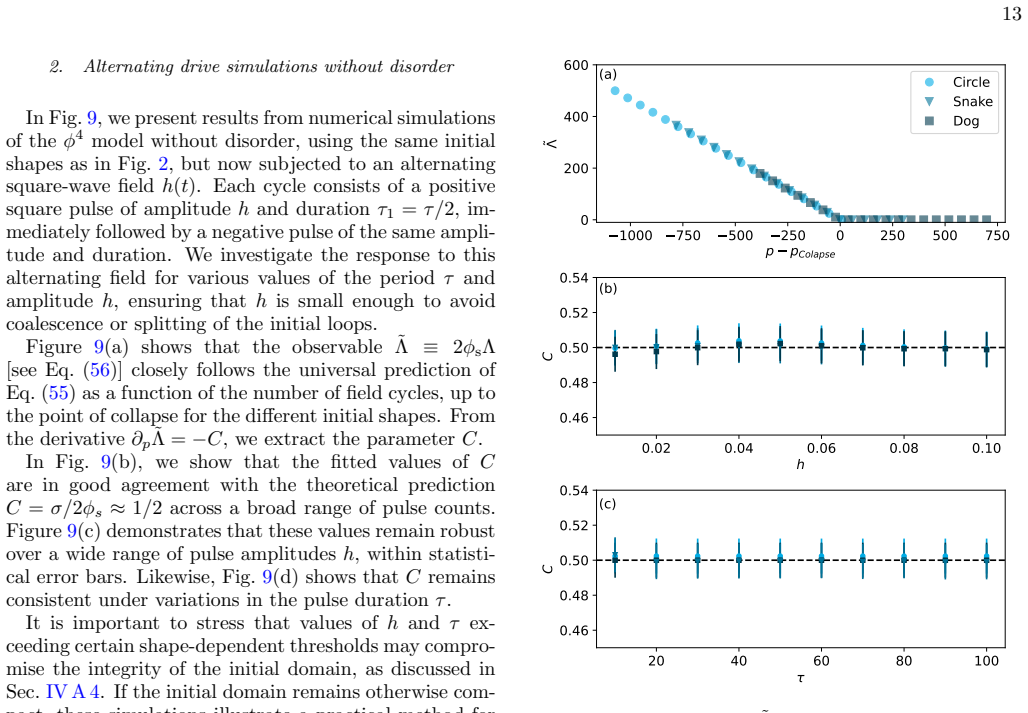
Alternating drive simulations without disorder In Fig. 9, we present results from numerical simulations of theϕ 4 model without disorder, using the same initial shapes as in Fig. 2, but now subjected to an alternating square-wave fieldh(t). Each cycle consists of a positive square pulse of amplitudehand durationτ 1 =τ /2, im- mediately followed by a negat...
-
[7]
Alternating drive simulations with disorder We now test Eqs. (57) and (58) using simulations of theϕ 4 model with quenched disorder at zero tempera- ture, i.e., with a non-zeror(x, y) in Eq. (9), under the same alternating square-pulse fieldh(t) described in the previous section. This study is directly relevant to ex- periments, where some degree of disor...
-
[8]
Without pinning We consider first the non-disordered case,V T (H)∼ mH, withm≡2/(ηϕ s) the DW mobility (we are ignoring here the effects of internals degrees of freedom such at the Walker breakdown at intermediate field values). The equation then reduces to the Cahn-Allen equation, dR dt = −m C R. The solution for this case isR 2 =R 2 0−2mCt, with R0 the i...
-
[9]
To get an idea, aR 0 = 50µm bubble hasτ 1/2 = 1 ms. This means that in the absence of disorder the collapse of a millimetric bubble should be observable in a scale of seconds. As previously pointed out, the result of Eq.(62) is ac- tually valid foranyinitial simple closed curve Γ(t) de- scribing the DW at timet, not only for a circular one. 17 The area in...
-
[10]
With pinning In the presence of disorder, we find thatC/R 0 ≪H d for all PMOKE observable bubbles, typicallyR 0 >1µm, whereH d is the characteristic depinning field of the sample [25]. This means that the collapse dynamics is dominated by the thermally activated collective creep regime [2]. Using the circular approximation we again get a closed equation f...
-
[11]
Further considerations The above extrapolation must be checked for finite- size effects which will be very important precisely in the limit of very low applied fields where the creep-law takes a different form. The cut-off size of creep events grows asL opt ∼L d(Hd/H) ν with the applied fieldH, and the associated barrier scale asU opt ∼L θ opt ∼H −θν =H −...
-
[12]
and the creep-law crossovers to normal Arrhenius ac- tivation over a size dependent barrierR −µ 0 corresponding to a thermal nucleus of sizeR 0. For curvature driven creep finite size effects will be important whenL opt ≈ Ld(HdR0/C) ν =L d(R0/Rd)ν > R0 withν= 3/4. That is (Ld/Rd)(R0/Rd)ν−1 >1. For Pt/Co/Pt films we have for instanceL d/Rd ≈4 (L d ≈0.04µma...
-
[13]
C. P. Quinteros, M. J. C. Burgos, L. J. Albornoz, J. E. G´ omez, P. Granell, F. Golmar, M. L. Ibarra, S. Bustin- gorry, J. Curiale, and M. Granada, Journal of Physics D: Applied Physics54, 015002 (2020)
work page 2020
-
[14]
S. Lemerle, J. Ferr´ e, C. Chappert, V. Mathet, T. Gia- marchi, and P. Le Doussal, Phys. Rev. Lett.80, 849 (1998)
work page 1998
-
[15]
Creep and depinning in disordered media
P. Chauve, T. Giamarchi, and P. Le Doussal, Phys. Rev. B62, 6241 (2000), arXiv:cond-mat/0002299 [cond- mat.dis-nn]
work page internal anchor Pith review Pith/arXiv arXiv 2000
-
[16]
A. Nicolas, E. E. Ferrero, K. Martens, and J.-L. Barrat, Rev. Mod. Phys.90, 045006 (2018)
work page 2018
-
[17]
Kardar, Physics Reports301, 85 (1998), arXiv:cond- mat/9704172 [cond-mat.stat-mech]
M. Kardar, Physics Reports301, 85 (1998), arXiv:cond- mat/9704172 [cond-mat.stat-mech]
-
[18]
J. Ferr´ e, P. J. Metaxas, A. Mougin, J.-P. Jamet, J. Gor- chon, and V. Jeudy, Comptes Rendus Physique14, 651 (2013)
work page 2013
-
[19]
M. E. Gage and R. S. Hamilton, Journal of Differential Geometry23, 69 (1986)
work page 1986
-
[20]
M. A. Grayson, Journal of Differential Geometry26, 285 (1987)
work page 1987
-
[21]
Evolution of curves and surfaces by mean curvature
B. White, “Evolution of curves and surfaces by mean curvature,” (2002), arXiv:math/0212407 [math.DG]
work page internal anchor Pith review Pith/arXiv arXiv 2002
- [22]
-
[23]
N. L. Schryer and L. R. Walker, Journal of Applied Physics45, 5406 (1974)
work page 1974
-
[24]
A. B. Kolton, E. E. Ferrero, and A. Rosso, Phys. Rev. B108, 174201 (2023)
work page 2023
-
[25]
N. B. Caballero, E. E. Ferrero, A. B. Kolton, J. Curiale, V. Jeudy, and S. Bustingorry, Phys. Rev. E97, 062122 (2018)
work page 2018
-
[26]
Ginzburg-landau micromag- netic model to study domain wall dynamics in thin fer- romagnetic systems,
P. C. Guruciaga, N. B. Caballero, V. Jeudy, J. Curi- ale, and S. Bustingorry, “Ginzburg-landau micromag- netic model to study domain wall dynamics in thin fer- romagnetic systems,” (2019), arXiv:1912.09392 [cond- mat.dis-nn]
-
[27]
P. C. Hohenberg and B. I. Halperin, Reviews of Modern Physics49, 435 (1977)
work page 1977
-
[28]
N. Caballero, E. Agoritsas, V. Lecomte, and T. Gia- marchi, Phys. Rev. B102, 104204 (2020)
work page 2020
-
[29]
A. L. Barab´ asi and H. E. Stanley,Fractal Concepts in Surface Growth(Cambridge University Press, 1995)
work page 1995
-
[30]
A. Sicilia, J. J. Arenzon, A. J. Bray, and L. F. Cuglian- dolo, Phys. Rev. E76, 061116 (2007)
work page 2007
- [31]
-
[32]
P. Domenichini, C. P. Quinteros, M. Granada, S. Collin, J.-M. George, J. Curiale, S. Bustingorry, M. G. Capeluto, and G. Pasquini, Phys. Rev. B99, 214401 (2019)
work page 2019
-
[33]
P. Domenichini, F. Paris, M. G. Capeluto, M. Granada, J.-M. George, G. Pasquini, and A. B. Kolton, Phys. Rev. B103, L220409 (2021)
work page 2021
-
[34]
P. Domenichini, J. A. Brock, J. Curiale, and A. B. Kolton, Phys. Rev. B110, 014401 (2024)
work page 2024
-
[35]
J. Gorchon, S. Bustingorry, J. Ferr´ e, V. Jeudy, A. B. Kolton, and T. Giamarchi, Phys. Rev. Lett.113, 027205 (2014), arXiv:1407.7781 [cond-mat.dis-nn]
work page internal anchor Pith review Pith/arXiv arXiv 2014
- [36]
- [37]
- [38]
discussion (0)
Sign in with ORCID, Apple, or X to comment. Anyone can read and Pith papers without signing in.