REVIEW 4 major objections 5 minor 32 references
A tactile-only policy, TacRefineNet, refines in-hand object pose to roughly 5 mm and 3.5 degrees using only fingertip touch, with no vision.
Reviewed by Pith at T0; open to challenge. T0 means a machine referee read the full paper against a public rubric. the ladder, T0–T4 →
2026-08-04 13:40 UTC pith:ZCZFWZT2
load-bearing objection Useful 4-DoF tactile regrasp system with a neat cross-combination training idea, but the 6-DoF/arbitrary-pose claims outrun what was actually trained and tested. the 4 major comments →
TacRefineNet: Goal-Conditioned Tactile Grasp Refinement for Edge-Prominent Objects
The pith
A machine-rendered reading of the paper's core claim, the machinery that carries it, and where it could break.
Core claim
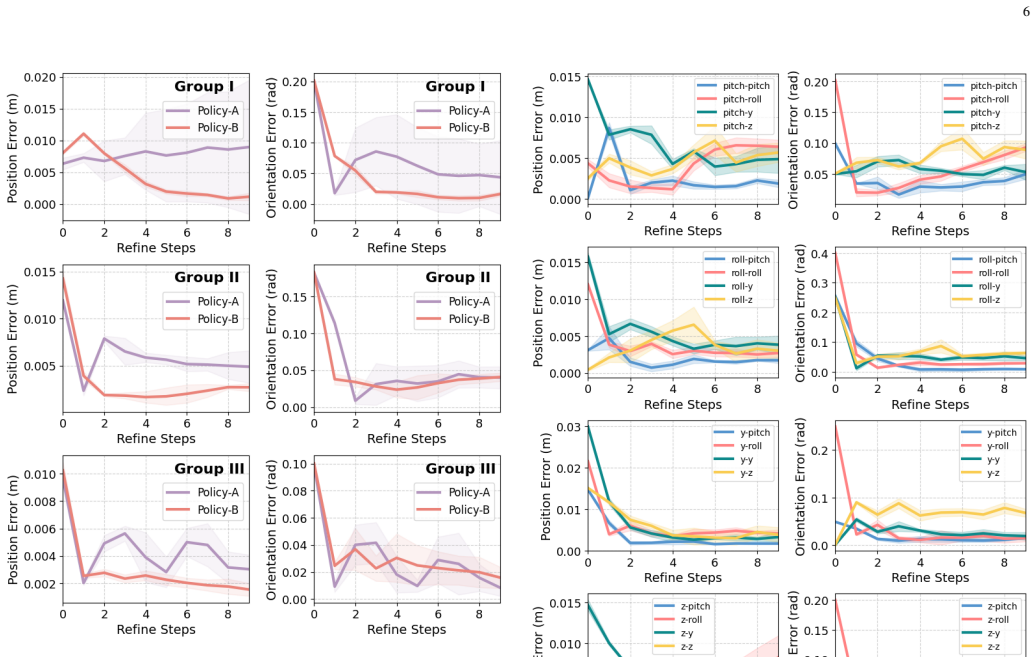
In the paper's terms, TacRefineNet is a tactile-only, goal-conditioned policy that regresses a 6-DoF wrist pose increment from multi-finger tactile images and hand proprioception. Trained with cross-combination sampling—randomly pairing current and target tactile images—it can steer an 11-DoF hand to any in-hand target within the sampled pose range without retraining. Real-world tests on an 11-DoF five-fingered hand with piezoresistive fingertip arrays report about 5.2 mm and 3.5° mean error after five steps, success rates up to 80.7% under a 10°/10 mm criterion for fixed targets, and continuous correction during long-horizon perturbations. The authors note the system samples only four of si
What carries the argument
The central mechanism is an iterative external-dexterity tactile servoing loop: after each grasp, fingertip tactile images (11×9 taxel arrays) and joint angles are fed to a multi-branch Siamese-style network that fuses per-finger tactile encodings with positional encoding and proprioception, then a three-layer MLP predicts wrist pose increments. The hand reopens, moves, and regrasps until the current tactile image matches the target. Cross-combination training—randomly pairing current and target samples from an N×N set—provides goal conditioning without per-pose retraining, and a physics-based simulation of the tactile sensors supplies large-scale training data before fine-tuning on real dat
Load-bearing premise
The central claim stands or falls on the assumption that x-translation and yaw errors are unnecessary to control directly—that they are absent, negligible, or correctable through coupling with the four sampled dimensions pitch, roll, y, and z.
What would settle it
Run the trained policy with an initial pose perturbed only in x-translation (or only in yaw), with all four sampled dimensions already at target; if the policy never outputs a corrective increment and the pose error in that dimension does not shrink, then the arbitrary-6-DoF claim is falsified in practice. A simpler check is to inspect the training data: if it contains no variation along x or yaw, the ground-truth increments for those dimensions are always zero.
If this is right
- If correct, tactile-only refinement can replace vision in final grasp alignment for thin/planar objects, reducing error accumulation in long-horizon tasks.
- Cross-combination training means a single demonstrated target tactile image is enough to specify any reachable in-hand pose, enabling user-specified goals without retraining.
- The sim-to-real recipe (large simulated dataset plus small real fine-tuning) is what makes the zero-shot deployment work; Policy B outperforms simulation-only training.
- The system can track a moving object over time using only touch, suggesting application in dynamic grasping and assembly.
- Generalization to unseen objects is partial and mostly along roll, so the method is currently limited to known objects or similar-geometry instances.
Where Pith is reading between the lines
- Because the training samples omit x-translation and yaw, the "6-DoF arbitrary pose" claim is only as strong as the assumption that those errors are negligible or coupled to the sampled dimensions; a deployment requiring explicit x or yaw correction would likely need additional sensing.
- The same cross-combination idea could extend to other pose-observable contact signatures, but for objects with symmetry or weak tactile discriminability, ambiguity grows—so tactile-only refinement is best suited to objects with distinctive contact geometry.
- A natural extension is to fuse sparse vision or tactile history over multiple regrasps to resolve the redundant dimensions, or to train directly on all six DOFs with data augmentation that breaks the x/roll and yaw/other couplings.
- If the approach scales to wider object classes, it could serve as a plug-in "final alignment" module inside larger manipulation pipelines, reducing the need for high-precision arm controllers.
Editorial analysis
A structured set of objections, weighed in public.
Referee Report
Summary. The paper presents TacRefineNet, a tactile-only, goal-conditioned framework for refining the in-hand pose of flat, edge-prominent objects. A multi-branch Siamese-like policy takes current and target fingertip tactile images plus joint positions and outputs a wrist pose increment; the hand iteratively opens, moves, and regrasps to converge to the target. The policy is trained in MuJoCo with a physics-based tactile model (156,007 simulated samples) and cross-combination pairing of current/target poses, then optionally fine-tuned on real data (Policy B). Real-world experiments report millimeter-level position accuracy and ~0.02 rad orientation errors on seen objects, with limited generalization to unseen objects in the same category. The paper claims 6-DoF arbitrary in-hand pose refinement, zero-shot sim-to-real deployment, and being the first tactile-only method for arbitrary in-hand pose adjustment.
Significance. If the claims were fully supported, the paper would be a valuable contribution: a practical tactile-only servoing loop for high-precision regrasping, a large simulated tactile dataset, and a clean cross-combination training scheme that avoids per-pose retraining. The real-robot evaluation and the sim-only vs. fine-tuned comparison are concrete strengths. However, the headline claims are substantially over-broad relative to the evidence: the system is trained and evaluated only on four pose dimensions (pitch, roll, y, z), and the best real-world policy is fine-tuned on real data, not zero-shot. The contribution is better characterized as 4-DoF tactile refinement along tactilely observable dimensions, with sim-to-real transfer improved by a small amount of real fine-tuning.
major comments (4)
- [§III-C; Eq. (1); Contributions] Data collection samples only pitch, roll, y, and z because tactile images along x overlap with roll and images along yaw overlap with other axes (§III-C). Yet Eq. (1) outputs Δx∈R^6 and the first contribution claims 6-DoF in-hand pose refinement. Section IV-C parameterizes test poses only along pitch, roll, y, z, and Table III contains no pure-x or pure-yaw rows. The policy is therefore never trained or evaluated on x/yaw increments, so the 6-DoF and 'arbitrary in-hand pose' claims are unsupported. Please either narrow the claims to 4-DoF refinement along the observable dimensions or supply training and evaluation data for x and yaw.
- [Abstract vs. §IV-B] The abstract states the policy is 'trained entirely in MuJoCo before zero-shot deployment to an 11-DoF five-fingered hand.' Section IV-B, however, defines Policy B as 'pretrained on simulated data and fine-tuned using real-world data,' and Table II shows that Policy B, not the simulation-only Policy A, achieves the best real-world results. The zero-shot sim-to-real claim is thus contradicted by the paper's own experimental protocol. The abstract and Section V should be revised to distinguish simulation-only results from fine-tuned results.
- [Abstract vs. §IV-A metrics] The abstract reports '80.7% and 59.3% success under the 10°/10 mm criterion for fixed and random targets.' Section IV-A defines success thresholds as ε_pos=0.005 m and ε_rot=0.05 rad, which are stricter than 10 mm/10°, and Table II lists Policy B success rates of 100% for all groups. No 80.7%/59.3% values appear anywhere in the body. The mismatch between the abstract's numbers/thresholds and the experimental section must be resolved, and the provenance of the abstract numbers clarified.
- [§IV-D, Fig. 8] The long-horizon tracking experiment is described as tracking motion along 'the yaw dimension' in the body text, while the Fig. 8 caption lists pitch, y, and roll. Since §III-C explicitly excludes yaw from training because of overlap with other axes, claiming yaw tracking without any yaw-specific quantitative result is inconsistent. The caption/body disagreement compounds the issue. Either provide yaw-specific evaluation and explain how the policy handles yaw, or remove the yaw claim from the experiment.
minor comments (5)
- [§IV-A, Eq. (3)] The quaternion distance formula δ_rot = 2 arccos(|⟨Q,Q_g⟩|) is standard but the notation Q, Q_g is not defined before use; please define the quaternion variables and the inner-product convention.
- [Table III] The table is described as having 'darker colors indicate higher success rates,' but the printed table appears grayscale and the darkening is not legible. Please use a numerical color scale or add explicit values.
- [§III-D.2] The amount of real-world fine-tuning data for Policy B is not specified. Please report the size of D_real and how many real poses were used.
- [References [21], [24]] Reference [21] contains a placeholder arXiv ID '2312.XXXX'; please update to the actual identifier. Also check whether [24] is cited with the correct venue/arXiv number.
- [§IV-E vs. §V] Section IV-E reports limited within-category generalization to unseen objects, while the Conclusion says 'the policy is currently effective on a single object.' These statements should be reconciled; the conclusion appears to undersell the generalization result or Section IV-E should clarify the failure modes.
Circularity Check
No circular derivation: supervised regression against ground-truth pose increments; the 6-DoF/4-DoF mismatch is an evidence gap, not a circular step.
full rationale
The paper's derivation chain is an empirical supervised-learning pipeline rather than an analytical derivation that reduces to its inputs. Equation (1) defines the policy as a function from current/target tactile images and joint states to a 6-DoF wrist increment; Equation (2) is an MSE loss against ground-truth pose increments collected in simulation and the real world; Equation (3) measures pose error relative to the wrist pose recorded at demonstration time. The target pose is self-consistent with the target tactile image, but it is not used to construct the training labels, so this is not circularity. Cross-combination training is a data-augmentation scheme, not a hidden fit of the evaluation quantity. Self-citations appear in the related-work survey (e.g., refs [2], [4], [7], [12]) but none is load-bearing for the central claim, and no uniqueness theorem or ansatz is imported from the authors' prior work. The paper's own Section III-C restricts training sampling to pitch, roll, y, and z, and Section IV-C evaluates only those dimensions; Section IV-D even labels the tracked axis inconsistently. This means the '6-DoF' and 'arbitrary in-hand pose' claims are not fully supported by the reported experiments, but that is an evidence/validity gap, not a circular step. No fitted parameter is renamed as a prediction, and no result is equivalent to its inputs by construction. Therefore no significant circularity is present.
Axiom & Free-Parameter Ledger
free parameters (4)
- Pose sampling bounds for pitch, roll, y, z
- Success thresholds epsilon_pos, epsilon_rot =
0.005 m; 0.05 rad in Section IV-A (abstract states 10 mm/10 deg)
- Data augmentation parameters =
Tactile scale ~mu(0.5, 1.0); joint noise ~mu(-0.04, 0.04) (Table I)
- Network hyperparameters (encoder, latent dim, MLP, learning rate, batch size) =
not reported
axioms (4)
- domain assumption MuJoCo elastic-contact tactile model faithfully reproduces real piezoresistive fingertip responses.
- ad hoc to paper Tactile images uniquely encode pose along pitch, roll, y, z for the object set; x/roll and yaw/other overlaps justify dropping x and yaw.
- domain assumption Cross-combination training from random pairs generalizes to all target poses in the sampled range.
- domain assumption Object pose is stable during each regrasp, so tactile images correspond to commanded wrist pose.
Cite this review
Pith. "Pith review of TacRefineNet: Goal-Conditioned Tactile Grasp Refinement for Edge-Prominent Objects." pith.science (2026). https://pith.science/paper/ZCZFWZT2
@misc{pith2026250925746,
  author       = {Pith},
  title        = {Pith review of: TacRefineNet: Goal-Conditioned Tactile Grasp Refinement for Edge-Prominent Objects},
  year         = {2026},
  howpublished = {\url{https://pith.science/paper/ZCZFWZT2}},
  note         = {Machine review of arXiv:2509.25746}
}
read the original abstract
Accurate final grasp alignment remains challenging for edge-prominent objects such as thin plates, discs, and rods, whose sparse contacts are easily occluded and poorly resolved by depth sensing. We present TacRefineNet, a tactile-only, goal-conditioned framework for local refinement along tactilely observable pose dimensions. Given current and target multi-finger tactile images and their corresponding hand-joint configurations, a Siamese policy network directly predicts corrective wrist pose increments. The hand iteratively opens, moves, and regrasps, forming an external-dexterity tactile servoing loop. Cross-combination training pairs current and target samples, allowing targets within the sampled pose range to be specified without retraining. We collect 156,007 simulated samples from 15 plates, discs, and rods and train the policy entirely in MuJoCo before zero-shot deployment to an 11-DoF five-fingered hand with piezoresistive sensors. On seen objects, the real system achieves 80.7\% and 59.3\% success under the $10^\circ$/10\,mm criterion for fixed and random targets, respectively; after five steps, the mean errors are approximately 5.2\,mm and $3.5^\circ$. Experiments further show continuous correction under long-horizon perturbations and limited within-category transfer to unseen objects, with reduced performance for symmetric or weakly discriminative contacts. Project website is available at https://sites.google.com/view/tacrefinenet
Figures




Reference graph
Works this paper leans on
-
[1]
Deep learning ap- proaches to grasp synthesis: A review,
R. Newbury, M. Gu, L. Chumbley, A. Mousavian, C. Eppner, J. Leitner, J. Bohg, A. Morales, T. Asfour, D. Kragicet al., “Deep learning ap- proaches to grasp synthesis: A review,”IEEE Transactions on Robotics, vol. 39, no. 5, pp. 3994–4015, 2023
2023
-
[2]
Dydexhandover: Human-like bimanual dynamic dexterous handover using rgb-only perception,
H. Zhou, Y . You, and S. Wang, “Dydexhandover: Human-like bimanual dynamic dexterous handover using rgb-only perception,”arXiv preprint arXiv:2509.17350, 2025
arXiv 2025
-
[3]
A generic control method of manipulator based on optimization,
S. Wang, X. Wang, B. Zhan, S. Wang, and F. Zha, “A generic control method of manipulator based on optimization,” in2017 2nd Interna- tional Conference on Advanced Robotics and Mechatronics (ICARM). IEEE, 2017, pp. 486–491
2017
-
[4]
Learning adaptive reaching and pushing skills using contact information,
S. Wang, L. Sun, F. Zha, W. Guo, and P. Wang, “Learning adaptive reaching and pushing skills using contact information,”Frontiers in Neurorobotics, vol. 17, p. 1271607, 2023
2023
-
[5]
Integrated grasp planning and visual object localization for a humanoid robot with five-fingered hands,
A. Morales, T. Asfour, P. Azad, S. Knoop, and R. Dillmann, “Integrated grasp planning and visual object localization for a humanoid robot with five-fingered hands,” in2006 IEEE/RSJ International Conference on Intelligent Robots and Systems. IEEE, 2006, pp. 5663–5668
2006
-
[6]
Dexgrasp anything: Towards universal robotic dexterous grasping with physics awareness,
Y . Zhong, Q. Jiang, J. Yu, and Y . Ma, “Dexgrasp anything: Towards universal robotic dexterous grasping with physics awareness,” inPro- ceedings of the Computer Vision and Pattern Recognition Conference, 2025, pp. 22 584–22 594
2025
-
[7]
Learning adaptive grasping from human demonstrations,
S. Wang, W. Hu, L. Sun, X. Wang, and Z. Li, “Learning adaptive grasping from human demonstrations,”IEEE/ASME Transactions on Mechatronics, vol. 27, no. 5, pp. 3865–3873, 2022
2022
-
[8]
Tinyvla: Towards fast, data-efficient vision-language- action models for robotic manipulation,
J. Wen, Y . Zhu, J. Li, M. Zhu, Z. Tang, K. Wu, Z. Xu, N. Liu, R. Cheng, C. Shenet al., “Tinyvla: Towards fast, data-efficient vision-language- action models for robotic manipulation,”IEEE Robotics and Automation Letters, 2025
2025
-
[9]
Rt-2: Vision-language-action models transfer web knowledge to robotic control,
B. Zitkovich, T. Yu, S. Xu, P. Xu, T. Xiao, F. Xia, J. Wu, P. Wohlhart, S. Welker, A. Wahidet al., “Rt-2: Vision-language-action models transfer web knowledge to robotic control,” inConference on Robot Learning. PMLR, 2023, pp. 2165–2183
2023
-
[10]
Learning fine- grained bimanual manipulation with low-cost hardware,
T. Z. Zhao, V . Kumar, S. Levine, and C. Finn, “Learning fine- grained bimanual manipulation with low-cost hardware,”arXiv preprint arXiv:2304.13705, 2023
Pith/arXiv arXiv 2023
-
[11]
Diffusion policy: Visuomotor policy learning via ac- tion diffusion,
C. Chi, Z. Xu, S. Feng, E. Cousineau, Y . Du, B. Burchfiel, R. Tedrake, and S. Song, “Diffusion policy: Visuomotor policy learning via ac- tion diffusion,”The International Journal of Robotics Research, p. 02783649241273668, 2023
2023
-
[12]
Learning an image-based visual servoing controller for object grasping,
S. Wang, L. Sun, M. Li, P. Wang, F. Zha, W. Guo, and Q. Li, “Learning an image-based visual servoing controller for object grasping,”Inter- national Journal of Humanoid Robotics, vol. 21, no. 05, p. 2350033, 2024
2024
-
[13]
S. Luo, N. F. Lepora, W. Yuan, K. Althoefer, G. Cheng, and R. Dahiya, “Tactile robotics: An outlook,”arXiv preprint arXiv:2508.11261, 2025
Pith/arXiv arXiv 2025
-
[14]
3d-vitac: Learning fine-grained manipulation with visuo-tactile sensing,
B. Huang, Y . Wang, X. Yang, Y . Luo, and Y . Li, “3d-vitac: Learning fine-grained manipulation with visuo-tactile sensing,”arXiv preprint arXiv:2410.24091, 2024
Pith/arXiv arXiv 2024
-
[15]
Multi-fingered in-hand manipulation with various object properties using graph convolutional networks and distributed tactile sensors,
S. Funabashi, T. Isobe, F. Hongyi, A. Hiramoto, A. Schmitz, S. Sugano, and T. Ogata, “Multi-fingered in-hand manipulation with various object properties using graph convolutional networks and distributed tactile sensors,”IEEE Robotics and Automation Letters, vol. 7, no. 2, pp. 2102– 2109, 2022
2022
-
[16]
Tactile regrasp: Grasp adjustments via simulated tactile transformations,
F. R. Hogan, M. Bauza, O. Canal, E. Donlon, and A. Rodriguez, “Tactile regrasp: Grasp adjustments via simulated tactile transformations,” in 2018 IEEE/RSJ International Conference on Intelligent Robots and Systems (IROS), 2018, pp. 2963–2970
2018
-
[17]
Fine-grained recognition of manipulation activities on objects via multi-modal sensing,
X. Liu, B. Zhang, L. Wang, S. Chen, X. Xie, X. Tong, T. Gu, and K. Li, “Fine-grained recognition of manipulation activities on objects via multi-modal sensing,”IEEE Transactions on Mobile Computing, vol. 23, no. 10, pp. 9614–9628, 2024
2024
-
[18]
Learning of grasp adaptation through experience and tactile sensing,
M. Li, Y . Bekiroglu, D. Kragic, and A. Billard, “Learning of grasp adaptation through experience and tactile sensing,” in2014 IEEE/RSJ International Conference on Intelligent Robots and Systems. Ieee, 2014, pp. 3339–3346
2014
-
[19]
Sim2real manipulation on unknown objects with tactile-based rein- forcement learning,
E. Su, C. Jia, Y . Qin, W. Zhou, A. Macaluso, B. Huang, and X. Wang, “Sim2real manipulation on unknown objects with tactile-based rein- forcement learning,” in2024 IEEE International Conference on Robotics and Automation (ICRA). IEEE, 2024, pp. 9234–9241
2024
-
[20]
Fbi: Learning dexterous in-hand manipulation with dynamic visuotactile shortcut policy,
Y . Chen, W. Xu, Z. Yu, T. Tang, Y . Li, S. Yao, and C. Lu, “Fbi: Learning dexterous in-hand manipulation with dynamic visuotactile shortcut policy,”arXiv preprint arXiv:2508.14441, 2025
Pith/arXiv arXiv 2025
-
[21]
Vint-6d: Visuo-tactile dataset for in-hand manipulation via object reposing and regrasping,
Z. Wanet al., “Vint-6d: Visuo-tactile dataset for in-hand manipulation via object reposing and regrasping,”arXiv preprint arXiv:2312.XXXX, 2023
2023
-
[22]
Learning tactile grasping with tactile-driven reinforce- ment learning,
B. Wenet al., “Learning tactile grasping with tactile-driven reinforce- ment learning,”IEEE Transactions on Robotics, vol. 36, no. 5, pp. 1523– 1538, 2020. 9
2020
-
[23]
Vita: Visuo-tactile action dataset for contact-rich manipulation,
V . Dikhaleet al., “Vita: Visuo-tactile action dataset for contact-rich manipulation,” inConference on Robot Learning (CoRL), 2022
2022
-
[24]
Hydroelastictouch: Simulation of tactile sensors with hydroelastic contact surfaces,
D. P. Leins, F. Patzelt, and R. Haschke, “Hydroelastictouch: Simulation of tactile sensors with hydroelastic contact surfaces,”arXiv preprint arXiv:2501.08077, 2025
Pith/arXiv arXiv 2025
-
[25]
Learning to imitate human tactile-proprioceptive contact with transformers,
O. Adenijiet al., “Learning to imitate human tactile-proprioceptive contact with transformers,” inRobotics: Science and Systems (RSS), 2023
2023
-
[26]
Soft tactile sensing for object classification and fine grasping adjustment using a pneumatic hand with an inflatable palm,
M. Su, D. Huang, Y . Guan, C. Xiang, H. Zhu, and Z. Liu, “Soft tactile sensing for object classification and fine grasping adjustment using a pneumatic hand with an inflatable palm,”IEEE Transactions on Industrial Electronics, vol. 71, no. 4, pp. 3873–3883, 2023
2023
-
[27]
Tactile regrasp: Grasp adjustments via simulated tactile transformations,
F. Hoganet al., “Tactile regrasp: Grasp adjustments via simulated tactile transformations,” inIEEE/RSJ International Conference on Intelligent Robots and Systems (IROS), 2020
2020
-
[28]
Learning tactile feature encodings for reactive grasping and regrasping,
H. Maoet al., “Learning tactile feature encodings for reactive grasping and regrasping,”Science Robotics, vol. 9, no. 71, 2024
2024
-
[29]
Tactile-based grasping stability prediction based on human grasp demonstration for robot manipulation,
Z. Zhao, W. He, and Z. Lu, “Tactile-based grasping stability prediction based on human grasp demonstration for robot manipulation,”IEEE Robotics and Automation Letters, vol. 9, no. 3, pp. 2646–2653, 2024
2024
-
[30]
Visuo-tactile feedback-based robot manipulation for object packing,
W. Liang, F. Fang, C. Acar, W. Q. Toh, Y . Sun, Q. Xu, and Y . Wu, “Visuo-tactile feedback-based robot manipulation for object packing,” IEEE Robotics and Automation Letters, vol. 8, no. 2, pp. 1151–1158, 2023
2023
-
[31]
Tacgnn: Learning in-hand manipulation from tactile graphs,
F. Yanget al., “Tacgnn: Learning in-hand manipulation from tactile graphs,” inIEEE International Conference on Robotics and Automation (ICRA), 2023
2023
-
[32]
Tactile goal-conditioned in-hand manipulation via reinforcement learning,
M. Pitzet al., “Tactile goal-conditioned in-hand manipulation via reinforcement learning,”IEEE Transactions on Robotics, 2024
2024
This paper was first reviewed by deepseek-v4-flash on August 4, 2026.
discussion (0)
Sign in with ORCID, Apple, or X to comment. Anyone can read and Pith papers without signing in.