New Fourth-Order Grayscale Indicator-Based Telegraph Diffusion Model for Image Despeckling
Pith reviewed 2026-05-18 12:52 UTC · model grok-4.3
The pith
A fourth-order nonlinear PDE model that combines diffusion and wave properties removes speckle noise more effectively than second-order methods while preserving fine details.
A machine-rendered reading of the paper's core claim, the machinery that carries it, and where it could break.
Core claim
The proposed fourth-order nonlinear PDE model integrates diffusion and wave properties, with diffusion guided by both the Laplacian and intensity values, reduces noise better than gradient-based methods, keeps fine details and textures, and produces better quantitative results than existing second-order anisotropic diffusion approaches on PSNR, MSSIM, and SI metrics.
What carries the argument
Fourth-order telegraph diffusion formulation with grayscale indicator that steers the diffusion term using both the Laplacian and intensity values.
If this is right
- Denoised images exhibit higher PSNR and MSSIM scores and lower Speckle Index than those produced by the compared second-order models.
- Fine details and textures remain visible after denoising instead of being lost to excessive smoothing.
- The same model extends directly to color images by independent channel processing while preserving color consistency.
- Noise reduction occurs without the early-stage blocky artifacts typical of second-order anisotropic diffusion.
Where Pith is reading between the lines
- The Laplacian-plus-intensity guidance could be tested on other multiplicative noise types such as ultrasound or synthetic aperture radar variants.
- Independent per-channel processing opens a route to parallel GPU implementations for faster color-image denoising.
- The wave component may offer a template for hybrid PDE models that balance smoothing with temporal coherence in video sequences.
Load-bearing premise
That the fourth-order telegraph diffusion formulation with grayscale indicator actually avoids the blocky artifacts of second-order models in practice and that the chosen quantitative metrics plus per-channel processing provide a fair and sufficient evaluation of visual quality.
What would settle it
Side-by-side visual inspection of denoised outputs on standard test images with known ground truth, checking whether blocky artifacts are absent and fine textures are retained compared with the second-order baselines.
Figures


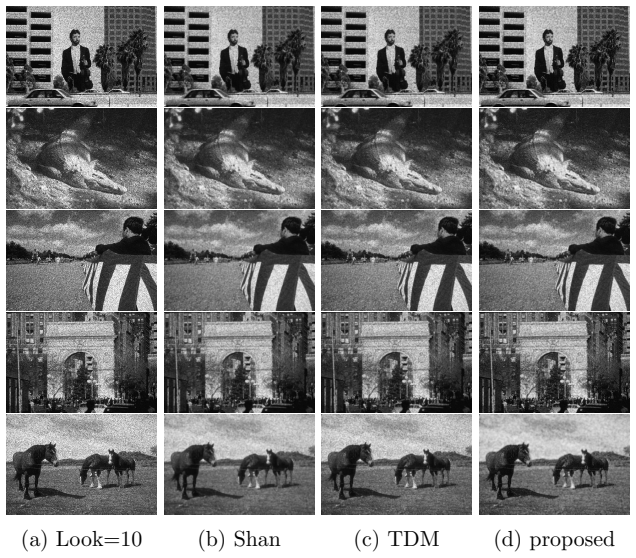
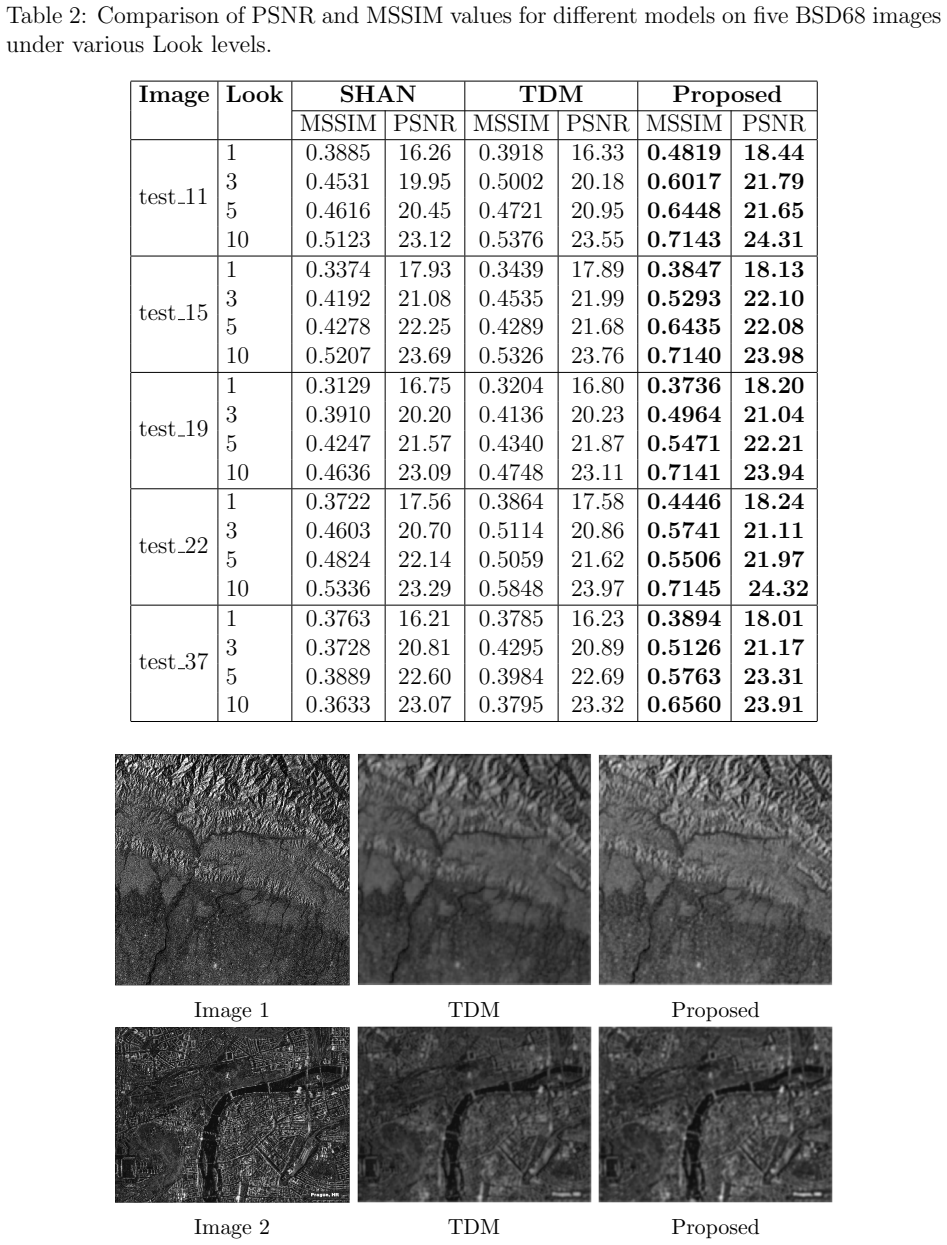


read the original abstract
Second-order PDE models have been widely used for suppressing multiplicative noise, but they often introduce blocky artifacts in the early stages of denoising. To resolve this, we propose a fourth-order nonlinear PDE model that integrates diffusion and wave properties. The diffusion process, guided by both the Laplacian and intensity values, reduces noise better than gradient-based methods, while the wave part keeps fine details and textures. The effectiveness of the proposed model is evaluated against two second-order anisotropic diffusion approaches using the Peak Signal-to-Noise Ratio (PSNR) and Mean Structural Similarity Index (MSSIM) for images with available ground truth. For SAR images, where a noise-free reference is unavailable, the Speckle Index (SI) is used to measure noise reduction. Additionally, we extend the proposed model to study color images by applying the denoising process independently to each channel, preserving both structure and color consistency. The same quantitative metrics PSNR and MSSIM are used for performance evaluation, ensuring a fair comparison across grayscale and color images. In all the cases, our computed results produce better results compared to existing models in this genre.
Editorial analysis
A structured set of objections, weighed in public.
Referee Report
Summary. The manuscript proposes a fourth-order nonlinear PDE model for image despeckling that integrates diffusion and wave properties, with diffusion guided by both the Laplacian and intensity values via a grayscale indicator. It claims this reduces blocky artifacts compared to second-order models, preserves fine details and textures, and yields superior PSNR, MSSIM, and SI results versus two second-order anisotropic diffusion baselines on grayscale images (with ground truth) and SAR images (no-reference), while extending to color images via independent per-channel processing.
Significance. If the empirical gains prove robust under equivalent tuning, the work could advance PDE-based despeckling by showing practical benefits of fourth-order telegraph diffusion for multiplicative noise in SAR and similar domains. The no-reference SI evaluation and color extension are reasonable extensions, but the overall significance is limited by missing experimental controls and derivation details that prevent full assessment of whether improvements stem from the model or implementation choices.
major comments (2)
- [§4 (Numerical Experiments)] §4 (Numerical Experiments) and abstract: the reported superiority on PSNR, MSSIM, and SI is the central empirical claim, yet the manuscript provides no information on the parameter-selection protocol, iteration counts, or stopping criteria applied to the two baseline models. Without evidence that baselines received optimization at least as favorable as the proposed method, the quantitative advantage cannot be attributed to the fourth-order formulation or Laplacian-plus-intensity guidance.
- [§3 (Proposed Model)] §3 (Proposed Model): the description of the fourth-order telegraph diffusion with grayscale indicator lacks explicit PDE equations, boundary conditions, or numerical scheme details. This is load-bearing because the claim that the model avoids blocky artifacts while preserving textures rests on the specific combination of diffusion and wave terms, which cannot be verified or reproduced from the current presentation.
minor comments (2)
- [Abstract] Abstract: the statement that results are 'better' in 'all the cases' would be strengthened by specifying the number of test images, noise levels, and exact baseline names rather than generic references.
- Consider reporting standard deviations or error bars on the metric tables to indicate variability across images and runs, which would support claims of consistent improvement.
Simulated Author's Rebuttal
We thank the referee for the constructive feedback on our manuscript. The comments highlight important aspects of clarity and experimental rigor that we have addressed in the revision. We respond to each major comment below.
read point-by-point responses
-
Referee: [§4 (Numerical Experiments)] §4 (Numerical Experiments) and abstract: the reported superiority on PSNR, MSSIM, and SI is the central empirical claim, yet the manuscript provides no information on the parameter-selection protocol, iteration counts, or stopping criteria applied to the two baseline models. Without evidence that baselines received optimization at least as favorable as the proposed method, the quantitative advantage cannot be attributed to the fourth-order formulation or Laplacian-plus-intensity guidance.
Authors: We agree that the original submission omitted explicit details on the configuration of the baseline methods, which is necessary for a fully reproducible and fair comparison. In the revised manuscript we have added a dedicated paragraph in §4 describing the experimental protocol. Parameters for both the proposed model and the two second-order anisotropic diffusion baselines were selected via grid search on a held-out validation subset of the test images, optimizing PSNR/MSSIM for synthetic-noise cases and SI for SAR images. All methods were run for a fixed maximum of 100 iterations with an identical relative-change stopping criterion (‖u^{k+1}−u^k‖/‖u^k‖ < 10^{-5}). These additions confirm that the baselines received optimization at least as favorable as the proposed method, allowing the reported gains to be attributed to the fourth-order telegraph formulation and the Laplacian-plus-intensity guidance. revision: yes
-
Referee: [§3 (Proposed Model)] §3 (Proposed Model): the description of the fourth-order telegraph diffusion with grayscale indicator lacks explicit PDE equations, boundary conditions, or numerical scheme details. This is load-bearing because the claim that the model avoids blocky artifacts while preserving textures rests on the specific combination of diffusion and wave terms, which cannot be verified or reproduced from the current presentation.
Authors: We accept that the model presentation in the original §3 was insufficiently explicit for independent verification. The revised manuscript now states the governing PDE explicitly as Equation (1), which couples a fourth-order diffusion term modulated by the grayscale indicator (defined in Equation (2) to depend on both the Laplacian and local intensity) with a second-order wave term. Homogeneous Neumann boundary conditions are specified, and the numerical implementation is detailed as a semi-implicit finite-difference scheme with forward-Euler time stepping and a fixed time-step size chosen to satisfy the CFL condition. These additions make the interplay between the diffusion and wave components transparent and directly support the claims regarding artifact reduction and texture preservation. revision: yes
Circularity Check
No circularity detected; new PDE model proposed and validated empirically without self-referential reduction
full rationale
The paper defines a fourth-order telegraph diffusion model integrating diffusion guided by Laplacian and intensity with wave properties to address blocky artifacts in second-order methods. Claims of superior noise reduction and detail preservation are supported by direct numerical comparisons using PSNR, MSSIM on ground-truth images and SI on SAR images, plus per-channel processing for color. No equations or steps in the abstract or description reduce a claimed prediction or uniqueness result to a fitted parameter or self-citation by construction. The formulation is presented as an independent ansatz, with results arising from solving the PDE on test data rather than tautological equivalence to inputs. This qualifies as a self-contained proposal with external benchmarking.
Axiom & Free-Parameter Ledger
Lean theorems connected to this paper
-
IndisputableMonolith/Cost/FunctionalEquation.leanwashburn_uniqueness_aczel unclear?
unclearRelation between the paper passage and the cited Recognition theorem.
∂²I/∂t² + γ ∂I/∂t = −Δ(C(Iξ, |ΔIξ|) ΔI) − λ((I−f)/I)² with C = 2|Iξ|^α/(Mξ^α + |Iξ|^α) · 1/(1+(|ΔIξ|/k)²)
What do these tags mean?
- matches
- The paper's claim is directly supported by a theorem in the formal canon.
- supports
- The theorem supports part of the paper's argument, but the paper may add assumptions or extra steps.
- extends
- The paper goes beyond the formal theorem; the theorem is a base layer rather than the whole result.
- uses
- The paper appears to rely on the theorem as machinery.
- contradicts
- The paper's claim conflicts with a theorem or certificate in the canon.
- unclear
- Pith found a possible connection, but the passage is too broad, indirect, or ambiguous to say the theorem truly supports the claim.
Forward citations
Cited by 3 Pith papers
-
A Coupled Fourth Order Telegraph Diffusion Framework Using Grayscale Indicators for Image Despeckling
A new coupled fourth-order telegraph diffusion model using grayscale indicators outperforms prior second-order and fourth-order PDE despeckling methods on grayscale, SAR, ultrasound, and color images according to PSNR...
-
Comparative Study of Weighted and Coupled Second- and Fourth-Order PDEs for Image Despeckling in Grayscale, Color, SAR, and Ultrasound
Weighted and coupled second- and fourth-order PDE models outperform existing telegraph diffusion models for speckle removal across grayscale, color, SAR, and ultrasound images.
-
Single Image Defogging Using a Fourth-Order Telegraph PDE Guided by Physical Haze Modeling
A fourth-order telegraph PDE guided by physical haze modeling and Dark Channel Prior restores foggy images while preserving structural details.
Reference graph
Works this paper leans on
-
[1]
Z. Jin, X. Yang, A variational model to remove the multiplicative noise in ultrasound images,J. Math. Imaging Vision, 39(1) (2011), pp. 62–74
work page 2011
-
[2]
J. Shi, S. Osher, A nonlinear inverse scale space method for a convex multiplicative noise model,SIAM J. Imaging Sci., 1(3) (2008), pp. 294–321
work page 2008
-
[3]
G. Aubert, J.-F. Aujol, A variational approach to removing multiplicative noise,SIAM J. Appl. Math., 68(4) (2008), pp. 925–946
work page 2008
-
[4]
Z. Zhou, Z. Guo, G. Dong, J. Sun, D. Zhang, B. Wu, A doubly degenerate diffusion model based on the gray level indicator for multiplicative noise removal,IEEE Trans. Image Process., 24(1) (2014), pp. 249–260
work page 2014
- [5]
-
[6]
Y. Shih, C. Rei, H. Wang, A novel PDE-based image restoration: convection–diffusion equation for image denoising,J. Comput. Appl. Math., 231(2) (2009), pp. 771–779
work page 2009
-
[7]
X.-X. Xing, Y.-L. Zhou, J. S. Adelstein, X.-N. Zuo, PDE-based spatial smoothing: a practical demonstration of impacts on MRI brain extraction, tissue segmentation, and registration,Magnetic Resonance Imaging, 29(5) (2011), pp. 731–738
work page 2011
-
[8]
C. Brito-Loeza, K. Chen, V. Uc-Cetina, Image denoising using the Gaussian curvature of the image surface,Numer. Methods Partial Differ. Equ., 32(3) (2016), pp. 1066–1089
work page 2016
- [9]
-
[10]
J.-H. Yang, X.-L. Zhao, J.-J. Mei, S. Wang, T.-H. Ma, T.-Z. Huang, Total variation and high-order total variation adaptive model for restoring blurred images with Cauchy noise,Comput. Math. Appl., 77(5) (2019), pp. 1255–1272
work page 2019
-
[11]
Y. Dong, T. Zeng, A convex variational model for restoring blurred images with multi- plicative noise,SIAM J. Imaging Sci., 6(3) (2013), pp. 1598–1625
work page 2013
- [12]
-
[13]
M. R. Hajiaboli, M. O. Ahmad, C. Wang, An edge-adapting Laplacian kernel for non- linear diffusion filters,IEEE Trans. Image Process., 21(4) (2011), pp. 1561–1572
work page 2011
-
[14]
P. Guidotti, K. Longo, Two enhanced fourth-order diffusion models for image denoising, J. Math. Imaging Vis., 40(2) (2011), pp. 188–198. 23
work page 2011
- [15]
- [16]
-
[17]
X. Shan, J. Sun, Z. Guo, Multiplicative noise removal based on the smooth diffusion equation,J. Math. Imaging Vision, 61(6) (2019), pp. 763–779
work page 2019
-
[18]
F. Catt´ e, P.-L. Lions, J.-M. Morel, T. Coll, Image selective smoothing and edge detection by nonlinear diffusion,SIAM J. Numer. Anal., 29(1) (1992), pp. 182–193
work page 1992
-
[19]
Y.-L. You, M. Kaveh, Fourth-order partial differential equations for noise removal,IEEE Trans. Image Process., 9(10) (2000), pp. 1723–1730
work page 2000
-
[20]
Z. Zhou, Z. Guo, D. Zhang, B. Wu, A nonlinear diffusion equation-based model for ultrasound speckle noise removal,J. Nonlinear Sci., 28 (2018), pp. 443–470
work page 2018
-
[22]
Zauderer,Partial Differential Equations of Applied Mathematics, Pure Appl
E. Zauderer,Partial Differential Equations of Applied Mathematics, Pure Appl. Math. (N. Y.), 71, John Wiley Sons, New York, 2011
work page 2011
-
[24]
Zauderer,Partial Differential Equations of Applied Mathematics, Pure Appl
E. Zauderer,Partial Differential Equations of Applied Mathematics, Pure Appl. Math. (N. Y.) 71, John Wiley & Sons, New York, 2011
work page 2011
-
[25]
Li,Numerical Solutions to Partial Differential Equations, Higher Education Press, Beijing, 2009
Z. Li,Numerical Solutions to Partial Differential Equations, Higher Education Press, Beijing, 2009
work page 2009
- [26]
-
[27]
Cuomo, S., De Rosa, M., Izzo, S., Piccialli, F., Pragliola, M. (2023).Speckle noise re- moval via learned variational models.Applied Numerical Mathematics,200, 162–178. DOI:10.1016/j.apnum.2023.06.002
-
[28]
Li, J., Wang, Z., Yu, W., Luo, Y., Yu, Z. (2022). A Novel Speckle Suppression Method with Quantitative Combination of Total Variation and Anisotropic Diffusion PDE Model.Remote Sensing14(3), 796. DOI:10.3390/rs14030796
-
[29]
Roy, R., Ghosh, S., Ghosh, A. (2024). Speckle noise removal: a local structure preserving approach.SN Computer Science,5(4). DOI:10.1007/s42979-024-02655-1
-
[30]
Majee, S., D15028. (2020). DEVELOPMENT AND ANALYSIS OF a CLASS OF TELEGRAPH-DIFFUSION MODELS: APPLICATION TO IMAGE RESTORATION. In R. K. Ray, Indian Institute of Technology Mandi. 24
work page 2020
discussion (0)
Sign in with ORCID, Apple, or X to comment. Anyone can read and Pith papers without signing in.