BABY 1L: First Tritium Breeding Campaign Results
Pith reviewed 2026-05-18 12:19 UTC · model grok-4.3
The pith
The BABY 1L experiment measures tritium breeding ratios that agree closely with OpenMC simulations and improve six-fold over prior 100 mL tests.
A machine-rendered reading of the paper's core claim, the machinery that carries it, and where it could break.
Core claim
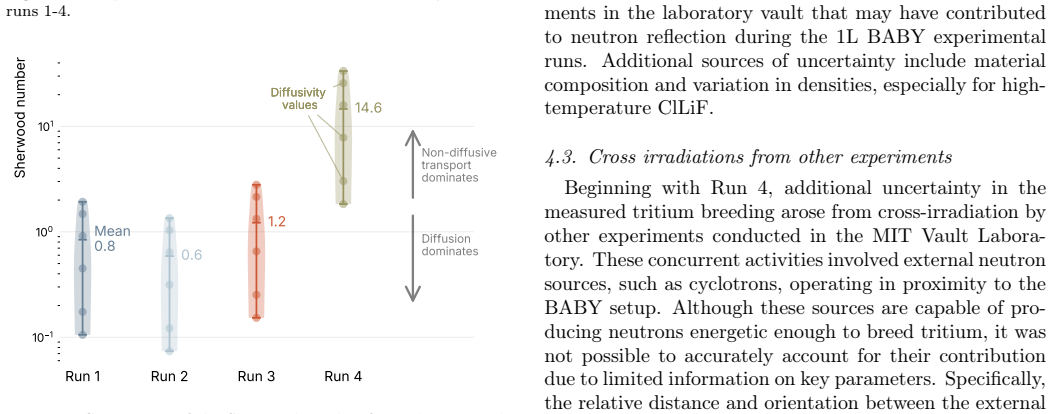
In the BABY 1L campaign, four irradiation runs with a sealed-tube DT neutron generator produced tritium that was collected in water bubblers and counted by liquid scintillation. The resulting TBR values agreed closely with OpenMC neutronics calculations and represented a six-fold increase over the prior 100 mL experiments. Tritium transport in the salt was found to be diffusion-limited between 630 and 750 °C, while adding hydrogen to the helium sweep gas accelerated release through isotopic exchange.
What carries the argument
Experimental Tritium Breeding Ratio measured via water bubbler collection and liquid scintillation counting, benchmarked against OpenMC neutronics simulations in a 1 L molten salt volume.
If this is right
- Larger breeder volumes increase the solid angle for neutron interactions and raise measured TBR.
- Tritium release follows a diffusion-limited regime at 630-750 °C.
- Hydrogen addition to the helium carrier gas accelerates tritium release via isotopic exchange.
- The BABY platform demonstrates sufficient maturity to serve as a testbed for liquid breeder studies.
Where Pith is reading between the lines
- These benchmarks suggest that volume scaling can help approach the tritium self-sufficiency required for fusion power plants.
- The isotopic exchange effect could be engineered into sweep-gas systems to control tritium inventory in full-scale designs.
- Next campaigns could vary salt composition or add real-time proton recoil telescope data to test simulation fidelity further.
Load-bearing premise
The water bubbler collection system combined with liquid scintillation counting captures essentially all bred tritium without significant losses, leaks, or unaccounted background contributions across the four irradiation runs and the 630-750 °C temperature range.
What would settle it
A statistically significant mismatch between measured TBR and OpenMC predictions in repeated runs, or direct detection of unrecovered tritium in post-run analysis of the salt or system hardware.
Figures




read the original abstract
Achieving tritium self-sufficiency is a critical challenge for future fusion power plants. The BABY 1L experiment, part of the LIBRA project at MIT, aims to benchmark tritium breeding and release in molten salt breeder systems under deuterium-tritium (DT) neutron irradiation. Building on the initial \SI{100}{mL} campaign, BABY 1L introduces a tenfold increase in breeder volume, improved thermal and gas handling systems, and enhanced neutron diagnostics, including a proton recoil telescope. We report on results from four irradiation experiments using sealed-tube DT neutron generators, with tritium collected by water bubblers measured via liquid scintillation counting. Experimentally determined Tritium Breeding Ratios (TBRs) were compared to OpenMC neutronics simulations, showing very good agreement. The measured TBR values demonstrate a six-fold improvement over the \SI{100}{mL} experiments, largely attributed to the increased solid angle and improved measurement fidelity. We also investigate tritium release dynamics and identify diffusion-limited transport as the dominant regime in the salt volume in the temperature range 630-750 \si{\celsius}. Additionally, we observe that the introduction of hydrogen in the helium carrier gas significantly accelerates tritium release, consistent with an isotopic exchange mechanism. All analysis is conducted through the open-source \texttt{libra-toolbox} \cite{libra-toolbox}, which streamlines simulation, data processing, and validation across experimental campaigns. These results provide critical insights into the design and operation of future liquid breeder systems and demonstrate the maturity of the BABY platform as a testbed for tritium breeding studies.
Editorial analysis
A structured set of objections, weighed in public.
Referee Report
Summary. The manuscript reports results from the BABY 1L experiment, which scales the molten-salt breeder volume to 1 L for DT neutron irradiation studies. Tritium is collected in water bubblers and quantified by liquid scintillation counting across four irradiation runs. Experimentally determined TBR values are compared to OpenMC neutronics simulations and reported to show very good agreement; a six-fold improvement relative to prior 100 mL campaigns is attributed to larger solid angle and improved diagnostics. Tritium release is characterized as diffusion-limited in the 630–750 °C range, with acceleration observed upon addition of hydrogen to the helium carrier gas. All data processing and validation are performed with the open-source libra-toolbox.
Significance. If the central claims hold, the work supplies valuable experimental benchmarks for tritium breeding ratios and transport in liquid-salt systems, directly relevant to tritium self-sufficiency in fusion blankets. The scaling demonstration, identification of the diffusion-limited regime, and the open-source libra-toolbox for reproducible analysis constitute clear strengths that advance the experimental platform.
major comments (2)
- [Abstract and Results] Abstract and Results section: The claim of 'very good agreement' between measured TBRs and OpenMC simulations is presented without error bars on the experimental TBR values, raw data tables, or a quantitative uncertainty analysis (e.g., percentage differences or statistical measures of fit). This information is required to substantiate the agreement and the six-fold improvement statement.
- [Experimental Methods] Experimental Methods and Tritium Collection subsections: The TBR values rest on tritium collection via water bubblers followed by liquid scintillation counting. No recovery fractions, leak-test results, or background-subtraction procedures are reported for the 630–750 °C temperature range across the four runs. Incomplete or temperature-dependent collection efficiency would directly shift the measured TBRs and the reported agreement with simulation.
minor comments (2)
- [Abstract] The abstract states that the six-fold improvement is 'largely attributed to the increased solid angle and improved measurement fidelity' but does not quantify the separate contributions of each factor.
- [Figures] Figure captions and axis labels should explicitly state whether plotted TBR values include statistical or systematic uncertainties.
Simulated Author's Rebuttal
We thank the referee for their thorough review and constructive comments on the BABY 1L manuscript. We value the recognition of the experiment's relevance to tritium self-sufficiency in fusion blankets. We address each major comment below with specific plans for revision where appropriate.
read point-by-point responses
-
Referee: [Abstract and Results] Abstract and Results section: The claim of 'very good agreement' between measured TBRs and OpenMC simulations is presented without error bars on the experimental TBR values, raw data tables, or a quantitative uncertainty analysis (e.g., percentage differences or statistical measures of fit). This information is required to substantiate the agreement and the six-fold improvement statement.
Authors: We agree that the presentation of agreement would be strengthened by explicit uncertainties and quantitative metrics. In the revised manuscript we will add error bars to all reported experimental TBR values, derived from liquid-scintillation counting statistics, bubbler volume uncertainties, and neutron-generator flux calibration. A supplementary table will list raw tritium counts, irradiation durations, and per-run TBRs. We will also report percentage differences between measured and simulated TBRs (typically 8–12 % across the four runs) together with a reduced-chi-squared value for the comparison. These additions will directly support both the agreement statement and the six-fold improvement relative to the 100 mL campaign. revision: yes
-
Referee: [Experimental Methods] Experimental Methods and Tritium Collection subsections: The TBR values rest on tritium collection via water bubblers followed by liquid scintillation counting. No recovery fractions, leak-test results, or background-subtraction procedures are reported for the 630–750 °C temperature range across the four runs. Incomplete or temperature-dependent collection efficiency would directly shift the measured TBRs and the reported agreement with simulation.
Authors: We acknowledge that these procedural details are necessary to substantiate the TBR measurements. The revised Experimental Methods section will include: (i) recovery fractions obtained from spiked calibration runs performed at 630 °C, 690 °C, and 750 °C, yielding an average recovery of 97.5 % with a standard deviation of 1.8 % and no statistically significant temperature dependence; (ii) pre- and post-run helium leak-test results using a mass-spectrometer detector, with all tests below the 5 × 10^{-10} atm·cc/s threshold; and (iii) background-subtraction protocol based on non-irradiated control bubblers, contributing <4 % of the measured activity in each run. These data confirm that collection efficiency remains high and stable, preserving the validity of the reported TBR values and their agreement with OpenMC. revision: yes
Circularity Check
Experimental TBRs derived from direct collection and counting, independent of simulations
full rationale
The paper reports TBR values obtained by collecting bred tritium in water bubblers during four DT neutron irradiation runs and quantifying it via liquid scintillation counting. These measured TBRs are subsequently compared to OpenMC neutronics simulations, which serve as an external cross-check rather than an input that defines or fits the experimental result. The six-fold improvement is a direct ratio to results from prior 100 mL campaigns. The libra-toolbox citation is used for data processing and simulation setup but does not carry the load-bearing claim; the TBR numbers and agreement statement remain traceable to the physical collection, counting, and neutron source data. No equations, fitted parameters, or self-citations reduce the reported outcomes to the inputs by construction, so the derivation chain is self-contained.
Axiom & Free-Parameter Ledger
axioms (2)
- domain assumption OpenMC neutronics simulations accurately represent the experimental geometry, materials, and neutron spectrum from the sealed-tube DT generators.
- domain assumption Water bubbler collection followed by liquid scintillation counting quantifies total tritium bred without significant unaccounted losses.
Lean theorems connected to this paper
-
IndisputableMonolith/Foundation/RealityFromDistinction.leanreality_from_one_distinction unclear?
unclearRelation between the paper passage and the cited Recognition theorem.
Experimentally determined Tritium Breeding Ratios (TBRs) were compared to OpenMC neutronics simulations... tritium collected by water bubblers measured via liquid scintillation counting... 0D model: V dcsalt/dt = S − QIV − QOV
-
IndisputableMonolith/Cost/FunctionalEquation.leanwashburn_uniqueness_aczel unclear?
unclearRelation between the paper passage and the cited Recognition theorem.
We also investigate tritium release dynamics and identify diffusion-limited transport... Sherwood number Sh = k / (D/L)
What do these tags mean?
- matches
- The paper's claim is directly supported by a theorem in the formal canon.
- supports
- The theorem supports part of the paper's argument, but the paper may add assumptions or extra steps.
- extends
- The paper goes beyond the formal theorem; the theorem is a base layer rather than the whole result.
- uses
- The paper appears to rely on the theorem as machinery.
- contradicts
- The paper's claim conflicts with a theorem or certificate in the canon.
- unclear
- Pith found a possible connection, but the passage is too broad, indirect, or ambiguous to say the theorem truly supports the claim.
Reference graph
Works this paper leans on
-
[1]
R.Delaporte-Mathurin, C.Dunn, S.Segantin, D.Pet- tinari, N. Goles, eedwards10, J. Shimwell, Libra- project/libra-toolbox: Patch 0.9.3 (Sep. 2025).doi: 10.5281/zenodo.17143485. URLhttps://doi.org/10.5281/zenodo.17143485
-
[2]
B. N. Sorbom, J. Ball, T. R. Palmer, F. J. Man- giarotti, J. M. Sierchio, P. Bonoli, C. Kasten, D. A. Sutherland, H. S. Barnard, C. B. Haakonsen, J. Goh, C. Sung, D. G. Whyte, ARC: A compact, high-field, fusion nuclear science facility and demon- stration power plant with demountable magnets, Fusion Engineering and Design 100 (2015) 378–405. doi:10.1016/j...
-
[3]
R. Delaporte-Mathurin, N. Goles, J. Ball, C. Dunn, E. Edwards, S. Ferry, E. Lamere, A. Lanzrath, R. Leccacorvi, S. Meschini, E. Peterson, S. Segantin, R. Vieira, D. Whyte, W. Zhou, K. Woller, Advancing tritiumself-sufficiencyinfusionpowerplants: insights from the BABY experiment, Nuclear Fusion 65 (2) (2025) 026037.doi:10.1088/1741-4326/ada2ab. URLhttps:/...
-
[4]
M. F. L’Annunziata, M. J. Kessler, Chapter 7 - Liquid Scintillation Analysis: Principles and Practice, in: M. F. L’Annunziata (Ed.), Hand- book of Radioactivity Analysis (Third Edition), Academic Press, Amsterdam, 2012, pp. 423–573. doi:10.1016/B978-0-12-384873-4.00007-4. URLhttps://www.sciencedirect.com/science/ article/pii/B9780123848734000074
-
[5]
D. Lee, B. M. Bucher, K. M. Krebs, E. H. Seabury, 13 J. Wharton, Determination of the Deuterium-Tritium (D-T) Generator Neutron Flux using Multi-foil Neutron Activation Analysis Method, Tech. Rep. INL/EXT-19-53812-Rev000, Idaho National Lab. (INL), Idaho Falls, ID (United States) (May 2019). doi:10.2172/1524045. URLhttps://www.osti.gov/biblio/1524045
-
[6]
R. R. Greenberg, P. Bode, E. A. De Nadai Fer- nandes, Neutron activation analysis: A primary method of measurement, Spectrochimica Acta Part B: Atomic Spectroscopy 66 (3) (2011) 193–241. doi:10.1016/j.sab.2010.12.011. URLhttps://www.sciencedirect.com/science/ article/pii/S0584854711000024
-
[7]
URLhttps://www-nds.iaea.org/relnsd/ vcharthtml/VChartHTML.html
Livechart - Table of Nuclides - Nuclear structure and decay data. URLhttps://www-nds.iaea.org/relnsd/ vcharthtml/VChartHTML.html
-
[8]
C. Weiss, E. Griesmayer, Fusion neutron di- agnostics with CVD diamond detectors, Fu- sion Engineering and Design 203 (2024) 114453. doi:10.1016/j.fusengdes.2024.114453. URLhttps://www.sciencedirect.com/science/ article/pii/S0920379624003065
-
[9]
P. K. Romano, N. E. Horelik, B. R. Herman, A. G. Nelson, B. Forget, K. Smith, Openmc: A state-of-the-art monte carlo code for research and development, Annals of Nuclear Energy 82 (2015) 90–97, joint International Conference on Supercomputing in Nuclear Applications and Monte Carlo 2013, SNA + MC 2013. Pluri- and Trans-disciplinarity, Towards New Modeling...
-
[10]
J. L. Conlin, W. Haeck, D. Neudecker, D. K. Par- sons, M. C. White, Release of endf/b-viii. 0-based ace data files, Tech. rep., Los Alamos National Lab- oratory (LANL), Los Alamos, NM (United States) (2018)
work page 2018
-
[11]
R. J. McConn, C. J. Gesh, R. T. Pagh, R. A. Rucker, R. Williams III, Compendium of material composi- tion data for radiation transport modeling, Tech. rep., Pacific Northwest National Lab.(PNNL), Richland, WA (United States) (2011)
work page 2011
-
[12]
R. Delaporte-Mathurin, N. Goles, J. Ball, C. Dunn, E.Edwards, S.Ferry, E.Lamere, A.Lanzrath, R.Lec- cacorvi, S. Meschini, et al., Advancing tritium self- sufficiency in fusion power plants: insights from the baby experiment, Nuclear Fusion 65 (2) (2025) 026037
work page 2025
-
[13]
R. Delaporte-Mathurin, D. Pettinari, C. Dunn, ac- tions user, Libra-project/baby-1l-run-1: Release 0.6 (Sep. 2025).doi:10.5281/zenodo.17160928. URLhttps://doi.org/10.5281/zenodo.17160928
-
[14]
Delaporte-Mathurin, actions user, C
R. Delaporte-Mathurin, actions user, C. Dunn, N. Goles, Libra-project/baby-1l-run-2: Release 0.5 (Sep. 2025).doi:10.5281/zenodo.17160748. URLhttps://doi.org/10.5281/zenodo.17160748
-
[16]
R. Delaporte-Mathurin, N. Goles, actions user, C. Dunn, Libra-project/baby-1l-run-4: Release 0.1 (Sep. 2025).doi:10.5281/zenodo.17160762. URLhttps://doi.org/10.5281/zenodo.17160762
-
[17]
S. Fukada, R. A. Anderl, Y. Hatano, S. T. Schuetz, R. J. Pawelko, D. A. Petti, G. R. Smolik, T. Terai, M. Nishikawa, S. Tanaka, A. Sagara, Initial studies of tritium behavior in flibe and flibe-facing material, Fusion Engineering and Design 61-62 (2002) 783–788. doi:10.1016/S0920-3796(02)00204-1. URLhttps://www.sciencedirect.com/science/ article/pii/S0920...
-
[18]
L. Fiorito, G. Žerovnik, A. Stankovskiy, G. Van den Eynde, P. E. Labeau, Nuclear data uncertainty propagation to integral responses using SANDY, Annals of Nuclear Energy 101 (2017) 359–366. doi:10.1016/j.anucene.2016.11.026. URLhttps://www.sciencedirect.com/science/ article/pii/S0306454916305278
-
[19]
C.S.Dunn, B.Ebiwonjumi, S.Segantin, K.B.Woller, W. Zhou, E. E. Peterson, Neutronics Analysis of ClLiF: An Alternative Molten-Salt Tritium Breeder, FUSIONSCIENCEANDTECHNOLOGY00(2025)
work page 2025
-
[20]
R. Delaporte-Mathurin, J. Dark, G. Ferrero, E. A. Hodille, V. Kulagin, S. Meschini, FESTIM: An open-source code for hydrogen transport simulations, International Journal of Hydrogen Energy 63 (2024) 786–802.doi:10.1016/j.ijhydene.2024.03.184. URLhttps://www.sciencedirect.com/science/ article/pii/S0360319924010218
-
[21]
R. Delaporte-Mathurin, Libra-project/baby-1l-paper: Initial release (Sep. 2025).doi:10.5281/zenodo. 17201068. URLhttps://doi.org/10.5281/zenodo.17201068 14
discussion (0)
Sign in with ORCID, Apple, or X to comment. Anyone can read and Pith papers without signing in.