REVIEW 4 major objections 4 minor 14 references
Data-to-Energy Stochastic Dynamics
T0 review · 4 major / 4 minor · reviewed 2026-08-04 · deepseek-v4-flash
Pith's one-line read This paper proposes the first general algorithm for Schrödinger bridge problems in which one or both endpoints are known only as unnormalised densities, extending iterative proportional fitting with a variance-minimising loss and demonstrat
desk verdict A genuinely new data-to-energy Schrödinger bridge algorithm that is likely the first of its kind, but the forward IPF step is heuristic and the paper's own tables contradict the secondary learned-variance claim. read the letter →
The pith
A machine-rendered reading of the paper's core claim, the machinery that carries it, and where it could break.
The reading
What carries the argument
The central mechanism is the iterative proportional fitting (IPF) recursion, which alternates half-bridge projections onto the two endpoint marginals. In the data-to-energy setting the forward projection is carried out by a source-conditional log-variance (VarGrad-type) loss: over a batch of trajectories sharing an initial point x0, it minimises the variance of log p_theta(tau|x0) - log p_phi(tau|x1) - log p1(x1), a quantity whose normalising constant cancels. Off-policy training distributions—a replay buffer of terminal samples, Langevin refreshes, and reuse of reverse trajectories—supply the x0 locations and trajectory batches that make the loss tractable in high dimensions.
What would settle it
For a two-dimensional Gauss-to-GMM pair with a known analytic or high-accuracy sample-based reference bridge, run data-to-energy IPF to convergence, then evaluate the time-0 marginal of the forward process against p0 and compare the joint (x0,x1) law against the entropic-optimal-transport coupling. Significant deviation in the time-0 marginal or the coupling would show that the conditional variance loss alone does not identify the bridge without an additional marginal constraint.
Extended reading notes
Core claim
The paper claims that the Schrödinger bridge between a sample-available distribution p0 and an energy-defined distribution p1 can be computed by running IPF where the forward half-bridge is solved with a source-conditional log-variance loss rather than maximum likelihood. The loss minimises the variance, over trajectories sharing the same x0, of log p_theta(tau|x0) - log p_phi(tau|x1) - log p1(x1); because the normalising constant of p1 cancels, no samples from p1 are needed. The paper further claims that learning the diffusion coefficients of the discretised processes—not only the drifts—systematically improves existing data-to-data bridge algorithms, and that applying the resulting data-to
Load-bearing premise
The forward IPF step is trained by minimising the variance of a trajectory log-ratio conditional on x0, which only approximately enforces p_theta(tau|x0) proportional to p1(x1)p_phi(tau|x1) and does not by itself constrain the time-0 marginal of the learned process to equal p0; if the off-policy training distribution over x0 misses regions of p0, the fixed point of the recursion need not be the Schrödinger bridge.
Editorial extensions
If this is right
- Bridge solvers can now target Boltzmann distributions, posteriors, and other energy models without a sample oracle, the main regime in scientific computing.
- Learning the diffusion coefficient as well as the drift yields better bridges under coarse discretisation, so existing sample-based bridge pipelines can be improved by the same change.
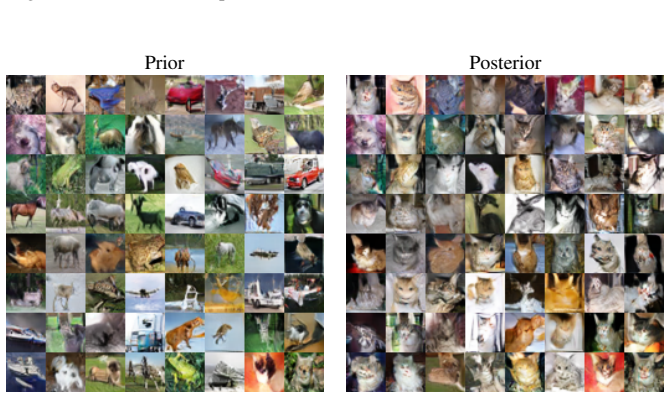
- Posterior sampling in latent spaces becomes a stochastic transport problem; class-conditional translation preserves unconstrained semantic structure such as background and digit style.
- Energy-to-energy bridges, with no samples from either endpoint, are feasible when both sides are equipped with replay buffers.
- Data-to-energy IPF reduces to diffusion sampler training when the forward process is already a bridge, connecting the new method to the diffusion-sampling literature.
Reading between the lines
- The authors left implicit that the same variance loss could handle constraints expressed as arbitrary reward-shaped weights, not just probabilities, since only the log-weight appears in the objective.
- The off-policy buffer acts as an implicit importance-sampling distribution; a natural extension would be to reweight buffer samples by importance weights or anneal the off-policy ratio dynamically, which the ablation suggests trades off mode coverage and transport cost.
- The paper does not directly report the time-0 marginal of the learned forward process; a sharper fixed-point test would compare it to p0, since this is the constraint the variance loss only approximately enforces.
Editorial analysis
A structured set of objections, weighed in public.
Referee Report
Summary. The paper proposes an extension of iterative proportional fitting (IPF) for Schrödinger bridge problems in which one or both endpoint marginals are available only as unnormalised densities (data-to-energy and energy-to-energy settings). The forward half-bridge is trained with a conditional log-variance (VarGrad) loss, Eq. (7)–(8), using off-policy replay buffers, reverse-trajectory reuse, and Langevin updates; the backward half-bridge is trained by maximum likelihood as in data-to-data IPF. The authors also train the diffusion coefficients of the forward/backward processes, claiming this improves discrete-time data-to-data IPF, and they apply the method to latent-space posterior sampling of GAN/VAE priors for image translation. The main positive results are on 2D synthetic benchmarks and on FID/reward metrics for CIFAR-10 and MNIST latent-space experiments. The central claim is that this is the first general method for data-to-energy and energy-to-energy Schrödinger bridges.
Significance. If the algorithm were proven to converge to the Schrödinger bridge, it would fill a genuine gap: existing IPF and Schrödinger-bridge matching methods require samples from both marginals, while many applications (Bayesian posteriors, reward-weighted priors) provide only unnormalised densities. The off-policy formulation is a plausible and potentially useful way to adapt diffusion-sampler losses to the bridge setting, and the authors have provided code. The empirical evaluation uses external metrics (W2 against oracle samples, FID against real images), which reduces circularity. However, the central convergence claim is not established: the forward IPF step is only heuristically justified, and the reported experiments do not demonstrate that the fixed point satisfies the p0 marginal constraint that defines the Schrödinger bridge. The secondary claim about learning diffusion coefficients is also only weakly supported by the tables. The paper is therefore more of a promising empirical proposal than a validated general method at this stage.
major comments (4)
- [§3.1, Eq. (8) and Algorithm 2] The forward IPF step is trained by minimising Eq. (8) over x0 drawn from p_train^0. In practice p_train^0 is a mixture of on-policy samples x0~p0 and off-policy samples obtained by reverse rollouts from a replay buffer. The paper states only that this loss 'approximately enforce[s] this proportionality' and that the choice of p_train^0 is 'very important'; no argument is given that the fixed point satisfies the p0 marginal constraint. This is load-bearing because the backward step in Algorithm 2 (line 4) conditions on x0~p0 and will query the forward conditional at those x0. For the energy-to-energy variant (§D.3), there is no on-policy p0 component and buffers are initialised with Gaussian noise, so coverage of p0 is even less certain. Please provide a support/convergence analysis, or modify the algorithm so that p_train^0 provably covers p0.
- [§3.1, Eq. (7)–(8)] The variance in Eq. (7) is defined over a full-support distribution p_train(τ|x0), but the implementation uses N=2 non-i.i.d. trajectories: one reverse roll-out from the buffer-conditioned backward process and one (or more) forward on-policy roll-outs. The empirical variance of a non-exchangeable batch is not an unbiased estimator of the variance of either marginal trajectory distribution, and at a global optimum it need not force p_θ(τ|x0) ∝ p_φ(τ|x1)p1(x1) for draws from the two different proposal mechanisms. This undermines the theoretical link between Eq. (8) and the half-bridge constraint. Please either use i.i.d. batches or provide a separate consistency argument for the non-i.i.d. estimator.
- [§5.1, Tables 1 and 4] The claim that learning the diffusion coefficient improves existing data-to-data IPF is not supported by the reported numbers. In Table 4, data-to-data learnt-variance has higher Path KL than fixed-variance at K=5, 10, 20 and 40, and in Table 1 it is worse or mixed on the Gauss↔GMM and Gauss↔Two Moons tasks. The statement that the results 'clearly show the benefits of training the variances' is therefore an overclaim. Please re-analyse the results or temper the contribution to specific settings (e.g., small numbers of steps and W2 metric).
- [§5.3, Table 2 and Fig. 4] The image-translation experiments contain no baselines: there is no comparison to the outsourced diffusion sampling method of Venkatraman et al. (2025) that the paper generalises, nor to a non-Schrödinger stochastic transport baseline. Consequently the claim that modelling a Schrödinger bridge is beneficial 'as opposed to a diffusion sampler' is unsupported. Additionally, the model's FID is lower than rejection-sampling FID for several classes, which is surprising and suggests either a bias in the classifier reward, mode collapse, or an artefact of the FID computation; this should be explained before the image results can be interpreted.
minor comments (4)
- [Appendix C, Eq. (17)] The Euler-Maruyama increment in Eq. (17) writes the noise term as σΔt ξ_k; it should be σ√Δt ξ_k under the convention used in Eq. (5a). This affects the intermediate algebra of the path-KL derivation, though the final limit is plausible.
- [§5.1] Typos: '2-dimentional', 'leant variance', 'undelying'. Appendix headings contain 'outsoursed'.
- [§5.2] The comparison between data-to-data and data-to-energy IPF in Fig. 3 is visual only; reporting quantitative metrics with error bars for the energy-to-energy setting would strengthen the claim of 'comparable' performance.
- [§3.3 and Algorithm 2] The notation for the forward and backward IPF steps is inconsistent: Eq. (3a)/(3b) are labelled with arrows but are later referred to as 'backward' and 'forward' respectively. Please align the terminology.
Circularity Check
No circular derivation; the central data-to-energy IPF construction is independent of its inputs and is validated on external benchmarks, though it uses several self-cited techniques as building blocks.
full rationale
The paper's central contribution is a new conditional log-variance loss (Eq. 7-8) applied to the standard IPF recursion. The loss is designed to enforce the half-bridge proportionality p_theta(tau|x0) proportional to p1(x1) p_phi(tau|x1); it is not fitted to the reported evaluation quantities, and the off-policy buffer supplies the appropriate time-0 marginal of the backward conditional (p1(x1) times the backward conditional process) for training the forward half-bridge. The lack of a formal convergence proof for the off-policy alternating scheme is a correctness and robustness concern, not a circular reduction of the result to its inputs. Headline results are measured with external, non-circular metrics: W2 against ground-truth samples, FID against real images, ELBO, and path KL against the reference process. Self-citations (Gritsaev et al. 2025, Sendera et al. 2024, Venkatraman et al. 2025, Berner et al. 2025) are used as modular building blocks rather than as evidence for the central claim; the paper provides its own comparisons, ablations, and synthetic benchmarks. No equation reduces to another by construction, and no fitted parameter is renamed as a prediction. The 'first general method' claim is a novelty assertion, not a circularity.
Assumptions & free parameters
free parameters (3)
- off-policy ratio =
0.8
- VarGrad trajectory batch size N =
2
- Langevin update schedule =
50-500 steps; step size 0.01 annealed to 0.001
assumptions (4)
- standard math The Schrödinger bridge problem has a unique solution that is an SDE with the same diffusion coefficient as the reference process.
- domain assumption p0 and p1 are absolutely continuous with finite variance, and E1 is evaluable with an unknown normalising constant Z.
- ad hoc to paper For the forward IPF step it is sufficient to enforce p_theta(tau|x0) proportional to p_phi(tau|x1) exp(-E1(x1)) for each x0 via a finite-batch variance loss (Eq. 7), and this fixed point satisfies the SB constraints.
- ad hoc to paper Euler-Maruyama discretisation with learned per-step variances yields processes that remain close to continuous-time SB solutions.
Cite this review
Pith. "Pith review of Data-to-Energy Stochastic Dynamics." pith.science (2026). https://pith.science/paper/XQHXV5QW
@misc{pith2026250926364,
  author       = {Pith},
  title        = {Pith review of: Data-to-Energy Stochastic Dynamics},
  year         = {2026},
  howpublished = {\url{https://pith.science/paper/XQHXV5QW}},
  note         = {Machine review of arXiv:2509.26364}
}
read the original abstract
The Schr\"odinger bridge problem is concerned with finding a stochastic dynamical system bridging two marginal distributions that minimises a certain transportation cost. This problem, which represents a generalisation of optimal transport to the stochastic case, has received attention due to its connections to diffusion models and flow matching, as well as its applications in the natural sciences. However, all existing algorithms allow to infer such dynamics only for cases where samples from both distributions are available. In this paper, we propose the first general method for modelling Schr\"odinger bridges when one (or both) distributions are given by their unnormalised densities, with no access to data samples. Our algorithm relies on a generalisation of the iterative proportional fitting (IPF) procedure to the data-free case, inspired by recent developments in off-policy reinforcement learning for training of diffusion samplers. We demonstrate the efficacy of the proposed data-to-energy IPF on synthetic problems, finding that it can successfully learn transports between multimodal distributions. As a secondary consequence of our reinforcement learning formulation, which assumes a fixed time discretisation scheme for the dynamics, we find that existing data-to-data Schr\"odinger bridge algorithms can be substantially improved by learning the diffusion coefficient of the dynamics. Finally, we apply the newly developed algorithm to the problem of sampling posterior distributions in latent spaces of generative models, thus creating a data-free image-to-image translation method. Code: https://github.com/mmacosha/d2e-stochastic-dynamics
Figures


Figures from the paper (8 more)




Reference graph
Works this paper leans on
-
[1]
Michael S Albergo, Nicholas M Boffi, and Eric Vanden-Eijnden. Stochastic interpolants: A unifying framework for flows and diffusions.arXiv preprint arXiv:2303.08797,
-
[4]
Julius Berner, Lorenz Richter, Marcin Sendera, Jarrid Rector-Brooks, and Nikolay Malkin. From discrete-time policies to continuous-time diffusion samplers: Asymptotic equivalences and faster training.arXiv preprint arXiv:2501.06148,
-
[5]
10 Preprint. Timofei Gritsaev, Nikita Morozov, Kirill Tamogashev, Daniil Tiapkin, Sergey Samsonov, Alexey Naumov, Dmitry Vetrov, and Nikolay Malkin. Adaptive destruction processes for diffusion samplers.arXiv preprint arXiv:2506.01541,
-
[9]
Alexander Tong, Kilian FATRAS, Nikolay Malkin, Guillaume Huguet, Yanlei Zhang, Jarrid Rector- Brooks, Guy Wolf, and Yoshua Bengio. Improving and generalizing flow-based generative models with minibatch optimal transport.Transactions on Machine Learning Research, 2024a. Alexander Tong, Nikolay Malkin, Kilian Fatras, Lazar Atanackovic, Yanlei Zhang, Guillau...
arXiv 1905
-
[10]
A RELATED WORKS In this section we establish links between our method and other research directions in the literature
13 Preprint. A RELATED WORKS In this section we establish links between our method and other research directions in the literature. Optimal transport.Optimal transport is a well-established area of research with a solid theoretical background and scalable applied algorithms. The problem is concerned with finding the optimal transportation map which minimi...
1958
-
[12]
The theoretical connection among various objectives was established in Berner et al
to amortise sampling from intractable density. The theoretical connection among various objectives was established in Berner et al. (2025). Outsourced sampling.The concept of outsourced diffusion sampling – modelling continuous- time dynamics in latent space for posterior inference under pretrained priors – was proposed in Venkatraman et al. (2025). The w...
2025
-
[13]
where𝑞(𝜏) is the time discretisation of the reference process Q𝑡
"𝐾−1∑︁ 𝑘=0 KL(− →𝑝𝜃(𝑥′ 𝑘+1|𝑥 𝑘)∥𝑞(𝑥 ′ 𝑘+1|𝑥 𝑘)) # (11) 14 Preprint. where𝑞(𝜏) is the time discretisation of the reference process Q𝑡. The estimator using transition KLs in (11) can be seen to be a Rao-Blackwellised (lower-variance) variant of the estimator in (10), and we use it because the KL can be computed analytically (as all transition kernels are Ga...
2023
-
[14]
This yields the path energy used in Shi et al
∫ ∥𝑣𝜃(𝑥𝑡,𝑡)∥ 2d𝑡 (18) The limit is justified by the Girsanov theorem (S¨arkk¨a & Solin, 2019). This yields the path energy used in Shi et al. (2023). D EXPERIMENT DETAILS D.1 DATA-TO-DATA EXPERIMENTS All data-to-data experiments are conducted under the unified setup. For neural network we use an MLP with 3 hidden layers and 64 neurons in each layer, each ...
2019
Show all 14 references
-
[1781]
Large language diffusion models.arXiv preprint arXiv:2502.09992,
Shen Nie, Fengqi Zhu, Zebin You, Xiaolu Zhang, Jingyang Ou, Jun Hu, Jun Zhou, Yankai Lin, Ji- Rong Wen, and Chongxuan Li. Large language diffusion models.arXiv preprint arXiv:2502.09992,
-
[2014]
Computationally, the problem can be solved using Iterative Proportional Fitting (IPF) algorithm (Fortet, 1940; Deming & Stephan, 1940; Sinkhorn, 1964)
and has interesting connections to optimal control theory (Chen et al., 2021c). Computationally, the problem can be solved using Iterative Proportional Fitting (IPF) algorithm (Fortet, 1940; Deming & Stephan, 1940; Sinkhorn, 1964). De Bortoli et al. (2021); Vargas et al. (2021...
1940
-
[2019]
Movie Gen: A cast of media foundation models.arXiv preprint arXiv:2410.13720,
Adam Polyak, Amit Zohar, Andrew Brown, Andros Tjandra, Animesh Sinha, Ann Lee, Apoorv Vyas, Bowen Shi, Chih-Yao Ma, Ching-Yao Chuang, et al. Movie Gen: A cast of media foundation models.arXiv preprint arXiv:2410.13720,
-
[2022]
Learning multiple layers of features from tiny images
Alex Krizhevsky. Learning multiple layers of features from tiny images. Technical Report TR-2009, University of Toronto,
2009
-
[2024]
Layer normalization.arXiv preprint arXiv:1607.06450,
Jimmy Lei Ba, Jamie Ryan Kiros, and Geoffrey E Hinton. Layer normalization.arXiv preprint arXiv:1607.06450,
-
[2025]
Optimal transport maps are good voice converters.arXiv preprint arXiv:2411.02402,
Arip Asadulaev, Rostislav Korst, Vitalii Shutov, Alexander Korotin, Yaroslav Grebnyak, Vahe Egiazarian, and Evgeny Burnaev. Optimal transport maps are good voice converters.arXiv preprint arXiv:2411.02402,
Reviewed August 4, 2026 · model on record in the stance chip above.
Discussion (0). Sign in to comment.