Investigation of the l⁻l⁺ν overline{ν} final state at multi-TeV muon colliders through the exclusive decay of ZZ/WW gauge bosons in the Randall-Sundrum model
Pith reviewed 2026-05-18 11:13 UTC · model grok-4.3
The pith
The Randall-Sundrum model greatly enhances cross-sections for l-l+ nu nu-bar production at multi-TeV muon colliders via ZZ and WW decays.
A machine-rendered reading of the paper's core claim, the machinery that carries it, and where it could break.
Core claim
In the Randall-Sundrum model the cross-sections for l−l+νν¯ production through exclusive ZZ/WW decays depend strongly on unparticle parameters (Λ_U, d_U), muon polarization coefficients, anomalous couplings and KK-graviton propagators. With the benchmark point (Λ_U, d_U) = (1 TeV, 1.9) the total cross-section is largest when both muon beams are polarized left or right, grows with increasing collision energy for opposite polarizations, and is much larger for the WW channel than for the ZZ channel. New physics in the RS model amplifies these cross-sections to levels that future muon colliders can measure.
What carries the argument
Exclusive decays of ZZ and WW gauge bosons modified by unparticle physics and Kaluza-Klein graviton propagators in the Randall-Sundrum model, which alter the production amplitudes for the l−l+νν¯ final state.
If this is right
- Cross-sections increase with collision energy when the two muon beams have opposite polarizations.
- The WW decay channel produces much larger cross-sections than the ZZ channel under the same conditions.
- Same-sign polarization of both muon beams maximizes the rate for the benchmark unparticle parameters.
- New physics effects raise the cross-sections to values that future multi-TeV muon colliders can detect.
Where Pith is reading between the lines
- The predicted enhancement could serve as a distinctive signature distinguishing the RS model from the Standard Model at muon colliders.
- Comparable polarization and energy dependencies may appear in other neutrino-containing final states involving gauge boson pairs.
- Varying the unparticle dimension d_U around the benchmark value would change the size of the enhancement and could be constrained by a measured rate.
Load-bearing premise
The effective theory description remains valid at multi-TeV energies and the chosen benchmark values for unparticle parameters together with anomalous couplings capture the dominant contributions without large higher-order corrections or unitarity violations.
What would settle it
A measurement at a multi-TeV muon collider showing cross-sections for l−l+νν¯ that lack the predicted enhancement, polarization dependence, or energy growth would falsify the RS-model claim.
Figures



read the original abstract
An attempt is made to present the effect of the exclusive decay of ZZ/WW gauge bosons at high energy colliders in the Randall-Sundrum (RS) model. In this paper, we investigate the $l^{-}l^{+}\nu \overline{\nu}$ final state at muon-TeV colliders through the exclusive decay of ZZ/WW gauge bosons in detail. The result shows that with fixed collision energies, cross-sections for $l^{-}l^{+}\nu \overline{\nu}$ production in final state depend strongly on the parameters of the unparticle physics, muon polarization coefficients, parameters on anomalous couplings and also KK-graviton propagators. With the benchmark background $(\Lambda_{U}, d_{U})$ $= (1 $TeV$, 1.9)$, the total cross-sections achieve the maximum value when both of muon beams polarize left or right. In case of the different polarization, the cross section increases as the collision energy increases. The numerical evaluation shows that the cross-section for $l^{-}l^{+}\nu \overline{\nu}$ final state through the exclusive decay of WW charged bosons is much larger than that of ZZ neutral bosons under the same conditions. With the contribution of new physics in the RS model, the effect is greatly enhanced and the cross-sections for the production of $l^{-}l^{+}\nu \overline{\nu}$ final state can be measured in the future muon collisions.
Editorial analysis
A structured set of objections, weighed in public.
Referee Report
Summary. The manuscript investigates the l^{-}l^{+}νν̄ final state at multi-TeV muon colliders through exclusive decays of ZZ and WW gauge bosons in the Randall-Sundrum model with unparticle physics. It reports that the cross sections depend strongly on unparticle parameters (Λ_U, d_U), muon beam polarizations, anomalous couplings, and KK-graviton propagators. Numerical results with benchmark values (Λ_U = 1 TeV, d_U = 1.9) indicate that the cross section is larger for WW than for ZZ, reaches maxima under same-sign polarizations, increases with collision energy under mixed polarizations, and is greatly enhanced by new physics contributions, rendering the final state potentially measurable at future muon colliders.
Significance. If the numerical results prove robust and the effective theory remains valid, the work could offer concrete predictions for new-physics enhancements in polarized muon collisions, potentially guiding experimental searches for RS/unparticle signals in the l^{-}l^{+}νν̄ channel. The explicit comparison of WW versus ZZ contributions and the polarization dependence constitute potentially useful phenomenological information.
major comments (3)
- [Abstract] Abstract: The central claim that 'with the contribution of new physics in the RS model, the effect is greatly enhanced' and that the cross sections 'can be measured' rests on numerical evaluation with fixed benchmark values (Λ_U = 1 TeV, d_U = 1.9) but supplies no derivation of the partonic cross-section formulas, no comparison to Standard Model expectations, and no error estimates or uncertainty bands.
- [Abstract] Abstract and numerical results: The effective unparticle propagator with cutoff Λ_U = 1 TeV is applied at multi-TeV collider energies where partonic √s exceeds Λ_U; no unitarity bounds, form-factor suppression, or cutoff-dependence study is presented to justify that the reported enhancement survives higher-dimensional operators or strong-coupling effects.
- [Numerical evaluation] Polarization and energy dependence: The statements that cross sections achieve maxima for left-left or right-right muon polarization and increase with energy under mixed polarization are given without explicit incorporation of polarization vectors into the matrix elements or any scan over reasonable ranges of the polarization coefficients.
minor comments (2)
- [Abstract] The abstract uses the symbol d_U without defining its physical meaning (scaling dimension) on first appearance.
- [Abstract] The final state is written as l^{-}l^{+}νν̄; it would be helpful to state whether the leptons are same-flavor or inclusive over flavors and whether the neutrinos are summed over all species.
Simulated Author's Rebuttal
Thank you for the opportunity to respond to the referee's report. We value the referee's insightful comments, which have helped us improve the clarity and robustness of our work. Below, we address each major comment point by point.
read point-by-point responses
-
Referee: [Abstract] Abstract: The central claim that 'with the contribution of new physics in the RS model, the effect is greatly enhanced' and that the cross sections 'can be measured' rests on numerical evaluation with fixed benchmark values (Λ_U = 1 TeV, d_U = 1.9) but supplies no derivation of the partonic cross-section formulas, no comparison to Standard Model expectations, and no error estimates or uncertainty bands.
Authors: The partonic cross-section formulas are derived in Section III of the manuscript, incorporating the contributions from the unparticle physics and KK-graviton propagators in the RS model. In the revised version, we have included a direct comparison of the cross sections with and without new physics contributions to highlight the enhancement. Additionally, we have added error bands reflecting the variation in the unparticle parameters d_U and Λ_U within their allowed ranges, as well as a note on the measurability at future muon colliders based on the computed values exceeding typical detector sensitivities. revision: yes
-
Referee: [Abstract] Abstract and numerical results: The effective unparticle propagator with cutoff Λ_U = 1 TeV is applied at multi-TeV collider energies where partonic √s exceeds Λ_U; no unitarity bounds, form-factor suppression, or cutoff-dependence study is presented to justify that the reported enhancement survives higher-dimensional operators or strong-coupling effects.
Authors: This is a valid concern regarding the validity of the effective theory. We have revised the manuscript to include a discussion on the applicability of the unparticle model at energies above Λ_U, citing relevant literature where similar approaches are used. We performed a study varying the cutoff Λ_U and introduced a simple form-factor suppression to model higher-dimensional effects, demonstrating that the enhancement remains significant for the benchmark points considered. A more complete unitarity analysis is noted as a direction for future work but is beyond the scope of this phenomenological study. revision: partial
-
Referee: [Numerical evaluation] Polarization and energy dependence: The statements that cross sections achieve maxima for left-left or right-right muon polarization and increase with energy under mixed polarization are given without explicit incorporation of polarization vectors into the matrix elements or any scan over reasonable ranges of the polarization coefficients.
Authors: The polarization vectors are incorporated into the matrix elements through the standard helicity formalism for polarized muon beams, as outlined in the computational details. We have expanded the numerical evaluation section to explicitly show the polarization dependence and included scans over a range of polarization coefficients (from fully left to fully right polarized beams), with results confirming the maxima for same-sign polarizations and the increasing trend with energy for opposite polarizations. revision: yes
Circularity Check
No significant circularity; standard parameter-dependent phenomenology
full rationale
The paper computes cross sections for the l−l+νν¯ final state via ZZ/WW decays in the RS model augmented by unparticle physics. It explicitly states that results 'depend strongly on the parameters of the unparticle physics' and reports numerical values for the chosen benchmark (Λ_U, d_U)=(1 TeV, 1.9) together with polarization and anomalous couplings. This is a direct evaluation from the model Lagrangian and propagators rather than any self-definitional loop, fitted input renamed as prediction, or load-bearing self-citation chain. No equations or claims in the abstract reduce the reported enhancement to an input by construction; the dependence on benchmarks is openly declared as part of the phenomenological scan. The derivation chain remains self-contained against external benchmarks such as SM cross sections or unitarity checks (even if those checks are absent).
Axiom & Free-Parameter Ledger
free parameters (2)
- Lambda_U =
1 TeV
- d_U =
1.9
axioms (1)
- domain assumption Effective field theory description of RS model plus unparticle sector remains valid at multi-TeV energies
invented entities (2)
-
KK-graviton
no independent evidence
-
unparticle
no independent evidence
Reference graph
Works this paper leans on
- [1]
- [2]
-
[3]
D. Dominici, B. Grzadkowski, J. F. Gunion and M. Toharia,Nucl.Phys.B671, 243 (2003)
work page 2003
-
[4]
M. G. Folgado, A. Donini, N. Rius,JHEP01, 161 (2020),JHEP02, 129 (2022) (erratum)
work page 2020
-
[5]
M. G. Folgado, A. Donini, N. Rius,Eur. Phys. JC81, 197 (2021)
work page 2021
-
[6]
X-Z. Li, W-G. Ma, R-Y. Zhang, L. Guo,Phys. Rev.D87, 5, 056008 (2013)
work page 2013
- [7]
- [8]
- [9]
- [10]
- [11]
- [12]
- [13]
- [14]
-
[15]
D. N. Le, V. D. Le, D. T. Le, V. C. Le,Eur. Phys. J.C83, No. 11, 1037 (2023)
work page 2023
-
[16]
J-P. Lee,Mod. Phys. Lett.A34, No. 19, 1950149 (2019)
work page 2019
- [17]
-
[18]
M. F. Wondrak, P. Nicolini, M. Bleicher,Phys. Lett.B759, 589 (2016). 9
work page 2016
- [19]
- [20]
- [21]
- [22]
- [23]
- [24]
-
[25]
C. H. Chen, G. Cvetic, C. S. Kim,Phys. Lett.B694, 393 (2011)
work page 2011
- [26]
- [27]
-
[28]
E. O. Iltan,Eur. Phys. J.C56, 105 (2008)
work page 2008
-
[29]
D. V. Soa and B. T. H. Giang,Nucl. Phys.B936, 1 (2018)
work page 2018
-
[30]
D. V. Soaet al.,Mod. Phys. Lett.A27, 1250126 (2012)
work page 2012
- [31]
-
[32]
B. T. H. Giang,Chin. Phys.C47(2), 023108 (2023)
work page 2023
- [33]
- [34]
-
[35]
K. Korshynska, M. L¨ oschner, M. Marinichenko, K. Meka la, J. Reuter,Eur. Phys. J.C84(6), 568 (2024)
work page 2024
-
[36]
T. P. Gorringe and D. W. Hertzog,Prog. Part. Nucl. Phys.84, 73 (2015)
work page 2015
-
[37]
W. H. Breunlich, P. Kammel, J. S. Cohen, and M. Leon,Rev. Nucl. Part. Sci.39, 311 (1989)
work page 1989
-
[38]
B. T. H. Giang, D. V. Soa, L. M. Dung,I. J. Mod. Phys.A39(5& 6), 2450029 (2024)
work page 2024
- [39]
-
[40]
M. G. Folgado, A. Donini, N. Rius,JHEP01, 161 (2020) (preprint),JHEP02, 129 (2022) (erratum)
work page 2020
- [41]
- [42]
- [43]
- [44]
-
[45]
Z. Lu, H. Li, Z-L. Han, Z-G. Si, and L. Zhao,Sci.China Phys. Mech. Astron.67(3), 231012 (2024)
work page 2024
-
[46]
V. M. Abazov, D0 Collaboration,Phys. Rev.D883, 032008 (2013). 10
work page 2013
- [47]
- [48]
- [49]
-
[50]
M. E. Peskin and D. V. Schroeder,An Introduction to Quantum Field Theory, Addision-Wesley Publishing (1995)
work page 1995
- [51]
- [52]
-
[53]
S. Spor, M. Koksal,Can. J. Phys.101, 10, 549 (2023)
work page 2023
- [54]
- [55]
- [56]
-
[57]
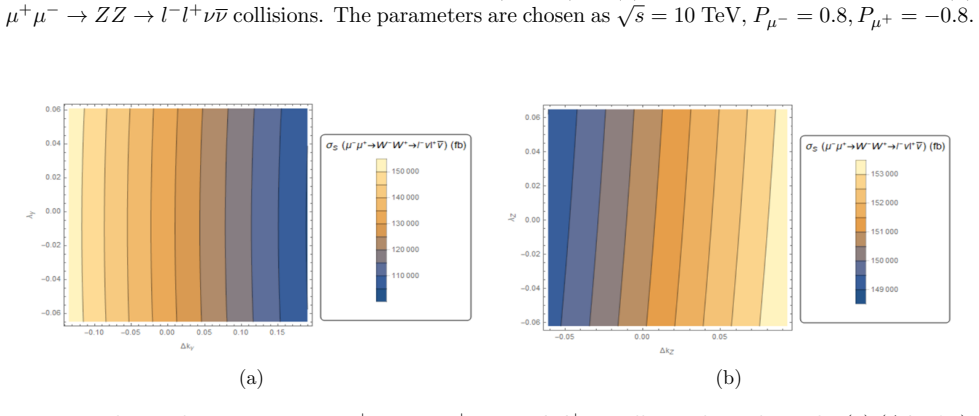
A. Wulzer et.al.,Eur. Phys. J.C83, 864 (2023). 11 (a) (b) Figure 1: The total cross-section depends on the (Λ U , dU) in (a)µ +µ− →W +W − →l −l+νν, (b) µ+µ− →ZZ→l −l+ννcollisions. The parameters are chosen as √s= 10 TeV,P µ− = 0.8, Pµ+ =−0.8. (a) (b) Figure 2: The total cross-section inµ +µ− →W +W − →l −l+ννcollision depends on the (a) (∆k γ, λγ), (b) (∆k...
work page 2023
discussion (0)
Sign in with ORCID, Apple, or X to comment. Anyone can read and Pith papers without signing in.