REVIEW 2 major objections 6 minor 54 references
The Principle of Isomorphism: A Theory of Population Activity in Grid Cells and Beyond
T0 review · 2 major / 6 minor · reviewed 2026-08-04 · deepseek-v4-flash
Pith's one-line read The tasks grid cells perform mathematically force their population code into a torus.
desk verdict The math is right and the new bits are the Gauss-Bonnet route and the Euclidean unification; the main soft spot is an unargued orientability assumption, and the experiments hard-code the torus. read the letter →
The pith
A machine-rendered reading of the paper's core claim, the machinery that carries it, and where it could break.
The reading
What carries the argument
Two mathematical results carry the argument: the Gauss–Bonnet theorem (total curvature is 2π times the Euler characteristic, so a flat compact boundaryless surface has zero Euler characteristic, and orientability leaves the torus as the only candidate) and the classification of compact connected Abelian Lie groups (which must be tori). The experimental machinery is the Topo-Constrained Network (TopoCN), a feedforward network whose latent layer is explicitly a torus (two circular coordinate pairs with learnable radii and wavenumbers), with a torus-size parameter s and a scale factor ρ; it is trained with a conformal-isometry loss plus size regularization to probe which single-cell firing patt
What would settle it
Run a path-integration / neural-metric model on a Klein-bottle latent manifold (flat, compact, boundaryless, non-orientable) and test whether the decoded map supports consistent left/right navigation through a double cover. If it does, the orientability premise collapses and the neural-metric route no longer uniquely forces the torus; the paper's claim of two independent derivations would be weakened.
Extended reading notes
Core claim
The paper's central claim is that the topology of a neural population manifold is determined by the mathematical structure of the computational task. Under the Principle of Isomorphism, the neural-metric task—encoding distances and angles in flat space—forces population activity onto a torus: a flat Riemannian metric on a compact, boundaryless, orientable surface forces Euler characteristic zero, and the only such surface is the torus (Gauss–Bonnet plus surface classification). Path integration—summing displacement vectors—forces population activity onto the same torus because a compact connected two-dimensional Abelian Lie group must be a torus. The paper shows these two derivations unify n
Load-bearing premise
The load-bearing premise is that spatial representations must be orientable: the paper asserts without argument that the Klein bottle is excluded because navigation needs consistent left/right and forward/backward; if a non-orientable population manifold could still support navigation (e.g., via a double cover), the neural-metric route would not uniquely force the torus.
Editorial extensions
If this is right
- If PIso is correct, any neural population that performs path integration or provides an intrinsic flat-space metric must be toroidal; torus topology is a necessary condition, not an accident of a particular model.
- The framework predicts that head-direction cells instantiate the same principle in one dimension (circle topology) and that 3D grid cells, if the tasks extend unchanged, should form a 3-torus—an experiment the paper explicitly proposes.
- The simulations show that conformal isometry loss is insufficient for hexagonal fields: single-cell hexagonality depends on the torus size parameter, so models that report hexagons from CI must be operating in the right geometric regime.
- Grid spacing is predicted to scale as 1/ρ (inverse of the physical-to-neural scale) and to increase monotonically with torus size, giving two quantitative, testable relations for neural recordings and models.
Reading between the lines
- A direct extrapolation beyond the paper: PIso implies that for any task whose structure is a compact Lie group, the neural manifold must be a torus; this could be tested in non-spatial domains such as periodic motor tasks by measuring population topology.
- The orientability assumption is the soft spot: if a non-orientable flat manifold (e.g., the Klein bottle) could support navigation through a double cover or a global phase convention, the neural-metric route alone would not force the torus; the group-theoretic route would then bear the full weight.
- The reported cubic spacing–size relationship is an empirical regularity in their model without a derivation; if it holds generally, it may reflect a deeper geometric law connecting torus area to decoded physical scale, and deriving it could yield new predictions.
- Their 'topology prior' design principle for machine learning—constrain latent spaces to the topology of the task geometry—could be stress-tested by building networks with spherical or hyperbolic latent manifolds on non-Euclidean tasks and comparing robustness to unconstrained networks.
Editorial analysis
A structured set of objections, weighed in public.
Referee Report
Summary. The paper proposes a 'Principle of Isomorphism' (PIso), according to which the mathematical structure of a computational task is preserved in the topology of the neural population that implements it. Applied to grid cells, it argues that the neural-metric task (flat 2D Riemannian structure) and path integration (compact connected Abelian Lie group) each independently force the latent population manifold to be a torus, and that these two constraints unify in Euclidean space. The paper then introduces a feedforward network (TopoCN) whose input is explicitly a toroidal embedding (Eq. 2) and shows that hexagonal grid fields appear only for intermediate torus sizes, concluding that conformal isometry alone is not sufficient for hexagonality. It also reports spacing scaling with the scale parameter ρ and torus size.
Significance. If the central claim were fully established, the paper would provide a clean normative explanation for the toroidal topology observed in grid-cell population recordings (Gardner et al.) and would separate three levels: latent topology, embedding geometry, and decoded physical geometry. The PIso principle is broad and potentially useful as a design heuristic for neural networks. The two mathematical routes are elementary and correct conditional on the stated idealizations; the paper is honest about what remains open (e.g., the origin of hexagonality). The code is released and the simulations are clearly described, which is a strength. However, the novelty is incremental: toroidal topology from path integration has been argued in earlier group-representation papers, and the NM argument as formulated is incomplete without an explicit orientability axiom.
major comments (2)
- [§3.1 (Theorem 1, Eq. 1)] The conclusion that the NM task forces the torus uses the classification of compact boundaryless surfaces with χ=0 into torus and Klein bottle, and excludes the Klein bottle solely on the ground that 'spatial representation must be orientable.' This orientability requirement is asserted, not derived from the NM task or from PIso. A flat compact boundaryless surface can be the Klein bottle; a Klein-bottle population manifold would still admit a local flat metric and could, in principle, support distance/angle readouts up to a global orientation-reversing identification. Unless orientability is shown to follow from the task structure (e.g., from the need for globally consistent left/right), Theorem 1 should be restated as: NM implies χ(M)=0, i.e., M is torus or Klein bottle; with the additional biological axiom of orientability, it is the torus. As written, the abstract's claim that 'each
- [§3.2] The PI route assumes that path integration requires the population manifold itself to be a compact connected 2D Abelian Lie group, and then invokes the classification of such groups to conclude torus. But a representation of (R^2,+) could equally be a group action on a manifold that is not itself a group (e.g., the manifold is a homogeneous space of the 2-torus). The paper should justify why the neural state space carries the full group structure rather than merely supporting a transitive group action. If the population activity is identified with the group element (as in a chart of the torus), the argument goes through; this should be stated explicitly. Without this identification, the classification theorem does not apply.
minor comments (6)
- [§4.2.4 / Appendix D] The statement 'we predict that ... spacing should be inversely proportional to ρ' is a consequence of the definition of ρ in Eq. (5), not an independent model prediction. The loss explicitly scales neural displacement by ρ; if the torus is fixed, the physical period is proportional to 1/ρ by construction. Report this as a consistency check rather than a test.
- [Eq. (4)] The typesetting of Eq. (4) is broken in the manuscript ('1 𝑚 ∑︁...' with misplaced characters). Please clean up all equations for readability.
- [Abstract / §2] There are missing spaces in several places, e.g., 'thePrinciple ofIsomorphism' and 'Path Integration (PI)is'. General proofreading is needed.
- [§4.2.1] The mention of 'spontaneous subdivision into multiple modules' at large torus sizes is not quantified or analyzed. Either provide a supporting analysis or remove the claim.
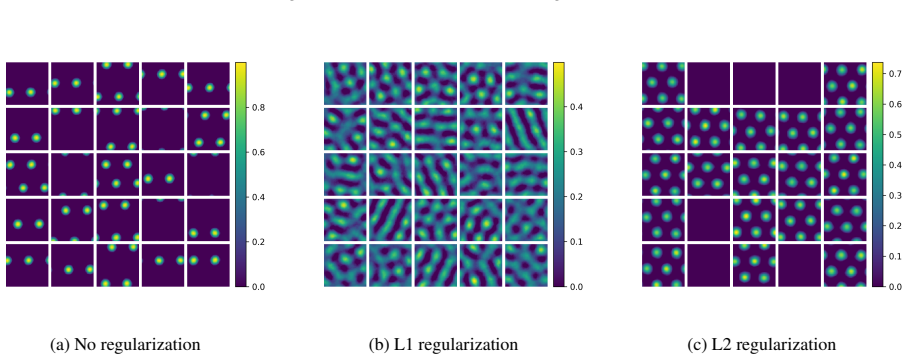
- [Appendix C] The comparison of L1/L2 capacity regularization is interesting, but the conclusion 'torus size—not capacity—is the true factor' is somewhat overstrong because the torus-size regularization directly controls the quantity being penalized. Clarify that this is an interpretation of the model, not a rigorous causal claim.
- [§5 / References] Reference formatting is inconsistent (e.g., 'Gao et al.[23]' and 'Xu et al.[24]' lack spaces). Also, reference [44] is a specialized research paper; a standard textbook on Lie groups would be more accessible for the classification result.
Circularity Check
Spacing ∝ 1/ρ 'prediction' is built into the conformal-isometry loss via ρ; the central torus derivation remains independent.
-
fitted input called prediction
[§4.1 Eq. (5); §4.2.4 'Grid field spacing as a function of ρ and s0']
"L=E h∥Δg∥−ρ∥Δx∥ 2 exp −∥Δx∥ 2 2σ 2 i +λ(s−s0)2 ... Since the scaling factor ρ controls the mapping between physical displacement and neural-space displacement, we predict that, when the torus size s0 is held constant, grid spacing should be inversely proportional to ρ. This prediction is clearly confirmed by our simulations (Fig. 5a)."
In Eq. (5), ρ is the target ratio between neural-space displacement ∥Δg∥ and physical displacement ∥Δx∥. Minimizing the loss enforces ∥Δg∥ ≈ ρ∥Δx∥ locally, so the mapping scale is set to ρ by construction. Grid spacing is the physical distance corresponding to one full traversal around the torus; under the enforced local isometry this distance is (neural-space loop length)/ρ, hence spacing ∝ 1/ρ follows directly from the objective. The reported AdjR²=0.992 confirms that the trained network obeys its own loss, not an independent empirical law. Appendix D's substitution of nominal ρ by 'measured ρ_true' and fitting sp∝1/ρ is a calibration check of the same definitional relation.
full rationale
The paper's central theoretical derivation is not circular. The NM route applies Gauss-Bonnet to a compact, boundaryless, flat 2-manifold to obtain χ(M)=0, then excludes the Klein bottle by an asserted orientability constraint; the PI route invokes the external classification of compact connected Abelian Lie groups to obtain a torus. Both are valid conditional derivations, and the cited uniqueness theorems (Gauss-Bonnet, Lie-group classification, Hatcher's surface classification) are external mathematics, not self-citations. The 'Xu et al.' works cited here are by Dehong Xu et al., not the current authors, so there is no load-bearing self-citation. However, one supporting 'prediction' is circular by construction: the spacing ∝ 1/ρ law follows immediately from the conformal-isometry loss (Eq. 5), where ρ is defined as the target scale between neural and physical displacements. Thus the high AdjR² confirms the network satisfies its own loss, not an independent relation. The TopoCN experiments explicitly assume a torus in the input (Eq. 2); that makes them conditional demonstrations rather than circular predictions. The Klein-bottle/orientability gap is a justification or correctness concern, not a definitional circle. Overall score 4 reflects one non-central prediction reducing by construction while the main topology derivation retains independent mathematical content.
Assumptions & free parameters
free parameters (5)
- ρ (mapping scale) =
varied 0.8–1.4 nominal; effective ρtrue measured
- s0 (target torus size) =
varied 0.3–0.84
- λ (torus-size regularization weight) =
2
- σ (locality of conformal isometry) =
not stated in main text
- Torus embedding parameters R, r, k1..k4 =
learned during training
assumptions (8)
- ad hoc to paper PIso: essential structural features of a computational task are preserved in neural population structure
- domain assumption NM task structure is a 2D flat Riemannian manifold
- domain assumption PI task structure is the Abelian Lie group (R²,+)
- domain assumption Neural activity is bounded, hence the representational manifold is compact
- domain assumption Spatial representation must be orientable
- domain assumption Representational manifold is boundaryless
- standard math Gauss–Bonnet theorem and classification of compact 2-manifolds
- standard math Classification of compact connected Abelian Lie groups as tori
Cite this review
Pith. "Pith review of The Principle of Isomorphism: A Theory of Population Activity in Grid Cells and Beyond." pith.science (2026). https://pith.science/paper/IQ5BDEUB
@misc{pith2026251002853,
  author       = {Pith},
  title        = {Pith review of: The Principle of Isomorphism: A Theory of Population Activity in Grid Cells and Beyond},
  year         = {2026},
  howpublished = {\url{https://pith.science/paper/IQ5BDEUB}},
  note         = {Machine review of arXiv:2510.02853}
}
read the original abstract
Neural population activity organizes into low-dimensional manifolds embedded within high-dimensional state spaces, yet the principles governing the topology and geometry of these manifolds remain elusive. Here, we propose the Principle of Isomorphism (PIso), which posits that the topology of a neural manifold is constrained by the mathematical structure of the computational task it supports. We apply this framework to the mammalian grid cell system through two distinct theoretical lenses: an intrinsic neural metric, which requires a locally flat Riemannian structure, and path integration, which requires a compact connected Abelian Lie group structure. We show that these two routes are both sufficient conditions that converge on the same toroidal latent topology, and that they naturally unify within Euclidean space. Using a minimal feedforward network that constrains population activity to a torus with tunable geometry, we find that hexagonal grid fields emerge only in an intermediate geometric regime, becoming diffuse or square-like otherwise. Our work clarifies the separation between three notions: latent topology, extrinsic embedding geometry, and decoded physical geometry, and identifies the topology of the population code as the more invariant consequence of the task structure, while leaving the precise mechanism that selects hexagonal single-cell firing patterns as an open problem.
Figures


Figures from the paper (6 more)




Reference graph
Works this paper leans on
-
[1]
From the neuron doctrine to neural networks.Nature reviews neuroscience, 16(8):487–497, 2015
Rafael Yuste. From the neuron doctrine to neural networks.Nature reviews neuroscience, 16(8):487–497, 2015
2015
-
[2]
Computation through neural population dynamics.Annual review of neuroscience, 43(1):249–275, 2020
Saurabh Vyas, Matthew D Golub, David Sussillo, and Krishna V Shenoy. Computation through neural population dynamics.Annual review of neuroscience, 43(1):249–275, 2020
2020
-
[3]
Neural tuning and representational geometry.Nature Reviews Neuroscience, 22(11):703–718, 2021
Nikolaus Kriegeskorte and Xue-Xin Wei. Neural tuning and representational geometry.Nature Reviews Neuroscience, 22(11):703–718, 2021
2021
-
[4]
Aneuralmanifoldviewofthebrain.NatureNeuroscience, pages 1–16, 2025
MatthewGPerich,DevikaNarain,andJuanAGallego. Aneuralmanifoldviewofthebrain.NatureNeuroscience, pages 1–16, 2025. 9
2025
-
[5]
Large-scale neural recordings call for new insights to link brain and behavior.Nature neuroscience, 25(1):11–19, 2022
Anne E Urai, Brent Doiron, Andrew M Leifer, and Anne K Churchland. Large-scale neural recordings call for new insights to link brain and behavior.Nature neuroscience, 25(1):11–19, 2022
2022
-
[6]
Neural population dynamics during reaching.Nature, 487(7405):51–56, 2012
Mark M Churchland, John P Cunningham, Matthew T Kaufman, Justin D Foster, Paul Nuyujukian, Stephen I Ryu, and Krishna V Shenoy. Neural population dynamics during reaching.Nature, 487(7405):51–56, 2012
2012
-
[7]
Towardstheneuralpopulationdoctrine.Currentopinioninneurobiology, 55:103–111, 2019
ShreyaSaxenaandJohnPCunningham. Towardstheneuralpopulationdoctrine.Currentopinioninneurobiology, 55:103–111, 2019
2019
-
[8]
A unifying perspective on neural manifolds and circuits for cognition.Nature Reviews Neuroscience, 24(6):363–377, 2023
Christopher Langdon, Mikhail Genkin, and Tatiana A Engel. A unifying perspective on neural manifolds and circuits for cognition.Nature Reviews Neuroscience, 24(6):363–377, 2023
2023
Show all 54 references
-
[9]
Spatial representation in the entorhinal cortex.Science, 305(5688):1258–1264, 2004
Marianne Fyhn, Sturla Molden, Menno P Witter, Edvard I Moser, and May-Britt Moser. Spatial representation in the entorhinal cortex.Science, 305(5688):1258–1264, 2004
2004
-
[10]
Microstructure of a spatial map in the entorhinal cortex.Nature, 436(7052):801–806, 2005
Torkel Hafting, Marianne Fyhn, Sturla Molden, May-Britt Moser, and Edvard I Moser. Microstructure of a spatial map in the entorhinal cortex.Nature, 436(7052):801–806, 2005
2005
-
[11]
Conjunctive representation of position, direction, and velocity in entorhinal cortex.Science, 312(5774):758–762, 2006
Francesca Sargolini, Marianne Fyhn, Torkel Hafting, Bruce L McNaughton, Menno P Witter, May-Britt Moser, and Edvard I Moser. Conjunctive representation of position, direction, and velocity in entorhinal cortex.Science, 312(5774):758–762, 2006
2006
-
[12]
Toroidal topology of population activity in grid cells.Nature, 602(7895):123–128, 2022
Richard J Gardner, Erik Hermansen, Marius Pachitariu, Yoram Burak, Nils A Baas, Benjamin A Dunn, May-Britt Moser, and Edvard I Moser. Toroidal topology of population activity in grid cells.Nature, 602(7895):123–128, 2022
2022
-
[13]
Path integration and the neural basis of the’cognitive map’.Nature Reviews Neuroscience, 7(8):663–678, 2006
Bruce L McNaughton, Francesco P Battaglia, Ole Jensen, Edvard I Moser, and May-Britt Moser. Path integration and the neural basis of the’cognitive map’.Nature Reviews Neuroscience, 7(8):663–678, 2006
2006
-
[14]
Accuratepathintegrationincontinuousattractornetworkmodelsofgridcells.PLoS computational biology, 5(2):e1000291, 2009
YoramBurakandIlaRFiete. Accuratepathintegrationincontinuousattractornetworkmodelsofgridcells.PLoS computational biology, 5(2):e1000291, 2009
2009
-
[15]
Impairedpathintegrationinmicewithdisruptedgridcellfiring.Natureneuroscience,21(1):81–91,2018
Mariana Gil, Mihai Ancau, Magdalene I Schlesiger, Angela Neitz, Kevin Allen, Rodrigo J De Marco, and Hannah Monyer. Impairedpathintegrationinmicewithdisruptedgridcellfiring.Natureneuroscience,21(1):81–91,2018
2018
-
[16]
A metric for space.Hippocampus, 18(12):1142–1156, 2008
Edvard I Moser and May-Britt Moser. A metric for space.Hippocampus, 18(12):1142–1156, 2008
2008
-
[17]
Are grid cells used for navigation? on local metrics, subjective spaces, and black holes.Neuron, 111(12):1858–1875, 2023
Gily Ginosar, Johnatan Aljadeff, Liora Las, Dori Derdikman, and Nachum Ulanovsky. Are grid cells used for navigation? on local metrics, subjective spaces, and black holes.Neuron, 111(12):1858–1875, 2023
2023
-
[18]
The hippocampus as a predictive map
Kimberly L Stachenfeld, Matthew M Botvinick, and Samuel J Gershman. The hippocampus as a predictive map. Nature neuroscience, 20(11):1643–1653, 2017
2017
-
[19]
Vector-based navigation using grid-like representations in artificial agents.Nature, 557(7705):429–433, 2018
Andrea Banino, Caswell Barry, Benigno Uria, Charles Blundell, Timothy Lillicrap, Piotr Mirowski, Alexander Pritzel, Martin J Chadwick, Thomas Degris, Joseph Modayil, et al. Vector-based navigation using grid-like representations in artificial agents.Nature, 557(7705):429–433, 2018
2018
-
[20]
Emergence of grid-like representations by training recurrent neural networks to perform spatial localization.arXiv preprint arXiv:1803.07770, 2018
Christopher J Cueva and Xue-Xin Wei. Emergence of grid-like representations by training recurrent neural networks to perform spatial localization.arXiv preprint arXiv:1803.07770, 2018
2018 arXiv
-
[21]
A unified theory for the origin of grid cells through the lens of pattern formation.Advances in neural information processing systems, 32, 2019
Ben Sorscher, Gabriel Mel, Surya Ganguli, and Samuel Ocko. A unified theory for the origin of grid cells through the lens of pattern formation.Advances in neural information processing systems, 32, 2019
2019
-
[22]
The tolman-eichenbaum machine: unifying space and relational memory through generalization in the hippocampal formation.Cell, 183(5):1249–1263, 2020
JamesCRWhittington,TimothyHMuller,ShirleyMark,GuifenChen,CaswellBarry,NeilBurgess,andTimothyEJ Behrens. The tolman-eichenbaum machine: unifying space and relational memory through generalization in the hippocampal formation.Cell, 183(5):1249–1263, 2020
2020
-
[23]
On path integration of grid cells: group representation and isotropic scaling.Advances in Neural Information Processing Systems, 34:28623–28635, 2021
Ruiqi Gao, Jianwen Xie, Xue-Xin Wei, Song-Chun Zhu, and Ying Nian Wu. On path integration of grid cells: group representation and isotropic scaling.Advances in Neural Information Processing Systems, 34:28623–28635, 2021
2021
-
[24]
Conformal isometry of lie group representation in recurrent network of grid cells.arXiv preprint arXiv:2210.02684, 2022
Dehong Xu, Ruiqi Gao, Wen-Hao Zhang, Xue-Xin Wei, and Ying Nian Wu. Conformal isometry of lie group representation in recurrent network of grid cells.arXiv preprint arXiv:2210.02684, 2022
2022 arXiv
-
[25]
Actionable neural representa- tions: Grid cells from minimal constraints.arXiv preprint arXiv:2209.15563, 2022
William Dorrell, Peter E Latham, Timothy EJ Behrens, and James CR Whittington. Actionable neural representa- tions: Grid cells from minimal constraints.arXiv preprint arXiv:2209.15563, 2022
2022 arXiv
-
[26]
Rylan Schaeffer, Mikail Khona, and Ila Fiete. No free lunch from deep learning in neuroscience: A case study through models of the entorhinal-hippocampal circuit.Advances in neural information processing systems, 35: 16052–16067, 2022
2022
-
[27]
Coherently remapping toroidal cells but not grid cells are responsible for path integration in virtual agents.Iscience, 26(11), 2023
Vemund Schøyen, Markus Borud Pettersen, Konstantin Holzhausen, Marianne Fyhn, Anders Malthe-Sørenssen, and Mikkel Elle Lepperød. Coherently remapping toroidal cells but not grid cells are responsible for path integration in virtual agents.Iscience, 26(11), 2023. 10
2023
-
[28]
A unified theory for the computational and mechanistic origins of grid cells.Neuron, 111(1):121–137, 2023
Ben Sorscher, Gabriel C Mel, Samuel A Ocko, Lisa M Giocomo, and Surya Ganguli. A unified theory for the computational and mechanistic origins of grid cells.Neuron, 111(1):121–137, 2023
2023
-
[29]
Self-supervised learningofrepresentationsforspacegeneratesmulti-modulargridcells.AdvancesinNeuralInformationProcessing Systems, 36:23140–23157, 2023
Rylan Schaeffer, Mikail Khona, Tzuhsuan Ma, Cristobal Eyzaguirre, Sanmi Koyejo, and Ila Fiete. Self-supervised learningofrepresentationsforspacegeneratesmulti-modulargridcells.AdvancesinNeuralInformationProcessing Systems, 36:23140–23157, 2023
2023
-
[30]
Self-supervised grid cells without path integration.bioRxiv, pages 2024–05, 2024
Markus Pettersen, Vemund Sigmundson Schøyen, Mattis Dalsætra Østby, Anders Malthe-Sørenssen, and Mikkel Elle Lepperød. Self-supervised grid cells without path integration.bioRxiv, pages 2024–05, 2024
2024
-
[31]
On conformal isometry of grid cells: Learning distance-preserving position embedding
Dehong Xu, Ruiqi Gao, Wenhao Zhang, Xue-Xin Wei, and Ying Nian Wu. On conformal isometry of grid cells: Learning distance-preserving position embedding. InThe Thirteenth International Conference on Learning Representations, 2025. URLhttps://openreview.net/forum?id=Xo0Q1N7CGk
2025
-
[32]
Some informational aspects of visual perception.Psychological review, 61(3):183, 1954
Fred Attneave. Some informational aspects of visual perception.Psychological review, 61(3):183, 1954
1954
-
[33]
Possible principles underlying the transformation of sensory messages.Sensory communication, 1(01):217–233, 1961
Horace B Barlow et al. Possible principles underlying the transformation of sensory messages.Sensory communication, 1(01):217–233, 1961
1961
-
[34]
Second-order isomorphism of internal representations: Shapes of states
Roger N Shepard and Susan Chipman. Second-order isomorphism of internal representations: Shapes of states. Cognitive psychology, 1(1):1–17, 1970
1970
-
[35]
Representation is representation of similarities.Behavioral and brain sciences, 21(4):449–467, 1998
Shimon Edelman. Representation is representation of similarities.Behavioral and brain sciences, 21(4):449–467, 1998
1998
-
[36]
No free lunch theorems for optimization.IEEE transactions on evolutionary computation, 1(1):67–82, 1997
David H Wolpert and William G Macready. No free lunch theorems for optimization.IEEE transactions on evolutionary computation, 1(1):67–82, 1997
1997
-
[37]
Representation learning: A review and new perspectives
Yoshua Bengio, Aaron Courville, and Pascal Vincent. Representation learning: A review and new perspectives. IEEE transactions on pattern analysis and machine intelligence, 35(8):1798–1828, 2013
2013
-
[38]
Geometric deep learning: Grids, groups, graphs, geodesics, and gauges.arXiv preprint arXiv:2104.13478, 2021
Michael M Bronstein, Joan Bruna, Taco Cohen, and Petar Veličković. Geometric deep learning: Grids, groups, graphs, geodesics, and gauges.arXiv preprint arXiv:2104.13478, 2021
2021 arXiv
-
[39]
Getting aligned on representational alignment.arXiv preprint arXiv:2310.13018, 2023
Ilia Sucholutsky, Lukas Muttenthaler, Adrian Weller, Andi Peng, Andreea Bobu, Been Kim, Bradley C Love, Erin Grant, Iris Groen, Jascha Achterberg, et al. Getting aligned on representational alignment.arXiv preprint arXiv:2310.13018, 2023
2023 arXiv
-
[40]
What grid cells convey about rat location.Journal of Neuroscience, 28(27):6858–6871, 2008
Ila R Fiete, Yoram Burak, and Ted Brookings. What grid cells convey about rat location.Journal of Neuroscience, 28(27):6858–6871, 2008
2008
-
[41]
PrincetonUniversity Press, 2021
TristanNeedham.Visualdifferentialgeometryandforms: amathematicaldramainfiveacts. PrincetonUniversity Press, 2021
2021
-
[42]
Cambridge University Press, 2002
Allen Hatcher.Algebraic Topology. Cambridge University Press, 2002
2002
-
[43]
Grid cells generate an analog error-correcting code for singularly precise neural computation.Nature neuroscience, 14(10):1330–1337, 2011
Sameet Sreenivasan and Ila Fiete. Grid cells generate an analog error-correcting code for singularly precise neural computation.Nature neuroscience, 14(10):1330–1337, 2011
2011
-
[44]
The elementary geometric structure of compact lie groups
William Gerard Dwyer and Clarence W Wilkerson. The elementary geometric structure of compact lie groups. Bulletin of the London Mathematical Society, 30(4):337–364, 1998
1998
-
[45]
Head-directioncellsinthedeeplayersofdorsalpresubiculumoffreelymovingrats
JBRank. Head-directioncellsinthedeeplayersofdorsalpresubiculumoffreelymovingrats. InSoc.Neuroscience Abstr., volume 10, page 599, 1984
1984
-
[46]
Locally ordered representation of 3d space in the entorhinal cortex.Nature, 596(7872):404–409, 2021
Gily Ginosar, Johnatan Aljadeff, Yoram Burak, Haim Sompolinsky, Liora Las, and Nachum Ulanovsky. Locally ordered representation of 3d space in the entorhinal cortex.Nature, 596(7872):404–409, 2021
2021
-
[47]
Irregular distribution of grid cell firing fields in rats exploring a 3d volumetric space.Nature neuroscience, 24(11):1567–1573, 2021
Roddy M Grieves, Selim Jedidi-Ayoub, Karyna Mishchanchuk, Anyi Liu, Sophie Renaudineau, Éléonore Duvelle, and Kate J Jeffery. Irregular distribution of grid cell firing fields in rats exploring a 3d volumetric space.Nature neuroscience, 24(11):1567–1573, 2021
2021
-
[48]
A model of the neural basis of the rat’s sense of direction.Advances in neural information processing systems, 7, 1994
William Skaggs, James Knierim, Hemant Kudrimoti, and Bruce McNaughton. A model of the neural basis of the rat’s sense of direction.Advances in neural information processing systems, 7, 1994
1994
-
[49]
Representation of spatial orientation by the intrinsic dynamics of the head-direction cell ensemble: a theory.Journal of Neuroscience, 16(6):2112–2126, 1996
Kechen Zhang. Representation of spatial orientation by the intrinsic dynamics of the head-direction cell ensemble: a theory.Journal of Neuroscience, 16(6):2112–2126, 1996
1996
-
[50]
Grid cell symmetry is shaped by environmental geometry.Nature, 518(7538):232–235, 2015
Julija Krupic, Marius Bauza, Stephen Burton, Caswell Barry, and John O’Keefe. Grid cell symmetry is shaped by environmental geometry.Nature, 518(7538):232–235, 2015
2015
-
[51]
Local transformations of the hippocampal cognitive map.Science, 359(6380):1143–1146, 2018
Julija Krupic, Marius Bauza, Stephen Burton, and John O’Keefe. Local transformations of the hippocampal cognitive map.Science, 359(6380):1143–1146, 2018. 11
2018
-
[52]
Shearing-induced asymmetry in entorhinal grid cells.Nature, 518(7538):207–212, 2015
Tor Stensola, Hanne Stensola, May-Britt Moser, and Edvard I Moser. Shearing-induced asymmetry in entorhinal grid cells.Nature, 518(7538):207–212, 2015
2015
-
[53]
Information processing with population codes.Nature Reviews Neuroscience, 1(2):125–132, 2000
Alexandre Pouget, Peter Dayan, and Richard Zemel. Information processing with population codes.Nature Reviews Neuroscience, 1(2):125–132, 2000
2000
-
[54]
Connecting multiple spatial scales to decode the population activity of grid cells.Science Advances, 1(11):e1500816, 2015
Martin Stemmler, Alexander Mathis, and Andreas VM Herz. Connecting multiple spatial scales to decode the population activity of grid cells.Science Advances, 1(11):e1500816, 2015. A Numerical Simulation Setup Our implementation was partly adapted from the publicly available cod...
2015
Reviewed August 4, 2026 · model on record in the stance chip above.
Discussion (0). Sign in to comment.