REVIEW 2 major objections 5 minor 18 references
From Moments to Models: Graphon-Mixture Learning for Mixup and Contrastive Learning
T0 review · 2 major / 5 minor · reviewed 2026-08-04 · deepseek-v4-flash
Pith's one-line read A moment-based clustering of graphs into latent graphon mixtures improves graph mixup and contrastive learning, with a claimed tighter motif-density concentration bound.
desk verdict Mixture-of-graphons framing is genuinely new and the empirical work is solid, but the headline theorem has a definition mismatch and relies on an unproved lemma, so the core theory is not established as printed. read the letter →
The pith
A machine-rendered reading of the paper's core claim, the machinery that carries it, and where it could break.
The reading
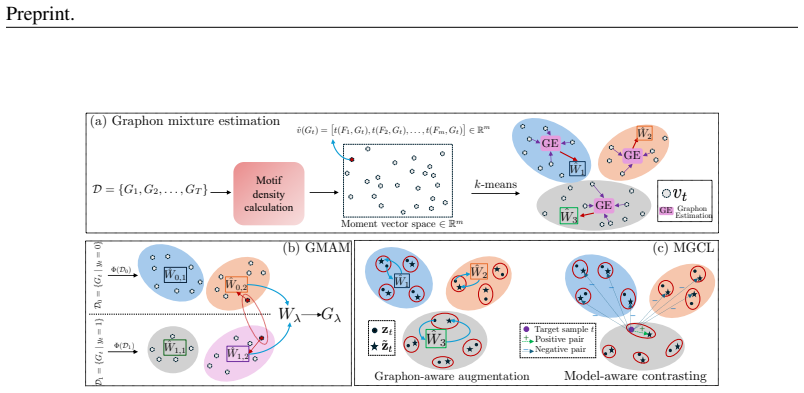
With clusters in hand, the paper builds two tools. For supervised mixup (GMAM), it interpolates between graphons from different classes and generates new graphs from the mixed probability function. For self-supervised contrastive learning (MGCL), it resamples a fraction of edges using the cluster's graphon to create an augmented view, and it modifies the contrastive loss so that negative samples only come from other clusters, avoiding false negatives.
The paper's theory claims a new bound: if two graphons are close in cut distance, the motif densities of graphs sampled from them are close with high probability, with a sampling error that improves on older bounds. The proof, however, leaves the key edge-noise lemma unproved, and the theorem statement defines m in a way that contradicts the proof. The empirical sections also contain inconsistent dataset counts. The main ideas are plausible but need a corrected proof before the theoretical claim can be accepted.
Extended reading notes
Core claim
The paper's headline assertion is Theorem 1: for two n-vertex graphs G1,G2 sampled from graphons W1,W2 with d_cut(W1,W2)≤ε and any motif F, |t(F,G1)−t(F,G2)| ≤ e(F)ε + 2( sqrt(1/(2m)log(4/η)) + e(F)/sqrt(n(n−1)) sqrt(2log(4/η)) ) with probability ≥1−2η (Eq. 10). On this basis, the authors claim that moment-vector clustering 'justifies the use of motif-based embeddings for graph clustering' and enables state-of-the-art mixup and contrastive learning.
Load-bearing premise
The bound rests on Lemma 2 (Appendix B.1), which asserts the edge-noise concentration Pr(|t(F,G)−bt(F;X)|≥δ_e | X) ≤ 2 exp(−n(n−1)δ_e^2/(2e(F)^2)) without proof. A second issue: Theorem 1 defines m as the binomial coefficient C(n,k), while the proof's Lemma 1 uses m=floor(n/k); the printed inequality is therefore not the one derived. If the lemma is wrong or the m definition stands, the claimed O(√k) improvement over the classical bound is unsupported.
Editorial analysis
A structured set of objections, weighed in public.
Referee Report
Summary. The paper proposes a graphon-mixture framework for graph representation learning. The method clusters graphs by their empirical motif-density (moment) vectors, estimates a graphon for each cluster using SIGL, and uses the estimated mixture in two downstream tasks: graphon-mixture-aware mixup (GMAM) and model-aware graph contrastive learning (MGCL). The central theoretical claim, Theorem 1, bounds the difference between empirical motif densities of two n-vertex graphs sampled from graphons with cut distance at most ε by e(F)ε plus a sampling-error term, with a claimed O(√k) improvement over classical bounds. Experiments on synthetic data show that moment-based clustering separates graphs from different graphons, and experiments on TU datasets report strong performance for GMAM and MGCL, including the best average rank among compared contrastive methods.
Significance. The paper addresses an important and timely problem: heterogeneous graph datasets are often mixtures of generative models, and existing methods such as G-Mixup assume a single graphon per class. The proposed pipeline is a coherent synthesis of moment-based clustering, graphon estimation, mixup, and contrastive learning. The strongest contributions are the detailed experimental evaluation (including ablations on motif count, cluster count, and false-negative behavior), the clear algorithmic description, and the identification of a potential new concentration bound for motif densities. If Theorem 1 is correctly stated and proved, it would provide a principled justification for moment-based graph clustering and would be a useful result in the graphon-learning literature. However, as printed, the theorem contains a definition/proof mismatch and relies on an unproved lemma, so the central mathematical guarantee is not yet established. The empirical results are extensive and plausible, but several performance gaps are within one standard deviation, so the SOTA claims should be tempered.
major comments (2)
- [Theorem 1 (Section 3.1, Eq. (10)) and Lemma 1 (Appendix B.1)] The theorem statement defines m = C(n,k) in Eq. (10), while the proof of Lemma 1 in Appendix B.1 uses m = floor(n/k). The vertex-noise bound Pr(|bt(F;X)-t(F,W)| >= δ_v) <= 2 exp(-2m δ_v^2) is then inverted with δ_v = sqrt(1/(2m) log(4/η)) using the latter m. With m = C(n,k), the bound would be exponentially small in a quantity much larger than n, which cannot follow from a function of n latent variables; Lemma 1 as stated would be implausible. The asymptotic comparison in B.2.2 explicitly approximates m ≈ n/k, confirming the intended definition. Thus the printed inequality is not the theorem proved, and the claimed O(√k) improvement over the classical bound is unsupported as written. This appears fixable by aligning Eq. (10) with the proof (m = floor(n/k)), but it is a load-bearing correction.
- [Appendix B.1, Lemma 2] The edge-noise bound Pr(|t(F,G)-bt(F;X)| >= δ_e | X) <= 2 exp(- n(n-1) δ_e^2 / (2 e(F)^2)) is stated without proof. This lemma is essential: the sampling-error term in Eq. (10) is the sum δ_v + δ_e, so the theorem's guarantee depends directly on this concentration inequality. The bound is plausible (e.g., by a McDiarmid or Azuma-style argument on edge flips), but the exact constant in the exponent cannot be verified from the manuscript. A complete proof should be supplied, or the statement should be derived explicitly.
minor comments (5)
- [Notation, Eq. (9) vs Eq. (10)] The symbol m is overloaded: Eq. (9) uses m for the number of motifs in the family F, while Eq. (10) redefines m as C(n,k). Use distinct symbols (e.g., m_F and m_sample) to avoid ambiguity.
- [Section 3.1, paragraph after Theorem 1] The text says that by applying a union bound across all motifs in F, the principle extends to the full moment vector. This is true, but the probability bound would acquire a factor of |F|; the explicit statement is missing. Please state the resulting high-probability guarantee for the vector case.
- [Section 4.2, text after Table 2] The prose states that GMAM achieves the highest accuracy on 'five of eight benchmarks,' but Table 2 contains seven datasets and GMAM is best on six (and second on one), consistent with the abstract's '6 out of 7.' The count should be corrected.
- [Tables 2 and 3] Several reported improvements are within one standard deviation of the closest baseline (e.g., IMDB-B, IMDB-M, REDD-M12 in Table 2; NCI1 and PROTEINS in Table 3). The 'state-of-the-art' wording should be softened or supplemented with significance tests or multiple-seed reporting over the full deviation.
- [Appendix F, TFR metric] The TFR increase is presented as evidence that clustering reduces false negatives. Since MGCL deliberately removes same-cluster negatives, the mechanism is direct; it would be helpful to report the p-values or confidence intervals for the TFR differences, and to state explicitly that the increase implies clusters align with class labels.
Assumptions & free parameters
free parameters (4)
- Number of clusters K =
K = log T
- Per-cluster refinement size L =
unspecified
- Mixup coefficient λ =
Uniform(0, 0.2)
- Edge resampling ratio r =
20%
assumptions (4)
- domain assumption Each observed graph is sampled from exactly one of K unknown graphons (finite mixture model).
- domain assumption The 9-dimensional vector of connected motif densities up to 4 nodes separates distinct graphons in real-world datasets.
- standard math Hoeffding/McDiarmid concentration and the counting lemma (Lovász 2012, Thm 10.23) are valid.
- domain assumption SIGL accurately estimates graphons and latent node positions from cluster graphs.
Cite this review
Pith. "Pith review of From Moments to Models: Graphon-Mixture Learning for Mixup and Contrastive Learning." pith.science (2026). https://pith.science/paper/HFAOGF2G
@misc{pith2026251003690,
  author       = {Pith},
  title        = {Pith review of: From Moments to Models: Graphon-Mixture Learning for Mixup and Contrastive Learning},
  year         = {2026},
  howpublished = {\url{https://pith.science/paper/HFAOGF2G}},
  note         = {Machine review of arXiv:2510.03690}
}
read the original abstract
Real-world graph datasets often arise from mixtures of populations, where graphs are generated by multiple distinct underlying distributions. In this work, we propose a unified framework that explicitly models graph data as a mixture of probabilistic graph generative models represented by graphons. To characterize and estimate these graphons, we leverage graph moments (motif densities) to cluster graphs generated from the same underlying model. We establish a novel theoretical guarantee, deriving a tighter bound showing that graphs sampled from structurally similar graphons exhibit similar motif densities with high probability. This result enables principled estimation of graphon mixture components. We show how incorporating estimated graphon mixture components enhances two widely used downstream paradigms: graph data augmentation via mixup and graph contrastive learning. By conditioning these methods on the underlying generative models, we develop graphon-mixture-aware mixup (GMAM) and model-aware graph contrastive learning (MGCL). Extensive experiments on both simulated and real-world datasets demonstrate strong empirical performance. In supervised learning, GMAM outperforms existing augmentation strategies, achieving new state-of-the-art accuracy on 6 out of 7 datasets. In unsupervised learning, MGCL performs competitively across seven benchmark datasets and achieves the lowest average rank overall.
Figures


Figures from the paper (4 more)


Reference graph
Works this paper leans on
-
[1]
Output:Augmented set eD={(G (m) λ ,y (m) λ )}M m=1 of sizeM=⌈rT⌉
runper class; mixing coefficient distributionλ∼Uniform(0,0.2); target node countn; augmentation ratior∈(0,1]. Output:Augmented set eD={(G (m) λ ,y (m) λ )}M m=1 of sizeM=⌈rT⌉. 1Partition data by class:D i ={G t |y t =i}fori= 1, . . . , C. 2fori= 1toCdo 3({ ˆWi,1, . . . ,ˆWi,Ki }, πi)←Φ(D i). 4M← ⌈rT⌉, eD ←∅. 5form= 1toMdo 6Sample distinct classesi̸=j; sam...
2014
-
[2]
E EXPERIMENTAL DETAILS
the estimation of the latent variables given an input graphs, i.e., an inverse mappingW −1 :A→η. E EXPERIMENTAL DETAILS. E.1 GROUND TRUTH GRAPHONS In Table 4, we provide the mathematical definition of the graphon used in Section 4 for the synthetic experiments. Table 4: Ground truth graphons. ω(x, y) 0xy 1exp(−(x 0.7 +y 0.7)) 2 1 4 (x2 +y 2 + √x+ √y) 3 1 ...
2015
-
[8]
Yu Rong, Wenbing Huang, Tingyang Xu, and Junzhou Huang. Dropedge: Towards deep graph convolutional networks on node classification.arXiv preprint arXiv:1907.10903,
arXiv 1907
-
[11]
Model-agnostic augmentation for accurate graph classifi- cation
Jaemin Yoo, Sooyeon Shim, and U Kang. Model-agnostic augmentation for accurate graph classifi- cation. InProceedings of the ACM Web Conference 2022, pp. 1281–1291,
2022
-
[16]
Table 5: Benchmark datasets statistics
used in our real-world experiments. Table 5: Benchmark datasets statistics. Biochemical Molecules Social Networks Statistic NCI1 PROTEINS DD MUTAG AIDS COLLAB RDT-B RDT-M5K IMDB-B #Graphs 4,110 1,113 1,178 188 2,000 5,000 2,000 4,999 1,000 Avg. #Nodes29.87 39.06 284.32 17.93 15.69 74.5 429.6 508.8 19.8 Avg. #Edges 32.30 72.82 715.66 19.79 16.20 2457.78 49...
2019
-
[17]
• GraphCL You et al
that maximizes mutual information between graph-level and substructure representations at multiple scales. • GraphCL You et al. (2020): Learns representations via predefined augmentations such as edge perturbation, node dropping, and attribute masking. • MVGRL Hassani & Khasahmadi (2020): Performs contrastive learning between structural views, e.g., adjac...
2020
-
[23]
D GRAPHON ESTIMATION Here we expalin the details of SIGL
As a result, as discussed in Section 3.3 and shown by the above proofs together with Proposition 2, minimizing our refined loss function pushes each graph away from the centroid of graphs generated by other models, whereas the standard InfoNCE loss uses all graphs and pushes it away from the centroid of the entire dataset. D GRAPHON ESTIMATION Here we exp...
2011
-
[32]
22 Preprint. 0 1 2 3 4 5 6 TFR (TN/FN) NCI1 PROTEINS DD MUTAG COLLAB RDT-B RDT-M5K IMDB-B ↑4.0% ↑6.5% ↑11.4% ↑14.7% ↑23.6% ↑105.2% ↑27.7% ↑2.0% TFR comparison across datasets Baseline MGCL Figure 4:Effect of clustering on TFR across different datasets. •Moment Embedding (Ours):This is our proposed method, where each graph is repre- sented by a 9-dimension...
2016
Show all 18 references
-
[128]
The best test epoch is selected based on validation performance, and test accuracy is reported over eight runs with the sameseedused in Han et al
The dataset is split into training, validation, and test sets in a 7:1:2 ratio. The best test epoch is selected based on validation performance, and test accuracy is reported over eight runs with the sameseedused in Han et al. (2022). We generate 20% more graphs for training. ...
2022
-
[2001]
Fully distributed online training of graph neural networks in networked systems
Rostyslav Olshevskyi, Zhongyuan Zhao, Kevin Chan, Gunjan Verma, Ananthram Swami, and San- tiago Segarra. Fully distributed online training of graph neural networks in networked systems. In 2025 IEEE International Conference on Machine Learning for Communication and Networking ...
2025
-
[2011]
Kriege, Franka Bause, Kristian Kersting, Petra Mutzel, and Marion Neumann
Christopher Morris, Nils M. Kriege, Franka Bause, Kristian Kersting, Petra Mutzel, and Marion Neumann. Tudataset: A collection of benchmark datasets for learning with graphs. InICML 2020 Workshop on Graph Representation Learning and Beyond (GRL+ 2020),
2020
-
[2014]
A few moments please: Scalable graphon learning via moment matching.arXiv preprint arXiv:2506.04206,
Reza Ramezanpour, Victor M Tenorio, Antonio G Marques, Ashutosh Sabharwal, and Santiago Segarra. A few moments please: Scalable graphon learning via moment matching.arXiv preprint arXiv:2506.04206,
-
[2015]
Thomas Kipf and Max Welling
10 Preprint. Thomas Kipf and Max Welling. Semi-supervised classification with graph convolutional networks. ArXiv, abs/1609.02907,
-
[2019]
Mixup for node and graph classification
Yiwei Wang, Wei Wang, Yuxuan Liang, Yujun Cai, and Bryan Hooi. Mixup for node and graph classification. InProceedings of the Web Conference 2021, WWW ’21, pp. 3663–3674, New York, NY , USA,
2021
-
[2020]
graph2vec: Learning distributed representations of graphs.arXiv preprint arXiv:1707.05005,
Annamalai Narayanan, Mahinthan Chandramohan, Rajasekar Venkatesan, Lihui Chen, Yang Liu, and Shantanu Jaiswal. graph2vec: Learning distributed representations of graphs.arXiv preprint arXiv:1707.05005,
-
[2021]
ISBN 9781450383127
Association for Computing Machinery. ISBN 9781450383127. Jun Xia, Lirong Wu, Jintao Chen, Bozhen Hu, and Stan Z Li. Simgrace: A simple framework for graph contrastive learning without data augmentation. InProceedings of the ACM web conference 2022, pp. 1070–1079,
2022
-
[2022]
Graphmad: Graph mixup for data augmentation using data- driven convex clustering
Madeline Navarro and Santiago Segarra. Graphmad: Graph mixup for data augmentation using data- driven convex clustering. InICASSP 2023 - 2023 IEEE International Conference on Acoustics, Speech and Signal Processing (ICASSP), pp. 1–5,
2023
-
[2025]
Representation learning with contrastive predic- tive coding.arXiv preprint arXiv:1807.03748,
Aaron van den Oord, Yazhe Li, and Oriol Vinyals. Representation learning with contrastive predic- tive coding.arXiv preprint arXiv:1807.03748,
Reviewed August 4, 2026 · model on record in the stance chip above.
Discussion (0). Sign in to comment.