BGRem: A background noise remover for astronomical images based on a diffusion model
Pith reviewed 2026-05-18 09:20 UTC · model grok-4.3
The pith
BGRem uses a diffusion model trained on simulations to remove background noise from astronomical images, raising true positive source detections by about 7 percent with SExtractor on MeerLICHT data.
A machine-rendered reading of the paper's core claim, the machinery that carries it, and where it could break.
Core claim
BGRem is a diffusion-based model with an attention U-Net backbone trained in a supervised manner on simulated images to denoise astronomical data over several diffusion steps. When used as pre-processing, it increases the count of true positive sources detected by SExtractor by about 7 percent for MeerLICHT observations. The model further improves source detection efficiency on optical images from additional telescopes and on simulated gamma-ray images representative of Fermi-LAT, demonstrating adaptability across noise types and wavelengths.
What carries the argument
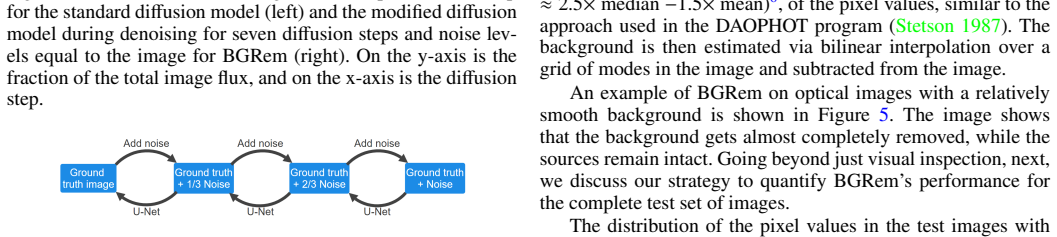
A diffusion model with attention U-Net backbone that performs supervised denoising of simulated astronomical images over multiple diffusion steps.
If this is right
- BGRem pre-processing raises the yield of reliable sources extracted by pixel-based tools such as SExtractor.
- The model applies directly to optical images from telescopes other than MeerLICHT without additional training.
- BGRem maintains its denoising benefit when applied to simulated gamma-ray images with noise statistics different from optical data.
- The cross-wavelength results position BGRem as a candidate general-purpose background removal step for multi-wavelength surveys.
Where Pith is reading between the lines
- If the performance gain holds on real gamma-ray observations, the same model could assist source searches in high-energy surveys where background modeling is especially difficult.
- Routine use of BGRem before cataloging could lower the detection threshold for faint sources in wide-field optical surveys.
- The zero-shot transfer observed on other optical telescopes suggests the learned noise statistics may be broadly representative rather than instrument-specific.
Load-bearing premise
The simulated training images accurately capture the statistical properties of real background noise and source distributions so that results on held-out simulations transfer to actual telescope data.
What would settle it
A side-by-side run of SExtractor on a large collection of real MeerLICHT images processed with and without BGRem, counting whether true positive detections rise by 7 percent while false positives stay flat or drop.
Figures




read the original abstract
Context: Astronomical imaging aims to maximize signal capture while minimizing noise. Enhancing the signal-to-noise ratio directly on detectors is difficult and expensive, leading to extensive research in advanced post-processing techniques. Aims: Removing background noise from images is a valuable pre-processing step catalog-building tasks. We introduce BGRem, a machine learning (ML) based tool to remove background noise from astronomical images. Methods: BGRem uses a diffusion-based model with an attention U-Net as backbone, trained on simulated images for optical and gamma ({\gamma})-ray data from the MeerLICHT and Fermi-LAT telescopes. In a supervised manner, BGRem learns to denoise astronomical images over several diffusion steps. Results: BGRem performance was compared with a widely used tool for cataloging astronomical sources, SourceExtractor (SExtractor). It was shown that the amount of true positive sources using SExtractor increased by about 7% for MeerLICHT data when BGRem was used as a pre-processing step. We also show the generalizability of BGRem by testing it with optical images from different telescopes and also on simulated {\gamma}-ray data representative of the Fermi-LAT telescope. We show that in both cases, BGRem improves the source detection efficiency. Conclusions: BGRem can improve the accuracy in source detection of traditional pixel-based methods by removing complex background noise. Using zero-shot approach, BGRem can generalize well to a wide range of optical images. The successful application of BGRem to simulated {\gamma}-ray images, alongside optical data, demonstrates its adaptability to distinct noise characteristics and observational domains. This cross-wavelength performance highlights its potential as a general-purpose background removal framework for multi-wavelength astronomical surveys.
Editorial analysis
A structured set of objections, weighed in public.
Referee Report
Summary. The manuscript introduces BGRem, a diffusion-based model with an attention U-Net backbone for background noise removal in astronomical images. Trained in a supervised manner exclusively on simulated optical and gamma-ray data from MeerLICHT and Fermi-LAT, it is evaluated as a pre-processing step for SExtractor. The central empirical claim is an approximately 7% increase in true-positive sources detected on MeerLICHT data; additional tests demonstrate generalization to optical images from other telescopes and to simulated gamma-ray data.
Significance. If the simulation-to-real transfer is validated, BGRem would represent a useful addition to the toolkit for improving source detection efficiency in catalog-building pipelines, particularly for handling complex backgrounds that challenge traditional pixel-based methods. The reported cross-wavelength applicability and zero-shot generalization to varied optical data are potential strengths for multi-messenger or survey applications.
major comments (2)
- [Results (MeerLICHT evaluation)] Results section on MeerLICHT performance: the reported ~7% increase in true-positive sources detected by SExtractor is presented without quantitative validation that the simulated background noise and source distributions match the statistical properties of real MeerLICHT data (e.g., via power spectra, noise histograms, or source-density comparisons). This validation is load-bearing for the transfer of the performance gain from simulation to actual telescope observations.
- [Methods (training and evaluation)] Methods section on training and evaluation: no details are provided on the training/validation splits, the specific diffusion schedule and number of steps, or error bars/statistical significance tests for the 7% figure. These omissions prevent assessment of whether the improvement is robust or could be an artifact of the simulation setup.
minor comments (1)
- [Abstract] The abstract refers to a 'zero-shot approach' for generalization but does not define what this means operationally for the diffusion model or the held-out test sets.
Simulated Author's Rebuttal
We thank the referee for their constructive and detailed review of our manuscript on BGRem. We have addressed each major comment below and will incorporate revisions to strengthen the presentation of our methods and results.
read point-by-point responses
-
Referee: [Results (MeerLICHT evaluation)] Results section on MeerLICHT performance: the reported ~7% increase in true-positive sources detected by SExtractor is presented without quantitative validation that the simulated background noise and source distributions match the statistical properties of real MeerLICHT data (e.g., via power spectra, noise histograms, or source-density comparisons). This validation is load-bearing for the transfer of the performance gain from simulation to actual telescope observations.
Authors: We agree that explicit quantitative validation of the simulation-to-real match is important for supporting the claimed performance transfer. While our simulations were designed using known MeerLICHT instrument properties and noise characteristics from prior literature, the original manuscript did not include direct statistical comparisons. In the revised manuscript we will add these validations to the Results section, specifically including power spectrum comparisons, noise histogram matches, and source-density analyses between the simulated and real MeerLICHT data. revision: yes
-
Referee: [Methods (training and evaluation)] Methods section on training and evaluation: no details are provided on the training/validation splits, the specific diffusion schedule and number of steps, or error bars/statistical significance tests for the 7% figure. These omissions prevent assessment of whether the improvement is robust or could be an artifact of the simulation setup.
Authors: We acknowledge that the current Methods section lacks sufficient detail for full reproducibility and robustness evaluation. We will expand this section in the revision to report the training/validation split ratios and image counts, the precise diffusion schedule and number of steps used, and error bars on the 7% true-positive improvement together with statistical significance tests (such as paired t-tests across multiple evaluation runs). These additions will allow readers to assess whether the gain is robust. revision: yes
Circularity Check
No significant circularity in derivation or claims
full rationale
The paper describes training a diffusion model with attention U-Net on simulated optical and gamma-ray images, then reports an empirical 7% increase in true-positive sources detected by SExtractor on real MeerLICHT data when BGRem is used as pre-processing. No mathematical derivation, first-principles prediction, or fitted parameter is presented that reduces by construction to its own inputs or to a self-citation chain. The performance number is an observed measurement on held-out real data rather than a quantity forced by the training procedure or by renaming a known result. The central claim therefore remains independent of the listed circularity patterns.
Axiom & Free-Parameter Ledger
free parameters (1)
- diffusion schedule and number of steps
axioms (1)
- domain assumption Simulated images faithfully reproduce the statistical properties of real background noise and source distributions for both optical and gamma-ray instruments.
Reference graph
Works this paper leans on
-
[1]
2015, TensorFlow: Large-scale ma- chine learning on heterogeneous systems
Abadi, M., Agarwal, A., Barham, P., et al. 2015, TensorFlow: Large-scale ma- chine learning on heterogeneous systems
work page 2015
-
[2]
Abdollahi, S. et al. 2020, The Astrophysical Journal Supplement Series, 247, 33
work page 2020
-
[3]
2021, Frontiers in artificial intelligence, 4, 649917
Acciarri, R., Adams, C., Andreopoulos, C., et al. 2021, Frontiers in artificial intelligence, 4, 649917
work page 2021
-
[4]
Acero, F. et al. 2016, The Astrophysical Journal Supplement Series, 223, 26
work page 2016
-
[5]
Akhlaghi, M. & Ichikawa, T. 2015, The Astrophysical Journal Supplement Se- ries, 220, 1 Andrew L. Maas, Awni Y . Hannun, A. Y . N. 2013, International Conference on Machine Learning, 30
work page 2015
-
[6]
Atwood, W. B. et al. 2009, The Astrophysical Journal, 697, 1071
work page 2009
-
[7]
Bellm, E. C. et al. 2018, Publications of the Astronomical Society of the Pacific, 131, 018002
work page 2018
-
[8]
Bertin, E. & Arnouts, S. 1996, Astronomy and astrophysics supplement series, 117, 393
work page 1996
-
[9]
2023, Journal of Cosmology and As- troparticle Physics, 2023, 013
Caron, S., Eckner, C., Hendriks, L., et al. 2023, Journal of Cosmology and As- troparticle Physics, 2023, 013
work page 2023
-
[10]
Chollet, F. et al. 2015, Keras,https://keras.io
work page 2015
-
[11]
Croitoru, F.-A., Hondru, V ., Ionescu, R. T., & Shah, M. 2023, IEEE Transactions on Pattern Analysis and Machine Intelligence, 45, 10850–10869
work page 2023
-
[12]
2022, Monthly Notices of the Royal Astronomical Society, 515, 5185
Ehlert, S., Chen, C.-T., Swartz, D., et al. 2022, Monthly Notices of the Royal Astronomical Society, 515, 5185
work page 2022
-
[13]
Gheller, C. & Vazza, F. 2021, Monthly Notices of the Royal Astronomical Soci- ety, 509, 990
work page 2021
-
[14]
J., Bloemen, S., Vreeswijk, P., et al
Groot, P. J., Bloemen, S., Vreeswijk, P., et al. 2024, Publications of the Astro- nomical Society of the Pacific, 136, 115003
work page 2024
-
[15]
Haigh, C. et al. 2021, Astronomy & Astrophysics, 645, A107
work page 2021
-
[16]
Heymans, C. et al. 2012, Monthly Notices of the Royal Astronomical Society, 427, 146 Ivezi´c, Ž. et al. 2019, The Astrophysical Journal, 873, 111
work page 2012
-
[17]
Jia, P. et al. 2023, Monthly Notices of the Royal Astronomical Society, 527, 6581 Jonathan Ho, Ajay Jain, P. A. 2020, Advances in Neural Information Processing Systems, 33, 6840
work page 2023
-
[18]
Kingma, D. P. & Ba, J. 2014, arXiv preprint arXiv:1412.6980
work page internal anchor Pith review Pith/arXiv arXiv 2014
-
[19]
Oetelaar, C. et al. 2021, PoS, ICRC, 663
work page 2021
-
[20]
Attention U-Net: Learning Where to Look for the Pancreas
Oktay, O., Schlemper, J., Folgoc, L. L., et al. 2018, arXiv preprint arXiv:1804.03999
work page internal anchor Pith review Pith/arXiv arXiv 2018
-
[21]
2021, Astronomy & astrophysics, 656, A62
Panes, B., Eckner, C., Hendriks, L., et al. 2021, Astronomy & astrophysics, 656, A62
work page 2021
-
[22]
Robotham, A. et al. 2018, Monthly Notices of the Royal Astronomical Society, 476, 3137
work page 2018
-
[23]
Ronneberger, O., Fischer, P., & Brox, T. 2015, in Medical Image Computing and Computer-Assisted Intervention – MICCAI 2015 (Springer International Publishing), 234–241
work page 2015
-
[24]
Roscani, V . et al. 2020, Astronomy & Astrophysics, 643, A43
work page 2020
-
[25]
T., Jarvis, M., Mandelbaum, R., et al
Rowe, B. T., Jarvis, M., Mandelbaum, R., et al. 2015, Astronomy and Comput- ing, 10, 121
work page 2015
-
[26]
2015, in In- ternational conference on machine learning, PMLR, 2256–2265
Sohl-Dickstein, J., Weiss, E., Maheswaranathan, N., & Ganguli, S. 2015, in In- ternational conference on machine learning, PMLR, 2256–2265
work page 2015
-
[27]
Song, Y . et al. 2020, International Conference on Learning Representations
work page 2020
-
[28]
Stetson, P. B. 1987, Publications of the Astronomical Society of the Pacific, 99, 191
work page 1987
-
[29]
2022, Astronomy & Astrophysics, 662, A109
Stoppa, F., Vreeswijk, P., Bloemen, S., et al. 2022, Astronomy & Astrophysics, 662, A109
work page 2022
-
[30]
Tian, C. et al. 2020, Neural Networks, 131, 251
work page 2020
-
[31]
Tung, Y .-C., Li, J., Hsiung, Y ., et al. 2024, Nuclear Instruments and Methods in Physics Research Section A: Accelerators, Spectrometers, Detectors and Associated Equipment, 1059, 169010
work page 2024
-
[32]
2017, Advances in neural information processing systems, 30 V ojtekova, A
Vaswani, A., Shazeer, N., Parmar, N., et al. 2017, Advances in neural information processing systems, 30 V ojtekova, A. et al. 2020, Monthly Notices of the Royal Astronomical Society, 503, 3204
work page 2017
-
[33]
Wolf, T. N., Jones, B. A., & Bowler, B. P. 2024, The Astronomical Journal, 167, 92
work page 2024
discussion (0)
Sign in with ORCID, Apple, or X to comment. Anyone can read and Pith papers without signing in.