REVIEW 3 major objections 4 minor 1 cited by
Enhancing Optomechanical Entanglement and Mechanical Squeezing by the Synergistic Effect of Quadratic Optomechanical Coupling and Coherent Feedback
T0 review · 3 major / 4 minor · reviewed 2026-08-04 · deepseek-v4-flash
Pith's one-line read A coherent feedback loop plus quadratic coupling lifts optomechanical entanglement fivefold and mechanical squeezing past 10 dB.
desk verdict Plausible standard-formalism numerical proposal for optomechanical entanglement and squeezing via QOC plus coherent feedback; the central claims need a stability check and a physical mapping of g1/g2 before they fully land. read the letter →
The pith
A machine-rendered reading of the paper's core claim, the machinery that carries it, and where it could break.
The reading
What carries the argument
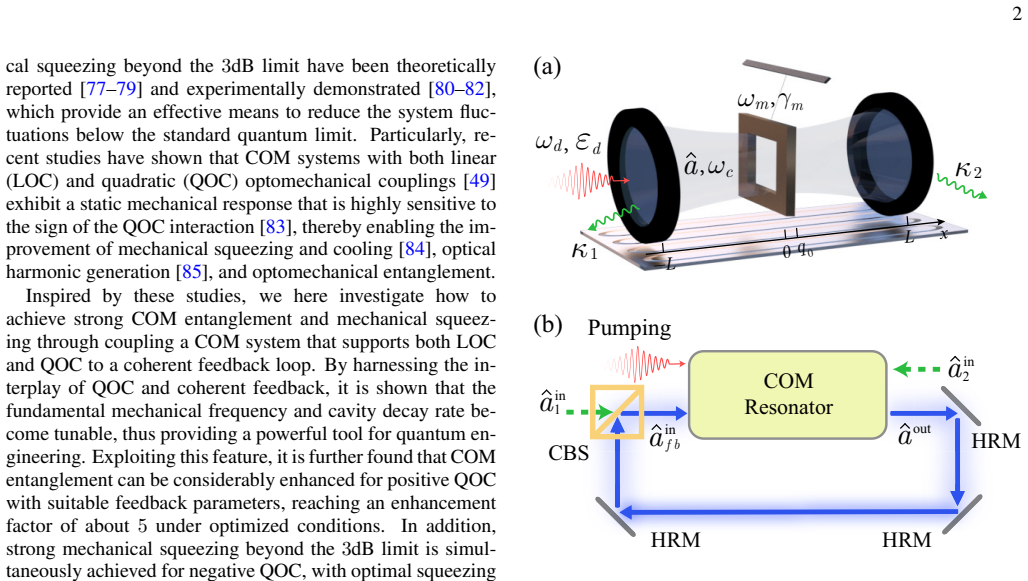
The load-bearing object is the 4×4 steady-state covariance matrix of the linearized membrane-cavity system, obtained from the Lyapunov equation. The two expressions that do the physical work are the effective mechanical frequency Ω_m = ω_m − 2g2|α_s|^2 and the feedback-modified cavity decay rate κ̃ = κ_tot − 2√(κ1κ2)r_B cos θ; together they convert the sign of the quadratic coupling and the feedback phase into direct control over the stability regime, decoherence rate, and effective optomechanical coupling strength. Quantum effects are quantified by the logarithmic negativity E_N for entanglement and the mechanical quadrature variance S_j for squeezing.
What would settle it
Solve the original nonlinear quantum Langevin equations without dropping fluctuation products for the parameters used in Figs. 3(d) and 4(f) and check whether a stable physical steady state with E_N ≈ 0.2 and S_q > 10 dB exists; if the only solutions lie on or beyond the Routh-Hurwitz stability boundary, the linearized prediction is not realized.
Extended reading notes
Core claim
The central discovery is that the effective mechanical frequency Ω_m = ω_m − 2g2|α_s|^2 changes with the sign of the quadratic coupling g2: positive g2 softens the membrane, negative g2 stiffens it. The coherent feedback loop separately modifies the effective cavity decay rate κ̃ = κ_tot − 2√(κ1κ2)r_B cos θ and the effective detuning. Tuning these controls moves the stability boundary, permitting a larger effective optomechanical coupling λ before the system becomes unstable. Solving the linearized quantum Langevin equations and the Lyapunov equation for the steady-state covariance matrix, the paper shows that positive g2 with feedback yields optomechanical entanglement E_N ≈ 0.2, about five
Load-bearing premise
The paper treats the linear and quadratic couplings as freely tunable parameters, but in the membrane-in-cavity geometry both are fixed by the same reflectivity and equilibrium position, and the linearized equations are trusted exactly where the system is closest to instability.
Editorial extensions
If this is right
- Positive quadratic coupling combined with coherent feedback lifts steady-state optomechanical entanglement to about five times the level of a bare linear-coupling system.
- Negative quadratic coupling alone already exceeds the 3 dB mechanical squeezing limit; adding feedback with r_B = 0.8 and θ = 0 pushes the squeezing above 10 dB and broadens the usable detuning range.
- The feedback loop can reduce the effective cavity decay rate to below 25% of its bare value, directly slowing the decoherence that limits steady-state nonclassicality.
- The sign of the quadratic coupling acts as a switch: positive values favor entanglement, negative values favor squeezing, so a single tunable setup can serve both tasks.
- The protocol does not require backaction-evading measurements or reservoir engineering; it relies only on optical pumping, a membrane, and a coherent feedback path.
Reading between the lines
- An open question is whether the specific (g1, g2) pairs used in the figures can be realized by a single membrane reflectivity and equilibrium position; the paper treats the couplings as independently adjustable even though both derive from the same geometry.
- The predicted enhancements sit near the boundary of the linearized stability regime, so a full nonlinear treatment that retains fluctuation products could reveal whether the reported values are robust or an artifact of linearization.
- The same stability-reconfiguration mechanism may extend to other optomechanical tasks, such as ground-state cooling or quantum state transfer, by choosing the sign of the quadratic coupling and feedback phase to shift the instability boundary advantageously.
- A direct experimental test could scan the feedback phase θ and membrane position q0 and look for the predicted periodic increase in output squeezing, which would be a distinctive signature of this mechanism.
Editorial analysis
A structured set of objections, weighed in public.
Referee Report
Summary. The paper proposes a membrane-in-cavity optomechanical system with both linear and quadratic optomechanical couplings, embedded in a coherent feedback loop. After linearizing the quantum Langevin equations, the authors compute the steady-state covariance matrix from the Lyapunov equation and use it to evaluate logarithmic negativity and mechanical squeezing. They report that positive quadratic coupling, combined with coherent feedback, enhances optomechanical entanglement by roughly a factor of five (E_N up to about 0.2), while negative quadratic coupling with feedback yields mechanical squeezing above 10 dB, beyond the 3 dB limit. The claimed mechanism is that the synergistic control of quadratic coupling and feedback reshapes the stability region so that stronger effective optomechanical coupling can be accessed before instability.
Significance. If the reported results are valid, the paper would present an all-optical, steady-state route to nonclassical mechanical states in a standard membrane-in-cavity geometry, with quantitatively large entanglement and squeezing. The theoretical framework is standard and the derivations are presented clearly. The paper is, however, a numerical parameter study rather than a parameter-free prediction, and its central claims rest on two assumptions that are not verified: the stability of the linearized system at the optimized operating points, and the physical realizability of the scanned (g1, g2) combinations. These are correctable with additional analysis, so the underlying idea is worth pursuing, but the current evidence does not yet establish the headline numbers.
major comments (3)
- [Sec. III and Eq. (17); Figs. 3(d)/(f) and 4(f)] The central claim that QOC plus coherent feedback 'reconfigures the stability regime' is never supported by a stability analysis. The Lyapunov equation (17) yields a physical steady-state covariance matrix only when the matrix A in Eq. (15) is Hurwitz, yet no Routh-Hurwitz condition or eigenvalue calculation is reported. The text itself states that E_N reaches its maximum near the instability point, so the optimized parameters in Figs. 3(d)/(f) and 4(f) are exactly where a small parameter error could take the system outside the stable domain. If those points are unstable, the plotted E_N>0.2 and S_q>10 dB are not steady-state results. Please report the stability boundary for the linearized system and the stability margin (e.g., the largest real part of the eigenvalues of A) for every optimized parameter set, and restrict plotted regions to the stable domain.
- [Sec. II, Eq. (3) vs. parameter choices in Figs. 3-4] The numerical scans vary g2/g1 as an independent parameter while fixing g1=1351.38 Hz, but Eq. (3) shows that both g1 and g2 are determined by the same membrane reflectivity R_m, mode number, cavity length, and equilibrium position q0. It is not demonstrated that the pairs (fixed g1; g2/g1 in the range 10^-5 to 10^-3) used in Figs. 3 and 4 can be realized by any single physical geometry, nor that the implied variations of R_m and q0 are compatible with the assumptions used in deriving Eq. (3). Please provide the explicit (R_m, q0) mapping for the scanned values or discuss a separate mechanism that makes the linear and quadratic couplings independently tunable. Without this, the reported enhanced parameter region may be physically inaccessible.
- [Sec. II, Eq. (8); Sec. III] The linearization leading to Eq. (8) neglects products of fluctuation operators, but the paper does not check that these products are small at the plotted maxima. Near instability, the mechanical response is resonantly enhanced, so fluctuation amplitudes can grow and invalidate the linearized treatment. The covariance matrix computed from Eq. (17) is a property of the linearized system and cannot by itself certify the validity of the linearization. Please report the mean photon and phonon numbers and the relevant variances for the optimized points, and indicate the regime where the linearized equations are quantitatively justified.
minor comments (4)
- [Figs. 3 and 4 captions/labels] Several axis labels and panel annotations are garbled in the figures, e.g., '2/g155' instead of a clear g2/g1 or g2/g1 x10^-5. Please regenerate the figures with clean, readable labels.
- [Sec. II, Eq. (10)] The decomposition of the feedback-modified input field into r_B and t_B should state explicitly that t_B is real and nonnegative, and define the sign convention; otherwise the superposition in Eq. (10) is ambiguous.
- [Sec. IV, Fig. 4 parameters] The main text should explicitly note that the numerical parameters for the squeezing results differ from those in Sec. III (κ1/2π=2.25 MHz, κ2/2π=0.75 MHz, T=1 mK), rather than only stating this in the figure caption.
- [Sec. II, Eq. (6)] The statement that α_s can be taken real by choosing a suitable phase reference should be justified in one sentence, since the feedback phase θ and the detuning Δ both enter the optical response.
Circularity Check
No circularity: the claimed entanglement and squeezing enhancements are computed from a self-contained linearized-Langevin/Lyapunov model with scanned parameters, not from fitted or redefined target quantities.
full rationale
The derivation chain is self-contained. Starting from the Hamiltonian (4) and QLEs (5), the paper linearizes around the steady-state means (6)-(8), includes coherent feedback via the standard input-output relation and beam-splitter field relation (9)-(12), and then solves the Lyapunov equation (17) for the steady-state covariance matrix. Entanglement E_N (18) and squeezing S_j (20) are evaluated from that covariance matrix. No parameter is fitted to E_N or S_q; the quantities g2/g1, r_B, and theta are scanned, which is parameter optimization rather than data fitting. The sign-dependent mechanisms (mechanical softening/stiffening via Omega_m = omega_m - 2g2|alpha_s|^2 and cavity-decay suppression via kappa_tilde) are illustrated in Fig. 2 before the target quantities are computed, but the E_N and S_q values themselves are numerical outputs of the solved equations, not inputs. Citations to the authors' previous works appear only as introductory context and are not load-bearing ingredients; the model and stability-related mechanisms rely on independent references, e.g., Refs. [86]-[89], [25], [64], and [90]. The skeptical concerns about the joint realizability of g1 and g2 from Eq. (3) and the absence of an explicit stability boundary near the reported maxima are physical-realizability and numerical-verification issues, not circularity: they do not make any prediction equal to an input by construction. Therefore no circular step is present.
Assumptions & free parameters
free parameters (6)
- linear coupling g1 =
1351.38 Hz
- quadratic coupling ratio g2/g1 =
ranges 0 to 6×10^-5 (entanglement) and 0 to -15×10^-3 (squeezing)
- feedback reflection r_B =
0 to 0.8
- feedback phase θ =
0 to 2π, optimum θ=0 (squeezing) and θ=3π/2 (entanglement)
- bath temperature T =
10 mK (entanglement), 1 mK (squeezing)
- cavity decay rates κ1, κ2 =
1.5 MHz each (entanglement); 2.25 MHz and 0.75 MHz (squeezing)
assumptions (5)
- domain assumption Linearization of QLEs: neglect of higher-order fluctuation terms δa†δa, δa†δq, δaδq, δqδq (Eq. 8)
- domain assumption Instantaneous, effectively lossless coherent feedback: output field fed back with delay negligible compared with cavity lifetime (Sec. II around Eq. 10)
- ad hoc to paper g1 and g2 can be tuned independently (Sec. II Eq. (3) vs. parameter choices in Figs. 3-4)
- domain assumption Markovian approximation for the mechanical Brownian noise (Sec. II after Eq. 5)
- domain assumption Stability of the drift matrix A for all plotted points (Secs. III-IV)
Cite this review
Pith. "Pith review of Enhancing Optomechanical Entanglement and Mechanical Squeezing by the Synergistic Effect of Quadratic Optomechanical Coupling and Coherent Feedback." pith.science (2026). https://pith.science/paper/PLHARKX2
@misc{pith2026251004732,
  author       = {Pith},
  title        = {Pith review of: Enhancing Optomechanical Entanglement and Mechanical Squeezing by the Synergistic Effect of Quadratic Optomechanical Coupling and Coherent Feedback},
  year         = {2026},
  howpublished = {\url{https://pith.science/paper/PLHARKX2}},
  note         = {Machine review of arXiv:2510.04732}
}
abstract
In this paper, we investigate how to achieve strong optomechanical entanglement and mechanical squeezing in a membrane-embedded cavity optomechanical system incorporating a coherent feedback loop, where the membrane interacts with the cavity mode through both linear and quadratic optomechanical couplings. This hybrid optomechanical architecture offers a flexible tunability of intrinsic system parameters, thereby enabling controlled stiffening or softening of the mechanical mode through adjusting quadratic optomechanical coupling, as well as effective modulation of the cavity decay rate via feedback control. More importantly, the synergistic interplay effect allows for a strategic reconfiguration of the system's stability regime, which in turn permits the presence of significantly enhanced effective optomechanical coupling strengths before entering the unstable regime. Exploiting these unique features, we showcase that optomechanical entanglement can be substantially enhanced with positive coupling sign and suitable feedback parameters, while strong mechanical squeezing beyond the $3$dB limit is simultaneously achieved over a broad parameter range with negative coupling sign, reaching squeezing degree above $10$dB under optimized conditions. Our proposal, establishing an all-optical method for generating highly entangled or squeezed states in cavity optomechanical systems, opens up a new route to explore macroscopic quantum effects and to advance quantum information processing.
Figures


Figures from the paper (1 more)

Forward citations
Cited by 1 Pith paper
-
Optomechanical systems with a Fano membrane in the middle
A Fano membrane in the middle of a Fabry-Pérot cavity creates narrow hybrid optical modes that enable ground-state sideband cooling despite an unresolved bare cavity linewidth.
Reference graph
Works this paper leans on
-
[1]
Horodecki, P
R. Horodecki, P. Horodecki, M. Horodecki, and K. Horodecki, Quantum entanglement, Rev. Mod. Phys.81, 865 (2009)
2009
-
[2]
U. L. Andersen, T. Gehring, C. Marquardt, and G. Leuchs, 30 years of squeezed light generation, Phys. Scr.91, 053001 (2016)
2016
-
[3]
J. P. Dowling and G. J. Milburn, Quantum technology: the second quantum revolution, Phil. Trans. R. Soc. A361, 1655 (2003)
2003
-
[4]
S. L. Braunstein and P. van Loock, Quantum information with continuous variables, Rev. Mod. Phys.77, 513 (2005)
2005
-
[5]
U. L. Andersen, G. Leuchs, and C. Silberhorn, Continuous- variable quantum information processing, Laser & Photon. Rev. 4, 337 (2010)
2010
-
[6]
K. Modi, A. Brodutch, H. Cable, T. Paterek, and V . Vedral, The classical-quantum boundary for correlations: Discord and re- lated measures, Rev. Mod. Phys.84, 1655 (2012)
2012
-
[7]
Y . Xia, A. R. R. Agrawal, C. M. M. Pluchar, A. J. J. Brady, Z. Liu, Q. Zhuang, D. J. J. Wilson, and Z. Zhang, Entanglement-enhanced optomechanical sensing, Nat. Photon. 17, 470 (2023)
2023
-
[8]
Q.-Y . He, L. Rosales-Z ´arate, G. Adesso, and M. D. Reid, Se- cure Continuous Variable Teleportation and Einstein-Podolsky- Rosen Steering, Phys. Rev. Lett.115, 180502 (2015)
2015
Show all 92 references
-
[9]
Zhang, H.-O
X. Zhang, H.-O. Li, G. Cao, M. Xiao, G.-C. Guo, and G.-P. Guo, Semiconductor quantum computation, Natl. Sci. Rev.6, 32 (2018)
2018
-
[10]
Wang, L.-K
X.-L. Wang, L.-K. Chen, W. Li, H.-L. Huang, C. Liu, C. Chen, Y .-H. Luo, Z.-E. Su, D. Wu, Z.-D. Li, H. Lu, Y . Hu, X. Jiang, C.-Z. Peng, L. Li, N.-L. Liu, Y .-A. Chen, C.-Y . Lu, and J.-W. Pan, Experimental Ten-Photon Entanglement, Phys. Rev. Lett. 117, 210502 (2016)
2016
-
[11]
H.-N. Dai, B. Yang, A. Reingruber, X.-F. Xu, X. Jiang, Y .-A. Chen, Z.-S. Yuan, and J.-W. Pan, Generation and detection of atomic spin entanglement in optical lattices, Nat. Phys.12, 783 (2016)
2016
-
[12]
X.-Y . Luo, Y . Yu, J.-L. Liu, M.-Y . Zheng, C.-Y . Wang, B. Wang, J. Li, X. Jiang, X.-P. Xie, Q. Zhang, X.-H. Bao, and J.-W. Pan, Postselected Entanglement between Two Atomic Ensem- bles Separated by 12.5 km, Phys. Rev. Lett.129, 050503 (2022)
2022
-
[13]
J. Ma, X. Wang, C. Sun, and F. Nori, Quantum spin squeezing, Phys. Rep.509, 89 (2011)
2011
-
[14]
Est `eve, C
J. Est `eve, C. Gross, A. Weller, S. Giovanazzi, and M. K. Oberthaler, Squeezing and entanglement in a Bose-Einstein condensate, Nature (London)455, 1216 (2008)
2008
-
[15]
T. P. Purdy, P.-L. Yu, R. W. Peterson, N. S. Kampel, and C. A. Regal, Strong Optomechanical Squeezing of Light, Phys. Rev. X3, 031012 (2013). 9
2013
-
[16]
Wang and A
Y .-D. Wang and A. A. Clerk, Reservoir-Engineered Entangle- ment in Optomechanical Systems, Phys. Rev. Lett.110, 253601 (2013)
2013
-
[17]
Jiao, Y .-L
Y .-F. Jiao, Y .-L. Zuo, Y . Wang, W. Lu, J.-Q. Liao, L.-M. Kuang, and H. Jing, Tripartite Quantum Entanglement with Squeezed Optomechanics, Laser & Photon. Rev.18, 2301154
-
[18]
Y .-F. Jiao, J. Wang, D.-Y . Wang, L. Tang, Y . Wang, Y .-L. Zuo, W.-S. Bao, L.-M. Kuang, and H. Jing, Phase-selective tripartite entanglement and asymmetric Einstein-Podolsky-Rosen steer- ing in squeezed optomechanics, Phys. Rev. A112, 012421 (2025)
2025
-
[19]
Lai, J.-Q
D.-G. Lai, J.-Q. Liao, A. Miranowicz, and F. Nori, Noise- Tolerant Optomechanical Entanglement via Synthetic Mag- netism, Phys. Rev. Lett.129, 063602 (2022)
2022
-
[20]
Liu, Y .-F
J.-X. Liu, Y .-F. Jiao, Y . Li, X.-W. Xu, Q.-Y . He, and H. Jing, Phase-Controlled Asymmetric Optomechanical Entanglement against Optical Backscattering, Sci. China-Phys. Mech. Astron. 66, 230312 (2023)
2023
-
[21]
Liu, J.-Y
J.-X. Liu, J.-Y . Yang, T.-X. Lu, Y .-F. Jiao, and H. Jing, Phase- controlled robust quantum entanglement of remote mechanical oscillators, Phys. Rev. A109, 023519 (2024)
2024
-
[22]
Lai, Y .-H
D.-G. Lai, Y .-H. Chen, W. Qin, A. Miranowicz, and F. Nori, Tripartite optomechanical entanglement via optical-dark-mode control, Phys. Rev. Res.4, 033112 (2022)
2022
-
[23]
Huang, D.-G
J. Huang, D.-G. Lai, and J.-Q. Liao, Thermal-noise-resistant optomechanical entanglement via general dark-mode control, Phys. Rev. A106, 063506 (2022)
2022
-
[24]
Riste, M
D. Riste, M. Dukalski, C. A. Watson, G. de Lange, M. J. Tiggel- man, Y . M. Blanter, K. W. Lehnert, R. N. Schouten, and L. Di- Carlo, Deterministic entanglement of superconducting qubits by parity measurement and feedback, Nature (London)502, 350 (2013)
2013
-
[25]
J. Li, G. Li, S. Zippilli, D. Vitali, and T. Zhang, Enhanced en- tanglement of two different mechanical resonators via coherent feedback, Phys. Rev. A95, 043819 (2017)
2017
-
[26]
D. Miki, N. Matsumoto, A. Matsumura, T. Shichijo, Y . Sugiyama, K. Yamamoto, and N. Yamamoto, Generating quantum entanglement between macroscopic objects with con- tinuous measurement and feedback control, Phys. Rev. A107, 032410 (2023)
2023
-
[27]
M. Ho, E. Oudot, J.-D. Bancal, and N. Sangouard, Witnessing Optomechanical Entanglement with Photon Counting, Phys. Rev. Lett.121, 023602 (2018)
2018
-
[28]
Wang, X.-Y
M. Wang, X.-Y . L¨u, Y .-D. Wang, J. Q. You, and Y . Wu, Macro- scopic Quantum Entanglement in Modulated Optomechanics, Phys. Rev. A94, 053807 (2016)
2016
-
[29]
Hu, L.-T
C.-S. Hu, L.-T. Shen, Z.-B. Yang, H. Wu, Y . Li, and S.-B. Zheng, Manifestation of Classical Nonlinear Dynamics in Op- tomechanical Entanglement with a Parametric Amplifier, Phys. Rev. A100, 043824 (2019)
2019
-
[30]
Yang, T.-X
J. Yang, T.-X. Lu, M. Peng, J. Liu, Y .-F. Jiao, and H. Jing, Multi-field-driven optomechanical entanglement, Opt. Express 32, 785 (2024)
2024
-
[31]
Jiao, S.-D
Y .-F. Jiao, S.-D. Zhang, Y .-L. Zhang, A. Miranowicz, L.-M. Kuang, and H. Jing, Nonreciprocal Optomechanical Entan- glement against Backscattering Losses, Phys. Rev. Lett.125, 143605 (2020)
2020
-
[32]
Jiao, J.-X
Y .-F. Jiao, J.-X. Liu, Y . Li, R. Yang, L.-M. Kuang, and H. Jing, Nonreciprocal Enhancement of Remote Entanglement between Nonidentical Mechanical Oscillators, Phys. Rev. Applied18, 064008 (2022)
2022
-
[33]
Y .-F. Jiao, J. Wang, Q. Zhang, H. Lin, and H. Jing, Nonreciprocal quantum optics: New effects and ap- plications in quantum sensing, Fundamental Research https://doi.org/10.1016/j.fmre.2024.12.018 (2025)
2024 doi
-
[34]
Mari and J
A. Mari and J. Eisert, Gently Modulating Optomechanical Sys- tems, Phys. Rev. Lett.103, 213603 (2009)
2009
-
[35]
Han, D.-Y
X. Han, D.-Y . Wang, C.-H. Bai, W.-X. Cui, S. Zhang, and H.- F. Wang, Mechanical squeezing beyond resolved sideband and weak-coupling limits with frequency modulation, Phys. Rev. A 100, 033812 (2019)
2019
-
[36]
F. Yang, M. Fu, B. Bosnjak, R. H. Blick, Y . Jiang, and E. Scheer, Mechanically Modulated Sideband and Squeezing Effects of Membrane Resonators, Phys. Rev. Lett.127, 184301 (2021)
2021
-
[37]
L¨u, J.-Q
X.-Y . L¨u, J.-Q. Liao, L. Tian, and F. Nori, Steady-state mechan- ical squeezing in an optomechanical system via Duffing nonlin- earity, Phys. Rev. A91, 013834 (2015)
2015
-
[38]
Huang and A
S. Huang and A. Chen, Mechanical squeezing in a dissipative optomechanical system with two driving tones, Phys. Rev. A 103, 023501 (2021)
2021
-
[39]
Ruskov, K
R. Ruskov, K. Schwab, and A. N. Korotkov, Squeezing of a nanomechanical resonator by quantum nondemolition measure- ment and feedback, Phys. Rev. B71, 235407 (2005)
2005
-
[40]
Szorkovszky, A
A. Szorkovszky, A. C. Doherty, G. I. Harris, and W. P. Bowen, Mechanical Squeezing via Parametric Amplification and Weak Measurement, Phys. Rev. Lett.107, 213603 (2011)
2011
-
[41]
Szorkovszky, G
A. Szorkovszky, G. A. Brawley, A. C. Doherty, and W. P. Bowen, Strong thermomechanical squeezing via weak mea- surement, Phys. Rev. Lett.110, 184301 (2013)
2013
-
[42]
Huang, D.-G
J. Huang, D.-G. Lai, and J.-Q. Liao, Controllable generation of mechanical quadrature squeezing via dark-mode engineering in cavity optomechanics, Phys. Rev. A108, 013516 (2023)
2023
-
[43]
Zhang, Y .-X
J. Zhang, Y .-X. Liu, and F. Nori, Cooling and squeezing the fluctuations of a nanomechanical beam by indirect quantum feedback control, Phys. Rev. A79, 052102 (2009)
2009
-
[44]
Vinante and P
A. Vinante and P. Falferi, Feedback-Enhanced Parametric Squeezing of Mechanical Motion, Phys. Rev. Lett.111, 207203 (2013)
2013
-
[45]
P. Rabl, A. Shnirman, and P. Zoller, Generation of squeezed states of nanomechanical resonators by reservoir engineering, Phys. Rev. B70, 205304 (2004)
2004
-
[46]
M. J. Woolley and A. A. Clerk, Two-mode squeezed states in cavity optomechanics via engineering of a single reservoir, Phys. Rev. A89, 063805 (2014)
2014
-
[47]
Bai and J.-H
S.-Y . Bai and J.-H. An, Generating Stable Spin Squeezing by Squeezed-Reservoir Engineering, Phys. Rev. Lett.127, 083602 (2021)
2021
-
[48]
Aspelmeyer, T
M. Aspelmeyer, T. J. Kippenberg, and F. Marquardt, Cavity op- tomechanics, Rev. Mod. Phys.86, 1391 (2014)
2014
-
[49]
Rocheleau, T
T. Rocheleau, T. Ndukum, C. Macklin, J. Hertzberg, A. Clerk, and K. Schwab, Preparation and detection of a mechanical res- onator near the ground state of motion, Nature (London)463, 72 (2010)
2010
-
[50]
A. D. O’Connell, M. Hofheinz, M. Ansmann, R. C. Bialczak, M. Lenander, E. Lucero, M. Neeley, D. Sank, H. Wang, M. Wei- des, J. Wenner, J. M. Martinis, and A. N. Cleland, Quantum ground state and single-phonon control of a mechanical res- onator, Nature (London)464, 697 (2010)
2010
-
[51]
L. Du, J. Monsel, W. Wieczorek, and J. Splettstoesser, Coher- ent feedback control for cavity optomechanical systems with a frequency-dependent mirror, Phys. Rev. A111, 013506 (2025)
2025
-
[52]
Xiong, L.-G
H. Xiong, L.-G. Si, X.-Y . L¨u, X.-X. Yang, and Y . Wu, Review of cavity optomechanics in the weak-coupling regime: from lin- earization to intrinsic nonlinear interactions, Sci. China Phys. Mech. Astron.58, 1 (2015)
2015
-
[53]
Rabl, Photon Blockade Effect in Optomechanical Systems, Phys
P. Rabl, Photon Blockade Effect in Optomechanical Systems, Phys. Rev. Lett.107, 063601 (2011). 10
2011
-
[54]
C. Zhai, R. Huang, H. Jing, and L.-M. Kuang, Mechanical switch of photon blockade and photon-induced tunneling, Opt. Express27, 27649 (2019)
2019
-
[55]
Xie, C.-G
H. Xie, C.-G. Liao, X. Shang, M.-Y . Ye, and X.-M. Lin, Phonon blockade in a quadratically coupled optomechanical system, Phys. Rev. A96, 013861 (2017)
2017
-
[56]
Zheng, T.-S
L.-L. Zheng, T.-S. Yin, Q. Bin, X.-Y . L ¨u, and Y . Wu, Single-photon-induced phonon blockade in a hybrid spin- optomechanical system, Phys. Rev. A99, 013804 (2019)
2019
-
[57]
L¨u, L.-L
X.-Y . L¨u, L.-L. Zheng, G.-L. Zhu, and Y . Wu, Single-Photon- Triggered Quantum Phase Transition, Phys. Rev. Applied9, 064006 (2018)
2018
-
[58]
Zhu, X.-Y
G.-L. Zhu, X.-Y . L ¨u, L.-L. Zheng, Z.-M. Zhan, F. Nori, and Y . Wu, Single-photon-triggered quantum chaos, Phys. Rev. A 100, 023825 (2019)
2019
-
[59]
J. I. Cirac, P. Zoller, H. J. Kimble, and H. Mabuchi, Quantum State Transfer and Entanglement Distribution among Distant Nodes in a Quantum Network, Phys. Rev. Lett.78, 3221 (1997)
1997
-
[60]
T. A. Palomaki, J. W. Harlow, J. D. Teufel, R. W. Simmonds, and K. W. Lehnert, Coherent state transfer between itinerant microwave fields and a mechanical oscillator, Nature (London) 495, 210 (2013)
2013
-
[61]
Marinkovi ´c, A
I. Marinkovi ´c, A. Wallucks, R. Riedinger, S. Hong, M. As- pelmeyer, and S. Gr ¨oblacher, Optomechanical Bell Test, Phys. Rev. Lett.121, 220404 (2018)
2018
-
[62]
H. Yu, L. McCuller, M. Tse, N. Kijbunchoo, L. Barsotti, N. Mavalvala, and L. S. Collaboration, Quantum correlations between light and the kilogram-mass mirrors of LIGO, Nature (London)583, 43 (2020)
2020
-
[63]
Vitali, S
D. Vitali, S. Gigan, A. Ferreira, H. R. B ¨ohm, P. Tombesi, A. Guerreiro, V . Vedral, A. Zeilinger, and M. Aspelmeyer, Op- tomechanical Entanglement between a Movable Mirror and a Cavity Field, Phys. Rev. Lett.98, 030405 (2007)
2007
-
[64]
Genes, A
C. Genes, A. Mari, P. Tombesi, and D. Vitali, Robust Entan- glement of a Micromechanical Resonator with Output Optical Fields, Phys. Rev. A78, 032316 (2008)
2008
-
[65]
Ghobadi, S
R. Ghobadi, S. Kumar, B. Pepper, D. Bouwmeester, A. I. Lvovsky, and C. Simon, Optomechanical Micro-Macro Entan- glement, Phys. Rev. Lett.112, 080503 (2014)
2014
-
[66]
E. E. Wollman, C. U. Lei, A. J. Weinstein, J. Suh, A. Kron- wald, F. Marquardt, A. A. Clerk, and K. C. Schwab, Quantum squeezing of motion in a mechanical resonator, Science349, 952 (2015)
2015
-
[67]
G. S. Agarwal and S. Huang, Strong mechanical squeezing and its detection, Phys. Rev. A93, 043844 (2016)
2016
-
[68]
Marti, U
S. Marti, U. von Lupke, O. Joshi, Y . Yang, M. Bild, A. Oma- hen, Y . Chu, and M. Fadel, Quantum squeezing in a nonlinear mechanical oscillator, Nat. Phys.20, 1448 (2024)
2024
-
[69]
Riedinger, S
R. Riedinger, S. Hong, R. A. Norte, J. A. Slater, J. Shang, A. G. Krause, V . Anant, M. Aspelmeyer, and S. Gr ¨oblacher, Non- classical correlations between single photons and phonons from a mechanical oscillator, Nature (London)530, 313 (2016)
2016
-
[70]
T. A. Palomaki, J. D. Teufel, R. W. Simmonds, and K. W. Lehn- ert, Entangling Mechanical Motion with Microwave Fields, Sci- ence342, 710 (2013)
2013
-
[71]
J. Chen, M. Rossi, D. Mason, and A. Schliesser, Entanglement of propagating optical modes via a mechanical interface, Nat. Commun.11, 943 (2020)
2020
-
[72]
Barzanjeh, E
S. Barzanjeh, E. S. Redchenko, M. Peruzzo, M. Wulf, D. P. Lewis, G. Arnold, and J. M. Fink, Stationary entangled radia- tion from micromechanical motion, Nature (London)570, 480 (2019)
2019
-
[73]
C. F. Ockeloen-Korppi, E. Damsk ¨agg, J.-M. Pirkkalainen, M. Asjad, A. A. Clerk, F. Massel, M. J. Woolley, and M. A. Sillanp¨a¨a, Stabilized entanglement of massive mechanical os- cillators, Nature (London)556, 478 (2018)
2018
-
[74]
Kotler, G
S. Kotler, G. A. Peterson, E. Shojaee, F. Lecocq, K. Cicak, A. Kwiatkowski, S. Geller, S. Glancy, E. Knill, R. W. Sim- monds, J. Aumentado, and J. D. Teufel, Direct observation of deterministic macroscopic entanglement, Science372, 622 (2021)
2021
-
[75]
Mercier de L ´epinay, C
L. Mercier de L ´epinay, C. F. Ockeloen-Korppi, M. J. Woolley, and M. A. Sillanp¨a¨a, Quantum mechanics–free subsystem with mechanical oscillators, Science372, 625 (2021)
2021
-
[76]
Riedinger, A
R. Riedinger, A. Wallucks, I. Marinkovi ´c, C. L ¨oschnauer, M. Aspelmeyer, S. Hong, and S. Gr ¨oblacher, Remote quantum entanglement between two micromechanical oscillators, Nature (London)556, 473 (2018)
2018
-
[77]
Dassonneville, R
R. Dassonneville, R. Assouly, T. Peronnin, A. Clerk, A. Bien- fait, and B. Huard, Dissipative Stabilization of Squeezing Be- yond 3 dB in a Microwave Mode, PRX Quantum2, 020323 (2021)
2021
-
[78]
W. Qin, A. Miranowicz, and F. Nori, Beating the 3 dB Limit for Intracavity Squeezing and Its Application to Nondemolition Qubit Readout, Phys. Rev. Lett.129, 123602 (2022)
2022
-
[79]
Kustura, C
K. Kustura, C. Gonzalez-Ballestero, A. d. l. R. Sommer, N. Meyer, R. Quidant, and O. Romero-Isart, Mechanical Squeezing via Unstable Dynamics in a Microcavity, Phys. Rev. Lett.128, 143601 (2022)
2022
-
[80]
C. U. Lei, A. J. Weinstein, J. Suh, E. E. Wollman, A. Kronwald, F. Marquardt, A. A. Clerk, and K. C. Schwab, Quantum Non- demolition Measurement of a Quantum Squeezed State Beyond the 3 dB Limit, Phys. Rev. Lett.117, 100801 (2016)
2016
-
[81]
W. Jia, V . Xu, K. Kuns, M. Nakano, L. Barsotti, M. Evans, N. Mavalvala, and L. S. Collaboration, Squeezing the quantum noise of a gravitational-wave detector below the standard quan- tum limit, Science385, 1318 (2024)
2024
-
[82]
Kamba, N
M. Kamba, N. Hara, and K. Aikawa, Quantum squeezing of a levitated nanomechanical oscillator, Science389, 1225 (2025)
2025
-
[83]
Zhang and Z
L. Zhang and Z. Song, Modification on static responses of a nano-oscillator by quadratic optomechanical couplings, Sci. China-Phys. Mech. Astron.57, 880 (2014)
2014
-
[84]
Xuereb and M
A. Xuereb and M. Paternostro, Selectable linear or quadratic coupling in an optomechanical system, Phys. Rev. A87, 023830 (2013)
2013
-
[85]
Zhang and H.-Y
L. Zhang and H.-Y . Kong, Self-sustained oscillation and har- monic generation in optomechanical systems with quadratic couplings, Phys. Rev. A89, 023847 (2014)
2014
-
[86]
Bhattacharya, H
M. Bhattacharya, H. Uys, and P. Meystre, Optomechanical trap- ping and cooling of partially reflective mirrors, Phys. Rev. A77, 033819 (2008)
2008
-
[87]
C. W. Gardiner and P. Zoller,Quantum Noise(Springer, Berlin, 2000)
2000
-
[88]
G. S. Agarwal,Quantum optics(Cambridge University Press, Cambridge, UK, 2013)
2013
-
[89]
Adesso, A
G. Adesso, A. Serafini, and F. Illuminati, Extremal entangle- ment and mixedness in continuous variable systems, Phys. Rev. A70, 022318 (2004)
2004
-
[90]
Ghorbani, A
N. Ghorbani, A. Motazedifard, and M. H. Naderi, Effects of quadratic optomechanical coupling on bipartite entanglements, mechanical ground-state cooling, and mechanical quadrature squeezing in an electro-optomechanical system, Phys. Rev. A 111, 013524 (2025)
2025
-
[91]
Zhang, Y
R. Zhang, Y . Fang, Y .-Y . Wang, S. Chesi, and Y .-D. Wang, Strong mechanical squeezing in an unresolved-sideband op- tomechanical system, Phys. Rev. A99, 043805 (2019)
2019
-
[92]
Yu, Y .-F
H.-Y . Yu, Y .-F. Jiao, J. Wang, F. Li, B. Yin, T. Jiang, Q.-R. Liu, H. Jing, and K. Wei, Strong Molecule-Light Entanglement with 11 Molecular Cavity Optomechanics, arXiv:2505.21227
Reviewed August 4, 2026 · model on record in the stance chip above.
Discussion (0). Continue with ORCID to comment.