Spin-spiral instability of the Nagaoka ferromagnet in the crossover between square and triangular lattices
Pith reviewed 2026-05-18 08:59 UTC · model grok-4.3
The pith
On lattices interpolating between square and triangular geometries, the Nagaoka ferromagnet becomes unstable to a spin spiral at an exact critical point.
A machine-rendered reading of the paper's core claim, the machinery that carries it, and where it could break.
Core claim
On lattices which interpolate between square and triangular, there is a phase transition at which the ferromagnetic order becomes unstable to a spin spiral. We model this transition, finding the exact location of the spin-spiral instability in the hard-core Fermi-Hubbard model near half-filling.
What carries the argument
The continuous lattice interpolation parameter between square and triangular geometries that locates the point where the Nagaoka ferromagnetic state loses stability to a spin spiral.
If this is right
- The Nagaoka ferromagnet remains stable only up to a finite degree of triangular lattice distortion.
- Beyond the critical interpolation the ground state switches to a spiral order resembling the 120-degree state of the triangular lattice.
- The transition provides a continuous geometric route connecting unfrustrated ferromagnetism to frustrated spiral order.
- The model yields the instability location without further numerical approximations.
Where Pith is reading between the lines
- Cold-atom experiments could tune lattice geometry in real time to observe the switch between ferromagnetic and spiral magnetic order.
- Analogous instabilities may appear when interpolating other pairs of lattices that differ in frustration, such as honeycomb to triangular.
- The exact result supplies a benchmark for testing approximate methods at finite doping or with longer-range hopping.
Load-bearing premise
The hard-core Fermi-Hubbard model near half-filling on continuously interpolated lattices admits an exact determination of the spin-spiral instability point.
What would settle it
Direct computation or measurement of the energy or spin structure factor comparing the ferromagnetic state to the spiral state exactly at the predicted critical interpolation value would confirm or disprove the instability location.
Figures

read the original abstract
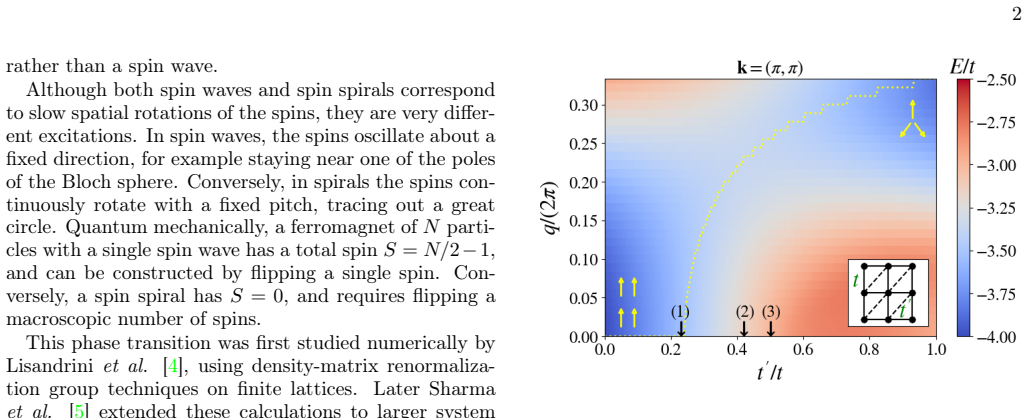
We study the hard-core Fermi-Hubbard model in the crossover between square and triangular lattices near half-filling. As was recognized by Nagaoka in the 1960s, on the square lattice the presence of a single hole leads to ferromagnetic spin ordering. On the triangular lattice, geometric frustration instead leads to a spin-singlet ground state, which can be associated with a 120-degree spiral order. On lattices which interpolate between square and triangular, there is a phase transition at which the ferromagnetic order becomes unstable to a spin spiral. We model this transition, finding the exact location of the spin-spiral instability.
Editorial analysis
A structured set of objections, weighed in public.
Referee Report
Summary. The manuscript studies the hard-core Fermi-Hubbard model on lattices that continuously interpolate between square and triangular geometries, near half-filling. It recalls Nagaoka ferromagnetism for a single hole on the square lattice and 120° spiral order on the triangular lattice, then identifies a ferromagnetic-to-spin-spiral transition in the interpolated family and reports an exact location for the instability point.
Significance. If the location is obtained from a controlled, parameter-free calculation within the single-hole sector, the result supplies a sharp benchmark for the competition between Nagaoka ferromagnetism and geometric frustration. Such an exact anchor would be useful for testing numerical methods and for extensions to finite doping in the crossover regime.
major comments (2)
- [§4] §4 (or equivalent section presenting the instability criterion): the reported 'exact' location is obtained by equating the ferromagnetic energy to the variationally minimized energy of a single-Q spin spiral on the interpolated lattice. This procedure is exact only inside the assumed ansatz; the manuscript does not demonstrate that other orders (multi-Q spirals, stripe states, or phase separation) remain higher in energy near the critical interpolation parameter.
- [§3 or §5] Near-half-filling discussion (likely §3 or §5): the Nagaoka theorem guarantees ferromagnetism only for a single hole; the central claim that the instability location remains sharp at small but finite doping requires an explicit argument or calculation showing that hole-hole interactions do not shift the critical point or destabilize the spiral before the single-hole threshold is reached.
minor comments (2)
- [Model section] The interpolation scheme (bond-angle or hopping-ratio parameter) should be defined with an explicit equation in the model section so that the critical value can be reproduced without ambiguity.
- [Figures] Figure captions for the energy comparison or magnon dispersion should state the system size and boundary conditions used to extract the instability point.
Simulated Author's Rebuttal
We thank the referee for the careful reading of our manuscript and for the constructive comments. We address each major point below and indicate the revisions we will make.
read point-by-point responses
-
Referee: [§4] §4 (or equivalent section presenting the instability criterion): the reported 'exact' location is obtained by equating the ferromagnetic energy to the variationally minimized energy of a single-Q spin spiral on the interpolated lattice. This procedure is exact only inside the assumed ansatz; the manuscript does not demonstrate that other orders (multi-Q spirals, stripe states, or phase separation) remain higher in energy near the critical interpolation parameter.
Authors: We agree that the reported critical interpolation parameter is exact only within the single-Q spin-spiral variational family. The calculation equates the ferromagnetic energy to the minimized energy of a single-Q spiral, which is the natural ansatz given the 120° order known to be stable on the triangular lattice. We do not claim to have performed an exhaustive comparison against all possible competing states. In the revised manuscript we will clarify in §4 that the result locates the point of instability to single-Q spirals and add a brief discussion noting that multi-Q or stripe states would require separate variational or numerical treatment; we expect the single-Q channel to be the leading instability on symmetry grounds but acknowledge this remains an assumption. revision: partial
-
Referee: [§3 or §5] Near-half-filling discussion (likely §3 or §5): the Nagaoka theorem guarantees ferromagnetism only for a single hole; the central claim that the instability location remains sharp at small but finite doping requires an explicit argument or calculation showing that hole-hole interactions do not shift the critical point or destabilize the spiral before the single-hole threshold is reached.
Authors: The referee is correct that the Nagaoka theorem applies strictly to the single-hole sector. Our manuscript identifies the instability in that sector and suggests the location remains relevant for small finite doping. However, we do not provide an explicit calculation or detailed argument demonstrating that hole-hole interactions leave the critical point unshifted. In the revised version we will remove the statement that the location remains sharp at small but finite doping, restrict the central claim to the single-hole case where the result is controlled, and add a sentence noting that extensions to finite doping constitute an interesting direction for future work. revision: yes
Circularity Check
No significant circularity; derivation self-contained within modeled ansatz
full rationale
The abstract and available context present the central result as a modeled transition on interpolated lattices with an exact instability location obtained via the hard-core Fermi-Hubbard model near half-filling. No quoted equations, self-citations, or fitted parameters are shown that reduce the reported critical point to a definition or input by construction. The procedure is described as independent modeling of the FM-to-spiral instability, consistent with a variational or magnon-softening calculation inside the assumed single-hole sector. This is the most common honest outcome for papers whose central claim rests on an explicit ansatz rather than a tautological renaming or self-referential fit.
Axiom & Free-Parameter Ledger
axioms (1)
- domain assumption Hard-core Fermi-Hubbard model near half-filling on interpolated lattices admits an exact determination of the spin-spiral instability.
Lean theorems connected to this paper
-
IndisputableMonolith/Foundation/AlexanderDuality.leanalexander_duality_circle_linking unclear?
unclearRelation between the paper passage and the cited Recognition theorem.
We model this transition, finding the exact location of the spin-spiral instability... by searching for a vanishing spin stiffness... E2(t,t')=0
-
IndisputableMonolith/Cost/FunctionalEquation.leanwashburn_uniqueness_aczel unclear?
unclearRelation between the paper passage and the cited Recognition theorem.
variational ansatz |ψ⟩=∑i fi ∏j≠i (uj c†j↑ + vj c†j↓)|vac⟩ ... perturbation theory to exactly calculate E2
What do these tags mean?
- matches
- The paper's claim is directly supported by a theorem in the formal canon.
- supports
- The theorem supports part of the paper's argument, but the paper may add assumptions or extra steps.
- extends
- The paper goes beyond the formal theorem; the theorem is a base layer rather than the whole result.
- uses
- The paper appears to rely on the theorem as machinery.
- contradicts
- The paper's claim conflicts with a theorem or certificate in the canon.
- unclear
- Pith found a possible connection, but the passage is too broad, indirect, or ambiguous to say the theorem truly supports the claim.
Reference graph
Works this paper leans on
-
[1]
Nagaoka, Ferromagnetism in a Narrow, Almost Half- FilledsBand, Phys
Y. Nagaoka, Ferromagnetism in a Narrow, Almost Half- FilledsBand, Phys. Rev.147, 392 (1966)
work page 1966
-
[2]
D. J. Thouless, Exchange in solid3Heand the Heisen- berg Hamiltonian, Proceedings of the Physical Society 86, 893–904 (1965)
work page 1965
-
[3]
J. O. Haerter and B. S. Shastry, Kinetic Antiferromag- netism in the Triangular Lattice, Phys. Rev. Lett.95, 087202 (2005)
work page 2005
-
[4]
F. T. Lisandrini, B. Bravo, A. E. Trumper, L. O. Manuel, and C. J. Gazza, Evolution of Nagaoka phase with kinetic energy frustrating hopping, Phys. Rev. B95, 195103 (2017)
work page 2017
-
[5]
Instability of Nagaoka State and Quantum Phase Transition via Kinetic Frustration Control
P. Sharma, Y. Peng, D. N. Sheng, H. J. Changlani, and Y. Wang, Instability of Nagaoka State and Quan- tum Phase Transition via Kinetic Frustration Control, arXiv:2508.08410
work page internal anchor Pith review Pith/arXiv arXiv
-
[6]
D. Pereira and E. J. Mueller, Kinetic magnetism in the crossover between the square and triangular lattice Fermi-Hubbard models, arXiv:2506.15669
-
[7]
C. N. Sposetti, B. Bravo, A. E. Trumper, C. J. Gazza, and L. O. Manuel, Classical Antiferromagnetism in Ki- netically Frustrated Electronic Models, Phys. Rev. Lett. 112, 187204 (2014)
work page 2014
-
[8]
M. Davydova, Y. Zhang, and L. Fu, Itinerant spin polaron and metallic ferromagnetism in semiconductor moiré superlattices, Phys. Rev. B107, 224420 (2023)
work page 2023
-
[9]
T. G. Kiely, C. Zhang, and E. J. Mueller, Vacancy- assisted superfluid drag, Phys. Rev. A111, 053302 (2025)
work page 2025
-
[10]
S. R. White and I. Affleck, Density matrix renormaliza- tion group analysis of the Nagaoka polaron in the two- dimensionalt−Jmodel, Phys. Rev. B64, 024411 (2001)
work page 2001
-
[11]
M. Xu, L. H. Kendrick, A. Kale, Y. Gang, G. Ji, R. T. Scalettar, M. Lebrat, and M. Greiner, Frustration- and doping-induced magnetism in a Fermi–Hubbard simula- tor, Nature620, 971–976 (2023)
work page 2023
- [12]
-
[13]
M. L. Prichard, B. M. Spar, I. Morera, E. Demler, Z. Z. Yan, and W. S. Bakr, Directly imaging spin polarons in a kinetically frustrated Hubbard system, Nature629, 323–328 (2024)
work page 2024
-
[14]
M. Kjaergaard, M. E. Schwartz, J. Braumüller, P. Krantz, J. I.-J. Wang, S. Gustavsson, and W. D. Oliver, Superconducting Qubits: Current State of Play, Annu. Rev. Condens. Matter Phys.11, 369 (2020)
work page 2020
-
[15]
F. Wu, T. Lovorn, E. Tutuc, and A. H. MacDonald, Hub- bard Model Physics in Transition Metal Dichalcogenide Moiré Bands, Phys. Rev. Lett.121, 026402 (2018)
work page 2018
-
[16]
L. Ciorciaro, T. Smolenski, I. Morera, N. Kiper, S. Hies- tand, M. Kroner, Y. Zhang, K. Watanabe, T. Taniguchi, E. Demler,et al., Kinetic Magnetism in Triangular Moiré Materials, Nature623, 509 (2023)
work page 2023
-
[17]
Z. Tao, W. Zhao, B. Shen, T. Li, P. Knüppel, K. Watan- abe, T. Taniguchi, J. Shan, and K. F. Mak, Observation of spin polarons in a frustrated moiré Hubbard system, Nat. Phys.20, 783–787 (2024)
work page 2024
-
[18]
I. M. Georgescu, S. Ashhab, and F. Nori, Quantum sim- ulation, Rev. Mod. Phys.86, 153 (2014)
work page 2014
- [19]
-
[20]
C. Glittum, A. Štrkalj, D. Prabhakaran, P. A. Goddard, C. D. Batista, and C. Castelnovo, A resonant valence bond spin liquid in the dilute limit of doped frustrated Mott insulators, Nat. Phys.21, 1211 (2025)
work page 2025
- [21]
-
[22]
J. Villain, R. Bidaux, J.-P. Carton, and R. Conte, Order as an effect of disorder, J. Phys. France41, 1263–1272 (1980)
work page 1980
discussion (0)
Sign in with ORCID, Apple, or X to comment. Anyone can read and Pith papers without signing in.