Dissociative associated J/psi and dimuon production in Ap ultraperipheral collisions via double parton scattering
Pith reviewed 2026-05-18 08:42 UTC · model grok-4.3
The pith
A pocket formula describes dissociative J/ψ and dimuon production via double parton scattering in ultraperipheral nucleus-proton collisions.
A machine-rendered reading of the paper's core claim, the machinery that carries it, and where it could break.
Core claim
In nucleus-proton ultraperipheral collisions the dissociative associated production of J/ψ and dimuon proceeds via double parton scattering, for which a pocket formula is derived together with the corresponding effective cross section, enabling demonstration of its kinematic dependence and predictions of differential DPS cross sections at LHC and FCC energies.
What carries the argument
The DPS pocket formula for this associated J/ψ and dimuon production, which supplies a simplified expression for the cross section by combining the nuclear photon flux with the proton gluon distributions under double parton scattering.
If this is right
- The effective cross section depends on the kinematics of the produced particles in a calculable way.
- Differential cross sections can be predicted for the energies reached at the LHC and the Future Circular Collider.
- The channel gives direct access to the gluon distributions inside the proton.
Where Pith is reading between the lines
- Pocket formulas of the same form could be written for other dissociative vector-meson plus lepton-pair final states to probe additional parton distributions.
- Higher-energy runs might expose how nuclear modifications alter the size of the effective cross section in ultraperipheral collisions.
- The rapidity-gap tag could be used to isolate double parton scattering contributions in other heavy-ion or proton-nucleus systems.
Load-bearing premise
Dissociative associated J/ψ and dimuon production proceeds dominantly via double parton scattering with a clear rapidity gap that permits clean factorization between the nuclear photon flux and the proton's gluon distributions.
What would settle it
LHC data that either lack the predicted rapidity gap in the J/ψ and dimuon events or show an effective cross section whose kinematic dependence deviates from the derived expression would indicate that double parton scattering is not the dominant mechanism.
Figures




read the original abstract
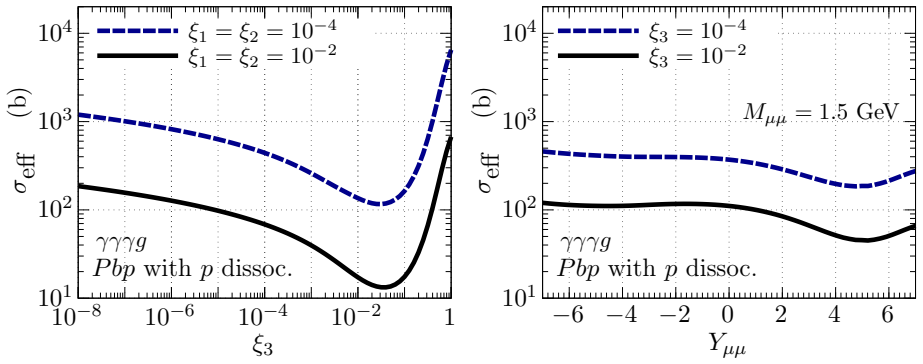
We study the dissociative associated production of a $J/\psi$ meson and a dimuon via double parton scattering (DPS) in nucleus--proton ultraperipheral collisions. This new channel, characterized by a rapidity gap, is sensitive to the photon and gluon distributions of the proton. We derive a DPS pocket formula for this process, together with a corresponding expression for the effective cross section. Furthermore, we demonstrate the kinematic dependence of the effective cross section and present predictions for the differential DPS cross section at LHC and FCC energies.
Editorial analysis
A structured set of objections, weighed in public.
Referee Report
Summary. The manuscript studies dissociative associated production of a J/ψ meson and a dimuon via double parton scattering (DPS) in nucleus-proton ultraperipheral collisions. It derives a DPS pocket formula together with an expression for the effective cross section, demonstrates the kinematic dependence of the effective cross section, and presents predictions for differential DPS cross sections at LHC and FCC energies.
Significance. If the central assumptions hold, the work introduces a new channel in ultraperipheral collisions characterized by a rapidity gap and sensitive to both photon and gluon distributions. The derivation of a pocket formula and the corresponding effective-cross-section expression, together with explicit predictions at collider energies, would provide a compact framework for testing DPS phenomenology in a relatively clean environment.
major comments (1)
- [Abstract and DPS pocket formula derivation section] The derivation of the pocket formula (abstract and the section presenting the DPS formula) assumes that dissociative associated production proceeds dominantly via DPS with a clear rapidity gap and clean factorization between the nuclear photon flux and proton gluon distributions. No explicit estimate, suppression factor, or upper bound is given for single-parton-scattering (SPS) contributions, photon-exchange interference, or nuclear-breakup effects that could fill the gap or invalidate the factorization. This assumption is load-bearing for the applicability of both the pocket formula and the quoted effective cross section.
minor comments (1)
- [Abstract] The abstract states that the effective cross section's kinematic dependence is demonstrated, but does not indicate whether this dependence is parameter-free or derived from first principles; a short clarifying phrase would help readers.
Simulated Author's Rebuttal
We thank the referee for the careful reading of our manuscript and for the constructive major comment. We address the point raised below and indicate the changes we will make in the revised version.
read point-by-point responses
-
Referee: [Abstract and DPS pocket formula derivation section] The derivation of the pocket formula (abstract and the section presenting the DPS formula) assumes that dissociative associated production proceeds dominantly via DPS with a clear rapidity gap and clean factorization between the nuclear photon flux and proton gluon distributions. No explicit estimate, suppression factor, or upper bound is given for single-parton-scattering (SPS) contributions, photon-exchange interference, or nuclear-breakup effects that could fill the gap or invalidate the factorization. This assumption is load-bearing for the applicability of both the pocket formula and the quoted effective cross section.
Authors: We agree that the derivation of the pocket formula and the effective cross section rests on the assumption of DPS dominance with a clear rapidity gap and factorization between the nuclear photon flux and proton parton distributions. The current manuscript does not provide explicit numerical estimates, suppression factors, or upper bounds for SPS contributions, photon-exchange interference, or nuclear-breakup effects. In the revised version we will add a dedicated paragraph after the derivation of the pocket formula that discusses the expected suppression of SPS in this channel (arising from the requirement of a large rapidity gap and the color-singlet nature of the J/ψ), together with order-of-magnitude estimates drawn from analogous DPS/SPS comparisons in the literature. We will also include a short discussion of why photon-exchange interference and nuclear-breakup contributions are expected to remain small for the selected kinematics and impact-parameter range typical of ultraperipheral collisions, with references to existing studies of gap survival in UPCs. These additions will clarify the domain of applicability without changing the central DPS results. revision: yes
Circularity Check
No significant circularity; derivation presented as independent
full rationale
The paper states it derives a DPS pocket formula and effective cross-section expression for the new dissociative associated production channel in Ap UPCs. The abstract and summary describe this as a direct derivation sensitive to photon and gluon distributions, with predictions for differential cross sections at LHC/FCC energies. No self-citations are invoked as load-bearing for the central premise, no fitted parameters are relabeled as predictions, and no ansatz or uniqueness theorem is smuggled in. The derivation chain appears self-contained against external benchmarks, with the effective cross section's kinematic dependence presented as a new result rather than a tautology or renormalization to prior data. This is the expected honest non-finding for a phenomenology paper introducing a new channel.
Axiom & Free-Parameter Ledger
axioms (2)
- domain assumption Double parton scattering can be treated with a pocket formula that factorizes nuclear photon flux from proton gluon distributions
- domain assumption A rapidity gap cleanly isolates the dissociative associated production channel
Reference graph
Works this paper leans on
- [1]
- [2]
- [3]
-
[4]
Elements of a theory for multiparton interactions in QCD
M. Diehl, D. Ostermeier, and A. Schafer, JHEP03, 089 (2012) [arXiv:1111.0910 [hep-ph]]
work page internal anchor Pith review Pith/arXiv arXiv 2012
-
[5]
Multi-Parton Interactions at the LHC
P. Bartaliniet al., [arXiv:1111.0469 [hep-ph]]
work page internal anchor Pith review Pith/arXiv arXiv
-
[6]
A. V. Manohar and W. J. Waalewijn, Phys. Lett. B713, 196-201 (2012) [arXiv:1202.5034 [hep-ph]]
work page internal anchor Pith review Pith/arXiv arXiv 2012
-
[7]
Double hard scattering without double counting
M. Diehl, J. R. Gaunt, and K. Sch¨ onwald, JHEP06, 083 (2017) [arXiv:1702.06486 [hep-ph]]
work page internal anchor Pith review Pith/arXiv arXiv 2017
-
[8]
Bansal, S.et al., JHEP06, 083 (2017) [arXiv:1410.6664 [hep-ph]]
work page internal anchor Pith review Pith/arXiv arXiv 2017
-
[9]
Valence and sea parton correlations in double parton scattering from data
E. Huayra, J. V. C. Lovato and E. G. de Oliveira, JHEP09, 177 (2023) [arXiv:2305.11106 [hep-ph]]
work page internal anchor Pith review Pith/arXiv arXiv 2023
-
[10]
J. V. C. Lovato, E. Huayra and E. G. de Oliveira,accept for publication in JHEP [arXiv:2506.05337 [hep-ph]]
work page internal anchor Pith review Pith/arXiv arXiv
-
[11]
Double, triple, and $n$-parton scatterings in high-energy proton and nuclear collisions
D. d’Enterria and A. Snigirev, Adv. Ser. Direct. High Energy Phys.29, 159-187 (2018) [arXiv:1708.07519 [hep-ph]]
work page internal anchor Pith review Pith/arXiv arXiv 2018
-
[12]
S. Bashiret al.[LHCb], Acta Phys. Polon. Supp.15, 33 (2022). 15
work page 2022
-
[13]
R. Aaijet al.[LHCb], Phys. Rev. Lett.125, 212001 (2020) [arXiv:2007.06945 [hep-ex]]
-
[14]
A. Hayrapetyanet al.[CMS], Phys. Rev. D110, 092002 (2024) [arXiv:2407.03223 [nucl-ex]]
- [15]
- [16]
- [17]
-
[18]
DPS mechanism for associated $c\bar c b\bar b$ production in $AA$ UPCs
E. Huayra, E. G. de Oliveira and R. Pasechnik, Eur. Phys. J. C80, 772 (2020) [arXiv:2003.06412 [hep-ph]]
work page internal anchor Pith review Pith/arXiv arXiv 2020
-
[19]
E. Huayra, E. G. de Oliveira, R. Pasechnik and B. O. Stahlh¨ ofer, Phys. Rev. D104, (2021) [arXiv:2106.11465 [hep-ph]]
work page internal anchor Pith review Pith/arXiv arXiv 2021
-
[20]
S. Acharyaet al.[ALICE], Phys. Rev. D108, 112004 (2023) [arXiv:2304.12403 [nucl-ex]]
- [21]
-
[22]
C. F. von Weizsacker, Z. Phys.88, 612-625 (1934)
work page 1934
-
[23]
E. J. Williams, Phys. Rev.45, 729-730 (1934)
work page 1934
-
[24]
E. J. Williams, Kong. Dan. Vid. Sel. Mat. Fys. Med.13N4, 1-50 (1935)
work page 1935
-
[25]
J. D. Jackson,Classical electrodynamics; 2nd ed. New York, NY: Wiley, 1975
work page 1975
-
[26]
D. Mateusz, “Two-Photon Interactions in Proton-Proton Collisions with the AT- LAS Experiment at the LHC. High Energy Physics,” Universit´ e Paris Sud - Paris XI; AGH University of Science and Technology (Cracovie, Pologne), (2015)
work page 2015
-
[27]
V. M. Budnev, I. F. Ginzburg, G. V. Meledin and V. G. Serbo, Phys. Rept.15, 181-281 (1975)
work page 1975
-
[28]
L. A. Harland-Lang, V. A. Khoze and M. G. Ryskin, Eur. Phys. J. C79, 39 (2019) [arXiv:1810.06567 [hep-ph]]
work page internal anchor Pith review Pith/arXiv arXiv 2019
-
[29]
M. N. Rosenbluth, Phys. Rev.79, 615-619 (1950)
work page 1950
-
[30]
R. Hofstadter, F. Bumiller and M. R. Yearian, Rev. Mod. Phys.30, 482 (1958)
work page 1958
-
[31]
M. V. Galynsky and E. A. Kuraev, JETP Lett.96, 6-12 (2012) [arXiv:1210.0634 [nucl-th]]
work page internal anchor Pith review Pith/arXiv arXiv 2012
-
[32]
J. C. Bernaueret al.[A1], Phys. Rev. C90, 015206 (2014) [arXiv:1307.6227 [nucl-ex]]
work page internal anchor Pith review Pith/arXiv arXiv 2014
- [33]
-
[34]
J. C. Bernauer, “Measurement of the elastic electron-proton cross section and sep- aration of the electric and magnetic form factor in the Q 2 range from 0.004 to 1 (GeV/c)2,” Johannes Gutenberg University (Mainz, Germany), (2010)
work page 2010
- [35]
-
[36]
Transverse nucleon structure and diagnostics of hard parton-parton processes at LHC
L. Frankfurt, M. Strikman and C. Weiss, Phys. Rev. D83, 054012 (2011) [arXiv:1009.2559 [hep-ph]]
work page internal anchor Pith review Pith/arXiv arXiv 2011
-
[37]
Ultrarelativistic heavy-ion collisions,
R. Vogt, “Ultrarelativistic heavy-ion collisions,” Lawrence Berkeley Laboratory, USA: Elsevier, 2007. 16
work page 2007
- [38]
-
[39]
S. J. Brodsky, T. Kinoshita and H. Terazawa, Phys. Rev. D4, 1532-1557 (1971)
work page 1971
-
[40]
Xieet al.[CTEQ-TEA], JHEP04, 022 (2024) [arXiv:2305.10497 [hep-ph]]
K. Xieet al.[CTEQ-TEA], JHEP04, 022 (2024) [arXiv:2305.10497 [hep-ph]]
- [41]
- [42]
-
[43]
Measurement of inelastic J/psi and psi^prime photoproduction at HERA
H. Abramowiczet al.[ZEUS], JHEP02, 071 (2013) [arXiv:1211.6946 [hep-ex]]
work page internal anchor Pith review Pith/arXiv arXiv 2013
-
[44]
F. D. Aaronet al.[H1], Eur. Phys. J. C68, 401-420 (2010) [arXiv:1002.0234 [hep-ex]]
work page internal anchor Pith review Pith/arXiv arXiv 2010
-
[45]
Elastic and Proton-Dissociative Photoproduction of J/psi Mesons at HERA
C. Alexaet al.[H1], Eur. Phys. J. C73, 2466 (2013) [arXiv:1304.5162 [hep-ex]]
work page internal anchor Pith review Pith/arXiv arXiv 2013
- [46]
-
[47]
F. James and M. Winkler, “MINUIT User’s Guide”. Appendix A: Dissociative doubleJ/ψDPS production in UPCP bpcollisions It is also of interest to calculate the dissociative doubleJ/ψDPS production in UPC P bpcollisions. For this purpose, we use the effective cross section previously calculated for γγgginitial partons in Ref. [17]. Following the idea of the ...
discussion (0)
Sign in with ORCID, Apple, or X to comment. Anyone can read and Pith papers without signing in.