Revisiting Invex Functions: Explicit Kernel Constructions and Characterizations
Pith reviewed 2026-05-18 09:46 UTC · model grok-4.3
The pith
Invex functions admit explicit kernel constructions that also characterize pseudoconvexity.
A machine-rendered reading of the paper's core claim, the machinery that carries it, and where it could break.
Core claim
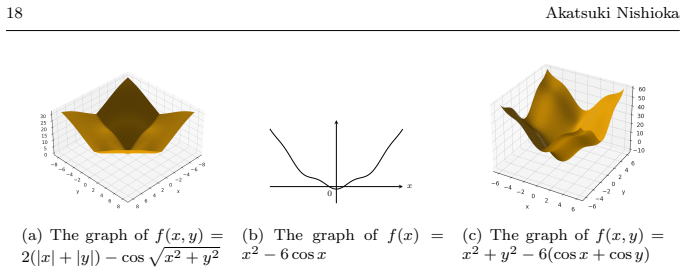
We develop several methods for constructing explicit kernel functions and establish a characterization of pseudoconvexity in terms of kernel functions. These results provide constructive tools for proving invexity of new functions and for clarifying their structural properties. We also present examples of nonsmooth, non-pseudoconvex invex functions arising in signal processing.
What carries the argument
The kernel function, a scalar-valued map that, together with a suitable vector eta, satisfies the invex inequality for a given objective f.
If this is right
- Invexity of new candidate functions can be verified directly by exhibiting one of the constructed kernels.
- The kernel form distinguishes pseudoconvex functions from broader invex classes.
- Nonsmooth invex examples from signal processing demonstrate global minimization at stationary points without pseudoconvexity.
- Structural properties of invex functions become easier to inspect once an explicit kernel is available.
Where Pith is reading between the lines
- The constructions could be applied to loss functions in machine learning to ensure stationary points yield global optima.
- Numerical checks of the kernels on concrete signal-processing datasets would test their practical range.
- The same explicit-kernel approach might extend to other generalized-convexity notions in variational problems.
Load-bearing premise
That the functions under study possess a kernel satisfying the invexity inequality for some vector-valued eta and that this kernel can be exhibited explicitly without further regularity assumptions.
What would settle it
An explicit function that is invex yet admits no kernel constructible by the paper's methods, or whose kernel fails to match the stated pseudoconvexity characterization.
Figures


read the original abstract
An invex function generalizes a convex function in the sense that every stationary point is a global minimizer. Recently, invex functions and their subclasses have attracted attention in signal processing and machine learning. However, verifying invexity is often difficult because its definition involves an unknown function called a kernel function. This paper studies kernel functions associated with invex functions, which have received relatively limited attention in the literature. In particular, we develop several methods for constructing explicit kernel functions and establish a characterization of pseudoconvexity in terms of kernel functions. These results provide constructive tools for proving invexity of new functions and for clarifying their structural properties. We also present examples of nonsmooth, non-pseudoconvex invex functions arising in signal processing.
Editorial analysis
A structured set of objections, weighed in public.
Referee Report
Summary. The paper revisits invex functions by studying their kernel functions, which are central to the definition but often difficult to verify explicitly. It develops several methods for constructing explicit kernel functions for various classes of invex functions and establishes a characterization of pseudoconvexity in terms of kernel functions. The work also includes examples of nonsmooth, non-pseudoconvex invex functions arising in signal processing, handled via subdifferential versions of the invex inequality.
Significance. If the explicit constructions and the pseudoconvexity characterization hold, the results supply constructive tools for proving invexity of new functions without relying on abstract existence arguments. This is valuable in signal processing and machine learning applications where invexity guarantees that stationary points are global minimizers, and the kernel-based characterization may clarify structural properties of pseudoconvexity.
minor comments (3)
- [Introduction] The abstract states that constructions and a characterization are given, yet the main text would benefit from a brief overview paragraph early in the introduction that enumerates the specific methods (e.g., direct substitution, algebraic manipulation) and the precise statement of the pseudoconvexity characterization before diving into details.
- [Section on nonsmooth examples] In the nonsmooth examples, the subdifferential version of the kernel inequality is used; adding a short remark on why local Lipschitz continuity (already assumed) suffices to guarantee the existence of the required eta without invoking additional regularity would improve readability for readers outside optimization theory.
- [Throughout] Notation for the kernel function and the vector-valued eta could be standardized across sections to avoid minor inconsistencies in subscript usage when moving between smooth and nonsmooth cases.
Simulated Author's Rebuttal
We thank the referee for the positive assessment of our work on explicit kernel constructions for invex functions, the kernel-based characterization of pseudoconvexity, and the signal-processing examples. We appreciate the recommendation for minor revision and the recognition of potential value in applications where invexity ensures global minimizers at stationary points.
Circularity Check
No significant circularity; derivations are constructive and self-contained
full rationale
The manuscript develops explicit kernel constructions for invex functions through direct algebraic substitutions and manipulations that satisfy the standard invex inequality by explicit choice of the vector-valued eta for given function classes. The pseudoconvexity characterization is obtained by substituting the constructed kernel into the first-order stationarity condition and verifying equivalence, without any reduction to fitted parameters or self-referential definitions. Nonsmooth cases are handled via subdifferential extensions with explicit eta selections under local Lipschitz continuity. No load-bearing self-citations, uniqueness theorems imported from prior author work, or ansatzes smuggled via citation are present; all steps build outward from the classical invex definition in a verifiable, non-circular manner.
Axiom & Free-Parameter Ledger
axioms (1)
- domain assumption Invexity is defined via existence of a kernel function eta such that f(y) >= f(x) + <nabla f(x), eta(x,y)> for all x,y.
Lean theorems connected to this paper
-
IndisputableMonolith/Cost/FunctionalEquation.leanwashburn_uniqueness_aczel echoes?
echoesECHOES: this paper passage has the same mathematical shape or conceptual pattern as the Recognition theorem, but is not a direct formal dependency.
Theorem 4.2 ... η(x,y)=h(x)/h(y)(y−x); Corollary 3 ... η(x,y)=((g(x)+c)/(g(y)+c))^2 (y−x)
-
IndisputableMonolith/Foundation/RealityFromDistinction.leanreality_from_one_distinction unclear?
unclearRelation between the paper passage and the cited Recognition theorem.
Proposition 2.1 ... every stationary point is a global minimizer
What do these tags mean?
- matches
- The paper's claim is directly supported by a theorem in the formal canon.
- supports
- The theorem supports part of the paper's argument, but the paper may add assumptions or extra steps.
- extends
- The paper goes beyond the formal theorem; the theorem is a base layer rather than the whole result.
- uses
- The paper appears to rely on the theorem as machinery.
- contradicts
- The paper's claim conflicts with a theorem or certificate in the canon.
- unclear
- Pith found a possible connection, but the passage is too broad, indirect, or ambiguous to say the theorem truly supports the claim.
Reference graph
Works this paper leans on
-
[1]
Journal of Mathematical Analysis and Applications328(2), 767–779 (2007)
Barani, A., Pouryayevali, M.R.: Invex sets and preinvex functions on Riemannian man- ifolds. Journal of Mathematical Analysis and Applications328(2), 767–779 (2007)
work page 2007
-
[2]
Proceedings of the 39th International Confer- ence on Machine Learning162, 1627–1646 (2022)
Barik, A., Honorio, J.: Sparse mixed linear regression with guarantees: Taming an in- tractable problem with invex relaxation. Proceedings of the 39th International Confer- ence on Machine Learning162, 1627–1646 (2022)
work page 2022
-
[3]
arXiv preprint arXiv:2307.04456 (2023)
Barik, A., Sra, S., Honorio, J.: Invex programs: First order algorithms and their con- vergence. arXiv preprint arXiv:2307.04456 (2023)
-
[4]
Neural Networks101, 1–14 (2018)
Bian, W., Ma, L., Qin, S., Xue, X.: Neural network for nonsmooth pseudoconvex opti- mization with general convex constraints. Neural Networks101, 1–14 (2018)
work page 2018
-
[5]
Clarke, F.H.: Optimization and Nonsmooth Analysis. SIAM, Philadelphia (1990)
work page 1990
-
[6]
Bulletin of the Australian Mathematical Society24(3), 357–366 (1981)
Craven, B.D.: Invex functions and constrained local minima. Bulletin of the Australian Mathematical Society24(3), 357–366 (1981)
work page 1981
-
[7]
Journal of the Australian Mathematical Society39(1), 1–20 (1985)
Craven, B.D., Glover, B.M.: Invex functions and duality. Journal of the Australian Mathematical Society39(1), 1–20 (1985)
work page 1985
-
[8]
Cui, Y., Pang, J.S.: Modern Nonconvex Nondifferentiable Optimization. SIAM, Philadelphia (2021)
work page 2021
-
[9]
Journal of Mathematical Analysis and Applications80(2), 545–550 (1981)
Hanson, M.A.: On sufficiency of the Kuhn–Tucker conditions. Journal of Mathematical Analysis and Applications80(2), 545–550 (1981)
work page 1981
-
[10]
Proceedings of the 33rd Conference on Learning Theory pp
Hinder, O., Sidford, A., Sohoni, N.: Near-optimal methods for minimizing star-convex functions and beyond. Proceedings of the 33rd Conference on Learning Theory pp. 1894–1938 (2020)
work page 1938
-
[11]
Springer Berlin, Heidelberg (2008)
Mishra, S.K., Giorgi, G.: Invexity and Optimization. Springer Berlin, Heidelberg (2008)
work page 2008
-
[12]
arXiv preprint arXiv:2503.02391 (2025)
Nishioka, A.: Pseudo-concave optimization of the first eigenvalue of elliptic opera- tors with application to topology optimization by homogenization. arXiv preprint arXiv:2503.02391 (2025)
-
[13]
arXiv preprint arXiv:2506.16739 (2025)
Nishioka, A., Kanno, Y.: A class of nonconvex semidefinite programming in which every KKT point is globally optimal. arXiv preprint arXiv:2506.16739 (2025)
-
[14]
Computational Optimiza- tion and Applications90, 303–336 (2024)
Nishioka, A., Toyoda, M., Tanaka, M., Kanno, Y.: On a minimization problem of the maximum generalized eigenvalue: properties and algorithms. Computational Optimiza- tion and Applications90, 303–336 (2024)
work page 2024
-
[15]
Journal of Optimization Theory and Applications92, 343–356 (1997)
Penot, J.P., Quang, P.H.: Generalized convexity of functions and generalized monotonic- ity of set-valued maps. Journal of Optimization Theory and Applications92, 343–356 (1997)
work page 1997
-
[16]
Optimization29(4), 301–309 (1994)
Pini, R.: Convexity along curves and invexity. Optimization29(4), 301–309 (1994)
work page 1994
-
[17]
Advances in Neural Information Processing Systems 35, 10,780–10,794 (2022)
Pinilla, S., Mu, T., Bourne, N., Thiyagalingam, J.: Improved imaging by invex regulariz- ers with global optima guarantees. Advances in Neural Information Processing Systems 35, 10,780–10,794 (2022)
work page 2022
-
[18]
Proceedings of the 12th International Conference on Learning Representations (2024)
Pinilla, S., Thiyagalingam, J.: Global optimality for non-linear constrained restoration problems via invexity. Proceedings of the 12th International Conference on Learning Representations (2024)
work page 2024
-
[19]
Bulletin of the Australian Mathematical Society 42(3), 437–446 (1990)
Reiland, T.W.: Nonsmooth invexity. Bulletin of the Australian Mathematical Society 42(3), 437–446 (1990)
work page 1990
-
[20]
Springer Berlin, Heidelberg (1998) 20 Akatsuki Nishioka
Rockafellar, R.T., Wets, R.J.B.: Variational Analysis. Springer Berlin, Heidelberg (1998) 20 Akatsuki Nishioka
work page 1998
-
[21]
Stancu-Minasian, I.M.: Fractional Programming: Theory, Methods and Applications. Springer, Dordrecht (2012)
work page 2012
-
[22]
Journal of Optimization Theory and Appli- cations162, 695–704 (2014)
Z˘ alinescu, C.: A critical view on invexity. Journal of Optimization Theory and Appli- cations162, 695–704 (2014)
work page 2014
discussion (0)
Sign in with ORCID, Apple, or X to comment. Anyone can read and Pith papers without signing in.