Fairness in Token Delegation: Mitigating Voting Power Concentration in DAOs
Pith reviewed 2026-05-18 09:34 UTC · model grok-4.3
The pith
Delegations in DAOs are frequently misaligned with token holders' priorities and current ranking interfaces worsen voting power concentration.
A machine-rendered reading of the paper's core claim, the machinery that carries it, and where it could break.
Core claim
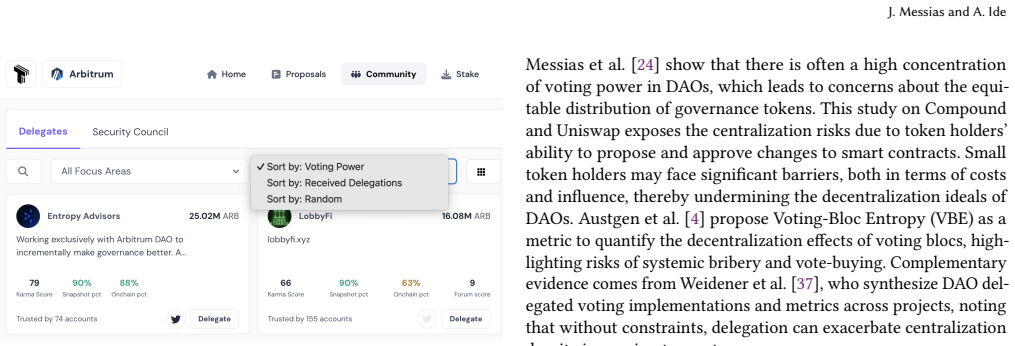
An empirical analysis of delegation in 14 DAO forums reveals that delegations are frequently misaligned with token holders' expressed priorities and that current ranking-based interfaces exacerbate power concentration. The authors argue that incorporating interest alignment into delegation processes could mitigate these imbalances and improve the representativeness of DAO decision-making.
What carries the argument
A methodology that links forum participants to on-chain addresses, extracts governance interests via large language models from posts, and compares those interests against delegates' historical voting behavior to measure alignment.
Load-bearing premise
Forum posts can be reliably linked to specific on-chain addresses and large language model extractions from those posts accurately capture token holders' true governance priorities.
What would settle it
A large-scale check of linked addresses showing that most delegations match the governance interests extracted from the corresponding forum posts would undermine the misalignment claim.
Figures


read the original abstract
Decentralized Autonomous Organizations (DAOs) aim to enable participatory governance, but in practice face challenges of voter apathy, concentration of voting power, and misaligned delegation. Existing delegation mechanisms often reinforce visibility biases, where a small set of highly ranked delegates accumulate disproportionate influence regardless of their alignment with the broader community. In this paper, we conduct an empirical study of delegation in DAO governance off-chain discussions from 14 DAO forums. We develop a methodology to link forum participants to on-chain addresses, extract governance interests using large language models, and compare these interests against delegates' historical behavior. Our analysis reveals that delegations are frequently misaligned with token holders' expressed priorities and that current ranking-based interfaces exacerbate power concentration. We argue that incorporating interest alignment into delegation processes could mitigate these imbalances and improve the representativeness of DAO decision-making. To support future research, we will release our dataset and code in a public repository.
Editorial analysis
A structured set of objections, weighed in public.
Referee Report
Summary. The paper conducts an empirical study of delegation practices across 14 DAO forums. It develops a methodology to link forum participants to on-chain addresses, uses LLMs to extract governance interests from posts, and compares these interests against delegates' historical voting records. The central findings are that delegations are frequently misaligned with token holders' expressed priorities and that ranking-based delegation interfaces exacerbate voting power concentration. The authors argue for incorporating interest alignment into delegation mechanisms to improve representativeness and plan to release the dataset and code.
Significance. If the empirical results hold after methodological validation, the work would provide concrete evidence of misalignment in DAO governance and a practical direction for interface and mechanism redesign. This could influence both academic research on decentralized governance and the development of delegation tools in production DAOs, particularly by shifting focus from visibility-based ranking to alignment-based matching.
major comments (1)
- [Data collection and address linking section] The linking methodology (described in the section on data collection and address linking) provides no precision, recall, or false-positive metrics and no manual audit of a sample of mappings. Because the misalignment statistics and conclusions about ranking interfaces rest entirely on correctly associating forum posts with specific on-chain addresses, the absence of validation directly undermines the reliability of all downstream LLM-based interest extraction and delegate-behavior comparisons. Even moderate mapping error rates would render the reported misalignment frequencies uninterpretable.
minor comments (2)
- [Abstract] The abstract states that the dataset and code will be released but does not provide a repository URL or access instructions; this detail should be added for reproducibility.
- [Throughout] Notation for 'delegates,' 'token holders,' and 'forum participants' should be defined once early in the paper and used consistently to avoid ambiguity when discussing the linking step.
Simulated Author's Rebuttal
We thank the referee for their careful reading and for highlighting the need for explicit validation of our address-linking procedure. We address this point directly below and commit to strengthening the manuscript accordingly.
read point-by-point responses
-
Referee: [Data collection and address linking section] The linking methodology (described in the section on data collection and address linking) provides no precision, recall, or false-positive metrics and no manual audit of a sample of mappings. Because the misalignment statistics and conclusions about ranking interfaces rest entirely on correctly associating forum posts with specific on-chain addresses, the absence of validation directly undermines the reliability of all downstream LLM-based interest extraction and delegate-behavior comparisons. Even moderate mapping error rates would render the reported misalignment frequencies uninterpretable.
Authors: We agree that quantitative validation of the linking step is essential for interpreting the misalignment statistics. The current manuscript describes the heuristic rules and manual spot-checks used to map forum usernames to on-chain addresses but does not report aggregate precision/recall figures or the size of the audited sample. In the revised version we will add a dedicated subsection that (i) details the manual audit protocol, (ii) reports precision, recall, and estimated false-positive rate on a randomly sampled subset of at least 200 mappings, and (iii) discusses the sensitivity of the downstream misalignment frequencies to plausible error rates. This addition will directly address the concern that moderate mapping errors could render the reported statistics uninterpretable. revision: yes
Circularity Check
Empirical observational study with no derivations or self-referential reductions
full rationale
The paper conducts an empirical analysis of delegation patterns in 14 DAOs by linking forum participants to on-chain addresses, applying LLM-based interest extraction, and comparing results to delegate voting histories. No equations, fitted parameters, or predictions are defined in terms of the target outputs. No self-citations are invoked as load-bearing uniqueness theorems or ansatzes. The central claims rest on data processing steps whose validity can be assessed externally rather than reducing tautologically to prior quantities by construction. This is a standard empirical workflow with independent content.
Axiom & Free-Parameter Ledger
axioms (2)
- domain assumption Forum posts accurately reflect token holders' governance interests
- domain assumption Forum participants can be correctly mapped to on-chain addresses
Reference graph
Works this paper leans on
- [1]
-
[2]
Shiri Alouf-Heffetz, Tanmay Inamdar, Pallavi Jain, Nimrod Talmon, and Yash More Hiren. 2024. Controlling Delegations in Liquid Democracy. InProceed- ings of the 23rd International Conference on Autonomous Agents and Multiagent Systems(Auckland, New Zealand)(AAMAS ’24). International Foundation for Autonomous Agents and Multiagent Systems, Richland, SC, 2624–2632
work page 2024
-
[3]
Shiri Alouf-Heffetz, Łukasz Janeczko, Grzegorz Lisowski, and Georgios Papa- sotiropoulos. 2025. The cost perspective of liquid democracy: feasibility and control. InProceedings of the Thirty-Ninth AAAI Conference on Artificial In- telligence and Thirty-Seventh Conference on Innovative Applications of Artifi- cial Intelligence and Fifteenth Symposium on Ed...
- [4]
-
[5]
Jan Behrens. 2017. The origins of liquid democracy.The Liquid Democracy Journal5, 2 (2017)
work page 2017
-
[6]
Christian Blum and Christina Isabel Zuber. 2016. Liquid democracy: Potentials, problems, and perspectives.Journal of political philosophy24, 2 (2016)
work page 2016
- [7]
-
[8]
Lewis Carroll. 1884. Principles of Parliamentary Representation. (1884)
-
[9]
Chaotao Chen and Jiangtao Ren. 2017. Forum latent Dirichlet allocation for user interest discovery.Knowledge-Based Systems126 (2017), 1–7
work page 2017
-
[10]
CoinMarketCap. 2025. Top DAO Tokens by Market Capitalization. https:// coinmarketcap.com/view/dao. Accessed July 2025
work page 2025
-
[11]
Abhisek Dash, Abhijnan Chakraborty, Saptarshi Ghosh, Animesh Mukherjee, and Krishna P. Gummadi. 2021. When the Umpire is also a Player: Bias in Private Label Product Recommendations on E-commerce Marketplaces. InProceedings of the 2021 ACM Conference on Fairness, Accountability, and Transparency(Virtual Event, Canada)(FAccT ’21). Association for Computing...
-
[12]
Abhisek Dash, Abhijnan Chakraborty, Saptarshi Ghosh, Animesh Mukherjee, and Krishna P. Gummadi. 2022. Alexa, in you, I trust! Fairness and Interpretability Issues in E-commerce Search through Smart Speakers. InProceedings of the ACM Web Conference 2022(Virtual Event, Lyon, France)(WWW ’22). Association for Computing Machinery, New York, NY, USA, 3695–3705...
-
[13]
Abhisek Dash, Abhijnan Chakraborty, Saptarshi Ghosh, Animesh Mukherjee, and Krishna P. Gummadi. 2023. FaiRIR: Mitigating Exposure Bias From Related Item Recommendations in Two-Sided Platforms.IEEE Transactions on Computational Social Systems10, 3 (2023), 1301–1313. doi:10.1109/TCSS.2022.3164655
-
[14]
ENS. 2023. Ethereum Name Service (ENS). https://docs.ens.domains Accessed on July 15, 2025
work page 2023
-
[15]
Etherscan. 2025. Etherscan (ETH) Blockchain Explorer. https://etherscan.io. Accessed September 2025
work page 2025
-
[16]
Mengyuan Fang, Jiatian Yu, Chaoyue Gao, and Alvin Leung. 2024. Enhanced Engagement Yet Undermined Decentralization: The Impact of Delegation on User Voting Behavior in DAO. (2024)
work page 2024
-
[17]
Rainer Feichtinger, Robin Fritsch, Lioba Heimbach, Yann Vonlanthen, and Roger Wattenhofer. 2024. SoK: Attacks on DAOs. In6th Conference on Advances in Financial Technologies (AFT 2024) (Leibniz International Proceedings in Informatics (LIPIcs), Vol. 316), Rainer Böhme and Lucianna Kiffer (Eds.). 28:1–28:27. doi:10. 4230/LIPIcs.AFT.2024.28
work page 2024
-
[18]
Emilio Frangella and Lasse Herskind. 2022. Aave v3 technical paper.Visited on 20, 08 (2022), 2022
work page 2022
-
[19]
Bundeszentrale für Politische Bildung. 2025. Wahl-O-Mat. https://www.wahl- o-mat.de/bundestagswahl2025/app/main_app.html. Accessed on February 24, 2025
work page 2025
-
[20]
Matthew Weinberg, and Edward W
Harry Kalodner, Steven Goldfeder, Xiaoqi Chen, S. Matthew Weinberg, and Edward W. Felten. 2018. Arbitrum: Scalable, private smart contracts. In27th USENIX Security Symposium
work page 2018
-
[21]
Imed Keraghel, Stanislas Morbieu, and Mohamed Nadif. 2024. Beyond Words: A Comparative Analysis of LLM Embeddings for Effective Clustering. InAdvances in Intelligent Data Analysis XXII, Ioanna Miliou, Nico Piatkowski, and Panagiotis Papapetrou (Eds.). Springer Nature Switzerland, Cham, 205–216. 9 J. Messias and A. Ide
work page 2024
-
[22]
Robert Leshner and Geoffrey Hayes. 2019. Compound: The money market protocol
work page 2019
-
[23]
Messari. 2025. Governance Taxonomy — docs.messari.io. https://docs.messari. io/glossary/governance-taxonomy. [Accessed 23-09-2025]
work page 2025
-
[24]
Johnnatan Messias, Vabuk Pahari, Balakrishnan Chandrasekaran, Krishna P. Gummadi, and Patrick Loiseau. 2024. Understanding Blockchain Gover- nance: Analyzing Decentralized Voting to Amend DeFi Smart Contracts. arXiv:2305.17655 [cs.CR] https://arxiv.org/abs/2305.17655
- [25]
- [26]
-
[27]
Apurva Shah, Axel Abels, Ann Nowé, and Tom Lenaerts. 2025. Artificial Del- egates Resolve Fairness Issues in Perpetual Voting with Partial Turnout. In Proceedings of the ACM Collective Intelligence Conference (CI ’25). Association for Computing Machinery, New York, NY, USA, 71–82. doi:10.1145/3715928.3737482
-
[28]
Tanusree Sharma, Yujin Potter, Kornrapat Pongmala, Henry Wang, Andrew Miller, Dawn Song, and Yang Wang. 2024. Unpacking How Decentralized Au- tonomous Organizations (DAOs) Work in Practice. In2024 IEEE International Conference on Blockchain and Cryptocurrency (ICBC)
work page 2024
-
[29]
Tally. 2025. Arbitrum Delegates. https://www.tally.xyz/gov/arbitrum/delegates. Accessed on February 24, 2025
work page 2025
-
[30]
Tally. 2025. Compound Delegates. https://www.tally.xyz/gov/compound/ delegates. Accessed on February 24, 2025
work page 2025
-
[31]
Tally. 2025. ENS Delegates. https://www.tally.xyz/gov/ens/delegates. Accessed on February 24, 2025
work page 2025
-
[32]
Tally. 2025. Tally: Institutional-Grade Tokens. https://www.tally.xyz. Accessed on July 17, 2025
work page 2025
-
[33]
Tally. 2025. Uniswap Delegates. https://www.tally.xyz/gov/uniswap/delegates. Accessed on February 24, 2025
work page 2025
-
[34]
Tally. 2025. ZKsync Delegates. https://www.tally.xyz/gov/zksync/delegates. Accessed on February 24, 2025
work page 2025
-
[35]
Eric Tang, Bangding Yang, and Xingyou Song. 2025. Understanding LLM Em- beddings for Regression.Transactions on Machine Learning Research(2025). https://openreview.net/forum?id=Wt6Iz5XNIO
work page 2025
-
[36]
The web3.py team. 2025. Web3.py documentation. https://web3py.readthedocs.io. Accessed September 2025
work page 2025
-
[37]
Lukas Weidener, Fabio Laredo, Kishore Kumar, and Karlin Compton. 2025. Del- egated voting in decentralized autonomous organizations: a scoping review. Frontiers in Blockchain8 (2025), 1598283
work page 2025
-
[38]
Inc Wikimedia Foundation. 2025. The rich get richer and the poor get poorer. https://en.wikipedia.org/wiki/The_rich_get_richer_and_the_poor_get_ poorer. Accessed on February 24, 2025. A Delegation Graph Statistics Table 6 reports detailed structural statistics for delegation graphs across the five studied protocols. Each graph models addresses as nodes an...
work page 2025
discussion (0)
Sign in with ORCID, Apple, or X to comment. Anyone can read and Pith papers without signing in.