Entanglement dynamics and performance of two-qubit gates for superconducting qubits under non-Markovian effects
Pith reviewed 2026-05-18 09:29 UTC · model grok-4.3
The pith
Non-Markovian qubit-reservoir correlations must be included to accurately describe disentanglement dynamics and two-qubit gate performance in superconducting systems.
A machine-rendered reading of the paper's core claim, the machinery that carries it, and where it could break.
Core claim
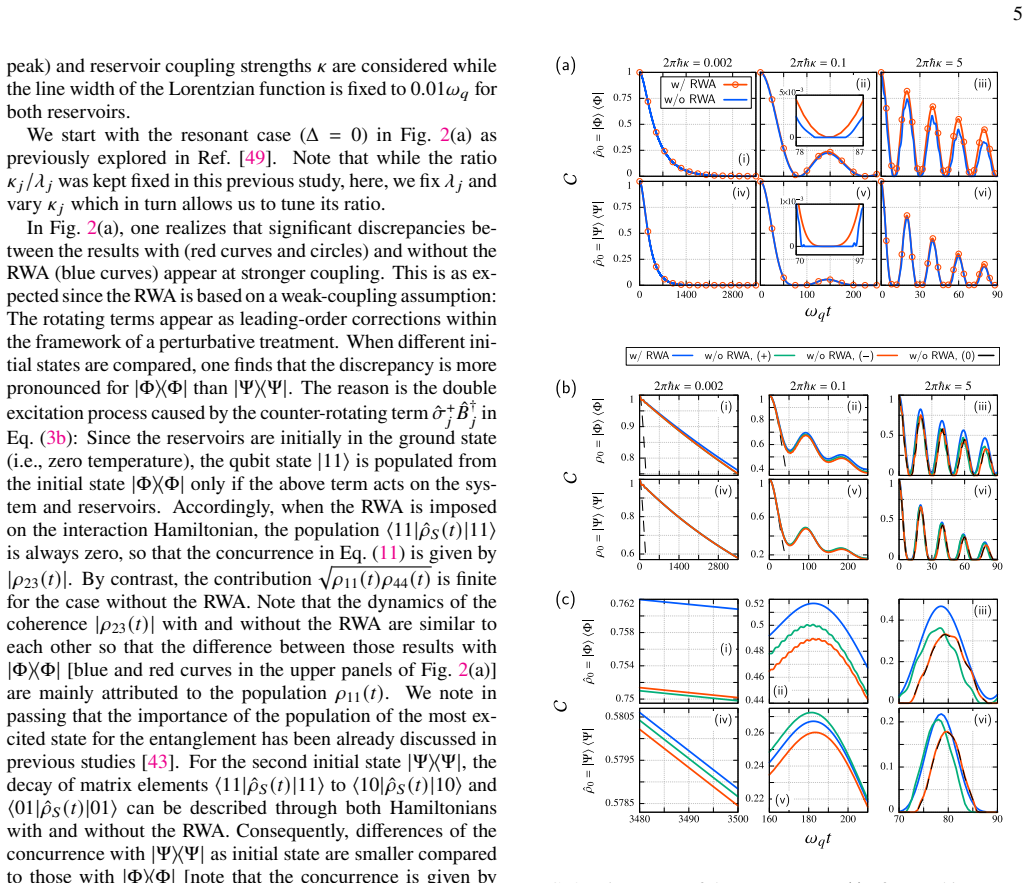
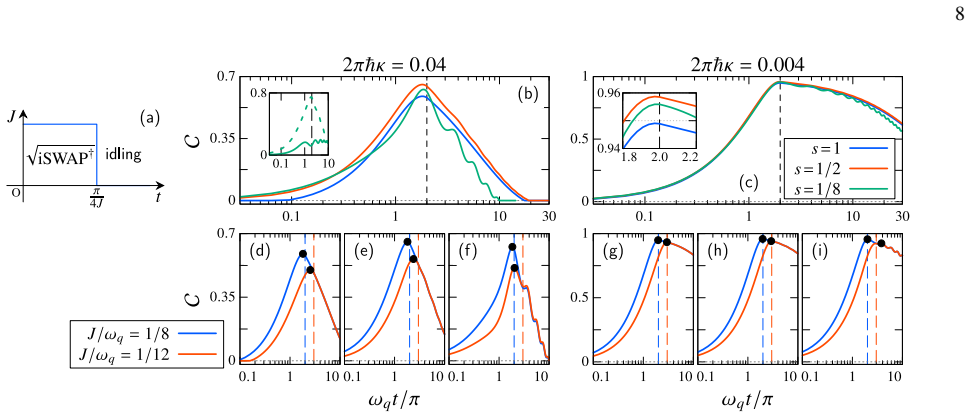
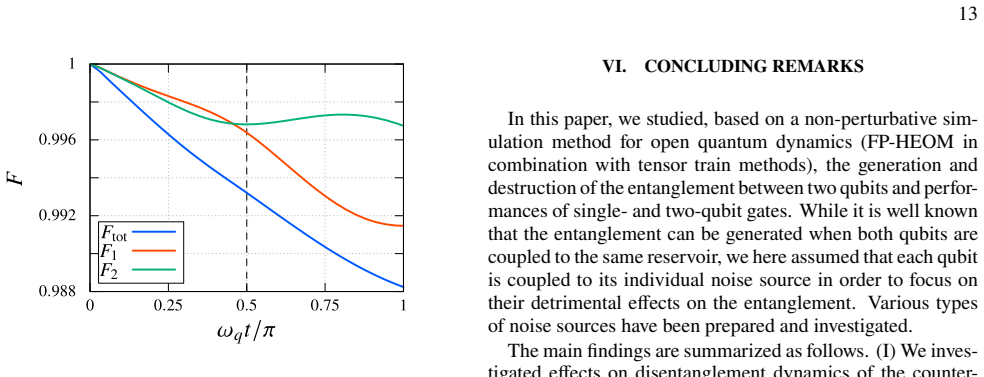
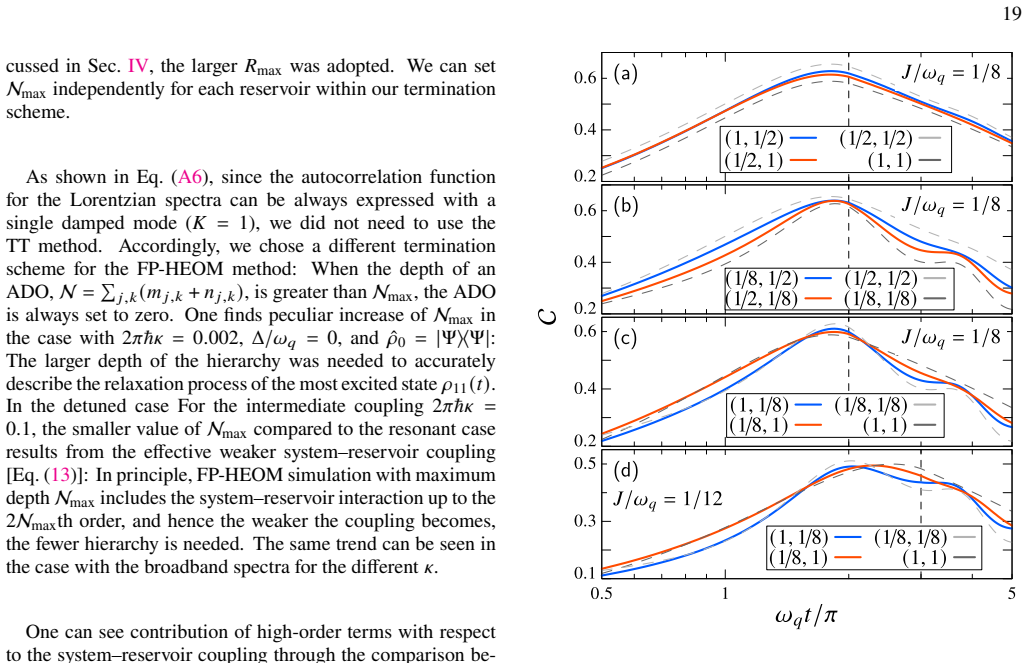
Within a numerically exact simulation technique, the dissipative dynamics of a two-qubit architecture is considered in which each qubit couples to its individual noise source. The work examines the validity of the rotating wave approximation for disentanglement, analyzes entanglement generation and destruction during and after a √iSWAP† gate with focus on reservoir memory effects, and evaluates the performance of a Hadamard + CNOT sequence under different decomposition schemes and various noise sources.
What carries the argument
Numerically exact simulation of the reduced dynamics for two qubits each coupled to its own reservoir, used to track non-Markovian memory effects and to test the rotating wave approximation.
If this is right
- The rotating wave approximation fails to capture key features of disentanglement dynamics for certain qubit parameters and reservoir spectra.
- Reservoir memory effects modify both the creation and the subsequent decay of entanglement during √iSWAP† gate operation.
- Different decompositions of the Hadamard + CNOT sequence exhibit distinct fidelity losses when non-Markovian contributions are retained.
- Accounting for individual-reservoir correlations improves predictions of gate performance across a range of noise strengths.
Where Pith is reading between the lines
- Device calibration routines could be extended to include short-time reservoir correlation measurements to adjust gate timings.
- The same simulation approach applied to three or more qubits might expose how non-Markovian errors accumulate in larger circuits.
- Reservoir spectral engineering that suppresses memory effects could be tested as a practical mitigation strategy.
Load-bearing premise
The numerically exact simulation technique accurately captures the full dissipative dynamics of each qubit coupled to its individual reservoir without introducing uncontrolled approximations beyond those explicitly tested.
What would settle it
Direct experimental measurement of concurrence decay or gate fidelity in a superconducting two-qubit device under parameters where the simulations predict clear non-Markovian deviations from rotating-wave or Markovian results; agreement with the simpler models would falsify the necessity of the full correlations.
Figures





read the original abstract
Within a numerically exact simulation technique, the dissipative dynamics of a two-qubit architecture is considered in which each qubit couples to its individual noise source (reservoir). The goal is to reveal the role of subtle qubit-reservoir correlations including non-Markovian processes as a prerequisite to guide further improvements of quantum computing devices. This paper addresses the following three topics. First, we examine the validity of the rotating wave approximation imposed previously on the qubit-reservoir coupling with respect to the disentanglement dynamics. Second, generation of the entanglement as well as destruction are analyzed by monitoring the reduced dynamics during and after application of a $\sqrt{\mbox{iSWAP}^\dagger}$ gate, also focusing on memory effects caused by reservoirs. Finally, the performance of a Hadamard + CNOT sequence is analyzed for different gate decomposition schemes. In all three cases, various types of noise sources and qubit parameters are considered.
Editorial analysis
A structured set of objections, weighed in public.
Referee Report
Summary. The paper examines the dissipative dynamics of a two-qubit superconducting architecture in which each qubit couples independently to its own reservoir. Using a numerically exact simulation technique, it investigates three topics: (i) the validity of the rotating-wave approximation for disentanglement dynamics, (ii) entanglement generation and destruction during and after a √iSWAP† gate with emphasis on reservoir memory effects, and (iii) the performance of Hadamard+CNOT sequences under different gate decompositions, considering various noise sources and qubit parameters.
Significance. If the numerical method is shown to be free of uncontrolled truncations and the reported differences between non-Markovian and Markovian/RWA cases are robust, the results would usefully quantify when subtle qubit-reservoir correlations must be retained for accurate modeling of entanglement decay and two-qubit gate fidelity in superconducting platforms. The concrete focus on experimentally relevant gates adds practical value for device characterization.
major comments (2)
- [Abstract] Abstract and opening paragraph: the assertion that a 'numerically exact simulation technique' is employed is central to the claim that non-Markovian correlations must be included. However, no explicit validation against known limits (Markovian limit, weak-coupling analytic results, or convergence with respect to bath discretization/memory cutoff) is described, nor are quantitative error bars or sensitivity tests provided. Without these, it is impossible to confirm that the reported concurrence decay rates or gate infidelities exceed any numerical artifacts.
- [Abstract] The three topics listed in the abstract each rely on the fidelity of the reduced dynamics. A direct comparison of concurrence or gate fidelity with and without the rotating-wave approximation (or with varying non-Markovian memory depth) should be presented with explicit numerical differences and statistical uncertainties to establish that the non-Markovian corrections are load-bearing rather than marginal.
minor comments (2)
- Notation for the √iSWAP† gate and the precise definition of the two-qubit Hamiltonian should be stated explicitly in the main text rather than only in the abstract.
- Figure captions (if present) should include the specific parameter values (coupling strengths, cutoff frequencies, temperature) used for each curve to allow reproducibility.
Simulated Author's Rebuttal
We thank the referee for the constructive feedback on our manuscript. We have revised the paper to include additional validations and direct comparisons as suggested. Our point-by-point responses are as follows.
read point-by-point responses
-
Referee: [Abstract] Abstract and opening paragraph: the assertion that a 'numerically exact simulation technique' is employed is central to the claim that non-Markovian correlations must be included. However, no explicit validation against known limits (Markovian limit, weak-coupling analytic results, or convergence with respect to bath discretization/memory cutoff) is described, nor are quantitative error bars or sensitivity tests provided. Without these, it is impossible to confirm that the reported concurrence decay rates or gate infidelities exceed any numerical artifacts.
Authors: We acknowledge the need for explicit validation to support the 'numerically exact' claim. In the revised manuscript, we have included a dedicated paragraph in the Methods section describing the convergence tests with respect to bath discretization and memory cutoff. We also compare our results to the Markovian limit obtained from the Lindblad equation and to weak-coupling analytics where applicable. Error estimates derived from the truncation parameters are now provided, demonstrating that the differences in concurrence decay and gate fidelities are well above numerical uncertainties. revision: yes
-
Referee: [Abstract] The three topics listed in the abstract each rely on the fidelity of the reduced dynamics. A direct comparison of concurrence or gate fidelity with and without the rotating-wave approximation (or with varying non-Markovian memory depth) should be presented with explicit numerical differences and statistical uncertainties to establish that the non-Markovian corrections are load-bearing rather than marginal.
Authors: We agree that presenting direct comparisons with quantitative differences is essential. We have updated the figures corresponding to the three topics to include comparisons with and without the rotating-wave approximation, as well as results for varying memory depths. Explicit percentage differences in key quantities (e.g., concurrence at specific times or gate infidelities) are now reported in the text and captions. Sensitivity to parameters serves as a proxy for uncertainties, shown via shaded areas in plots. These revisions confirm that non-Markovian effects lead to noticeable changes in the dynamics. revision: yes
Circularity Check
No circularity: forward numerical simulation of non-Markovian open-system dynamics
full rationale
The paper applies a numerically exact simulation technique to compute reduced dynamics, concurrence, and gate fidelities for a two-qubit system with independent reservoirs. All reported results on RWA validity, entanglement generation/destruction under √iSWAP† and Hadamard+CNOT, and memory effects follow directly from these computations across varied noise models and parameters. No equations reduce outputs to inputs by construction, no predictions are statistically forced by prior fits within the same run, and any methodological citations are not load-bearing for the central claims. The derivation chain is self-contained and externally verifiable through the described numerics.
Axiom & Free-Parameter Ledger
axioms (2)
- domain assumption Each qubit couples to its own individual noise source (reservoir).
- domain assumption A numerically exact simulation technique exists that can capture the full non-Markovian dynamics without further uncontrolled approximations.
Lean theorems connected to this paper
-
IndisputableMonolith/Cost/FunctionalEquation.leanwashburn_uniqueness_aczel unclear?
unclearRelation between the paper passage and the cited Recognition theorem.
Within a numerically exact simulation technique, the dissipative dynamics of a two-qubit architecture is considered in which each qubit couples to its individual noise source (reservoir). ... FP-HEOM method
-
IndisputableMonolith/Foundation/ArithmeticFromLogic.leanreality_from_one_distinction unclear?
unclearRelation between the paper passage and the cited Recognition theorem.
We examine the validity of the rotating wave approximation ... generation of the entanglement as well as destruction ... Hadamard + CNOT sequence
What do these tags mean?
- matches
- The paper's claim is directly supported by a theorem in the formal canon.
- supports
- The theorem supports part of the paper's argument, but the paper may add assumptions or extra steps.
- extends
- The paper goes beyond the formal theorem; the theorem is a base layer rather than the whole result.
- uses
- The paper appears to rely on the theorem as machinery.
- contradicts
- The paper's claim conflicts with a theorem or certificate in the canon.
- unclear
- Pith found a possible connection, but the passage is too broad, indirect, or ambiguous to say the theorem truly supports the claim.
Reference graph
Works this paper leans on
-
[1]
This is more difficult than the task to maintain the populations of 𝜌22 (𝑡) and 𝜌33 (𝑡) for the ideal state(|10⟩ + 𝑒𝑖 𝜑 |01⟩)/ √ 2 due to the relaxation process. Next, we turn to the performance for various spectral expo- nents,i.e.,differenttypesofreservoirs. Theaveragedfidelities andconcurrencesofthefourinitialstatesarelistedinTableIII. Again,twosequenc...
-
[2]
For the sake of simplicity, we refer interested readers to Ref
Details of the free-pole hierarchical equations of motion (FP-HEOM) Even for multiple-reservoir systems, the form of the FP- HEOM is almost the same as the original version for single- reservoir systems [34]. For the sake of simplicity, we refer interested readers to Ref. [84–86] and here only display the detailed form of the equation: 𝜕 𝜕𝑡 ˆ𝜌 ®𝑚, ®𝑛 (𝑡) ...
-
[3]
Analytical expression of the dynamics under the rotating wave approximation At zero temperature and without gate operations [Ω1 (𝑡) = Ω2 (𝑡) = 𝐽 (𝑡) = 0], the dynamics of the RDO with the Hamil- tonian in Eqs. (1) and (3a) are expressed analytically as fol- lows [39, 67, 87]: for the diagonal elements, 𝜌11 (𝑡) =𝜌11 (0)| ℎ1(𝑡)| 2|ℎ2 (𝑡)| 2 , 𝜌22 (𝑡) =𝜌22 (...
-
[4]
A. P. M. Place, L. V. H. Rodgers, P. Mundada, B. M. Smitham, M.Fitzpatrick,Z.Leng,A.Premkumar,J.Bryon,A.Vrajitoarea, S. Sussman,et al., New material platform for superconducting transmon qubits with coherence times exceeding 0.3 millisec- onds, Nat. Commun.12, 1779 (2021)
work page 2021
-
[5]
C.Wang,X.Li,H.Xu,Z.Li,J.Wang,Z.Yang,Z.Mi,X.Liang, T. Su, C. Yang,et al., Towards practical quantum computers: transmon qubit with a lifetime approaching 0.5 milliseconds, npj Quantum Inf.8, 3 (2022)
work page 2022
-
[6]
Bao,et al., High-coherence fluxonium qubits manufactured with a wafer-scale-uniformity process, Phys
F.Wang,K.Lu,H.Zhan,L.Ma,F.Wu,H.Sun,H.Deng,Y.Bai, F. Bao,et al., High-coherence fluxonium qubits manufactured with a wafer-scale-uniformity process, Phys. Rev. Applied23, 044064 (2025)
work page 2025
-
[7]
M. Tuokkola, Y. Sunada, H. Kivijärvi, J. Albanese, L. Grön- berg, J.-P. Kaikkonen, V. Vesterinen, J. Govenius, and M. Möt- tönen, Methods to achieve near-millisecond energy relaxation anddephasingtimesforasuperconductingtransmonqubit,Nat. Commun.16, 5421 (2025)
work page 2025
-
[8]
V. Negîrneac, H. Ali, N. Muthusubramanian, F. Battistel, R.Sagastizabal,M.S.Moreira,J.F.Marques,W.J.Vlothuizen, M. Beekman, C. Zachariadis,et al., High-Fidelity Controlled- 𝑍 Gate with Maximal Intermediate Leakage Operating at the Speed Limit in a Superconducting Quantum Processor, Phys. Rev. Lett.126, 220502 (2021)
work page 2021
-
[9]
Y. Sung, L. Ding, J. Braumüller, A. Vepsäläinen, B. Kannan, M.Kjaergaard, A.Greene, G.O.Samach, C.McNally, D.Kim, 21 et al., Realization of High-Fidelity CZ and𝑍 𝑍-Free iSWAP GateswithaTunableCoupler,Phys.Rev.X 11,021058(2021)
work page 2021
-
[10]
A.Kandala,K.X.Wei,S.Srinivasan,E.Magesan,S.Carnevale, G.A.Keefe,D.Klaus,O.Dial,andD.C.McKay,Demonstration of a High-Fidelitycnot Gate for Fixed-Frequency Transmons with Engineered𝑍 𝑍Suppression, Phys. Rev. Lett.127, 130501 (2021)
work page 2021
-
[11]
R.Li,K.Kubo,Y.Ho,Z.Yan,Y.Nakamura,andH.Goto,Real- ization of High-Fidelity CZ Gate Based on a Double-Transmon Coupler, Phys. Rev. X14, 041050 (2024)
work page 2024
- [12]
- [13]
-
[14]
Google Quantum AI, Suppressing quantum errors by scaling a surface code logical qubit, Nature (London)614, 676 (2023)
work page 2023
-
[15]
Y. Kim, A. Eddins, S. Anand, K. X. Wei, E. van den Berg, S. Rosenblatt, H. Nayfeh, Y. Wu, M. Zaletel, K. Temme,et al., Evidence for the utility of quantum computing before fault tol- erance, Nature (London)618, 500 (2023)
work page 2023
-
[16]
V.Havlíček,A.D.Córcoles,K.Temme,A.W.Harrow,A.Kan- dala,J.M.Chow,andJ.M.Gambetta,Supervisedlearningwith quantum-enhanced feature spaces, Nature (London)567, 209 (2019)
work page 2019
-
[17]
A. Kandala, A. Mezzacapo, K. Temme, M. Takita, M. Brink, J.M.Chow,andJ.M.Gambetta,Hardware-efficientvariational quantumeigensolverforsmallmoleculesandquantummagnets, Nature (London)549, 242 (2017)
work page 2017
-
[18]
M.Rossmannek,F.Pavošević,A.Rubio,andI.Tavernelli,Quan- tum Embedding Method for the Simulation of Strongly Corre- latedSystemsonQuantumComputers,J.Phys.Chem.Lett. 14, 3491 (2023)
work page 2023
-
[19]
M.Willsch,D.Willsch,F.Jin,H.DeRaedt,andK.Michielsen, Benchmarking the quantum approximate optimization algo- rithm, Quantum Inf. Process.19, 197 (2020)
work page 2020
-
[20]
G. García-Pérez, M. A. C. Rossi, and S. Maniscalco, IBM Q Experience as a versatile experimental testbed for simulating open quantum systems, npj Quantum Inf.6, 1 (2020)
work page 2020
-
[21]
X. Dan, E. Geva, and V. S. Batista, Simulating Non-Markovian QuantumDynamicsonNISQComputersUsingtheHierarchical EquationsofMotion,J.Chem.TheoryComput. 21,1530(2025)
work page 2025
- [22]
-
[23]
D.Ristè,C.C.Bultink,M.J.Tiggelman,R.N.Schouten,K.W. Lehnert,andL.DiCarlo,Millisecondcharge-parityfluctuations and induced decoherence in a superconducting transmon qubit, Nat. Commun.4, 1913 (2013)
work page 1913
-
[24]
L. Cardani, F. Valenti, N. Casali, G. Catelani, T. Charpen- tier, M. Clemenza, I. Colantoni, A. Cruciani, G. D’Imperio, L. Gironi,et al., Reducing the impact of radioactivity on quan- tum circuits in a deep-underground facility, Nat. Commun.12, 2733 (2021)
work page 2021
-
[25]
X.Pan,Y.Zhou,H.Yuan,L.Nie,W.Wei,L.Zhang,J.Li,S.Liu, Z. H. Jiang, G. Catelani,et al., Engineering superconducting qubitstoreducequasiparticlesandchargenoise,Nat.Commun. 13, 7196 (2022)
work page 2022
-
[26]
J. Tuorila, J. Stockburger, T. Ala-Nissila, J. Ankerhold, and M. Möttönen, System-environment correlations in qubit initial- ization and control, Phys. Rev. Research1, 013004 (2019)
work page 2019
-
[27]
A. P. Babu, J. Tuorila, and T. Ala-Nissila, State leakage during fastdecayandcontrolofasuperconductingtransmonqubit,npj Quantum Inf.7, 30 (2021)
work page 2021
-
[28]
Fast estimation of physical error contributions of quantum gates, 2023
M. Papič, A. Auer, and I. de Vega, Fast Estimation of Physical Error Contributions of Quantum Gates, arXiv:2305.08916
-
[29]
K. Nakamura and J. Ankerhold, Gate operations for supercon- ducting qubits and non-Markovianity, Phys. Rev. Research6, 033215 (2024)
work page 2024
-
[30]
B. Gulácsi and G. Burkard, Temporally correlated quantum noise in driven quantum systems with applications to quantum gate operations, Phys. Rev. Res.7, 023073 (2025)
work page 2025
-
[31]
B. Gulácsi and G. Burkard, Signatures of non-Markovianity of a superconducting qubit, Phys. Rev. B107, 174511 (2023)
work page 2023
-
[32]
K. Nakamura and J. Ankerhold, Qubit dynamics beyond Lind- blad: Non-Markovianity versus rotating wave approximation, Phys. Rev. B109, 014315 (2024)
work page 2024
-
[33]
K. Nakamura and J. Ankerhold, Impact of time-retarded noise ondynamical decouplingschemesfor qubits,Phys.Rev. B 111, 064503 (2025)
work page 2025
-
[34]
A.P.Babu,T.Orell,V.Vadimov,W.Teixeira,M.Möttönen,and M. Silveri, Quantum error correction under numerically exact open-quantum-systemdynamics,Phys.Rev.Research 5,043161 (2023)
work page 2023
- [35]
- [36]
-
[37]
M. Xu, Y. Yan, Q. Shi, J. Ankerhold, and J. T. Stockburger, TamingQuantumNoiseforEfficientLowTemperatureSimula- tions of Open Quantum Systems, Phys. Rev. Lett.129, 230601 (2022)
work page 2022
- [38]
-
[39]
T.YuandJ.H.Eberly,Suddendeathofentanglement: Classical noise effects, Opt. Commun.264, 393 (2006)
work page 2006
-
[40]
T.YuandJ.H.Eberly,QuantumOpenSystemTheory: Bipartite Aspects, Phys. Rev. Lett.97, 140403 (2006)
work page 2006
-
[41]
C. E. López, G. Romero, F. Lastra, E. Solano, and J. C. Re- tamal, Sudden Birth versus Sudden Death of Entanglement in Multipartite Systems, Phys. Rev. Lett.101, 080503 (2008)
work page 2008
-
[42]
B. Bellomo, R. Lo Franco, and G. Compagno, Non-Markovian Effects on the Dynamics of Entanglement, Phys. Rev. Lett.99, 160502 (2007)
work page 2007
-
[43]
B. Bellomo, R. Lo Franco, and G. Compagno, Entanglement dynamics of two independent qubits in environments with and without memory, Phys. Rev. A77, 032342 (2008)
work page 2008
-
[44]
B. Bellomo, R. L. Franco, S. Maniscalco, and G. Com- pagno,Two-qubitentanglementdynamicsfortwodifferentnon- Markovian environments, Phys. Scr.2010, 014014 (2010)
work page 2010
-
[45]
M. Governale, M. Grifoni, and G. Schön, Decoherence and dephasing in coupled Josephson-junction qubits, Chem. Phys. 268, 273 (2001)
work page 2001
-
[46]
M. Ikram, F.-l. Li, and M. S. Zubairy, Disentanglement in a two-qubit system subjected to dissipation environments, Phys. Rev. A75, 062336 (2007)
work page 2007
-
[47]
A.Al-QasimiandD.F.V.James,Suddendeathofentanglement at finite temperature, Phys. Rev. A77, 012117 (2008)
work page 2008
-
[48]
X.CaoandH.Zheng,Non-Markoviandisentanglementdynam- ics of a two-qubit system, Phys. Rev. A77, 022320 (2008)
work page 2008
-
[49]
J.Ma,Z.Sun,X.Wang,andF.Nori,Entanglementdynamicsof two qubits in a common bath, Phys. Rev. A85, 062323 (2012). 22
work page 2012
-
[50]
L.-A. Wu, C. X. Yu, and D. Segal, Exact dynamics of interact- ing qubits in a thermal environment: results beyond the weak coupling limit, New J. Phys.15, 023044 (2013)
work page 2013
-
[51]
L. Duan, H. Wang, Q.-H. Chen, and Y. Zhao, Entanglement dynamics of two qubits coupled individually to Ohmic baths, The Journal of Chemical Physics139, 044115 (2013)
work page 2013
-
[52]
C. Wang and Q.-H. Chen, Exact dynamics of quantum correla- tions of two qubits coupled to bosonic baths, New J. Phys.15, 103020 (2013)
work page 2013
- [53]
- [54]
-
[55]
A. G. Dijkstra and Y. Tanimura, Non-Markovian Entanglement Dynamics in the Presence of System-Bath Coherence, Phys. Rev. Lett.104, 250401 (2010)
work page 2010
-
[56]
H.-T. Wang, C.-F. Li, Y. Zou, R.-C. Ge, and G.-C. Guo, Non- Markovianentanglementsuddendeathandrebirthofatwo-qubit systeminthepresenceofsystem-bathcoherence,PhysicaA 390, 3183 (2011)
work page 2011
-
[57]
E. Paladino, A. D’Arrigo, A. Mastellone, and G. Falci, Relax- ationprocessesinsolid-statetwo-qubitgates,PhysicaE 42,439 (2010)
work page 2010
-
[58]
E. Paladino, A. D’Arrigo, A. Mastellone, and G. Falci, Deco- herence times of universal two-qubit gates in the presence of broad-band noise, New J. Phys.13, 093037 (2011)
work page 2011
-
[59]
A.D’ArrigoandE.Paladino,Optimaloperatingconditionsofan entanglingtwo-transmongate,NewJ.Phys. 14,053035(2012)
work page 2012
-
[60]
D.LossandD.P.DiVincenzo,Quantumcomputationwithquan- tum dots, Phys. Rev. A57, 120 (1998)
work page 1998
-
[61]
M.ThorwartandP.Hänggi,Decoherenceanddissipationduring aquantumXORgateoperation,Phys.Rev.A 65,012309(2001)
work page 2001
-
[62]
Y. C. Cheng and R. J. Silbey, Stochastic Liouville equation approachfortheeffectofnoiseinquantumcomputations,Phys. Rev. A69, 052325 (2004)
work page 2004
-
[63]
M.J.Storcz, F.Hellmann, C.Hrelescu,andF.K.Wilhelm,De- coherence of a two-qubit system away from perfect symmetry, Phys. Rev. A72, 052314 (2005)
work page 2005
-
[64]
S. Maniscalco, F. Francica, R. L. Zaffino, N. Lo Gullo, and F. Plastina, Protecting Entanglement via the Quantum Zeno Ef- fect, Phys. Rev. Lett.100, 090503 (2008)
work page 2008
-
[65]
A. D’Arrigo, A. Mastellone, E. Paladino, and G. Falci, Effects of low-frequency noise cross-correlations in coupled supercon- ducting qubits, New J. Phys.10, 115006 (2008)
work page 2008
-
[66]
L.Mazzola,S.Maniscalco,J.Piilo,K.-A.Suominen,andB.M. Garraway, Sudden death and sudden birth of entanglement in commonstructuredreservoirs,Phys.Rev.A 79,042302(2009)
work page 2009
-
[67]
D. Kast and J. Ankerhold, Bipartite entanglement dynamics of two-level systems in sub-Ohmic reservoirs, Phys. Rev. B90, 100301 (2014)
work page 2014
-
[68]
R. Hartmann and W. T. Strunz, Environmentally Induced En- tanglement — Anomalous Behavior in the Adiabatic Regime, Quantum4, 347 (2020)
work page 2020
-
[69]
A.CaldeiraandA.Leggett,Quantumtunnellinginadissipative system, Ann. Phys.149, 374 (1983)
work page 1983
-
[70]
H.-P. Breuer and F. Petruccione,The Theory of Open Quantum Systems(Oxford University Press, Oxford, 2002)
work page 2002
-
[71]
Weiss,Quantum Dissipative Systems, 4th ed
U. Weiss,Quantum Dissipative Systems, 4th ed. (World Scien- tific, Singapore, 2012)
work page 2012
-
[72]
A. Barone and G. Paternò,Physics and Applications of the Josephson Effect(John Wiley & Sons, New York, 1982)
work page 1982
-
[73]
G.WendinandV.S.Shumeiko,SuperconductingQuantumCir- cuits, Qubits and Computing, arXiv:cond-mat/0508729
work page internal anchor Pith review Pith/arXiv arXiv
-
[74]
L. I. Glazman and G. Catelani, Bogoliubov quasiparticles in superconducting qubits, SciPost Phys. Lect. Notes31(2021)
work page 2021
-
[75]
Machlup, Noise in Semiconductors: Spectrum of a Two- Parameter Random Signal, J
S. Machlup, Noise in Semiconductors: Spectrum of a Two- Parameter Random Signal, J. Appl. Phys.25, 341 (1954)
work page 1954
-
[76]
E. Paladino, Y. M. Galperin, G. Falci, and B. L. Altshuler,1/ 𝑓 noise: Implications for solid-state quantum information, Rev. Mod. Phys.86, 361 (2014)
work page 2014
- [77]
-
[78]
J. Bylander, S. Gustavsson, F. Yan, F. Yoshihara, K. Harrabi, G.Fitch,D.G.Cory,Y.Nakamura,J.-S.Tsai,andW.D.Oliver, Noise spectroscopy through dynamical decoupling with a su- perconducting flux qubit, Nat. Phys.7, 565 (2011)
work page 2011
-
[79]
A. J. Leggett, S. Chakravarty, A. T. Dorsey, M. P. A. Fisher, A.Garg,andW.Zwerger,Dynamicsofthedissipativetwo-state system, Rev. Mod. Phys.59, 1 (1987)
work page 1987
-
[80]
Z. Wang, W. Wu, and J. Wang, Steady-state entanglement and coherenceoftwocoupledqubitsinequilibriumandnonequilib- rium environments, Phys. Rev. A99, 042320 (2019)
work page 2019
discussion (0)
Sign in with ORCID, Apple, or X to comment. Anyone can read and Pith papers without signing in.