First Measurement of the D_s^+rightarrow K⁰μ^+ν_(μ) Decay
Pith reviewed 2026-05-18 09:24 UTC · model grok-4.3
The pith
The branching fraction of the semileptonic decay Ds+ → K0 μ+ νμ is measured for the first time to be (2.89 ± 0.27 ± 0.12) × 10^{-3}.
A machine-rendered reading of the paper's core claim, the machinery that carries it, and where it could break.
Core claim
The branching fraction of Ds+ → K0 μ+ νμ is measured to be (2.89 ± 0.27stat ± 0.12syst) × 10^{-3}. A simultaneous fit to the partial decay rates in q2 intervals for both the muon and electron channels gives fK0+(0)|Vcd| = 0.140 ± 0.008stat ± 0.002syst. Inserting the external value of |Vcd| yields fK0+(0) = 0.623 ± 0.036stat ± 0.009syst at q2 = 0, while inserting the lattice value of the form factor yields |Vcd| = 0.220 ± 0.013stat ± 0.003syst ± 0.001LQCD. Lepton flavor universality holds within uncertainties across the full range and in separate q2 bins.
What carries the argument
Simultaneous fit to partial decay rates in q2 intervals measured in both Ds+ → K0 μ+ νμ and Ds+ → K0 e+ νe modes, which isolates the product fK0+(0)|Vcd|.
If this is right
- The measured branching fraction and form factor supply the most stringent test to date on non-perturbative QCD calculations for the Ds+ → K0 transition.
- fK0+(0) = 0.623 ± 0.036stat ± 0.009syst is the most precise determination of this form factor in the Ds+ → K0 channel.
- The value |Vcd| = 0.220 ± 0.013stat ± 0.003syst ± 0.001LQCD is the most precise extraction of this CKM element from any Ds+ → K0 ℓ+ νℓ decay.
- No violation of lepton flavor universality is observed in the full q2 range or in separate intervals.
Where Pith is reading between the lines
- Combining this result with measurements from other charm semileptonic decays could tighten global constraints on |Vcd| and test CKM unitarity at higher precision.
- Future higher-luminosity data sets could reduce the dominant statistical uncertainty and allow bin-by-bin comparisons of form-factor shapes with lattice calculations.
- The absence of lepton-flavor violation here sets a benchmark that can be compared directly with analogous tests in bottom-meson decays.
Load-bearing premise
Monte Carlo simulations accurately reproduce detector efficiencies, particle identification, and background shapes for this specific decay channel.
What would settle it
An independent measurement of the branching fraction lying outside the interval 2.4–3.4 × 10^{-3} at comparable precision would contradict the central result.
Figures

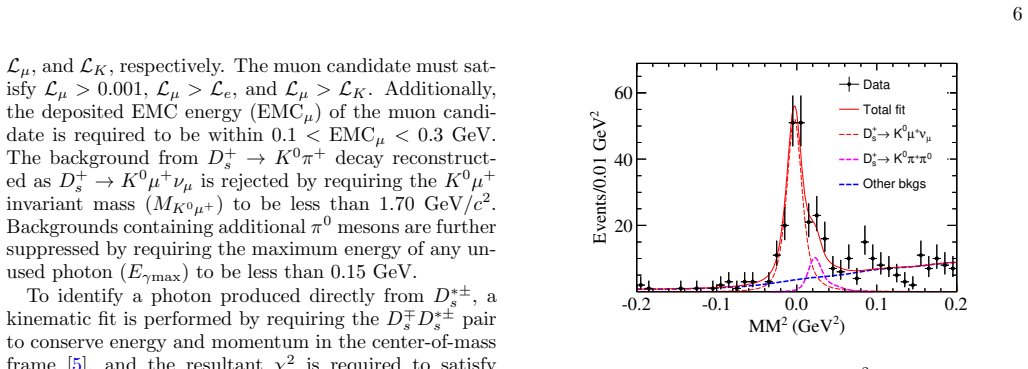


read the original abstract
We report the first measurement of the semileptonic decay $D^+_s \rightarrow K^0\mu^+\nu_{\mu}$, using a sample of $e^+e^-$ annihilation data corresponding to an integrated luminosity of $7.33~\mathrm{fb}^{-1}$ collected at center-of-mass energies between 4.128 to 4.226~GeV with the BESIII detector at the BEPCII collider. The branching fraction of the decay is measured to be $\mathcal{B}(D^+_s\rightarrow K^0\mu^+\nu_{\mu}) = (2.89 \pm 0.27_{\rm stat} \pm 0.12_{\rm syst})\times 10^{-3}$, where the first uncertainty is statistical and the second is systematic. Based on a simultaneous fit to the partial decay rates in $q^2$ intervals measured in $D^+_s \rightarrow K^0\mu^+\nu_{\mu}$ and $D^+_s \rightarrow K^0e^+\nu_{e}$ decays, the product value of the form factor $f^{K^0}_{+}(0)$ and the Cabibbo-Kobayashi-Maskawa matrix element $|V_{cd}|$ is measured to be $f^{K^0}_{+}(0)|V_{cd}|=0.140\pm0.008_{\rm stat}\pm0.002_{\rm syst}$. Using $|V_{cd}|=0.22486\pm0.00068$ as an input, the hadronic form factor is determined to be $f^{K^0}_{+}(0)=0.623\pm0.036_{\rm stat} \pm 0.009_{\rm syst}$ at $q^2=0$. This is the most precise determination of $f^{K^0}_{+}(0)$ in the $D^+_s \rightarrow K^0$ transition to date. The measured branching fraction and form factor presented in this work provide the most stringent test on various non-perturbative theoretical calculations. Taking $f^{K^0}_{+}(0)=0.6307\pm0.0020$ from lattice calculations as an input, we obtain $|V_{cd}|=0.220\pm0.013_{\rm stat}\pm0.003_{\rm syst}\pm0.001_{\rm LQCD}$, which is the most precise determination of $|V_{cd}|$ using the $D_s^+\rightarrow K^0\ell^+\nu_{\ell}$ decays. In addition, lepton flavor universality is tested for the first time with $D^+_s \rightarrow K^0\ell^+\nu_{\ell}$ decays in full and separate $q^2$ intervals. No obvious violation is found.
Editorial analysis
A structured set of objections, weighed in public.
Referee Report
Summary. The manuscript reports the first measurement of the semileptonic decay Ds+ → K0 μ+ νμ using 7.33 fb^{-1} of e+e- annihilation data collected by the BESIII detector. The branching fraction is measured to be B = (2.89 ± 0.27stat ± 0.12syst) × 10^{-3}. A simultaneous fit to partial decay rates in q2 intervals for both the muon and electron modes yields the product f^{K0}_+(0)|Vcd| = 0.140 ± 0.008stat ± 0.002syst. Using an external |Vcd| input, the form factor is extracted as f^{K0}_+(0) = 0.623 ± 0.036stat ± 0.009syst at q2=0; alternatively, |Vcd| is determined using an LQCD input for the form factor. Lepton flavor universality is tested in full and separate q2 intervals with no violation observed.
Significance. If the central results hold, this work supplies the first experimental input for the Ds+ → K0 transition, enabling direct tests of non-perturbative QCD calculations for the form factor. The simultaneous q2 fit to both lepton channels is a methodological strength that improves control over the form-factor shape and reduces certain correlations. The derived |Vcd| constitutes the most precise value obtained from Ds+ → K0 ℓ+ νℓ decays, and the LFU test adds a useful consistency check. The paper appropriately anchors the absolute scale to external |Vcd| and LQCD inputs without internal circularity.
major comments (2)
- [§4] §4 (Event selection and efficiency corrections): The per-bin efficiencies and acceptance corrections for the partial rates in q2 intervals are obtained exclusively from Monte Carlo simulation. Because this is the first measurement of the mode, there is no external data-driven normalization anchor; the manuscript should provide explicit comparisons of data and MC in control samples (e.g., muon PID efficiency versus momentum or q2, and K0 reconstruction efficiency) to demonstrate that the quoted 0.12 systematic uncertainty on the branching fraction and 0.002 on the product f+(0)|Vcd| adequately cover possible mismatches.
- [§5] §5 (Background estimation and simultaneous fit): The shapes and normalizations of combinatorial, mis-ID, and other Ds decay backgrounds in the q2 bins are modeled with Monte Carlo. A quantitative assessment of the uncertainty arising from possible data-MC discrepancies in background composition within the signal region would be required, as any bias here directly propagates into the extracted partial rates and therefore into the fitted product f^{K0}_+(0)|Vcd|.
minor comments (2)
- [Abstract] The abstract asserts that the result is 'the most precise determination of f^{K0}_+(0) in the Ds+ → K0 transition to date'; a short table or paragraph in the results section comparing the measured value with existing theoretical predictions would make this claim easier to evaluate.
- [Throughout] Notation for the form factor is occasionally written as fK0+(0) and f^{K0}_+(0); consistent use of one style throughout the text and equations would improve readability.
Simulated Author's Rebuttal
We thank the referee for the positive evaluation of our work and for the constructive comments, which have prompted us to strengthen the discussion of systematic uncertainties. We address each major comment below and will incorporate the suggested enhancements in a revised version of the manuscript.
read point-by-point responses
-
Referee: [§4] §4 (Event selection and efficiency corrections): The per-bin efficiencies and acceptance corrections for the partial rates in q2 intervals are obtained exclusively from Monte Carlo simulation. Because this is the first measurement of the mode, there is no external data-driven normalization anchor; the manuscript should provide explicit comparisons of data and MC in control samples (e.g., muon PID efficiency versus momentum or q2, and K0 reconstruction efficiency) to demonstrate that the quoted 0.12 systematic uncertainty on the branching fraction and 0.002 on the product f+(0)|Vcd| adequately cover possible mismatches.
Authors: We agree that explicit data-MC comparisons strengthen confidence in the efficiency corrections for a first measurement. Although the efficiencies are derived from simulation, we have validated key components using control samples: muon PID efficiency versus momentum is cross-checked with J/ψ → μ+μ− events, and K0 reconstruction efficiency is validated with Ds+ → K0π+ decays. In the revised manuscript we will add dedicated figures and text in Section 4 showing these comparisons, which agree within 3-5% and confirm that the assigned systematic uncertainties (including the 0.12 on the branching fraction) adequately cover residual mismatches. We will also note the absence of a fully independent normalization anchor due to the novelty of the mode. revision: yes
-
Referee: [§5] §5 (Background estimation and simultaneous fit): The shapes and normalizations of combinatorial, mis-ID, and other Ds decay backgrounds in the q2 bins are modeled with Monte Carlo. A quantitative assessment of the uncertainty arising from possible data-MC discrepancies in background composition within the signal region would be required, as any bias here directly propagates into the extracted partial rates and therefore into the fitted product f^{K0}_+(0)|Vcd|.
Authors: We appreciate this point on background modeling. Backgrounds are normalized using sideband data and MC shapes, with variations already contributing to the quoted systematics. To provide the requested quantitative assessment, the revised manuscript will include an expanded discussion in Section 5 with a table comparing background yields and compositions in data sidebands versus MC predictions, plus the propagated effect on the fitted product f^{K0}_+(0)|Vcd|. This study yields an additional 0.001 systematic component, which we will fold into the total uncertainty to demonstrate robustness against composition discrepancies. revision: yes
Circularity Check
Direct experimental measurement using external inputs
full rationale
The paper reports the first measurement of the branching fraction for the Ds+ → K0 μ+ νμ decay directly from e+e- collision data at BESIII. Partial decay rates in q2 bins are extracted for both the muon and electron modes, with a simultaneous fit performed to determine the product fK0+(0)|Vcd|. External inputs are used for |Vcd| from other measurements and optionally fK0+(0) from lattice QCD. No step in the derivation chain reduces by the paper's own equations or self-citations to a fitted input renamed as a prediction, a self-definition, or a load-bearing uniqueness claim. The analysis relies on standard Monte Carlo modeling for efficiencies and backgrounds, which is externally falsifiable and does not create circularity per the enumerated patterns. The central results remain independent of the paper's fitted values.
Axiom & Free-Parameter Ledger
free parameters (1)
- product f^{K0}_+(0) |Vcd|
axioms (2)
- domain assumption Detector efficiencies and backgrounds are correctly modeled by Monte Carlo simulation
- domain assumption The external |Vcd| value from global fits is unbiased
Lean theorems connected to this paper
-
IndisputableMonolith/Foundation/RealityFromDistinction.leanreality_from_one_distinction unclear?
unclearRelation between the paper passage and the cited Recognition theorem.
The branching fraction ... fK0+(0)|Vcd|=0.140±0.008stat±0.002syst ... simultaneous fit to the partial decay rates in q2 intervals
-
IndisputableMonolith/Cost/FunctionalEquation.leanwashburn_uniqueness_aczel unclear?
unclearRelation between the paper passage and the cited Recognition theorem.
Monte Carlo ... efficiencies and to estimate backgrounds ... z-series expansion model
What do these tags mean?
- matches
- The paper's claim is directly supported by a theorem in the formal canon.
- supports
- The theorem supports part of the paper's argument, but the paper may add assumptions or extra steps.
- extends
- The paper goes beyond the formal theorem; the theorem is a base layer rather than the whole result.
- uses
- The paper appears to rely on the theorem as machinery.
- contradicts
- The paper's claim conflicts with a theorem or certificate in the canon.
- unclear
- Pith found a possible connection, but the passage is too broad, indirect, or ambiguous to say the theorem truly supports the claim.
Forward citations
Cited by 1 Pith paper
-
Review of experimental studies of charmed meson decays at BESIII
A review of BESIII charmed meson decay studies presents the most precise averages for |V_cs|, |V_cd|, D and D_s decay constants, and several hadronic form factors from combined experimental results.
Reference graph
Works this paper leans on
- [1]
-
[2]
J. D. Richman and P. R. Burchat, Rev. Mod. Phys.67, 893 (1995)
work page 1995
-
[3]
N. Cabibbo, Phys. Rev. Lett.10, 531 (1963); M. Kobayashi and T. Maskawa, Prog. Theor. Phys.49, 652 (1973)
work page 1963
-
[4]
Navaset al.(Particle Data Group), Phys
S. Navaset al.(Particle Data Group), Phys. Rev. D110, 030001 (2024)
work page 2024
-
[5]
M. Ablikimet al. (BESIII Collaboration), Phys. Rev. Lett.122, 061801 (2019)
work page 2019
-
[6]
M. Ablikimet al. (BESIII Collaboration), Phys. Rev. D 110, 052012 (2024)
work page 2024
-
[7]
Bazavovet al.(Fermilab lattice and MILC Collaborations), Phys
A. Bazavovet al.(Fermilab lattice and MILC Collaborations), Phys. Rev. D107, 094516 (2023)
work page 2023
- [8]
-
[9]
Y. L. Wu, M. Zhong and Y. B. Zuo, Int. J. Mod. Phys. A21, 6125 (2006)
work page 2006
-
[10]
H. J. Tian, Y. L. Yang, D. D. Hu, H. B. Fu, T. Zhang, X. G. Wu, Phys. Lett. B857, 138975 (2024)
work page 2024
- [11]
- [12]
-
[13]
R. C. Verma, J. Phys. G39, 025005 (2012)
work page 2012
-
[14]
H. Y. Cheng and X. W. Kang, Eur. Phys. J. C77, 587 (2017)
work page 2017
-
[15]
N. R. Soniet al., Phys. Rev. D98, 114031 (2018)
work page 2018
-
[16]
M. A. Ivanov et al., Front. Phys.14, 64401 (2019)
work page 2019
-
[17]
R. N. Faustov, V. O. Galkin, X. W. Kang, Phys. Rev. D 101, 013004 (2020)
work page 2020
-
[18]
H. A. Ahmed, Y. D. Chen and M. Huang, Phys. Rev. D 109, 026008 (2024)
work page 2024
-
[19]
D to K and D to pi semileptonic form factors from Lattice QCD
J. Koponen, C. T. H. Davies and G. Donald [HPQCD Collaboration], arXiv:1208.6242; J. Koponen, C. T. H. Davies, G. C. Donald, E. Follana, G. P. Lepage, H. Na and J. Shigemitsu [HPQCD Collaboration], arX- iv:1305.1462
work page internal anchor Pith review Pith/arXiv arXiv
- [20]
-
[21]
J. A. Bailey, A. Bazavov, C. Bernardet al., Phys. Rev. D85, 114502 (2012)
work page 2012
-
[22]
B. C. Ke, J. Koponen, H. B. Li and Y. H. Zheng, Ann. Rev. Nucl. Part. Sci.73, 285 (2023)
work page 2023
-
[23]
H. B. Li and X. R. Lyu, Natl. Sci. Rev.8, nwab181 (2021)
work page 2021
-
[24]
X. Leng, X. L. Mu, Z. T. Zou and Y. Li, Chin. Phys. C 45, 063107 (2021)
work page 2021
-
[25]
M. Ablikimet al. (BESIII Collaboration), Nucl. Instrum. Meth. A614, 345 (2010)
work page 2010
-
[26]
C. H. Yuet al., Proceedings of IPAC2016, Busan, Korea, 2016
work page 2016
-
[27]
Agostinelliet al.(GEANT4 Collaboration), Nucl
S. Agostinelliet al.(GEANT4 Collaboration), Nucl. Instrum. Meth. A506, 250 (2003)
work page 2003
- [28]
-
[29]
D. J. Lange, Nucl. Instrum. Meth. A462, 152 (2001); R. G. Ping, Chin. Phys. C32, 599 (2008)
work page 2001
-
[30]
J. C. Chen, G. S. Huang, X. R. Qi, D. H. Zhang and Y. S. Zhu, Phys. Rev. D62, 034003 (2000)
work page 2000
- [31]
- [32]
-
[33]
M. Ablikimet al. (BESIII Collaboration), Phys. Rev. Lett.135, 111803 (2025)
work page 2025
-
[34]
TheK 0 S fraction of aK 0 is taken as 50% and the BF ofK 0 S →π +π− is taken from PDG [4]
The BFs ofK 0 →K 0 S andK 0 S →π +π− are not included in the detection efficiencyϵ DT. TheK 0 S fraction of aK 0 is taken as 50% and the BF ofK 0 S →π +π− is taken from PDG [4]
-
[35]
Ablikimet al.(BESIII Collaboration), Phys
M. Ablikimet al.(BESIII Collaboration), Phys. Rev. Lett.124, 241802 (2020)
work page 2020
-
[36]
Ablikimet al.(BESIII Collaboration), Phys
M. Ablikimet al.(BESIII Collaboration), Phys. Rev. D 101, 112002 (2020)
work page 2020
-
[37]
[6] because theD s lifetime is updated according to PDG 2024 [4]
There is a slightly difference of Γ K0e+νe reported in this work in comparison to Ref. [6] because theD s lifetime is updated according to PDG 2024 [4]
work page 2024
- [38]
- [39]
-
[40]
Y. Aokiet al.[Flavour Lattice Averaging Group], arX- iv:2411.04268
work page internal anchor Pith review Pith/arXiv arXiv
- [41]
discussion (0)
Sign in with ORCID, Apple, or X to comment. Anyone can read and Pith papers without signing in.