Optimised spectral purity of unfiltered photons via pump and nonlinearity shaping
Pith reviewed 2026-05-18 08:53 UTC · model grok-4.3
The pith
Shaping both the pump spectrum and crystal nonlinearity into Gaussian forms produces unfiltered telecom photons with spectral purity above 99.9%.
A machine-rendered reading of the paper's core claim, the machinery that carries it, and where it could break.
Core claim
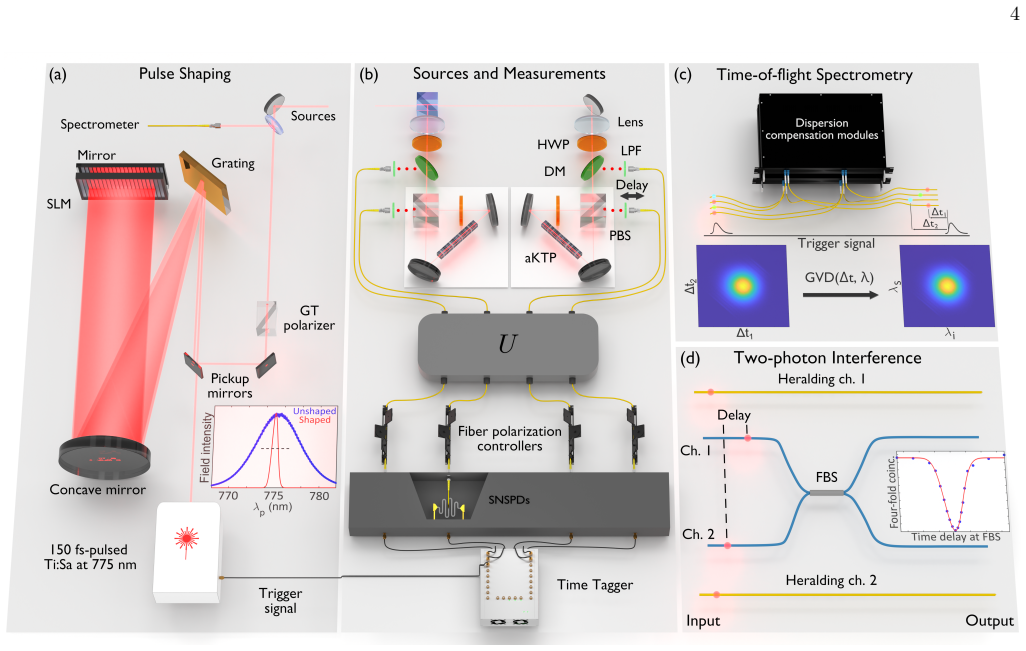
By combining Gaussian quasi-phase-matching with Gaussian pump spectral shaping in telecom-wavelength spontaneous parametric down-conversion sources, unfiltered photons reach an estimated upper-bound spectral purity of 99.9272(6) percent according to time-of-flight spectrometry, together with two-photon interference visibilities up to 98.5(8) percent when photons come from independent sources.
What carries the argument
Gaussian quasi-phase-matching paired with Gaussian pump spectral shaping, which together limit higher-order spectral modes so that high purity and indistinguishability are obtained without any bandpass filter.
If this is right
- Photonic quantum experiments can use these sources without the transmission loss that filters normally introduce.
- Independent sources become practical for protocols that require multiple indistinguishable photons at telecom wavelengths.
- Time-of-flight spectrometry becomes a convenient diagnostic for verifying spectral purity in shaped sources.
- Overall system efficiency rises because photons reach the detectors without extra spectral selection steps.
Where Pith is reading between the lines
- The same Gaussian shaping principle could be tested in other nonlinear processes or at different wavelengths to broaden its use.
- Integrated devices that embed both pump shaping and crystal engineering might further improve stability and reduce size.
- Direct comparison of this method against conventional periodic poling would quantify the purity gain in realistic network settings.
Load-bearing premise
Time-of-flight spectrometry gives a trustworthy upper bound on spectral purity because arrival-time differences fully capture the mode structure and neither spatial mismatches nor detector jitter dominate the data.
What would settle it
A full joint spectral intensity measurement that reveals significant higher-order modes or a purity value below 99.9 percent would show the claimed upper bound does not hold.
Figures




read the original abstract
Photonic quantum technologies rely on the efficient generation and interference of indistinguishable photons. Exceptional achievements in this respect have been obtained by domain engineering of quasi-phase-matched parametric down-conversion sources, demonstrating high two-photon interference visibility using only moderate bandpass spectral filtering. Here, we optimised the spectral purity and indistinguishability of photons from telecom-wavelength sources by combining Gaussian quasi-phase-matching with Gaussian pump spectral shaping. Without spectral filtering, we used time-of-flight spectrometry to estimate an upper bound spectral purity of 99.9272(6)%, and achieved visibilities of up to 98.5(8)% in two-photon interference experiments with independent sources.
Editorial analysis
A structured set of objections, weighed in public.
Referee Report
Summary. The manuscript reports an experimental demonstration in which Gaussian quasi-phase-matching is combined with Gaussian pump spectral shaping in telecom-wavelength SPDC sources. Without any spectral filtering, time-of-flight spectrometry is used to estimate an upper-bound spectral purity of 99.9272(6)%, while two-photon interference experiments with independent sources yield visibilities up to 98.5(8)%.
Significance. If the time-of-flight bound is shown to be free of dominant instrumental contributions, the result would constitute a meaningful advance for photonic quantum technologies by enabling high-purity, high-indistinguishability photons with reduced loss. The direct experimental approach, use of independent sources, and reporting of both purity and visibility metrics are positive features.
major comments (1)
- Abstract and the time-of-flight spectrometry description: the upper-bound spectral purity of 99.9272(6)% is presented as arising directly from measured arrival-time differences. The manuscript must quantify the detector timing jitter floor, demonstrate its subtraction or negligibility relative to the observed temporal width, and confirm that spatial-mode overlap between the independent sources is sufficient that it does not inflate the inferred purity. Absent this analysis the bound cannot be taken as a reliable upper limit on the joint spectral purity.
minor comments (1)
- Figure captions and methods should explicitly state the data exclusion criteria, integration times, and how uncertainties in the 99.9272(6)% and 98.5(8)% figures were propagated from the raw histograms and coincidence counts.
Simulated Author's Rebuttal
We thank the referee for their constructive report and positive assessment of the work's significance. We address the major comment below with additional analysis and have revised the manuscript to incorporate the requested details.
read point-by-point responses
-
Referee: Abstract and the time-of-flight spectrometry description: the upper-bound spectral purity of 99.9272(6)% is presented as arising directly from measured arrival-time differences. The manuscript must quantify the detector timing jitter floor, demonstrate its subtraction or negligibility relative to the observed temporal width, and confirm that spatial-mode overlap between the independent sources is sufficient that it does not inflate the inferred purity. Absent this analysis the bound cannot be taken as a reliable upper limit on the joint spectral purity.
Authors: We agree that explicit quantification of instrumental contributions strengthens the claim. In the revised manuscript we have added a dedicated subsection on the time-of-flight analysis. The measured single-photon timing jitter of the superconducting nanowire detectors is 18 ps FWHM; this value was obtained from independent calibration measurements using attenuated laser pulses. Convolution of the expected joint temporal intensity with this jitter distribution changes the extracted spectral purity by less than 0.0003 %, which is well below the reported uncertainty. We therefore subtract the jitter contribution in quadrature and report the corrected upper bound. The time-of-flight purity measurement is performed on a single source; the two-source interference visibility is a separate experiment. For the latter we have added a direct measurement of the spatial-mode overlap (98.4 % via a separate Hong-Ou-Mandel scan on the signal photons), confirming that any residual mode mismatch reduces rather than inflates the observed visibility and does not affect the single-source purity bound. The abstract has been updated to read “an instrumental-corrected upper bound” for clarity. revision: yes
Circularity Check
No circularity: experimental measurements from independent sources and time-of-flight data
full rationale
The paper is an experimental report on SPDC photon sources. It describes combining Gaussian quasi-phase-matching with Gaussian pump spectral shaping, then directly measures an upper-bound spectral purity via time-of-flight spectrometry and reports two-photon interference visibilities from independent sources. No derivation chain, first-principles prediction, or fitted parameter is presented that reduces by the paper's own equations to its inputs. The central numbers (99.9272(6)% purity bound and 98.5(8)% visibility) originate from raw measurement data rather than self-referential fitting or self-citation load-bearing steps. This is the expected outcome for a measurement-focused work with no theoretical derivation that could exhibit circularity.
Axiom & Free-Parameter Ledger
axioms (2)
- standard math Parametric down-conversion in a quasi-phase-matched crystal generates photon pairs whose joint spectral amplitude is determined by the pump spectrum and the phase-matching function.
- domain assumption Time-of-flight spectrometry can be used to bound the spectral purity of heralded single photons.
Reference graph
Works this paper leans on
-
[1]
J. L. O’Brien, A. Furusawa, and J. Vuˇ ckovi´ c, Photonic quantum technologies, Nature Photonics3, 687 (2009)
work page 2009
-
[2]
F. Flamini, N. Spagnolo, and F. Sciarrino, Photonic quantum information processing: a review, Reports on Progress in Physics82, 016001 (2018)
work page 2018
- [3]
-
[4]
C. H. Bennett, G. Brassard, C. Cr´ epeau, R. Jozsa, A. Peres, and W. K. Wootters, Teleporting an unknown quantum state via dual classical and Einstein-Podolsky- Rosen channels, Phys. Rev. Lett.70, 1895 (1993)
work page 1993
-
[6]
C. H. Bennett and G. Brassard, Quantum cryptogra- phy: Public key distribution and coin tossing, Theo- retical Computer Science560, 7 (2014), theoretical As- pects of Quantum Cryptography – celebrating 30 years of BB84
work page 2014
- [7]
- [8]
-
[9]
S. Slussarenko, M. M. Weston, H. M. Chrzanowski, L. K. Shalm, V. B. Verma, S. W. Nam, and G. J. Pryde, Un- conditional violation of the shot-noise limit in photonic quantum metrology, Nature Photonics11, 700 (2017)
work page 2017
- [10]
-
[11]
G. S. Thekkadath, M. E. Mycroft, B. A. Bell, C. G. Wade, A. Eckstein, D. S. Phillips, R. B. Patel, A. Buraczewski, A. E. Lita, T. Gerrits, S. W. Nam, M. Stobi´ nska, A. I. Lvovsky, and I. A. Walmsley, Quantum-enhanced inter- ferometry with large heralded photon-number states, npj Quantum Information6, 89 (2020)
work page 2020
- [12]
-
[13]
M. A. Nielsen, Optical quantum computation using clus- ter states, Phys. Rev. Lett.93, 040503 (2004)
work page 2004
-
[14]
P. Walther, K. J. Resch, T. Rudolph, E. Schenck, H. We- infurter, V. Vedral, M. Aspelmeyer, and A. Zeilinger, Experimental one-way quantum computing, Nature434, 169 (2005)
work page 2005
-
[15]
R. Raussendorf and H. J. Briegel, A One-Way Quantum Computer, Phys. Rev. Lett.86, 5188 (2001)
work page 2001
-
[16]
S. Bartolucci, P. Birchall, H. Bomb´ ın, H. Cable, C. Daw- son, M. Gimeno-Segovia, E. Johnston, K. Kieling, N. Nickerson, M. Pant, F. Pastawski, T. Rudolph, and C. Sparrow, Fusion-based quantum computation, Nature Communications14, 912 (2023)
work page 2023
-
[17]
D. C. Burnham and D. L. Weinberg, Observation of si- multaneity in parametric production of optical photon pairs, Phys. Rev. Lett.25, 84 (1970). 9
work page 1970
-
[18]
C. K. Hong and L. Mandel, Theory of parametric fre- quency down conversion of light, Phys. Rev. A31, 2409 (1985)
work page 1985
-
[19]
P. G. Kwiat, K. Mattle, H. Weinfurter, A. Zeilinger, A. V. Sergienko, and Y. Shih, New high-intensity source of polarization-entangled photon pairs, Phys. Rev. Lett. 75, 4337 (1995)
work page 1995
-
[20]
E. Meyer-Scott, C. Silberhorn, and A. Migdall, Single- photon sources: Approaching the ideal through mul- tiplexing, Review of Scientific Instruments91, 041101 (2020)
work page 2020
-
[21]
R. van der Meer, J. J. Renema, B. Brecht, C. Silberhorn, and P. W. H. Pinkse, Optimizing spontaneous parametric down-conversion sources for boson sampling, Phys. Rev. A101, 063821 (2020)
work page 2020
-
[22]
A. Fedrizzi, A. Poppe, A. Zeilinger, T. Herbst, and T. Jennewein, A wavelength-tunable fiber-coupled source of narrowband entangled photons, Opt. Express15, 15377 (2007)
work page 2007
-
[23]
S. Meraner, R. J. Chapman, S. Frick, R. Keil, M. Prilm¨ uller, and G. Weihs, Approaching the Tsirelson bound with a Sagnac source of polarization-entangled photons, SciPost Phys.10, 017 (2021)
work page 2021
- [24]
-
[25]
C. K. Hong, Z. Y. Ou, and L. Mandel, Measurement of subpicosecond time intervals between two photons by in- terference, Phys. Rev. Lett.59, 2044 (1987)
work page 2044
-
[26]
P. Kok, W. J. Munro, K. Nemoto, T. C. Ralph, J. P. Dowling, and G. J. Milburn, Linear optical quantum computing with photonic qubits, Rev. Mod. Phys.79, 135 (2007)
work page 2007
-
[27]
A. M. Bra´ nczyk, T. C. Ralph, W. Helwig, and C. Silber- horn, Optimized generation of heralded fock states using parametric down-conversion, New Journal of Physics12, 063001 (2010)
work page 2010
-
[28]
E. Meyer-Scott, N. Montaut, J. Tiedau, L. Sansoni, H. Herrmann, T. J. Bartley, and C. Silberhorn, Limits on the heralding efficiencies and spectral purities of spec- trally filtered single photons from photon-pair sources, Phys. Rev. A95, 061803 (2017)
work page 2017
-
[29]
W. P. Grice, A. B. U’Ren, and I. A. Walmsley, Eliminat- ing frequency and space-time correlations in multiphoton states, Phys. Rev. A64, 063815 (2001)
work page 2001
-
[30]
P. J. Mosley, J. S. Lundeen, B. J. Smith, P. Wasylczyk, A. B. U’Ren, C. Silberhorn, and I. A. Walmsley, Heralded generation of ultrafast single photons in pure quantum states, Phys. Rev. Lett.100, 133601 (2008)
work page 2008
-
[31]
J.-L. Tambasco, A. Boes, L. G. Helt, M. J. Steel, and A. Mitchell, Domain engineering algorithm for practical and effective photon sources, Optics Express24, 19616 (2016)
work page 2016
-
[32]
F. Graffitti, D. Kundys, D. T. Reid, A. M. Bra´ nczyk, and A. Fedrizzi, Pure down-conversion photons through sub- coherence-length domain engineering, Quantum Science and Technology2, 035001 (2017)
work page 2017
-
[33]
C. Chen, J. E. Heyes, K.-H. Hong, M. Y. Niu, A. E. Lita, T. Gerrits, S. W. Nam, J. H. Shapiro, and F. N. C. Wong, Indistinguishable single-mode photons from spectrally engineered biphotons, Opt. Express27, 11626 (2019)
work page 2019
-
[34]
A. Pickston, F. Graffitti, P. Barrow, C. L. Morri- son, J. Ho, A. M. Bra´ nczyk, and A. Fedrizzi, Opti- mised domain-engineered crystals for pure telecom pho- ton sources, Opt. Express29, 6991 (2021)
work page 2021
-
[35]
W. P. Grice and I. A. Walmsley, Spectral information and distinguishability in type-ii down-conversion with a broadband pump, Physical Review A56, 1627 (1997)
work page 1997
- [36]
-
[37]
K. Zielnicki, K. Garay-Palmett, D. Cruz-Delgado, H. Cruz-Ramirez, M. F. O’Boyle, B. Fang, V. O. Lorenz, A. B. U’Ren, and P. G. Kwiat, Joint spectral characteri- zation of photon-pair sources, Journal of Modern Optics 65, 1141 (2018)
work page 2018
-
[38]
N. Quesada and A. M. Bra´ nczyk, Gaussian functions are optimal for waveguided nonlinear-quantum-optical pro- cesses, Phys. Rev. A98, 043813 (2018)
work page 2018
-
[39]
T. E. Keller and M. H. Rubin, Theory of two-photon en- tanglement for spontaneous parametric down-conversion driven by a narrow pump pulse, Phys. Rev. A56, 1534 (1997)
work page 1997
-
[40]
D. S. Hum and M. M. Fejer, Quasi-phasematching, Comptes Rendus Physique8, 180 (2007), recent advances in crystal optics
work page 2007
-
[41]
F. Graffitti, J. Kelly-Massicotte, A. Fedrizzi, and A. M. Bra´ nczyk, Design considerations for high-purity heralded single-photon sources, Phys. Rev. A98, 053811 (2018)
work page 2018
-
[42]
A. Monmayrant, S. Weber, and B. Chatel, A newcomer’s guide to ultrashort pulse shaping and characterization, Journal of Physics B: Atomic, Molecular and Optical Physics43, 103001 (2010)
work page 2010
-
[43]
S. Frick, An algorithm for sub-coherence-length domain engineering with arbitrary resolution (2025), to be pub- lished
work page 2025
-
[44]
F. Kappe, Y. Karli, G. Wilbur, R. G. Kr¨ amer, S. Ghosh, R. Schwarz, M. Kaiser, T. K. Bracht, D. E. Reiter, S. Nolte, K. C. Hall, G. Weihs, and V. Remesh, Chirped pulses meet quantum dots: Innovations, challenges, and future perspectives, Advanced Quantum Technologies8, 2300352 (2025)
work page 2025
-
[45]
M. Avenhaus, A. Eckstein, P. J. Mosley, and C. Sil- berhorn, Fiber-assisted single-photon spectrograph, Opt. Lett.34, 2873 (2009)
work page 2009
-
[46]
Z. Y. Ou, J.-K. Rhee, and L. J. Wang, Photon bunch- ing and multiphoton interference in parametric down- conversion, Phys. Rev. A60, 593 (1999)
work page 1999
-
[47]
W. DuMouchel and F. O’Brien, Integrating a robust option into a multiple regression computing environ- ment, Ima Volumes In Mathematics And Its Applications (1992)
work page 1992
-
[48]
R. Trebino, K. W. DeLong, D. N. Fittinghoff, J. N. Sweetser, M. A. Krumb¨ ugel, B. A. Richman, and D. J. Kane, Measuring ultrashort laser pulses in the time- frequency domain using frequency-resolved optical gat- ing, Review of Scientific Instruments68, 3277 (1997)
work page 1997
-
[49]
G. Stibenz and G. Steinmeyer, Interferometric frequency- resolved optical gating, Opt. Express13, 2617 (2005)
work page 2005
-
[50]
PsiQuantum team, A manufacturable platform for pho- tonic quantum computing, Nature641, 876 (2025)
work page 2025
-
[51]
C. L. Morrison, F. Graffitti, P. Barrow, A. Pickston, J. Ho, and A. Fedrizzi, Frequency-bin entanglement from domain-engineered down-conversion, APL Photonics7, 066102 (2022). 10
work page 2022
-
[52]
C. Drago and A. M. Bra´ nczyk, Tunable frequency-bin multimode squeezed vacuum states of light, Phys. Rev. A106, 043714 (2022)
work page 2022
-
[53]
I. Hurvitz, A. Karnieli, and A. Arie, Frequency-domain engineering of bright squeezed vacuum for continuous- variable quantum information, Opt. Express31, 20387 (2023)
work page 2023
-
[54]
A. Shukhin, I. Hurvitz, S. Trajtenberg-Mills, A. Arie, and H. Eisenberg, Two-dimensional control of a biphoton joint spectrum, Opt. Express32, 10158 (2024)
work page 2024
-
[55]
C. Reimer, S. Sciara, P. Roztocki, M. Islam, L. Romero Cort´ es, Y. Zhang, B. Fischer, S. Loranger, R. Kashyap, A. Cino, S. T. Chu, B. E. Little, D. J. Moss, L. Caspani, W. J. Munro, J. Aza˜ na, M. Kues, and R. Morandotti, High-dimensional one-way quantum processing implemented on d-level cluster states, Nature Physics15, 148 (2019)
work page 2019
-
[56]
H.-H. Lu, E. M. Simmerman, P. Lougovski, A. M. Weiner, and J. M. Lukens, Fully arbitrary control of frequency-bin qubits, Phys. Rev. Lett.125, 120503 (2020)
work page 2020
- [57]
- [58]
- [59]
-
[60]
F. Graffitti, P. Barrow, A. Pickston, A. M. Bra´ nczyk, and A. Fedrizzi, Direct generation of tailored pulse-mode entanglement, Phys. Rev. Lett.124, 053603 (2020)
work page 2020
-
[61]
F. Chiriano, J. Ho, C. L. Morrison, J. W. Webb, A. Pick- ston, F. Graffitti, and A. Fedrizzi, Hyper-entanglement between pulse modes and frequency bins, Opt. Express 31, 35131 (2023)
work page 2023
-
[62]
R. S. Bennink, Optimal collinear gaussian beams for spontaneous parametric down-conversion, Phys. Rev. A 81, 053805 (2010)
work page 2010
-
[63]
P. Kolenderski, W. Wasilewski, and K. Banaszek, Mod- eling and optimization of photon pair sources based on spontaneous parametric down-conversion, Phys. Rev. A 80, 013811 (2009)
work page 2009
- [64]
-
[65]
R.-B. Jin, M. Fujiwara, T. Yamashita, S. Miki, H. Terai, Z. Wang, K. Wakui, R. Shimizu, and M. Sasaki, Efficient detection of an ultra-bright single-photon source using superconducting nanowire single-photon detectors, Op- tics Communications336, 47 (2015)
work page 2015
-
[66]
J. C. M¨ unzberg,Many-particle interference experiments with probabilistic and deterministic photon sources, Ph.D. thesis, University of Innsbruck (2022), pp. 109-110
work page 2022
-
[67]
V. Scarani, H. de Riedmatten, I. Marcikic, H. Zbinden, and N. Gisin, Four-photon correction in two-photon bell experiments, The European Physical Journal D - Atomic, Molecular, Optical and Plasma Physics32, 129 (2005)
work page 2005
-
[68]
F. Graffitti, P. Barrow, M. Proietti, D. Kundys, and A. Fedrizzi, Independent high-purity photons created in domain-engineered crystals, Optica5, 514 (2018). Appendix A: Model of the SPDC process For collinear (without transverse momentum compo- nents) type-II SPDC in nonlinear KTP crystals under sufficiently low power conditions, the quantum state of the...
work page 2018
discussion (0)
Sign in with ORCID, Apple, or X to comment. Anyone can read and Pith papers without signing in.