Going off Pattern? QAOA Parameter Heuristics and Potentials of Parsimony
Pith reviewed 2026-05-18 09:19 UTC · model grok-4.3
The pith
High-quality QAOA parameters often deviate from expected regular patterns, and a simple iterative fixing method matches or beats standard selection strategies at shallow depths.
A machine-rendered reading of the paper's core claim, the machinery that carries it, and where it could break.
Core claim
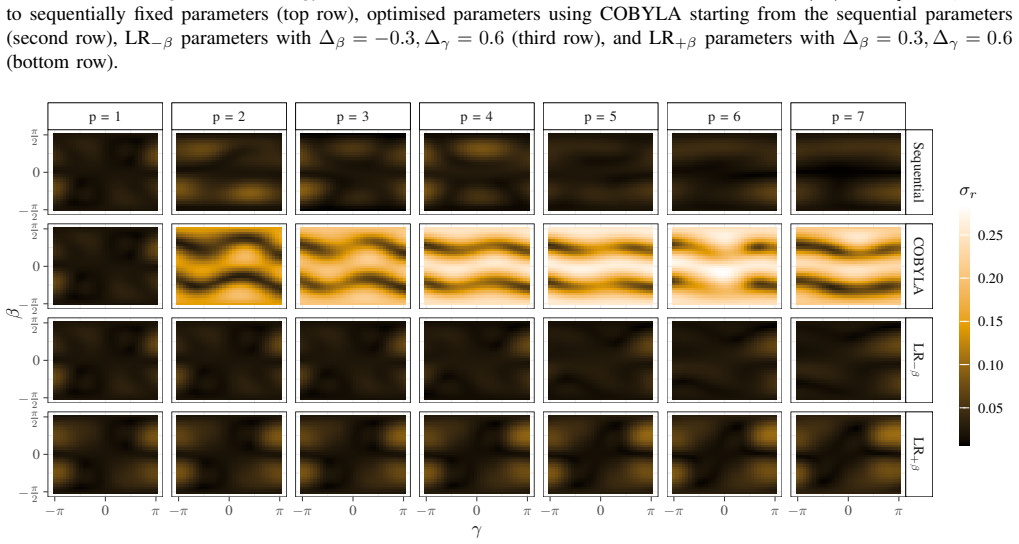
High-quality parameters often deviate substantially from expected patterns; QAOA performance becomes progressively less sensitive to specific parameter choices as depth increases; and iterative component-wise fixing performs on par with, and at shallow depth may even outperform, several established parameter-selection strategies. The work also identifies conditions under which structured parameter patterns emerge and when deviations warrant further consideration.
What carries the argument
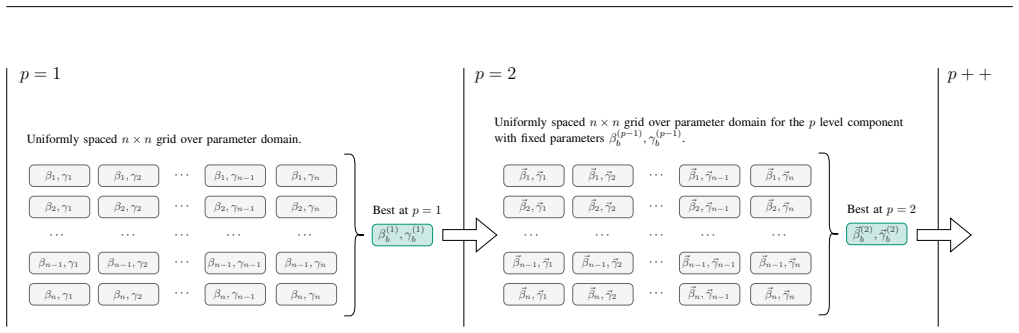
The iterative component-wise fixing heuristic, which optimizes parameters one at a time while holding the others fixed, to locate effective variational values for low-depth QAOA circuits.
If this is right
- Structured parameter patterns appear only under specific conditions tied to problem class and depth.
- Deviations from those patterns become important to account for when targeting optimal performance at shallow depths.
- Reduced sensitivity to parameter values at greater depths offers a route to more robust operation despite hardware imperfections.
- The fixing heuristic supplies a computationally lightweight alternative for practical parameter setting on near-term devices.
Where Pith is reading between the lines
- If the reduced sensitivity at depth holds, it may simplify error-mitigation strategies that tolerate small parameter drifts.
- The same iterative fixing idea could be tested as a starting point for other variational quantum algorithms beyond QAOA.
- Hardware experiments that deliberately introduce controlled noise levels would clarify how far the simulation results generalize.
Load-bearing premise
The chosen problem instances and noise-free simulation model reflect the behavior that QAOA will show on actual noisy NISQ hardware for the target optimization problems.
What would settle it
Executing the proposed iterative fixing heuristic on real quantum hardware for the same problem instances and comparing the achieved approximation ratios against the noise-free simulation predictions would directly test whether the observed parameter insensitivity and heuristic performance persist under hardware noise.
Figures




read the original abstract
Structured variational quantum algorithms such as the Quantum Approximate Optimisation Algorithm (QAOA) have emerged as leading candidates for exploiting advantages of near-term quantum hardware. They interlace classical computation, in particular optimisation of variational parameters, with quantum-specific routines, and combine problem-specific advantages -- sometimes even provable -- with adaptability to the constraints of noisy, intermediate-scale quantum (NISQ) devices. While circuit depth can be parametrically increased and is known to improve performance in an ideal (noiseless) setting, on realistic hardware greater depth exacerbates noise: The overall quality of results depends critically on both, variational parameters and circuit depth. Although identifying optimal parameters is NP-hard, prior work has suggested that they may exhibit regular, predictable patterns for increasingly deep circuits and depending on the studied class of problems. In this work, we systematically investigate the role of classical parameters in QAOA performance through extensive numerical simulations and suggest a simple, yet effective heuristic scheme to find good parameters for low-depth circuits. Our results demonstrate that: (i) high-quality parameters often deviate substantially from expected patterns; (ii) QAOA performance becomes progressively less sensitive to specific parameter choices as depth increases; and (iii) iterative component-wise fixing performs on par with, and at shallow depth may even outperform, several established parameter-selection strategies. We identify conditions under which structured parameter patterns emerge, and when deviations from the patterns warrant further consideration. These insights for low-depth circuits may inform more robust pathways to harnessing QAOA in realistic quantum computing scenarios.
Editorial analysis
A structured set of objections, weighed in public.
Referee Report
Summary. The manuscript reports extensive numerical simulations of the Quantum Approximate Optimization Algorithm (QAOA) examining the behavior of its variational parameters. It claims that (i) high-quality parameters frequently deviate substantially from previously reported regular patterns, (ii) performance becomes progressively less sensitive to exact parameter values as circuit depth increases, and (iii) a simple iterative component-wise fixing heuristic performs on par with or better than several established parameter-selection strategies at shallow depths. The authors also identify conditions under which structured patterns emerge and discuss implications for low-depth QAOA on NISQ hardware.
Significance. If the numerical observations hold, the work would offer practical value by reducing the classical optimization burden for QAOA through a parsimonious heuristic and by highlighting robustness to parameter choice at moderate depths. The finding that deviations from expected patterns are common challenges prior heuristics and could guide more adaptive parameter strategies. The emphasis on low-depth regimes aligns with current NISQ constraints, though the noiseless setting limits immediate hardware relevance.
major comments (2)
- [Numerical experiments section] Numerical experiments section: All reported results, including the progressive decrease in parameter sensitivity (claim ii) and the performance of the iterative fixing heuristic (claim iii), are obtained from ideal noiseless simulations. The abstract and introduction explicitly position these insights as relevant to realistic NISQ scenarios where noise accumulates with depth, yet no noisy simulations or error-model analysis are provided to test whether the observed landscape flattening or heuristic advantage survives gate errors and decoherence.
- [Results on heuristic comparisons] Results on heuristic comparisons (around the discussion of iterative component-wise fixing): The claim that the proposed heuristic matches or outperforms established strategies at shallow depth depends on the specific problem instances and the definition of 'high-quality' parameters. The manuscript summarizes but does not fully detail instance selection criteria, ensemble sizes, or statistical controls, making it difficult to assess whether the reported advantage is robust or instance-dependent.
minor comments (2)
- [Methods] Notation for the iterative fixing procedure is introduced without a compact algorithmic description or pseudocode, which would improve reproducibility.
- [Figures] Several figures comparing parameter landscapes would benefit from explicit error bars or shading indicating variability across instances.
Simulated Author's Rebuttal
We thank the referee for their constructive and detailed feedback. The comments highlight important aspects of scope and presentation that we will address in the revision. We respond to each major comment below and indicate planned changes to the manuscript.
read point-by-point responses
-
Referee: [Numerical experiments section] Numerical experiments section: All reported results, including the progressive decrease in parameter sensitivity (claim ii) and the performance of the iterative fixing heuristic (claim iii), are obtained from ideal noiseless simulations. The abstract and introduction explicitly position these insights as relevant to realistic NISQ scenarios where noise accumulates with depth, yet no noisy simulations or error-model analysis are provided to test whether the observed landscape flattening or heuristic advantage survives gate errors and decoherence.
Authors: We agree that all numerical results are obtained under ideal noiseless conditions and that this constitutes a limitation when the abstract and introduction frame the findings as relevant to NISQ hardware. The study was intentionally restricted to the noiseless setting to isolate the intrinsic behavior of QAOA parameters and the proposed heuristic without the confounding effects of specific noise models. In the revised manuscript we will add a dedicated paragraph in the Discussion section that explicitly acknowledges this limitation, provides a qualitative discussion of how gate errors and decoherence could interact with the observed parameter robustness and landscape flattening, and clarifies that the reported advantages are demonstrated in the ideal case. We will also insert a brief qualifying statement in the abstract and introduction. Comprehensive noisy simulations lie outside the primary scope of the present work due to the additional computational cost and the need to select particular error models; we therefore do not plan to include them in this revision. revision: partial
-
Referee: [Results on heuristic comparisons] Results on heuristic comparisons (around the discussion of iterative component-wise fixing): The claim that the proposed heuristic matches or outperforms established strategies at shallow depth depends on the specific problem instances and the definition of 'high-quality' parameters. The manuscript summarizes but does not fully detail instance selection criteria, ensemble sizes, or statistical controls, making it difficult to assess whether the reported advantage is robust or instance-dependent.
Authors: We accept that greater transparency regarding the experimental setup is necessary for readers to evaluate the robustness of the heuristic comparisons. In the revised version we will expand the Numerical Experiments section to specify: the precise criteria used to generate and select problem instances (including graph sizes and MaxCut instance families), the number of independent instances per ensemble and per depth, and the statistical procedures employed (including the number of optimization runs per instance, averaging method, and reporting of standard deviations or confidence intervals). These additions will enable clearer assessment of whether the observed performance advantage is consistent across the tested ensemble. revision: yes
Circularity Check
No circularity: results are direct outputs of numerical simulations
full rationale
The paper's central claims rest on extensive numerical simulations that directly compare QAOA performance metrics and parameter sensitivities against established strategies across problem instances. No mathematical derivation, prediction, or first-principles result is presented that reduces by construction to fitted inputs, self-definitions, or self-citation chains. The observations on pattern deviations, depth-dependent sensitivity, and heuristic performance are empirical outputs rather than tautological renamings or forced extrapolations from the paper's own assumptions.
Axiom & Free-Parameter Ledger
Lean theorems connected to this paper
-
IndisputableMonolith.Foundation.RealityFromDistinctionreality_from_one_distinction unclear?
unclearRelation between the paper passage and the cited Recognition theorem.
QAOA performance becomes progressively less sensitive to specific parameter choices as depth increases; iterative component-wise fixing performs on par with... established parameter-selection strategies.
-
IndisputableMonolith.Cost.FunctionalEquationwashburn_uniqueness_aczel unclear?
unclearRelation between the paper passage and the cited Recognition theorem.
optimal parameters often deviate substantially from expected patterns; ... γ increasing and β decreasing
What do these tags mean?
- matches
- The paper's claim is directly supported by a theorem in the formal canon.
- supports
- The theorem supports part of the paper's argument, but the paper may add assumptions or extra steps.
- extends
- The paper goes beyond the formal theorem; the theorem is a base layer rather than the whole result.
- uses
- The paper appears to rely on the theorem as machinery.
- contradicts
- The paper's claim conflicts with a theorem or certificate in the canon.
- unclear
- Pith found a possible connection, but the passage is too broad, indirect, or ambiguous to say the theorem truly supports the claim.
Reference graph
Works this paper leans on
-
[1]
Quantum error correction below the surface code threshold
Rajeev Acharya et al. “Quantum error correction below the surface code threshold”. In:Nature638 (2025), pp. 920–926.DOI: 10 . 1038 / s41586 - 024 - 08449-y. 15
work page 2025
-
[2]
Benjamin, Suguru Endo, William J
Tameem Albash and Daniel A. Lidar. “Adiabatic quantum computation”. In:Rev. Mod. Phys.90 (1 Jan. 2018), p. 015002.DOI: 10.1103/RevModPhys. 90.015002
-
[3]
Noisy intermediate-scale quan- tum algorithms
Kishor Bharti et al. “Noisy intermediate-scale quan- tum algorithms”. In:Rev. Mod. Phys.94 (1 Feb. 2022), p. 015004.DOI: 10 . 1103 / RevModPhys . 94 . 015004
work page 2022
-
[4]
Training Varia- tional Quantum Algorithms Is NP-Hard
Lennart Bittel and Martin Kliesch. “Training Varia- tional Quantum Algorithms Is NP-Hard”. In:Phys- ical Review Letters127.12 (Sept. 2021). Publisher: American Physical Society, p. 120502.DOI: 10.1103/ PhysRevLett.127.120502
work page 2021
-
[5]
A review on quantum approximate optimization algorithm and its variants,
Kostas Blekos et al. “A review on Quantum Approx- imate Optimization Algorithm and its variants”. In: Physics Reports. A review on Quantum Approximate Optimization Algorithm and its variants 1068 (June 2024), pp. 1–66.DOI: 10.1016/j.physrep.2024.03.002
-
[6]
Fernando G. S. L. Brandao et al.For Fixed Control Parameters the Quantum Approximate Optimization Algorithm’s Objective Function Value Concentrates for Typical Instances. arXiv:1812.04170 [quant-ph]. Dec. 2018.DOI: 10.48550/arXiv.1812.04170
work page internal anchor Pith review Pith/arXiv arXiv doi:10.48550/arxiv.1812.04170 2018
-
[7]
Obstacles to Variational Quan- tum Optimization from Symmetry Protection
Sergey Bravyi et al. “Obstacles to Variational Quan- tum Optimization from Symmetry Protection”. In: Phys. Rev. Lett.125 (26 Dec. 2020), p. 260505.DOI: 10.1103/PhysRevLett.125.260505
-
[8]
Challenges for Quantum Software Engineering: An Industrial Application Scenario Perspective,
Cecilia Carbonelli et al. “Challenges for Quantum Software Engineering: An Industrial Application Sce- nario Perspective”. In:Quantum Software: Aspects of Theory and System Design. Ed. by Iaakov Exman et al. Cham: Springer Nature Switzerland, 2024, pp. 311–335.DOI: 10.1007/978-3-031-64136-7_12
-
[9]
Variational quantum algorithms.Na- ture Rev
M. Cerezo et al. “Variational Quantum Algorithms”. In:Nature Reviews Physics3.9 (Aug. 2021), pp. 625– 644.DOI: 10.1038/s42254-021-00348-9
-
[10]
Warm-starting quantum optimization
Daniel J. Egger, Jakub Mare ˇcek, and Stefan Woerner. “Warm-starting quantum optimization”. In:Quantum 5 (June 2021), p. 479.DOI: 10.22331/q-2021-06-17- 479
-
[11]
A Quantum Approximate Optimization Algorithm
Edward Farhi, Jeffrey Goldstone, and Sam Gutmann. A Quantum Approximate Optimization Algorithm. arXiv:1411.4028 [quant-ph]. Nov. 2014
work page internal anchor Pith review Pith/arXiv arXiv 2014
-
[12]
Edward Farhi and Aram W. Harrow.Quantum Supremacy through the Quantum Approximate Op- timization Algorithm. arXiv:1602.07674 [quant-ph]. Oct. 2019
-
[13]
Mario Fernández-Pendás et al. “A study of the per- formance of classical minimizers in the Quantum Approximate Optimization Algorithm”. In:Journal of Computational and Applied Mathematics404 (Apr. 2022), p. 113388.DOI: 10.1016/j.cam.2021.113388
-
[14]
Scalable Quantum Al- gorithms for Noisy Quantum Computers
Gacon, Julien Sebastian. “Scalable Quantum Al- gorithms for Noisy Quantum Computers”. en. In: (2024).DOI: 10.5075/EPFL-THESIS-11132
-
[15]
Alexey Galda et al.Transferability of optimal QAOA parameters between random graphs. Los Alamitos, CA, USA, Oct. 2021.DOI: 10.1109/QCE52317.2021. 00034
-
[16]
Defects in Quantum Com- puters
Bartłomiej Gardas et al. “Defects in Quantum Com- puters”. en. In:Scientific Reports8.1 (Mar. 2018). Publisher: Nature Publishing Group, p. 4539.DOI: 10.1038/s41598-018-22763-2
-
[17]
Quantum Data Encoding Patterns and their Conse- quences
Martin Gogeissl, Hila Safi, and Wolfgang Mauerer. “Quantum Data Encoding Patterns and their Conse- quences”. In:Proceedings of the 1st Workshop on Quantum Computing and Quantum-Inspired Tech- nology for Data-Intensive Systems and Applications. Q-Data ’24. Santiago, AA, Chile: Association for Computing Machinery, 2024, pp. 27–37.DOI: 10 . 1145/3665225.3665446
-
[18]
From the quantum approximate optimization algorithm to a quantum alternating operator ansatz,
Stuart Hadfield et al. “From the Quantum Approx- imate Optimization Algorithm to a Quantum Alter- nating Operator Ansatz”. In:Algorithms12.2 (2019). DOI: 10.3390/a12020034
-
[19]
Alignment between initial state and mixer improves QAOA performance for con- strained optimization
Zichang He et al. “Alignment between initial state and mixer improves QAOA performance for con- strained optimization”. en. In:npj Quantum Informa- tion9.1 (Nov. 2023). Publisher: Nature Publishing Group, pp. 1–11.DOI: 10.1038/s41534-023-00787- 5
-
[20]
Nishant Jain et al. “Graph neural network initial- isation of quantum approximate optimisation”. In: Quantum6 (Nov. 2022), p. 861.DOI: 10.22331/q- 2022-11-17-861
work page doi:10.22331/q- 2022
-
[21]
Ali Javadi-Abhari et al.Quantum computing with Qiskit. 2024.DOI: 10.48550/arXiv.2405.08810
work page internal anchor Pith review Pith/arXiv arXiv doi:10.48550/arxiv.2405.08810 2024
-
[22]
Reducibility among Combinatorial Problems
Richard M. Karp. “Reducibility among Combinatorial Problems”. In:Complexity of Computer Computa- tions. Springer US, 1972, pp. 85–103.DOI: 10.1007/ 978-1-4684-2001-2_9
work page 1972
-
[23]
C., Barends, R., Biswas, R., Boixo, S., Brandao, F
Youngseok Kim et al. “Evidence for the utility of quantum computing before fault tolerance”. en. In: Nature618.7965 (June 2023). Publisher: Nature Pub- lishing Group, pp. 500–505.DOI: 10.1038/s41586- 023-06096-3
-
[24]
Richer, Junae Kim, and Damian Marriott
Vladimir Kremenetski et al.Quantum Alternating Operator Ansatz (QAOA) Phase Diagrams and Ap- plications for Quantum Chemistry. arXiv:2108.13056 [quant-ph]. Oct. 2021.DOI: 10.48550/arXiv.2108. 13056
-
[25]
2024.DOI: 10.48550/arXiv.2408.06493
Tom Krüger and Wolfgang Mauerer.Out of the Loop: Structural Approximation of Optimisation Landscapes and non-Iterative Quantum Optimisation. 2024.DOI: 10.48550/arXiv.2408.06493
-
[26]
Quantum Annealing-Based Software Components: An Exper- imental Case Study with SAT Solving
Tom Krüger and Wolfgang Mauerer. “Quantum Annealing-Based Software Components: An Exper- imental Case Study with SAT Solving”. In:Pro- ceedings of the IEEE/ACM 42nd International Con- ference on Software Engineering Workshops. IC- SEW’20. Seoul, Republic of Korea: Association for 16 Computing Machinery, 2020, pp. 445–450.DOI: 10. 1145/3387940.3391472
-
[27]
A Depth-Progressive Initialization Strategy for Quantum Approximate Optimization Al- gorithm
Xinwei Lee et al. “A Depth-Progressive Initialization Strategy for Quantum Approximate Optimization Al- gorithm”. en. In:Mathematics11.9 (Jan. 2023). Num- ber: 9 Publisher: Multidisciplinary Digital Publishing Institute, p. 2176.DOI: 10.3390/math11092176
-
[28]
Xinwei Lee et al. “Parameters Fixing Strategy for Quantum Approximate Optimization Algorithm”. en. In:2021 IEEE International Conference on Quantum Computing and Engineering (QCE). Oct. 2021.DOI: 10.1109/QCE52317.2021.00016
-
[29]
Empirical performance bounds for quantum approximate optimization
Phillip C. Lotshaw et al. “Empirical performance bounds for quantum approximate optimization”. In: Quantum Information Processing20.12 (Dec. 2021), p. 403.DOI: 10.1007/s11128-021-03342-3
-
[30]
1-2-3 Reproducibility for Quantum Software Experiments
Wolfgang Mauerer and Stefanie Scherzinger. “1-2-3 Reproducibility for Quantum Software Experiments”. In:2022 IEEE International Conference on Software Analysis, Evolution and Reengineering (SANER). 2022, pp. 1247–1248.DOI: 10.1109/SANER53432. 2022.00148
-
[31]
Hard and easy distributions of SAT problems
David Mitchell, Bart Selman, and Hector Levesque. “Hard and easy distributions of SAT problems”. In: Proceedings of the tenth national conference on Ar- tificial intelligence. AAAI’92. San Jose, California: AAAI Press, July 1992, pp. 459–465
work page 1992
-
[32]
J. A. Montañez-Barrera and Kristel Michielsen. “To- ward a linear-ramp QAOA protocol: evidence of a scaling advantage in solving some combinatorial optimization problems”. In:npj Quantum Information 11.1 (Aug. 2025).DOI: 10.1038/s41534-025-01082- 1
-
[33]
Transfer learning of optimal QAOA pa- rameters in combinatorial optimization
J. A. Montañez-Barrera, Dennis Willsch, and Kristel Michielsen. “Transfer learning of optimal QAOA pa- rameters in combinatorial optimization”. In:Quantum Information Processing24.5 (May 2025).DOI: 10. 1007/s11128-025-04743-4
work page 2025
-
[34]
Maniraman Periyasamy et al. “Guided-SPSA: Simul- taneous Perturbation Stochastic Approximation As- sisted by the Parameter Shift Rule”. In:2024 IEEE In- ternational Conference on Quantum Computing and Engineering (QCE). V ol. 01. 2024, pp. 1504–1515. DOI: 10.1109/QCE60285.2024.00177
-
[35]
A variational eigenvalue solver on a quantum processor
Alberto Peruzzo et al. “A variational eigen- value solver on a quantum processor”. In:Nature Communications5.1 (July 2014). arXiv:1304.3061 [physics, physics:quant-ph], p. 4213.DOI: 10.1038/ ncomms5213
work page internal anchor Pith review Pith/arXiv arXiv 2014
-
[36]
M. J. D. Powell. “A Direct Search Optimization Method That Models the Objective and Constraint Functions by Linear Interpolation”. en. In: Book Ti- tle: Advances in Optimization and. Springer Nether- lands, 1994.DOI: 10.1007/978-94-015-8330-5_4
-
[37]
Hila Safi, Karen Wintersperger, and Wolfgang Mauerer. “Influence of HW-SW-Co-Design on Quan- tum Computing Scalability”. In:2023 IEEE Inter- national Conference on Quantum Software (QSW). 2023, pp. 104–115.DOI: 10.1109/QSW59989.2023. 00022
-
[38]
Path matters: Industrial data meet quantum optimization,
Lukas Schmidbauer et al.Path Matters: Industrial Data Meet Quantum Optimization. 2025.DOI: 10 . 48550/arXiv.2504.16607
-
[39]
Quantum-Inspired Digital Annealing for Join Ordering
Manuel Schönberger, Immanuel Trummer, and Wolf- gang Mauerer. “Quantum-Inspired Digital Annealing for Join Ordering”. In:Proc. VLDB Endow.17.3 (Nov. 2023), pp. 511–524.DOI: 10.14778/3632093. 3632112
-
[40]
Michael Streif and Martin Leib. “Training the quan- tum approximate optimization algorithm without ac- cess to a quantum processing unit”. In:Quantum Science and Technology5.3 (May 2020), p. 034008. DOI: 10.1088/2058-9565/ab8c2b
-
[41]
Parameter-setting heuristic for the quantum alternating operator ansatz
James Sud et al. “Parameter-setting heuristic for the quantum alternating operator ansatz”. In:Phys. Rev. Res.6 (2 May 2024), p. 023171.DOI: 10 . 1103 / PhysRevResearch.6.023171
work page 2024
-
[42]
Reuben Tate et al. “Warm-Started QAOA with Cus- tom Mixers Provably Converges and Computationally Beats Goemans-Williamson’s Max-Cut at Low Cir- cuit Depths”. In:Quantum7 (Sept. 2023), p. 1121. DOI: 10.22331/q-2023-09-26-1121
-
[43]
Approximatesolutionsofcombinatorialprob- lemsviaquantumrelaxations
Simone Tibaldi et al. “Bayesian Optimization for QAOA”. In:IEEE Transactions on Quantum Engi- neering4 (2023). Conference Name: IEEE Transac- tions on Quantum Engineering.DOI: 10.1109/TQE. 2023.3325167
work page doi:10.1109/tqe 2023
-
[44]
An expressive ansatz for low-depth quantum approximate optimisation
V Vijendran et al. “An expressive ansatz for low-depth quantum approximate optimisation”. In: Quantum Science and Technology9.2 (Feb. 2024), p. 025010.DOI: 10.1088/2058-9565/ad200a
-
[45]
2021.DOI: 10.1109/ TQE.2021.3122568
Jonathan Wurtz and Peter Love.Classically optimal variational quantum algorithms. 2021.DOI: 10.1109/ TQE.2021.3122568
-
[46]
MaxCut quan- tum approximate optimization algorithm performance guarantees forp>1
Jonathan Wurtz and Peter Love. “MaxCut quan- tum approximate optimization algorithm performance guarantees forp>1”. In:Physical Review A103.4 (Apr. 2021). Publisher: American Physical Society, p. 042612.DOI: 10.1103/PhysRevA.103.042612
-
[47]
Counterdiabatic- ity and the quantum approximate optimization algo- rithm
Jonathan Wurtz and Peter J. Love. “Counterdiabatic- ity and the quantum approximate optimization algo- rithm”. In:Quantum6 (Jan. 2022), p. 635.DOI: 10. 22331/q-2022-01-27-635
work page 2022
-
[48]
Jonathan Wurtz and Danylo Lykov.Fixed-angle con- jectures for the quantum approximate optimization algorithm on regular MaxCut graphs. Nov. 2021. DOI: 10.1103/PhysRevA.104.052419
-
[49]
Leo Zhou et al. “Quantum Approximate Optimization Algorithm: Performance, Mechanism, and Implemen- tation on Near-Term Devices”. In:Physical Review X10.2 (June 2020). Publisher: American Physical 17 Society, p. 021067.DOI: 10 . 1103 / PhysRevX . 10 . 021067. APPENDIX A. LANDSCAPE EVALUATION ALGORITHM Algorithm 1Landscape scan with iteratively increasing d...
work page 2020
discussion (0)
Sign in with ORCID, Apple, or X to comment. Anyone can read and Pith papers without signing in.