Entangled Photon Pair Generator via Biexciton-Exciton Cascade in Semiconductor Quantum Dots and its Simulation
Pith reviewed 2026-05-18 07:59 UTC · model grok-4.3
The pith
A quantum dot's biexciton-exciton cascade can be modeled to generate polarization-entangled photon pairs and simulated as an efficient component for larger experiments.
A machine-rendered reading of the paper's core claim, the machinery that carries it, and where it could break.
Core claim
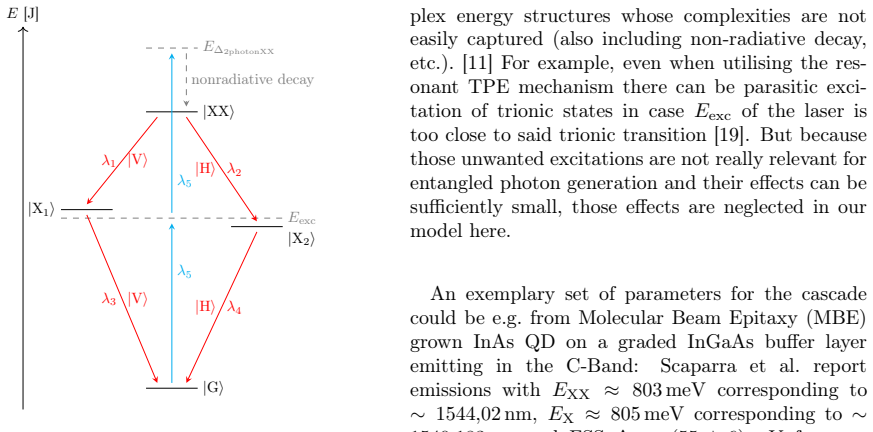
The entangled photon pair generator is implemented and simulated as a self-contained component using the biexciton-exciton cascade in semiconductor quantum dots. It uses the Kraus operator formalism to provide a compact description that can be seamlessly integrated into larger simulations of quantum optical experiments while supporting various excitation strategies such as resonant two-photon excitation, adiabatic rapid passage chirped excitation, and dichromatic pulsed excitation.
What carries the argument
The Kraus operator formalism applied to the biexciton-exciton cascade, which compactly represents the quantum state evolution and photon emissions for efficient computation.
If this is right
- The model accommodates a wide range of parameter regimes for different excitation strategies.
- It enables simulation of multi-component quantum optical experiments at reasonable cost.
- The description covers fundamentals to executable software implementation.
- Many different excitation strategies can be simulated including resonant, chirped, and dichromatic pulses.
Where Pith is reading between the lines
- This approach could facilitate the design of scalable quantum networks using multiple quantum dot sources.
- Integration with other simulated components like photon detectors or quantum gates might allow end-to-end simulation of quantum protocols.
- Extensions to include noise models or specific material properties could be added to the framework.
Load-bearing premise
The standard biexciton-exciton cascade in semiconductor quantum dots produces the expected polarization-entangled photons without significant additional effects not accounted for in the model.
What would settle it
An experimental measurement showing that the simulated photon pair correlations or entanglement measures deviate significantly from the model's predictions under one of the described excitation regimes.
Figures




read the original abstract
The generation of entangled photon pairs is highly useful for many types of quantum technologies. In this work an entangled photon pair generator that utilises the biexciton-exciton cascade in semiconductor quantum dots is described on a physical, mathematical, and software level. The system is implemented and simulated as a self-contained component in a framework for bigger quantum optical experiments. Thus, it is a description to further the holistic understanding of the system for interdisciplinary audiences in a hopefully simple yet sufficient manner. It is described from the condensed matter physics fundamentals, over the most important quantum optical properties, to a mathematical description of the used model, and finally a software description and simulation, making it an executable description of such a system. We provide a compact description in the Kraus operator formalism to seamlessly incorporate such an entangled photon pair generator simulation component into bigger simulations consisting of multiple components at a reasonable computational cost. The simulation accommodates a wide range of parameter regimes and makes it possible to simulate many different excitation strategies. This includes resonant two-photon excitation, adiabatic rapid passage chirped excitation, and dichromatic pulsed excitation.
Editorial analysis
A structured set of objections, weighed in public.
Referee Report
Summary. The manuscript presents a description and simulation of an entangled photon pair generator utilizing the biexciton-exciton cascade in semiconductor quantum dots. It covers condensed-matter fundamentals, key quantum-optical properties, a mathematical model, and software implementation as a self-contained component for larger experiments. A compact Kraus-operator representation is provided to enable efficient integration, supporting excitation strategies including resonant two-photon, adiabatic rapid passage chirped, and dichromatic pulsed excitation.
Significance. If the central simulation claims hold, the work offers a modular, computationally efficient building block for quantum-optical simulations, with the Kraus formalism providing a clear strength for scalability in multi-component setups. The broad parameter coverage and executable description could aid interdisciplinary users. However, the absence of new experimental validation and reliance on established physics without addressing common real-device effects limits the immediate impact on predictive modeling of actual quantum-dot sources.
major comments (1)
- [Mathematical model / Kraus operator section] Mathematical model / Kraus operator section: the description of the biexciton-exciton cascade and associated Kraus map does not include the fine-structure splitting term for the bright exciton states (typically 1-100 μeV due to electron-hole exchange). This term introduces which-path information that reduces two-photon concurrence; its omission means the simulated polarization-entangled output cannot be guaranteed to match the entanglement properties asserted for the generator component.
minor comments (2)
- [Abstract] The abstract states that the simulation 'accommodates a wide range of parameter regimes' but provides no concrete examples of simulated output statistics, concurrence values, or fidelity metrics for the listed excitation strategies.
- [Software description] Software description: additional quantitative comparison of computational cost between the Kraus-operator implementation and a full density-matrix simulation would strengthen the claim of 'reasonable computational cost' for larger experiments.
Simulated Author's Rebuttal
We thank the referee for their careful reading of the manuscript and for highlighting an important physical effect in the biexciton-exciton cascade. We address the major comment below and describe the revisions we intend to implement.
read point-by-point responses
-
Referee: Mathematical model / Kraus operator section: the description of the biexciton-exciton cascade and associated Kraus map does not include the fine-structure splitting term for the bright exciton states (typically 1-100 μeV due to electron-hole exchange). This term introduces which-path information that reduces two-photon concurrence; its omission means the simulated polarization-entangled output cannot be guaranteed to match the entanglement properties asserted for the generator component.
Authors: We agree that the fine-structure splitting (FSS) of the bright exciton states is a key effect in real quantum dots that introduces which-path information and can degrade two-photon concurrence. Our model was formulated for the ideal case of vanishing FSS, which is a common starting point when emphasizing the cascade dynamics, excitation strategies, and the compact Kraus representation for modular integration. This approximation allows perfect entanglement in the absence of other decoherence channels and keeps the component self-contained for users who may apply external tuning or strain to suppress FSS. To strengthen the manuscript, we will revise the mathematical model section to include the FSS term explicitly in the Hamiltonian, update the Kraus operators to account for it, add a discussion of its impact on concurrence, and provide simulation examples with nonzero FSS values. These changes will make the tool more directly applicable to realistic devices while preserving its modular character. revision: yes
Circularity Check
No significant circularity; model builds on established condensed-matter and quantum-optics results without self-referential reduction.
full rationale
The paper presents a simulation component for the standard biexciton-exciton cascade using Kraus operators, drawing explicitly from established physics rather than deriving new predictions from quantities fitted or defined inside the work itself. No load-bearing step reduces by construction to an input (no self-definitional fits, no 'prediction' of a fitted parameter, no uniqueness theorem imported solely from the authors' prior work). The central claim is the provision of a compact, executable description for larger simulations, which is achieved by standard modeling rather than tautological re-expression of the paper's own assumptions. Self-citations, if present, are not load-bearing for the core implementation.
Axiom & Free-Parameter Ledger
free parameters (1)
- Excitation strategy parameters
axioms (2)
- domain assumption Biexciton-exciton cascade in quantum dots produces polarization-entangled photon pairs
- standard math Kraus operator formalism accurately captures the system's dynamics at reasonable computational cost
Lean theorems connected to this paper
-
IndisputableMonolith/Cost/FunctionalEquation.leanwashburn_uniqueness_aczel unclear?
unclearRelation between the paper passage and the cited Recognition theorem.
We model the dynamics on Htotal with a time-dependent Hamiltonian composed of three terms: HFSS + Hdrive(t) + Hdetuning(t). ... Lindblad master equation ... Kraus representation
-
IndisputableMonolith/Foundation/AlexanderDuality.leanalexander_duality_circle_linking unclear?
unclearRelation between the paper passage and the cited Recognition theorem.
Fine-structure splitting ... Δ ... exciton states acquire phases
What do these tags mean?
- matches
- The paper's claim is directly supported by a theorem in the formal canon.
- supports
- The theorem supports part of the paper's argument, but the paper may add assumptions or extra steps.
- extends
- The paper goes beyond the formal theorem; the theorem is a base layer rather than the whole result.
- uses
- The paper appears to rely on the theorem as machinery.
- contradicts
- The paper's claim conflicts with a theorem or certificate in the canon.
- unclear
- Pith found a possible connection, but the passage is too broad, indirect, or ambiguous to say the theorem truly supports the claim.
Reference graph
Works this paper leans on
-
[1]
Quantum cryptography based on Bell’s theorem
A. K. Ekert. “Quantum cryptography based on Bell’s theorem”. In:Physical Review Letters67 (6 Aug. 1991), pp. 661–663.doi: 10 . 1103 / PhysRevLett . 67 . 661. url: https : / / link . aps.org/doi/10.1103/PhysRevLett.67.661
-
[2]
Quantum authen- tication of classical messages
M. Curty and D. J. Santos. “Quantum authen- tication of classical messages”. In:Physical Re- view A 64 (6 Nov. 2001), p. 062309.doi: 10. 1103 / PhysRevA . 64 . 062309. url: https : / / link.aps.org/doi/10.1103/PhysRevA.64. 062309
-
[3]
Quantum key distribution and quantum authentication based on entangled state
B.-S. Shi, J. Li, J.-M. Liu, X.-F. Fan, and G.-C. Guo. “Quantum key distribution and quantum authentication based on entangled state”. In: Physics Letters A281.2 (2001), pp. 83–87.issn: 0375-9601. doi: https://doi.org/10.1016/ S0375-9601(01)00129-3. url: https://www. sciencedirect.com/science/article/pii/ S0375960101001293. 18
work page 2001
-
[4]
Com- ment on “Quantum Key Distribution and Quantum Authentication Based on Entangled State
T.-S. Wei, C.-W. Tsai, and T. Hwang. “Com- ment on “Quantum Key Distribution and Quantum Authentication Based on Entangled State””. In:International Journal of Theoreti- cal Physics 50 (9 2011), pp. 2703–2707.issn: 1572-9575. doi: 10.1007/s10773- 011- 0768- 0
-
[5]
Arbi- trated quantum signature scheme using Bell states
Q. Li, W. H. Chan, and D.-Y. Long. “Arbi- trated quantum signature scheme using Bell states”. In:Physical Review A79 (5 May 2009), p. 054307. doi: 10 . 1103 / PhysRevA . 79 . 054307. url: https://link.aps.org/doi/ 10.1103/PhysRevA.79.054307
-
[6]
Scaling of Entanglement-Assisted Communication in Am- plified Fiber Links
S. Sekavčnik and J. Nötzel. “Scaling of Entanglement-Assisted Communication in Am- plified Fiber Links”. In: (2022).doi: https : / / doi . org / 10 . 48550 / arXiv . 2211 . 13296. arXiv: 2211.13296 [quant-ph] . url: https: //arxiv.org/abs/2211.13296
-
[7]
C. Kittel. Introduction to Solid State Physics. 8 [repr.] Wiley, 2013. isbn: 978-0-471-41526-
work page 2013
- [8]
- [9]
-
[10]
M. Fox. Quantum Optics: An Introduction . Vol. 15. Oxford Master Series in Physics. Ox- ford University Press, 2023. isbn: 978-1-383- 02962-8. doi: 10.1093/oso/9780198566724. 001 . 0001. url: https : / / worldcat . org / title/1406788189
-
[11]
Semiconductor Quantum Optics at Telecom Wavelengths
K. Zeuner. “Semiconductor Quantum Optics at Telecom Wavelengths”. PhD thesis. KTH, Quantum and Biophotonics, 2020. isbn: 978- 91-7873-689-8. url: http : / / urn . kb . se / resolve ? urn = urn % 3Anbn % 3Ase % 3Akth % 3Adiva-285782
work page 2020
-
[12]
S. Gordon. “Einzelne Quantenpunkte in elek- trisch abstimmbaren Diodenstrukturen: Pho- tolumineszenz und kohärente Photostromspek- troskopie”. PhD thesis. Department Physik der Universität Paderborn, 2017. doi: 10.17619/ UNIPB/1-258. url: https://nbn-resolving. org/urn:nbn:de:hbz:466:2-30086
work page 2017
-
[13]
A. Schoenflies. Krystallsysteme und Krystall- structur. Habilitationsschrift Universität Göt- tingen. Leipzig: B.G. Teubner, 1891. url: https://worldcat.org/title/2742553
-
[14]
Inversion of exciton level splitting in quantum dots
R. J. Young, R. M. Stevenson, A. J. Shields, P. Atkinson, K. Cooper, D. A. Ritchie, K. M. Groom, A. I. Tartakovskii, and M. S. Skol- nick. “Inversion of exciton level splitting in quantum dots”. In: Physical Review B 72 (11 Sept. 2005), p. 113305. doi: 10 . 1103 / PhysRevB . 72 . 113305 . arXiv: quant - ph / 0601198 [quant-ph] . url: https : / / link . ap...
-
[15]
Stimulated Generation of Indistinguishable Single Photons from a Quantum Ladder System
F. Sbresny, L. Hanschke, E. Schöll, W. Rauhaus, B. Scaparra, K. Boos, E. Zubizarreta Casalengua, H. Riedl, E. del Valle, J. J. Fin- ley, K. D. Jöns, and K. Müller. “Stimulated Generation of Indistinguishable Single Photons from a Quantum Ladder System”. In:Physical Review Letters 128 (9 Mar. 2022), p. 093603. doi: 10.1103/PhysRevLett.128.093603. url: http...
-
[16]
De- terministic Photon Pairs and Coherent Optical Control of a Single Quantum Dot
H. Jayakumar, A. Predojević, T. Huber, T. Kauten, G. S. Solomon, and G. Weihs. “De- terministic Photon Pairs and Coherent Optical Control of a Single Quantum Dot”. In:Physical Review Letters110 (13 Mar. 2013), p. 135505. doi: 10.1103/PhysRevLett.110.135505. url: https : / / link . aps . org / doi / 10 . 1103 / PhysRevLett.110.135505
-
[17]
P.-L. Ardelt, L. Hanschke, K. A. Fischer, K. Müller, A. Kleinkauf, M. Koller, A. Bechtold, T. Simmet, J. Wierzbowski, H. Riedl, G. Ab- streiter, and J. J. Finley. “Dissipative prepa- ration of the exciton and biexciton in self- assembled quantum dots on picosecond time scales”. In:Physical Review B 90 (24 Dec. 2014), p. 241404.doi: 10.1103/PhysRevB.90. 24...
-
[18]
Generation of Non-Classical Light Using Semiconductor Quantum Dots
R. Trivedi, K. A. Fischer, J. Vučković, and K. Müller. “Generation of Non-Classical Light Using Semiconductor Quantum Dots”. In: Advanced Quantum Technologies 3.1 (2020), p. 1900007. doi: 10 . 1002 / qute . 201900007. eprint: https://onlinelibrary.wiley.com/ doi/pdf/10.1002/qute.201900007
-
[19]
Phonon-assisted biexciton generation in a single quantum dot
F. Findeis, A. Zrenner, G. Böhm, and G. Ab- streiter. “Phonon-assisted biexciton generation in a single quantum dot”. In:Physical Review B 61 (16 Apr. 2000), R10579–R10582.doi: 10. 1103 / PhysRevB . 61 . R10579. url: https : / / link.aps.org/doi/10.1103/PhysRevB.61. R10579
-
[20]
Max- imally entangled and gigahertz-clocked on- demand photon pair source
C. Hopfmann, W. Nie, N. L. Sharma, C. Weigelt, F. Ding, and O. G. Schmidt. “Max- imally entangled and gigahertz-clocked on- demand photon pair source”. In:Physical Re- view B 103 (7 Feb. 2021), p. 075413.doi: 10. 1103/PhysRevB.103.075413 . url: https:// link.aps.org/doi/10.1103/PhysRevB.103. 075413
-
[21]
Phonon- assisted robust and deterministic two-photon biexciton preparation in a quantum dot
S. Bounouar, M. Müller, A. M. Barth, M. Glässl, V. M. Axt, and P. Michler. “Phonon- assisted robust and deterministic two-photon biexciton preparation in a quantum dot”. In: Physical Review B91(16Apr.2015),p.161302. doi: 10 . 1103 / PhysRevB . 91 . 161302. url: https : / / link . aps . org / doi / 10 . 1103 / PhysRevB.91.161302
work page 2015
-
[22]
B. Scaparra, A. Ajay, P. S. Avdienko, Y. Xue, H.Riedl,P.Kohl,B.Jonas,B.Costa,E.Sirotti, P. Schmiedeke, V. Villafañe, I. D. Sharp, E. Za- llo, G. Koblmüller, J. J. Finley, and K. Müller. “Structural properties of graded InxGa1–xAs metamorphic buffer layers for quantum dots emitting in the telecom bands”. In: Materi- als for Quantum Technology3.3 (Aug. 2023...
-
[23]
B. Scaparra, E. Sirotti, A. Ajay, B. Jonas, B. Costa, H. Riedl, P. Avdienko, I. D. Sharp, G. Koblmüller, E. Zallo, J. J. Finley, and K. Müller. “Broad Range Tuning of InAs Quan- tum Dot Emission for Nanophotonic Devices in the Telecommunication Bands”. In:ACS Ap- plied Nano Materials 7 (23 2024), pp. 26854– 26862. doi: 10.1021/acsanm.4c04810
-
[24]
Two-Photon Coherent Con- trol of a Single Quantum Dot
T. Flissikowski, A. Betke, I. A. Akimov, and F. Henneberger. “Two-Photon Coherent Con- trol of a Single Quantum Dot”. In:Physical Review Letters 92 (22 June 2004), p. 227401. doi: 10.1103/PhysRevLett.92.227401 . url: https : / / link . aps . org / doi / 10 . 1103 / PhysRevLett.92.227401
-
[25]
Two-color two-photon Rabi oscillation of biexciton in single InAs/GaAs quantum dot
S. Boyle, A. Ramsay, A. Fox, and M. Skol- nick. “Two-color two-photon Rabi oscillation of biexciton in single InAs/GaAs quantum dot”. In:Physica E: Low-dimensional Systems and Nanostructures42.10 (2010). 14th Interna- tional Conference on Modulated Semiconduc- tor Structures, pp. 2485–2488.issn: 1386-9477. doi: 10 . 1016 / j . physe . 2009 . 11 . 008. url...
work page 2010
-
[26]
P. Dey, J. Paul, G. Moody, C. E. Stevens, N. Glikin,Z.D.Kovalyuk,Z.R.Kudrynskyi,A.H. Romero, A. Cantarero, D. J. Hilton, and D. Karaiskaj.“Biexcitonformationandexcitonco- herent coupling in layered GaSe”. In:The Jour- nal of Chemical Physics 142.21 (Apr. 2015), p. 212422. issn: 0021-9606. doi: 10.1063/1. 4917169. eprint: https : / / pubs . aip . org / aip...
work page doi:10.1063/1 2015
-
[27]
Indistinguishability, Interchangeabil- ity, and Indeterminism
A. Bach. “Indistinguishability, Interchangeabil- ity, and Indeterminism”. In:Statistics in Sci- ence: The Foundations of Statistical Methods in Biology, Physics and Economics. Ed. by R. Cooke and D. Costantini. Dordrecht: Springer Netherlands, 1990, pp. 149–166.isbn: 978-94- 009-0619-8. doi: 10.1007/978-94-009-0619- 8_9. url: https://doi.org/10.1007/978- ...
-
[28]
H.-P. Breuer and F. Petruccione. The The- ory of Open Quantum Systems. Oxford Univer- 20 sity Press, 2007.isbn: 978-0-19-921390-0. doi: 10.1093/acprof:oso/9780199213900.001
- [29]
-
[30]
S. Sekavčnik, K. H. El-Safty, and J. Nötzel. “PhotonWeave”. In:Journal of Open Source Software 10.107 (2025), p. 7468. doi: 10 . 21105 / joss . 07468. url: https : / / joss . theoj.org/papers/10.21105/joss.07468#
-
[31]
URLhttps://www.sciencedirect.com/science/ article/pii/S0010465512000835
J. R. Johansson, P. D. Nation, and F. Nori. “QuTiP: An open-source Python framework for the dynamics of open quantum systems”. In: Computer Physics Communications 183.8 (2012), pp. 1760–1772.issn: 0010-4655. doi: 10.1016/j.cpc.2012.02.021. url: https:// www.sciencedirect.com/science/article/ pii/S0010465512000835
-
[32]
N. Lambert, E. Giguère, P. Menczel, B. Li, P. Hopf, G. Suárez, M. Gali, J. Lishman, R. Gad- hvi, R. Agarwal, A. Galicia, N. Shammah, P. Nation, J. R. Johansson, S. Ahmed, S. Cross, A. Pitchford, and F. Nori.QuTiP 5: The Quan- tum Toolbox in Python. 2024. doi: 10.48550/ arXiv . 2412 . 04705. arXiv: 2412 . 04705v1 [quant-ph]
work page 2024
-
[33]
S. Sekavčnik, P. Kohl, and J. Nötzel.Entangled Photon Pair Generator via Biexciton-Exciton Cascade in Semiconductor Quantum Dots and its Simulation - Data Set and Code. GitHub, Sept. 2025. url: https://github.com/tqsd/ BEC. A Rotated Ladder Operators We consider a single spatio-temporal mode of light, which supports two orthogonal polarizations; hori- zon...
work page 2025
discussion (0)
Sign in with ORCID, Apple, or X to comment. Anyone can read and Pith papers without signing in.