Breakdown of the Wiedemann-Franz law in an interacting quantum Hall metamaterial
Pith reviewed 2026-05-18 08:24 UTC · model grok-4.3
The pith
In a chain of metallic dots with ballistic connections, the Wiedemann-Franz law breaks down because the Lorenz ratio grows with the square root of the chain length.
A machine-rendered reading of the paper's core claim, the machinery that carries it, and where it could break.
Core claim
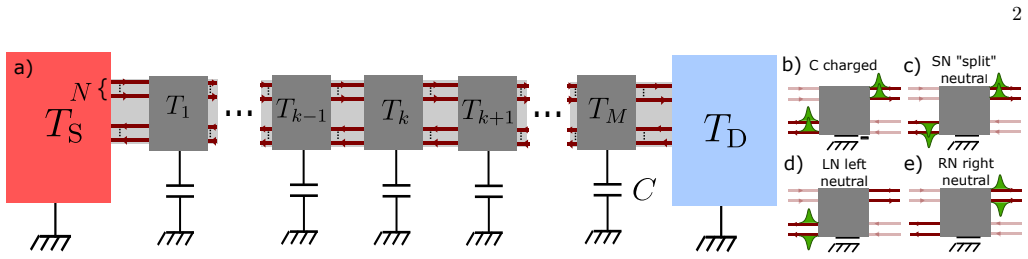
In a chain of metallic dots with frozen charge dynamics connected by ballistic channels, a neutral mode of transport emerges that entwines local diffusion by neutral excitations with long-range correlations between islands' charge states, resulting in a violation of the Wiedemann-Franz law where the Lorenz ratio scales as the square root of the chain's length.
What carries the argument
The neutral mode of transport that is specific to a chain with at least two islands and links local diffusion to long-range charge-state correlations.
If this is right
- The Lorenz ratio increases with the number of dots in the chain.
- Transport properties are governed by neutral excitations rather than charged carriers.
- Long-range correlations between charge states on different dots directly shape the conductivities.
- The effect requires a chain of at least two islands and vanishes for a single dot.
Where Pith is reading between the lines
- The same neutral-mode mechanism could appear in other chains of ballistic islands or quantum-Hall edge segments.
- Varying the number of dots in an experiment would provide a direct test of the predicted square-root scaling.
- The result suggests that interaction effects become more visible when ballistic structures are scaled up rather than kept minimal.
Load-bearing premise
Charge dynamics on the metallic dots remain frozen so that transport occurs only through neutral excitations.
What would settle it
Measure both thermal and electrical conductances through chains of varying numbers of dots and check whether the Lorenz ratio grows proportionally to the square root of chain length.
Figures


read the original abstract
Coulomb interactions deeply affect quantum transport in simple ballistic systems, but their impact on scaled up ballistic structures remains underexplored. Here we theoretically consider a chain of small metallic dots with frozen charge dynamics, connected by ballistic channels. We identify a neutral mode of transport, that is specific to a chain with at least two islands, and entwines local diffusion by neutral excitations with long-range correlations between islands' charge states. We show, as an experimentally measurable signature of this many-body behavior, that the Wiedemann-Franz law is violated with a Lorenz ratio scaling as the square root of the chain's length.
Editorial analysis
A structured set of objections, weighed in public.
Referee Report
Summary. The manuscript theoretically studies transport through a chain of small metallic dots with frozen charge dynamics, linked by ballistic channels. It identifies a neutral mode of transport that appears only for chains containing at least two islands and combines local diffusive transport by neutral excitations with long-range correlations among the islands' charge states. The central result is an experimentally measurable violation of the Wiedemann-Franz law in which the Lorenz ratio scales as the square root of the chain length L.
Significance. If the frozen-charge approximation is valid, the work supplies a parameter-free scaling prediction that constitutes a distinctive, falsifiable signature of many-body neutral-mode physics in a scaled ballistic quantum-Hall structure. The absence of adjustable parameters and the explicit link to a measurable transport coefficient are strengths that would make the result of interest to the mesoscopic-transport community.
major comments (2)
- [Abstract and model] Abstract and implied model section: The sqrt(L) scaling of the Lorenz ratio is derived under the assumption of strictly frozen charge dynamics on the dots. The manuscript does not quantify the regime of validity (e.g., charging energy E_c relative to temperature T, level spacing, or inter-island coupling) over which charge fluctuations remain negligible for the chain lengths at which the scaling is predicted. If finite charging energy allows charge fluctuations, the long-range correlations are screened and the neutral mode is replaced by charged modes that restore the standard Wiedemann-Franz relation; this assumption is therefore load-bearing for the central claim.
- [Transport results] Transport calculation (presumably §3 or §4): The explicit mapping from the neutral-mode diffusion plus long-range charge correlations to the claimed sqrt(L) Lorenz-ratio scaling is not visible in the provided text. Without the intermediate steps or the conductance expressions that produce this scaling, it is not possible to verify that the result is robust against small perturbations of the frozen-charge condition or against finite-length corrections.
minor comments (2)
- [Notation and figures] Clarify the precise definition of the Lorenz ratio (electrical vs. thermal conductance ratio) and the normalization used when plotting its L dependence.
- [Introduction] Add a brief discussion or reference to related neutral-mode literature in quantum-Hall edges or Luttinger-liquid chains to place the new mode in context.
Simulated Author's Rebuttal
We thank the referee for their careful reading, positive assessment of the significance, and for identifying areas where additional clarification would strengthen the manuscript. We address both major comments below and have revised the manuscript to include the requested details on the validity regime and the explicit derivation steps.
read point-by-point responses
-
Referee: The sqrt(L) scaling of the Lorenz ratio is derived under the assumption of strictly frozen charge dynamics on the dots. The manuscript does not quantify the regime of validity (e.g., charging energy E_c relative to temperature T, level spacing, or inter-island coupling) over which charge fluctuations remain negligible for the chain lengths at which the scaling is predicted. If finite charging energy allows charge fluctuations, the long-range correlations are screened and the neutral mode is replaced by charged modes that restore the standard Wiedemann-Franz relation; this assumption is therefore load-bearing for the central claim.
Authors: We agree that the frozen-charge approximation is central and that its regime of validity merits explicit quantification. The model is defined in the limit E_c much larger than both temperature and level spacing, which suppresses charge fluctuations and enforces the long-range correlations. In the revised manuscript we have added a dedicated paragraph in the model section that specifies the conditions E_c/T ≫ 1 and L ≪ exp(E_c/T) for which the neutral mode and the sqrt(L) scaling remain valid, together with a brief estimate showing that these conditions are accessible in current quantum-Hall dot experiments for moderate chain lengths. revision: yes
-
Referee: The explicit mapping from the neutral-mode diffusion plus long-range charge correlations to the claimed sqrt(L) Lorenz-ratio scaling is not visible in the provided text. Without the intermediate steps or the conductance expressions that produce this scaling, it is not possible to verify that the result is robust against small perturbations of the frozen-charge condition or against finite-length corrections.
Authors: We apologize for the omission of intermediate steps. The original text presented only the final scaling for conciseness. In the revised version we have expanded the transport calculation section to include the full derivation: we start from the diffusion equation for neutral excitations on the chain, impose the frozen-charge constraint that generates the long-range correlations, obtain the effective thermal conductance scaling as 1/sqrt(L) while the electrical conductance remains L-independent, and thereby arrive at the Lorenz ratio ~ sqrt(L). We also add a short discussion of robustness to weak charge fluctuations and finite-L corrections. revision: yes
Circularity Check
No circularity: derivation follows directly from stated model assumptions
full rationale
The paper defines a model consisting of a chain of metallic dots connected by ballistic channels under the explicit assumption of frozen charge dynamics. From this setup it identifies a neutral mode (present only for chains with at least two islands) that combines local diffusion with long-range charge-state correlations, then derives the sqrt(L) scaling of the Lorenz ratio as a direct consequence. No equations or steps reduce the claimed scaling or neutral-mode signature to a fitted parameter, self-definition, or load-bearing self-citation; the result is obtained by construction from the model rather than by renaming or circular re-use of inputs. The derivation is therefore self-contained against the paper's own premises.
Axiom & Free-Parameter Ledger
axioms (2)
- domain assumption Charge dynamics on the metallic dots are frozen, allowing only neutral excitations to mediate transport.
- standard math Channels between dots are ballistic and the system is in the quantum Hall regime.
invented entities (1)
-
Neutral mode of transport
no independent evidence
Lean theorems connected to this paper
-
IndisputableMonolith/Cost/FunctionalEquation.leanwashburn_uniqueness_aczel unclear?
unclearRelation between the paper passage and the cited Recognition theorem.
In the opposite case kBT/ℏ ≪ G0/C, in the so-called Heat Coulomb Blockade (HCB) regime, charge cannot vary on the island. ... 2N−1 neutral modes carry energy but no net charge, while one remaining charge mode...
What do these tags mean?
- matches
- The paper's claim is directly supported by a theorem in the formal canon.
- supports
- The theorem supports part of the paper's argument, but the paper may add assumptions or extra steps.
- extends
- The paper goes beyond the formal theorem; the theorem is a base layer rather than the whole result.
- uses
- The paper appears to rely on the theorem as machinery.
- contradicts
- The paper's claim conflicts with a theorem or certificate in the canon.
- unclear
- Pith found a possible connection, but the passage is too broad, indirect, or ambiguous to say the theorem truly supports the claim.
Forward citations
Cited by 1 Pith paper
-
Tunneling in multi-site mesoscopic quantum Hall circuits
Four-site and larger mesoscopic quantum Hall circuits exhibit interaction-driven quantum critical points with universal scaling due to relevant higher-order backscattering, while multichannel versions can restore the ...
Reference graph
Works this paper leans on
-
[1]
K. v. Klitzing, G. Dorda, and M. Pepper, New method for high-accuracy determination of the fine-structure con- stant based on quantized hall resistance, Phys. Rev. Lett. 45, 494 (1980)
work page 1980
-
[2]
S. Jezouin, F. D. Parmentier, A. Anthore, U. Gennser, A. Cavanna, Y. Jin, and F. Pierre, Quantum limit of heat flow across a single electronic channel, Science342, 601 (2013)
work page 2013
-
[3]
S. K. Srivastav, M. R. Sahu, K. Watanabe, T. Taniguchi, S. Banerjee, and A. Das, Universal quantized thermal conductance in graphene, Science Advances5, eaaw5798 (2019)
work page 2019
-
[4]
M. Banerjee, M. Heiblum, A. Rosenblatt, Y. Oreg, D. E. Feldman, A. Stern, and V. Umansky, Observed quanti- zation of anyonic heat flow, Nature545, 75 (2017)
work page 2017
-
[5]
M. Banerjee, M. Heiblum, V. Umansky, D. E. Feldman, Y. Oreg, and A. Stern, Observation of half-integer ther- mal hall conductance, Nature559, 205 (2018)
work page 2018
- [6]
- [7]
-
[8]
J. Crossno, J. K. Shi, K. Wang, X. Liu, A. Harzheim, A. Lucas, S. Sachdev, P. Kim, T. Taniguchi, K. Watan- abe, T. A. Ohki, and K. C. Fong, Observation of the dirac fluid and the breakdown of the wiedemann-franz law in graphene, Science351, 1058 (2016)
work page 2016
- [9]
-
[10]
M. N. Kiselev, Generalized wiedemann-franz law in a two-site charge kondo circuit: Lorenz ratio as a mani- festation of the orthogonality catastrophe, Phys. Rev. B 108, L081108 (2023)
work page 2023
-
[11]
A. Anthore, Z. Iftikhar, E. Boulat, F. D. Parmentier, A. Cavanna, A. Ouerghi, U. Gennser, and F. Pierre, Cir- cuit quantum simulation of a tomonaga-luttinger liquid with an impurity, Phys. Rev. X8, 031075 (2018). S6
work page 2018
- [12]
-
[13]
D. B. Karki, E. Boulat, and C. Mora, Double-charge quantum island in the quasiballistic regime, Phys. Rev. B105, 245418 (2022)
work page 2022
-
[14]
T. Morel, J.-Y. M. Lee, H.-S. Sim, and C. Mora, Fraction- alization and anyonic statistics in the integer quantum hall collider, Phys. Rev. B105, 075433 (2022)
work page 2022
- [15]
-
[16]
A. O. Slobodeniuk, I. P. Levkivskyi, and E. V. Sukho- rukov, Equilibration of quantum hall edge states by an ohmic contact, Phys. Rev. B88, 165307 (2013)
work page 2013
- [17]
-
[18]
F. St¨ abler and E. Sukhorukov, Mesoscopic heat multiplier and fractionalizer, Phys. Rev. B108, 235405 (2023)
work page 2023
-
[19]
F. St¨ abler, A. Gadiaga, and E. V. Sukhorukov, Giant heat flux effect in nonchiral transmission lines, Phys. Rev. Res.7, 033228 (2025)
work page 2025
-
[20]
C. Sp˚ ansl¨ att, F. St¨ abler, E. V. Sukhorukov, and J. Splettstoesser, Impact of potential and temperature fluctuations on charge and heat transport in quantum hall edges in the heat coulomb blockade regime, Phys. Rev. B110, 075431 (2024)
work page 2024
-
[21]
M. K¨ onig, S. Wiedmann, C. Br¨ une, A. Roth, H. Buh- mann, L. W. Molenkamp, X.-L. Qi, and S.-C. Zhang, Quantum spin hall insulator state in hgte quantum wells, Science318, 766 (2007)
work page 2007
-
[22]
C.-Z. Chang, C.-X. Liu, and A. H. MacDonald, Collo- quium: Quantum anomalous hall effect, Rev. Mod. Phys. 95, 011002 (2023)
work page 2023
-
[23]
M. P. Blencowe and V. Vitelli, Universal quantum limits on single-channel information, entropy, and heat flow, Phys. Rev. A62, 052104 (2000)
work page 2000
-
[24]
See supplemental materials
-
[25]
G. Le Breton, R. Delagrange, Y. Hong, M. Garg, K. Watanabe, T. Taniguchi, R. Ribeiro-Palau, P. Roul- leau, P. Roche, and F. D. Parmentier, Heat equilibra- tion of integer and fractional quantum hall edge modes in graphene, Phys. Rev. Lett.129, 116803 (2022)
work page 2022
- [26]
-
[27]
BALLISTIC-TO-DIFFUSIVE TRANSITION IN ENGINEERED COUNTER-PROPAGATING QUANTUM HALL CHANNELS
I. Petkovi´ c, F. I. B. Williams, and D. C. Glattli, Edge magnetoplasmons in graphene, Journal of Physics D: Ap- plied Physics47, 094010 (2014). SUPPLEMENTARY MATERIAL FOR “BALLISTIC-TO-DIFFUSIVE TRANSITION IN ENGINEERED COUNTER-PROPAGATING QUANTUM HALL CHANNELS” In this supplementary material we detail some calculations that are not shown in the main tex...
work page 2014
discussion (0)
Sign in with ORCID, Apple, or X to comment. Anyone can read and Pith papers without signing in.