REVIEW 3 major objections 4 minor 1 cited by
Oscillator-qubit generalized quantum signal processing for vibronic models: a case study of uracil cation
T0 review · 3 major / 4 minor · reviewed 2026-08-04 · deepseek-v4-flash
Pith's one-line read A compiler for hybrid oscillator-qubit processors synthesizes arbitrary bosonic phase gates in depth O(log(1/ε)), enabling anharmonic vibronic dynamics without discretizing the continuous variables.
desk verdict The CD-gate OQ-GQSP construction is genuinely new and checkable, but the O(log 1/ε) claim rests on a strip-analyticity assumption that the paper's own Morse potentials violate. read the letter →
The pith
A machine-rendered reading of the paper's core claim, the machinery that carries it, and where it could break.
The reading
What carries the argument
The core object is the OQ-GQSP sequence built from two complementary signal operators A_Q = diag(e^{iπQ/L}, I) and B_Q = diag(I, e^{-iπQ/L}), each constructed from two Z-basis conditional-displacement gates and a reusable ancilla. By the GQSP theorem, an alternating product of these operators and qubit rotations realizes a block matrix whose top-left entry is an arbitrary Laurent polynomial F(e^{iπQ/L}) in the displacement operator. This Laurent polynomial is used to approximate the Fourier series of exp(iΔt V(Q)), so the same circuit performs the nonlinear phase gate; a second OQ-GQSP block, followed by qubit measurements, makes the gate state-dependent (apply to one electronic state only).
What would settle it
Compute the Fourier coefficients a_k of g(x)=exp(iΔt V_Morse(x)) on [-L,L] for the paper's ν26 mode parameters and check whether |a_k| decays as C ρ^{-|k|} with ρ=e^{πσ/L} or only polynomially. If the decay is algebraic, the d=O(log 1/ε) theorem does not apply to this case and the observed fidelity 0.9229 at d=39 would be the expected behavior, not an anomaly.
Extended reading notes
Core claim
The paper's central claim is that arbitrary bosonic phase functions can be generated on an oscillator-qubit processor by a sequence of Z-basis conditional-displacement gates, removing the parity constraints of earlier hybrid QSP and thereby enabling state-dependent nonlinear bosonic phase gates through postselection. Theorem 2 asserts that one Trotter step of an anharmonic vibronic Hamiltonian costs O(N M' ln(1/ε) + N^2 M) conditional-displacement gates with success probability (1-δ)^{2M'N}, where N and M are the numbers of electronic states and vibrational modes and M' the number of anharmonic modes. The paper also shows numerically that the OQ-GQSP simulation of uracil cation captures the
Load-bearing premise
The claim that the circuit depth grows only as log(1/ε) assumes that each phase function exp(iΔt V(Q)) extends to a holomorphic function on a strip of width σ around the real axis, and for the Morse potentials used in the uracil cation model this periodic-extension analyticity does not appear to hold, since the potential differs by several eV across the period boundary.
Editorial extensions
If this is right
- If correct, anharmonic molecular dynamics can be simulated on hybrid oscillators with gate count growing linearly with modes and logarithmically with accuracy, avoiding the exponential cost of MCTDH and the discretization overhead of qubit-only encodings.
- The same compiler can prepare vibrational states matching anharmonic potentials, since the phase gates approximate arbitrary analytic potentials and can be used in state preparation.
- Success probability can be traded against circuit depth by adjusting the Fourier degree, giving a practical trade-off for near-term hardware.
- The protocol extends the reach of analog vibronic simulators by adding diagonal anharmonicity (Morse, quartic) while keeping off-diagonal linear couplings native.
- The uracil cation case shows anharmonic terms are necessary to reproduce sub-50 fs population relaxation, so the method addresses a physically relevant failure mode of harmonic models.
Reading between the lines
- The O(log 1/ε) resource claim rests on exponential decay of Fourier coefficients of exp(iΔt V(x)) for the 2L-periodic extension; for the Morse potentials in this paper, V(-L) and V(L) differ by several eV, so the periodic extension is discontinuous and the coefficients decay only algebraically. A direct numerical check of the Fourier coefficient decay for the paper's ν26 mode would determine wheth
- The reported fidelity of 0.9229 at d=39 (error ~0.08) is far from the ρ=e^π≈23.14 geometric rate predicted under the strip-analytic assumption, suggesting that the numerical convergence observed is consistent with algebraic rather than exponential decay. Testing higher d values would clarify the actual cost.
- If the holomorphic-extension assumption fails only at the boundary, a modified approximation—e.g., using a windowed or L-dependent periodization of the potential—might restore exponential convergence and is a natural extension.
- The same Fourier/GQSP synthesis could be extended to multivariate potentials once multivariable QSP angle finding becomes practical, which would allow mode–mode couplings rather than only diagonal anharmonicity.
Editorial analysis
A structured set of objections, weighed in public.
Referee Report
Summary. The paper introduces OQ-GQSP, a compilation method for hybrid oscillator–qubit processors, which uses generalized quantum signal processing (GQSP) with Z-basis conditional-displacement gates to implement nonlinear bosonic phase gates exp(i Δt V(Q)). The main theoretical claims are: (i) Lemma 1 constructs the required complementary signal operators from two CD gates; (ii) Lemma 2 converts such an approximation into a state-dependent nonlinear phase gate by postselection; and (iii) Theorem 2 asserts that a Trotter step of an anharmonic vibronic Hamiltonian costs O(N M' log(1/ε)+N^2 M) CD gates, with success probability (1-δ)^{2M'N}, giving the headline O(log(1/ε)) Fourier degree. The method is applied to a four-state, multimode model of the uracil cation with Morse and quartic potentials, with numerical demonstrations of Wigner functions and reduced two-mode population dynamics.
Significance. If the central complexity claim were correct, OQ-GQSP would be a meaningful step for hybrid CV-DV quantum simulation: it would compile anharmonic molecular potentials without discretizing the vibrational continuum and would achieve polylogarithmic cost in accuracy, linear in the number of modes. Lemma 1 is a clean and checkable construction, and the numerical dynamics simulation, though on a reduced model, is a forward computation with no fitted outcome parameters. However, the key analytic argument for exponential Fourier convergence is invalid for the potentials used in the case study, so the headline resource advantage is not established. The numerical data in Fig. 6 actually contradict the claimed convergence rate. The paper therefore does not currently support its main contribution as stated.
major comments (3)
- [Appendix C, Lemma 5 / Theorem 2 (Eqs. C7–C10)] The hypothesis that the 2L-periodic extension of g(x)=exp(iΔt V(x)) admits a holomorphic extension to the strip S_σ with sup |g|≤B is not satisfiable for the case-study potentials. For the Morse potentials in Table IV, e.g., the ν26 D2 well, V(-L)-V(L) grows with L (by several eV already at L≈5), so the periodic extension is discontinuous at x=±L. A discontinuous periodic function cannot have exponentially decaying Fourier coefficients; the coefficients decay only algebraically, and the bound d=O(log(1/ε)) in Theorem 2 is unsupported. The statement after Eq. (C14) that entire potentials such as polynomials and Morse functions allow σ=L is also false: even for f(z)=z^2, exp(iΔt z^2) is unbounded on any horizontal strip, and the periodic extension has a derivative jump. This is load-bearing because Theorem 2 and the resource comparison in Table I both rely on d=O(log(1/ε)).
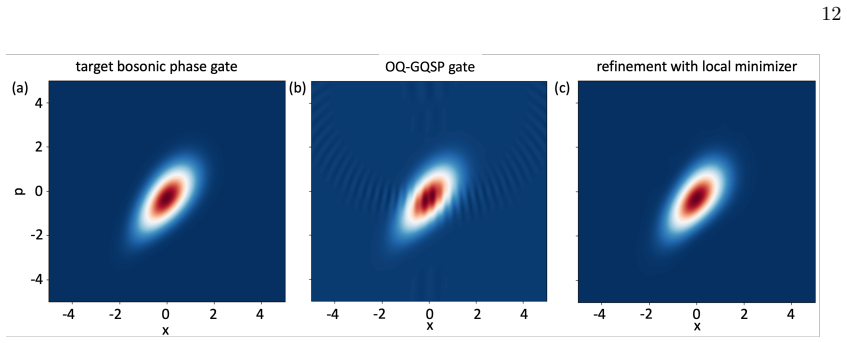
- [Section IV.A, Fig. 6] The paper's own unoptimized result, d=39 with fidelity 0.9229 for the ν26 Morse phase gate, is grossly inconsistent with the stated ρ=e^π≈23.14 rate: the Lemma 5 bound would predict an error far below 10^-50 at d=39, not ~0.077. The observed error is consistent with slow algebraic convergence of a discontinuous periodic extension. The vacuum-state-refined angles achieve 0.9999 but are state-dependent; they do not rescue Theorem 2, which requires a uniform gate approximation over all states occurring in the Trotter evolution. This numerical check should be addressed explicitly.
- [Appendix C, Lemma 2 proof (Eq. C6)] The construction replaces F(U)†F(U) by I on off-target electronic branches (the ≈ in the penultimate line of Eq. C6) without tracking the induced error in the theorem's error budget. Since |F|≤1 and F approximates a phase, the error is controllable by the Fourier truncation error, but the lemma as stated claims an exact state-dependent phase gate. The approximation should be stated as an additional error term and included in the final ε budget; as written, the proof contains an uncontrolled step.
minor comments (4)
- [Appendix C numbering] The appendix presents 'Lemma 1', 'Lemma 2', and then 'Lemma 5' with no Lemmas 3–4; the numbering is confusing and should be made consistent with the main text.
- [Section IV.B, Fig. 7 caption] The caption states that each OQ-GQSP synthesis is 'bounded by the Fourier series approximation error of 0.001', while Fig. 6 reports fidelity 0.9229 for d=39 and the text says the optimized gate reaches 0.9999. It should be clarified which gates (unoptimized or vacuum-refined) are used in the dynamics simulation and how the 0.001 bound is compatible with Fig. 6.
- [Section III.C after Lemma 1] The sentence 'OQ-GQSP can generate arbitrary bosonic phase functions with Fourier series approximation' is too broad. The construction is limited to the Fourier approximation of phase functions whose periodic extension has sufficient smoothness; otherwise convergence is algebraic. This qualification is important given the case-study potentials.
- [Section V, Table I] The table header for OQ-GQSP lists the Trotter layer count as p=Γt^2ε^{-1}, which seems dimensionally inconsistent with the definition p=⌈Γt^2/ε_Trot⌉ in Eq. (19). Please align notation and define Γ in the table caption.
Circularity Check
No significant circularity: the derivation is a forward application of an external GQSP theorem and standard Fourier analysis; the main gap is an unverified analyticity premise, not a reduction of output to input.
full rationale
The claimed derivation chain is: (i) Theorem 1 (GQSP) is imported as an external mathematical result with citations [11,21,22,25]; (ii) Lemma 1 explicitly constructs the signal operators A_Q and B_Q from Z-basis CD gates with a detailed linear-algebra proof (Appendix C, Eqs. C1–C3); (iii) Lemma 2 is a heralded postselection calculation converting OQ-GQSP into a state-dependent nonlinear bosonic phase gate; (iv) Lemma 5 is a standard Cauchy-estimate bound on Fourier coefficients under a stated holomorphy assumption; and (v) Theorem 2 combines these with a first-order Trotter error bound. No step fits a parameter to the quantity it later claims to predict. The Fourier coefficients c_n follow from the externally supplied anharmonic potentials (Appendix A, Tables II–IV), and the GQSP angles come from independent angle-finding literature, not from the simulated population dynamics. The one numerical refinement — optimizing GQSP angles for vacuum-state fidelity (Fig. 6c) — is explicitly disclosed and is not used to establish the asymptotic O(N M' ln(1/ε) + N^2 M) resource claim; the paper even notes that unoptimized gates are required for accuracy across general excited states. The serious weakness in the paper, namely that Lemma 5's hypothesis of a holomorphic 2L-periodic extension of exp(iΔt V(x)) appears to fail for the asymmetric Morse wells used in the uracil case study, is a correctness / falsifiability issue in applying the theorem, not circularity: Theorem 2 is explicitly conditional ('Assume the analyticity and boundedness hypotheses of Lemma 5 for each g_nr(x)'), and the algebraic construction does not presuppose its own conclusion. Therefore no circular step is exhibited, and the circularity score is 0.
Assumptions & free parameters
free parameters (3)
- Fourier half-period L =
unspecified in the paper
- Optimized GQSP angles (vacuum-state refinement) =
not tabulated
- Uracil cation model parameters (external fits from Refs. [15,16]) =
tabulated in Appendix A (d, a, q0, e0, k, kappa, gamma, lambda)
assumptions (5)
- standard math GQSP theorem (Thm 1): any F, G with |F|^2 + |G|^2 = 1 on the unit circle is realizable by SU(2) rotation sequences
- domain assumption The 2L-periodic extension of g(x) = exp(i dt V(x)) is holomorphic in a strip of width sigma with sup |g| <= B (Lemma 5)
- ad hoc to paper F(U)^dag F(U) approximately equals I on off-target electronic branches (Lemma 2)
- standard math First-order Trotter error bound with commutator bound Gamma (Eqs. 18-19)
- domain assumption Inverted unary encoding: |Dn> maps to a one-zero-qubit state, and LVC terms factor into sigma_x sigma_x + sigma_y sigma_y products (Eq. 4)
Cite this review
Pith. "Pith review of Oscillator-qubit generalized quantum signal processing for vibronic models: a case study of uracil cation." pith.science (2026). https://pith.science/paper/5YOHCPZA
@misc{pith2026251010495,
  author       = {Pith},
  title        = {Pith review of: Oscillator-qubit generalized quantum signal processing for vibronic models: a case study of uracil cation},
  year         = {2026},
  howpublished = {\url{https://pith.science/paper/5YOHCPZA}},
  note         = {Machine review of arXiv:2510.10495}
}
read the original abstract
Hybrid oscillator-qubit processors have recently demonstrated high-fidelity control of both continuous- and discrete-variable information processing. However, most of the quantum algorithms remain limited to homogeneous quantum architectures. Here, we present a compiler for hybrid oscillator-qubit processors, implementing state preparation and time evolution. In hybrid oscillator-qubit processors, this compiler invokes generalized quantum signal processing (GQSP) to constructively synthesize arbitrary bosonic phase gates with moderate circuit depth O(log(1/{\varepsilon})). The approximation cost is scaled by the Fourier bandwidth of the target bosonic phase, rather than by the degree of nonlinearity. Armed with GQSP, nonadiabatic molecular dynamics can be decomposed with arbitrary-phase potential propagators. Compared to fully discrete encodings, our approach avoids the overhead of truncating continuous variables, showing linear dependence on the number of vibration modes while trading success probability for circuit depth. We validate our method on the uracil cation, a canonical system whose accurate modeling requires anharmonic vibronic models, estimating the cost for state preparation and time evolution.
Figures


Figures from the paper (6 more)




Forward citations
Cited by 1 Pith paper
-
Benchmarking trigonometric continuous-variable gate primitives with trapped ions
Cosine gates exp(-iθ cos(c x̂)) in one- and two-mode versions were implemented on trapped-ion motional modes and benchmarked against noise-inclusive simulations via Fock-space transition probabilities.
Reference graph
Works this paper leans on
-
[1]
Y. Liu, S. Singh, K. C. Smith, E. Crane, J. M. Martyn, A. Eickbusch, A. Schuckert, R. D. Li, J. Sinanan- Singh, M. B. Soley, T. Tsunoda, I. L. Chuang, N. Wiebe, and S. M. Girvin, Hybrid oscillator-qubit quantum processors: Instruction set architectures, abstract machine models, and applications (2025), arXiv:2407.10381 [quant-ph]
arXiv 2025
-
[2]
O. Hahn, G. Ferrini, and R. Takagi, Bridging magic and non-gaussian resources via gottesman-kitaev- preskill encoding, PRX Quantum6, 010330 (2025)
2025
-
[3]
Sørensen and K
A. Sørensen and K. Mølmer, Entanglement and quantum computation with ions in thermal motion, Phys. Rev. A62, 022311 (2000)
2000
-
[4]
Eickbusch, V
A. Eickbusch, V. Sivak, A. Z. Ding, S. S. Elder, S. R. Jha, J. Venkatraman, B. Royer, S. M. Girvin, R. J. Schoelkopf, and M. H. Devoret, Fast universal control of an oscillator with weak dispersive coupling to a qubit, Nat. Phys.18, 1464 (2022)
2022
-
[5]
R. J. MacDonell, C. E. Dickerson, C. J. T. Birch, A. Kumar, C. L. Edmunds, M. J. Biercuk, C. Hempel, and I. Kassal, Analog quantum simulation of chemical dynamics, Chem. Sci.12, 9794 (2021)
2021
-
[6]
M. Kang, H. Nuomin, S. N. Chowdhury, J. L. Yuly, K. Sun, J. Whitlow, J. Valdiviezo, Z. Zhang, P. Zhang, D. N. Beratan, and K. R. Brown, Seeking a quantum advantage with trapped-ion quantum simulations of condensed-phase chemical dynamics, Nat. Rev. Chem.8, 340 (2024)
2024
-
[7]
G. A. Worth, H.-D. Meyer, H. K¨ oppel, L. S. Cederbaum, and I. B. and, Using the mctdh wavepacket propagation method to describe multimode non-adiabatic dynamics, Int. Rev. Phys. Chem.27, 569 (2008)
2008
-
[8]
Valahu, V
C. Valahu, V. Olaya-Agudelo, R. MacDonell, T. Navickas, A. Rao, M. Millican, J. P´ erez-S´ anchez, J. Yuen-Zhou, M. Biercuk, C. Hempel, T. Tan, and I. Kassal, Direct observation of geometric-phase interference in dynamics around a conical intersection, Nat. Chem.15, 1503 (2023)
2023
Show all 42 references
-
[9]
Whitlow, Z
J. Whitlow, Z. Jia, Y. Wang, C. Fang, J. Kim, and K. Brown, Quantum simulation of conical intersec- tions using trapped ions, Nat. Chem.15, 1509 (2023)
2023
-
[10]
C. S. Wang, N. E. Frattini, B. J. Chapman, S. Puri, S. M. Girvin, M. H. Devoret, and R. J. Schoelkopf, Observation of wave-packet branching through an engineered conical intersection, Phys. Rev. X13, 011008 (2023)
2023
-
[11]
Motlagh and N
D. Motlagh and N. Wiebe, Generalized quantum signal processing, PRX Quantum5, 020368 (2024)
2024
-
[12]
Matsika, Two- and three-state conical intersections in the uracil cation, Chem
S. Matsika, Two- and three-state conical intersections in the uracil cation, Chem. Phys.349, 356 (2008)
2008
-
[13]
Vasconcelos and A
F. Vasconcelos and A. Gily´ en, Methods for reducing ancilla-overhead in block encodings (2025), arXiv:2507.07900 [quant-ph]
2025
-
[14]
J. Y. Araz, M. Grau, J. Montgomery, and F. Ringer, Hybrid quantum simulations with qubits and qumodes on trapped-ion platforms, Phys. Rev. A112, 012620 (2025)
2025
-
[15]
Assmann, H
M. Assmann, H. K¨ oppel, and S. Matsika, Photoelectron spectrum and dynamics of the uracil cation, J. Phys. Chem. A119, 866 (2015)
2015
-
[16]
Vindel-Zandbergen, S
P. Vindel-Zandbergen, S. Matsika, and N. T. Maitra, Exact-factorization-based surface hopping for multistate dynamics, J. Phys. Chem. Lett.13, 1785 (2022)
2022
-
[17]
Ha and R
J.-K. Ha and R. J. MacDonell, Analog quantum simulation of coupled electron-nuclear dynamics in molecules, Chem. Sci. , (2025)
2025
-
[18]
O. Katz, M. Cetina, and C. Monroe, Programmablen-body interactions with trapped ions, PRX Quantum4, 030311 (2023)
2023
-
[19]
G. H. Low, T. J. Yoder, and I. L. Chuang, Methodology of resonant equiangular composite quantum gates, Phys. Rev. X6, 041067 (2016)
2016
-
[20]
K. Park, P. Marek, and R. Filip, Efficient quantum simulation of nonlinear interactions using snap and rabi gates, Quantum Sci. Technol.9, 025004 (2024)
2024
-
[21]
Laneve, Generalized quantum signal processing and non-linear fourier transform are equivalent (2025), arXiv:2503.03026 [quant-ph]
L. Laneve, Generalized quantum signal processing and non-linear fourier transform are equivalent (2025), arXiv:2503.03026 [quant-ph]
2025 arXiv
-
[22]
H. Ni, R. Sarkar, L. Ying, and L. Lin, Inverse nonlinear fast fourier transform on su(2) with applications to quantum signal processing (2025), arXiv:2505.12615 [quant-ph]. 24
2025 arXiv
-
[23]
Y. Liu, J. M. Martyn, J. Sinanan-Singh, K. C. Smith, S. M. Girvin, and I. L. Chuang, Toward mixed analog-digital quantum signal processing: Quantum ad/da conversion and the fourier transform (2025), arXiv:2408.14729
2025
-
[24]
J. M. Martyn, Y. Liu, Z. E. Chin, and I. L. Chuang, Efficient fully-coherent quantum signal processing algorithms for real-time dynamics simulation, J. Chem. Phys.158, 024106 (2023)
2023
-
[25]
Yamamoto and N
S. Yamamoto and N. Yoshioka, Robust angle finding for generalized quantum signal processing (2024), arXiv:2402.03016 [quant-ph]
2024 arXiv
-
[26]
Lin and C.-H
W.-C. Lin and C.-H. Wang, Analog quantum phase estimation with single-mode readout (2025), arXiv:2506.15668 [quant-ph]
2025 arXiv
-
[27]
Motlagh, R
D. Motlagh, R. A. Lang, P. Jain, J. A. Campos-Gonzalez-Angulo, W. Maxwell, T. Zeng, A. Aspuru- Guzik, and J. Miguel Arrazola, Quantum algorithm for vibronic dynamics: case study on singlet fission solar cell design, Quantum Sci. Technol.10, 045048 (2025)
2025
-
[28]
Z. M. Rossi and I. L. Chuang, Multivariable quantum signal processing (M-QSP): prophecies of the two-headed oracle, Quantum6, 811 (2022)
2022
-
[29]
H. Mori, K. Mizuta, and K. Fujii, Comment on ”Multivariable quantum signal processing (M-QSP): prophecies of the two-headed oracle”, Quantum8, 1512 (2024)
2024
-
[30]
N´ emeth, B
B. N´ emeth, B. K¨ ov´ er, B. Kulcs´ ar, R. B. Mikl´ osi, and A. Gily´ en, On variants of multivariate quantum signal processing and their characterizations (2023), arXiv:2312.09072 [quant-ph]
2023 arXiv
-
[31]
Y. Ito, H. Mori, K. Sakamoto, and K. Fujii, Polynomial time constructive decision algorithm for multivariable quantum signal processing (2025), arXiv:2410.02332 [quant-ph]
2025 arXiv
-
[32]
Laneve and S
L. Laneve and S. Wolf, On multivariate polynomials achievable with quantum signal processing, Quan- tum9, 1641 (2025)
2025
-
[33]
Laneve, An adversary bound for quantum signal processing (2025), arXiv:2506.20484 [quant-ph]
L. Laneve, An adversary bound for quantum signal processing (2025), arXiv:2506.20484 [quant-ph]
2025
-
[34]
P´ erez-Salinas, M
A. P´ erez-Salinas, M. Y. Rad, A. Barthe, and V. Dunjko, Universal approximation of continuous func- tions with minimal quantum circuits (2025), arXiv:2411.19152 [quant-ph]
2025
-
[35]
Niset, J
J. Niset, J. Fiur´ aˇ sek, and N. J. Cerf, No-go theorem for gaussian quantum error correction, Phys. Rev. Lett.102, 120501 (2009)
2009
-
[36]
Vuillot, H
C. Vuillot, H. Asasi, Y. Wang, L. P. Pryadko, and B. M. Terhal, Quantum error correction with the toric gottesman-kitaev-preskill code, Phys. Rev. A99, 032344 (2019)
2019
-
[37]
K. Noh, S. M. Girvin, and L. Jiang, Encoding an oscillator into many oscillators, Phys. Rev. Lett.125, 080503 (2020)
2020
-
[38]
Wu and Q
J. Wu and Q. Zhuang, Continuous-variable error correction for general gaussian noises, Phys. Rev. Appl.15, 034073 (2021)
2021
-
[39]
J. Wu, A. J. Brady, and Q. Zhuang, Optimal encoding of oscillators into more oscillators, Quantum7, 1082 (2023)
2023
-
[40]
J.-T. Bu, L. Zhang, Z. Yu, J.-B. Wang, W.-Q. Ding, W.-F. Yuan, B. Wang, H.-J. Du, W.-J. Chen, L. Chen, J.-W. Zhang, J.-C. Li, F. Zhou, X. Wang, and M. Feng, Exploring the experimental limit of deep quantum signal processing using a trapped-ion simulator, Phys. Rev. Appl.23, 03...
2025
-
[41]
Zeytino˘ glu and S
S. Zeytino˘ glu and S. Sugiura, Error-robust quantum signal processing using rydberg atoms, Phys. Rev. Res.6, 013003 (2024)
2024
-
[42]
K. Park, J. Hastrup, J. S. Neergaard-Nielsen, J. B. Brask, R. Filip, and U. L. Andersen, Slowing quantum decoherence of oscillators by hybrid processing, npj Quantum Inf.8, 67 (2022)
2022
Reviewed August 4, 2026 · model on record in the stance chip above.
Discussion (0). Sign in to comment.