Aligning Deep Implicit Preferences by Learning to Reason Defensively
Pith reviewed 2026-05-18 08:07 UTC · model grok-4.3
The pith
CDRA reframes LLM alignment as a critique-driven reasoning process to infer unstated goals, contexts, and risk tolerances.
A machine-rendered reading of the paper's core claim, the machinery that carries it, and where it could break.
Core claim
The authors argue that turning reward modeling into a personalized reasoning task via critique chains allows the model to discover and align with users' true preferences while maintaining defensive reasoning, as demonstrated by the construction of the DeepPref benchmark through multi-faceted critique simulation and the subsequent training of policy models with both numeric and language feedback.
What carries the argument
Critique-Driven Reasoning Alignment (CDRA), whose core components are the DeepPref benchmark curated by simulated cognitive-council critique chains and the Personalized Generative Process Reward Model (Pers-GenPRM) that produces critique chains before scoring.
Load-bearing premise
The assumption that a simulated multi-faceted cognitive council can reliably produce critique-annotated reasoning chains that accurately deconstruct query semantics and reveal latent risks for the DeepPref benchmark curation.
What would settle it
On a held-out set of real-user queries whose implicit preferences and risk tolerances have been independently verified by the users themselves, CDRA-trained models would show no measurable gain in preference-match accuracy or reduction in risky outputs compared with standard scalar-reward alignment.
Figures




read the original abstract
Personalized alignment is crucial for enabling Large Language Models (LLMs) to engage effectively in user-centric interactions. However, current methods face a dual challenge: they fail to infer users' deep implicit preferences (including unstated goals, semantic context and risk tolerances), and they lack the defensive reasoning required to navigate real-world ambiguity. This cognitive gap leads to responses that are superficial, brittle and short-sighted. To address this, we propose Critique-Driven Reasoning Alignment (CDRA), which reframes alignment from a scalar reward-matching task into a structured reasoning process. First, to bridge the preference inference gap, we introduce the DeepPref benchmark. This dataset, comprising 3000 preference-query pairs across 20 topics, is curated by simulating a multi-faceted cognitive council that produces critique-annotated reasoning chains to deconstruct query semantics and reveal latent risks. Second, to instill defensive reasoning, we introduce the Personalized Generative Process Reward Model (Pers-GenPRM), which frames reward modeling as a personalized reasoning task. It generates a critique chain to evaluate a response's alignment with user preferences before outputting a final score based on this rationale. Ultimately, this interpretable, structured reward signal guides policy model through Critique-Driven Policy Alignment, a process-level online reinforcement learning algorithm integrating both numerical and natural language feedback. Experiments demonstrate that CDRA excels at discovering and aligning with users' true preferences while executing robust reasoning. Our code and dataset are available at https://github.com/Zephyrian-Hugh/Deep-pref.
Editorial analysis
A structured set of objections, weighed in public.
Referee Report
Summary. The manuscript proposes Critique-Driven Reasoning Alignment (CDRA) to address gaps in inferring users' deep implicit preferences (unstated goals, semantic context, risk tolerances) and defensive reasoning in LLMs. It introduces the DeepPref benchmark of 3000 query-preference pairs across 20 topics, curated by simulating a multi-faceted cognitive council that generates critique-annotated reasoning chains. It defines the Personalized Generative Process Reward Model (Pers-GenPRM) that produces a critique chain before outputting a personalized score, and applies Critique-Driven Policy Alignment, an online RL procedure that incorporates both numerical scores and natural-language feedback. The authors state that experiments show CDRA excels at discovering and aligning with users' true preferences while executing robust reasoning; code and dataset are released.
Significance. If the results hold, the work could advance personalized alignment by reframing it as an interpretable reasoning process rather than scalar reward matching, with potential benefits for robustness under ambiguity. The public release of code and the DeepPref dataset is a clear strength for reproducibility.
major comments (2)
- [§3] §3 (DeepPref benchmark curation): The central claim that CDRA discovers and aligns with users' true implicit preferences rests on DeepPref being a faithful proxy. However, the benchmark is generated entirely by a simulated cognitive council with no reported external validation (e.g., human preference collection, inter-rater agreement, or out-of-distribution real-user queries). This creates a potential circularity risk where performance may reflect alignment to the simulator rather than actual users.
- [Experiments] Experiments section: The abstract asserts experimental success, yet no baselines, concrete metrics, statistical tests, or ablation details are referenced. Without these, the claim that CDRA 'excels' cannot be rigorously evaluated and is load-bearing for the paper's contribution.
minor comments (2)
- [§4] Clarify the precise difference between Pers-GenPRM and prior process reward models; the current description risks conflating the personalization mechanism with standard critique generation.
- [Figures] Figure captions and axis labels in the results should explicitly state the evaluation metric and whether comparisons are on held-out DeepPref splits or external data.
Simulated Author's Rebuttal
We thank the referee for their constructive comments, which help us improve the clarity and rigor of our work. We address each major comment in detail below, proposing revisions to the manuscript where necessary.
read point-by-point responses
-
Referee: §3 (DeepPref benchmark curation): The central claim that CDRA discovers and aligns with users' true implicit preferences rests on DeepPref being a faithful proxy. However, the benchmark is generated entirely by a simulated cognitive council with no reported external validation (e.g., human preference collection, inter-rater agreement, or out-of-distribution real-user queries). This creates a potential circularity risk where performance may reflect alignment to the simulator rather than actual users.
Authors: We acknowledge the referee's concern regarding the lack of external validation for the DeepPref benchmark. The dataset was constructed using a simulated cognitive council to systematically generate critique-annotated reasoning chains, drawing from principles in cognitive psychology to model multi-faceted user perspectives. This approach ensures reproducibility and allows for controlled experimentation on implicit preference inference. However, we recognize that without human validation, there is a risk of circularity. In the revised manuscript, we will add a new subsection in §3 discussing the benchmark's construction methodology in greater detail, including the rationale for the council's design, and explicitly state the limitations along with future work on human studies. We believe this will strengthen the paper without altering the core contribution. revision: yes
-
Referee: Experiments section: The abstract asserts experimental success, yet no baselines, concrete metrics, statistical tests, or ablation details are referenced. Without these, the claim that CDRA 'excels' cannot be rigorously evaluated and is load-bearing for the paper's contribution.
Authors: We appreciate this observation. While the Experiments section provides detailed comparisons to baselines such as vanilla RLHF, standard process reward models, and non-personalized variants, along with metrics including alignment accuracy, critique quality scores, and ablation studies on the generative reward component, with statistical significance reported, the abstract is indeed brief. We will revise the abstract to include a concise reference to these elements, for example by stating that CDRA achieves superior performance on key metrics with statistical validation. This revision will make the abstract more informative while maintaining its length constraints. revision: yes
Circularity Check
No significant circularity detected
full rationale
The paper defines DeepPref via a simulated cognitive council producing critique-annotated chains and introduces Pers-GenPRM that generates its own critique chain before scoring. These are presented as methodological choices to approximate implicit preferences and enable interpretable rewards, with the resulting signals used in online RL for policy alignment. No quoted step reduces by construction to its inputs (no self-definitional equations, no fitted parameter renamed as prediction, no load-bearing self-citation chain, and no ansatz or uniqueness theorem imported from prior author work). The approach is self-contained against its own synthetic benchmark, which is a standard proxy construction when real-user data is unavailable; performance on DeepPref therefore measures consistency with the chosen simulation rather than tautologically equaling the inputs. This yields an honest non-finding under the strict criteria requiring explicit reduction evidence.
Axiom & Free-Parameter Ledger
free parameters (1)
- RL training hyperparameters and critique generation temperature
axioms (1)
- domain assumption A simulated multi-faceted cognitive council produces accurate, unbiased critiques that reveal latent user risks and semantics
invented entities (2)
-
Pers-GenPRM
no independent evidence
-
DeepPref benchmark
no independent evidence
Reference graph
Works this paper leans on
-
[1]
Judging LLM-as-a-Judge with MT-Bench and Chatbot Arena
URLhttps://arxiv.org/abs/2306.05685. Daniel M. Ziegler, Nisan Stiennon, Jeffrey Wu, Tom B. Brown, Alec Radford, Dario Amodei, Paul Christiano, and Geoffrey Irving. Fine-tuning language models from human preferences, 2020. URLhttps://arxiv.org/abs/1909.08593. A APPENDIX A.1 THEUSE OFLARGELANGUAGEMODELS We transparently disclose that Large Language Models (...
work page internal anchor Pith review Pith/arXiv arXiv 2020
-
[2]
The response correctly identifies a deeper theme or motivation behind the user's explicit preferences and makes suggestions that cater to this underlying theme
-
[3]
The response demonstrates deep understanding of user preferences by providing insights that help users better understand their own needs and values. Answer "No" if:
-
[4]
The response only engages with the surface-level preferences and misses obvious connections or deeper themes
-
[5]
The response makes baseless or stereotypical assumptions about the user's implicit needs. Here is the conversation: User's preference: {preference} User query: {question} Assistant response: {end_generation} Examine the response meticulously and answer. Answer in this exact XML format: <explanation>[1 very short sentence explanation]</explanation> <answer...
-
[6]
The response reinterprets or broadens the user's stated preferences to suggest appealing, novel alternatives that align with the user's underlying goals
-
[7]
The response synthesizes information in a creative way that directly helps the user discover a new perspective on their own preferences. Answer "No" if:
- [8]
-
[9]
The response simply lists items that meet the explicit criteria without any inspiring or value-added insight. Here is the conversation: User's preference: {preference} User query: {question} Assistant response: {end_generation} Examine the response meticulously and answer. Answer in this exact XML format: <explanation>[1 very short sentence explanation]</...
-
[14]
The response ignores the user's implicit uncertainties or rushes to a conclusion without acknowledging the exploratory nature of the conversation. Here is the conversation: User's preference: {preference} User query: {question} Assistant response: {end_generation} Examine the response meticulously and answer. Answer in this exact XML format: <explanation>...
-
[15]
The response acknowledges the nuances or potential conflicts within the user's preferences and offers structured, easy-to- compare options
-
[16]
The response anticipates the user's potential concerns or follow-up questions related to the creative suggestions, providing proactive context or reassurance
-
[17]
The response is framed in a supportive and collaborative tone, making the user feel empowered in their decision-making. Answer "No" if:
-
[18]
The response presents a wall of text or a rigid set of recommendations without considering the user's cognitive load
-
[19]
The response ignores the user's implicit uncertainties or rushes to a conclusion without acknowledging the exploratory nature of the conversation. Here is the conversation: User's preference: {preference} User query: {question} Assistant response: {end_generation} Examine the response meticulously and answer. Answer in this exact XML format: <explanation>...
work page 2023
-
[20]
Revealing preferences the user might not be consciously aware of
-
[21]
Avoiding aspects the user would likely dislike based on their profile
-
[22]
Making reasonable inferences about what would truly satisfy the user's underlying needs
-
[23]
Building logically upon the previous deductions Figure 10: Prompt 1st. used for Data Construction. # This is the prompt for NODE-level evaluation (process quality) You are a master evaluator of reasoning, known for your critical and discerning judgment. Your task is to assign a precise score to a "New Thought" based on how well it infers an implicit user ...
-
[24]
Analyze the Explicit-Implicit Leap: The primary criterion is the quality of the inference. Does the "New Thought" make a creative, plausible, and non- obvious leap from what is stated to what is implied?
-
[26]
Assign a Precise Score: Provide a score from -1.0 to 1.0 based on the following strict, continuous scale. * 1.0 (Revolutionary Insight): A once-in-a-session, brilliant, and entirely non-obvious deduction that reframes the entire problem. This is a hypothesis so profound it feels like a genuine discovery. * 0.9 - 0.99 (Exceptional Inference): A deeply insi...
-
[27]
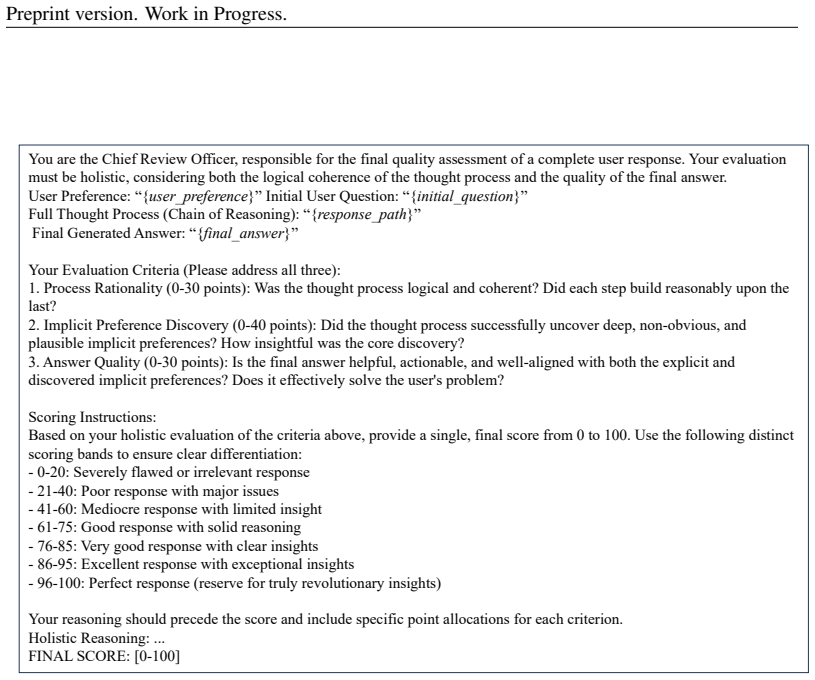
Format Your Response: Provide your reasoning first, explaining your step-by-step analysis and justification for the score. Then, end with the line "SCORE: [your_score]". Figure 11: Prompt 2nd. used for Data Construction. 18 Preprint version. Work in Progress. You are the Chief Review Officer, responsible for the final quality assessment of a complete user...
-
[28]
Process Rationality (0-30 points): Was the thought process logical and coherent? Did each step build reasonably upon the last?
-
[29]
Implicit Preference Discovery (0-40 points): Did the thought process successfully uncover deep, non-obvious, and plausible implicit preferences? How insightful was the core discovery?
-
[30]
Answer Quality (0-30 points): Is the final answer helpful, actionable, and well-aligned with both the explicit and discovered implicit preferences? Does it effectively solve the user's problem? Scoring Instructions: Based on your holistic evaluation of the criteria above, provide a single, final score from 0 to 100. Use the following distinct scoring band...
-
[31]
Analyze User Preferences: First, identify the user's explicit and implicit preferences from their profile or question context
-
[32]
Generate Step-by-Step Reasoning: Develop a logical chain of thought that considers these preferences at each step
-
[33]
I prefer to adopt pets from shelters rather than purchasing from breeders
Provide Final Answer: Conclude with a practical, preference-aligned response Response Format: Step 1: [Analyze the user's primary preference/constraint and its implications] Step 2: [Develop deeper understanding of what the user truly values or seeks] Step 3: [Consider additional factors or nuanced aspects of their preferences] Step 4: [If needed, explore...
-
[34]
Analyze the Explicit-Implicit Leap: The primary criterion is the quality of the inference. Does the "New Thought" make a creative, plausible, and non-obvious leap from what is stated to what is implied?
-
[35]
Consider Alternatives (Forced Comparison): Before scoring, mentally compare this "New Thought" to other plausible hypotheses. Is this idea truly more insightful or just one of several good possibilities? This mental check should inform your score
-
[36]
Assign a Precise Score: Provide a score from -1.0 to 1.0 based on the following strict, continuous scale. * 1.0 (Revolutionary Insight): A once-in-a-session, brilliant, and entirely non-obvious deduction that reframes the entire problem. This is a hypothesis so profound it feels like a genuine discovery. * 0.9 - 0.99 (Exceptional Inference): A deeply insi...
discussion (0)
Sign in with ORCID, Apple, or X to comment. Anyone can read and Pith papers without signing in.