One-dimensional topology and topolectrics of nonsymmorphic Kramers degenerate systems
Pith reviewed 2026-05-18 07:36 UTC · model grok-4.3
The pith
Nonsymmorphic four-band models in one dimension support Z2 and Z4 topological phases realized and detected in topolectric circuits.
A machine-rendered reading of the paper's core claim, the machinery that carries it, and where it could break.
Core claim
Nonsymmorphic four-band tight-binding models in one dimension with Kramers degeneracy fall into the AII class with a Z2 invariant and the D class with a Z4 classification. Extending the open-path winding-number formulation allows computation of these invariants. Topolectric circuit realizations reproduce the phase boundaries and zero-energy modes through impedance response. In the minimal nearest-neighbor Z4 model, domain-wall zero modes stay pinned at zero energy under disorder since it has no first-order coupling to the soliton subspace.
What carries the argument
Open-path winding-number formulation extended to Kramers-degenerate four-band systems
If this is right
- Impedance response in the topolectric circuits matches the predicted topological phase boundaries for the AII and Z4 models.
- Zero-energy modes appear at the locations expected from the invariants in both circuit realizations.
- Certain domain-wall zero modes in the minimal nearest-neighbor Z4 model remain pinned at zero energy under disorder.
Where Pith is reading between the lines
- The disorder-pinning mechanism could be tested in fabricated topolectric networks to check robustness beyond the minimal model.
- The extended winding-number method may apply to related symmetry classes in circuit or lattice systems.
- Longer-range terms that restore symmetries could be used to tune the protection of the pinned modes.
Load-bearing premise
The open-path winding-number formulation previously used for non-Kramers-degenerate nonsymmorphic Z2 phases extends without modification to compute the invariants of Kramers-degenerate four-band systems.
What would settle it
An impedance measurement in the proposed topolectric circuit that fails to reproduce the predicted phase boundaries and zero-energy modes, or a shift of the domain-wall modes away from zero energy when disorder is added to the minimal Z4 model.
Figures



read the original abstract
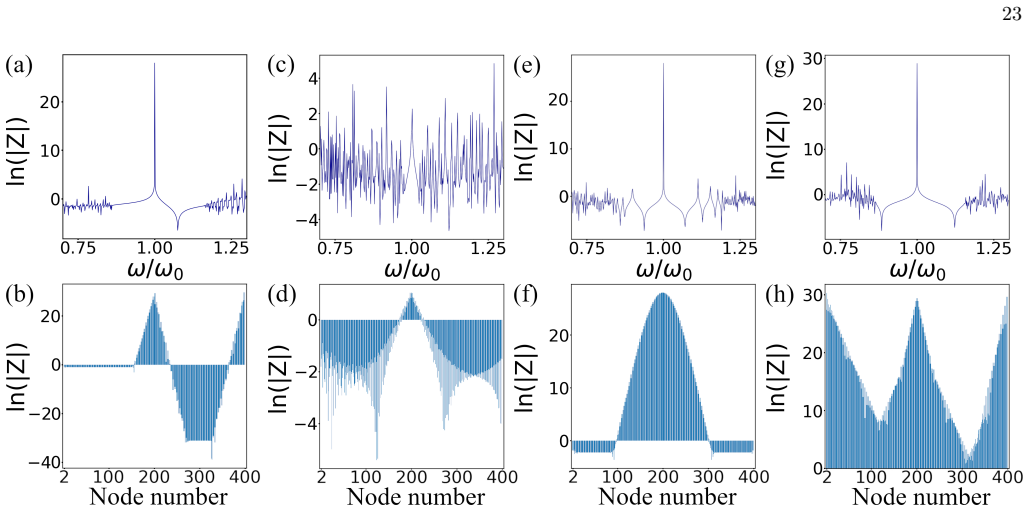
We describe nonsymmorphic four-band tight-binding models in one dimension with Kramers degeneracy, and propose topolectric-circuit realizations of their topological phases. We begin with a representative model in the nonsymmorphic AII class with symmorphic time-reversal symmetry and nonsymmorphic charge-conjugation and chiral symmetries, resulting in a $\mathbb{Z}_2$ invariant. We also provide a Bogoliubov-de Gennes model in the nonsymmorphic D class with symmorphic charge-conjugation symmetry and nonsymmorphic time-reversal and chiral symmetries, which supports a $\mathbb{Z}_4$ classification. To compute these invariants, we extend an open-path winding-number formulation previously used for non-Kramers-degenerate nonsymmorphic $\mathbb{Z}_2$ phases to Kramers-degenerate four-band systems. We propose topolectric circuit implementations of nonsymmorphic systems, beginning with a comparison between the symmorphic Su-Schrieffer-Heeger and nonsymmorphic charge-density-wave models. We then extend this methodology to topolectric realizations of the AII and $\mathbb{Z}_4$ models, finding that the impedance response reproduces the predicted phase boundaries and associated zero energy modes. Finally, we analyze disorder in the $\mathbb{Z}_4$ model and find that, although disorder breaks the nonsymmorphic symmetries, certain domain-wall zero modes in the minimal nearest-neighbor model remain pinned at zero energy because the disorder has no first-order coupling to the soliton subspace; longer-range terms satisfying relevant symmetries lift this emergent property.
Editorial analysis
A structured set of objections, weighed in public.
Referee Report
Summary. The manuscript constructs one-dimensional nonsymmorphic four-band tight-binding models with Kramers degeneracy, one in the AII class (Z2 invariant) with symmorphic time-reversal and nonsymmorphic charge-conjugation/chiral symmetries, and one in the D class (Z4 invariant) with symmorphic charge-conjugation and nonsymmorphic time-reversal/chiral symmetries. It extends a prior open-path winding-number method to evaluate these invariants for the four-band Kramers systems, proposes topolectric-circuit realizations, and reports that the impedance response reproduces the predicted phase boundaries together with associated zero-energy modes. Disorder analysis in the minimal Z4 model shows that certain domain-wall zero modes remain pinned at zero energy because disorder lacks first-order coupling to the soliton subspace.
Significance. If the extension of the open-path winding number is rigorously justified, the work supplies concrete lattice models and circuit blueprints for nonsymmorphic Kramers-degenerate topological phases, together with an impedance-based diagnostic that can be implemented in existing topolectric platforms. The observation that certain zero modes survive disorder through an emergent decoupling mechanism adds a useful robustness result. These elements would be of interest to both the topological-matter and circuit-QED communities.
major comments (2)
- [Abstract / computation of invariants paragraph] Abstract (paragraph on computation of invariants): The statement that the open-path winding-number formulation 'extends without modification' to Kramers-degenerate four-band systems is load-bearing for the entire classification and for the subsequent claims that impedance spectra reproduce the Z2 and Z4 phase boundaries. No explicit formula, path choice, or reduction check (e.g., recovery of the two-band SSH limit) is supplied in the abstract or referenced section; if Kramers pairing or the combined symmorphic/nonsymmorphic symmetries introduce an extra phase or force a different open-path definition, the computed invariants and all downstream predictions become unreliable.
- [Model definitions] Section on AII and Z4 model definitions: The manuscript states that the models belong to the nonsymmorphic AII and D classes, yet the explicit four-band Hamiltonians, the nonsymmorphic operators, and the symmetry algebra are not displayed in the provided text. Without these, it is impossible to verify that the claimed symmetry classes are realized or that the open-path winding number is being applied to the correct Brillouin-zone path.
minor comments (2)
- [Circuit implementations] The abstract mentions 'topolectric-circuit realizations' and 'impedance response' but does not specify the circuit topology (capacitor/inductor values, grounding scheme) or the frequency range used to extract the zero-mode signatures; these details should be added for reproducibility.
- [Notation] Notation for the Z4 invariant and the open-path winding number should be introduced with a short equation or diagram early in the text rather than only in the methods section.
Simulated Author's Rebuttal
We thank the referee for the careful reading and constructive feedback. The comments highlight opportunities to strengthen the presentation of the invariant computation and model definitions. We address each point below and will incorporate clarifications in the revised manuscript.
read point-by-point responses
-
Referee: [Abstract / computation of invariants paragraph] Abstract (paragraph on computation of invariants): The statement that the open-path winding-number formulation 'extends without modification' to Kramers-degenerate four-band systems is load-bearing for the entire classification and for the subsequent claims that impedance spectra reproduce the Z2 and Z4 phase boundaries. No explicit formula, path choice, or reduction check (e.g., recovery of the two-band SSH limit) is supplied in the abstract or referenced section; if Kramers pairing or the combined symmorphic/nonsymmorphic symmetries introduce an extra phase or force a different open-path definition, the computed invariants and all downstream predictions become unreliable.
Authors: We agree that additional explicit support is warranted for the extension of the open-path winding number. In the revised manuscript we will augment the abstract with a concise statement of the adapted formula, specify the open path (integrating over half the Brillouin zone with Kramers-pair branch choices), and add a short reduction check demonstrating recovery of the conventional two-band SSH winding number in the appropriate limit. These details will also be expanded in the main text and a new appendix to rigorously justify that the core definition carries over without modification once the path and pairing are accounted for. revision: yes
-
Referee: [Model definitions] Section on AII and Z4 model definitions: The manuscript states that the models belong to the nonsymmorphic AII and D classes, yet the explicit four-band Hamiltonians, the nonsymmorphic operators, and the symmetry algebra are not displayed in the provided text. Without these, it is impossible to verify that the claimed symmetry classes are realized or that the open-path winding number is being applied to the correct Brillouin-zone path.
Authors: The full manuscript contains the four-band Hamiltonians, nonsymmorphic operators (glide or screw combined with time-reversal or particle-hole), and the resulting symmetry algebra in the model-definition section. To address the concern directly, we will revise the section to display the Hamiltonians as the first displayed equations, include an explicit table of the symmetry operators and their algebra, and state the precise Brillouin-zone path used for the winding-number integral. This will make verification immediate without altering any results. revision: yes
Circularity Check
Classification of AII/Z2 and D/Z4 phases rests on extending prior open-path winding-number without explicit derivation or limit check in this work
specific steps
-
self citation load bearing
[Abstract]
"To compute these invariants, we extend an open-path winding-number formulation previously used for non-Kramers-degenerate nonsymmorphic Z2 phases to Kramers-degenerate four-band systems."
The Z2 and Z4 invariants that define the phase boundaries and protected zero modes are computed via this extension. Because the manuscript presents the extension as given without deriving the open-path winding explicitly for the four-band Kramers case or verifying it against a known limit, the classification and all downstream claims about impedance reproduction of boundaries reduce to the assumptions of the cited prior formulation.
full rationale
The paper's topological classification, phase boundaries, and zero-mode predictions are obtained by announcing an extension of a previously published open-path winding-number method to the present Kramers-degenerate four-band case. The abstract states the extension occurs but supplies neither the modified formula nor a reduction check (e.g., to the two-band SSH limit). The subsequent topolectric-circuit impedance results and disorder analysis are independent of this step and provide external grounding, keeping overall circularity moderate rather than forcing the central claims by definition or self-citation chain alone.
Axiom & Free-Parameter Ledger
axioms (2)
- domain assumption Nonsymmorphic charge-conjugation and chiral symmetries together with symmorphic time-reversal symmetry place the four-band model in the AII class with a Z2 invariant.
- domain assumption The open-path winding-number formulation extends directly to Kramers-degenerate four-band systems.
Lean theorems connected to this paper
-
IndisputableMonolith/Cost/FunctionalEquation.leanwashburn_uniqueness_aczel unclear?
unclearRelation between the paper passage and the cited Recognition theorem.
We generalize a winding-number method, previously applied only to Z2 invariants without Kramers degeneracy, to compute indices for both the Z4 model and a non-superconducting AII model with nonsymmorphic chiral symmetry and Kramers degeneracy.
-
IndisputableMonolith/Foundation/AlexanderDuality.leanalexander_duality_circle_linking unclear?
unclearRelation between the paper passage and the cited Recognition theorem.
Example trajectories of the winding path E_q(k) ... across the Brillouin zone
What do these tags mean?
- matches
- The paper's claim is directly supported by a theorem in the formal canon.
- supports
- The theorem supports part of the paper's argument, but the paper may add assumptions or extra steps.
- extends
- The paper goes beyond the formal theorem; the theorem is a base layer rather than the whole result.
- uses
- The paper appears to rely on the theorem as machinery.
- contradicts
- The paper's claim conflicts with a theorem or certificate in the canon.
- unclear
- Pith found a possible connection, but the passage is too broad, indirect, or ambiguous to say the theorem truly supports the claim.
Reference graph
Works this paper leans on
-
[1]
We note that the solitons shown in Fig
which flips the sign ofY, resulting in a transition between phasesN NS D = 3 andN NS D = 1. We note that the solitons shown in Fig. 19 are example transitions, and, alternatively, there may be different phase transitions or no phase transition depending on the parameter values. Taking finite chains, with topological transitions oc- curring at the center o...
-
[2]
thus defining a aZ⊕Z 2 index [28]. This can be under- stood as each of the 2×2 sub-blocks of the Hamiltonian atk= 0 corresponding to the transitions of the wind- ing number, as the path ofE q(k) only passes through the origin atk= 0. Therefore, for this minimal model, there are four phases of the index which can be written as NNS BDI = (ν1, ν2, NNS BDI), ...
-
[3]
A. Y. Kitaev, Unpaired Majorana fermions in quantum wires, Phys.-Usp.44, 131 (2001)
work page 2001
-
[4]
A. Y. Kitaev, Fault-tolerant quantum computation by anyons, Ann. Phys. (N. Y),303, 2 (2003)
work page 2003
- [5]
-
[6]
A. Stern, and N. H. Lindner, Topological quantum com- putation—from basic concepts to first experiments, Sci. 339, 1179 (2013)
work page 2013
-
[7]
V. Lahtinen, and J. K. Pachos, A short introduction to topological quantum computation, SciPost Phys.3, (2017)
work page 2017
-
[8]
C. W. J. Beenakker, Random-matrix theory of Majorana fermions and topological superconductors, Rev. Mod. Phys.87, 1037 (2015)
work page 2015
-
[9]
Guo, A brief review on one-dimensional topological insulators and superconductors, Sci
H.-M. Guo, A brief review on one-dimensional topological insulators and superconductors, Sci. China Phys. Mech. 59, 637401 (2016)
work page 2016
-
[10]
M. Sato and Y. Ando, Topological superconductors: a review, Rep. Prog. Phys.80, 076501 (2017)
work page 2017
-
[11]
M. M. Sharma, P. Sharma, N. K. Karn, and V. P. S. Awana, Comprehensive review on topological supercon- ducting materials and interfaces, Supercond. Sci. Tech- nol.35, 083003 (2022)
work page 2022
-
[12]
T. Dvir, G. Wang, N. van Loo, et al., Realization of a minimal Kitaev chain in coupled quantum dots, Nature 614, 445 (2023)
work page 2023
-
[13]
C. Chiu, J. C. Y. Teo, A. P. Schnyder, and S. Ryu, Clas- sification of topological quantum matter with symmetries Rev. Mod. Phys.88, 035005 (2016)
work page 2016
-
[14]
S. Das Sarma, M. Freedman, and C. Nayak, Topological quantum computation, Phys. Today59(7), 32 (2006)
work page 2006
-
[15]
K. Laubscher, J. D. Sau, and S. D. Sarma, Majorana zero modes in gate-defined germanium hole nanowires, Phys. Rev. B109, 035433 (2024)
work page 2024
- [16]
-
[17]
A. Das, Y. Ronen, Y. Most, Y. Oreg, M. Heiblum, and H. Shtrikman, Zero-bias peaks and splitting in an Al–InAs nanowire topological superconductor as a signature of Majorana fermions, Nat. Phys.8, 887 (2012)
work page 2012
-
[18]
M. T. Deng, S. Vaitiek˙ enas, E. B. Hansen, J. Danon, M. Leijnse, K. Flensberg, J. Nyg˚ ard, P. Krogstrup, and C. M. Marcus, Majorana bound state in a coupled quantum- dot hybrid-nanowire system, Sci.354, 1557 (2016)
work page 2016
-
[19]
S. Nadj-Perge, I. K. Drozdov, J. Li, H. Chen, S. Jeon, J. Seo, A. H. MacDonald, B. A. Bernevig, and A. Yaz- dani, Observation of Majorana fermions in ferromagnetic atomic chains on a superconductor, Sci.346, 602 (2014)
work page 2014
-
[20]
M. Ruby, F. Pientka, Y. Peng, F. v. Oppen, B. W. Hein- rich, and K. J. Franke, End States and Subgap Struc- ture in Proximity-Coupled Chains of Magnetic Adatoms, Phys. Rev. Lett.115, 197204 (2015)
work page 2015
- [21]
- [22]
-
[23]
A. Altland and M. R. Zirnbauer, Nonstandard symme- try classes in mesoscopic normal-superconducting hybrid structures, Phys. Rev. B55, 1142 (1997)
work page 1997
-
[24]
A. P. Schnyder, S. Ryu, A. Furusaki, and A. W. W. Lud- wig, Classification of topological insulators and super- conductors in three spatial dimensions, Phys. Rev. B78, 195125 (2008)
work page 2008
-
[25]
Kitaev, Periodic table for topological insulators and superconductors, AIP Conf
A. Kitaev, Periodic table for topological insulators and superconductors, AIP Conf. Proc.1134, 22 (2009)
work page 2009
-
[26]
X. L. Qi, Taylor, L. Hughes, and S. C. Zhang, Topolog- ical invariants for the Fermi surface of a time-reversal- invariant superconductor, Phys. Rev. B81, 134508 (2010)
work page 2010
-
[27]
S. Ryu, A. P. Schnyder, A. Furusaki, and A. W. W. Lud- wig, Topological insulators and superconductors: tenfold way and dimensional hierarchy, New J. Phys.12, 065010 (2010)
work page 2010
-
[28]
J. C. Y. Teo and C. L. Kane, Topological defects and gapless modes in insulators and superconductors, Phys. Rev. B82, 115120 (2010)
work page 2010
-
[29]
P. Matveeva, T. Hewitt, D. Liu, K. Reddy, D. Gutman, and Sam T. Carr, One-dimensional noninteracting topo- logical insulators with chiral symmetry Phys. Rev. B107, 075422 (2023)
work page 2023
-
[30]
K. Shiozaki, M. Sato, and K. Gomi, Topology of non- symmorphic crystalline insulators and superconductors, Phys. Rev. B93, 195413 (2016)
work page 2016
-
[31]
J. C. Y. Teo, L. Fu, and C. L. Kane, Surface states and topological invariants in three-dimensional topolog- ical insulators: Application to Bi 1−xSbx, Phys. Rev. B 78, 045426 (2008)
work page 2008
-
[32]
Fu, Topological Crystalline Insulators Phys
L. Fu, Topological Crystalline Insulators Phys. Rev. Lett. 106, 106802 (2011)
work page 2011
-
[33]
T. H. Hsieh, H. Lin, J. Liu, W. Duan, A. Bansil, and L. Fu, Topological crystalline insulators in the SnTe mate- rial class Nat. Commun.3, 982 (2012)
work page 2012
- [34]
-
[35]
K. Shiozaki and M. Sato, Topology of crystalline insu- lators and superconductors, Phys. Rev. B90, 165114 (2014)
work page 2014
-
[36]
S. M. Young and C. L. Kane, Dirac semimetals in two dimensions, Phys. Rev. Lett.115, 126803 (2015)
work page 2015
-
[37]
Z. Wang, A. Alexandradinata, R. J. Cava, and B. A. Bernevig, Hourglass fermions, Nature532, 189 (2016)
work page 2016
- [38]
-
[39]
J. Kruthoff, J. de Boer, J. van Wezel, C. L. Kane, and R.-J. Slager, Topological classification of crystalline insu- lators through band structure combinatorics, Phys. Rev. X7, 041069 (2017)
work page 2017
-
[40]
M. A. J. Herrera and D. Bercioux, Tunable Dirac points in a two-dimensional nonsymmorphic wallpaper group lattice, Commun. Phys.6, 42 (2023)
work page 2023
-
[41]
J. Cayssol and J.-N. Fuchs, Topological and geometrical aspects of band theory, J. Phys. Mater.4, 034007 (2021)
work page 2021
-
[42]
W. P. Su, J. R. Schrieffer, and A. J. Heeger, Solitons in Polyacetylene, Phys. Rev. Lett.42, 1698 (1979)
work page 1979
-
[43]
W. P. Su, J. R. Schrieffer, and A. J. Heeger, Soliton ex- citations in polyacetylene, Phys. Rev. B 22, 2099 (1980)
work page 2099
-
[44]
M. Z. Hasan and C. L. Kane, Colloquium: Topological insulators, Rev. Mod. Phys.82, 3045 (2010)
work page 2010
-
[45]
J. K. Asb´ oth, L. Oroszl´ any, and A. P´ alyi, A Short Course on Topological Insulators (Springer, Cham, 2016)
work page 2016
-
[46]
K. Shiozaki, M. Sato, and K. Gomi,Z 2 topology in non- symmorphic crystalline insulators: M¨ obius twist in sur- face states, Phys. Rev. B91, 155120 (2015)
work page 2015
-
[47]
W. Brzezicki and T. Hyart, Topological domain wall states in a nonsymmorphic chiral chain, Phys. Rev. B 101, 235113 (2020)
work page 2020
-
[48]
R. E. J. Allen, H. V. Gibbons, A. M. Sherlock, H. R. M. Stanfield, and E. McCann, Nonsymmorphic chiral sym- metry and solitons in the Rice-Mele model, Phys. Rev. B106, 165409 (2022)
work page 2022
-
[49]
Kivelson, Solitons with adjustable charge in a commen- surate Peierls insulator, Phys
S. Kivelson, Solitons with adjustable charge in a commen- surate Peierls insulator, Phys. Rev. B28, 2653 (1983)
work page 1983
-
[50]
J.-N. Fuchs and F. Pi´ echon, Orbital embedding and topology of one-dimensional two-band insulators, Phys. Rev. B104, 235428 (2021)
work page 2021
-
[51]
M. J. Rice and E. J. Mele, Elementary Excitations of a Linearly Conjugated Diatomic Polymer, Phys. Rev. Lett. 49, 1455 (1982)
work page 1982
-
[52]
R. S. K. Mong, A. M. Essin, and J. E. Moore, Antiferro- magnetic topological insulators, Phys. Rev. B81, 245209 (2010)
work page 2010
-
[53]
C. Fang and L. Fu, New classes of three-dimensional topological crystalline insulators: Nonsymmorphic and magnetic, Phys. Rev. B91, 161105(R) (2015)
work page 2015
-
[54]
Y. X. Zhao and A. P. Schnyder, Nonsymmor- phic symmetry-required band crossings in topological semimetals, Phys. Rev. B94, 195109 (2016)
work page 2016
-
[55]
Y. Yanase and K. Shiozaki, M¨ obius topological supercon- ductivity in UPt3, Phys. Rev. B95, 224514 (2017)
work page 2017
-
[56]
J. Arkinstall, M. H. Teimourpour, L. Feng, R. El- Ganainy, and H. Schomerus, Topological tight-binding models from nontrivial square roots, Phys. Rev. B95, 165109 (2017)
work page 2017
-
[57]
M. M. Otrokovet al., Prediction and observation of an antiferromagnetic topological insulator, Nature576, 416 (2019)
work page 2019
-
[58]
Gonget al., Experimental realization of an intrin- sic magnetic topological insulator, Chin
Y. Gonget al., Experimental realization of an intrin- sic magnetic topological insulator, Chin. Phys. Lett.36, 076801 (2019)
work page 2019
- [59]
-
[60]
C. Niu, H. Wang, N. Mao, B. Huang, Y. Mokrousov, and Y. Dai, Antiferromagnetic topological insulator with nonsymmorphic protection in two dimensions, Phys. Rev. Lett.124, 066401 (2020)
work page 2020
-
[61]
A. M. Marques and R. G. Dias, One-dimensional topo- logical insulators with noncentered inversion symmetry axis, Phys. Rev. B100, 041104(R) (2019)
work page 2019
-
[62]
Y. Yang, H. C. Po, V. Liu, J. D. Joannopoulos, L. Fu, and M. Soljaˇ ci´ c, Non-Abelian nonsymmorphic chiral symme- tries, Phys. Rev. B106, L161108 (2022)
work page 2022
-
[63]
McCann, Catalog of noninteracting tight-binding models with two energy bands in one dimension, Phys
E. McCann, Catalog of noninteracting tight-binding models with two energy bands in one dimension, Phys. Rev. B107, 245401 (2023)
work page 2023
- [64]
-
[65]
Alicea, New directions in the pursuit of Majorana fermions in solid state systems, Rep
J. Alicea, New directions in the pursuit of Majorana fermions in solid state systems, Rep. Prog. Phys.75, 076501 (2012)
work page 2012
-
[66]
M. Leijnse and K. Flensberg, Introduction to topologi- cal superconductivity and Majorana fermions, Semicond. Sci. Technol.27, 124003 (2012)
work page 2012
-
[67]
F. J. Dyson, Statistical Theory of the Energy Levels of Complex Systems. I, J. Math. Phys.3, 140 (1962)
work page 1962
-
[68]
E. P. Wigner, Random matrices in physics, SIAM Rev. 9, 1 (1967)
work page 1967
-
[69]
M. L. Mehta, Random Matrix Theory (Springer, New York, 1990)
work page 1990
-
[70]
T. Guhr, A. M¨ uller-Groeling, and H. A. Weidenm¨ uller, Random-matrix theories in quantum physics: Common con- cepts, Phys. Rep.299, 189 (1998)
work page 1998
-
[71]
V. Oganesyan and D. A. Huse, Localization of interacting fermions at high temperature, Phys. Rev. B75, 155111 (2007)
work page 2007
-
[72]
Y. Y. Atas, E. Bogomolny, O. Giraud, and G. Roux, Distribution of the ratio of consecutive level spacings in random matrix ensembles, Phys. Rev. Lett.110, 084101 (2013)
work page 2013
-
[73]
M. Tymczyszyn and E. McCann, One-dimensionalZ 4 topological superconductor, Phys. Rev. B110, 085416 (2024)
work page 2024
-
[74]
C. H. Lee, S. Imhof, C. Berger, F. Bayer, J. Brehm, L. W. Molenkamp, T. Kiessling, and R. Thomale, Topolectrical circuits, Commun. Phys.1, 39 (2018)
work page 2018
- [75]
-
[76]
M. Ezawa, Higher-order topological electric circuits and topological corner resonance on the breathing kagome and pyrochlore lattices, Phys. Rev. B98, 201402(R) (2018)
work page 2018
-
[77]
T. Hofmann, T. Helbig, C. H. Lee, M. Greiter, and R. Thomale, Chiral Voltage Propagation and Calibration in a Topolectrical Chern Circuit, Phys. Rev. Lett.122, 247702 (2019)
work page 2019
-
[78]
M. Ezawa, Braiding of Majorana-like corner states in electric circuits and its non-Hermitian generalization, Phys. Rev. B100, 045407 (2019)
work page 2019
-
[79]
M. Ezawa, Non-Abelian braiding of Majorana-like edge states and topological quantum computations in electric circuits, Phys. Rev. B102, 075424 (2020)
work page 2020
-
[80]
J. Dong, V. Juriˇ ci´ c, and B. Roy, Topolectric circuits: Theory and construction, Phys. Rev. Research3, 023056 (2021)
work page 2021
discussion (0)
Sign in with ORCID, Apple, or X to comment. Anyone can read and Pith papers without signing in.