Host-atom-driven transformation of a honeycomb oxide into a dodecagonal quasicrystal
Pith reviewed 2026-05-18 07:53 UTC · model grok-4.3
The pith
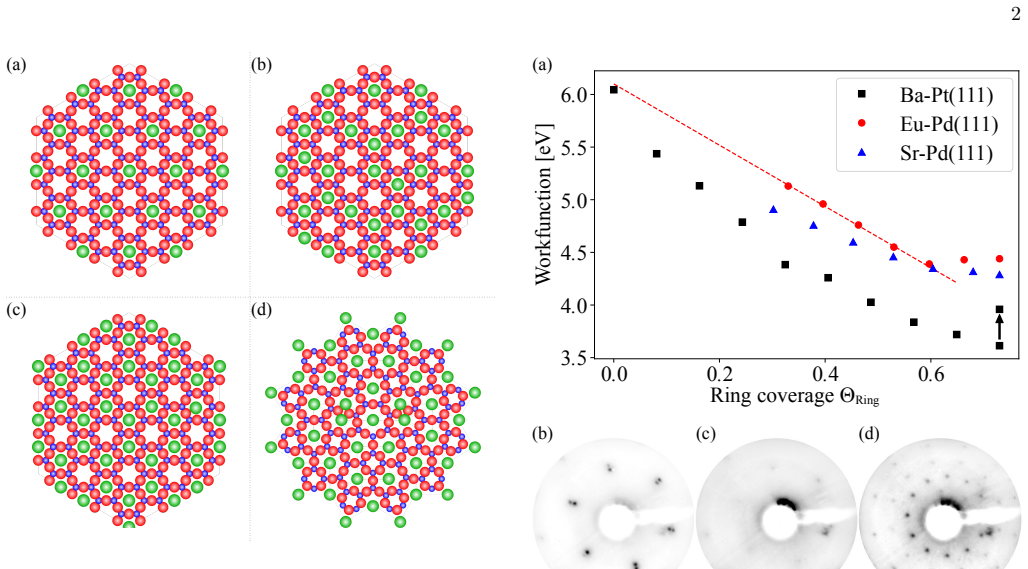
Adsorbing Ba, Sr or Eu onto a honeycomb oxide layer transforms it into a dodecagonal quasicrystal once 73% of the rings are occupied.
A machine-rendered reading of the paper's core claim, the machinery that carries it, and where it could break.
Core claim
Adsorption of Ba, Sr, or Eu onto the HC layer triggers its reorganization into a dodecagonal tiling, as revealed by low-energy electron diffraction and scanning tunneling microscopy. Full conversion occurs when 73% of the honeycomb rings are occupied. Kelvin probe and UV photoelectron spectroscopy show a linear decrease in work function with increasing host coverage, followed by a sharp increase upon quasicrystal formation due to reduced host dipoles. This transformation mechanism enables the fabrication of structurally precise OQCs, including a new Eu-Ti-O phase that extends the field to lanthanide quasicrystals, forming a 2D grid of localized magnetic moments.
What carries the argument
Host-atom adsorption that drives reorganization of the honeycomb oxide network into dodecagonal tiling, with complete conversion at 73% ring occupancy.
If this is right
- Structurally precise oxide quasicrystals become fabricable on demand, including a new Eu-Ti-O phase with a 2D grid of localized magnetic moments.
- The method supplies a general route to test lattice-matched substrates for epitaxial growth of aperiodic films.
- The same host-atom trigger may be tried on other 2D honeycomb systems such as graphene, hexagonal ice, or silica.
- Work-function measurements can track the moment of quasicrystal formation through the sharp increase that follows the linear decrease.
Where Pith is reading between the lines
- The coverage-dependent work-function shift offers a possible experimental handle for tuning surface potentials before and after the structural change.
- If the occupancy threshold proves general, similar host-atom additions could be tested on non-oxide honeycomb layers to produce new classes of aperiodic 2D materials.
- A 2D grid of magnetic moments arranged in dodecagonal order supplies a concrete platform for examining magnetic frustration or spin-glass behavior in aperiodic lattices.
Load-bearing premise
The LEED and STM patterns represent a genuine dodecagonal quasicrystal rather than a periodic approximant or disordered phase, and the 73% occupancy marks the threshold for complete structural conversion.
What would settle it
High-resolution STM images or LEED patterns that instead show repeating periodic order or lack of dodecagonal symmetry above 73% host coverage would disprove the quasicrystal claim.
Figures


read the original abstract
Dodecagonal oxide quasicrystals (OQCs) have so far been limited to a few elemental systems, with no general formation mechanism established. Here, we demonstrate a versatile approach to OQC formation via a host-atom-induced transformation of a metal-oxide honeycomb (HC) network. Adsorption of Ba, Sr, or Eu onto the HC layer triggers its reorganization into a dodecagonal tiling, as revealed by low-energy electron diffraction and scanning tunneling microscopy. Full conversion occurs when 73% of the honeycomb rings are occupied. Kelvin probe and UV photoelectron spectroscopy show a linear decrease in work function with increasing host coverage, followed by a sharp increase upon quasicrystal formation due to reduced host dipoles. This transformation mechanism enables the fabrication of structurally precise OQCs, including a new Eu-Ti-O phase that extends the field to lanthanide quasicrystals, forming a 2D grid of localized magnetic moments. The method offers a general route to explore lattice-matched substrates for epitaxial growth and may be adapted to other 2D honeycomb materials - such as graphene, hexagonal ice, and silica - paving the way for engineered aperiodic systems beyond transition metal oxides.
Editorial analysis
A structured set of objections, weighed in public.
Referee Report
Summary. The manuscript reports an experimental demonstration that adsorption of Ba, Sr, or Eu onto a pre-existing honeycomb (HC) metal-oxide layer induces reorganization into a dodecagonal oxide quasicrystal (OQC). LEED and STM data are presented as evidence for a dodecagonal tiling, with full structural conversion reported at 73% occupancy of the honeycomb rings. Kelvin probe and UPS measurements show a work-function minimum followed by an upturn upon quasicrystal formation. The work also introduces a new Eu-Ti-O OQC containing localized magnetic moments and proposes the host-atom route as a general method applicable to other 2D honeycomb lattices.
Significance. If the structural assignment is confirmed, the result supplies a concrete, host-atom-driven formation mechanism for dodecagonal oxide quasicrystals and extends the known examples to a lanthanide-based phase. The approach is experimentally straightforward and potentially transferable to graphene, silica, or ice monolayers, offering a route to lattice-matched aperiodic templates.
major comments (2)
- [LEED/STM results and discussion] LEED and STM structural assignment: The claim that the observed patterns establish a genuine aperiodic dodecagonal quasicrystal (rather than a high-order periodic approximant or a locally ordered disordered phase) is load-bearing for the central result and the 73% threshold. No phason-strain analysis, large-area Fourier filtering demonstrating absence of periodic Bragg peaks, or direct comparison against known dodecagonal approximant models is described in the results or discussion sections.
- [Coverage-dependent measurements] Occupancy threshold: The reported 73% ring-occupancy value for complete conversion is tied directly to the quasicrystal interpretation. STM-based counting of occupied rings would mark a true conversion threshold only once the final structure has been shown to be aperiodic over length scales much larger than the STM field of view.
minor comments (2)
- [Abstract] Abstract and methods: Coverage calibration details, error bars on the 73% figure, and explicit checks against approximant structures are not supplied.
- [Figures] Figure clarity: STM images and LEED patterns should include explicit scale bars, Fourier transforms, and labeling that allows direct comparison with approximant simulations.
Simulated Author's Rebuttal
We thank the referee for the constructive and detailed comments, which help clarify the strength of the structural evidence. We have revised the manuscript to incorporate additional analyses and clarifications addressing the concerns about aperiodicity and the occupancy threshold. Our responses to the major comments are provided below.
read point-by-point responses
-
Referee: [LEED/STM results and discussion] LEED and STM structural assignment: The claim that the observed patterns establish a genuine aperiodic dodecagonal quasicrystal (rather than a high-order periodic approximant or a locally ordered disordered phase) is load-bearing for the central result and the 73% threshold. No phason-strain analysis, large-area Fourier filtering demonstrating absence of periodic Bragg peaks, or direct comparison against known dodecagonal approximant models is described in the results or discussion sections.
Authors: We agree that explicit comparisons and additional filtering strengthen the quasicrystal assignment. In the revised manuscript we now include a side-by-side comparison of the experimental LEED spots with simulated patterns for the known dodecagonal approximants (e.g., the 3/2 and 5/3 approximants), demonstrating systematic mismatches in both positions and relative intensities that rule out these periodic structures. We have also added Fourier transforms computed from multiple larger STM frames (up to 50 nm × 50 nm) that show only the expected dodecagonal reciprocal-space peaks and no additional periodic Bragg spots. A quantitative phason-strain analysis is not feasible with the present STM data set because of the limited field of view and the absence of extended defects that would allow reliable phason mapping; however, the sharpness of the LEED spots and the absence of measurable tiling distortions across sampled regions indicate low phason strain. These additions are now described in the results and discussion sections. revision: yes
-
Referee: [Coverage-dependent measurements] Occupancy threshold: The reported 73% ring-occupancy value for complete conversion is tied directly to the quasicrystal interpretation. STM-based counting of occupied rings would mark a true conversion threshold only once the final structure has been shown to be aperiodic over length scales much larger than the STM field of view.
Authors: The 73 % threshold was obtained by averaging ring-occupancy statistics from dozens of STM images recorded at different locations and sample preparations, all showing the same sharp transition to the dodecagonal tiling. To address the length-scale concern we have added the corresponding coverage-dependent LEED data, which demonstrate that the characteristic dodecagonal diffraction pattern appears uniformly across the macroscopic sample area precisely when the local STM occupancy reaches ~73 %. Because LEED probes length scales orders of magnitude larger than individual STM frames, this correlation supports that the conversion threshold is not an artifact of local ordering. We have clarified the multi-scale nature of the evidence in the revised text. revision: partial
Circularity Check
No circularity: purely experimental observations with direct reporting of surface measurements
full rationale
The paper reports experimental results on host-atom adsorption inducing reorganization of a honeycomb oxide layer into a dodecagonal structure, observed via LEED and STM, with full conversion noted at 73% ring occupancy from direct STM counting. No mathematical derivation, ansatz, parameter fitting, or self-citation chain is present that would reduce any claimed result to its own inputs by construction. The central claims rest on raw diffraction and microscopy data rather than a model whose outputs are forced by the inputs, rendering the work self-contained against external benchmarks with no load-bearing circular steps.
Axiom & Free-Parameter Ledger
Lean theorems connected to this paper
-
IndisputableMonolith/Foundation/AlexanderDuality.leanalexander_duality_circle_linking unclear?
unclearRelation between the paper passage and the cited Recognition theorem.
Full conversion occurs when 73% of the honeycomb rings are occupied... dodecagonal square-triangle-rhombus tiling
What do these tags mean?
- matches
- The paper's claim is directly supported by a theorem in the formal canon.
- supports
- The theorem supports part of the paper's argument, but the paper may add assumptions or extra steps.
- extends
- The paper goes beyond the formal theorem; the theorem is a base layer rather than the whole result.
- uses
- The paper appears to rely on the theorem as machinery.
- contradicts
- The paper's claim conflicts with a theorem or certificate in the canon.
- unclear
- Pith found a possible connection, but the passage is too broad, indirect, or ambiguous to say the theorem truly supports the claim.
Reference graph
Works this paper leans on
-
[1]
D. Shechtman, I. Blech, D. Gratias, and J. W. Cahn, Metallic Phase with Long-Range Orientational Order and No Translational Symmetry, Physical Review Let- ters53, 1951 (1984)
work page 1951
-
[2]
X. Zeng, B. Glettner, U. Baumeister, B. Chen, G. Ungar, F. Liu, and C. Tschierske, A columnar liquid quasicrystal with a honeycomb structure that consists of triangular, square and trapezoidal cells, Nature Chemistry15, 625 (2023)
work page 2023
-
[3]
C. Xiao, N. Fujita, K. Miyasaka, Y. Sakamoto, and O. Terasaki, Dodecagonal tiling in mesoporous silica, Na- ture487, 349 (2012)
work page 2012
- [4]
-
[5]
A. Jagannathan, B. Dou¸ cot, A. Szallas, and S. Wessel, Geometric fluctuations in a two-dimensional quantum antiferromagnet, Physical Review B85, 094434 (2012)
work page 2012
-
[6]
A. Szallas, A. Jagannathan, and S. Wessel, Phason- disordered two-dimensional quantum antiferromagnets, Physical Review B79, 172406 (2009)
work page 2009
-
[7]
M. De Boissieu, Phonons, phasons and atomic dynam- ics in quasicrystals, Chemical Society Reviews41, 6778 (2012)
work page 2012
-
[8]
R. Tamura, A. Ishikawa, S. Suzuki, T. Kotajima, Y. Tanaka, T. Seki, N. Shibata, T. Yamada, T. Fujii, C.- W. Wang, M. Avdeev, K. Nawa, D. Okuyama, and T. J. Sato, Experimental Observation of Long-Range Magnetic Order in Icosahedral Quasicrystals, Journal of the Amer- ican Chemical Society143, 19938 (2021)
work page 2021
-
[9]
S. F¨ orster, K. Meinel, R. Hammer, M. Trautmann, and W. Widdra, Quasicrystalline structure formation in a classical crystalline thin-film system, Nature502, 215 (2013)
work page 2013
- [10]
-
[11]
E. Cockayne, M. Mihalkoviˇ c, and C. L. Henley, Structure of periodic crystals and quasicrystals in ultrathin films of Ba-Ti-O, Physical Review B93, 020101 (2016)
work page 2016
-
[12]
N. Niizeki and H. Mitani, Two-dimensional dodecagonal quasilattices, Journal of Physics A: Mathematical and General20, L405 (1987)
work page 1987
-
[13]
G¨ ahler, Proceedings of the ILL/CODEST workshop, World Scientific Singapore (1988)
F. G¨ ahler, Proceedings of the ILL/CODEST workshop, World Scientific Singapore (1988)
work page 1988
- [14]
-
[15]
A. Stone and D. Wales, Theoretical studies of icosahedral C60 and some related species, Chemical Physics Letters 128, 501 (1986)
work page 1986
-
[16]
C. Wu, M. R. Castell, J. Goniakowski, and C. Noguera, Stoichiometry engineering of ternary oxide ultrathin films:Ba xT i2O3 on Au(111), Physical Review B91, 155424 (2015)
work page 2015
-
[17]
T. T. Dorini, F. Brix, C. Chatelier, A. Kokalj, and E. Gaudry, Two-dimensional oxide quasicrystal approx- imants with tunable electronic and magnetic properties, Nanoscale13, 10771 (2021)
work page 2021
-
[18]
M¨ uller,Anorganische Strukturchemie (Vieweg+Teubner, Wiesbaden, 2008)
U. M¨ uller,Anorganische Strukturchemie (Vieweg+Teubner, Wiesbaden, 2008)
work page 2008
- [19]
-
[20]
M. Farstad, D. Ragazzon, H. Gr¨ onbeck, M. Strømsheim, C. Stavrakas, J. Gustafson, A. Sandell, and A. Borg, TiOx thin films grown on Pd(100) and Pd(111) by chem- ical vapor deposition, Surface Science649, 80 (2016)
work page 2016
-
[21]
S. Schenk, S. F¨ orster, K. Meinel, R. Hammer, B. Lei- bundgut, M. Paleschke, J. Pantzer, C. Dresler, F. O. Schumann, and W. Widdra, Observation of a dodecago- nal oxide quasicrystal and its complex approximant in the SrTiO 3 -Pt(1 1 1) system, Journal of Physics: Con- densed Matter29, 134002 (2017)
work page 2017
-
[22]
F. Silly and M. R. Castell, Encapsulated Pd Nanocrystals Supported by Nanoline-Structured SrTiO 3 (001), The Journal of Physical Chemistry B109, 12316 (2005)
work page 2005
-
[23]
A. W. Robertson, C. S. Allen, Y. A. Wu, K. He, 6 J. Olivier, J. Neethling, A. I. Kirkland, and J. H. Warner, Spatial control of defect creation in graphene at the nanoscale, Nature Communications3, 1144 (2012)
work page 2012
-
[24]
S. Kurasch, J. Kotakoski, O. Lehtinen, V. Sk´ akalov´ a, J. Smet, C. E. Krill, A. V. Krasheninnikov, and U. Kaiser, Atom-by-Atom Observation of Grain Bound- ary Migration in Graphene, Nano Letters12, 3168 (2012)
work page 2012
-
[25]
R. Ma, D. Cao, C. Zhu, Y. Tian, J. Peng, J. Guo, J. Chen, X.-Z. Li, J. S. Francisco, X. C. Zeng, L.-M. Xu, E.-G. Wang, and Y. Jiang, Atomic imaging of the edge struc- ture and growth of a two-dimensional hexagonal ice, Na- ture577, 60 (2020)
work page 2020
-
[26]
J. Hong, Y. Tian, T. Liang, X. Liu, Y. Song, D. Guan, Z. Yan, J. Guo, B. Tang, D. Cao, J. Guo, J. Chen, D. Pan, L.-M. Xu, E.-G. Wang, and Y. Jiang, Imaging surface structure and premelting of ice Ih with atomic resolution, Nature 10.1038/s41586-024-07427-8 (2024)
- [27]
-
[28]
J.-Q. Zhong and H.-J. Freund, Two-Dimensional Ultra- thin Silica Films, Chemical Reviews122, 11172 (2022)
work page 2022
-
[29]
P. I. Wemhoff, C. Noguera, J. Goniakowski, and N. Nil- ius, Structure and Stoichiometry Self-Organization in a Mixed Vanadium–Iron Oxide Honeycomb Film on Ru(0001), The Journal of Physical Chemistry C126, 19947 (2022)
work page 2022
discussion (0)
Sign in with ORCID, Apple, or X to comment. Anyone can read and Pith papers without signing in.