REVIEW 4 major objections 5 minor 37 references
At ν=1 in 3.65° twisted WSe2, the 120° antiferromagnet gives way to multi-Q spin-valley order with a four-times-enlarged unit cell.
Reviewed by Pith at T0; open to challenge. T0 means a machine referee read the full paper against a public rubric. the ladder, T0–T4 →
T0 review · deepseek-v4-flash
2026-08-04 09:50 UTC pith:634L5S5L
load-bearing objection Careful HF study that finds genuinely new multi-Q magnetic orders in twisted WSe2; plausible within mean-field, but the experimental-relevance claim rests on untested subtraction choices and missing beyond-HF checks. the 4 major comments →
Multi-Q spin-valley order in twisted WSe2
The pith
A machine-rendered reading of the paper's core claim, the machinery that carries it, and where it could break.
Core claim
The central claim is that, at ν=1, the ground state of twisted WSe2 can be a multi-Q intervalley-coherent (IVC) magnetic order that breaks the generalized translation symmetry T'_{a_i} — a moiré translation followed by a spin rotation. The order parameter acquires four nonzero wavevectors: the κ± K-point wavevector of the parent 120° AFM plus the three M-point wavevectors, giving a four-fold enlarged unit cell. The transition from the 120° AFM to the multi-Q state is continuous, signalled by a smooth mean-field gap and by condensation of the TDHF Goldstone mode at the M-points. Two variants appear: a non-coplanar order (breaking T' time reversal) at smaller ε and a coplanar order (preserving
What carries the argument
The load-bearing mechanism is the intervalley-coherence order parameter combined with the generalized translation symmetry T'_{a_i} (translation by a moiré lattice vector followed by a spin rotation). Its spontaneous breaking folds the moiré Brillouin zone and generates the four-wavevector spin texture. The companion tool is the time-dependent Hartree-Fock (TDHF) mode calculation, whose M-point Goldstone mode softens as ε or E is tuned, serving as the diagnostic for the continuous transition and as the proposed precursor for pairing.
Load-bearing premise
The load-bearing premise is that the Hartree-Fock ground state of the four-active-band projected model, with the double-counting subtraction H_sub, correctly captures this strongly correlated regime; if quantum fluctuations beyond mean field are strong, the multi-Q order could be destabilized or shifted and the continuous character of the transition would need revisiting.
What would settle it
A many-body calculation beyond Hartree-Fock (exact diagonalization or density-matrix renormalization group on a finite moiré cluster) of the same interacting model at ν=1, ε≈30, E≈0 that yields a symmetric metal or a different ordered state would disprove the claimed multi-Q ground state. Alternatively, a momentum-resolved spin-fluctuation measurement (e.g., resonant inelastic X-ray scattering) showing no M-point softening as the AFM–multi-Q boundary is approached would refute the precursor scenario.
If this is right
- The 120° AFM–to–multi-Q transition adds a previously overlooked insulating phase to the tWSe2 phase diagram at ν=1, with a four-times-larger magnetic unit cell.
- Soft M-point spin fluctuations near the transition offer a candidate pairing mechanism for the superconductivity observed at small displacement fields.
- The non-coplanar multi-Q order has zero Chern number, so it is a trivial correlated insulator despite the nonzero band topology of the underlying moiré bands.
- The predicted M-point softening gives a concrete experimental target: a momentum-resolved probe of spin fluctuations should see a low-lying mode at the M-points that softens as the transition is approached.
- Agreement between the lowest-order and higher-order continuum models indicates the multi-Q order is not an artifact of one particular band-structure parametrization.
Where Pith is reading between the lines
- If quantum fluctuations beyond Hartree-Fock soften or destroy the static multi-Q order, the M-point fluctuation softening may still survive and extend over a wide parameter region, keeping the pairing scenario alive without static order.
- The zero-Chern non-coplanar order provides a clean platform to test for a vanishing anomalous Hall response; a nonzero Hall signal in the insulating region would point to a different order than the one claimed here.
- A natural extension is to compute the superconducting instability in the same model using the M-point fluctuation spectrum as input to a linearized Eliashberg or RPA gap equation, which would make the pairing claim quantitative.
- A finite-temperature extension of the Hartree-Fock calculation could map out the fluctuation regime above the ordering temperature, where soft M-point modes may produce anomalous thermal or transport signatures distinct from the 120° AFM.
Editorial analysis
A structured set of objections, weighed in public.
Referee Report
Summary. The manuscript studies the zero-temperature phase diagram of 3.65° twisted bilayer WSe2 at moiré hole filling ν=1 using Hartree–Fock applied to two continuum models: a three-parameter lowest-order (LO) model and a reduced 16-parameter higher-order (HO) model. The central claim is that, for relative dielectric constants ε≳24 and small displacement fields, the previously known 120° spin-valley antiferromagnet (AFM) becomes unstable to a multi-Q inter-valley-coherent (IVC) order with spin textures modulated at the three M points and one K point of the moiré Brillouin zone, enlarging the unit cell by a factor of four. Two variants are reported: a non-coplanar T′-breaking order and a coplanar T′-symmetric order. The transition is argued to be continuous, with a softening of the M-point spin fluctuations visible in time-dependent Hartree–Fock (TDHF); this softening is proposed as a possible pairing glue for the nearby superconducting dome. The authors check robustness by comparing LO and HO models and by validating the 16-parameter model against the full 77-parameter band structure.
Significance. If the multi-Q ground state is correct, the paper identifies a qualitatively new broken-symmetry order in twisted TMDs: a four-wave-vector spin-valley texture emerging continuously from the 120° AFM. The prediction of M-point spin-fluctuation softening is concrete, in principle falsifiable by momentum-resolved spectroscopy, and potentially relevant to the superconducting mechanism. The numerical study is careful in its use of two independent continuum models and in separating order-parameter definitions from mean-field solutions. The primary limitation is that the order is established only at Hartree–Fock level with a single double-counting convention; the experimentally relevant ε≈30 lies close to the mean-field phase boundary, so the prediction is conditional on that approximation.
major comments (4)
- [SM, Eqs. (22)–(28)] The subtraction H_sub = H_h[P0] + H_f[P0] is constructed so that the non-interacting continuum bands are an exact HF solution at full filling. This is a reasonable convention, but the continuum parameters are fitted to DFT bands whose exchange-correlation functional differs from the explicit gate-screened Coulomb interaction V(q)=e^2/(2ϵ0ϵ) tanh(qD)/q. The AFM-to-multi-Q boundary occurs at ε≈24 in the HO model, and the paper adopts ε≈30 from Ref. [19] as the experimentally relevant value. Since the boundary location depends on the double-counting convention and no sensitivity test (e.g., scaling the Fock subtraction or using a different P0) is provided, the experimental-relevance claim is not yet secured.
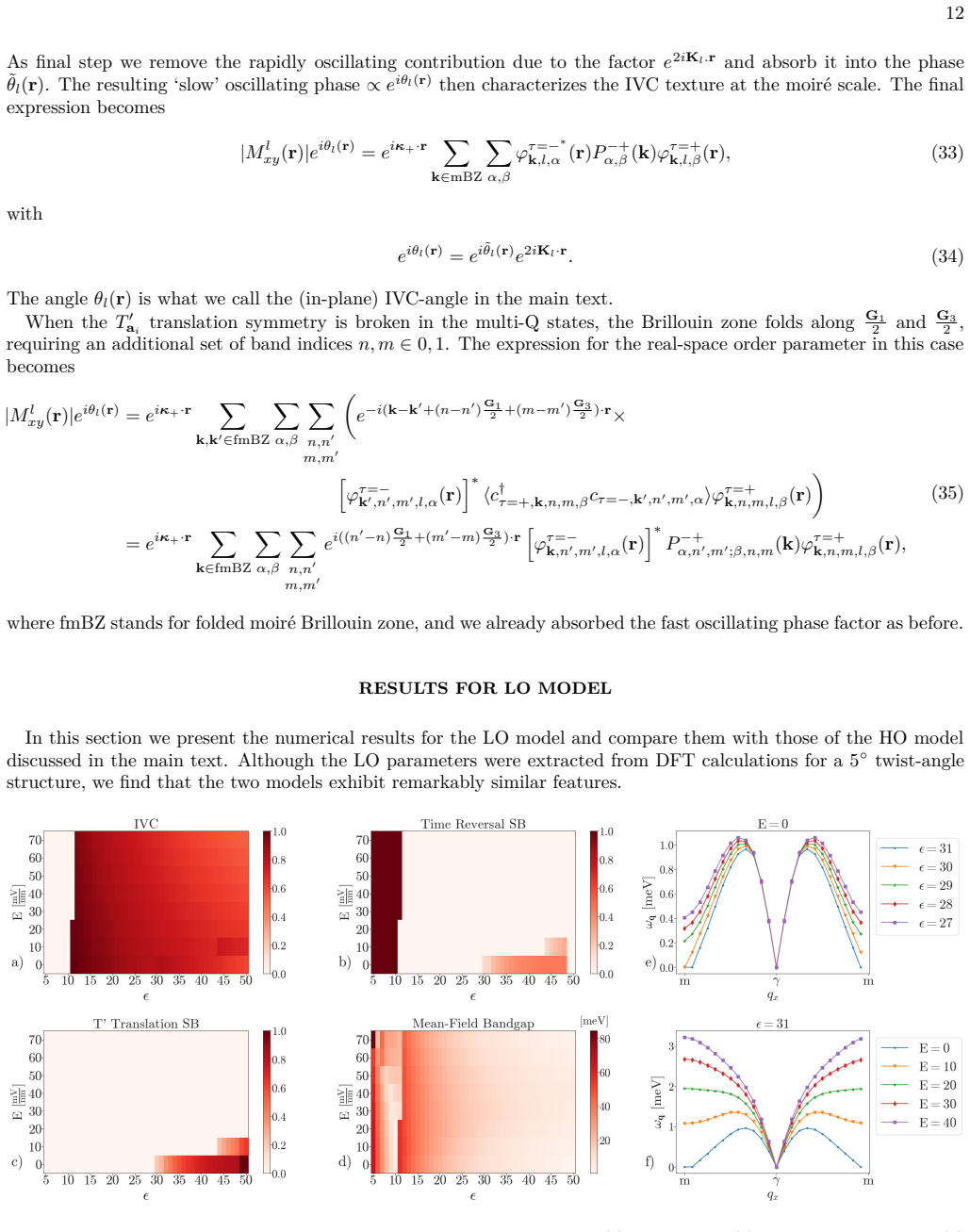
- [Figs. 1(e–f)] The softening of the TDHF M-point mode is used to conclude that the transition is continuous and that the multi-Q order develops from the 120° AFM. But in the same regime the spin fluctuations are by construction strong, so Gaussian fluctuations around the 120° state are not negligible. The manuscript does not show that the multi-Q HF state is a stable local minimum of the HF energy (positive Hessian) or that its energy lies below the 120° AFM by an amount larger than the TDHF zero-point correction. Without this, the mean-field phase boundaries in Fig. 1 could shift, or the order could be destroyed by fluctuations. A concrete step would be to compare TDHF-corrected energies of both states, or to benchmark on a small cluster with an unbiased method.
- [SM, Eqs. (8)–(10) and Fig. 4] The 16-parameter HO model is validated only against the 77-parameter band structure. The interaction matrix elements of Eq. (21) and the projected form factors entering the real-space order parameter (Eqs. (33)/(35)) are not benchmarked against the full model. The multi-Q states involve finite-q couplings with intertwined valley/spin structure, and the active-space projection onto four bands per valley is not tested for convergence. Please provide a comparison of the projected Coulomb vertices and a check with, e.g., six active bands per valley, or justify why four bands are sufficient.
- [Main text, 'Interacting phase diagram'] The continuous character of the AFM-to-multi-Q transition is asserted from the smooth evolution of the mean-field bandgap and the M-point mode softening. However, the order parameters in Figs. 1(a–c) are shown as phase diagrams; no numerical curves (e.g., O_T′ or O_IVC as a function of ε at fixed E) are shown to demonstrate that the order parameter grows continuously from zero. Given that this continuity is a central claim, I ask for such a plot at a representative displacement field.
minor comments (5)
- [Main text, Eq. (2)] The order parameter O_IVC sums over band indices α, α′. Please specify whether α runs over all active bands or only the two topmost bands; this matters because the IVC amplitude may be distributed over multiple bands.
- [SM, Eq. (17)] The notation for the dielectric constant is inconsistent: the main text uses ε and the SM uses ϵr in V(q). Unify, and state explicitly whether ε is the relative permittivity of the hBN environment or an effective/tunable parameter.
- [Fig. 1(d)] The mean-field bandgap is used as a proxy for incompressibility. State explicitly that this is the HF single-particle gap and that charge fluctuations are not included.
- [Conclusions] The statement that the M-point spin-fluctuation gap is 'less than 1 meV' should carry a caveat about numerical precision; TDHF is a harmonic approximation and the 24×24 grid imposes a momentum resolution. Report an estimate of the discretization error or phrase the result as '<1 meV in our TDHF calculation'.
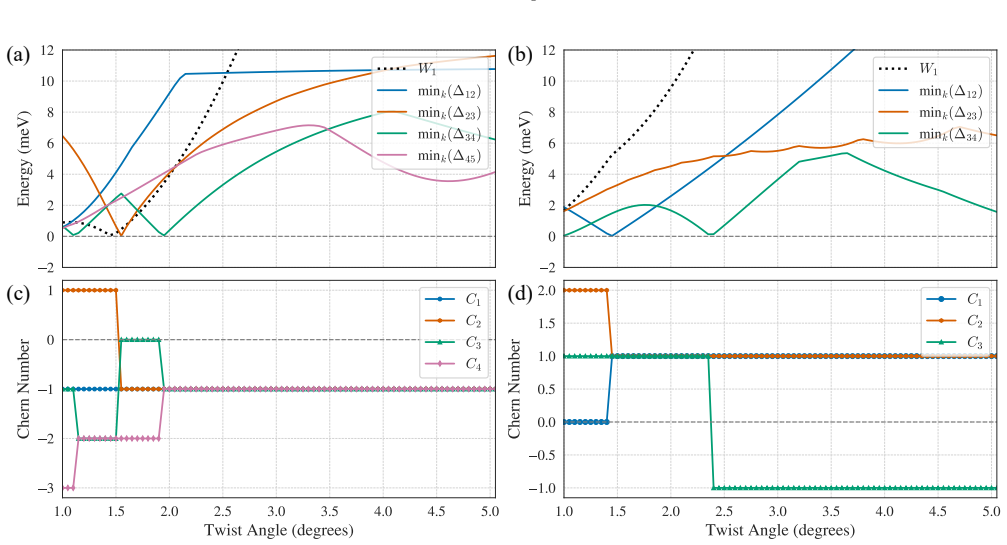
- [SM, Fig. 5] The Chern-number panels lack labels or a legend; adding explicit values for each region would improve clarity.
Circularity Check
No significant circularity: the multi-Q ground states and M-point softening are numerical outputs of a parameterized interacting model, not inputs or renamed fits.
full rationale
The paper's central claim is a Hartree-Fock phase diagram at ν=1 in a continuum model whose single-particle parameters come from external DFT fits (Refs. [24], [32], [33]). The multi-Q IVC states are obtained by numerically solving the HF self-consistency equations, Eq. (2)-surrounding text, not by imposing the target order. The double-counting subtraction H_sub is chosen so that the noninteracting continuum bands solve HF at full filling, but this fixes only the full-filling reference, not the ν=1 broken-symmetry solution; the AFM-to-multi-Q transition emerges from the calculation. The dielectric constant is scanned, and the experimentally relevant value ε≈30 is imported from Ref. [19], which calibrated it against the layer-polarized regime rather than the multi-Q phase, so the multi-Q prediction is not fitted to its own target. The TDHF M-point softening is computed from the same mean-field Hamiltonian, so it is internally consistent, but it is not a circular reduction: the softening diagnoses the instability that independently produces the multi-Q state. The only self-citation, Ref. [36] by Bultinck et al., is a methodological review of the RPA/TDHF equation and is not load-bearing. Honest caveats (e.g., LO parameters from 5° DFT structures) weaken external validity but do not constitute circularity. Therefore no specific circular step can be exhibited.
Axiom & Free-Parameter Ledger
free parameters (5)
- relative dielectric constant ε =
scanned ε ≈ 8–50; key multi-Q region ε ≈ 24–33
- sample-gate distance D =
16.5 nm (D = 50 a0)
- displacement field E (u_D) =
scanned E ≈ 0–20 mV/nm
- LO continuum parameters (V, φ, w) =
9 meV, 128°, 18 meV
- 16-parameter reduced HO model parameters =
Tables XV–XVII of Ref [33]; available on GitHub [38]
axioms (5)
- domain assumption Hartree-Fock mean-field theory (with TDHF/RPA for collective modes) correctly describes the ν=1 ground state and phase boundaries of tWSe2.
- domain assumption The quadratic subtraction terms H_sub = H_h[P0] + H_f[P0] fully account for double counting between DFT-fitted continuum bands and the added Coulomb interaction.
- domain assumption Truncation to 4 active bands per valley with frozen remote bands is sufficient.
- domain assumption The reduced 16-parameter HO model accurately represents the full 77-parameter model at θ = 3.65°.
- domain assumption Inter-valley scattering in the Coulomb interaction is negligible, suppressed by a factor ~V(2K_τ)/V(0).
read the original abstract
We report on a study of the interacting phase diagram of $3.65^\circ$-twisted WSe$_2$ at moir\'e hole filling $\nu=1$, in which we find previously-overlooked types of magnetism. Specifically, in part of the phase diagram we obtain a magnetic order parameter which modulates in space with four different non-zero wave vectors, corresponding to the three $M$-points and one $K$-point of the moir\'e Brillouin zone. These multi-Q orders, which can be coplanar or non-coplanar, are continuous deformations of the $120^\circ$ spin-valley anti-ferromagnet (AFM), where the unit cell has expanded by a factor of four. Interestingly, we find that the multi-Q states are stabilized for experimentally relevant values of interaction strength and displacement field, and are accompanied by a softening of the spin fluctuations near the $M$-points of the moir\'e
Figures




Reference graph
Works this paper leans on
-
[1]
Y. Xia, Z. Han, K. Watanabe, T. Taniguchi, J. Shan, and K. F. Mak, Nature637, 833 (2025)
2025
-
[2]
Y. Guo, J. Pack, J. Swann, L. Holtzman, M. Cothrine, K. Watanabe, T. Taniguchi, D. G. Mandrus, K. Bar- mak, J. Hone, et al., Nature637, 839–845 (2025), ISSN 1476-4687, URLhttp://dx.doi.org/10.1038/ s41586-024-08381-1
2025
-
[3]
Y. Xia, Z. Han, J. Zhu, Y. Zhang, P. Kn¨ uppel, K. Watan- abe, T. Taniguchi, K. F. Mak, and J. Shan,Simulating high-temperature superconductivity in moir´ e wse2(2025), 2508.02662, URLhttps://arxiv.org/abs/2508.02662
Pith/arXiv arXiv 2025
-
[4]
M. B´ elanger, J. Fournier, and D. S´ en´ echal, Phys. Rev. B 106, 235135 (2022), URLhttps://link.aps.org/doi/ 10.1103/PhysRevB.106.235135
-
[5]
Klebl, A
L. Klebl, A. Fischer, L. Classen, M. M. Scherer, and D. M. Kennes, Phys. Rev. Res.5, L012034 (2023), URLhttps://link.aps.org/doi/10.1103/ PhysRevResearch.5.L012034
2023
-
[6]
Y.-M. Wu, Z. Wu, and H. Yao, Phys. Rev. Lett.130, 126001 (2023), URLhttps://link.aps.org/doi/10. 1103/PhysRevLett.130.126001
2023
-
[7]
Zegrodnik and A
M. Zegrodnik and A. Biborski, Phys. Rev. B108, 064506 (2023), URLhttps://link.aps.org/doi/10. 1103/PhysRevB.108.064506
2023
-
[8]
C. Schrade and L. Fu, Phys. Rev. B110, 035143 (2024), URLhttps://link.aps.org/doi/10.1103/PhysRevB. 110.035143
doi:10.1103/physrevb 2024
-
[9]
W. Akbar, A. Biborski, L. Rademaker, and M. Zegrod- nik, Phys. Rev. B110, 064516 (2024), URLhttps: //link.aps.org/doi/10.1103/PhysRevB.110.064516
-
[10]
A. V. Chubukov and C. M. Varma, Phys. Rev. B 111, 014507 (2025), URLhttps://link.aps.org/doi/ 10.1103/PhysRevB.111.014507
-
[11]
S. Kim, J. F. Mendez-Valderrama, X. Wang, and D. Chowdhury, Nature Communications16(2025), ISSN 2041-1723, URLhttp://dx.doi.org/10.1038/ s41467-025-56816-8
2025
-
[12]
J. Zhu, Y.-Z. Chou, M. Xie, and S. Das Sarma, Physical Review B111(2025), ISSN 2469-9969, URLhttp://dx. doi.org/10.1103/PhysRevB.111.L060501
-
[13]
M. Christos, P. M. Bonetti, and M. S. Scheurer, Phys. Rev. Lett.135, 046503 (2025), URLhttps://link.aps. org/doi/10.1103/7z4z-vlj8
-
[15]
D. Guerci, D. Kaplan, J. Ingham, J. H. Pixley, and A. J. Millis,Topological superconductivity from repul- sive interactions in twisted wse2 (2024), 2408.16075, URL https://arxiv.org/abs/2408.16075
Pith/arXiv arXiv 2024
- [16]
- [17]
-
[18]
A. Fischer, L. Klebl, V. Cr´ epel, S. Ryee, A. Rubio, L. Xian, T. O. Wehling, A. Georges, D. M. Kennes, and A. J. Millis,Theory of intervalley-coherent afm order and topological superconductivity in twse2 (2024), 2412.14296, URLhttps://arxiv.org/abs/2412.14296
arXiv 2024
-
[19]
L. Peng, C. D. Beule, D. Li, L. Yang, E. J. Mele, and S. Adam,Magnetism in twisted bilayer wse 2 (2025), 2503.09689, URLhttps://arxiv.org/abs/2503.09689
arXiv 2025
-
[20]
F. Xie, C. Li, J. Cano, and Q. Si,Kondo-lattice phe- nomenology of twisted bilayer wse 2 from compact molec- ular orbitals of topological bands(2025), 2503.21769, URL https://arxiv.org/abs/2503.21769
Pith/arXiv arXiv 2025
-
[21]
S. Ryee, L. Klebl, G. Rai, A. Fischer, V. Cr´ epel, L. Xian, A. Rubio, D. M. Kennes, R. Valent´ ı, A. J. Millis, et al., Site-polarized mott phases competing with a correlated metal in twisted wse 2 (2025), 2506.22325, URLhttps: //arxiv.org/abs/2506.22325
arXiv 2025
-
[22]
D. Mu˜ noz-Segovia, V. Cr´ epel, R. Queiroz, and A. J. Millis,Twist-angle evolution of the intervalley- coherent antiferromagnet in twisted wse2(2025), 2503.11763, URLhttps://ui.adsabs.harvard.edu/ abs/2025PhRvB.112h5111M
Pith/arXiv arXiv 2025
-
[23]
Z. Y. Zhu, Y. C. Cheng, and U. Schwingenschl¨ ogl, Phys. Rev. B84, 153402 (2011), URLhttps://link.aps.org/ doi/10.1103/PhysRevB.84.153402
-
[24]
F. Wu, T. Lovorn, E. Tutuc, I. Martin, and A. H. MacDonald, Phys. Rev. Lett.122, 086402 (2019), URL https://link.aps.org/doi/10.1103/PhysRevLett. 122.086402
-
[25]
J. Cai, E. Anderson, C. Wang, X. Zhang, X. Liu, W. Holtzmann, Y. Zhang, F. Fan, T. Taniguchi, K. Watanabe, et al., Nature (London)622, 63 (2023), 2304.08470
Pith/arXiv arXiv 2023
-
[26]
B. A. Foutty, C. R. Kometter, T. Devakul, A. P. Reddy, K. Watanabe, T. Taniguchi, L. Fu, and B. E. Feldman, Science384, 343 (2024)
2024
-
[27]
Y. Zeng, Z. Xia, K. Kang, J. Zhu, P. Kn¨ uppel, C. Vaswani, K. Watanabe, T. Taniguchi, K. F. Mak, and J. Shan, Nature (London)622, 69 (2023), 2305.00973
Pith/arXiv arXiv 2023
-
[28]
H. Park, J. Cai, E. Anderson, Y. Zhang, J. Zhu, X. Liu, C. Wang, W. Holtzmann, C. Hu, Z. Liu, et al., Nature (London)622, 74 (2023), 2308.02657
Pith/arXiv arXiv 2023
-
[29]
F. Xu, Z. Sun, T. Jia, C. Liu, C. Xu, C. Li, Y. Gu, K. Watanabe, T. Taniguchi, B. Tong, et al., Phys. Rev. X13, 031037 (2023), URLhttps://link.aps.org/doi/ 10.1103/PhysRevX.13.031037. 6
-
[30]
K. Kang, Y. Qiu, K. Watanabe, T. Taniguchi, J. Shan, and K. F. Mak, Nano Letters24, 14901 (2024)
2024
-
[31]
K. Kang, B. Shen, Y. Qiu, Y. Zeng, Z. Xia, K. Watanabe, T. Taniguchi, J. Shan, and K. F. Mak, Nature (London) 628, 522 (2024), 2402.03294
Pith/arXiv arXiv 2024
-
[32]
Devakul, V
T. Devakul, V. Cr´ epel, Y. Zhang, and L. Fu, Nature communications12, 6730 (2021)
2021
-
[33]
Y. Zhang, H. Pi, J. Liu, W. Miao, Z. Qi, N. Regnault, H. Weng, X. Dai, B. A. Bernevig, Q. Wu, et al. (2024), 2411.08108, URLhttps://arxiv.org/abs/2411.08108
Pith/arXiv arXiv 2024
-
[34]
See Supplemental Material at XXX
-
[35]
T. Wang, T. Devakul, M. P. Zaletel, and L. Fu, arXiv e-prints p. arXiv:2306.02501 (2023), 2306.02501
Pith/arXiv arXiv 2023
-
[36]
E. Khalaf, N. Bultinck, A. Vishwanath, and M. P. Zaletel, arXiv e-prints arXiv:2009.14827 (2020), 2009.14827
Pith/arXiv arXiv 2009
-
[37]
R. Xiong, Y. Guo, C. Qin, F. Yin, T. Wang, S. L. Brantly, J. Qi, J. Zhou, Z. Zhang, M. Erdi, et al.,Prop- agating Neutral Modes in an Intervalley Coherent State (2025), 2507.18770, URLhttps://ui.adsabs.harvard. edu/abs/2025arXiv250718770X
Pith/arXiv arXiv 2025
-
[38]
Zhang,Continuum model for twist tmds,https://github.com/zhangyan31415/ continuum-model-twist-tmds(2024)
Y. Zhang,Continuum model for twist tmds,https://github.com/zhangyan31415/ continuum-model-twist-tmds(2024). 7 Supplementary Material Multi-Q spin-valley order in twisted WSe 2 Arthur Bril1, Nai Chao Hu 1, Nick Bultinck1 1Department of Physics and Astronomy, Ghent University, Krijgslaan 281, 9000 Ghent, Belgium (Dated: October 16, 2025) CONTINUUM MODEL BAN...
2024
discussion (0)
Sign in with ORCID, Apple, or X to comment. Anyone can read and Pith papers without signing in.