Spatial patterning of force centers controls folding pathways of active elastic networks
Pith reviewed 2026-05-18 06:28 UTC · model grok-4.3
The pith
Correlating active force dipole positions in elastic networks causes only partial collapse and enhances stability.
A machine-rendered reading of the paper's core claim, the machinery that carries it, and where it could break.
Core claim
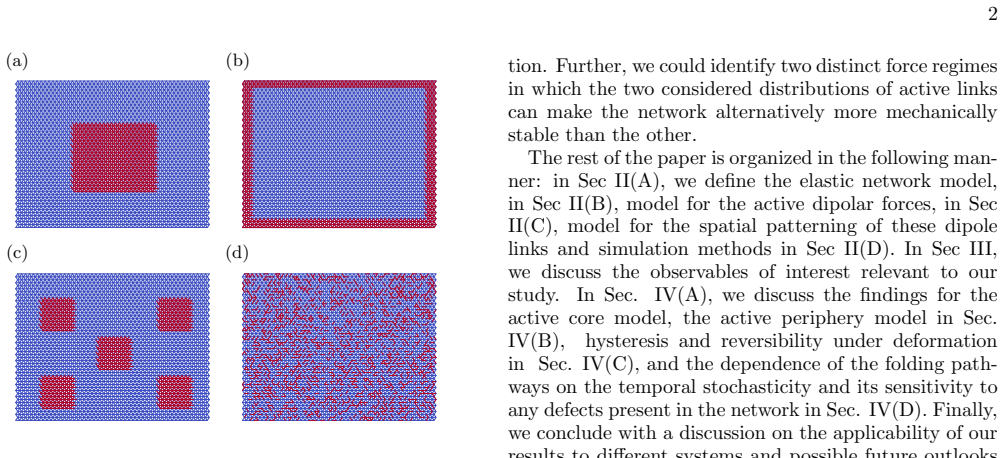
The central finding is that spatial correlation in the placement of active force dipoles stabilizes the network against complete folding. In the active core model a patch of dipoles at the center and in the active periphery model a band along the edge both produce only partial contraction at high force magnitudes, unlike the uniform random case. Stability crosses over from periphery being stronger at low forces to core being stronger at high forces. Irreversibility onsets at lower forces for patterned cases because of non-reversible creases, while folding routes stay similar under changes in force timing but alter with bond defects.
What carries the argument
Spatial patterning of force centers, realized as the active core model with central concentration and the active periphery model with edge concentration of dipoles, which limits global size reduction and raises the barrier to irreversible folding.
If this is right
- Periphery patterning provides superior stability compared with core patterning over a window of moderate force values.
- The force level at which folding becomes irreversible drops when moving from uniform to core to periphery distributions.
- Plastic creases form and persist after force removal or reversal, locking in the deformed shape.
- Folding paths show little dependence on the random time variation of active links but respond strongly to the removal of individual bonds.
Where Pith is reading between the lines
- Designers of active metamaterials could use force-center patterning as a low-cost control knob for tuning collapse resistance without altering dipole strength.
- The same localization principle may help explain or engineer robustness in biological sheets and shells where molecular motors are not uniformly distributed.
- Varying the spatial scale of the core or periphery region offers a testable route to map out optimal stability configurations in simulations and experiments.
Load-bearing premise
A discrete triangular lattice of beads connected by rigid-elastic springs with dipoles acting only at chosen locations is sufficient to represent the dominant folding mechanics without extra forces or boundary conditions changing the observed partial collapse.
What would settle it
A direct test would be to increase the active force magnitude in a core or periphery patterned network and check whether the overall radius or area continues to decrease linearly or saturates at a partial reduction value.
Figures


read the original abstract
We study the effect of the spatial distribution of active force dipoles on the folding pathways and mechanical stability of rigid-elastic networks using Langevin dynamics simulations. While it has been shown in Majumdar et al., J. Chem. Phys. 163, 114902 (2025) that a sharp collapse transition is evident in triangular (elastic) bead-spring networks under the action of contractile (or extensile) force dipoles distributed randomly across the network, here, we show that when the spatial distribution is correlated, e.g., like a patch in the center (``active core'' model) or a band-like distribution along the periphery (``active periphery'' model), the network undergoes only a partial decrease in size even at large forces, thereby showing an enhanced mechanical stability just from a spatial rearrangement of the active dipoles. Further, an active periphery network shows higher mechanical stability initially, for a range of forces, beyond which the active core network becomes more stable. Deformation in the network becomes irreversible beyond a threshold force, which depends on the type of distribution; for a uniform distribution of active dipoles, the irreversibility threshold almost coincides with the critical collapse point, it decreases for the active core system, and is decreased further for the active periphery system. It is shown that irreversibility arises due to plastic deformations in the form of crease formation which is not reversible even after the force is turned off or reversed. The folding pathways depend weakly on the temporal stochasticity of the active links, but are highly sensitive to any defects (missing bonds) in the network. Our findings, therefore, suggest active force localization (or delocalization) as a prime method to dynamically alter the mechanical stability and reversibility of the underlying elastic network.
Editorial analysis
A structured set of objections, weighed in public.
Referee Report
Summary. The manuscript uses Langevin dynamics simulations of triangular bead-spring networks to examine how spatial patterning of contractile or extensile force dipoles affects folding and stability. It reports that random dipole placement produces a sharp collapse transition, whereas correlated placements (central patch in the active-core model or peripheral band in the active-periphery model) yield only partial size reduction at high forces, conferring enhanced mechanical stability. The work further claims that the force threshold for irreversible deformation (linked to crease formation) is highest for uniform distributions and decreases for core then periphery configurations, with folding pathways sensitive to defects but only weakly dependent on temporal stochasticity of the active links.
Significance. If the reported differences in collapse behavior and irreversibility thresholds hold under quantitative scrutiny, the results establish spatial correlation of active forces as a control parameter for mechanical stability and reversibility in elastic networks. This offers a design route for active metamaterials that does not require changes in force magnitude or bond properties. The direct comparison of distributions on an otherwise identical network model is a clear strength, allowing attribution of the observed partial-collapse and crease phenomena to spatial arrangement alone.
major comments (2)
- [Abstract and results on active core/periphery models] Abstract and the results paragraphs comparing size reduction: the central claim that correlated distributions produce only a partial decrease in size even at large forces is load-bearing for the enhanced-stability conclusion, yet the text provides no quantitative metrics (e.g., fractional change in radius of gyration or end-to-end distance) nor error bars from ensemble averages, leaving the magnitude and statistical robustness of the partial collapse unsubstantiated.
- [Results on irreversibility and crease formation] Section describing irreversibility thresholds: the ordering of thresholds (uniform > core > periphery) and the attribution to crease formation are central to the reversibility claims. The manuscript does not specify the operational definition of the threshold (e.g., the force at which hysteresis first appears in the size-versus-force curve or the criterion for identifying persistent creases after force reversal), which is required to evaluate the reported dependence on spatial distribution.
minor comments (3)
- [Introduction] The citation to Majumdar et al. (2025) is appropriate; a one-sentence recap of their random-distribution collapse threshold would help readers gauge the magnitude of the stability gain reported here.
- [Model and simulation details] In the model section, the precise geometric definition of the active-periphery band (width in lattice units, fraction of sites activated) should be stated explicitly so that the setup can be reproduced.
- [Figures] Figure captions for network snapshots should indicate the color or symbol used for active sites and include a scale bar; this would improve clarity when comparing core versus periphery configurations.
Simulated Author's Rebuttal
We thank the referee for their careful reading of our manuscript and for the constructive comments, which have helped us improve the clarity and rigor of the presentation. We have revised the manuscript to incorporate quantitative metrics with error bars and to provide explicit operational definitions for the irreversibility thresholds. Below we respond point by point to the major comments.
read point-by-point responses
-
Referee: [Abstract and results on active core/periphery models] Abstract and the results paragraphs comparing size reduction: the central claim that correlated distributions produce only a partial decrease in size even at large forces is load-bearing for the enhanced-stability conclusion, yet the text provides no quantitative metrics (e.g., fractional change in radius of gyration or end-to-end distance) nor error bars from ensemble averages, leaving the magnitude and statistical robustness of the partial collapse unsubstantiated.
Authors: We agree that explicit quantitative metrics strengthen the central claim. In the revised manuscript we now report the fractional reduction in radius of gyration (with standard errors from N=20 independent Langevin trajectories) for each spatial distribution at the highest forces examined. These values confirm that the uniform case collapses by >70% while the active-core and active-periphery cases show only 25–35% reduction, thereby substantiating the enhanced stability conclusion without altering any results. revision: yes
-
Referee: [Results on irreversibility and crease formation] Section describing irreversibility thresholds: the ordering of thresholds (uniform > core > periphery) and the attribution to crease formation are central to the reversibility claims. The manuscript does not specify the operational definition of the threshold (e.g., the force at which hysteresis first appears in the size-versus-force curve or the criterion for identifying persistent creases after force reversal), which is required to evaluate the reported dependence on spatial distribution.
Authors: We thank the referee for highlighting this omission. The revised text now defines the irreversibility threshold as the lowest force at which, upon ramping the active force back to zero, the final radius of gyration remains more than 10% below its initial value (i.e., hysteresis exceeds this tolerance). Creases are identified as localized regions where the dihedral angle between adjacent triangles exceeds 120° and persists after force reversal. These criteria are applied uniformly across all three distributions and reproduce the reported ordering of thresholds. revision: yes
Circularity Check
No significant circularity: results follow directly from simulation comparisons
full rationale
The paper reports outcomes of Langevin dynamics simulations on a fixed triangular bead-spring network model, comparing random versus spatially correlated placements of active force dipoles (active core and active periphery). The central observations—partial size reduction, enhanced stability thresholds, and irreversibility via crease formation—are direct numerical outputs obtained by varying only the dipole locations while holding all other model parameters fixed. The single self-citation to prior work on the random-distribution case functions solely as background context and does not supply any fitted parameter, uniqueness theorem, or ansatz that the new claims reduce to. No equations are presented that derive predictions by construction from inputs, and the reported differences arise from explicit force-balance and strain accumulation under the stated simulation rules.
Axiom & Free-Parameter Ledger
free parameters (1)
- active force magnitude
axioms (1)
- domain assumption Langevin dynamics with thermal noise accurately captures the overdamped mechanics of the active elastic network.
Reference graph
Works this paper leans on
-
[1]
Protein folding and misfolding
Christopher M Dobson. Protein folding and misfolding. Nature, 426:884–890, 2003
work page 2003
-
[2]
James et al. Fraser. Hierarchical folding and reorganiza- tion of chromosomes are linked to transcriptional changes in cellular differentiation.Molecular Systems Biology, 11(852), 2015
work page 2015
-
[3]
Aki Teranishi, Misato Mori, Rihoko Ichiki, Satoshi Toda, Go Shioi, and Satoru Okuda. An actin bracket-induced elastoplastic transition determines epithelial folding irre- versibility.Nat. Comm., 15(10476), 2024
work page 2024
- [4]
-
[5]
The complexity of folding self-folding origami.Phys
Menachem Stern, Matthew B Pinson, and Arvind Muru- gan. The complexity of folding self-folding origami.Phys. Rev. X, 7(041070), 2017
work page 2017
-
[6]
Active elastic network: Cytoskeleton of the red blood cell.Phys
Nir S Gov. Active elastic network: Cytoskeleton of the red blood cell.Phys. Rev. E, 75(011921), 2007
work page 2007
-
[7]
Criticality and isostaticity in fibre net- works.Nat
C P Broedersz, Xiaoming Mao, T C Lubensky, and F C MacKintosh. Criticality and isostaticity in fibre net- works.Nat. Phys., 7(983-988), 2011
work page 2011
-
[8]
Moumita Das, David A Quint, and J M Schwarz. Re- dundancy and cooperativity in the mechanics of com- positely crosslinked filamentous networks.PLoS ONE, 7(5):e35939, 2012
work page 2012
-
[9]
Actively stressed marginal networks.Phys
M Sheinman, C P Broedersz, and F C MacKintosh. Actively stressed marginal networks.Phys. Rev. Lett., 109(238101), 2012
work page 2012
-
[10]
Molecular motors robustly drive active gels to a critically connected state.Nat
Jose Alvarado, Michael Sheinman, Abhinav Sharma, Fred C MacKintosh, and Gijsje H Koenderink. Molecular motors robustly drive active gels to a critically connected state.Nat. Phys., 9(11), 2013
work page 2013
-
[11]
Force per- colation of contractile active gels.Soft Matter, 13(5624), 2017
Jose Alvarado, Michael Sheinman, Abhinav Sharma, Fred C MacKintosh, and Gijsje H Koenderink. Force per- colation of contractile active gels.Soft Matter, 13(5624), 2017
work page 2017
-
[12]
Nonequilibrium dynamics of isostatic spring networks
Federico S Gnesotto, B M Remlein, and C P Broedersz. Nonequilibrium dynamics of isostatic spring networks. Phys. Rev. E, 100(013002), 2019
work page 2019
-
[13]
Scaling theory for mechanical critical behavior in fiber networks.Phys
Jordan L Shivers, Sadjad Arzash, Abhinav Sharma, and Fred C MacKintosh. Scaling theory for mechanical critical behavior in fiber networks.Phys. Rev. Lett., 122(188003), 2019
work page 2019
-
[14]
Shear-induced phase transition and critical expo- nents in three-dimensional fiber networks.Phys
Sadjad Arzash, Jordan L Shivers, and Fred C MacKin- tosh. Shear-induced phase transition and critical expo- nents in three-dimensional fiber networks.Phys. Rev. E, 104(L022402), 2021
work page 2021
-
[15]
Mechanical criticality of fiber networks at a finite temperature.Phys
Sadjad Arzash, Anupama Gannavarapu, and Fred C MacKintosh. Mechanical criticality of fiber networks at a finite temperature.Phys. Rev. E, 108(054403), 2023
work page 2023
-
[16]
Abhinav Kumar, David A Quint, and Kinjal Dasbiswas. Range and strength of mechanical interactions of force dipoles in elastic fiber networks.Soft Matter, 19:5805– 5823, 2023
work page 2023
-
[17]
Sinauer Associates, Sunderland, Mas- sachusetts, USA, 2001
Jonathon Howard.Mechanics of Motor Proteins and the Cytoskeleton. Sinauer Associates, Sunderland, Mas- sachusetts, USA, 2001
work page 2001
-
[18]
Selective and collective actuation in active solids.Nat
P Baconnier, D Shohat, C Hernandez L¨ opez, C Coulais, V Demery, G D¨ uring, and O Dauchot. Selective and collective actuation in active solids.Nat. Phys., 18:1234– 1239, 2022
work page 2022
-
[19]
Sadhana Singh and Rony Granek. Active fractal networks with stochastic force monopoles and force dipoles unravel subdiffusion of chromosomal loci.Chaos, 34(113107), 2024
work page 2024
-
[20]
Non-equilibrium dynamics of disordered bead-spring net- works with active forces.J
Debjyoti Majumdar, Sadhana Singh, and Rony Granek. Non-equilibrium dynamics of disordered bead-spring net- works with active forces.J. Chem. Phys., 163(114902), 2025
work page 2025
-
[21]
Pattern formation in active fluids.Phys
Justin S Bois, Frank Julicher, and Stephan W Grill. Pattern formation in active fluids.Phys. Rev. Lett., 106(028103), 2011
work page 2011
-
[22]
Pulsatory patterns in active fluids
K Vijay Kumar, Justin S Bois, Frank Julicher, and Stephan W Grill. Pulsatory patterns in active fluids. Phys. Rev. Lett., 112(208101), 2014
work page 2014
-
[23]
Jan Rombouts, Jenna Elliot, and Anna Erzberger. Force- ful patterning: theoretical principles of mechanochemi- cal pattern formation.EMBO reports, 24(e57739):1–24, 2023
work page 2023
-
[24]
Modeling semiflex- ible polymer networks.Rev
C P Broedersz and F C MacKintosh. Modeling semiflex- ible polymer networks.Rev. Mod. Phys., 86:995, 2014
work page 2014
-
[25]
C P Goodrich, Andrea J Liu, and Sidney R Nagel. The principle of independent bond-level response: Tuning by pruning to exploit disorder for global behavior.Phys. Rev. Lett., 114(22)(225501), 2015
work page 2015
-
[26]
Designing allostery-inspired response in mechanical net- works.Proc
Jason W Rocks, Nidhi Pashine, Irmgard Bischofberger, Carl P Goodrich, Andrea J Liu, and Sidney R Nagel. Designing allostery-inspired response in mechanical net- works.Proc. Natl. Acad. Sci., 114(10), 2017
work page 2017
-
[27]
Architecture and coevolution of allosteric mate- rials.Proc
Le Yan, Riccardo Ravasio, Carolina Brito, and Matthieu Wyart. Architecture and coevolution of allosteric mate- rials.Proc. Natl. Acad. Sci., 114(10):2526–2531, 2017
work page 2017
-
[28]
Less is more: removing a sin- gle bond increases the toughness of elastic networks
Antoine Sanner, Luca Michel, Alessandra Lingua, and Davis S Kammer. Less is more: removing a sin- gle bond increases the toughness of elastic networks. arXiv:2507.13806v1
-
[29]
J Prost, F Julicher, and J-F Joanny. Active gel physics. Nat. Phys., 11:111–117, 2015
work page 2015
-
[30]
Structure formation in active networks.Nat
Simone Kohler, Volker Schaller, and Andreas Bausch R. Structure formation in active networks.Nat. Mat., 10, 2011
work page 2011
- [31]
-
[32]
Zeb Rock- lin, and Emanuela Del
Shang Zhang, Leyou Zhang, Mehdi Bouzid, D. Zeb Rock- lin, and Emanuela Del. Correlated rigidity percolation and colloidal gels.Phys. Rev. Lett., 123(058001), 2019
work page 2019
-
[33]
Maxwell’s rule for mechanical stability states that in ad- dimensional network at the isostatic point the mean co- 11 ordination number⟨z⟩should be at least⟨z⟩= 2dwhich is 4 for two-dimensional systems
-
[34]
J C Maxwell. On the calculation of the equilibrium and stiffness of frames.The London, Edinburgh, and Dublin Philosophical Magazine and Journal of Science, 27(182):294–299, 1864
-
[35]
M. E. J. Newman and G. T. Barkema.Monte Carlo Methods in Statistical Physics. Clarendon Press, Oxford University Press, Oxford, UK, 1st edition, 1999
work page 1999
-
[36]
Adam C et al. Martin. Integration of contractile forces during tissue invagination.J Cell Biol, 188(5):735–749, 2010. 0 0.2 0.4 0.6 0.8 1 0 10 20 30 40 50 60 70 80 90 100 State time t 0 0.02 0.04 0.06 0.08 0.1 0.12 0.14 0.16 0 5 10 15 20 25 30 τ= 123 P (wt) wt 0 0.01 0.02 0.03 0.04 0.05 0.06 0.07 0.08 0.09 0.1 0 10 20 30 40 50 60 70 80 τ= 123 P (nt) nt FI...
work page 2010
discussion (0)
Sign in with ORCID, Apple, or X to comment. Anyone can read and Pith papers without signing in.