STAR: Decode-Phase Rescheduling for LLM Inference
Pith reviewed 2026-05-18 06:08 UTC · model grok-4.3
The pith
STAR reschedules LLM decode workloads using hidden-state length predictions to cut P99 TPOT by 75.1%.
A machine-rendered reading of the paper's core claim, the machinery that carries it, and where it could break.
Core claim
STAR is a decode rescheduling system powered by length prediction to anticipate future workloads. Its core contributions are a lightweight continuous LLM-native prediction method that leverages hidden states to model remaining generation length at high precision and low overhead, plus a rescheduling solution that applies a dynamic balancing mechanism integrating current and predicted workloads.
What carries the argument
Hidden-state length predictor that models remaining generation length from LLM internal states, combined with a dynamic balancing mechanism that reschedules decode-phase work.
If this is right
- Reduces P99 TPOT by 75.1%
- Achieves 2.63 times higher goodput
- Avoids SLO violations and OOM failures under evolving decode workloads
- Handles long-output reasoning tasks without static pre-assignment
Where Pith is reading between the lines
- The predictor could be reused in other variable-length generation settings such as code or math reasoning agents.
- Combining decode rescheduling with prefill optimizations might yield larger end-to-end gains in shared clusters.
- Production accuracy of the hidden-state predictor under shifting user query distributions would determine whether the reported gains persist.
Load-bearing premise
The hidden-state length predictor must remain accurate enough across diverse real-world workloads and model sizes so that rescheduling decisions improve rather than degrade performance.
What would settle it
Running STAR on workloads where length-prediction error is high and checking whether P99 TPOT rises or goodput falls below the static-scheduling baseline.
Figures


read the original abstract
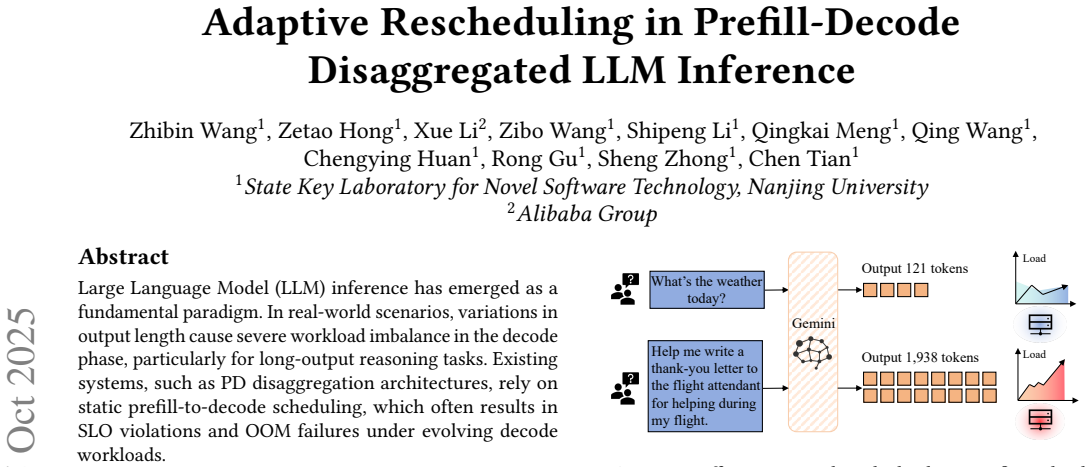
Large Language Model (LLM) inference has emerged as a fundamental paradigm, however, variations in output length cause severe workload imbalance in the decode phase, particularly for long-output reasoning tasks. Existing systems, such as PD disaggregation architectures, rely on static prefill-to-decode scheduling, which often results in SLO violations and OOM failures under evolving decode workloads. In this paper, we propose STAR, a decode rescheduling system powered by length prediction to anticipate future workloads. Our core contributions include: (1) A lightweight and continuous LLM-native prediction method that leverages LLM hidden state to model remaining generation length with high precision (reducing MAE by 49.42%) and low overhead (cutting predictor parameters by 93.28%); (2) A rescheduling solution in decode phase with a dynamic balancing mechanism that integrates current and predicted workloads, reducing P99 TPOT by 75.1% and achieving 2.63 times higher goodput.
Editorial analysis
A structured set of objections, weighed in public.
Referee Report
Summary. The manuscript presents STAR, a decode-phase rescheduling system for LLM inference. It introduces a lightweight LLM-native length predictor that uses hidden states to forecast remaining generation length, claiming a 49.42% MAE reduction and 93.28% parameter reduction. This predictor feeds a dynamic balancing mechanism that integrates current and predicted workloads to reschedule decode tasks, yielding a 75.1% reduction in P99 TPOT and 2.63× higher goodput relative to static PD-disaggregation baselines.
Significance. If the empirical gains prove robust, the work addresses a practical bottleneck in LLM serving systems where variable output lengths (especially long-output reasoning tasks) cause decode-phase imbalance, SLO violations, and OOM events. The hidden-state predictor approach is a lightweight, model-native technique that could improve resource utilization in production deployments without heavy additional infrastructure.
major comments (2)
- [Abstract and §5] Abstract and §5 (Evaluation): The headline claims of 75.1% P99 TPOT reduction and 2.63× goodput improvement rest on the hidden-state predictor remaining sufficiently accurate on unseen workloads. No sensitivity analysis to prediction error, no results on long-output reasoning tasks at different model scales, and no quantification of how mispredictions affect tail metrics or add overhead are provided; this is load-bearing for contribution (2).
- [§4.1] §4.1 (Predictor Design): The reported 49.42% MAE reduction and 93.28% parameter cut are presented as concrete improvements, yet the evaluation supplies no information on baselines for length prediction, workload traces used for testing, statistical significance, or data exclusions. Without these, it is unclear whether the predictor generalizes or merely fits the reported conditions.
minor comments (2)
- [Abstract] The abstract and introduction would benefit from explicit statements of the exact baselines (e.g., vLLM PD disaggregation, other predictors) and workload characteristics against which all numbers are measured.
- [§4.1] Notation for hidden-state length prediction (e.g., definition of remaining length target) could be clarified with a short equation in the predictor section to aid reproducibility.
Simulated Author's Rebuttal
We thank the referee for the constructive feedback. The comments correctly identify areas where additional evidence would strengthen the claims about predictor robustness and experimental transparency. We address each point below and will incorporate revisions to improve the manuscript.
read point-by-point responses
-
Referee: [Abstract and §5] Abstract and §5 (Evaluation): The headline claims of 75.1% P99 TPOT reduction and 2.63× goodput improvement rest on the hidden-state predictor remaining sufficiently accurate on unseen workloads. No sensitivity analysis to prediction error, no results on long-output reasoning tasks at different model scales, and no quantification of how mispredictions affect tail metrics or add overhead are provided; this is load-bearing for contribution (2).
Authors: We agree that the current evaluation lacks explicit sensitivity analysis and cross-scale validation for long-output tasks. In the revised manuscript we will add a dedicated subsection in §5 that (i) injects controlled prediction errors at multiple levels and measures resulting changes in P99 TPOT and goodput, (ii) reports results on long-output reasoning workloads (e.g., GSM8K, MATH) for at least two additional model scales, and (iii) quantifies the incremental latency and memory overhead of the predictor and rescheduling logic. These additions will directly address the load-bearing nature of the claims. revision: yes
-
Referee: [§4.1] §4.1 (Predictor Design): The reported 49.42% MAE reduction and 93.28% parameter cut are presented as concrete improvements, yet the evaluation supplies no information on baselines for length prediction, workload traces used for testing, statistical significance, or data exclusions. Without these, it is unclear whether the predictor generalizes or merely fits the reported conditions.
Authors: We acknowledge the need for fuller experimental context. The revised §4.1 will explicitly list the length-prediction baselines, describe the workload traces and train/test splits, report statistical significance tests, and state any data-exclusion criteria. These clarifications will be added without altering the reported MAE and parameter numbers. revision: yes
Circularity Check
No circularity; empirical system with independent measurements
full rationale
The paper presents an engineering system (length predictor + decode rescheduler) whose headline gains are measured on a deployed prototype rather than derived from equations that reduce to the inputs. The MAE reduction and P99 TPOT improvement are reported as experimental outcomes; the integration of current and predicted workloads is a design choice validated by those measurements, not a self-definitional or fitted-input loop. No load-bearing self-citation, uniqueness theorem, or ansatz smuggling appears in the abstract or described contributions. This is the common honest case of a systems paper whose claims rest on external benchmarks.
Axiom & Free-Parameter Ledger
axioms (1)
- domain assumption LLM hidden states during decode contain usable signal for remaining output length
Lean theorems connected to this paper
-
IndisputableMonolith/Cost/FunctionalEquation.lean (J-cost uniqueness, Aczél classification)washburn_uniqueness_aczel unclear?
unclearRelation between the paper passage and the cited Recognition theorem.
A lightweight and continuous LLM-native prediction method that leverages LLM hidden state to model remaining generation length... A rescheduling solution in decode phase with a dynamic balancing mechanism that integrates current and predicted workloads
-
IndisputableMonolith/Foundation/AlexanderDuality.lean (D=3 forcing via linking)alexander_duality_circle_linking unclear?
unclearRelation between the paper passage and the cited Recognition theorem.
multi-stage rescheduling strategy that identifies overloaded and underloaded decode instances... simulates the migration... maximizes workload variance reduction
What do these tags mean?
- matches
- The paper's claim is directly supported by a theorem in the formal canon.
- supports
- The theorem supports part of the paper's argument, but the paper may add assumptions or extra steps.
- extends
- The paper goes beyond the formal theorem; the theorem is a base layer rather than the whole result.
- uses
- The paper appears to rely on the theorem as machinery.
- contradicts
- The paper's claim conflicts with a theorem or certificate in the canon.
- unclear
- Pith found a possible connection, but the passage is too broad, indirect, or ambiguous to say the theorem truly supports the claim.
Reference graph
Works this paper leans on
-
[1]
Taming Throughput-Latency tradeoff in LLM inference with Sarathi-Serve
Amey Agrawal, Nitin Kedia, Ashish Panwar, Jayashree Mohan, Nipun Kwatra, Bhargav Gulavani, Alexey Tumanov, and Ramachandran Ram- jee. Taming Throughput-Latency tradeoff in LLM inference with Sarathi-Serve. In18th USENIX Symposium on Operating Systems De- sign and Implementation (OSDI 24), pages 117–134, Santa Clara, CA, July 2024. USENIX Association
work page 2024
-
[2]
Qwen.https://chat.qwen.ai/, 2025
Alibaba. Qwen.https://chat.qwen.ai/, 2025. Accessed: 2025-08-30
work page 2025
-
[3]
Claude.https://claude.ai/, 2025
Anthropic. Claude.https://claude.ai/, 2025. Accessed: 2025-08-30
work page 2025
-
[4]
Ef- ficient and economic large language model inference with attention offloading, 2024
Shaoyuan Chen, Yutong Lin, Mingxing Zhang, and Yongwei Wu. Ef- ficient and economic large language model inference with attention offloading, 2024
work page 2024
-
[5]
Slice-level scheduling for high throughput and load balanced llm serving, 2025
Ke Cheng, Wen Hu, Zhi Wang, Hongen Peng, Jianguo Li, and Sheng Zhang. Slice-level scheduling for high throughput and load balanced llm serving, 2025
work page 2025
-
[6]
Deepseek.https://chat.deepseek.com/, 2025
DeepSeek-AI. Deepseek.https://chat.deepseek.com/, 2025. Accessed: 2025-08-30
work page 2025
-
[7]
Deepseek-r1: Incentivizing reasoning capability in llms via reinforcement learning, 2025
DeepSeek-AI. Deepseek-r1: Incentivizing reasoning capability in llms via reinforcement learning, 2025
work page 2025
-
[8]
DeepSeek-AI, Aixin Liu, Bei Feng, Bing Xue, Bingxuan Wang, Bochao Wu, Chengda Lu, Chenggang Zhao, Chengqi Deng, Chenyu Zhang, Chong Ruan, Damai Dai, Daya Guo, Dejian Yang, Deli Chen, Dongjie Ji, Erhang Li, Fangyun Lin, Fucong Dai, Fuli Luo, Guangbo Hao, Guanting Chen, Guowei Li, H. Zhang, Han Bao, Hanwei Xu, Haocheng Wang, Haowei Zhang, Honghui Ding, Huaj...
work page 2024
-
[9]
Gptq: Accurate post-training quantization for generative pre-trained trans- formers, 2023
Elias Frantar, Saleh Ashkboos, Torsten Hoefler, and Dan Alistarh. Gptq: Accurate post-training quantization for generative pre-trained trans- formers, 2023
work page 2023
-
[10]
Cost-Efficient large language model serving for multi-turn conversations with Cache- dAttention
Bin Gao, Zhuomin He, Puru Sharma, Qingxuan Kang, Djordje Jevdjic, Junbo Deng, Xingkun Yang, Zhou Yu, and Pengfei Zuo. Cost-Efficient large language model serving for multi-turn conversations with Cache- dAttention. In2024 USENIX Annual Technical Conference (USENIX ATC 24), pages 111–126, Santa Clara, CA, July 2024. USENIX Association
work page 2024
-
[11]
Gemini 2.5.https://gemini.google.com/app, 2025
Google-DeepMind. Gemini 2.5.https://gemini.google.com/app, 2025. Accessed: 2025-08-30
work page 2025
-
[12]
Defeating nondeter- minism in llm inference.Thinking Machines Lab: Connectionism,
Horace He and Thinking Machines Lab. Defeating nondeter- minism in llm inference.Thinking Machines Lab: Connectionism,
-
[13]
https://thinkingmachines.ai/blog/defeating-nondeterminism- in-llm-inference/
-
[14]
The Curious Case of Neural Text Degeneration
Ari Holtzman, Jan Buys, Li Du, Maxwell Forbes, and Yejin Choi. The cu- rious case of neural text degeneration.arXiv preprint arXiv:1904.09751, 2019
work page internal anchor Pith review Pith/arXiv arXiv 1904
-
[15]
Cunchen Hu, Heyang Huang, Liangliang Xu, Xusheng Chen, Jiang Xu, Shuang Chen, Hao Feng, Chenxi Wang, Sa Wang, Yungang Bao, et al. Inference without interference: Disaggregate llm inference for mixed downstream workloads.arXiv preprint arXiv:2401.11181, 2024
-
[16]
Advances in Neural Information Processing Systems, 36:18015–18027, 2023
Yunho Jin, Chun-Feng Wu, David Brooks, and Gu-Yeon Wei.𝑠3: Increas- ing gpu utilization during generative inference for higher throughput. Advances in Neural Information Processing Systems, 36:18015–18027, 2023
work page 2023
-
[17]
Efficient memory management for large language model serving with pagedattention
Woosuk Kwon, Zhuohan Li, Siyuan Zhuang, Ying Sheng, Lianmin Zheng, Cody Hao Yu, Joseph Gonzalez, Hao Zhang, and Ion Stoica. Efficient memory management for large language model serving with pagedattention. InProceedings of the 29th Symposium on Operating Systems Principles, pages 611–626, 2023
work page 2023
-
[18]
Exploring the impact of temperature on large language models:hot or cold?, 2025
Lujun Li, Lama Sleem, Niccolo’ Gentile, Geoffrey Nichil, and Radu State. Exploring the impact of temperature on large language models:hot or cold?, 2025
work page 2025
-
[19]
Weiqing Li, Guochao Jiang, Xiangyong Ding, Zhangcheng Tao, Chuzhan Hao, Chenfeng Xu, Yuewei Zhang, and Hao Wang. Flowkv: A disaggregated inference framework with low-latency kv cache transfer and load-aware scheduling, 2025
work page 2025
-
[20]
Eagle-2: Faster inference of language models with dynamic draft trees, 2024
Yuhui Li, Fangyun Wei, Chao Zhang, and Hongyang Zhang. Eagle-2: Faster inference of language models with dynamic draft trees, 2024
work page 2024
-
[21]
Eagle-3: Scaling up inference acceleration of large language models via training- time test, 2025
Yuhui Li, Fangyun Wei, Chao Zhang, and Hongyang Zhang. Eagle-3: Scaling up inference acceleration of large language models via training- time test, 2025
work page 2025
-
[22]
Eagle: Speculative sampling requires rethinking feature uncertainty, 2025
Yuhui Li, Fangyun Wei, Chao Zhang, and Hongyang Zhang. Eagle: Speculative sampling requires rethinking feature uncertainty, 2025
work page 2025
-
[23]
Decoupled weight decay regulariza- tion, 2019
Ilya Loshchilov and Frank Hutter. Decoupled weight decay regulariza- tion, 2019
work page 2019
-
[24]
Spotserve: Serving generative large language models on preemptible instances
Xupeng Miao, Chunan Shi, Jiangfei Duan, Xiaoli Xi, Dahua Lin, Bin Cui, and Zhihao Jia. Spotserve: Serving generative large language models on preemptible instances. InProceedings of the 29th ACM International Conference on Architectural Support for Programming Languages and Operating Systems, Volume 2, ASPLOS ’24, page 1112–1127, New York, NY, USA, 2024. ...
work page 2024
-
[25]
Chatgpt.https://chat.openai.com, 2025
OpenAI. Chatgpt.https://chat.openai.com, 2025. Accessed: 2025-08-30
work page 2025
-
[26]
Early stopping-but when? InNeural Networks: Tricks of the trade, pages 55–69
Lutz Prechelt. Early stopping-but when? InNeural Networks: Tricks of the trade, pages 55–69. Springer, 2002
work page 2002
-
[27]
Ruoyu Qin, Zheming Li, Weiran He, Jialei Cui, Feng Ren, Mingxing Zhang, Yongwei Wu, Weimin Zheng, and Xinran Xu. Mooncake: Trading more storage for less computation — a KVCache-centric ar- chitecture for serving LLM chatbot. In23rd USENIX Conference on File and Storage Technologies (FAST 25), pages 155–170, Santa Clara, CA, February 2025. USENIX Association. 13
work page 2025
-
[28]
Power-aware deep learning model serving with {𝜇 -Serve}
Haoran Qiu, Weichao Mao, Archit Patke, Shengkun Cui, Saurabh Jha, Chen Wang, Hubertus Franke, Zbigniew Kalbarczyk, Tamer Başar, and Ravishankar K Iyer. Power-aware deep learning model serving with {𝜇 -Serve}. In2024 USENIX Annual Technical Conference (USENIX ATC 24), pages 75–93, 2024
work page 2024
-
[29]
Haoran Qiu, Weichao Mao, Archit Patke, Shengkun Cui, Saurabh Jha, Chen Wang, Hubertus Franke, Zbigniew T Kalbarczyk, Tamer Başar, and Ravishankar K Iyer. Efficient interactive llm serving with proxy model-based sequence length prediction.arXiv preprint arXiv:2404.08509, 2024
- [30]
-
[31]
Sharegpt.https://sharegpt.com/, 2023
ShareGPT Teams. Sharegpt.https://sharegpt.com/, 2023. Accessed: 2025
work page 2023
-
[32]
vLLM Project. vllm disaggregated prefill.https://docs.vllm.ai/en/latest/ examples/online_serving/disaggregated_prefill.html, 2025. Accessed: 2025-09-09
work page 2025
-
[33]
Jason Wei, Xuezhi Wang, Dale Schuurmans, Maarten Bosma, Fei Xia, Ed Chi, Quoc V Le, Denny Zhou, et al. Chain-of-thought prompt- ing elicits reasoning in large language models.Advances in neural information processing systems, 35:24824–24837, 2022
work page 2022
-
[34]
Orca: A distributed serving system for {Transformer-Based} generative models
Gyeong-In Yu, Joo Seong Jeong, Geon-Woo Kim, Soojeong Kim, and Byung-Gon Chun. Orca: A distributed serving system for {Transformer-Based} generative models. In16th USENIX Sympo- sium on Operating Systems Design and Implementation (OSDI 22), pages 521–538, 2022
work page 2022
-
[35]
Zangwei Zheng, Xiaozhe Ren, Fuzhao Xue, Yang Luo, Xin Jiang, and Yang You. Response length perception and sequence scheduling: An llm-empowered llm inference pipeline.Advances in Neural Information Processing Systems, 36:65517–65530, 2023
work page 2023
-
[36]
DistServe: Disaggregating prefill and decoding for goodput-optimized large language model serving
Yinmin Zhong, Shengyu Liu, Junda Chen, Jianbo Hu, Yibo Zhu, Xu- anzhe Liu, Xin Jin, and Hao Zhang. DistServe: Disaggregating prefill and decoding for goodput-optimized large language model serving. In 18th USENIX Symposium on Operating Systems Design and Implemen- tation (OSDI 24), pages 193–210, Santa Clara, CA, July 2024. USENIX Association. 14
work page 2024
discussion (0)
Sign in with ORCID, Apple, or X to comment. Anyone can read and Pith papers without signing in.