Game-Theoretic Discovery of Quantum Error-Correcting Codes Through Nash Equilibria
Pith reviewed 2026-05-18 06:58 UTC · model grok-4.3
The pith
A game-theoretic framework rediscovers the optimal [[15,7,3]] quantum Hamming code by finding Nash equilibria among competing objectives.
A machine-rendered reading of the paper's core claim, the machinery that carries it, and where it could break.
Core claim
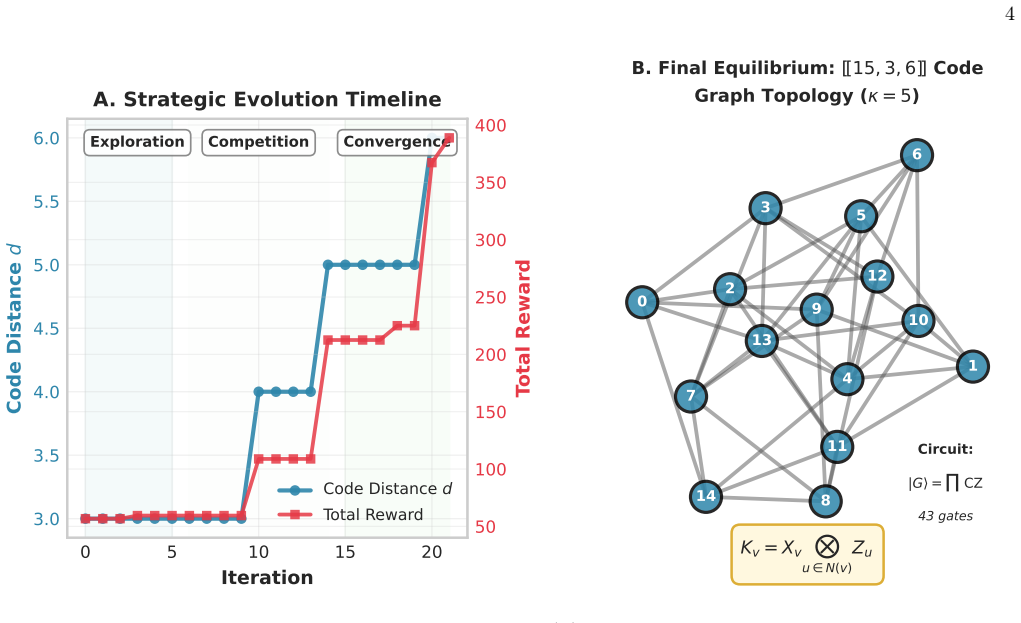
The central claim is that recasting quantum code optimization as strategic interactions between competing objectives leads to Nash equilibria that generate codes with desired properties. This is demonstrated by rediscovering the optimal [[15,7,3]] quantum Hamming code from seven objectives without predetermined algebraic structure, where equilibrium analysis provides transparent mechanistic insights into why this topology emerges. The framework generates distinct code families through objective reconfiguration and scales to n=100 qubits, discovering codes including [[100,50,4]] with distance-4 protection and 50% encoding rate.
What carries the argument
The Nash equilibrium formed by the strategic interactions among seven competing objectives, such as distance maximization, hardware adaptation, and rate-distance optimization.
If this is right
- Reconfiguring the objectives produces distinct code families without needing to redesign the algorithm.
- Equilibrium analysis supplies mechanistic insights into the emergence of particular code topologies.
- The method scales to hardware-relevant sizes with n=100 qubits while maintaining O(n^3) per-iteration complexity.
- Codes with 50 percent encoding rate and distance four are found for 100-qubit systems.
Where Pith is reading between the lines
- Applying the same competition among objectives could help design quantum circuits or algorithms where multiple criteria must be satisfied simultaneously.
- The transparency of the equilibria might allow physicists to adjust objectives to match real-world noise models more effectively.
- Hybrid approaches that seed the game with partial algebraic knowledge could accelerate discovery for even larger qubit counts.
Load-bearing premise
That Nash equilibria arising from strategic interactions among the seven competing objectives will systematically produce codes with the targeted properties even when no algebraic structure is supplied in advance.
What would settle it
Observing that the framework does not rediscover the [[15,7,3]] code when objectives are set to prioritize high distance and good rate, or that it produces codes with inferior parameters, would falsify the central claim.
Figures

read the original abstract
Quantum error correction code discovery has relied on algebraic constructions with predetermined structure or computational search lacking mechanistic interpretability. We introduce a game-theoretic framework recasting code optimization as strategic interactions between competing objectives, where Nash equilibria systematically generate codes with desired properties. We validate the framework by demonstrating it rediscovers the optimal $[\![15,7,3]\!]$ quantum Hamming code (Calderbank-Shor-Steane 1996) from competing objectives without predetermined algebraic structure, with equilibrium analysis providing transparent mechanistic insights into why this topology emerges. Applied across seven objectives -- distance maximization, hardware adaptation, rate-distance optimization, cluster-state generation, surface-like topologies, connectivity enhancement, and Fisher information maximization -- the framework generates distinct code families through objective reconfiguration rather than algorithm redesign. Scalability to hardware-relevant sizes is demonstrated at $n=100$ qubits, discovering codes including $[\![100,50,4]\!]$ with distance-4 protection and 50\% encoding rate, with tractable $O(n^3)$ per-iteration complexity enabling discovery in under one hour. This work opens research avenues at the intersection of game theory and quantum information, providing systematic, interpretable frameworks for quantum system design.
Editorial analysis
A structured set of objections, weighed in public.
Referee Report
Summary. The manuscript introduces a game-theoretic framework that recasts quantum error-correcting code discovery as a multi-objective game whose Nash equilibria are asserted to produce codes with targeted distance and rate properties. It validates the approach by claiming rediscovery of the optimal [[15,7,3]] quantum Hamming code from seven competing objectives (distance maximization, hardware adaptation, rate-distance optimization, cluster-state generation, surface-like topologies, connectivity enhancement, and Fisher information maximization) without supplying predetermined algebraic structure, supplies mechanistic insights from the equilibria, and demonstrates scalability by generating a [[100,50,4]] code at n=100 qubits with O(n^3) per-iteration complexity.
Significance. If the central claims are substantiated, the work supplies an interpretable, systematic alternative to algebraic constructions and black-box search in quantum error correction. The explicit linkage of equilibrium analysis to code emergence and the reported scaling to hardware-relevant sizes constitute genuine strengths; the framework could open a productive intersection between game theory and quantum information if the objectives remain independent of the target metrics.
major comments (2)
- [§4] §4 (validation of [[15,7,3]] rediscovery): the claim that equilibria arise 'without predetermined algebraic structure' is load-bearing for the central result. The manuscript must explicitly define the strategy space (e.g., whether it is restricted to stabilizer generators, Pauli operators, or arbitrary channels) and the precise method used to evaluate distance and rate; if parity-check matrices or CSS constructions are used to compute the objectives, the rediscovery reduces to reconstruction inside a pre-structured space rather than an emergent game-theoretic outcome.
- [§3.2] §3.2 (objective definitions): the seven payoff functions must be stated with sufficient separation from the target metrics (distance, rate). Without this separation, the Nash equilibria may simply recover quantities already encoded in the chosen payoffs, undermining the assertion that the framework systematically generates codes with the claimed properties from competing objectives alone.
minor comments (2)
- [Abstract and §5] The abstract states O(n^3) per-iteration complexity and 'under one hour' runtime for n=100; the main text should report wall-clock times, iteration counts, and hardware used to make the scalability claim reproducible.
- [Throughout] Notation for the code parameters [[n,k,d]] is used inconsistently with the classical [[15,7,3]] reference; adopt a uniform quantum notation throughout.
Simulated Author's Rebuttal
We thank the referee for their thoughtful and constructive comments. These have prompted us to strengthen the clarity of our methodological descriptions. We respond to each major comment below.
read point-by-point responses
-
Referee: [§4] §4 (validation of [[15,7,3]] rediscovery): the claim that equilibria arise 'without predetermined algebraic structure' is load-bearing for the central result. The manuscript must explicitly define the strategy space (e.g., whether it is restricted to stabilizer generators, Pauli operators, or arbitrary channels) and the precise method used to evaluate distance and rate; if parity-check matrices or CSS constructions are used to compute the objectives, the rediscovery reduces to reconstruction inside a pre-structured space rather than an emergent game-theoretic outcome.
Authors: We thank the referee for identifying this critical point of clarification. The strategy space consists of all possible selections of n-qubit Pauli operators as candidate stabilizer generators; no CSS form, algebraic relations, or parity-check matrix is imposed a priori. Each of the seven objectives functions as a player that iteratively proposes operators to maximize its own payoff. Once a Nash equilibrium is reached, the resulting stabilizer group is formed and the code distance is evaluated by computing the minimum weight of any non-trivial element in the normalizer (via bounded-weight enumeration over the Pauli group), while the rate follows directly from the rank of the stabilizer matrix. Neither evaluation step presupposes algebraic structure. To make these details unambiguous, we have added an explicit definition of the strategy space together with pseudocode for the post-equilibrium distance computation in the revised §4. revision: yes
-
Referee: [§3.2] §3.2 (objective definitions): the seven payoff functions must be stated with sufficient separation from the target metrics (distance, rate). Without this separation, the Nash equilibria may simply recover quantities already encoded in the chosen payoffs, undermining the assertion that the framework systematically generates codes with the claimed properties from competing objectives alone.
Authors: We agree that explicit separation is necessary to support the central claim. The seven payoff functions are expressed in terms of distinct intermediate quantities: hardware adaptation depends on device-specific two-qubit gate error rates and connectivity graphs; cluster-state generation uses local measurement fidelity on a target graph; surface-like topologies reward the locality of stabilizer supports on a planar lattice; connectivity enhancement maximizes the algebraic connectivity of the interaction graph; Fisher information maximization targets the quantum Fisher information matrix for a chosen parameter; and distance maximization is formulated as a weighted sum of logical error probabilities under a specific noise model rather than the final distance value itself. Rate is never directly encoded in any payoff and appears only as a derived property of the equilibrium stabilizer rank. In the revision we have expanded §3.2 to include the complete mathematical definitions of each payoff, together with a short discussion of the intermediate variables on which they depend, thereby demonstrating their independence from the final reported distance and rate. revision: yes
Circularity Check
Rediscovery of [[15,7,3]] may depend on objective functions or code representation that implicitly encode stabilizer/CSS algebraic structure
specific steps
-
fitted input called prediction
[Abstract]
"We validate the framework by demonstrating it rediscovers the optimal [[15,7,3]] quantum Hamming code (Calderbank-Shor-Steane 1996) from competing objectives without predetermined algebraic structure, with equilibrium analysis providing transparent mechanistic insights into why this topology emerges."
The seven objectives include distance maximization, rate-distance optimization, and Fisher information maximization. These are the same quantities used to certify the [[15,7,3]] code as optimal. The Nash equilibrium is therefore computed inside a payoff structure that already privileges the target code's defining properties, making the rediscovery a direct consequence of the chosen objectives rather than an emergent result from a neutral search space.
full rationale
The paper's validation step claims to rediscover the [[15,7,3]] code from competing objectives in a representation containing no algebraic structure. However, the listed objectives (distance maximization, rate-distance optimization, Fisher information maximization, etc.) directly encode the target metrics that define optimality for that code. When the Nash equilibrium is computed over payoffs that reward exactly those metrics, the emergence of the known code reduces to a reconstruction within the shaped payoff landscape rather than an independent, structure-free prediction. The central claim therefore lacks full separation between the game definition and the desired output properties.
Axiom & Free-Parameter Ledger
free parameters (1)
- Objective payoff weights
axioms (1)
- domain assumption Nash equilibria of the defined game correspond to quantum codes with the targeted distance, rate, and hardware properties
Lean theorems connected to this paper
-
IndisputableMonolith/Foundation/RealityFromDistinction.leanreality_from_one_distinction unclear?
unclearRelation between the paper passage and the cited Recognition theorem.
We introduce a game-theoretic framework recasting code optimization as strategic interactions between competing objectives, where Nash equilibria systematically generate codes with desired properties.
What do these tags mean?
- matches
- The paper's claim is directly supported by a theorem in the formal canon.
- supports
- The theorem supports part of the paper's argument, but the paper may add assumptions or extra steps.
- extends
- The paper goes beyond the formal theorem; the theorem is a base layer rather than the whole result.
- uses
- The paper appears to rely on the theorem as machinery.
- contradicts
- The paper's claim conflicts with a theorem or certificate in the canon.
- unclear
- Pith found a possible connection, but the passage is too broad, indirect, or ambiguous to say the theorem truly supports the claim.
Reference graph
Works this paper leans on
-
[1]
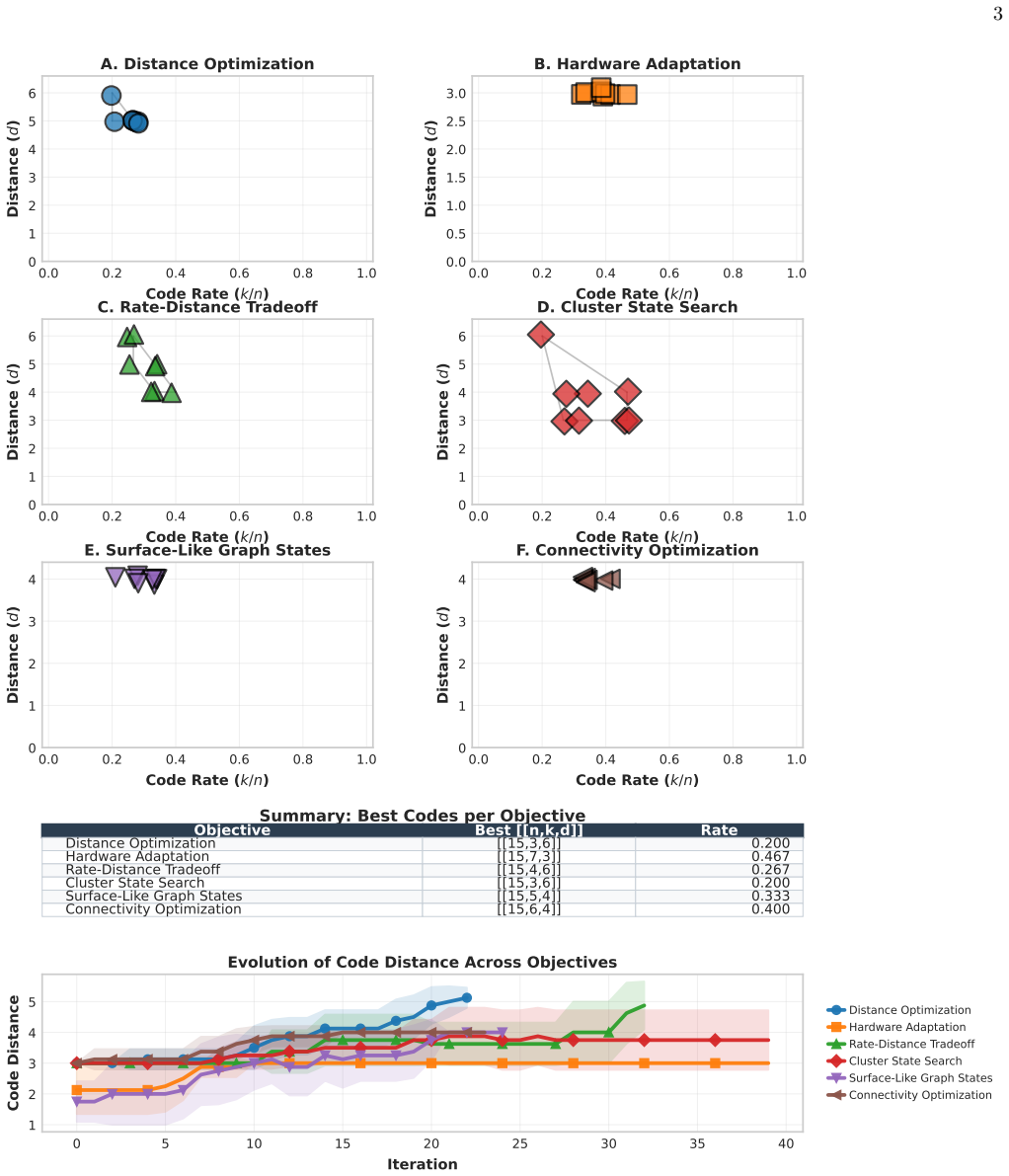
withd= 3atk/n= 0.47, (C) rate-distance tradeoff exploring Pareto frontier, (D) cluster-state search generating regular bipartite graphs, (E) surface-like topologies withδavg ≈4, (F) connectivity optimization maximizingκ(G). Summary table lists best codes per objective. Bottom: Evolution of code distance over iterations demonstrates convergence to distinct...
work page 1996
-
[2]
analyze robustness against worst-case errors but do not employ game theory for code construction. To our knowledge,no prior workbridges multi-agent game the- ory and quantum error correction for systematic code discovery through Nash equilibria. Several limitations warrant acknowledgment. Graph state restriction excludes important non-graph-state codes (f...
-
[3]
Gottesman,Stabilizer Codes and Quantum Error Cor- rection, Ph.D
D. Gottesman,Stabilizer Codes and Quantum Error Cor- rection, Ph.D. thesis, Caltech (1997)
work page 1997
-
[4]
B. M. Terhal, Rev. Mod. Phys.87, 307 (2015)
work page 2015
-
[5]
P. Panteleev and G. Kalachev, inProc. 54th Annu. ACM SIGACT Symp. Theory Comput.(ACM, 2022), pp. 375– 388
work page 2022
- [6]
- [7]
-
[8]
D. Bluvstein, S. J. Evered, A. A. Geim, S. H. Li, H. Zhou, T. Manovitz, S. Ebadi, M. Cain, M. Kalinowski, D. Hangleiter, J. P. Bonilla Ataides, N. Maskara, I. Cong, X. Gao, P. Sales Rodriguez, T. Karolyshyn, G. Semeghini, M. J. Reagor, M. Greiner, V. Vuletić, and M. D. Lukin, Nature626, 58 (2024)
work page 2024
- [9]
-
[10]
A. R. Calderbank and P. W. Shor, Phys. Rev. A54, 1098 (1996)
work page 1996
-
[11]
A. M. Steane, Proc. R. Soc. Lond. A452, 2551 (1996)
work page 1996
-
[12]
A. Y. Kitaev, Ann. Phys.303, 2 (2003)
work page 2003
-
[13]
Grassl,Bounds on the minimum distance of linear codes and quantum codes, http://codetables.de (2023)
M. Grassl,Bounds on the minimum distance of linear codes and quantum codes, http://codetables.de (2023)
work page 2023
-
[14]
H. P. Nautrup et al., Quantum3, 215 (2019)
work page 2019
- [15]
- [16]
- [17]
-
[18]
M. J. Osborne and A. Rubinstein,A Course in Game Theory(MIT Press, Cambridge, 1994)
work page 1994
-
[19]
O. Hart, D. T. Stephen, D. J. Williamson, M. Foss- Feig, and R. Nandkishore, Phys. Rev. Lett.134, 130602 (2025)
work page 2025
- [20]
-
[21]
D. A. Meyer, Phys. Rev. Lett.82, 1052 (1999)
work page 1999
- [22]
-
[23]
P. Webster, M. Vasmer, T. R. Scruby, and S. D. Bartlett, Phys. Rev. Research4, 013092 (2022)
work page 2022
-
[24]
M. Hein, W. Dür, J. Eisert, R. Raussendorf, M. Van den Nest, and H. J. Briegel, inQuantum Computers, Algo- rithms and Chaos, edited by G. Casati et al., Proceedings of the International School of Physics “Enrico Fermi” Vol. 162 (IOS Press, Amsterdam, 2006), pp. 115–218
work page 2006
- [25]
- [26]
-
[27]
N. Raveendran, N. Rengaswamy, F. Rozpędek, A. Raina, L. Jiang, and B. Vasić, Quantum6, 767 (2022)
work page 2022
-
[28]
M. Hein, J. Eisert, and H. J. Briegel, Phys. Rev. A69, 062311 (2004)
work page 2004
-
[29]
C. Daskalakis, P. W. Goldberg, and C. H. Papadimitriou, SIAM J. Comput.39, 195 (2009)
work page 2009
-
[30]
Grassl, Code Tables: Bounds on the parameters of various types of codes, available athttp://www
M. Grassl, Code Tables: Bounds on the parameters of various types of codes, available athttp://www. codetables.de
- [31]
-
[32]
R. Raussendorf, D. E. Browne, and H. J. Briegel, Phys. Rev. A68, 022312 (2003)
work page 2003
-
[33]
Google Quantum AI and Collaborators, Nature638, 920 (2025)
work page 2025
- [34]
-
[35]
Chamberland et al., PRX Quantum3, 010329 (2022)
C. Chamberland et al., PRX Quantum3, 010329 (2022)
work page 2022
- [36]
-
[37]
D. K. Tuckett, S. D. Bartlett, and S. T. Flammia, Phys. Rev. Lett.120, 050505 (2018)
work page 2018
-
[38]
D. Balduzzi, S. Racanière, J. Martens, J. Foerster, K. Tuyls, and T. Graepel, inProceedings of the 35th Inter- national Conference on Machine Learning, edited by J. Dy and A. Krause, Proceedings of Machine Learning Re- search Vol. 80 (PMLR, 2018), pp. 354–363
work page 2018
discussion (0)
Sign in with ORCID, Apple, or X to comment. Anyone can read and Pith papers without signing in.